 Global long-term economic growth has slowed dramatically since the financial crisis of 2007–8. This can be illustrated by comparing the two 20-year periods 1988 to 2007 and 2009 to 2028 (where IMF forecasts are used for 2024 to 2028: see WEO Database under the Data link below). Over the two periods, average annual world growth fell from 3.8% to 3.1%. In advanced countries it fell from 2.9% to 1.6% and in developing countries from 4.8% to 4.3%. In the UK it fell from 2.4% to 1.2%, in the USA from 3.1% to 1.8% and in Japan from 1.9% to 0.5%.
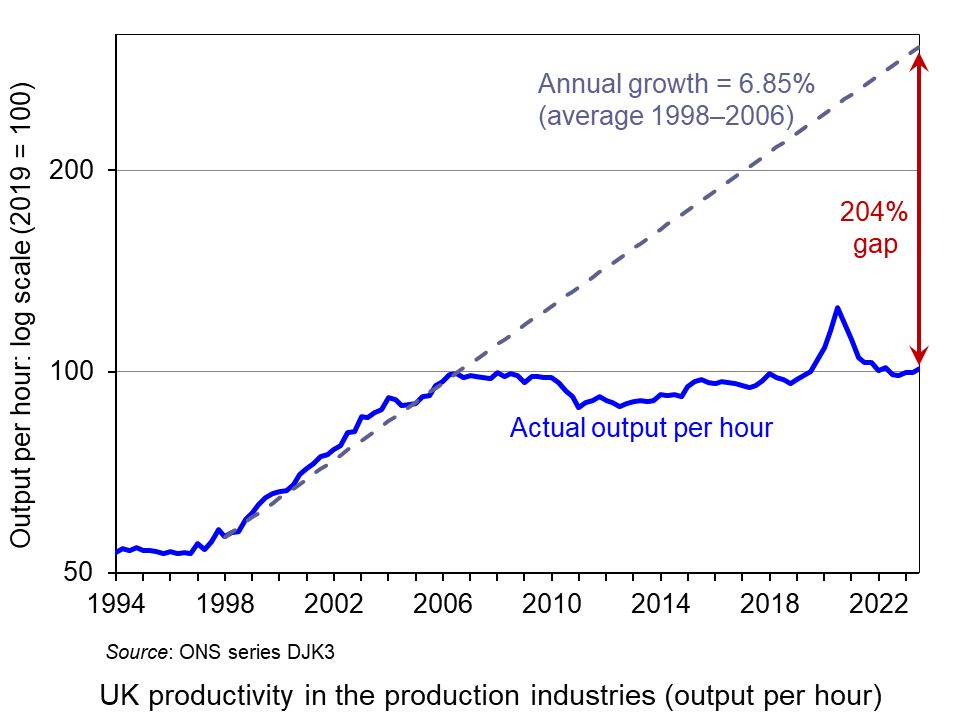 In the UK, labour productivity growth in the production industries was 6.85% per annum from 1998 to 2006. If this growth rate had been maintained, productivity would have been 204% higher by the end of 2023 than it actually was. This is shown in the chart (click here for a PowerPoint).
The key driver of long-term economic growth is labour productivity, which can best be measured by real GDP per hour worked. This depends on three things: the amount of capital per worker, the productivity of this capital and the efficiency of workers themselves – the latter two giving total factor productivity (TFP). Productivity growth has slowed, and with it the long-term rate of economic growth.
If we are measuring growth in output per head of the population, as opposed to simple growth in output, then another important factor is the proportion of the population that works. With ageing populations, many countries are facing an increase in the proportion of people not working. In most countries, these demographic pressures are likely to increase.
 A major determinant of long-term economic growth and productivity is investment. Investment has been badly affected by crises, such as the financial crisis and COVID, and by geopolitical tensions, such as the war in Ukraine and tensions between the USA and China and potential trade wars. It has also been adversely affected by government attempts to deal with rising debt caused by interventions following the financial crisis and COVID. The fiscal squeeze and, more recently higher interest rates, have dampened short-term growth and discouraged investment, thereby dampening long-term growth.
Another factor adversely affecting productivity has been a lower growth of allocative efficiency. Competition in many industries has declined as the rate of new firms entering and exiting markets has slowed. The result has been an increase in concentration and a growth in supernormal profits.
In the UK’s case, growth prospects have also been damaged by Brexit. According to Bank of England and OBR estimates, Brexit has reduced productivity by around 4% (see the blog: The costs of Brexit: a clearer picture). For many companies in the UK, Brexit has hugely increased the administrative burdens of trading with the EU. It has also reduced investment and led to a slower growth in the capital stock.
The UK’s poor productivity growth over many yeas is examined in the blog The UK’s poor productivity record.
Boosting productivity
So, how could productivity be increased and what policies could help the process?
 Artificial intelligence. One important driver of productivity growth is technological advance. The rapid advance in AI and its adoption across much of industry is likely to have a dramatic effect on working practices and output. Estimates by the IMF suggest that some 40% of jobs globally and 60% in advanced countries could be affected – some replaced and others complemented and enhanced by AI. The opportunities for raising incomes are huge, but so too are the dangers of displacing workers and deepening inequality, as some higher-paid jobs are enhanced by AI, while many lower paid jobs are little affected and other jobs disappear.
AI is also likely to increase returns to capital. This may help to drive investment and further boost economic growth. However, the increased returns to capital are also likely to exacerbate inequality.
To guard against the growth of market power and its abuse, competition policies may need strengthening to ensure that the benefits of AI are widely spread and that new entrants are encouraged. Also training and retraining opportunities to allow workers to embrace AI and increase their mobility will need to be provided.
 Training. And it is not just training in the use of AI that is important. Training generally is a key ingredient in encouraging productivity growth. In the UK, there has been a decline in investment in adult education and training, with a 70% reduction since the early 2000s in the number of adults undertaking publicly-funded training, and with average spending on training by employers decreasing by 27% per trainee since 2011. The Institute for Fiscal Studies identifies five main policy levers to address this: “public funding of qualifications and skills programmes, loans to learners, training subsidies, taxation of training and the regulation of training” (see link in articles below).
Competition. Another factor likely to enhance productivity is competition, both internationally and within countries. Removing trade restrictions could boost productivity growth; erecting barriers to protect inefficient domestic industry would reduce it.
Investment. Policies to encourage investment are also key to productivity growth. Private-sector investment can be encouraged by tax incentives. For example, in the UK the Annual Investment Allowance allows businesses to claim 100% of the cost of plant and machinery up to £1m in the year it is incurred. However, for tax relief to produce significant effects on investment, companies need to believe that the policy will stay and not be changed as economic circumstances or governments change.
 Public-sector investment is also key. Good road and rail infrastructure and public transport are vital in encouraging private investment and labour mobility. And investment in health, education and training are a key part in encouraging the development of human capital. Many countries, the UK included, cut back on public-sector capital investment after the financial crisis and this has had a dampening effect on economic growth.
Regional policy. External economies of scale could be encouraged by setting up development areas in various regions. Particular industries could be attracted to specific areas, where local skilled workers, managerial expertise and shared infrastructure can benefit all the firms in the industry. These ‘agglomeration economies’ have been very limited in the UK compared with many other countries with much stronger regional economies.
Changing the aims and governance of firms. A change in corporate structure and governance could also help to drive investment and productivity. According to research by the think tank, Demos (see the B Lab UK article and the second report below), if legislation required companies to consider the social, economic and environmental impact of their business alongside profitability, this could have a dramatic effect on productivity. If businesses were required to be ‘purpose-led’, considering the interests of all their stakeholders, this supply-side reform could dramatically increase growth and well-being.
Such stakeholder-governed businesses currently outperform their peers with higher levels of investment, innovation, product development and output. They also have higher levels of staff engagement and satisfaction.
Articles
- World Must Prioritize Productivity Reforms to Revive Medium-Term Growth
IMF Blog, Nan Li and Diaa Noureldin (10/4/24)
- Why has productivity slowed down?
Oxford Martin School News, Ian Goldin, Pantelis Koutroumpis, François Lafond and Julian Winkler (18/3/24)
- How can the UK revive its ailing productivity?
Economics Observatory, Michelle Kilfoyle (14/3/24)
- With the UK creeping out of recession, here’s an economist’s brief guide to improving productivity
The Conversation, Nigel Driffield (13/3/24)
- UK economy nearly a third smaller thanks to ‘catastrophically bad’ productivity slowdown
City A.M., Chris Dorrell (12/3/24)
- Can AI help solve the UK’s public sector productivity puzzle?
City A.M., Chris Dorrell (11/3/24)
- AI Will Transform the Global Economy. Let’s Make Sure it Benefits Humanity
IMF Blog, Kristalina Georgieva (14/1/24)
- Productivity and Investment: Time to Manage the Project of Renewal
NIESR, Paul Fisher (12/3/24)
- Productivity trends using key national accounts indicators
Eurostat (15/3/24)
- New report says change to company law could add £149bn to the UK economy
B Lab UK (28/11/23)
- Investment in training and skills: Green Budget Chapter 9
Institute for Fiscal Studies, Imran Tahir (12/10/23)
Reports
Data
Questions
- Why has global productivity growth been lower since 2008 than before 2008?
- Why has the UK’s productivity growth been lower than many other advanced economies?
- How does the short-run macroeconomic environment affect long-term growth?
- Find out why Japan’s productivity growth has been so poor compared with other countries.
- What are likely to be the most effective means of increasing productivity growth?
- How may demand management policies affect the supply side of the economy?
- How may the adoption of an ESG framework by companies for setting objectives affect productivity growth?
 The Competition and Markets Authority (CMA) is proposing to launch a formal Market Investigation into anti-competitive practices in the UK’s £2bn veterinary industry (for pets rather than farm animals or horses). This follows a preliminary investigation which received 56 000 responses from pet owners and vet professionals. These responses reported huge rises in bills for treatment and medicines and corresponding rises in the cost of pet insurance.
At the same time there has been a large increase in concentration in the industry. In 2013, independent vet practices accounted for 89% of the market; today, they account for only around 40%. Over the past 10 years, some 1500 of the UK’s 5000 vet practices had been acquired by six of the largest corporate groups. In many parts of the country, competition is weak; in others, it is non-existent, with just one of these large companies having a monopoly of veterinary services.
This market power has given rise to a number of issues. The CMA identifies the following:
- Of those practices checked, over 80% had no pricing information online, even for the most basic services. This makes is hard for pet owners to make decisions on treatment.
- Pet owners potentially overpay for medicines, many of which can be bought online or over the counter in pharmacies at much lower prices, with the pet owners merely needing to know the correct dosage. When medicines require a prescription, often it is not made clear to the owners that they can take a prescription elsewhere, and owners end up paying high prices to buy medicines directly from the vet practice.
- Even when there are several vet practices in a local area, they are often owned by the same company and hence there is no price competition. The corporate group often retains the original independent name when it acquires the practice and thus is is not clear to pet owners that ownership has changed. They may think there is local competition when there is not.
 Often the corporate group provides the out-of-hours service, which tends to charge very high prices for emergency services. If there is initially an independent out-of-hours service provider, it may be driven out of business by the corporate owner of day-time services only referring pet owners to its own out-of-hours service.
- The corporate owners may similarly provide other services, such as specialist referral centres, diagnostic labs, animal hospitals and crematoria. By referring pets only to those services owned by itself, this crowds out independents and provides a barrier to the entry of new independents into these parts of the industry.
- Large corporate groups have the incentive to act in ways which may further reduce competition and choice and drive up their profits. They may, for example, invest in advanced equipment, allowing them to provide more sophisticated but high-cost treatment. Simpler, lower-cost treatments may not be offered to pet owners.
- The higher prices in the industry have led to large rises in the cost of pet insurance. These higher insurance costs are made worse by vets steering owners with pet insurance to choosing more expensive treatments for their pets than those without insurance. The Association of British Insurers notes that there has been a large rise in claims attributable to an increasing provision of higher-cost treatments.
- The industry suffers from acute staff shortages, which cuts down on the availability of services and allows practices to push up prices.
- Regulation by the Royal College of Veterinary Surgeons (RCVS) is weak in the area of competition and pricing.
The CMA’s formal investigation will examine the structure of the veterinary industry and the behaviour of the firms in the industry. As the CMA states:
In a well-functioning market, we would expect a range of suppliers to be able to inform consumers of their services and, in turn, consumers would act on the information they receive.
Market failures in the veterinary industry
The CMA’s concerns suggest that the market is not sufficiently competitive, with vet companies holding significant market power. This leads to higher prices for a range of vet services. However, the CMA’s analysis suggests that market failures in the industry extend beyond the simple question of market power and lack of competition.
A crucial market failure is asymmetry of information. The veterinary companies have much better information than pet owners. This is a classic principal–agent problem. The agent, in this case the vet (or vet company), has much better information than the principal, in this case the pet owner. This information can be used to the interests of the vet company, with pet owners being persuaded to purchase more extensive and expensive treatments than they might otherwise choose if they were better informed.
The principal–agent problem also arises in the context of the dependant nature of pets. They are the ones receiving the treatment and, in this context, are the principals. Their owners are the ones acquiring the treatment for them and hence are the pets’ agents. The question is whether the owners will always do the best thing for their pets. This raises philosophical questions of animal rights and whether owners should be required to protect the interests of their pets.
 Another information issue is the short-term perspective of many pet owners. They may purchase a young and healthy pet and assume that it will remain so. However, as the pet gets older, it is likely to face increasing health issues, with correspondingly increasing vet bills. But many owners do not consider such future bills when they purchase the pet. They suffer from what behavioural economists call ‘irrational exuberance’. Such exuberance may also occur when the owner of a sick pet is offered expensive treatment. They may over-optimistically assume that the treatment will be totally successful and that their pet will not need further treatment.
Vets cite another information asymmetry. This concerns the costs they face in providing treatment. Many owners are unaware of these costs – costs that include rent, business rates, heating and lighting, staff costs, equipment costs, consumables (such as syringes, dressings, surgical gowns, antiseptic and gloves), VAT, and so on. Many of these costs have risen substantially in recent months and are reflected in the prices pet owners are charged. With people experiencing free health care for themselves from the NHS (or other national provider), this may make them feel that the price of pet health care is excessive.
Then there is the issue of inequality. Pets provide great benefits to many owners and contribute to owners’ well-being. If people on low incomes cannot afford high vet bills, they may either have to forgo having a pet, with the benefits it brings, or incur high vet bills that they ill afford or simply go without treatment for their pets.
 Finally, there are the external costs that arise when people abandon their pets with various health conditions. This has been a growing problem, with many people buying pets during lockdown when they worked from home, only to abandon them later when they have had to go back to the office or other workplace. The costs of treating or putting down such pets are born by charities or local authorities.
The CMA is consulting on its proposal to begin a formal Market Investigation. This closes on 11 April. If, in the light of its consultation, the Market Investigation goes ahead, the CMA will later report on its findings and may require the veterinary industry to adopt various measures. These could require vet groups to provide better information to owners, including what lower-cost treatments are available. But given the oligopolistic nature of the industry, it is unlikely to lead to significant reductions in vets bills.
Articles
- UK competition watchdog plans probe into veterinary market
Financial Times, Suzi Ring and Oliver Ralph (12/3/24)
 Vet prices: Investigation over concerns pet owners are being overcharged
Sky News (12/3/24)
- UK watchdog plans formal investigation into vet pricing
The Guardian, Kalyeena Makortoff (12/3/24)
- ‘Eye-watering’ vet bills at chain-owned surgeries prompt UK watchdog review
The Guardian, Kalyeena Makortoff (7/9/23)
- Warning pet owners could be overpaying for medicine
BBC News, Lora Jones & Jim Connolly (12/3/24)
- I own a vet practice, owners complain about the spiralling costs of treatments, but I only make 5 -10% profit – here’s our expenditure breakdown
Mail Online, Alanah Khosla (14/3/24)
- Vets bills around the world: As big-name veterinary practices come under pressure for charging pet owners ‘eyewatering’ care costs, how do fees in Britain compare to other countries?
Mail Online, Rory Tingle, Dan Grennan and Katherine Lawton (13/3/24)
CMA documents
Questions
- How would you establish whether there is an abuse of market power in the veterinary industry?
- Explain what is meant by the principal–agent problem. Give some other examples both in economic and non-economic relationships.
- What market advantages do large vet companies have over independent vet practices?
- How might pet insurance lead to (a) adverse selection; (b) moral hazard? Explain. How might (i) insurance companies and (ii) vets help to tackle adverse selection and moral hazard?
- Find out what powers the CMA has to enforce its rulings.
- Search for vet prices and compare the prices charged by at least three vet practices. How would you account for the differences or similarities in prices?
 High-tech firms, such as Google, Amazon, Meta and Apple, have increasingly been gaining the attention of competition authorities across the world, and not in a good way! Over the past few years, competition authorities in the UK, USA and Europe have all opened various cases against Apple, with particular focus on its App Store (see, for example, a blog post on this site from 2021 about the Epic v. Apple case in the USA).
The lead-up to the €1.8 billion fine issued by the European Commission (Europe’s competition regulator) on the 4th March 2024, began in 2019 when music streaming provider, Spotify, filed a complaint against Apple, after years of being bound by the ‘unfair’ App Store rules imposed by Apple.1
 Apple’s App Store has traditionally served as the only platform through which application developers can distribute their apps to iOS users, and app developers have had no choice but to adhere to whatever rules are set by Apple. As iPhone and iPad users know, the App Store is the only way in which users can download apps to their iOS devices, establishing Apple’s App Store as a ‘gatekeeper’, as described in the European Commission’s (EC) press release expressing their initial concerns in April 2021.2 When it comes to music streaming apps, Apple not only serves as the exclusive platform for downloading these apps, but also has its own music streaming app, Apple Music, that competes with other music-streaming providers.
 This means that Apple holds a dominant position in the market for the distribution of music streaming apps to iOS users through its App Store. Being a dominant firm is not necessarily a problem. However, firms which hold a dominant position do have a special responsibility not to abuse their position. The EC found that Apple was abusing its dominant position in this market, with particular concerns about the rules it imposed on music streaming app developers.
Apple requires that app developers use Apple’s own in-app purchase system. This means that users must make any in-app purchases or subscriptions to music streaming apps through Apple’s system, subsequently subjecting app developers to a 30% commission fee. The EC found that this often led app developers to pass on these costs to consumers through an increase in prices.
Although users could still purchase subscriptions outside of the app, which may be cheaper for users as these payments will not be subject to commission, the EC found that Apple limits the ability for app developers to inform users about these alternative methods. For example, Apple prevented app developers from including links within their apps to their websites, where users could purchase subscriptions. The implications of this extends beyond increased prices for consumers, potentially resulting in a degraded user experience as well.
These restrictions imposed by Apple are examples of what are known as ‘anti-steering provisions’, and it is this conduct that led the Commission to issue the fine for the abuse of a dominant market position.
 Whilst this case has now been concluded, the spotlight is not off of Apple yet. The European Commission had required that all ‘gatekeepers’ must comply with their Digital Markets Act (DMA) by the 7 March 2024.3 One implication of this for Apple, is the requirement to allow third-party app stores on iOS devices.
Whilst Apple has agreed to this requirement, concerns have been raised about the accompanying measures which Apple will introduce. This includes varying terms for app developers based on whether or not they offer their app exclusively through Apple’s App Store. As outlined in a recent article,4 one implication is that app developers exceeding 1 million existing downloads through the Apple App Store will incur a fee of €0.50 per additional user if they opt to distribute their app also through a competing app store. This may act as a deterrent to popular app developers to offer their app through a competing store.
The success of a platform like an app store, relies greatly on generating ‘network effects’ – more users attract more developers, leading to more users, and so on. Therefore, not being able to offer some of the most popular apps would make it challenging for a new app store to compete effectively with Apple’s App Store.
Recently, Spotify, along with game developer Epic and others, have expressed various concerns about Apple’s compliance with the DMA in a letter to the EC.5 It will be interesting to see whether the EC is satisfied with Apple’s approach to comply with the requirements of the DMA.
References
- A Timeline: How we got here
Time to Play Fair (Spotify) (updated March 2024)
- Antitrust: Commission sends Statement of Objections to Apple on App Store rules for music streaming providers
EC Press Release (30/4/21)
- The Digital Markets Act
EC: Business, Economy, Euro DG
- Apple’s exclusionary app store scheme: An existential moment for the Digital Markets Act
VOXEU, Jacques Crémer, Paul Heidhues, Monika Schnitzer and Fiona Scott Morton (6/3/24)
- A Letter to the European Commission on Apple’s Lack of DMA Compliance
Time to Play Fair (Spotify) (1/3/24)
Articles
Questions
- Why might ‘anti-steering provisions’ that limit the ability of app developers to inform users of alternative purchasing methods be harmful to consumers?
- Why is the existence of Apple’s own music streaming service, Apple Music, particularly significant in the context of its role as the operator of the App Store?
- Reflect on the potential advantages and disadvantages of allowing third-party app stores on iOS devices, as mandated by the Digital Markets Act (DMA).
 The UK Chancellor of the Exchequer, Jeremy Hunt, delivered his Spring Budget on 6 March 2024. In his speech, he announced a cut in national insurance (NI): a tax paid by workers on employment or self-employment income. The main rate of NI for employed workers will be cut from 10% to 8% from 6 April 2024. This follows a cut this January from 12% to 10%. The rate for the self-employed will be cut from 9% to 6% from 6 April. These will be the new marginal rates from the NI-free threshold of £12 750 to the higher threshold of £50 270 (above which the marginal rate is 2% and remains unchanged). Unlike income tax, NI applies only to income from work (employment or self-employment) and does not include pension incomes, rent, interest and dividends.
The cuts will make all employed and self-employed people earning more than £12 750 better off than they would have been without them. For employees on average incomes of £35 000, the two cuts will be worth £900 per year.
But will people end up paying less direct tax (income tax and NI) overall than in previous years? The answer is no because of the issue of fiscal drag (see the blog, Inflation and fiscal drag). Fiscal drag refers to the dampening effect on aggregate demand when higher incomes lead to a higher proportion being paid in tax. It occurs when there is a faster growth in incomes than in tax thresholds. This means that (a) the tax-free allowance accounts for a smaller proportion of people’s incomes and (b) a higher proportion of many people’s incomes will be paid at the higher income tax rate. Fiscal drag is especially acute when thresholds are frozen, when inflation is rapid and when real incomes rise rapidly.
Tax thresholds have been frozen since 2021 and the government plans to keep them frozen until 2028. This is illustrated in the following table.
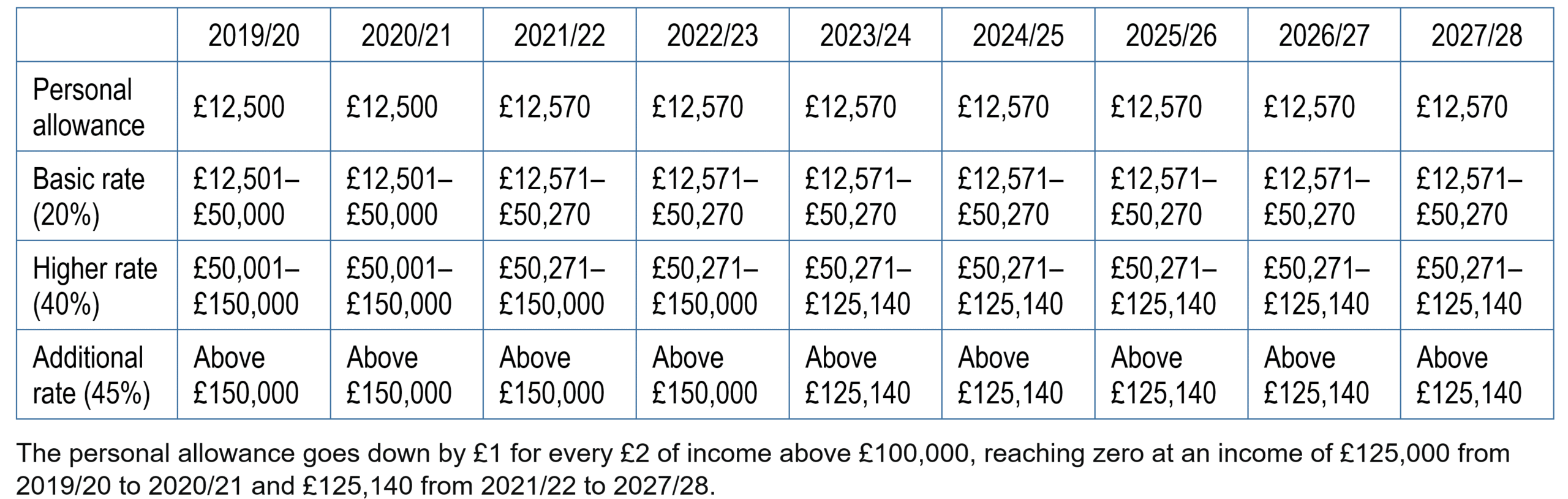
According to the Institute for Fiscal Studies, the net effect of fiscal drag means that for every £1 given back to employed and self-employed workers by the NI cuts, £1.30 will have been taken away as a result of freezing thresholds between 2021 and 2024. This will rise to £1.90 in 2027/28.
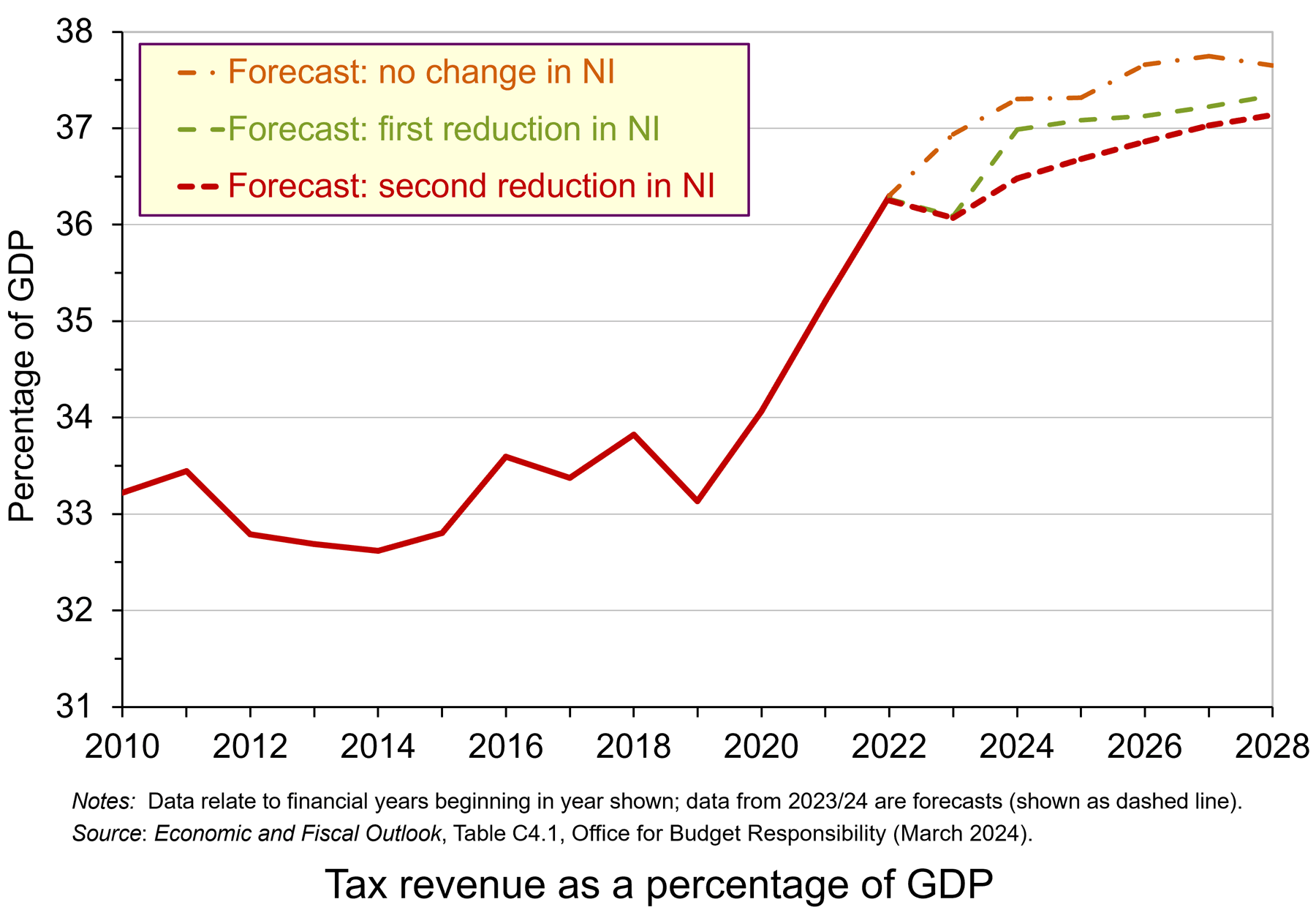 Tax revenues are still set to rise as a percentage of GDP. This is illustrated in the chart. Tax revenues were 33.2% of GDP in 2010/11. By 2022/23 the figure had risen to 36.3%. With neither of the two changes to NI (January 2024 and April 2024), the OBR forecasts that the figure would rise to 37.7% by 2028/29 – the top dashed line in the chart. After the first cut, announced in November, it forecasts a smaller rise to 37.3% – the middle dashed line. After the second cut, announced in the Spring Budget, the OBR cut the forecast figure to 37.1% – the bottom dashed line. (Click here for a PowerPoint of the chart.)
As you can see from the chart, despite the cut in NI rates, the fiscal drag from freezing thresholds means that tax revenue as a percentage of GDP is still set to rise.
Articles
Information, data and analysis
Questions
- Would fiscal drag occur with frozen nominal tax bands if there were zero real growth in incomes? Explain.
- Find out what happened to other taxes, benefits, reliefs and incentives in the 2024 Spring Budget. Assess their macroeconomic effect.
- If the government decides that it wishes to increase tax revenues as a proportion of GDP (for example, to fund increased government expenditure on infrastructure and socially desirable projects and benefits), examine the arguments for increasing personal allowances and tax bands in line with inflation but raising the rates of income tax in order to raise sufficient revenue?
- Distinguish between market-orientated and interventionist supply-side policies? Why do political parties differ in their approaches to supply-side policy?
- What is the Conservative government’s fiscal rule? Is the Spring Budget 2024 consistent with this rule?
- What policies were announced in the Spring Budget 2024 to increase productivity? Why is it difficult to estimate the financial outcome of such policies?
 The following blog is inspired by my teaching of macroeconomic issues to my final year students at Aston University. In the classes we’ve been discussing important aspects of monetary and fiscal policy design. What has become clear to me and my students is that the trade-offs which characterise the discipline of economics are certainly alive and well in the current environment in which monetary and fiscal policy choices are being made.
To demonstrate this we consider here some of the discussions we’ve had in class around central bank independence and monetary policy mandates. We’ve also looked at fiscal policy. Here we’ve examined the state of the public finances and the importance that seems to be attached to debt stabilisation and the imposition of debt rules.
Delegation and central bank mandates
My teaching this term began by introducing my students to one of the most important and influential monetary policy models. This is the model of Kydland and Prescott. Their model, published in the Journal of Political Economy in 1977 has become the theoretical bedrock for the modern-day operational independence of central banks.1
 The model explores how systemically high inflation can become established in economies when policymakers have the political incentive to lower unemployment or increase output above its long-run equilibrium value. This may be the case if governments operate monetary policy rather than the central bank (of if the central bank operates monetary policy but follows government objectives). By adopting expansionary monetary policy, governments can increase their popularity.
But this is likely to be short-lived, as any increased economic activity will only be temporary (assuming that the natural-rate hypothesis holds). Soon, inflation will rise.
But, if an election is on the horizon, there may be enough time to boost output and employment before inflation rises. In other words, an expectations-augmented Phillips curve may present governments with an incentive to loosen monetary policy and worry about the inflation consequences after the election.
However, the resulting ‘inflation surprise’ through the loosening of monetary policy means a fall in real pay and therefore in purchasing power. If people suspect that governments will be tempted to loosen policy, they will keep their expectations of inflation higher than the socially optimal inflation rate. Consequently, low-inflation targets lack credibility when governments have the temptation to loosen monetary policy. Such targets are time-inconsistent because governments have an incentive to renege and deliver higher inflation through a looser monetary policy. The result is an inflation bias.
Central bank independence
To prevent this inflationary bias arising, many central banks around the world have been given some form of operational independence with a mandate centred around an inflation-rate target. By delegating monetary policy to a more conservative central bank, the problem of inflationary bias can be addressed.
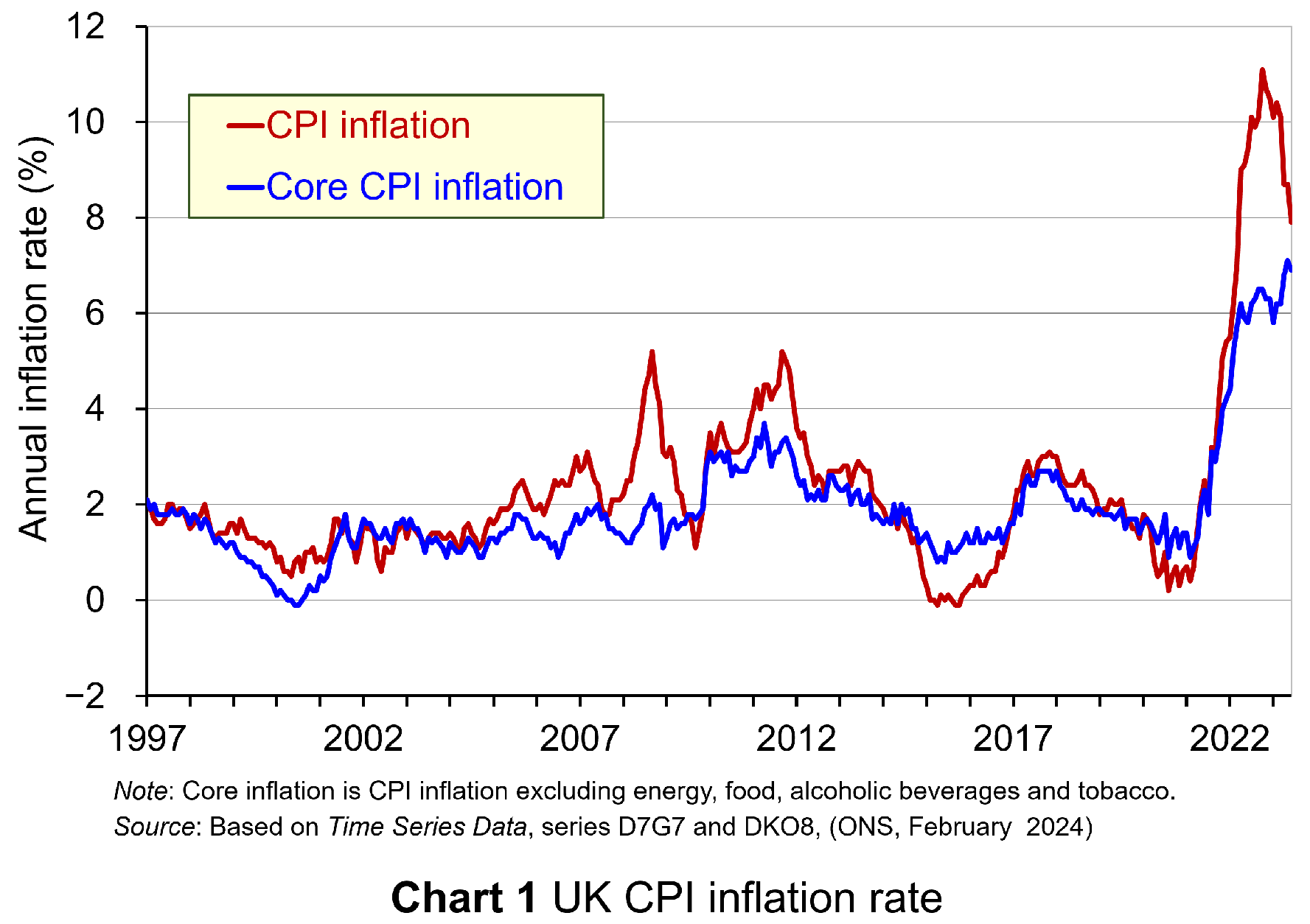 Yet central bank independence is not without its own issues and this has been an important part of the discussions with my students. Today, many economies are continuing to experience the effects of the inflationary shocks that began in 2021 (see Chart 1 for the UK CPI inflation rate: click here for a PowerPoint). The question is whether the appointment of a conservative or hard-nosed hawkish central banker trades off the stabilisation of inflation for greater volatility in output or unemployment.
The inflation–output stabilisation trade-off is closely associated with the works of Kenneth Rogoff2 and John Taylor3. The latter is known for his monetary policy rule, which has become known as the ‘Taylor rule’. This advocates that a rules-based central bank ought to place weight on both inflation and output stabilisation.
This is not without its own issues, however, since, by also placing weight on output stabilisation, we are again introducing the possibility of greater inflationary bias in policy making. Hence, while the act of delegation and a rules- or target-based approach may mitigate the extent of the bias relative to that in the Kydland and Prescott model, there nonetheless still remain issues around the design of the optimal framework for the conduct of monetary policy.
Indeed, the announcement that the UK had moved into recession in the last two quarters of 2023 can be seen as evidence that an otherwise abstract theoretical trade-off between inflation and output stabilisation is actually very real.
My classroom discussions have also shown how economic theory struggles to identify an optimal inflation-rate target. Beyond accepting that a low and stable inflation rate is desirable, it is difficult to address fully the student who asks what is so special about a 2% inflation target. Would not a 3% target, for example, be preferable, they might ask?
Whilst this may sound somewhat trivial, it has real-world consequences. In a world that now seems to be characterised by greater supply-side volatility and by more frequent inflation shocks than we were used to in recent history, might a higher inflation rate target be preferable? Certainly, one could argue that, with an inflation–output stabilisation trade-off, there is the possibility that monetary policy could be unduly restrictive in our potential new macroeconomic reality. Hence, we might come to see governments and central banks in the near future revisiting the mandates that frame the operation of their monetary policy. Time will tell.
Fiscal policy and debt stabilisation
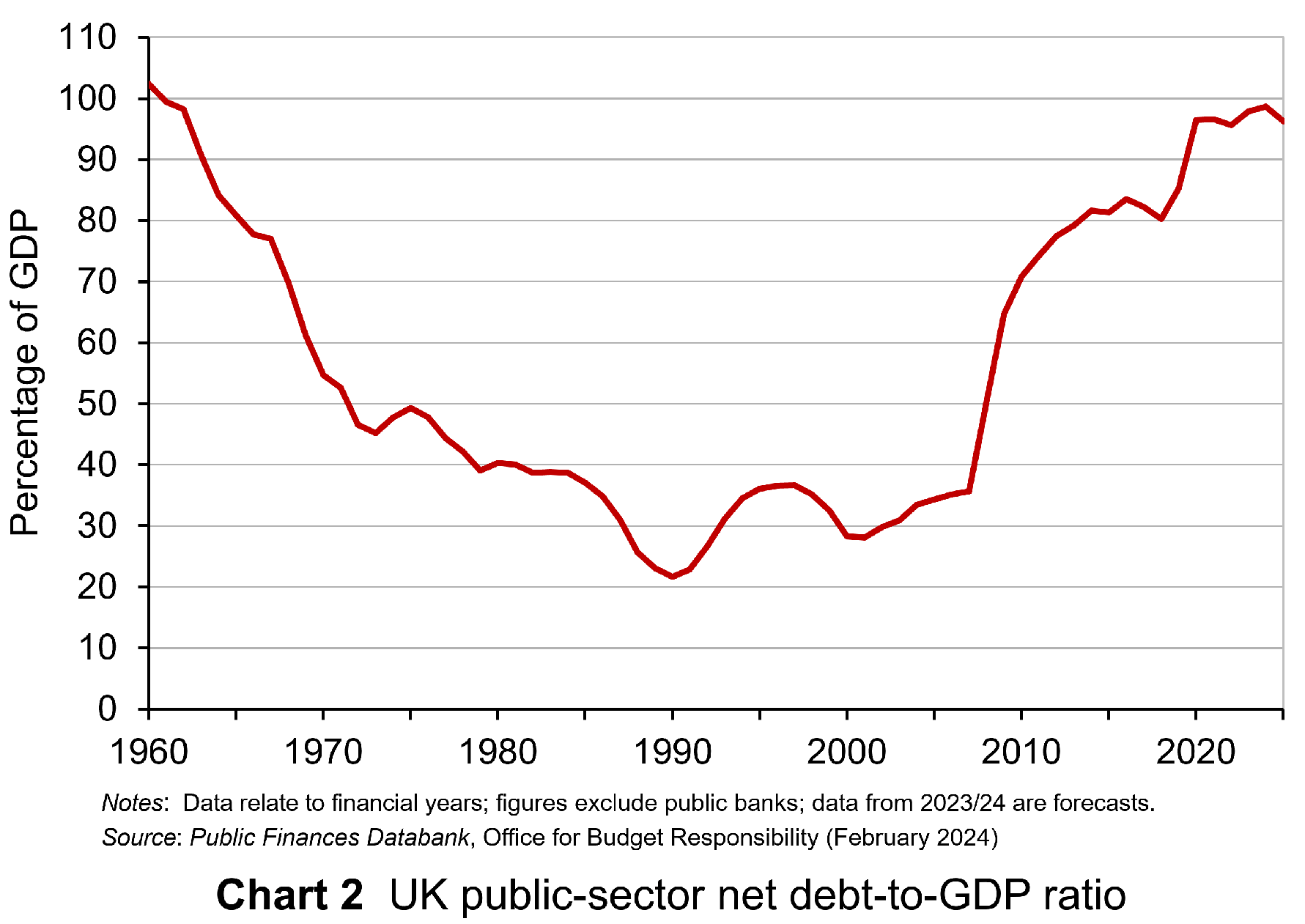 The second topic area that I have been discussing in my final-year macroeconomics classes has centred around fiscal policy and the state of the public finances. The context for this is that we have seen a significant increase in public debt-to-GDP ratios over the past couple of decades as the public sector has attempted to absorb significant economic shocks. These include the global financial crisis of 2007–8, the COVID-19 pandemic and the cost-of-living crisis. These interventions in the case of the UK have seen its public debt-to-GDP ratio more than triple since the early 2000s to close to 100% (see Chart 2: click here for a PowerPoint).
Understandably, given the stresses placed on the public finances, economists have increasingly debated issues around debt sustainability. These debates have been mirrored by politicians and policymakers. A key question is whether to have a public debt rule. The UK has in recent years adopted such a rule. The arguments for a rule centre on ensuring sound public finances and maintaining the confidence of investors to purchases public debt. A debt rule therefore places a discipline on fiscal policy, with implications for taxation and spending.
How easy it is to stick to a debt rule depends on three key factors. It will be harder to stick to the rule:
- The higher the current debt-to-GDP ratio and hence the more it needs to be reduced to meet the rule.
- The higher the rate of interest and hence the greater the cost of servicing the public debt.
- The lower the rate of economic growth and hence the less quickly will tax revenues rise.
With a given debt-to-GDP ratio, a given average interest rate payable on its debt, and a given rate of economic growth, we can determine the primary fiscal balance relative to GDP a government would need to meet for the debt-to-GDP ratio to remain stable. This is known as the ‘debt-stabilising primary balance’. The primary balance is the difference between a government’s receipts and its expenditures less the interest payments on its debt.
 This fiscal arithmetic is important in determining a government’s fiscal choices. It shows the implications for spending and taxation. These implications become ever more important and impactful on people, businesses, and society when the fiscal arithmetic becomes less favourable. This is a situation that appears to be increasingly the case for many countries, including the UK, as the rate of interest on public debt rises relative to a country’s rate of economic growth. As this happens, governments are increasingly required to run healthier primary balances. This of course implies a tightening of their fiscal stance.
Hence, the fiscal conversations with my students have focused on both the benefits and the costs of debt-stabilisation. In respect of the costs, a few issues have arisen.
First, as with the inflation-rate target, it is hard to identify an optimal public debt-to-GDP ratio number. While the fiscal arithmetic may offer some clue, it is not straightforward to address the question as to whether a debt-to-GDP ratio of say 100% or 120% would be excessive for the UK.
Second, it is possible that the debt stabilisation itself can make the fiscal arithmetic of debt stabilisation more difficult. This occurs if fiscal consolidation itself hinders long-term economic growth, which then makes the fiscal arithmetic more difficult. This again points to the difficulties in designing policy frameworks, whether they be for monetary or fiscal policy.
Third, a focus on debt stabilisation alone ignores the fact that there are two sides to any sector’s balance sheet. It would be very unusual when assessing the well-being of businesses or households if we were to ignore the asset side of their balance sheet. Yet, this is precisely the danger of focusing on public debt at the exclusion of what fiscal choices can mean for public-sector assets, from which we all can potentially benefit. Hence, some would suggest a more balanced approach to assessing the soundness of the public finances might involve a net worth (assets less liabilities) measure. This has parallels with the debates around whether mandates of central banks should be broader.
Applications in macroeconomics
What my teaching of a topics-based macroeconomics module this term has vividly demonstrated is that concepts, theories, and models come alive, and are capable of being understood better, when they are used to shine a light on real-world issues. The light being shone on monetary and fiscal policy in today’s turbulent macroeconomic environment is perhaps understandably very bright.
Indeed, the light being shone on fiscal policy in the UK and some other countries facing an upcoming election, is intensified further with the state of the public finances shaping much of the public discourse on fiscal choices. Hopefully, my students will continue to debate these important issues beyond their graduation, stressing their importance for people’s lives and, in doing so, going beyond the abstract.
References
- Rules rather than discretion: The inconsistency of optimal plans
The Journal of Political Economy, Finn E Kydland and Edward C. Prescott (1977, 85(3), pp 473–92)
- The optimal degree of commitment to an intermediate monetary target
Quarterly Journal of Economics, Kenneth Rogoff (November 1985, 100(4), pp 1169–89)
- Discretion versus policy rules in practice
Carnegie-Rochester Conference Series on Public Policy, John B Taylor (December 1993, 39, pp 195–214)
Articles
Questions
- What is meant by time-inconsistent monetary policy announcements? How has this concept been important for the way in which many central banks now conduct monetary policy?
- What is meant by a ‘conservative’ central banker? Why is the appointment of this type of central banker thought to be important in affecting inflation?
- What is the contemporary macroeconomic relevance of the inflation–output (or inflation–unemployment) stabilisation trade-off?
- How is the primary balance different from the actual budget balance?
- What do you understand by the concept of ‘the fiscal arithmetic’. Explain how each element of the fiscal arithmetic affects the debt-stabilising primary balance?
- Analyse the costs of benefits of a debt-based fiscal rule.