 The UK Chancellor of the Exchequer, Rachel Reeves, will present her annual Budget in late autumn. It will involve some hard economic and political choices. The government would like to spend more money on improving public services but has pledged not to raise taxes ‘on working people’, which is interpreted as not raising the rates of income tax, national insurance for employees and the self-employed, and VAT. What is more, government borrowing is forecast by the OBR to be £118 billion, or nearly 4.0% of GDP, for the the year 2025/26. This is a fall from the 5.1% in 2024/25 and is well below the 15.0% in 2020/21 during the pandemic. But it is significantly above the 2.1% in 2018/19.
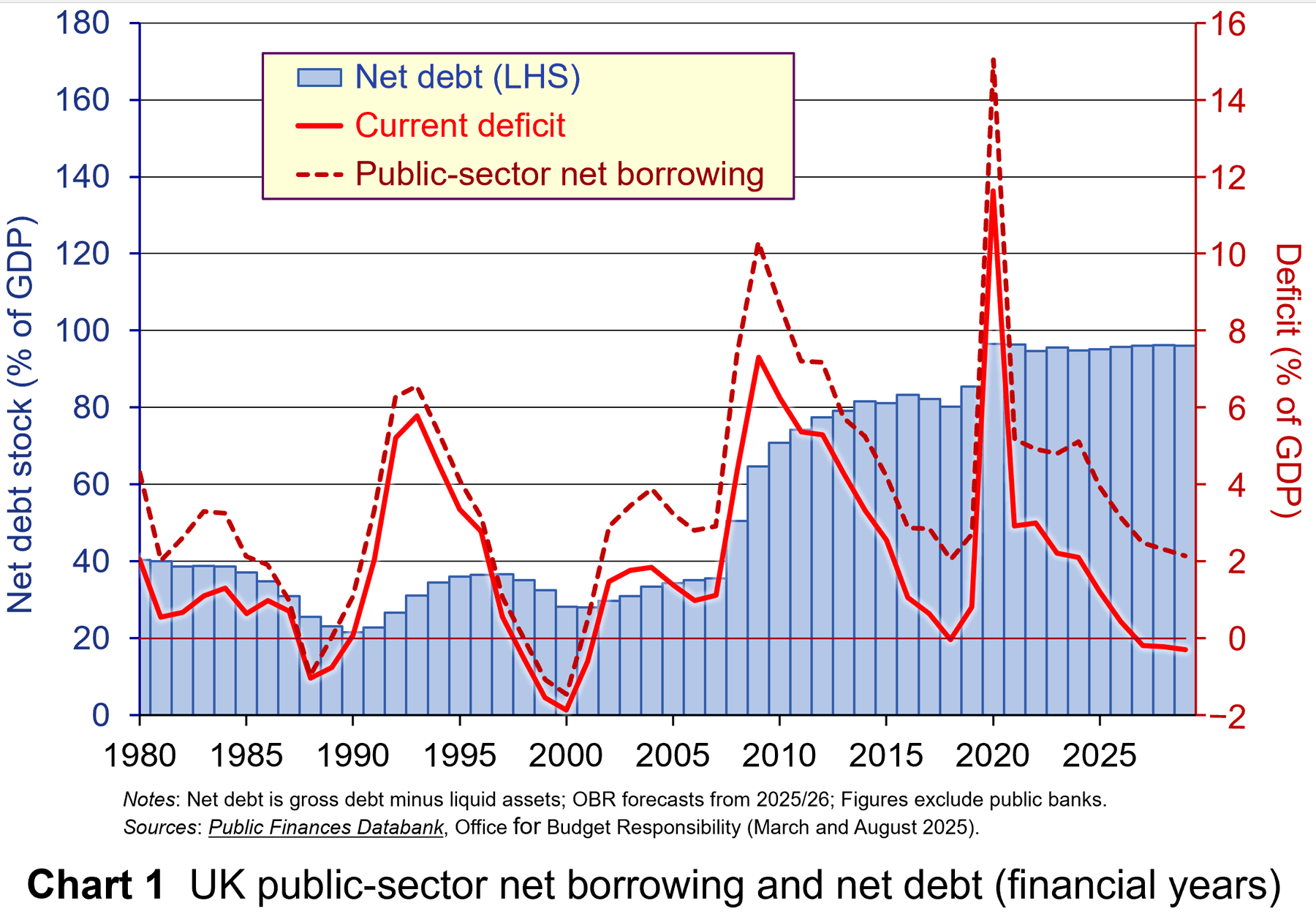 The government has pledged to stick to its two fiscal rules. The first is that the day-to-day, or ‘current’, budget (i.e. excluding investment) should be in surplus or in deficit of no more than 0.5 per cent of GDP by 2029/30 (or the third year of the rolling forecast period from the 2026/27 Budget). This allows investment to be funded by borrowing. The second rule is that public-sector net debt, which includes public-sector debt plus pension liabilities minus equity, loans and other financial assets, should be falling by 2029/30 (or the third year of the rolling forecast period from the 2026/27 Budget). The current budget deficit (i.e. excluding borrowing for investment) was forecast by the OBR in March to be 1.2% of GDP for 2025/26 (see Chart 1) and to be a surplus of 0.3% in 2029/30 (£9.9 billion). (Click here for a PowerPoint of the chart.)
The OBR’s March forecasts, therefore, were that the rules would be met with current policies and that the average rate of economic growth would be 1.8% over the next four years.
However, there would be very little room for manoeuvre, and with global political and economic uncertainty, including the effects of tariffs, climate change on harvests and the continuing war in Ukraine, the rate of economic growth might be well below 1.8%.
The March forecasts were based on the assumption that inflation would fall and hence that the Bank of England would reduce interest rates. Global pressure on inflation, however, might result in inflation continuing to be above the Bank of England’s target of 2%. This would mean that interest rates would be slow to fall – if at all. This would dampen growth and make it more expensive for the government to service the public-sector debt, thus making it harder to reduce the public-sector deficit.
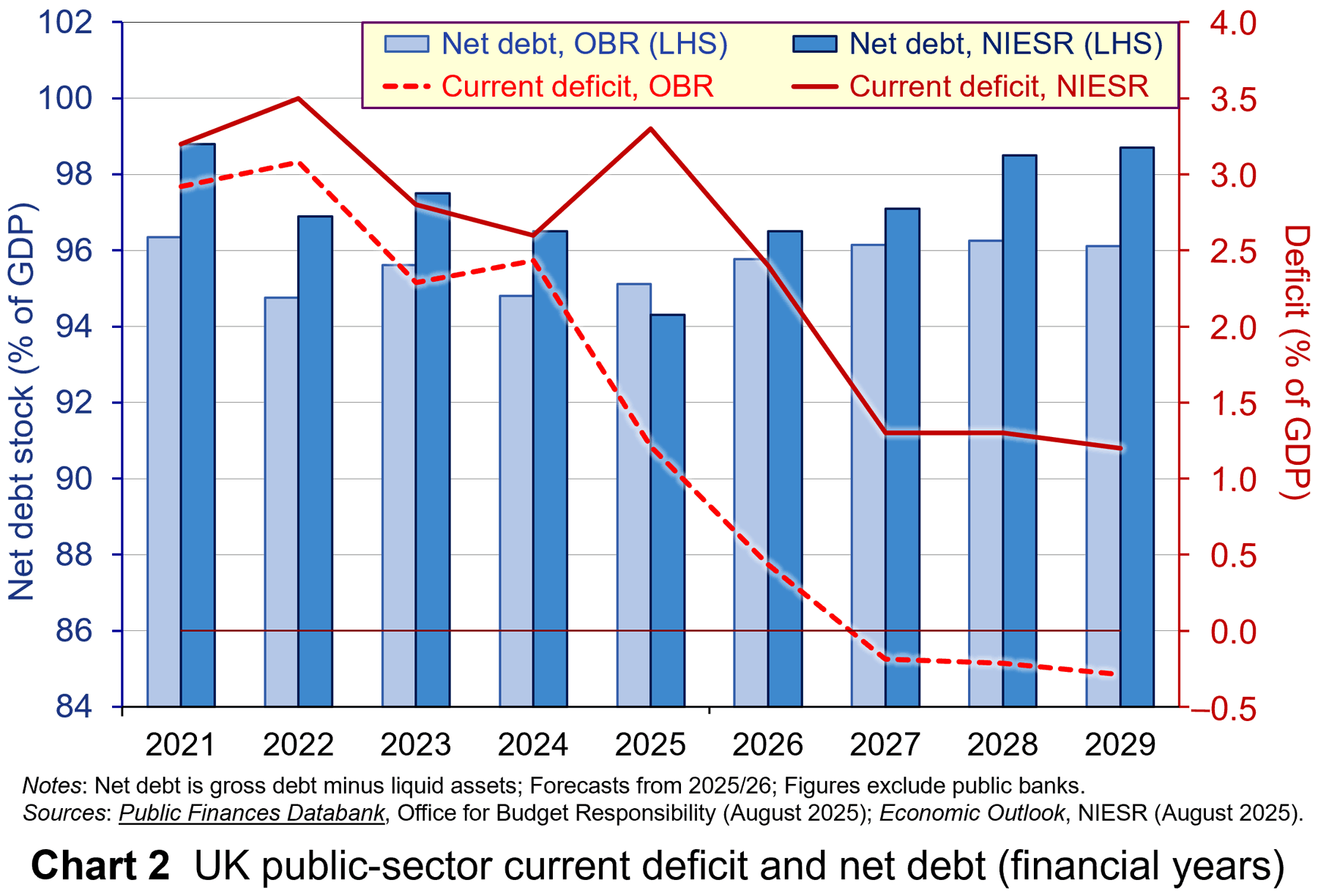 A forecast earlier this month by the National Institute for Economic and Social Research (NIESR) (see link below and Chart 2) reflects these problems and paints a gloomier picture than the OBR’s March forecast. The NIESR forecasts that GDP will grow by only 1.3 per cent in 2025, 1.2 per cent in 2026, 1.1% in 2027 and 1.0% in 2028, with the average for 2025 to 2023 being 1.13%. This is the result of high levels of business uncertainty and the effects of tariffs on exports. With no change in policy, the current deficit would be £41.2 billion in the 2029/30 financial year. Inflation would fall somewhat, but would stick at around 2.7% from 2028 to 2030. Net debt would be rising in 2029/30 &ndash but only slightly, from 98.7% to 99.0%. (Click here for a PowerPoint of the chart.)
So what are the policy options open to the government for dealing with a forecast current budget deficit of £41.2 billion (1.17% of GDP)? There are only three broad options.
Increase borrowing
One approach would be to scrap the fiscal rules and accept increased borrowing – at least temporarily. This would avoid tax increases or expenditure cuts. By running a larger budget deficit, this Keynesian approach would also have the effect of increasing aggregate demand and, other things being equal, could lead to a multiplied rise in national income. This in turn would lead to higher tax revenues and thereby result in a smaller increase in borrowing.
There are two big problems with this approach, however.
The first is that it would, over time, increase the public-sector debt and would involve having to spend more each year on servicing that debt. This would leave less tax revenue for current spending or investment. It would also involve having to pay higher interest rates to encourage people to buy the additional new government bonds necessary to finance the increased deficit.
 The second problem is that the Chancellor has said that she will stick to the fiscal rules. If she scraps them, if only temporarily, she runs the risk of losing the confidence of investors. This could lead to a run on the pound and even higher interest rates. This was a problem under the short-lived Liz Truss government when the ‘mini’ Budget of September 2022 made unfunded pledges to cut taxes. There was a run on the pound and the Bank of England had to make emergency gilt purchases.
One possibility that might be more acceptable to markets would be to rewrite the investment rule. There could be a requirement on government to invest a certain proportion of GDP (say, 3%) and fund it by borrowing. The supply-side benefits could be faster growth in potential output and higher tax revenue over the longer term, allowing the current deficit rule to be met.
Cut government expenditure
Politicians, especially in opposition, frequently claim that the solution is to cut out public-sector waste. This would allow public expenditure to be cut without cutting services. This, however, is harder than it might seem. There have been frequent efficiency drives in the public sector, but from 1919 to 2023 public-sector productivity fell by an average of 0.97% per year.
Causes include: chronic underinvestment in capital, resulting in outdated equipment and IT systems and crumbling estates; decades of underfunding that have left public services with crumbling estates, outdated equipment and insufficient IT systems; inconsistent, short-term government policy, with frequent changes in government priorities; bureaucratic systems relying on multiple legacy IT systems; workforce challenges, especially in health and social care, with high staff turnover, recruitment difficulties, and a lack of experienced staff.
 The current government has launched a Public Sector Productivity Programme. This is a a cross-government initiative to improve productivity across public services. Departments are required to develop productivity plans to invest in schemes designed to achieve cost savings and improve outcomes in areas such as the NHS, police, and justice system. A £1.8 billion fund was announced in March 2024, to support public-sector productivity improvements and digital transformation. Part of this is to be invested in digital services and AI to improve efficiency. According to the ONS, total public-service productivity in the UK grew by 1.0% in the year to Q1 2025; healthcare productivity grew 2.7% over the same period. It remains to be seen whether this growth in productivity will be maintained. Pressure from the public, however, will mean that any gains are likely to be in terms of improved services rather than reduced government expenditure.
Increase taxes
This is always a controversial area. People want better public services but also reduced taxes – at least for themselves! Nevertheless, it is an option seriously being considered by the government. However, if it wants to avoid raising the rates of income tax, national insurance for employees and the self-employed, and VAT, its options are limited. It has also to consider the political ramifications of taking unpopular tax-raising measures. The following are possibilities:
Continue the freeze on income tax bands. They are currently frozen until April 2028. The extra revenue from extending the freeze until April 2030 would be around £7 billion. Although this may be politically more palatable than raising the rate of income tax, the revenue raised will be well short of the amount required and thus other measures will be required. Although some £40 billion will have been raised up to 2028 (which has already been factored in), as inflation falls, so the fiscal drag effect will fall: nominal incomes will need to rise less to achieve any given rise in real incomes.
 Cutting tax relief for pensions. Currently, people get income tax relief at their marginal rate on pension contributions made by themselves and their employer up to £60 000 per year or 100% of their earnings, whichever is smaller. When people draw on their pension savings, they pay income tax at their marginal rate, even if the size of their savings has grown from capital gains, interest or dividends. Reducing the limits or restricting relief to the basic rate of tax could make a substantial contribution to increasing government revenue. In 2023/24, pension contribution relief cost the government £52 billion. Restricting relief to the basic rate or cutting the annual limit would make the relief less regressive. In such a case, when people draw on their pension savings, the income tax rate could be limited to the basic rate to avoid double taxation.
Raising the rate of inheritance tax (IHT) or reducing the threshold. Currently, estates worth more than £325 000 are taxed at a marginal rate of 40%. The threshold is frozen until 2029/30 and thus additional revenue will be received by the government as asset prices increase. If the rate is raised above 40%, perhaps in bands, or the threshold were lowered, then this will earn additional revenue. However, the amount will be relatively small compared to the predicted current deficit in 2029/30 of £41 billion. Total IHT revenue in 2022/23 was only 6.7 billion. Also, it is politically dangerous as people could claim that the government was penalising people who had saved in order to help the next generation, who are struggling with high rents or mortgages.
Increased taxes on business. The main rate of corporation tax was raised from 19% to 25% in April 2023 and the employers’ national insurance rate was raised from 13.8% to 15% and the threshold reduced from £9100 to £5000 per year in April 2025. There is little or no scope for raising business taxes without having significant disincentive effects on investment and employment. Also, there is the danger that raising rates might prompt companies to relocate abroad.
 Raise fuel and/or other duties. Fuel duties raise approximately £24 billion. They are set to decline gradually with the shift to EVs and more fuel-efficient internal combustion engines. Fuel duty remained unchanged at 57.95p per litre from 2011 to 2022 and then was ‘temporarily’ cut to 52.95p. The rate of 52.95p is set to remain until at least 2026. There is clearly scope here to raise it, if only by the rate of inflation each year. Again, the main problem is a political one that drivers and the motor lobby generally will complain. Other duties include alcohol, tobacco/cigarettes/vaping, high-sugar beverages and gambling. Again, there is scope for raising these. There are two problems here. The first is that these duties are regressive, falling more heavily on poorer people. The second is that high duties can encourage illegal trade in these products.
Raising one of the three major taxes: income tax, employees’ national insurance and VAT. This will involve reneging on the government’s election promises. But perhaps it’s better to bite the bullet and do it sooner rather than later. Six European countries have VAT rates of 21%, three of 22%, three of 23%, two of 24%, four of 25%, one of 25.5% and one of 27%. Each one percentage point rise would raise about 9 billion. A one percentage point rise across all UK income tax rates would raise around £5.8 billion. As far as employees’ national insurance rates are concerned, the Conservative government reduced the main rate twice from 12% to 10% in January 2024 and from 10% to 8% in April 2024. The government could argue that raising it back to, say, 10% would still leave it lower than previously. A rise to 10% would raise around £11 billion.
Conclusion
The choices for the Chancellor are not easy. As the NIESR’s Economic Outlook puts it:
Simply put, the Chancellor cannot simultaneously meet her fiscal rules, fulfil spending commitments, and uphold manifesto promises to avoid tax rises for working people. At least one of these will need to be dropped – she faces an impossible trilemma.
Articles
- The Chancellor’s Trilemma
UK Economic Outlook: NIESR, Benjamin Caswell, Fergus Jimenez-England, Hailey Low, Stephen Millard, Eliza da Silva Gomes, Adrian Pabst, Tibor Szendrei and Arnab Bhattacharjee (6/8/25)
- Reeves must raise tax to cover £41bn gap, says think tank
BBC News, Lucy Hooker (6/8/25)
- Chancellor warned ‘substantial tax rises’ needed – as she faces ‘impossible trilemma’
Sky News, Gurpreet Narwan (6/8/25)
- Rachel Reeves needs to put up taxes to cover £40bn deficit, thinktank says
The Guardian, Phillip Inman (6/8/25)
- What’s the secret to fixing the UK’s public finances? Here’s what our panel of experts would do
The Conversation, Steve Schifferes, Conor O’Kane, Guilherme Klein Martins, Jonquil Lowe and Maha Rafi Atal (15/8/25)
- Why radical tax reform may be only way for Reeves to balance the books
The Guardian, Phillip Inman (21/8/25)
- Reeves and Starmer to prepare ground for tax rises in a difficult autumn budget
The Guardian, Jessica Elgot, Richard Partington and Eleni Courea (7/8/25)
- How much money does the UK government borrow, and does it matter?
BBC News (21/8/25)
- More pain for Reeves as government borrowing cost nears 27-year high
The Guardian, Phillip Inman (26/8/25)
Data
Questions
- Which of the options would you choose and why?
- Should the government introduce a wealth tax on people with wealth above, say, £2 million? If so, should it be a once-only tax or an annual tax?
- Research another country’s fiscal position and assess the choices their finance minister took.
- Look at a previous UK Budget from a few years ago and the forecasts on which the Budget decisions were made (search Budget [year] on the GOV.UK website). How accurate did the forecasts turn out to be? If the Chancellor then had known what would actually happen in the future, would their decisions have been any different and, if so, in what ways?
- Should fiscal decisions be based on forecasts for three of four years hence when those forecasts are likely to be unreliable?
- Should fiscal and monetary policy decisions be made totally separately from each other?
For a while now, debate has raged over how to revive the fortunes of the London Stock Exchange (LSE). Since the 2008 financial crisis, the market has suffered a lack of investment, poor liquidity and low performance. This has produced a moribund financial market which has become unattractive to both investors and companies. Returns from the UK market lag international competitors, particularly the USA (see the chart).
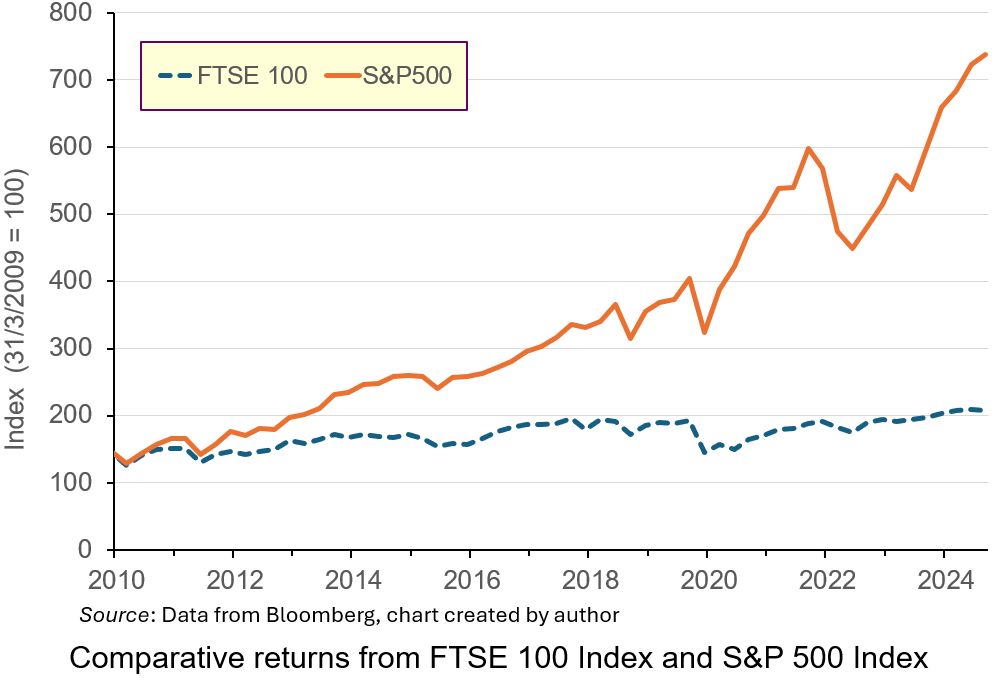
Investment in the S&P 500 Index over the period would have produced annualised rates of return of 14.35%, more than double that from the FTSE 100 Index. Part of this underperformance is due to the industrial mix of the listed companies: low-growth energy and mining compared to the high-growth technology sectors in the USA. This has led to the perception that London is not a place for firms to list, particularly those in high-growth sectors.
In 2024, 88 companies choose to delist or transfer their primary listing elsewhere. Only 18 took their place. Several big companies from a range of industries, including Ashtead, Flutter and CRH have transferred their primary listing to New York or have plans to do so.
 The new Labour government views stimulating higher levels of investment though the London market as an important element in its drive to boost productivity and growth in the UK. Recently, it has been reported that investment institutions have been lobbying the UK government to reduce significantly the tax-free allowance for Cash Individual Savings Accounts (ISAs) as a way to encourage more of UK households’ savings to be channelled through the UK stock market.
Currently, UK savers can save up to £20 000 annually into ISAs without paying tax on the interest earned. This can be held solely in Cash ISAs, or in a combination of Cash plus Stocks and Shares ISAs. The tax-free instruments which were introduced by a Labour government in 1999 to encourage higher savings have proved immensely popular. Data from Paragon Bank indicate that over £350 billion are held in these accounts. However, under the new proposals, the amount which would be allowed to be saved as cash has been rumoured to be cut to £4000 per year, with the hope that some of it will be invested in the UK stock market.
The proposals have proved controversial, with high-profile figures voicing opposition. In this blog, we’ll analyse the reasons behind the proposal and discuss whether it will have the desired effect of stimulating higher levels of investment. We’ll also discuss other proposed policies for making the LSE a more effective channel for investment flows to boost economic growth.
Stock markets and the saving and investment channel
 The main reason for the proposed ISA change is to encourage more investment in the UK stock market. By reducing the amount which can be saved in Cash ISAs, the government hopes to encourage savers to invest in Stocks and Shares ISAs instead, particularly ones linked to the UK market. This would increase the amount of finance capital in the market, thereby boosting its liquidity. This would then make it an attractive place for young, vibrant UK and foreign companies to list.
An active, liquid secondary market in shares is important to attract firms to list on stock exchanges by issuing shares to outside investors. Traditionally, this channel has been important to the growth and development of firms.
Existing savings in Cash ISAs are deposited with financial institutions such as banks and building societies. Through the credit-creation process such funds can be used to finance productive investment. In countries like the UK, lending by financial institutions is an important way that investment is financed, particularly for small and medium-sized enterprises. However, scale limits, regulatory restrictions and the need to diversify lending properly means that there are limits to the financing available for company investment through these institutions.
Capital markets like the LSE are intended to meet these larger-scale requirements. Financial claims, such as debt and equity, are divided into atomised instruments and sold to outside investors to fund investment and business growth.
 Further, the desire for a capital injection to finance growth is not the only reason that firms seek stock market listings. Founders of companies may have a lot of wealth invested in the equity of their firms. Selling some of their equity to outside investors through a stock market listing is a way of diversifying their wealth. However, if they are to maximise the potential sale price, there must be an active, liquid secondary market to encourage investors to buy shares in the primary market.
Proponents of reform want to encourage a greater appetite for risk among UK investors, which will produce more savings being channelled through the LSE.
One issue is whether savers will respond in the way anticipated and channel more funds through the UK stock market. Many savers like the security of Cash ISAs. Such vehicles offer a low-risk/low-return combination, which savers like because the tax benefits boost returns. A survey by the Nottingham Building Society found that a substantial number of Cash ISA savers are concerned that the proposed changes could affect their ability to save for important financial goals, such as buying a house or building an emergency fund. Higher-risk Stocks and Shares ISAs are not suitable for such savings because of the potential to lose the initial amount invested. Many may not be prepared to do so and one-third suggested they would save less overall.
According to the survey, only 38% of Cash ISA holders said they would consider investing in Stocks and Shares ISAs if the Cash ISA allowance were reduced. It may be difficult to alter such risk-averse preferences given the average amount saved through ISAs and demographics. In 2022/23, the average amount subscribed to ISAs was £5000. This does not suggest that average households have a significant surplus of cash that they may want to investment at a high risk through the stock market. Indeed, many may want to have access to the cash at short notice and so are not prepared to forgo liquidity for the time needed to accrue the benefits of compounding which stock market investing produces.
Demographics may also play a role in this. Many of those who save more are now retired, or near retirement. They are less likely to see the appeal of compounding returns over long periods through investment in shares. Instead, with shorter investment horizons, they may only see the potential for losses associated with Stocks and Shares ISAs. Indeed, they will be starting to liquidate their long-term positions to draw income in retirement. Therefore, they may save less.
For others, who may be prepared to accept the additional risk, with the prospect of higher returns in the way that advocates of the reform hope for, the reduction in the Cash ISA allowance does not necessarily mean that they will invest in Stocks and Shares ISAs linked to the UK market. Since returns from the UK market have lagged international competitors, it may be that savers will channel their savings to those international markets, particularly in the USA, where the risk–return relationship has been more rewarding. Doing so has been made much easier and cheaper through a combination of economic forces including technological advances, regulatory changes and increased competition. This makes it much easier for UK savers to channel investment funds to wherever potential return is highest. At the moment, this is unlikely to be the UK, meaning that the anticipated boost to investment funds may not be as much as anticipated.
Critics of the proposal also question the motives of investment fund managers who have been lobbying government. They argue that the reforms will mean that many people who do now choose to save in Stocks and Shares ISAs will buy funds managed by fund managers who will receive fees for doing so. Critics argue that it is the prospect of higher fees which is the real motive behind the lobbying, not any desire to boost investment and growth.
What alternatives are available to boost the London Stock Exchange
 The low valuations of LSE-listed companies compared to their international counterparts, particularly those in the USA, has discouraged growing firms from listing in London. To address this, there have been calls to enhance corporate governance standards and reduce regulatory burdens for listed companies.
This has already been recognised by the authorities. In 2024, UK regulators approved the biggest overhaul of rules regulating London-listed companies. The new listing rules will hand more power to company bosses to make decisions without shareholder votes. They will give companies more flexibility to adopt dual-class share structures used by founders and venture capital firms to give themselves stronger voting rights than other investors. This is particularly popular for founders who want to diversify their wealth without sacrificing control and is used frequently by tech companies and venture capitalists when listing in the USA. Such reforms may attract more companies in high-growth sectors to list in London.
Tax policies which provide the right incentives to buy and sell shares could also encourage more investment in the LSE. For instance, the repeal in the mid-1990s of the preferential tax treatment of dividend income for UK pension funds and insurance companies is seen as a major factor in discouraging those institutions from investing more funds in the London market. Since tax on capital gains is only liable when they are realised, this reduces their present value versus the equivalent amount on dividends.
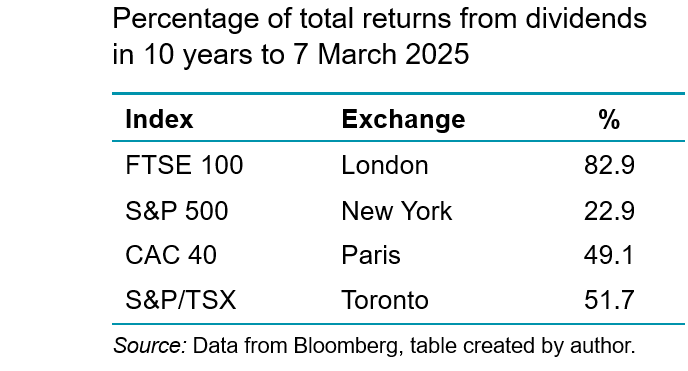
As the following table illustrates, given the significantly higher percentage of total returns derived from dividends in the LSE compared to other exchanges, the equal tax treatment of dividend and capital gains provides an incentive to seek jurisdictions where capital gains predominate. This is what UK pension funds have done. Data from the Office of National Statistics show that in 2024, 77% of UK occupational pensions equity investments were overseas.
Reinstating this tax benefit could stimulate greater demand for UK equity from this significant sector, boosting liquidity in the London market. Allied to this are proposals from the UK government to consolidate the fragmented UK pension industry to achieve greater scale economies in that channel for investment. This can reduce financing costs, boosting the marginal return from UK investments for these funds, encouraging greater investment in the UK market (ceteris paribus).
Further, the 2.5% stamp duty on share purchases has been viewed as another disincentive for both retail and institutional investors to engage in security trading on the London Stock Exchange. The duty, which is much higher than in peer economies, effectively raises the expected rate of return on UK equites which depresses perceptions of their values and prices. Its removal may raise trading volumes, improving the liquidity of the market and be offset by increased tax revenues in the future. However, the Treasury suggests that the removal of stamp duty is doubtful, since it would create a significant hole in the UK government’s budget.
 Ultimately, many of these reforms may have limited impact on investment. Efforts to boost confidence in the stock market will depend on improving the overall economic environment in the UK. Therefore, it will be the wider policies promoting growth in general which will increase the rates of return offered by London-listed firms and be more significant to attracting capital to London.
However, many of these are controversial themselves, such as relaxing laws around planning permissions and addressing business uncertainties around post-Brexit trading arrangements with the European Union. These broader economic measures could help make the UK generally, and the LSE specifically, more appealing to both domestic and international investors.
Conclusion
The UK government’s proposal to reduce the Cash ISA allowance is part of a broader strategy to boost investment in the stock market and stimulate economic growth. While this change could lead to more capital being directed towards productive investments, it also poses challenges for savers who like the security and simplicity of Cash ISAs.
The ultimate impact will depend on how savers respond to these changes. The potential reduction in overall savings rates could counteract some of the intended benefits. Further, the extent to which they are prepared to channel their savings into UK-listed companies will be important. If many seek higher returns elsewhere, the impact on the UK stock market may be limited. In any case, policies to address the problems of the UK stock market will only work if the wider issues associated with UK productivity and growth are addressed.
Articles
Data
Questions
- Explain how banks use cash ISAs to finance investment through credit creation.
- What do stock markets offer which may boost investment and economic growth?
- What are the issues with the London Stock Exchange which is making it unattractive for raising finance?
- How is the rumoured ISA reform intended to help address these issues?
- Analyse the extent to which it will do so.
- How might some of the broader reforms proposed by the UK government influence rate of return on UK equities and attract capital?
Economic growth is closely linked to investment. In the short term, there is a demand-side effect: higher investment, by increasing aggregate demand, creates a multiplier effect. GDP rises and unemployment falls. Over the longer term, higher net investment causes a supply-side effect: industrial capacity and potential output rise. This will be from both the greater quantity of capital and, if new investment incorporates superior technology, from a greater productivity of capital.
One of the biggest determinants of investment is certainty about the future: certainty allows businesses to plan investment. Uncertainty, by contrast, is likely to dampen investment. Investment is for future output and if the future is unknown, why undertake costly investment? After all, the cost of investment is generally recouped over several months or year, not immediately. Uncertainty thus increases the risks of investment.
 There is currently great uncertainty in the USA and its trading partners. The frequent changes in policy by President Trump are causing a fall in confidence and consequently a fall in investment. The past few weeks have seen large cuts in US government expenditure as his administration seeks to dismantle the current structure of government. The businesses supplying federal agencies thus face great uncertainty about future contracts. Laid-off workers will be forced to cut their spending, which will have knock-on effect on business, who will cut employment and investment as the multiplier and accelerator work through.
There are also worries that the economic chaos caused by President Trump’s frequent policy changes will cause inflation to rise. Higher inflation will prompt the Federal Reserve to raise interest rates. This, in turn, will increase the cost of borrowing for investment.
Tariff uncertainty
 Perhaps the biggest uncertainty for business concerns the imposition of tariffs. Many US businesses rely on imports of raw materials, components, equipment, etc. Imposing tariffs on imports raises business costs. But this will vary from firm to firm, depending on the proportion of their inputs that are imported. And even when the inputs are from other US companies, those companies may rely on imports and thus be forced to raise prices to their customers. And if, in retaliation, other countries impose tariffs on US goods, this will affect US exporters and discourage them from investing.
For many multinational companies, whether based in the USA or elsewhere, supply chains involve many countries. New tariffs will force them to rethink which suppliers to use and where to locate production. The resulting uncertainty can cause them to delay or cancel investments.
Uncertainty has also been caused by the frequent changes in the planned level of tariffs. With the Trump administration using tariffs as a threat to get trading partners to change policy, the threatened tariff rates have varied depending on how trading partners have responded. There has also been uncertainty on just how the tariff policy will be implemented, making it more difficult for businesses to estimate the effect on them.
Then there are serious issues for the longer term. Other countries will be less willing to sign trade deals with the USA if they will not be honoured. Countries may increasingly look to diverting trade from the USA to other countries.
Video
Articles
- Trump’s erratic trade policies are baffling businesses, threatening investment and economic growth
Associated Press, Paul Wiseman, Anne D’innocenzio and Mae Anderson (6/3/25)
- The world is beginning to tire of Trump’s whiplash leadership
CNN, Stephen Collinson (6/3/25)
- US stocks slide and Nasdaq enters correction as chaos over Trump’s tariffs intensifies
CNN, John Towfighi (6/3/25)
- Trump’s Tariffs And Trade: Uncertainty, Chaos Or Brilliance?
Forbes, Mike Patton (6/3/25)
- How Trump’s second term might affect the market and your finances
The Conversation, Art Durnev (4/3/25)
- US corporate bond investors cautiously navigate trade war uncertainty
Reuters, Matt Tracy (6/3/25)
 This week in Trumponomics: Playing chicken with markets
Yahoo Finance, Rick Newman (8/3/25)
- Measuring fear: What the VIX reveals about market uncertainty
The FRED Blog, Aakash Kalyani (13/2/25)
- Trump shrugs off stock market slump, but economic warning signs loom
The Conversation, Conor O’Kane (17/3/25)
Data
Questions
- Find out what tariffs have been proposed, imposed and changed since Donald Trump came to office on 20 January 2025.
- In what scenario might US investment be stimulated by Donald Trump’s policies?
- What countries’ economies have gained or are set to gain from Donald Trump’s policies?
- What is the USMCA agreement? Do Donald Trump’s policies break this agreement?
- Find out and explain what has happened to the US stock market since January 2025. How do share prices affect business investment?
- Which sector’s shares have risen and which have fallen?
- Using the Data link above, find out what has been happening to the US Policy Uncertainty Index since Donald Trump was elected and explain particular spikes in the index. Is this mirrored in the global Policy Uncertainty Index?
- Are changes in the Policy Uncertainty Index mirrored in the World Uncertainty Index (WUI) and the CBOE Volatility Index: VIX?
 In a blog from March 2023 (reproduced below), we saw how there has been growing pressure around the world for employers to move to a four-day week. Increasing numbers of companies have adopted the model of 80% of the hours for 100% of the pay.
As we see below, the model adopted has varied across companies, depending on what was seen as most suitable for them. Some give everyone Friday off; others let staff choose which day to have off; others let staff work 80% of the hours on a flexible basis. Firms adopting the model have generally found that productivity and revenue have increased, as has employee well-being. To date, over 200 employers in the UK, employing more than 5000 people, have adopted a permanent four-day week.
This concept of 100-80-100, namely 100% of pay for 80% of hours, but 100% of output, has been trialled in several countries. In Germany, after trials over 2024, 73% of the companies involved plan to continue with the new model, with the remaining 27% either making minor tweaks or yet to decide. Generally hourly productivity rose, and in many cases total output also rose. As the fourth article below states:
The primary causal factor for this intriguing revelation was simple – efficiency became the priority. Reports from the trial showed that the frequency and duration of meetings was reduced by 60%, which makes sense to anyone who works in an office – many meetings could have been a simple email. 25% of companies tested introduced new digitised ways of managing their workflow to optimise efficiency.
Original post
In two previous posts, one at the end of 2019 and one in July 2021, we looked at moves around the world to introduce a four-day working week, with no increase in hours on the days worked and no reduction in weekly pay. Firms would gain if increased worker energy and motivation resulted in a gain in output. They would also gain if fewer hours resulted in lower costs.
Workers would be likely to gain from less stress and burnout and a better work–life balance. What is more, firms’ and workers’ carbon footprint could be reduced as less time was spent at work and in commuting.
If the same output could be produced with fewer hours worked, this would represent an increase in labour productivity measured in output per hour.
The UK’s poor productivity record since 2008
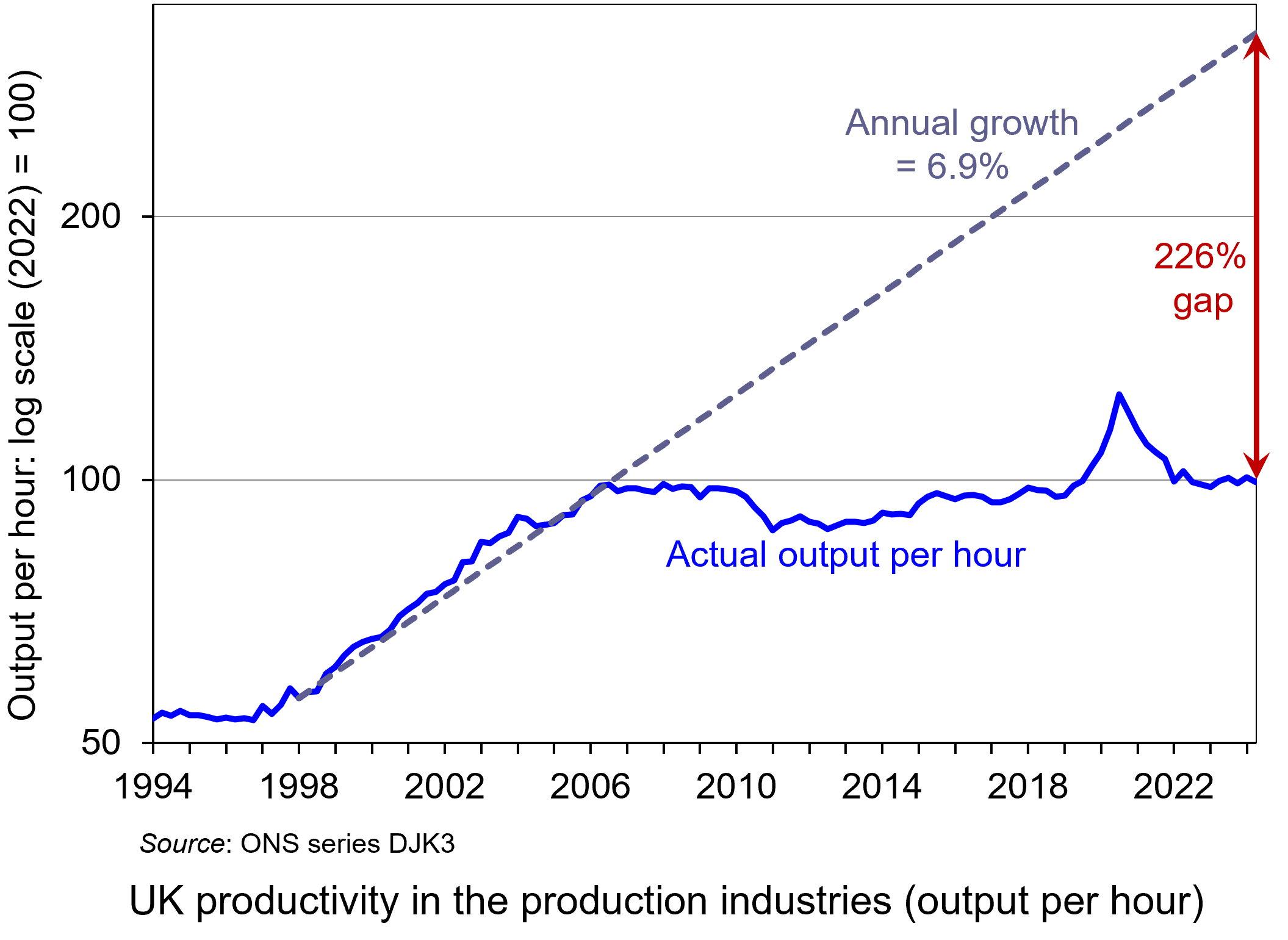 Since the financial crisis of 2007–8, the growth in UK productivity has been sluggish. This is illustrated in the chart, which looks at the production industries: i.e. it excludes services, where average productivity growth tends to be slower. The chart has been updated to 2024 Q2 – the latest data available. (Click here for a PowerPoint of the chart.)
Prior to the crisis, from 1998 to 2006, UK productivity in the production industries grew at an annual rate of 6.9%. From 2007 to the start of the pandemic in 2020, the average annual productivity growth rate in these industries was a mere 0.2%.
It grew rapidly for a short time at the start of the pandemic, but this was because many businesses temporarily shut down or went to part-time working, and many of these temporary job cuts were low-wage/low productivity jobs. If you take services, the effect was even stronger as sectors such as hospitality, leisure and retail were particularly affected and labour productivity in these sectors tends to be low. As industries opened up and took on more workers, so average productivity rapidly fell back. Since then productivity has flatlined.
If you project the average productivity growth rate from 1998 to 2007 of 6.9% forwards (see grey dashed line), then by 2024 Q3, output per hour in the production industries would have been 3.26 times higher than it actually was: a gap of 226%. This is a huge productivity gap.
 Productivity in the UK is lower than in many other competitor countries. According to the ONS, output per hour in the UK in 2021 was $59.14 in the UK. This compares with an average of $64.93 for the G7 countries, $66.75 in France, £68.30 in Germany, $74.84 in the USA, $84.46 in Norway and $128.21 in Ireland. It is lower, however, in Italy ($54.59), Canada ($53.97) and Japan ($47.28).
As we saw in the blog, The UK’s poor productivity record, low UK productivity is caused by a number of factors, not least the lack of investment in physical capital, both by private companies and in public infrastructure, and the lack of investment in training. Other factors include short-termist attitudes of both politicians and management and generally poor management practices. But one cause is the poor motivation of many workers and the feeling of being overworked. One solution to this is the four-day week.
Latest evidence on the four-day week
Results have just been released of a pilot programme involving 61 companies and non-profit organisations in the UK and nearly 3000 workers. They took part in a six-month trial of a four-day week, with no increase in hours on the days worked and no loss in pay for employees – in other words, 100% of the pay for 80% of the time. The trial was a success, with 91% of organisations planning to continue with the four-day week and a further 4% leaning towards doing so.
 The model adopted varied across companies, depending on what was seen as most suitable for them. Some gave everyone Friday off; others let staff choose which day to have off; others let staff work 80% of the hours on a flexible basis.
There was little difference in outcomes across different types of businesses. Compared with the same period last year, revenues rose by an average of 35%; sick days fell by two-thirds and 57% fewer staff left the firms. There were significant increases in well-being, with 39% saying they were less stressed, 40% that they were sleeping better; 75% that they had reduced levels of burnout and 54% that it was easier to achieve a good work–life balance. There were also positive environmental outcomes, with average commuting time falling by half an hour per week.
There is growing pressure around the world for employers to move to a four-day week and this pilot provides evidence that it significantly increases productivity and well-being.
Additional articles
Original set of articles
- Results from world’s largest 4 day week trial bring good news for the future of work
4 Day Week Global, Charlotte Lockhart (21/2/23)
- Four-day week: ‘major breakthrough’ as most UK firms in trial extend changes
The Guardian, Heather Stewart (21/2/23)
- Senedd committee backs four-day working week trial in Wales
The Guardian, Steven Morris (24/1/23)
- ‘Major breakthrough’: Most firms say they’ll stick with a four-day working week after successful trial
Sky News, Alice Porter (21/2/23)
- Major four-day week trial shows most companies see massive staff mental health benefits and profit increase
Independent, Anna Wise (21/2/23)
- Four-day week: Which countries have embraced it and how’s it going so far?
euronews, Josephine Joly and Luke Hurst (23/2/23)
- Firms stick to four-day week after trial ends
BBC News, Simon Read, Lucy Hooker & Emma Simpson (21/2/23)
- The climate benefits of a four-day workweek
BBC Future Planet, Giada Ferraglioni and Sergio Colombo (21/2/23)
- Four-day working week: why UK businesses and workers will continue with new work pattern, plus pros and cons
National World, Rochelle Barrand (22/2/23)
- Most companies in UK four-day week trial to continue with flexible working
Financial Times, Daniel Thomas and Emma Jacobs (21/2/23)
- The pros and cons of a four-day working week
Financial Times, Editorial (13/2/23)
- Explaining the UK’s productivity slowdown: Views of leading economists
VoxEU, Ethan Ilzetzki (11/3/20)
- Why the promised fourth industrial revolution hasn’t happened yet
The Conversation, Richard Markoff and Ralf Seifert (27/2/23)
Questions
- What are the possible advantages of moving to a four-day week?
- What are the possible disadvantages of moving to a four-day week?
- What types of companies or organisations are (a) most likely, (b) least likely to gain from a four-day week?
- Why has the UK’s productivity growth been lower than that of many of its major competitors?
- Why, if you use a log scale on the vertical axis, is a constant rate of growth shown as a straight line? What would a constant rate of growth line look like if you used a normal arithmetical scale for the vertical axis?
- Find out what is meant by the ‘fourth industrial revolution’. Does this hold out the hope of significant productivity improvements in the near future? (See, for example, last link above.)
 At an event at the London Palladium on 6 December staged to protest against elements in the recent Budget, the Conservative leader, Kemi Badenoch, was asked whether she would introduce a flat-rate income tax if the Conservatives were returned to government. She replied that it was a very attractive idea. But first the economy would need ‘rewiring’ so that the tax burden could be lightened.
A flat-rate income tax system could take various forms, but the main feature is that there is a single rate of income tax. The specific rate would depend on how much the government wanted to raise. Also it could apply to just income tax, or to both income tax and social insurance (national insurance contributions (NICs) in the UK), or to income tax, social insurance and the withdrawal rate of social benefits. It could also apply to local/state taxes as well as national/federal taxes.
Take the simplest case of a flat-rate income tax with no personal allowance. In this system the marginal and average rate of tax is the same for everyone. This is known as a proportional tax.
Most countries have a progressive income tax system. This normally involves personal allowances (i.e. a zero rate up to a certain level of income) and then various tax bands, with the marginal rate rising when particular tax thresholds are reached. In England, Wales and Northern Ireland, there are three tax bands: 20%, 40% and 45%. Thus the higher a person’s income is, the higher their average rate of tax.
A regressive tax, by contrast, would be one where the average rate of tax fell as incomes rose. The extreme case of a regressive tax would be a lump-sum tax (such as a TV or other licence), which would be same absolute amount for everyone liable to it, irrespective of their income. This was the case with the ‘poll tax’ (or Community Charge, to give it its official title), introduced by Margaret Thatcher’s government in 1989 in Scotland and 1990 in the rest of the UK. It was a local tax, with each taxpayer taxed the same fixed sum, with the precise amount being set by each local authority. After protests and riots, it was replaced in 1993 by the current system of local taxation (Council Tax) based on property values in bands.
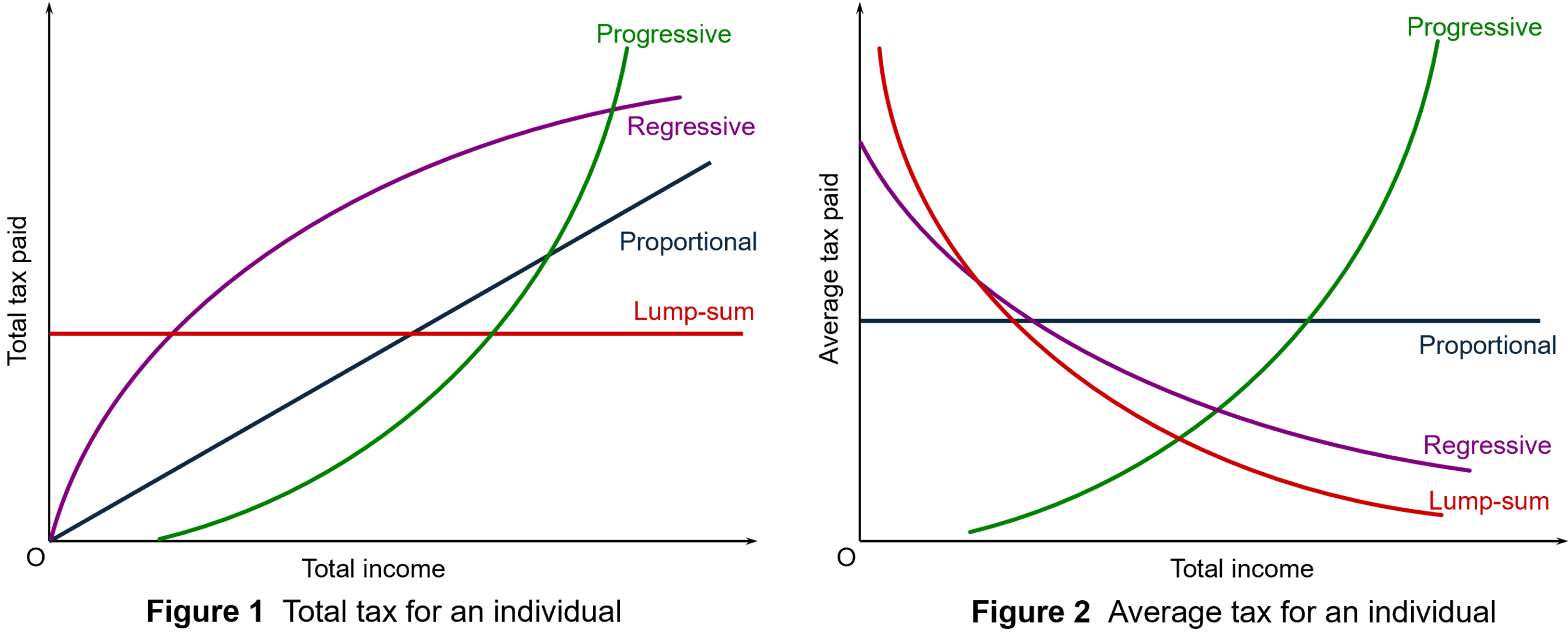
Figures 1 and 2 illustrate these different categories of tax: see Figure 11.12 in Economics, 12th edition. (Click here for a PowerPoint.) Income taxes in most countries are progressive, although just how progressive depends on the differences between the tax bands and the size of personal tax-free allowances. A flat-rate income tax with no allowances is shown by the black line in each diagram, the slope in Figure 1 and the height in Figure 2 depending on the tax rate.
Arguments for a flat-rate income tax
Generally, arguments in favour of flat-rate taxes come from the political right. The two main arguments in favour are tax simplification and incentives.
Advocates argue that a flat tax system makes tax collection easier and makes tax evasion harder. If there are no exemptions, then it can be easier to check that people are paying their taxes and working out the correct amount they owe. It is argued that, in contrast, high tax rates on top earners can encourage tax evasion.
Flat taxes can also be part of a drive to reduce the size of the informal economy. As the VoxEU article states:
Unlike progressive taxes, which include complex and numerous exceptions left to the tax collectors’ discretion, the flat tax is clear cut. In combination with the low rate, its simplicity considerably reduces the stimuli for being informal.
Several post-communist countries in Eastern Europe adopted flat taxes, but for most they were seen as a temporary measure to reduce the informal sector and clamp down on tax evasion. Most have now adopted progressive taxes, with the exceptions of Bulgaria and until recently Russia.
 The second major argument is that lower taxes for higher earners, especially for entrepreneurs, can act as a positive incentive. People work harder and there is more investment. The argument here is that the positive substitution effect from the lower tax (work is more profitable now and hence people substitute work for leisure) is greater than the negative income effect (lower taxes increase take-home pay so that people do not need to work so much now to maintain their standard of living).
Then there is the question of tax evasion. With high rates of income tax for top earners, such people may employ accountants to exploit tax loopholes and hide earnings. This could be seen as highly unfair by middle-income earners who are still paying relatively high rates of tax. Even though a move to flat taxes is likely to mean a cut in tax rates for high earners, the tax take from them could be higher. There is evidence that post-communist and developing countries that have adopted flat taxes have found an increase in tax revenues as evasion is harder.
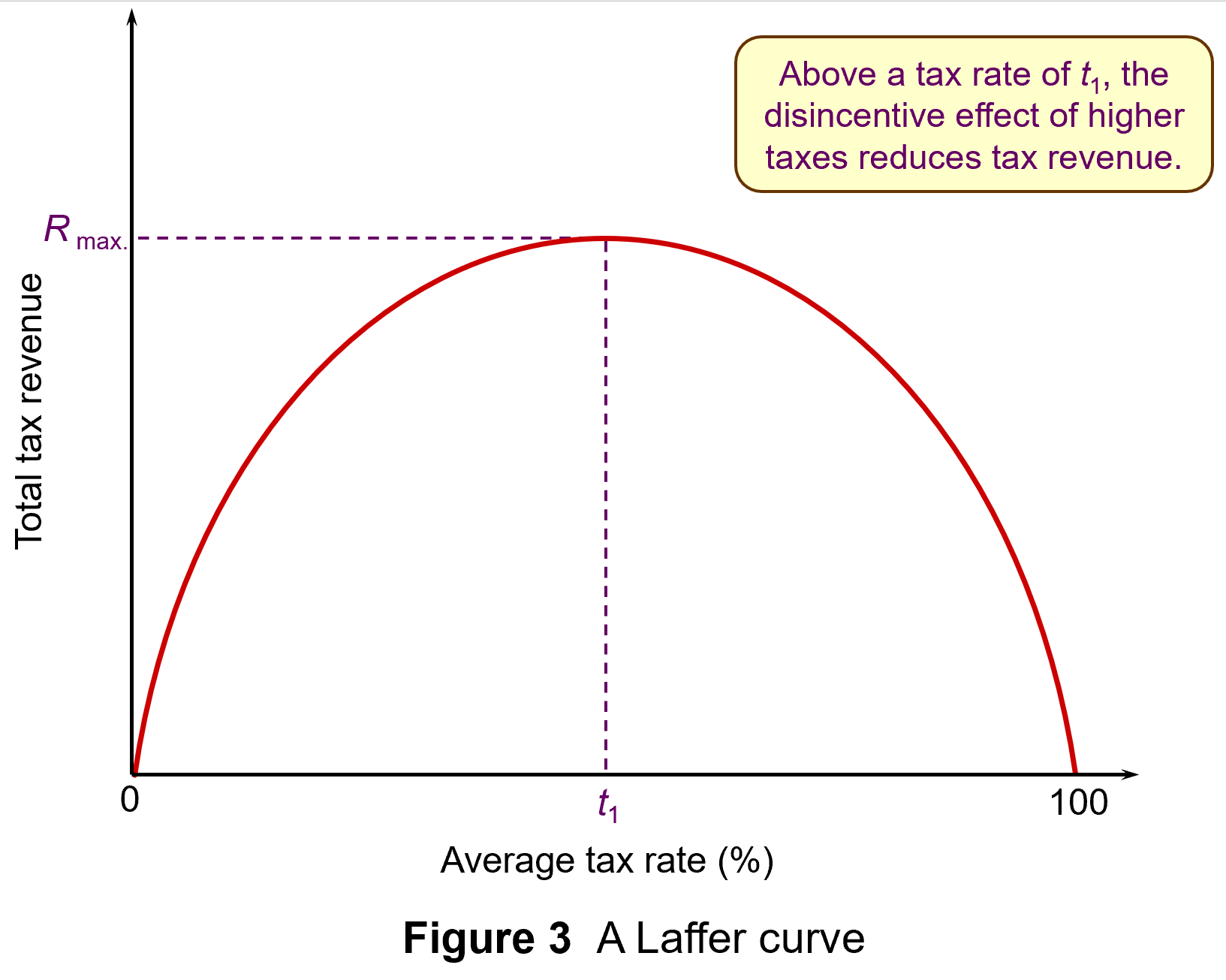 The Laffer curve is often used to illustrate such arguments that high top tax rates can lead to lower tax revenue. Professor Art Laffer was one of President Reagan’s advisers during his first administration (1981–4): see Box 11.3 in Economics, 11th edition. Laffer was a strong advocate of income tax cuts, arguing that substantial increases in output would result and that tax revenues could consequently increase.
The Laffer curve in Figure 3 shows tax revenues increasing as the tax rate increases – but only up to a certain tax rate (t1). Thereafter, tax rates become so high that the resulting fall in output more than offsets the rise in tax rate. When the tax rate reaches 100 per cent, the revenue will once more fall to zero, since no one will bother to work. (Click here for a PowerPoint)
However, as Box 11.3 explains, evidence suggests that tax rates in most countries were well below t1 in the 1980s and certainly are now, given the cuts in income tax rates that have been made around the world over the past 20 years.
Arguments against flat-rate income taxes
 The main argument against moving from a progressive to a flat-rate income tax in an advanced country, such as the UK, is that is would involve a large-scale redistribution of income from the poor to the rich. If the tax were designed to raise the same amount of revenue as at present, those on low incomes would pay more tax than now, as their tax rate would rise to the new flat rate. Those on high incomes would pay less tax, as their marginal rate would fall to the new flat rate.
If a new flat-rate tax in the UK also replaced national insurance contributions (NICs), then the effect would be less extreme as NICs are currently initially progressive, as there is a personal allowance before the 8% rate is applied (on incomes above £12 570 in 2024/25). But above a higher NI threshold (£50 270 in 2024/25), the marginal rate drops to 2%, making it a regressive tax beyond that level. Figure 4 shows tax and NI rates in England, Wales and Northern Ireland for 2024/25. (Click here for a PowerPoint.)
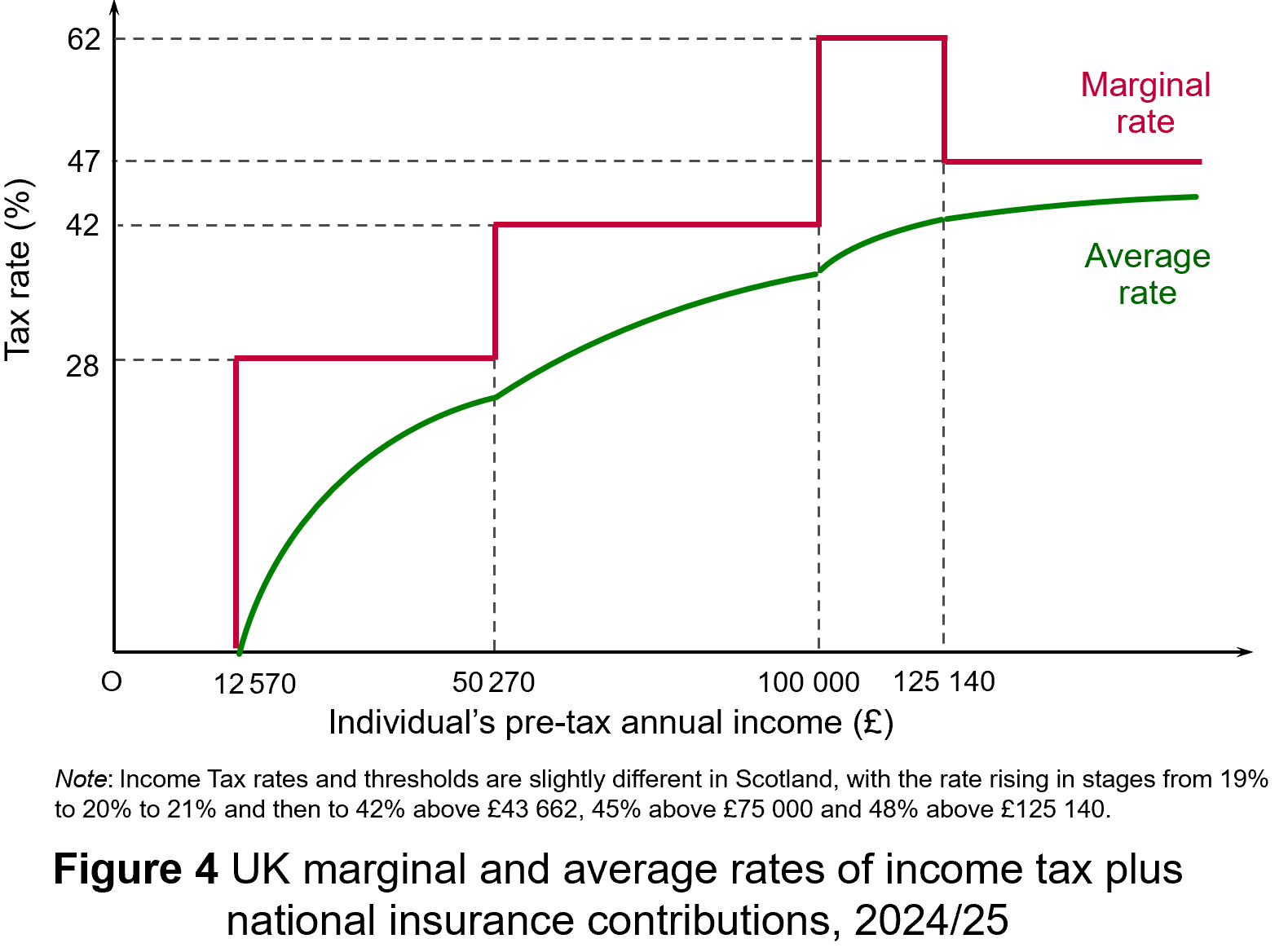 Nevertheless, even if a new flat-rate tax replaced NICs as well as varying rates of income tax, it would still involve a large-scale redistribution from low-income earners to high-income earners. The effect would be mitigated somewhat if personal allowances were raised so that the tax only applied to mid-to-higher incomes. Then the redistribution would be from middle-income earners to high-income earners and also somewhat to low-income earners: i.e. those below, or only a little above, the new higher personal allowance. If, on the other hand, personal allowances were scrapped so that the flat tax applied to all incomes, then there would be a massive redistribution from people on low incomes, including very low incomes, to those on high incomes.
 One of the arguments used to justify a flat-rate tax is that its simplicity would ensure greater compliance. But in an advanced country, compliance is high, except, perhaps, for those on very high incomes. Most people in the UK and many other countries, have tax deducted automatically from their wages. People cannot avoid such taxes.
As far as the self-employed are concerned, they file tax returns online and the software automatically works out the tax due. There are no complex calculations that have to be performed by the individual. There is come scope for tax evasion by charging various expenditures to the business that are really personal spending, but the tax authorities can ask for evidence and sometimes do, with penalties for false claims.
What tax evasion does take place, could still do so with a flat tax. At a rate of, say, 20%, it would still be financially beneficial for a dishonest person to lie if they could get way with it.
Conclusions
If the government did try to introduce a flat-rate income tax, there would probably be an outcry. Also, as some rich people would gain a very large amount of money, the number of people gaining would be lower than the number losing if the total revenue raised were to remain the same. In other words, it would be politically difficult to achieve if the number of losers exceeded the number of gainers.
It is true that if the top rate of income tax were very high, then reducing it might bring in more revenue. But at 45%, or 47% if you include NICs, the top marginal rate in the UK is relatively low compared with other countries. In 2024, the UK had the second lowest top rate of tax out of Western European countries (behind Norway and Switzerland) and only the 16th highest out of 33 European countries when Central and Eastern European countries are also included (see the final ink below under ‘Information’). Reducing the UK’s top rate would be unlikely to bring in more revenue and would redistribute income to high-income earners.
Articles
- Flat tax rate is an ‘attractive idea’, Kemi Badenoch says
The Guardian, Helena Horton (16/12/24)
- Tories could move to a system of ‘flat taxes’ where everyone pays the same rate, Kemi Badenoch indicates
Mail Online, Jason Groves (16/12/24)
- Flat Tax: What It Is and How It Works
Investopedia (8/11/24)
- Flat tax reform in Ukraine: Lessons from Bulgaria
VoxEU, Simeon Djankov (11/12/22)
- Why not… introduce a flat tax?
BBC News, Brian Wheeler (3/7/13)
- Five country cases illustrate how best to improve tax collection
IMF Finance and Development Magazine, Bernardin Akitoby (March 2018)
- Flat taxes and the desire to increase inequality
Funding the Future blog, Richard Murphy (15/5/14)
- Options for a UK ‘flat tax’: some simple simulations
IFS Briefing Note, Stuart Adam and James Browne (August 2006)
- Are the Flat Tax Folks Winning — or Have They Already Won?
Inequality.org, Sam Pizzigati (20/4/24)
Information
Questions
- Distinguish between progressive, proportional, regressive and lump-sum taxes. Into which of these four categories would you place (a) VAT, (b) motor fuel duties, (c) tobacco duties, (d) road-fund licence, (e) inheritance tax? Where the answer is either progressive or regressive, how progressive or regressive are they?
- What are the income and substitution effects of changing tax rates?
- Explain the Laffer curve and consider whether it is likely to be symmetrical.
- Discuss the desirability of having a flat tax set at a relatively high rate (say 25%) with tax-free personal allowances up to the level of income considered to be the poverty threshold. (In the UK the poverty threshold is often defined as 60% of median income.)
- In the London Palladium event where Kemi Badenoch stated that flat taxes were a very attractive idea, she also said that ‘We cannot afford flat taxes where we are now. We need to make sure we rewire our economy so that we can lighten the burden of tax and the regulation on individuals and on those businesses that are just starting out, in particular’. What do you think she meant by this?
- Find out what Bulgaria’s experience of a flat tax of 10% has been.