 Despite the prolonged stagnation in the UK, unemployment has not soared. In fact, over the past two years the ILO unemployment rate (see here for a definition) has fallen slightly – from 8.6% in October 2011 to around 8.0% today. What is more, the claimant count rate is considerably lower than the ILO rate – at around 4.4%.
Part of the reason for the relatively good unemployment figures is the rise in ‘zero-hours contracts’. These allow employers to cut the hours that people work without laying them off. The Office for National Statistics estimates that last year (2012) 250,000 people, or 0.84% of the workforce, were on such contracts.
But just what is meant by ‘zero-hours contracts’? According to the ONS:
People on zero-hours contracts are classified as being in employment regardless of the number of hours they actually worked during the survey reference week. This includes anyone who was not required to work any hours during the reference week whilst remaining on their current contract of employment. The continued existence of the contract of employment is the key determinant of their employment status in these situations.
If people are working less than they would like to, this is classified as underemployment, but such people do not appear in the unemployment statistics. Such contracts thus mask the true extent of surplus labour in the economy.
The Chartered Institute of Personnel and Development (CIPD) puts the figure much higher than the ONS. In the Summer 2013 issue of its Labour Market Outlook, it estimates that one million workers are on zero-hours contracts.
 Many employers use such contracts, including many voluntary-sector and public-sector organisations, including the NHS, local councils and Buckingham Palace. They are also used by many small and medium-sized enterprises and many well-known large companies, such as Sports Direct, Amazon, JD Wetherspoon and Cineworld. It gives them the flexibility to adjust the hours they employ people. It allows them to keep people in employment when demand is low. It also makes them more willing to take on staff when demand rises, as it removes the fear of being over-staffed if demand then falls back.
But many workers dislike such contracts, which give them fewer employment rights and fewer hours than they would like to work. It also makes it difficult to budget when future income is uncertain. It also make credit and mortgages harder to obtain, as people have no guaranteed income. Another complaint is that companies may use the threat of lower hours as a tool to bully staff and get away with poorer working conditions.
In May of this year, the Business Secretary, Vince Cable, announced that he was setting up a review of zero hours contracts.
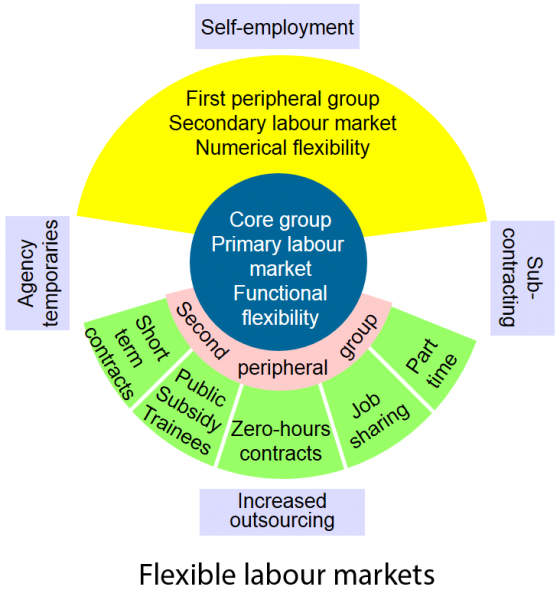 Note that zero hours are not the only form of flexible working. Other examples include: ‘self-employed’ workers, contracted separately for each job they do for a company; people paid largely or wholly on commission; on-call working; part-time working, where the hours are specified in advance, but where these are periodically re-negotiated; overtime; people producing a product or service for a company (perhaps at home), where the company varies the amount paid per unit according to market conditions.
The following videos and articles look at the issue in some detail: at the extent of the practice and at its benefits to employers and its costs (and some benefits) to workers. Both The Guardian and the BBC have an extensive range of articles on the topic.
Webcasts
 Do zero hours contracts create real jobs? BBC Newsnight, Allegra Stratton (14/8/12)
Record number of ‘Zero Hours Contracts’ ITV News on YouTube, Laura Kuenssberg (2/5/13)
Britons rally against ‘Zero Hour’ contracts Al Jazeera on YouTube (4/8/13)
Anger at Amazon working conditions Channel 4 News (1/8/13)
Government to include Amazon in its zero hours probe Channel 4 News (2/8/13)
Councils using zero hours contracts BBC London, Warren Nettleford (31/7/13)
Podcasts
The real economy: Labour market BBC Today Programme, Evan Davis (24/8/11)
Zero hour contracts ‘just the norm’ BBC Today Programme, Rochelle Monte and Peter Cheese (5/8/13)
Articles
Zero-hours contracts: One million British workers could be affected Independent, Nigel Morris (5/8/13)
Zero hours contracts “spreading like wildfire”, official stats show Union News, Pete Murray (1/8/13)
Zero-hours contracts: what are they? The Guardian, Phillip Inman (30/7/13)
Buckingham Palace uses zero-hours contracts for summer staff The Guardian, Simon Neville, Matthew Taylor and Phillip Inman (30/7/13)
Nick Clegg: business department will investigate zero-hours contracts The Guardian,
Patrick Wintour, Simon Neville, Matthew Taylor and Phillip Inman (31/7/13)
Zero-hours contracts are not unavoidable The Guardian, Phillip Inman (1/8/13)
ONS admits it underestimated number of zero-hours contracts The Guardian, Simon Neville (1/8/13)
Zero-hours contract workers – the new reserve army of labour? The Guardian, Philip Inman (4/8/13)
Zero-hours contracts cover more than 1m UK workers The Guardian, Simon Goodley and Phillip Inman (5/8/13)
Zero-hours contracts use by councils needs to be moderated The Guardian, Vidhya Alakeson (5/8/13)
If zero-hours contracts are driving this ‘recovery’, it’s a lousy kind of recover The Guardian, Deborah Orr (9/8/13)
ONS increases its estimate of workers on zero hours contracts Financial Times, John Aglionby (1/8/13)
Zero Hours Herald Scotland, Ian Bell and Scott Dickson (4/8/13)
Sports Direct protests planned over zero hours contracts Channel 4 News (3/8/13)
Cable warns of exploitation of zero-hours contracts BBC News (5/8/13)
Q&A: What are zero-hours contracts? BBC News (5/8/13)
Record number of 16-24s on zero hours contracts at work BBC Newsbeat, Jim Reed (15/5/13)
Figures show 18-24s most likely on zero-hours contract BBC Newsbeat, Jim Reed and Amelia Butterly (5/8/13)
Andy Burnham calls for ban on zero hours contracts BBC News (28/4/13)
Zero-hours contracts: What is it like living on one? BBC News, Sean Clare (5/8/13)
Small Talk: Zero-hours contracts? Key for growth Independent, David Prosser (5/8/13)
Zero Hour Contracts Manchester based law firm, Emma Cross (30/7/13)
Data
People and proportion in employment on a zero-hour contract ONS (31/7/13)
Estimating Zero-Hour Contracts from the Labour Force Survey ONS (26/7/13)
One million workers on zero hours contracts, finds CIPD study CIPD, Michelle Stevens (5/8/13)
Labour Market Outlook CIPD
Questions
- Distinguish between open unemployment, disguised unemployment and underemployment?
- Distinguish between functional, numerical and financial flexibility? Which type or types of flexibility do zero-hours contracts give the firm?
- Identify the various benefits to employers of zero-hours contracts?
- What are the costs and benefits to workers of such contracts?
- Identify what forms of flexible contracts are used for staff in your university or educational establishment. Do they benefit (a) staff; (b) students?
- Are zero-hours contracts fair?
- In what ways do zero-hours contracts transfer risks from employers to employees?
- If a company introduces a system of zero-hours contracts, is this in accordance with the marginal productivity theory of profit maximisation from employment?
- From the perspective of the employer, how do the benefits of zero-hours contracts compare with other forms of flexible working?
- Consider the arguments for and against (a) banning and (b) regulating zero-hours contracts.
 The Preliminary Estimate of the UK Q2 GDP figures by the Office for National Statistics show that the UK economy grew by 0.6% in the second quarter of 2013: double the growth rate of the first quarter and almost back to the long-run average growth rate prior to 2008.
At first sight, this would seem to be good news – certainly from the government’s point of view. What is more, unlike the previous quarter, growth is spread relatively evenly across the three main sectors: the production (manufacturing, mining, water supply, etc.) and services sectors both grew by 0.6% and the construction sector by 0.9% (this sector fell by 1.8% in the previous quarter). (Click here for a PowerPoint of the chart below.)
 But while growth in the latest quarter may be balanced between the broad sectors, the rise in aggregate demand is not balanced between its components. As an earlier news item (A balancing act) showed, the rise in aggregate demand has been driven largely by a rise in consumption, and a corresponding fall in saving. Exports are rising only slowly and investment is some 25% lower than in the boom years prior to 2008.
So will the latest growth be sustainable? Will investment now begin to pick up and what constraints are there on investment? The following articles consider some of the issues.
Articles
Economy firing on all cylinders as growth hits 0.6pc The Telegraph, Philip Aldrick (25/7/13)
The good, the bad or the ugly? How the UK economy stands up. The Telegraph, Philip Aldrick (25/7/13)
George Osborne’s 0.6% growth is good but unspectacular The Guardian, Larry Elliott (25/7/13)
The (not-so) green shoots of recovery The Economist, John Van Reenen (23/7/13)
Economic recovery slow to take root for some in UK Reuters, William Schomberg and Max De Haldevang (25/7/13)
GDP figures offer hard evidence for political narrative BBC News, Paul Mason (25/7/13)
Ignore the hype: Britain’s ‘recovery’ is a fantasy that hides our weakness The Observer, Will Hutton (21/7/13)
UK economy: Half-speed ahead BBC News, Stephanie Flanders (25/7/13)
BoE guidance can help sustain the UK recovery The Economist, Kevin Daly (22/7/13)
George Osborne’s description of the economy is near-Orwellian The Guardian, Ha-Joon Chang (26/7/13)
Economic growth: more must be done to encourage investment The Guardian, Phillip Inman (1/8/13)
Data
Gross Domestic Product: Preliminary Estimate, Q2 2013 ONS (25/7/13)
Questions
- Compare the macroeconomic situation today with that prior to the financial crisis of 2007/8 and subsequent recession.
- What factors will determine the sustainability of the UK economic recovery?
- What is meant by the ‘accelerator’ and what will determine the size of any accelerator effect from the latest rise in UK GDP?
- What supply-side constraints are likely to limit the rate and extent of recovery?
- Why do economies that are in recession ‘naturally bounce back’ without any government intervention? Have the macroeconomic policies of the UK government helped or hindered this bounce back? Explain.
- What monetary measures by the Bank of England are most appropriate in the current circumstances?
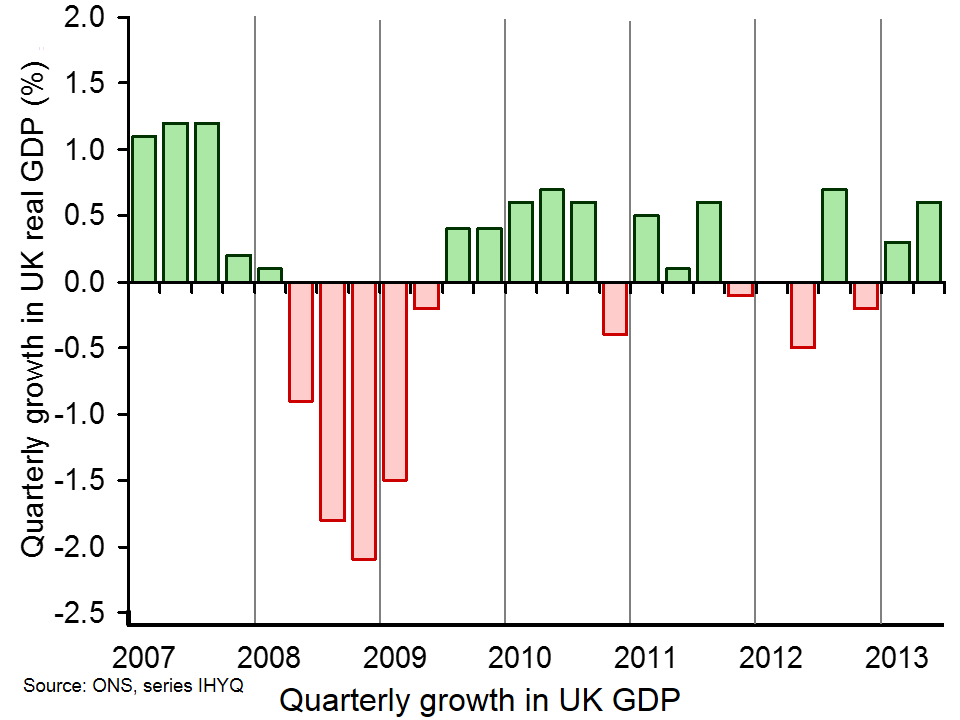
 One very important characteristic of economic growth is its short-term volatility. Economic activity is notoriously volatile. It is such a fundamental idea that economists refer to it as one of their threshold concepts. The volatility of growth sees occasional recessions. The traditional definition is where real GDP (output) declines for 2 or more consecutive quarters. The latest figures from the Quarterly National Accounts call into question whether the UK technically experienced a recession at the start of 2012 with output broadly flat in 2012 Q1 following a contraction of 0.1 per cent in 2011 Q4.
The ONS’s latest output numbers raise some interesting questions around our understanding of what constitutes a recession. These figures show that the 2008/9 recession was deeper than first thought with output declining by 7.2 per cent. They show that UK output peaked in 2008Q1 (£392.786 billion at 2010 prices). There then followed 6 quarters where output declined.
Output declined again in 2010 Q4 (–0.2% growth) and again in 2011 Q4 (–0.1% growth). But then interpretations of the data become more controversial. Not least, we get in the debates concerning the accuracy with which we can expect to measure the size of the economy and so to how many decimal places one should realistically measure a rise or fall. In terms of the raw real GDP numbers output fell in 2012 Q1. In 2011 Q4 GDP is estimated at £376,462 billion (at 2010 prices) ‘falling’ to £376,436 billion (at 2010 prices) in 2012 Q1. But, this is a percentage fall only when measured to the third decimal place (–0.007% growth).
In its publication Impact of changes in the National Accounts and economic commentary for Q1 2013 the ONS argue that:
While some commentators may attempt to read some significance into this revision, particularly in the context of whether the UK experienced a “double-dip” recession, it is clearly absurd to imagine that it is possible to measure the size of the economy to this degree of accuracy. The best interpretation of the Blue Book figures is that the economy was flat in the first quarter of 2012, and 0.6% larger than in the same quarter of 2011.
It is however understandable that those with vested interests – including economists, policy-makers and politicians – will take a slightly different view and will read more into the figures than perhaps an objective, sober view might demand. What appears more certain is that output did again fall in 2012 Q2 (–0.5 per cent growth) and in 2012 Q4 (–0.2 per cent growth). Despite estimated growth of 0.3 per cent in 2013 Q1, output remains 3.9 per cent lower than at its 2008 Q1 peak.
Perhaps the ‘absurdity’ or not around the debate of a double-dip recessions strengthens the argument for a more holistic and considered view of what constitutes a recession. In the USA the wonderfully-named Business Cycle Dating Committee takes a less fixed view of economic activity and, hence, of recessions. Its website argues:
It (the Committee) examines and compares the behavior of various measures of broad activity: real GDP measured on the product and income sides, economy-wide employment, and real income. The Committee also may consider indicators that do not cover the entire economy, such as real sales and the Federal Reserve’s index of industrial production (IP).
Of course, the advantage of focusing on real GDP alone in measuring activity and in determining recessions is that it is usually very straightforward to interpret. Regardless of whether the UK has experienced or not two recessions in close proximity, our chart helps to put the recent growth numbers into an historical context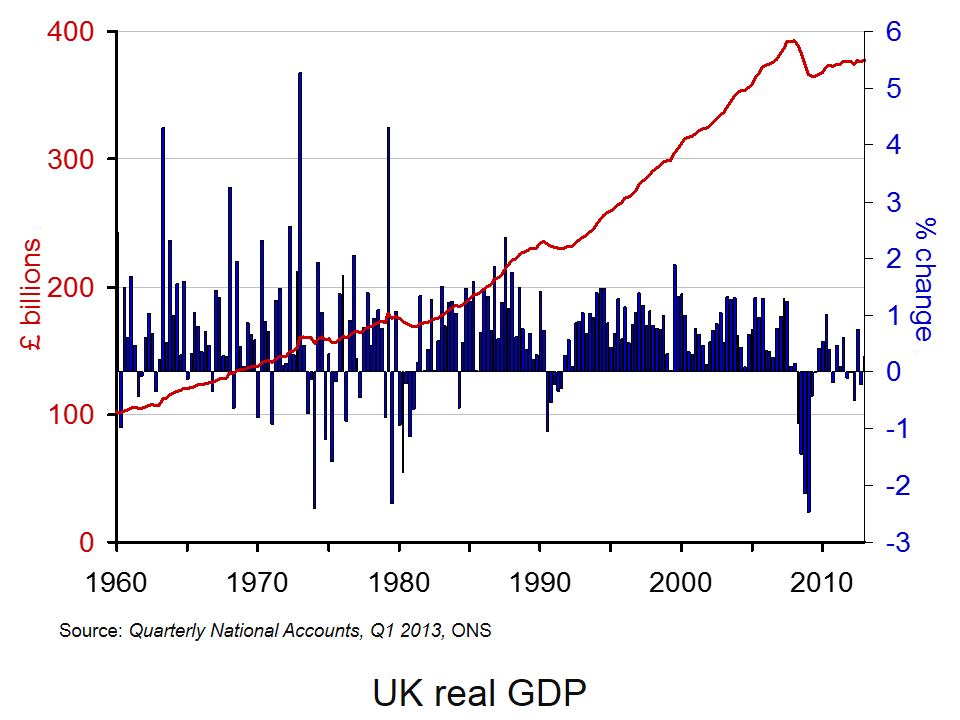 . It shows both the quarter-to-quarter changes in real GDP (left-hand axis) and the level of output as measured by GDP at constant 2010 prices (right-hand axis). Click here to download the chart to PowerPoint.
The chart captures nicely the twin characteristics of growth. Since 1960, the average rate of growth per quarter has been 0.63 per cent. This is equivalent to an average rate of growth of 2.55 per cent per year. Since 2008 Q2, quarterly growth has averaged –0.19 per cent which is equivalent to an annual rate of growth of –0.78 per cent! In any language these are extraordinary numbers. Indeed, one could argue that focusing any policy debate around whether or not the UK experienced a double-dip recession rather misses the more general point concerning the absense of any sustained economic growth since 2008.
Data
Quarterly National Accounts Time Series Dataset Q1 2013 Office for National StatisticsStatistical Bulletin: Quarterly National Accounts Q1 2013 Office for National Statistics
Articles
UK avoided double-dip recession in 2011, revised official data shows Guardian, Phillip Inman (27/6/13)
Britain’s double dip recession revised away, but picture still grim Reuters, David Milliken and William Schomberg (27/6/13)
UK double-dip recession revised away BBC News (27/6/13)
IMF raises UK economic growth forecast BBC News (9/7/13)
IMF raises UK economic growth forecast to 0.9% but cuts prediction for global growth Independent, Holly Williams (9/7/13)
IMF Upgrades UK Growth Forecast For 2013 Sky News (9/7/13)
Questions
- What is the difference between nominal and real GDP? Which of these helps to track changes in economic output?
- Looking at the chart above, summarise the key patterns in real GDP since the 1960s.
- What is a recession? What is a double-dip recession?
- What are some of the problems with the traditional definition of a recession?
- Explain the arguments for and against the proposition that the UK has recently experienced a double-dip recession.
- Can a recession occur if nominal GDP is actually rising? Explain your answer.
- What factors might result in economic growth being so variable?
- Produce a short briefing paper exploring the prospects for economic growth in the UK over the next 12 to 18 months.
 In the blogs The capital adequacy of UK banks and A co-operative or a plc? we focus on how British banks continue to look to repair their balance sheets. To do so, banks need to ‘re-balance’ their balance sheets. This may involve them holding more reserves and equity capital and/or a less risky and more liquid profile of assets. The objective is to make banks more resilient to shocks and less susceptible to financial distress.
This will take time and even then the behaviour of banks ought to look like quite different from that before the financial crisis. All of this means that we will need to learn to live with new banking norms which could have fundamental consequences for economic behaviour and activity.
The increasing importance of financial institutions to economic activity is known as financialisation. It is not perhaps the nicest word, but, in one way or another, we all experience it. I am writing this blog in a coffee shop in Leicester having paid for my coffee and croissant by a debit card. I take it for granted that I can use electronic money in this way. Later I am going shopping and I will perhaps use my credit card. I take this short term credit for granted too. On walking down from Leicester railway station to the coffee shop I walked past several estate agents advertising properties for sale. The potential buyers are likely to need a mortgage. In town, there are several construction sites as Leicester’s regeneration continues. These projects need financing and such projects often depend on loans secured from financial institutions.
 We should not perhaps expect economic relationships to look as they did before the financial crisis. The chart shows how levels of net lending by financial institutions to households have dramatically fallen since the financial crisis. (Click here for PowerPoint of chart.)
Net lending measures the amount of lending by financial institutions after deducting repayments. These dramatically smaller flows of credit do matter for the economy and they do affect important macroeconomic relationships.
Consider the consumption function. The consumption function is a model of the determinants of consumer spending. It is conventional wisdom that if we measure the growth of consumer spending over any reasonably long period of time it will basically reflect the growth in disposable income. This is less true in the short run and this is largely because of the financial system. We use the financial system to borrow and to save. It allow us to smooth our consumption profile making spending rather less variable. We can save during periods when income growth is strong and borrow when income growth is weak or income levels are actually falling. All of this means that in the short term consumption is less sensitive to changes in disposable income that it would otherwise be.
 The financial crisis means new norms for the banking system and, hence, for the economy. One manifestation of this is that credit is much harder to come by. In terms of our consumption function this might mean consumption being more sensitive to income changes that it would otherwise be. In other words, consumption is potentially more volatile as a result of the financial crisis. But, the point is more general. All spending activity, whether by households or firms, is likely to be more sensitive to economic and financial conditions than before. For example, firms’ capital spending will be more sensitive to their current financial health and crucially to their flows of profits.
We can expect particular markets and sectors to be especially affected by new financial norms. An obvious example is the housing market which is very closely tied to the mortgage market. But, any market or sector that traditionally is dependent on financial institutions for finance will be affected. This may include, for example, small and medium-sized enterprises or perhaps organsiations that invest heavily in R&D. It is my view that economists are still struggling to understand what the financial crisis means for the economy, for particular sectors of the economy and for the determination of key economic relationships, such as consumer spending and capital spending. What is for sure, is that these are incredibly exciting times to study economics and to be an economist.
Data
Statistical Interactive Database Bank of England
Articles
Cut in net lending to non-financial firms raises credit worries Herald Scotland, Mark Williamson (25/5/13)
Loans to business continue to shrink despite Funding for Lending Scheme Wales Online, Chris Kelsey (3/6/13)
Factbox – Capital shortfalls for five UK banks, mutuals Standard Chartered News (20/6/13)
UK banks ordered to plug £27.1bn capital shortfall The Guardian, Jill Treanor (20/6/13)
Barclays, Co-op, Nationwide, RBS and Lloyds responsible for higher-than-expected capital shortfall of £27.1bn The Telegraph, Harry Wilson (20/6/13)
UK banks need to plug £27bn capital hole, says PRA BBC News (20/6/13)
Barclays and Nationwide forced to strengthen BBC News, Robert Peston (20/6/13)
Five Banks Must Raise $21 Billion in Fresh Capital: BOE Bloomberg, Ben Moshinsky (20/6/13)
Co-operative Bank to list on stock market in rescue deal The Guardian, Jill Treanor (17/6/13)
Troubled Co-operative Bank unveils rescue plan to plug £1.5bn hole in balance sheet Independent, Nick Goodway (17/6/13)
Co-op Bank announces plan to plug £1.5bn hole Which?(17/6/13)
The Co-operative Bank and the challenge of finding co-op capital The Guardian, Andrew Bibby (13/6/13)
Co-op Bank seeks to fill £1.5bn capital hole Sky News (17/6/13)
Central banks told to head for exit Financial Times, Claire Jones (23/6/13)
Stimulating growth threatens stability, central banks warn The Guardian (23/6/13)
BIS Press Release and Report
Making the most of borrowed time: repair and reform the only way to growth, says BIS in 83rd Annual Report BIS Press Release (23/6/13)
83rd BIS Annual Report 2012/2013 Bank for International Settlements (23/6/13)
Questions
- What is meant by equity capital?
- How can banks increase the liquidity of their assets?
- Explain how Basel III is intended to increase the financial resilence of banks.
- What do you understand by the term ‘financialisation’? Use examples to illustrate this concept.
- How might we expect the financial crisis to affect the detemination of spending by economic agents?
- Using an appropriate diagram, explain how a reduction in capital spending could affect economic activity? Would this be just a short-term effect?
- What does it mean if we describe households as consumption-smoothers? How can households smooth their spending?
 When you are next in town shopping, just keep in mind that consumer spending accounts for a little over 60 per cent of GDP. Therefore, consumption is incredibly important to the economy. How consumers behave is crucial to our short-term economic growth. The second estimate of British growth from the Office for National Statistics shows that the economy expanded by 0.3 per cent in the first three months of 2013. This follows a 0.3 per cent decline in the final quarter of 2012. Real household expenditure rose by just 0.1 per cent in Q1 2013. However, this was the sixth consecutive quarter in which the volume of purchases by households has grown.
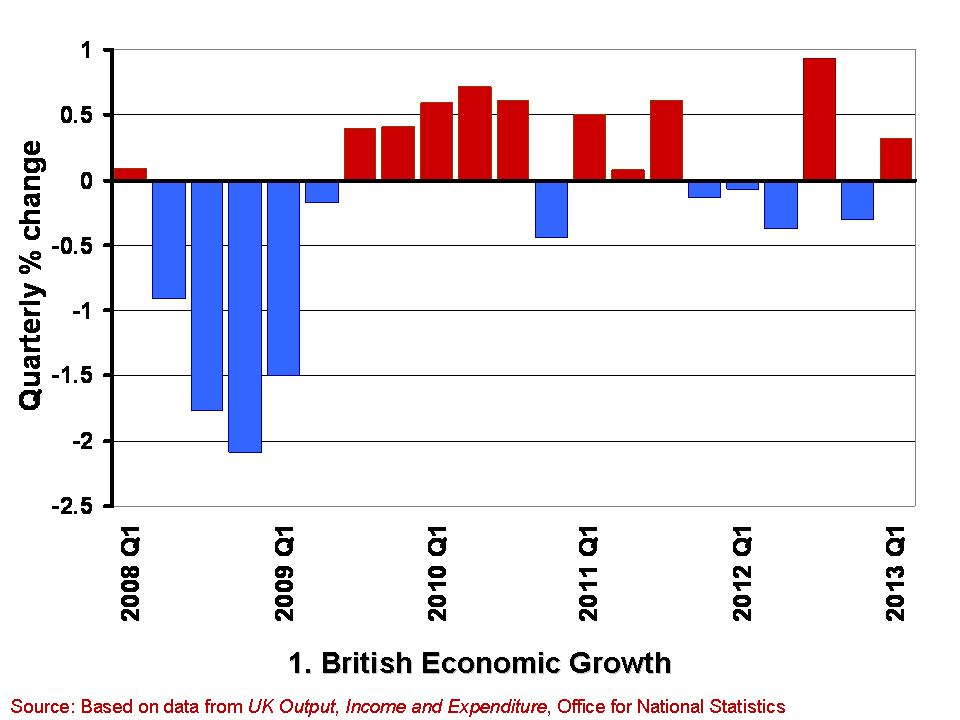 The growth in the economy is measured by changes in real GDP. Chart 1 shows the quarter-to-quarter change in real GDP since Q1 2008. (Click here to download a PowerPoint of the chart). During this period the economy is thought to have contracted in 10 of the 21 quarters shown. Furthermore, they show a double-dip recession and so two periods in close proximity where output shrank for two or more quarters. While more recent output numbers are frequently revised, which could see the double-dip recession possibly ‘statistically wiped’ from history, the period since 2008 will always been one characterised by anemic growth. The average quarterly growth rate since Q1 2008 has been -0.12 per cent.
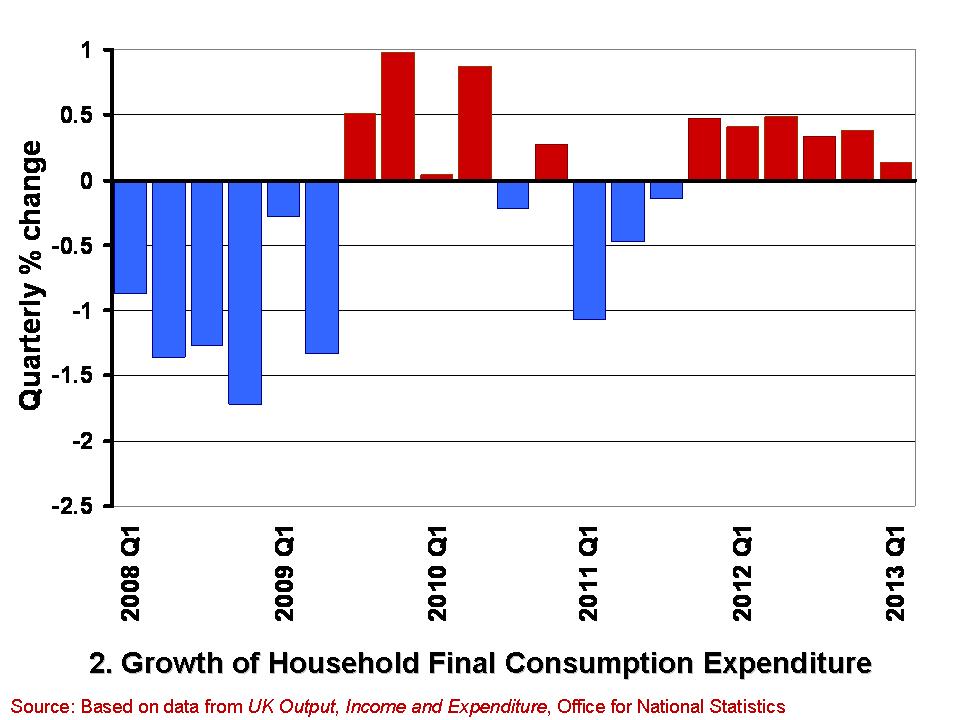 Chart 2 shows from Q1 2008 the quarterly growth in household expenditure in real terms, i.e. after stripping the effect of consumer price inflation. (Click here for a PowerPoint of the chart). Over the period, the volume of household consumption has typically fallen by 0.18 per cent per quarter. Hence, consumption has feared a little worse than the economy has a whole.
While the annualised rate of growth for the economy since Q1 2008 has averaged -0.47 per cent that for consumer spending has averaged -0.73 per cent. However, these figures disguise a recent improvement in consumer spending growth. This is because the volume of consumption has in fact grown in each of the six quarters since Q4 2011. In contrast, the economy has grown in only 2 of these quarters. It is, of course, much too early to start trumpeting consumption growth has heralding better times, not least because the 0.1 per cent growth in Q1 2013 is the weakest number since positive consumption growth resumed at the back end of 2011. Nonetheless, the figures do deserve some analysis by economists to understand what is going on.
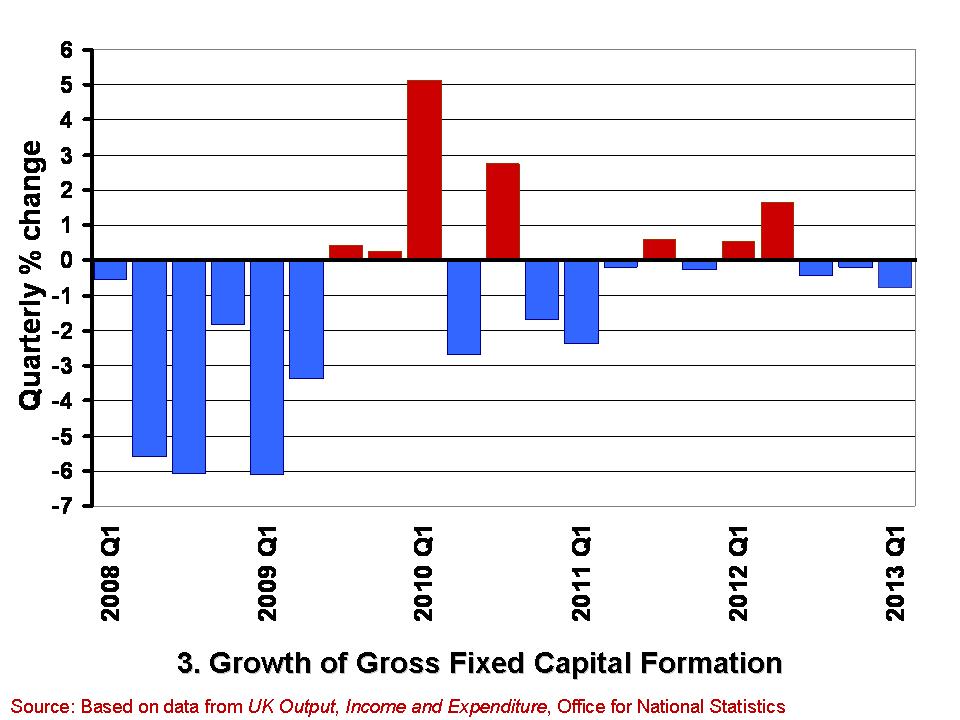 A slightly less promising note is struck by the gross fixed capital formation (GFCF) numbers. These numbers relate to the volume of investment in non-financial fixed assets, such as machinery, buildings, office space and fixtures and fittings. Chart 3 shows the quarterly growth in the volume of GFCF since Q1 2008. (Click here for a PowerPoint of the chart). The average quarterly rate of growth over this period has been -0.77 per cent. This is equivalent to an annual rate of decline of 3.9 per cent. GFCF has risen in only 7 of these quarters, declining in the remaining 14 quarters.
Worryingly, gross fixed capital formation has decreased in each of the last three quarters. While these figures may reflect continuing difficulties encountered by businesses in obtaining finance, they may also point to lingering concerns within the business community about the prospects for sustained growth. Therefore, it is important for economists to try and understand the drivers of these disappointing investment numbers and, hence, whether it is these or the slightly better consumption numbers that best hint at our short-term economic prospects.
Data
Second estimate of GDP, Q1 2013 Office for National Statistics
Second Estimate of GDP, Q1 2013 Dataset Office for National Statistics
Articles
UK GDP: concerns about underlying economy as 0.3pc growth confirmed Telegraph, Philip Aldrick (23/5/13)
UK investment fall among worst in G8 Guardian, Phillip Inman (23/5/13)
UK first-quarter growth unchanged BBC News (28/5/13)
U.K. Economy Grows 0.3% on Inventories, Consumer Spending Bloomberg, Svenja O’Donnell (23/5/13)
Surge in consumer spending kept UK out of recession The Telegraph (28/5/13)
Boost in service sector activity The Herald, Greig Cameron (28/5/13)
Hopes dashed as household spending rises by just 0.1% The Herald, Ian McConnell (24/5/13)
Questions
- Why do we typically focus on real GDP rather than nominal GDP when analysing economic growth?
- What is meant by aggregate demand? Of what importance is consumer spending to aggregate demand?
- Why might the patterns we observe in consumer spending differ from those in other components of aggregate demand?
- What factors might influence the determination of consumer spending?
- What do you understand by gross fixed capital formation? What factors might help to explain how its level is determined?
- Of what significance is gross fixed capital formation for aggregate demand and for aggregate supply?
- What is a recession? What is a double-dip recession?
- What data would you need to collect to identify a recession?
 Despite the prolonged stagnation in the UK, unemployment has not soared. In fact, over the past two years the ILO unemployment rate (see here for a definition) has fallen slightly – from 8.6% in October 2011 to around 8.0% today. What is more, the claimant count rate is considerably lower than the ILO rate – at around 4.4%.
 Many employers use such contracts, including many voluntary-sector and public-sector organisations, including the NHS, local councils and Buckingham Palace. They are also used by many small and medium-sized enterprises and many well-known large companies, such as Sports Direct, Amazon, JD Wetherspoon and Cineworld. It gives them the flexibility to adjust the hours they employ people. It allows them to keep people in employment when demand is low. It also makes them more willing to take on staff when demand rises, as it removes the fear of being over-staffed if demand then falls back.
 Note that zero hours are not the only form of flexible working. Other examples include: ‘self-employed’ workers, contracted separately for each job they do for a company; people paid largely or wholly on commission; on-call working; part-time working, where the hours are specified in advance, but where these are periodically re-negotiated; overtime; people producing a product or service for a company (perhaps at home), where the company varies the amount paid per unit according to market conditions.