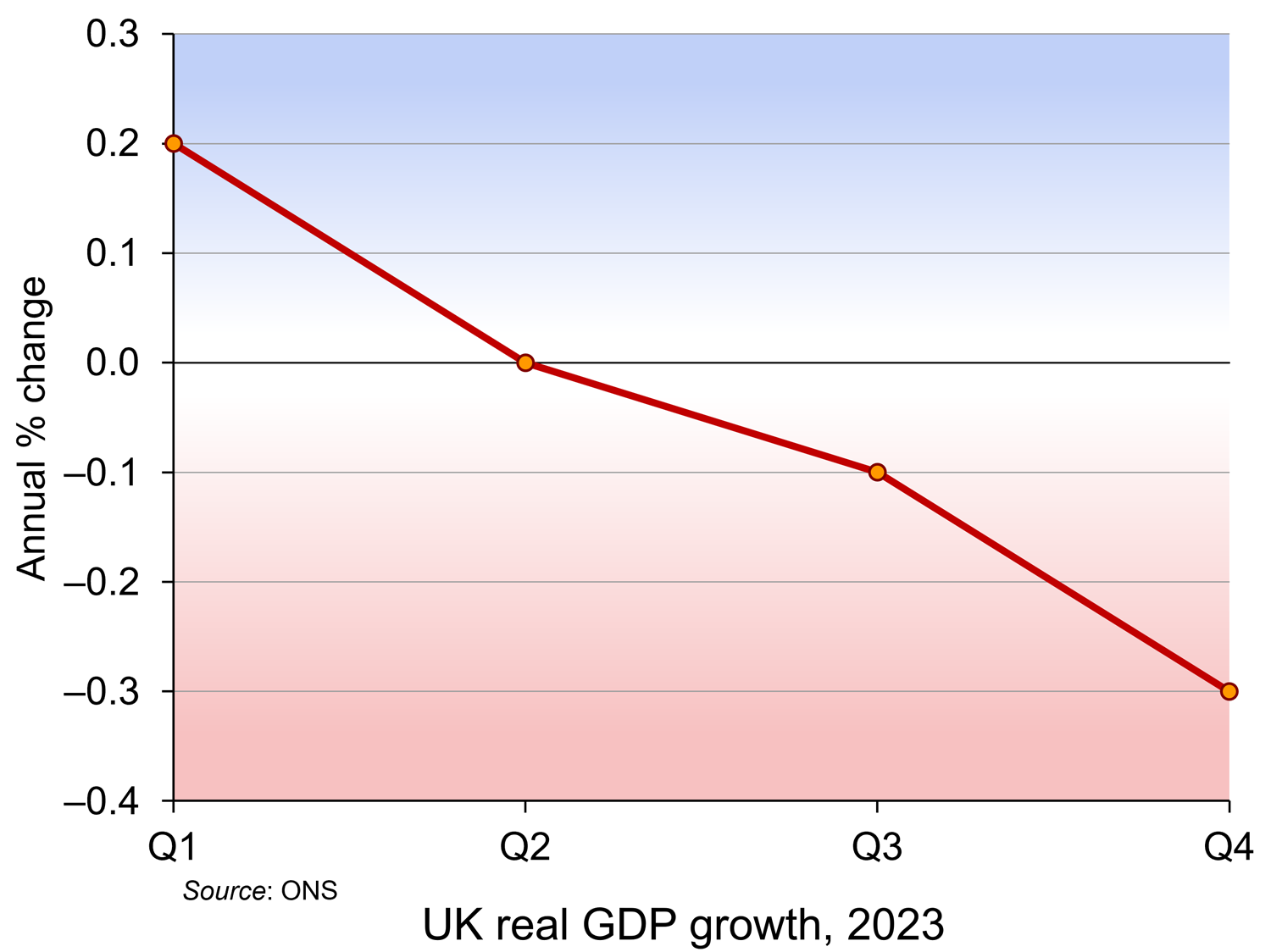
 Latest figures from the Office for National Statistics show that the UK was in recession at the end of 2023. The normal definition of recession is two quarters of falling real GDP. This is what happened to the UK in the last two quarters of 2023, with GDP falling by 0.1% in Q3 and 0.3% in Q4. In Q4, output of the service industries fell by 0.2%, production industries by 1.0% and construction by 1.3%.
But how bad is this? What are the implications for living standards? In some respects, the news is not as bad as the term ‘recession’ might suggest. In other respects, it’s worse than the headline figures might imply.
The good news (or not such bad news)
The first thing to note is that other countries too experienced a recession or slowdown in the second half of 2023. So, relative to these countries, the UK is not performing that badly. Japan, for example, also experienced a mild recession; Germany just missed one. These poor economic growth rates were caused largely by higher global energy and food prices and by higher central bank interest rates in response. The good news is that such cost pressures are already easing.
The second piece of good news is that GDP is expected to start growing again (modestly) in 2024. This will be helped by the Bank of England cutting interest rates. The Monetary Policy Committee is expected to do this at its May, June or August meetings provided that inflation falls. Annual CPI inflation was 4% in January – the same as in December. But it is expected to fall quite rapidly over the coming months provided that there are no serious supply-side shocks (e.g. from world political factors).
The third is that the recession is relatively modest compared with ones in the past. In the recession following the financial crisis, real GDP fell by 5.3% in 2009; during the pandemic, GDP fell by 10.7% in 2020. For this reason, some commentators have said that the last two quarters of 2023 represent a mere ‘technical recession’, with the economy expected to grow again in 2024.
Why things may be worse than the headline figures suggest
Real GDP per head
So far we have considered real GDP (i.e. GDP adjusted for inflation). But if changes in GDP are to reflect changes in living standards, we need to consider real GDP per head. Population is rising. This means that the rate of growth in real GDP per head is lower than the rate of growth in real GDP
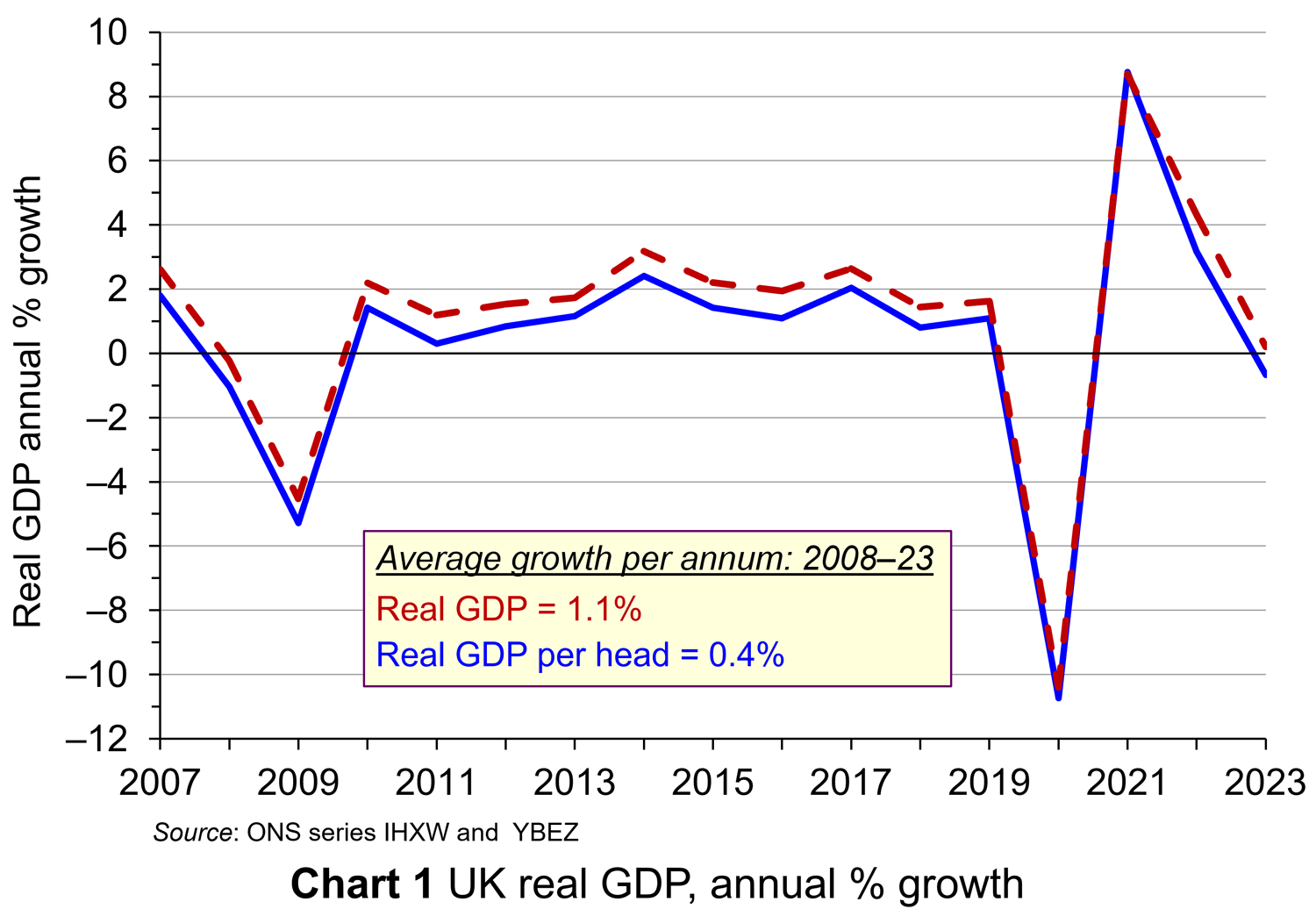 For 2023 as a whole, while real GDP rose by 0.20%, real GDP per head fell by 0.67%. In the last two quarters of 2023, while real GDP fell by 0.1% and 0.3% respectively, real GDP per head fell by 0.4% and 0.6%, respectively, having already fallen in each of the previous five quarters. Chart 1 shows real GDP growth and real GDP growth per head from 2007 to 2023 (click here for a PowerPoint). As you can see, given population growth, real GDP per head has consistently grown slower than real GDP.
Long-term trends.
If we are assessing the UK’s potential for growth in GDP, rather than the immediate past, it is useful to look at GDP growth over a longer period. Looking at past trend growth rates and explaining them can give us an indication of the likely future path of the growth in GDP – at least in the absence of a significant change in underlying economic factors. Since 2007, the average annual rate of growth of real GDP has been only 1.1% and that of real GDP per head a mere 0.4%.
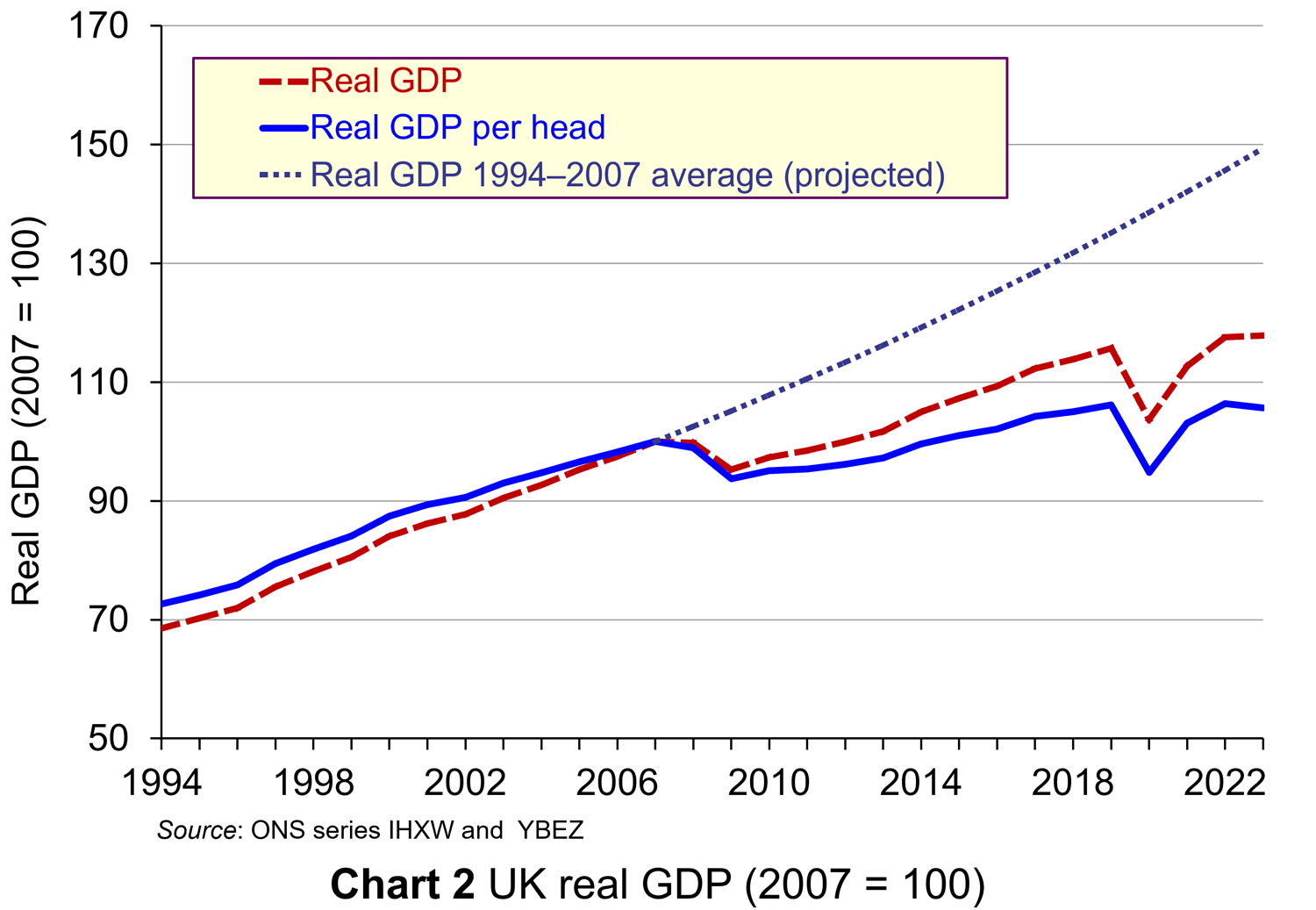 This compares unfavourably with the period from 1994 to 2007, when the average annual rate of growth of real GDP was 3.0% and that of real GDP per head was 2.5%.
This is illustrated in Chart 2 (click here for a PowerPoint). The chart also projects the growth rate in GDP per head of 2.5% forward from 2007 to 2023. Had this growth rate been achieved since 2007, GDP per head in 2023 would have been 41.4% higher than it actually was.
It is not only the UK that has seen low growth over the past 15 years compared to previous years. It has achieved a similar average annual growth rate over the period to Germany (1.1%), lower rates than the USA (1.8%) and Canada (1.6%), but higher than France (0.9%) and Japan (0.4%).
Low investment
A key determinant of economic growth is investment. Since 2008, the UK has invested an average of 17.3% of GDP. This is the lowest of the G7 countries and compares with 24.9% in Japan, 23.7% in Canada, 23.5% in France, 21.3% in Germany, 20.4% in the USA and 19.1% in Italy. If UK growth is to recover strongly over the longer term, the rate of investment needs to increase, both private and public. Of course, investment has to be productive, as the key underlying determinant of economic growth is the growth in productivity.
Low productivity growth
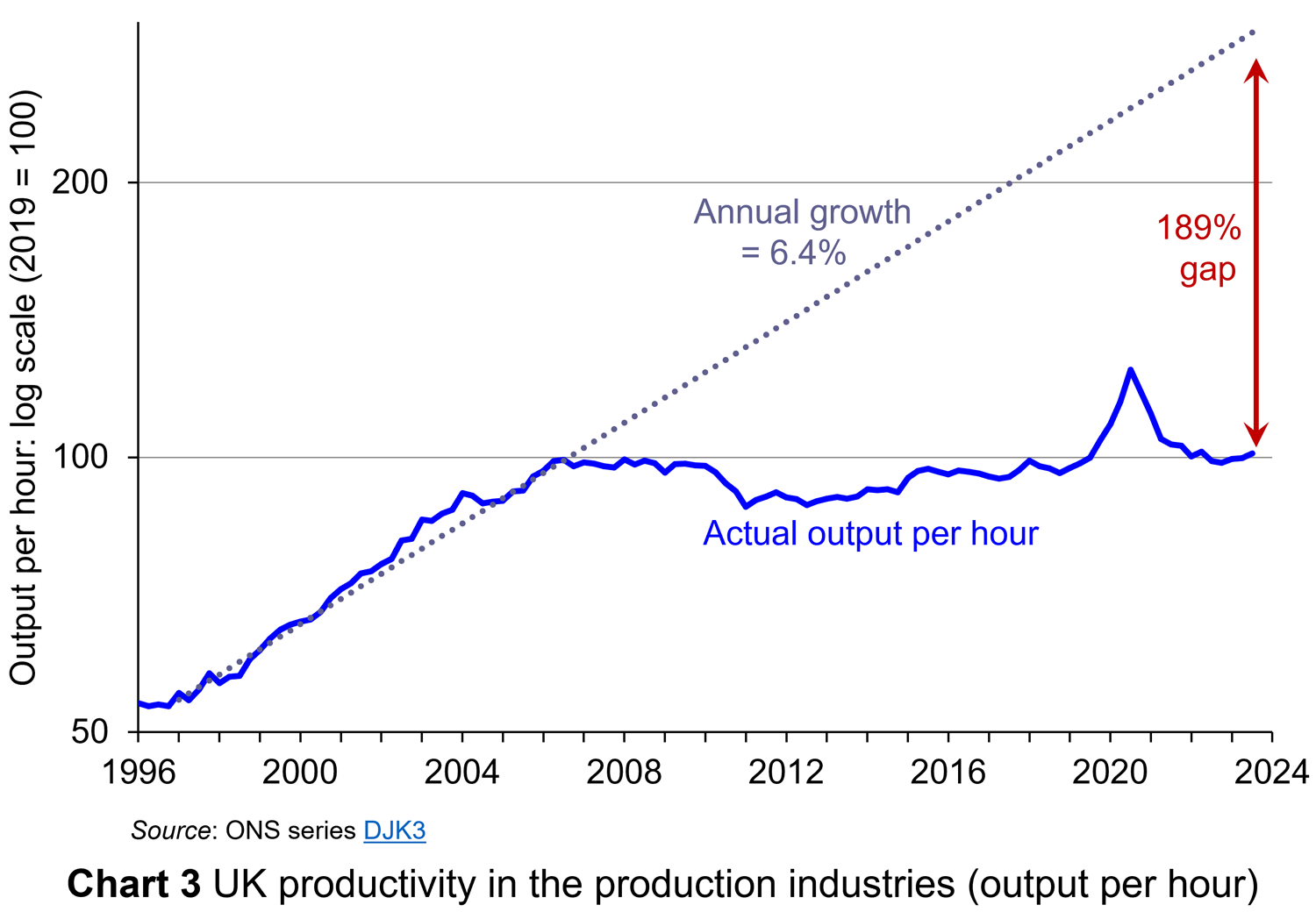 This is a key issue for the government – how to encourage a growth in productivity. The UK’s record of productivity growth has been poor since 2008. The period from 1996 to 2006 saw an average annual growth in labour productivity of 6.4%. Since then, however, labour productivity has grown by an average annual rate of only 0.3%. This is illustrated in Chart 3 (click here for a PowerPoint). If the pre-2007 rate had continued to the end of 2023, labour productivity would be 189% higher. This would have made GDP per head today substantially higher. If GDP per head is to grow faster, then the underlying issue of a poor growth in labour productivity will need to be addressed.
Inequality and poverty
Then there is the issue of the distribution of national income. The UK has a high level of income inequality. In 2022 (the latest data available), the disposable income of the poorest 20% of households was £13 218; that for the richest 20% was £83 687.  The top 1% of income earners’ share of disposable income is just under 9.0%. (Note that disposable income is after income taxes have been deducted and includes cash benefits and is thus more equally distributed than original income.)
The poorest 20% have been hit badly by the cost-of-living crisis, with many having to turn to food banks and not being able to afford to heat their homes adequately. They are also particularly badly affected by the housing crisis, with soaring and increasingly unaffordable rents. Many are facing eviction and others live in poor quality accommodation. Simple growth rates in real GDP do not capture such issues.
Limited scope for growth policies
Fiscal policy has an important role in stimulating growth. Conservatives stress tax cuts as a means of incentivising entrepreneurs and workers. Labour stresses the importance of public investment in infrastructure, health, education and training. Either way, such stimulus policy requires financing.
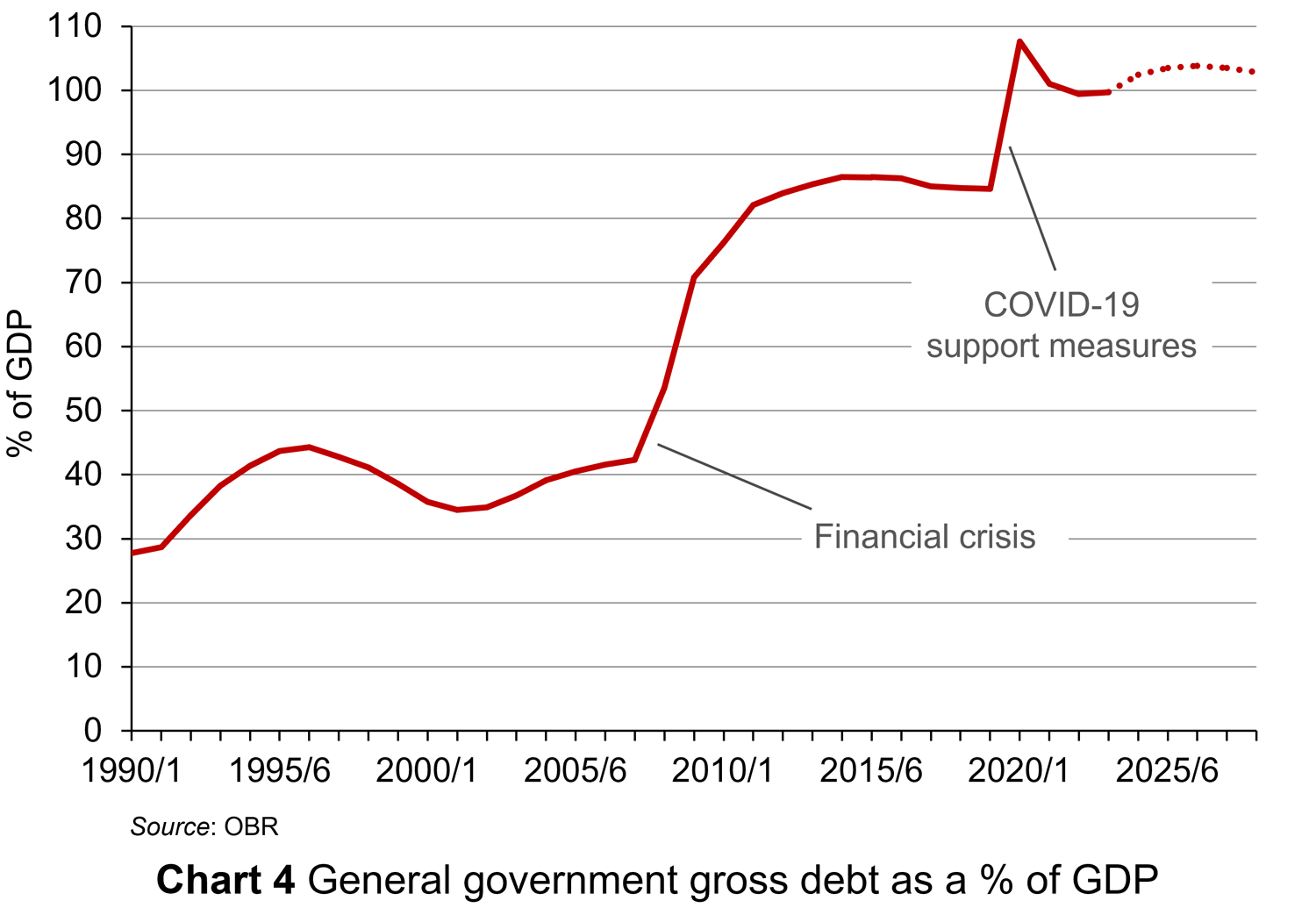 But, public finances have been under pressure in recent years, especially from COVID support measures. General government gross debt has risen from 27.7% of GDP in 1990/91 to 99.4% in 2022/23. This is illustrated in Chart 4 (click here for a PowerPoint). Although it has fallen from the peak of 107.6% of GDP in 2020/21 (during the COVID pandemic), according to the Office for Budget Responsibility it is set to rise again, peaking at 103.8% in 2026/27. There is thus pressure on the government to reduce public-sector borrowing, not increase it. This makes it difficult to finance public investment or tax cuts.
Measuring living standards
Questions about real GDP have huge political significance. Is the economy in recession? What will happen to growth in GDP over the coming months. Why has growth been sluggish in recent years? The implication is that if GDP rises, living standards will rise; if GDP falls, living standards will fall. But changes in GDP, even if expressed in terms of real GDP and even if the distribution of GDP is taken into account, are only a proxy for living standards. GDP measures the market value of the output of goods and services and, as such, may not necessarily be a good indicator of living standards, let alone well-being.
Produced goods and services that are not part of GDP
 The output of some goods and services goes unrecorded. As we note in Economics, 11e (section 15.2), “If you employ a decorator to paint your living room, this will be recorded in the GDP statistics. If, however, you paint the room yourself, it will not. Similarly, if a childminder is employed by parents to look after their children, this childcare will form part of GDP. If, however, a parent stays at home to look after the children, it will not.
The exclusion of these ‘do-it-yourself’ and other home-based activities means that the GDP statistics understate the true level of production in the economy. If over time there is an increase in the amount of do-it-yourself activities that people perform, the figures will also understate the rate of growth of national output.” With many people struggling with the cost of living, such a scenario is quite likely.
There are also activities that go unrecorded in the ‘underground’ or ‘shadow’ economy: unemployed people doing casual jobs for cash in hand that they do not declare to avoid losing benefits; people doing extra work outside their normal job and not declaring the income to evade taxes; builders doing work for cash to save the customer paying VAT.
Externalities
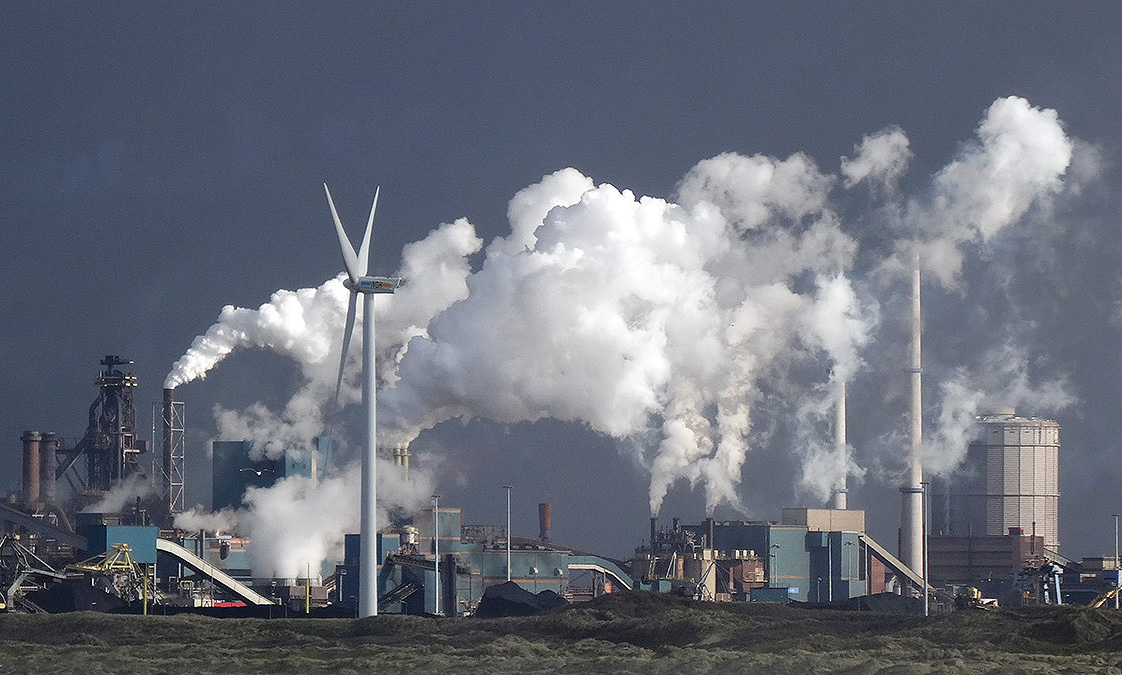 Large amounts of production and consumption involve external costs to the environment and to other people. These externalities are not included in the calculation of GDP.
If external costs increase faster than GDP, then GDP growth will overstate the rise in living standards. If external costs rise more slowly than GDP (or even fall), then GDP growth will understate the rise in living standards. We assume here that living standards include social and environmental benefits and are reduced by social and environmental costs.
Human costs of production
If production increases as a result of people having to work harder or longer hours, its net benefit will be less. Leisure is a desirable good, and so too are pleasant working conditions, but these items are not included in the GDP figures.
The production of certain ‘bads’ leads to an increase in GDP
 Some of the undesirable effects of growth may in fact increase GDP! Take the examples of crime, stress-related illness and environmental damage. Faster growth may lead to more of all three. But increased crime leads to more expenditure on security; increased stress leads to more expenditure on health care; and increased environmental damage leads to more expenditure on environmental clean-up. These expenditures add to GDP. Thus, rather than reducing GDP, crime, stress and environmental damage actually increase it.
Alternative approaches to measuring production and income
There have been various attempts to adjust GDP (actual or potential) to make it a better indicator of total production or income or, more generally, of living standards.
Index of Sustainable Economic Welfare (ISEW)
As Case Study 9.20 in the Essentials of Economics (9e) website explains, ISEW starts with consumption, as measured in GDP, and then makes various adjustments to account for factors that GDP ignores. These include:
- Inequality: the greater the inequality, the more the figure for consumption is reduced. This is based on the assumption of a diminishing marginal utility of income, such that an additional pound is worth less to a rich person than to a poor person.
- Household production (such as childcare, care for the elderly or infirm, housework and various do-it-yourself activities). These ‘services of household labour’ add to welfare and are thus entered as a positive figure.
- Defensive expenditures. This is spending to offset the adverse environmental effects of economic growth (e.g. asthma treatment for sufferers whose condition arises from air pollution). Such expenditures are taken out of the calculations.
- ‘Bads’ (such as commuting costs). The monetary expense entailed is entered as a negative figure (to cancel out its measurement in GDP as a positive figure) and then an additional negative element is included for the stress incurred.
- Environmental costs. Pollution is entered as a negative figure.
- Resource depletion and damage. This too is given a negative figure, in just the same way that depreciation of capital is given a negative figure when working out net national income.
Productive Capacities Index (PCI)
In 2023, the United Nations Conference on Trade and Development (UNCTAD) launched a new index to provide a better measure of countries’ economic potential. What the index focuses on is not actual GDP but potential output: in other words, ‘countries’ abilities to produce goods and deliver services’.
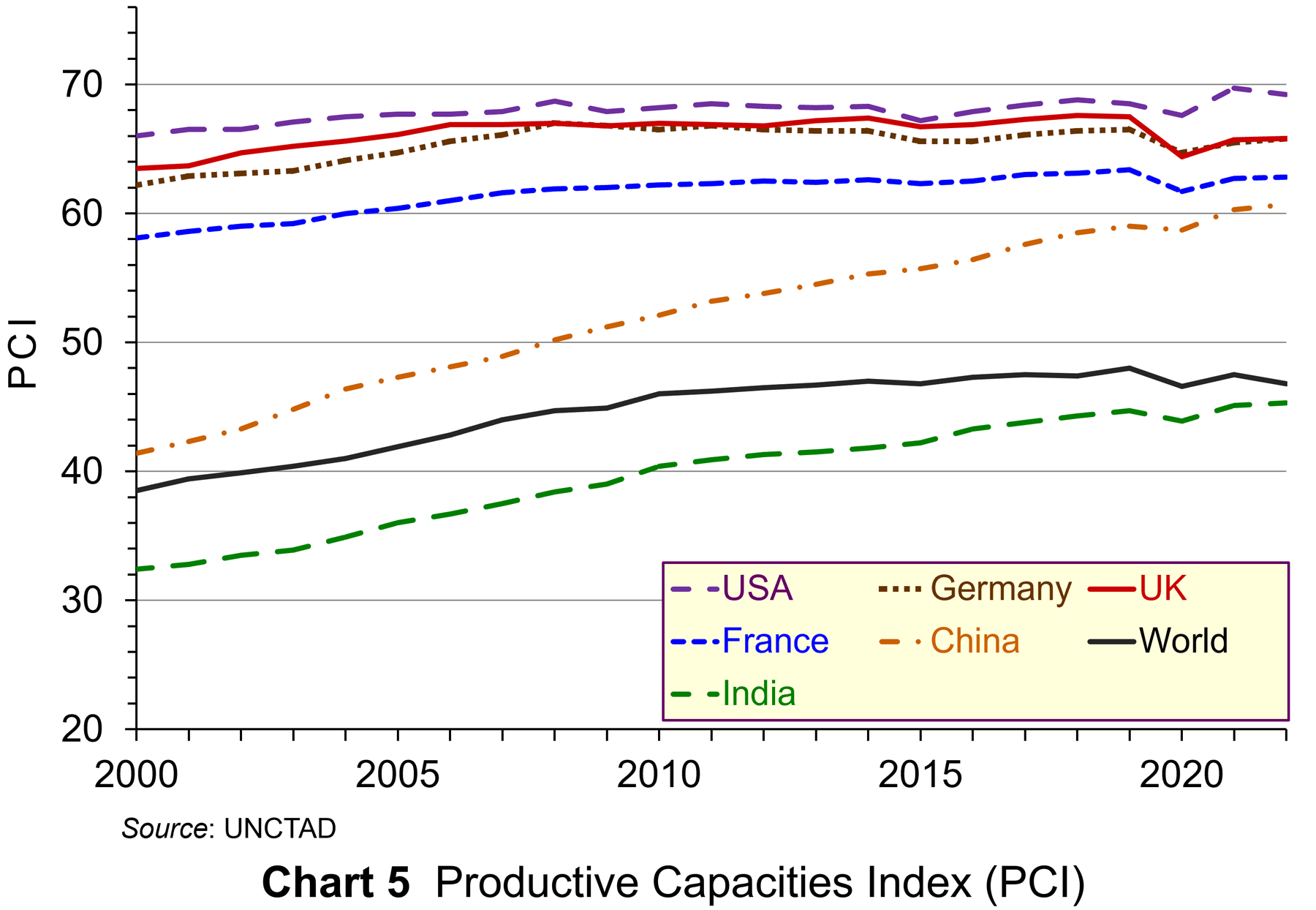 The PCI comprises 42 indicators under eight headings: human capital, natural capital, information and communication technology (ICT), structural change (the movement of labour and other productive resources from low-productivity to high-productivity economic activities), transport infrastructure, institutions (political, legal and financial) and the private sector (ease of starting businesses, availability of credit, ease of cross-border trade, etc.). It covers 194 economies since 2000 (currently to 2022). As UNCTAD states, ‘The PCI can help diagnose the areas where countries may be leading or falling behind, spotlighting where policies are working and where corrective efforts are needed.’ Chart 5 shows the PCI for various economies from 2000 to 2022 (click here for a PowerPoint).
The UK, with a PCI of 65.8 in 2022, compares relatively favourably with other developed countries. The USA’s PCI is somewhat higher (69.2), as is The Netherlands’ (69.8); Germany’s is the same (65.8); France’s is somewhat lower (62.8). The world average is 46.8. For developing countries, China is relatively high (60.7); India’s (45.3) is close to the developing country average of 43.4.
Looked at over a longer time period, the UK’s performance is relatively weak. The PCI in 2022 (65.8) was below that in 2006 (66.9) and below the peak of 67.6 in 2018.
GDP and well-being
GDP is often used as a proxy for well-being. If real GDP per head increases, then it is assumed that well-being will increase. In practice, people’s well-being depends on many factors, not just their income, although income is one important element.
The UK Measuring National Well-being (MNW) programme
 The MNW programme was established in 2010. This has resulted in Office for National Statistics developing new measures of national well-being. The ONS produces statistical bulletins and datasets with its latest results.
The aim of the programme is to provide a ‘fuller picture’ of how society is doing beyond traditional economic indicators. There are currently 44 indicators. These are designed to describe ‘how we are doing as individuals, as communities and as a nation, and how sustainable this is for the future’. The measures fall within a number of categories, including: personal well-being, relationships, health, what we do, where we live, personal finance, the economy, education and skills, governance and the natural environment.
Conclusions
In the light of the limitations of GDP as a measure of living standards, what can we make of the news that the UK entered recession in the last half of 2023? It does show that the economy is sluggish and that the production of goods and services that are included in the GDP measure declined.
But to get a fuller assessment of the economy, it is important to take a number of other factors into account. If we are to go further and ask what has happened to living standards or to well-being, then we have to look at a range of other factors. If we are to ask what the latest figures tell us about what is likely to happen in the future to production, living standards and well-being, then we will need to look further still.
Articles
- Britain falls into recession, with worst GDP performance in 2023 in years
CNN, Hanna Ziady (15/2/24)
- UK economy slipped into recession in 2023
Financial Times, Valentina Romei and George Parker (15/2/24)
- UK economy fell into recession after people cut spending
BBC News, Dearbail Jordan & Faisal Islam (15/2/24)
- Should we care that the UK is in recession?
BBC News, Faisal Islam (15/2/24)
- UK tips into recession in blow to Rishi Sunak
The Guardian, Richard Partington (15/2/24)
- Britain is in recession… and huge immigration has been masking how much poorer we’re getting
MSN, James Tapsfield (15/2/24)
- This isn’t a “mild” recession
The New Statesman, Duncan Weldon (15/2/24)
- UK middle classes ‘struggling despite incomes of up to £60,000 a year’
The Guardian, Larry Elliott (20/2/24)
- What is GDP and how is it measured?
BBC News (15/2/24)
 World at One (from 7’00” to 25’14”)
BBC Sounds, Torsten Bell and Norman Lamont (15/2/24)
- Does High GDP Mean Economic Prosperity?
Investopedia, Lisa Smith (29/9/23)
- A critical assessment of GDP as a measure of economic performance and social progress
Carnegie UK, Cressida Gaukroger (June 2023)
- When it comes to measuring economic welfare, GDP doesn’t cut it
Marketplace, Kai Ryssdal and Maria Hollenhorst (1/9/23)
- UNCTAD launches new index for countries to better measure economic potential
UNCTAD News (20/6/23)
- Redefining Economic Growth for a Climate-Conscious World
Forbes, Judah Taub (28/9/23)
- Bobby Kennedy on GDP: ‘measures everything except that which is worthwhile’
The Guardian, Simon Rogers (24/5/12)
- A guide to the UK National Accounts: Satellite Accounts
ONS (6/3/20)
Data and Analysis
- GDP first quarterly estimate, UK: October to December 2023
ONS (15/2/24)
- GDP (Average) per head, q-on-q4 growth rate CVM SA % (series N3Y8)
ONS
- Gross domestic product (Average) per head, CVM market prices: SA (series IHXW)
ONS
- GDP per capita, current prices (UK)
IMF
- Productive capacities index, annual, 2000-2022
UNCTAD
- The Scale of Economic Inequality in the UK
The Equality Trust (2023)
- Living standards, poverty and inequality in the UK: 2023
IFS, Sam Ray-Chaudhuri, Tom Waters, Thomas Wernham and Xiaowei Xu (July 2023)
- Quarterly personal well-being estimates – seasonally adjusted
ONS
Questions
- Using GDP and other data, summarise the outlook for the UK economy.
- Why is GDP so widely used as an indicator of living standards?
- Explain the three methods of measuring GDP?
- What key contributors to living standards are omitted from GDP?
- What are the ONS Satellite Accounts? Are they useful for measuring living standards?
- Assess the UK’s economic potential against each of the eight category indices in the Productive Capacities Index.
- What is the difference between ‘living standards’ and ‘well-being’?
 Last year was far from the picture of economic stability that all governments would hope for. Instead, the overarching theme of 2022 was uncertainty, which overshadowed many economic predictions throughout the year. The Collins English Dictionary announced that their word of the year for 2022 is ‘permacrisis’, which is defined as ‘an extended period of instability and insecurity’.
For the UK, 2022 was an eventful year, seeing two changes in prime minister, economic stagnation, financial turmoil, rampant inflation and a cost of living crisis. However, the UK was not alone in its economic struggles. Many believe that it is a minor miracle that the world did not experience a systemic financial crisis in 2022.
Russia’s invasion of Ukraine has led to the biggest land war in Europe since 1945, the most serious risk of nuclear escalation since the Cuban missile crisis and the most far-reaching sanctions regime since the 1930s. Soaring food and energy costs have fuelled the highest rates of inflation since the 1980s and the biggest macroeconomic challenge in the modern era of central banking (with the possible exception of the financial crisis of 2007–8 and its aftermath). For decades we have lived with the assumptions that nuclear war was never going to happen, inflation will be kept low and rich countries will not experience an energy crisis. In 2022 all of these assumptions and more have been shaken.
With the combination of rising interest rates and a massive increase in geopolitical risk, the world economy did well to survive as robustly as it did. However, with public and private debt having risen to record levels during the now-bygone era of ultra-low interest rates and with recession risks high, the global financial system faces a huge stress test.
Government pledges
 Rishi Sunak, the UK Prime Minister, started 2023 by setting out five pledges: to halve inflation, boost economic growth, cut national debt as a percentage of GDP, and to address NHS waiting lists and the issue of immigrants arriving in small boats. Whilst most would agree that meeting these pledges is desirable, a reduction in inflation is forecast to happen anyway, given the monetary policy being pursued by the Bank of England and an easing of commodity prices; and public-sector debt as a percentage of GDP is forecast to fall from 2024/25.
Success in meeting the first four pledges will partly depend on the effects of the current industrial action by workers across the UK. How soon will the various disputes be settled and on what terms? What will be the implications for service levels and for inflation?
A weak global economy
 Success will also depend on the state of the global economy, which is currently very fragile. In fact, it is predicted that a third of the global economy will be hit by recession this year. The head of the IMF has warned that the world faces a ‘tougher’ year in 2023 than in the previous 12 months. Such comments suggest the IMF is likely soon to cut its economic forecasts for 2023 again. The IMF already cut its 2023 outlook for global economic growth in October, citing the continuing drag from the war in Ukraine, as well as inflationary pressures and interest rate rises by major central banks.
The World Bank has also described the global economy as being ‘on a razor’s edge’ and warns that it risks falling into recession this year. The organisation expects the world economy to grow by just 1.7% this year, which is a sharp fall from an estimated 2.9% in 2022 according to the Global Economic Prospects report (see link below). It has warned that if financial conditions tighten, then the world’s economy could easily fall into a recession. If this becomes a reality, then the current decade would become the first since the 1930s to include two global recessions. Growth forecasts have been lowered for 95% of advanced economies and for more than 70% of emerging market and developing economies compared with six months ago. Given the global outlook, it is no surprise that the UK economy is expected to face a prolonged recession with declining growth and increased unemployment.
The current state of the UK economy
Despite all the concerns, official figures show that, even though households have been squeezed by rising prices, UK real GDP unexpectedly grew in November, by 0.1%. This has been explained by a boost to bars and restaurants from the World Cup as people went out to watch the football and also by demand for services in the tech sector.
At first sight, the UK’s cost of living crisis might look fairly mild compared to other countries. Its inflation rate was 10.7% in November 2022, compared to 12.6% in Italy, 16% in Poland and over 20% in Hungary and Estonia. But UK inflation is still way above the Bank of England’s 2% target. The Bank went on to tighten monetary policy further, by increasing interest rates to 3.5% in December. Further rate rises are expected in 2023. In fact, the markets and the Bank both expect the main rate to reach 5.2% by the end of this year. With the consequent squeeze on real incomes, the Bank of England expects a recession in the UK this year – possibly lasting until mid-2024.
 The UK is also affected by global interest rates, which affect global growth. Global interest rates average 5%. A 1 percentage point increase would reduce global growth this year from 1.7% to 0.6%, with per capita output contracting by 0.3%, once changes in population are taken into account. This would then meet the technical definition of a global recession. This means that the Bank’s November economic forecast, which was based on a Bank Rate of 3%, may worsen due to an even larger contraction than previously expected. The resulting drop in spending and investment by people and businesses could then cause inflation to come down faster than the Bank had predicted when rates were at 3%.
There could be some positive news however, that may help bring down inflation in addition to rate rises. There has been some appreciation in the pound since the huge drop caused by the September mini-budget that had brought its value to a nearly 40-year low. This will help to reduce inflation by reducing the price of imports.
As far as workers are concerned, pay increases have been broadly contained, with 2022 being one of the worst years in decades for UK real wage growth. Limiting pay rises can have a deflationary effect because people have less to spend, but it also weighs on economic growth and productivity. Despite the impact on inflation, there is a lot of unrest across the UK, with strike action continuing to be at the forefront of the news. Strikes over pay and conditions continue in various sectors in 2023, including transport, health, education and the postal service. Strikes and industrial action have a negative effect on the wider economy. If wages are stagnating and the economy is not performing well, productivity will suffer as workers are less motivated and less investment in new equipment takes place.
Financial stresses
 The UK economy is also under threat of a prolonged recession due to the proportion of households that lack insulation against financial setbacks. This proportion is unusually large for a wealthy economy. A survey conducted prior to the pandemic, found that 3 million people in the UK would fall into poverty if they missed one pay cheque, with the country’s high housing costs being a key source of vulnerability. Another survey recently suggested that one-third of UK adults would struggle if their costs rose by just £20 a month.
The pandemic itself meant that over 4 million households have taken on additional debt, with many now falling behind on repaying it. This, combined with recent jumps in energy and food bills, could push many over the edge, especially if heating costs remain high when the present government cap on energy prices ends in April.
However, there could be some better news for households with the easing of COVID restrictions in China. This could have a positive impact on the UK economy if it helps ease supply-chain disruptions occurring since the height of the global pandemic. It could reduce inflationary pressure in the UK and other countries that trade with China by making it easier – and therefore less costly – for people to get hold of goods.
Articles
Reports
Questions
- Define the term ‘deflation’.
- Explain how an appreciation of the pound is good for inflation.
- Discuss the wider economic impacts of industrial strike action.
- Why is it important for the government to keep wages contained?
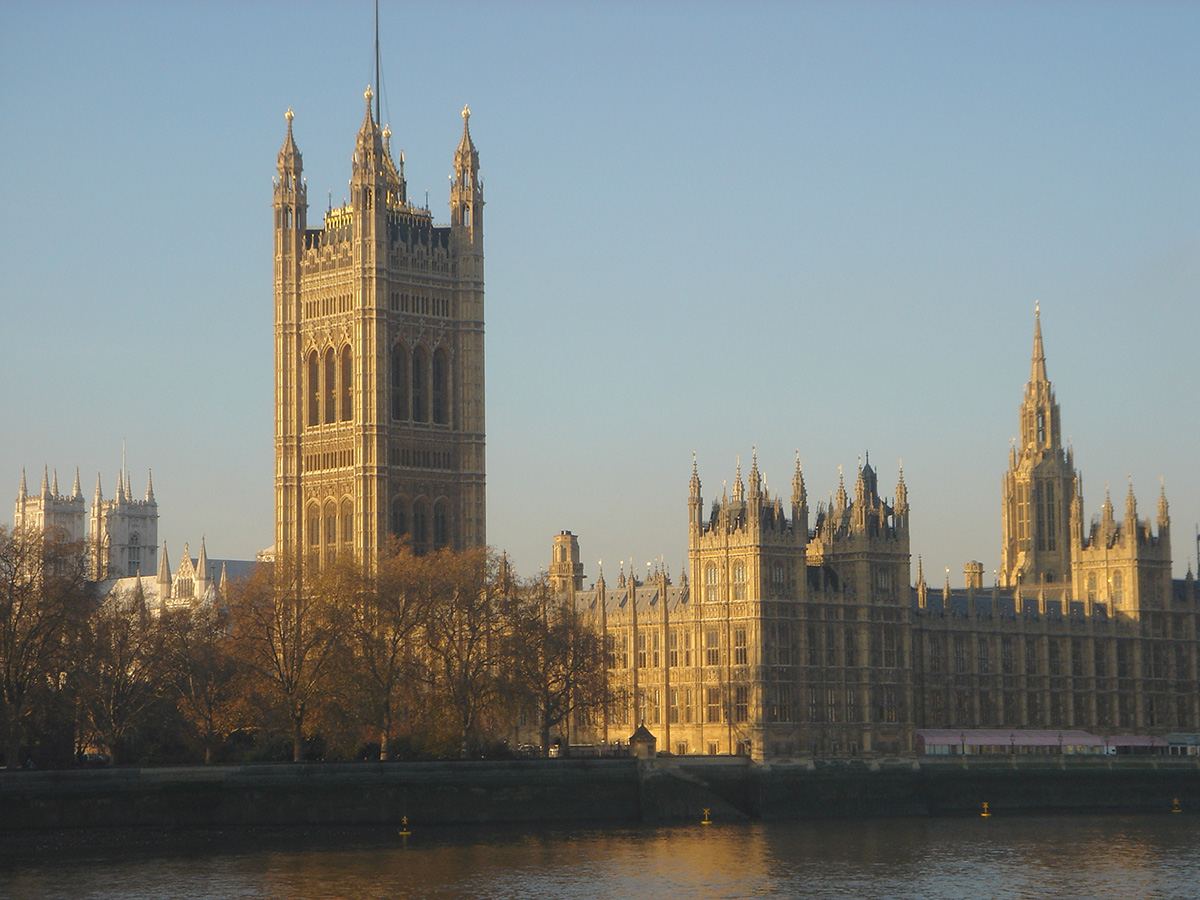 The Autumn Statement was announced by Jeremy Hunt in Parliament on Thursday 17th November. This was Hunt’s first big speech since becoming Chancellor or the Exchequer a few weeks ago. He revealed to the House of Commons that there will be tax rises and spending cuts worth billions of pounds, aimed at mending the nation’s finances. It is hoped that the new plans will restore market confidence shaken by his predecessor’s mini-Budget. He claimed that the mixture of tax rises and spending cuts would be distributed fairly.
What is the Autumn statement?
The March Budget is the government’s main financial plan, where it decides how much money people will be taxed and where that money will be spent. The Autumn Statement is like a second Budget. This is an update half a year later on how things are going. However, that doesn’t mean it is not as important. This year’s Autumn Statement is especially important given the number of changes in government in recent months. The Statement unfortunately comes at a time when the cost of living is rising at its fastest rate for 41 years, meaning that it is going to be a tough winter for many people.
Statement overview
 It was expected that the Statement was not going to be one to celebrate, given that the UK is now believed to be in a recession. The Office for Budget Responsibility (OBR) forecasts that the UK economy will shrink by 1.4% next year. However, Hunt said that his focus was on stability and ensuring a shallower downturn. The Chancellor outlined his ‘plan for stability’ by announcing deep spending cuts and tax rises in the autumn statement. He said that half of his £55bn plan would come from tax rises, and the rest from spending cuts.
The Chancellor plans to tackle rising prices and restore the UK’s credibility with international markets. He said that it will be a balanced path to stability, with the need to tackle inflation to bring down the cost of living while also supporting the economy on a path to sustainable growth. It will mean further concerns for many, but the Chancellor argued that the most vulnerable in society are being protected. He stated that despite difficult decisions being made, the plan was fair.
What was announced?
The government’s overall strategy appears to assume that, by tightening fiscal policy, monetary policy will not have to tighten as much. The hopeful consequence of which is that interest rates will be lower than they otherwise would have been. This means interest-rate sensitive parts of the economy, the housing sector in particular, are more protected than it would have been.
The following are some of the key measures announced:
- Tax thresholds will be frozen until April 2028, meaning millions will pay more tax as their nominal incomes rise.
- Spending on public services in England will rise more slowly than planned – with some departments facing cuts after the next election.
- The state pensions triple lock will be kept, meaning pensioners will see a 10.1% rise in weekly payments.
- The household energy price cap per unit of gas and electricity has been extended for one year beyond April but made less generous, with typical bills then being £3000 a year instead of £2500.
- There will be additional cost-of-living payments for the ‘most vulnerable’, with £900 for those on benefits, and £300 for pensioners.
- The top 45% additional rate of income tax will be paid on earnings over £125 140 instead of £150 000.
- The UK minimum wage (or ‘National Living Wage’ as the government calls it) for people over 23 will increase from £9.50 to £10.42 per hour.
- The windfall tax on oil and gas firms will increase from 25% to 35%, raising £55bn over the period from now until 2028.
The public finances
A key feature of the Autumn Statement was the Chancellor’s attempt to tackle the deteriorating public finances and to reduce the public-sector deficit and debt. The following three charts are based on data from the OBR (see data links below). They all show data for financial years beginning in the year shown. They all include OBR forecasts up to 2025/26, with the forecasts being based on the measures announced in the Autumn Statement.
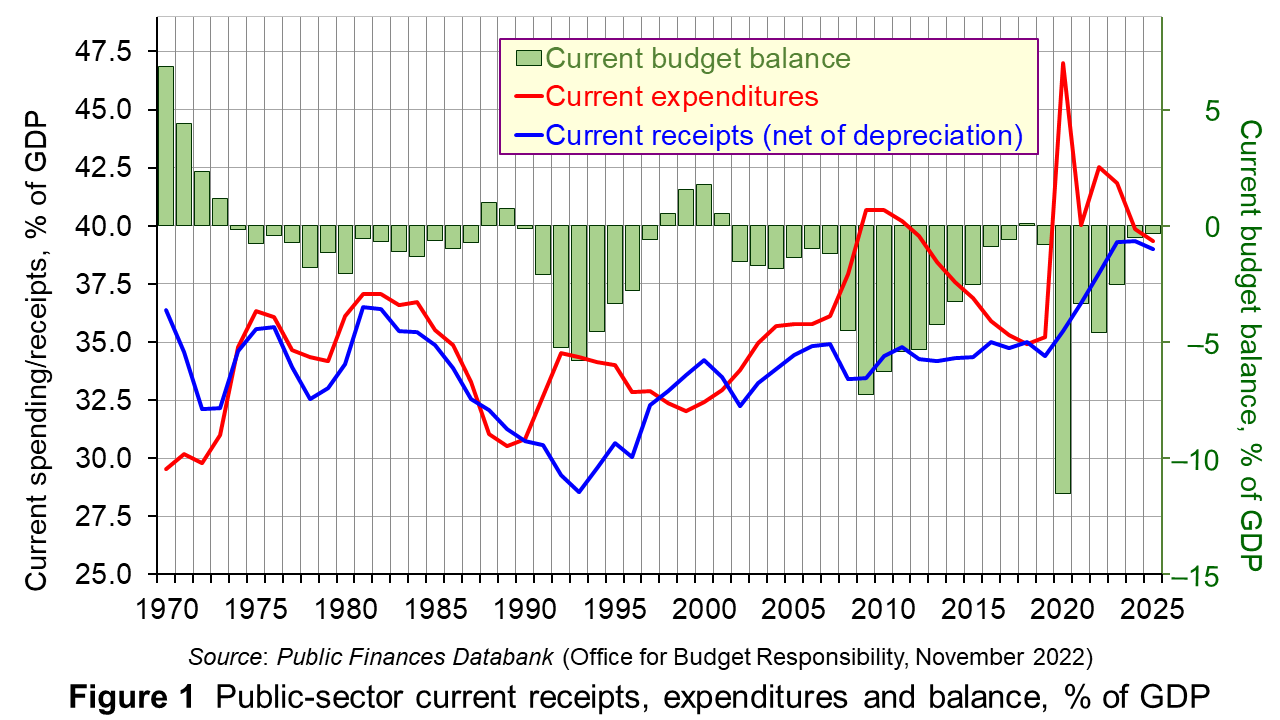 Figure 1 shows public-sector current expenditure and receipts and the balance between them, giving the current deficit (or surplus), shown by the green bars. Current expenditure excludes capital expenditure on things such as hospitals, schools and roads. Since 1973, there has been a current deficit in most years. However, the deficit of 11.5% of GDP in 2020/21 was exceptional given government support measures for households and business during the pandemic. The deficit fell to 3.3% in 2021/22, but is forecast to grow to 4.6% in 2022/23 thanks to government subsidies to energy suppliers to allow energy prices to be capped. (Click here for a PowerPoint of this chart.)
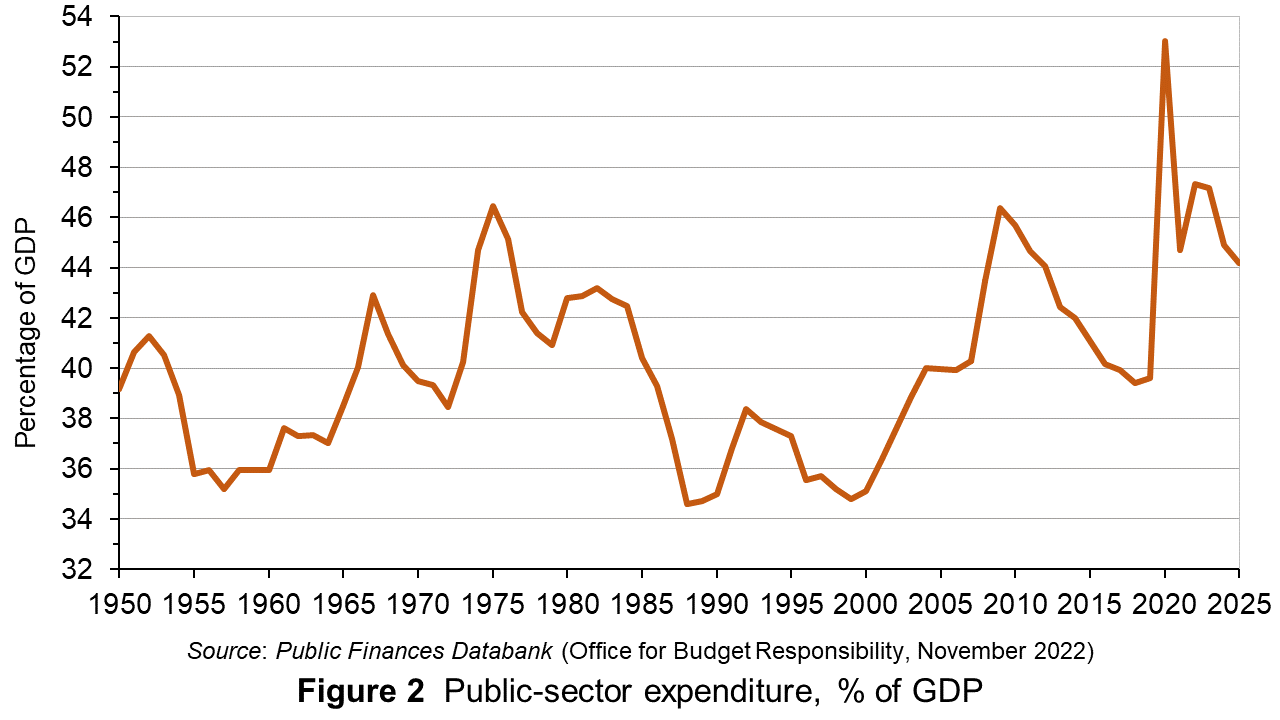 Figure 2 shows public-sector expenditure (current plus capital) from 1950. You can see the spike after the financial crisis of 2007–8 when the government introduced various measures to support the banking system. You can also see the bigger spike in 2020/21 when pandemic support measures saw government expenditure rise to a record 53.0% of GDP. It has risen again this financial year to a predicted to 47.3% of GDP from 44.7% last financial year. It is forecast to fall only slightly, to 47.2%, in 2023/24, before then falling more substantially as the tax rises and spending cuts announced in the Autumn Statement start to take effect. (Click here for a PowerPoint of this chart.)
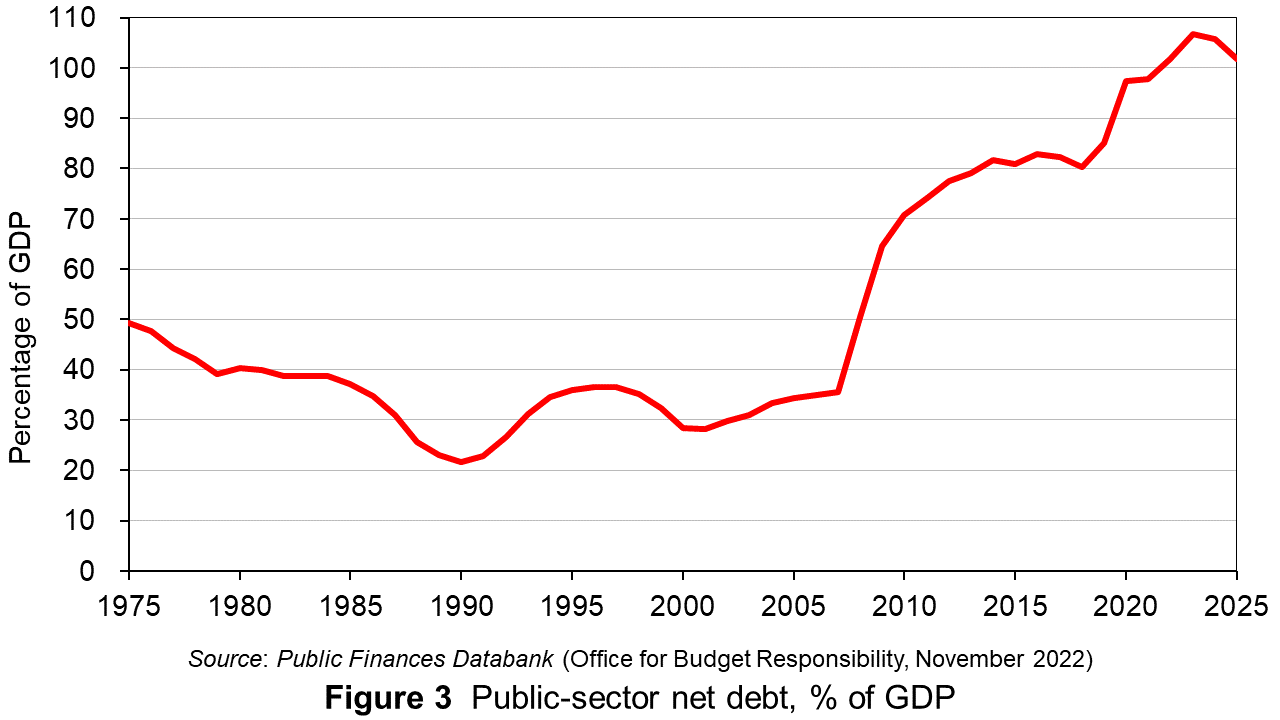 Figure 3 shows public-sector debt since 1975. COVID support measures, capping energy prices and a slow growing or falling GDP have contributed to a rise in debt as a proportion of GDP since 2020/21. Debt is forecast to peak in 2023/24 at a record 106.7% of GDP. During the 20 years from 1988/89 to 2007/8 it averaged just 30.9% of GDP. After the financial crisis of 2007–8 it rose to 81.6% by 2014/15 and then averaged 82.2% between 2014/15 and 2019/20. (Click here for a PowerPoint of this chart.)
Criticism
The government has been keen to stress that Mr Hunt’s statement does not amount to a return to the austerity policies of the Conservative-Liberal Democrat coalition government, in office between 2010 and 2015. However, Labour Shadow Chancellor, Rachel Reeves, said Mr Hunt’s Autumn Statement was an ‘invoice for the economic carnage’ the Conservative government had created. There have also been some comments raised by economists questioning the need for spending cuts and tax rises on this scale, with some saying that the decisions being made are political.
Paul Johnson, the director of the Institute for Fiscal Studies has commented on the plans, stating that the British people ‘just got a lot poorer’ after a series of ‘economic own goals’ that have made a recovery much harder than it might have been. He went on to say that the government was ‘reaping the costs of a long-term failure to grow the economy’, along with an ageing population and high levels of historic borrowing.
Disapproval also came from Conservative MP, Jacob Rees-Mogg, who criticised the government’s tax increases. He raised concerns about the government’s plans to increase taxation when the economy is entering a recession. He said, ’You would normally expect there to be some fiscal support for an economy in recession.’
Economic Outlook
High inflation and rising interest rates will lead to consumers spending less, tipping the UK’s economy into a recession, which the OBR expects to last for just over a year. Its forecasts show that the economy will grow by 4.2% this year but will shrink by 1.4% in 2023, before growth slowly picks up again. GDP should then rise by 1.3% in 2024, 2.6% in 2025 and 2.7% in 2026.
 The OBR predicts that there will be 3.2 million more people paying income tax between 2021/22 and 2027/28 as a result of the new tax policy and many more paying higher taxes as a proportion of their income. This is because they will be dragged into higher tax bands as thresholds and allowances on income tax, national insurance and inheritance tax have been frozen until 2028. Government documents said these decisions on personal taxes would raise an additional £3.5bn by 2028 – the consequence of ‘fiscal drag’ pulling more Britons into higher tax brackets. The OBR expects that there will be an extra 2.6 million paying tax at the higher, 40% rate. This is going to put more pressure on households who are already feeling the impact of inflation on their disposable income.
However, this pressure on incomes is set to continue, with real incomes falling by the largest amount since records began in 1956. Real household incomes are forecast to fall by 7% in the next few years, which even after the support from the government, is the equivalent of £1700 per year on average. And the number unemployed is expected to rise by more than 500 000. Senior research economist at the IFS, Xiaowei Xu, described the UK as heading for another lost decade of income growth.
There may be some good news for inflation, with suggestions that it has now peaked. The OBR forecasts that the inflation rate will drop to 7.4% next year. This is still a concern, however, given that the target set for inflation is 2%. Despite the inflation rate potentially peaking, the impact on households has not. The fall in the inflation rate does not mean that prices in the shops will be going down. It just means that they will be going up more slowly than now. The OBR expects that prices will not start to fall (inflation becoming negative) until late 2024.
Conclusion
The overall tone of the government’s announcements was no surprise and policies were largely expected by the markets, hence their muted response. However, this did not make them any less economically painful. There are major concerns for households over what they now face over the next few years, something that the government has not denied.
It has been suggested that this situation, however, has been made worse by historic choices, including cutting state capital spending, cuts in the budget for vocational education, Brexit and Kwasi Kwarteng’s mini-Budget. It is evident that Britons have a tough time ahead in the next year or so. The UK has already had one lost decade of flatlining living standards since the global financial crisis and is now heading for another one with the cost of living crisis.
Articles
- Autumn Statement 2022: Key points at-a-glance
BBC News (17/11/22)
- Autumn statement 2022: key points at a glance
The Guardian, Richard Partington and Aubrey Allegretti (17/11/22)
- Next two years will be ‘challenging’, says Chancellor Jeremy Hunt – as disposable incomes head for biggest fall on record
Sky News, Sophie Morris (18/11/22)
- What the Autumn Statement means for you and the cost of living
BBC News, Kevin Peachey (17/11/22)
- Autumn Statement: Jeremy Hunt warns of challenges as living standards plunge
BBC News, Kate Whannel (17/11/22)
- Autumn Statement: BBC experts on six things you need to know
BBC News (17/11/22)
- Autumn statement 2022: experts react
The Conversation (17/11/22)
- Autumn Statement Special: Top of the Charts
Resolution Foundation, Torsten Bell (18/11/22)
- Jeremy Hunt’s autumn statement is a poisoned chalice for whoever wins the next election
The Conversation, Steve Schifferes (18/11/22)
- UK households face largest fall in living standards in six decades
Financial Times, Delphine Strauss (17/11/22)
- How the autumn statement brought back the ‘squeezed middle’
The Guardian, Larry Elliott (18/11/22)
- The British people ‘just got a lot poorer’, says IFS thinktank
The Guardian, Anna Isaac (18/11/22)
- Autumn Statement: Hunt has picked pockets of entire country, Labour says
BBC News, Joshua Nevett (17/11/22)
- UK government announces budget; country faces largest fall in living standards since records began
CNBC, Elliot Smith (17/11/22)
- The first step to Britain’s economic recovery is to start telling the truth
The Observer, Will Hutton (20/11/22)
Videos
Analysis
- Autumn Statement 2022 response
Institute for Fiscal Studies, Stuart Adam, Carl Emmerson, Paul Johnson, Robert Joyce, Heidi Karjalainen, Peter Levell, Isabel Stockton, Tom Waters, Thomas Wernham, Xiaowei Xu and Ben Zaranko (17/11/22)
- Help today, squeeze tomorrow: Putting the 2022 Autumn Statement in context
Resolution Foundation, Torsten Bell, Mike Brewer, Molly Broome, Nye Cominetti, Adam Corlett, Emily Fry, Sophie Hale, Karl Handscomb, Jack Leslie, Jonathan Marshall, Charlie McCurdy, Krishan Shah, James Smith,
Gregory Thwaites & Lalitha Try (18/11/22)
Government documentation
Data
Questions
- What do you understand by the term ‘fiscal drag’?
- Provide a critique of the Autumn Statement from the left.
- Provide a critique of the Autumn Statement from the right.
- What are the concerns about raising taxation during a recession?
- Define the term ‘windfall tax’. What are the advantages and disadvantages of imposing/increasing windfall taxes on energy producers in the current situation?
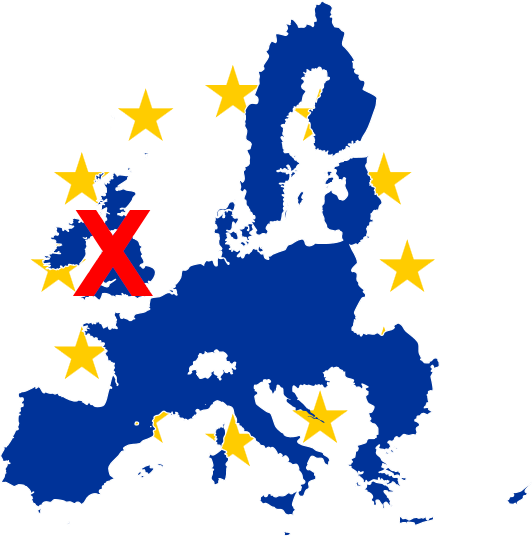 The UK left the EU on 31 January 2020 and entered an 11-month transition phase during which previous arrangements largely applied. On 30 December 2020, the UK and the EU signed the Trade and Cooperation Agreement (TCA) (see also), which set out the details of the post-Brexit trading arrangements between the UK and the EU after the ending of the transition period on 31 December 2020. The new arrangements have been implemented in stages so as to minimise disruption.
A major change was implemented on 1 January 2022, when full customs controls came into effect on imports into the UK from the EU. Later in the year a range of safety and security measures will be introduced, such as physical checks on live animals.
Not surprisingly, the anniversary of the TCA has been marked by many articles on Brexit: assessing its effects so far and looking into the future. Most of the articles see Brexit as having imposed net costs on the UK and the EU. They reflect the views of economists generally. As the first FT article linked below states, “The debate among economists on Brexit has rarely been about whether there would be a hit to growth and living standards, but rather how big a hit”.
The trade and GDP costs of Brexit
The Office for Budget Responsibility in October 2021 attempted to measure these costs in terms of the loss in trade and GDP. In October 2021, it stated:
Since our first post-EU referendum Economic and Fiscal Outlook in November 2016, our forecasts have assumed that total UK imports and exports will eventually both be 15 per cent lower than had we stayed in the EU. This reduction in trade intensity drives the 4 per cent reduction in long-run potential productivity we assume will eventually result from our departure from the EU.
…the evidence so far suggests that both import and export intensity have been reduced by Brexit, with developments still consistent with our initial assumption of a 15 per cent reduction in each.
This analysis is supported by evidence from John Springford, deputy director of the Centre for European Reform think-tank. He compares the UK’s actual performance with a ‘doppelgänger’ UK, which is an imaginary UK that has not left the EU. The doppelgänger used “is a subset of countries selected from a larger group of 22 advanced economies by an algorithm. The algorithm finds the countries that, when combined, create a doppelgänger UK that has the smallest possible deviation from the real UK data until December 2019, before the pandemic struck.” According to Springford, the shortfall in trade in October 2021 was 15.7 per cent – very much in line with the OBR’s forecasts.
Explanations of the costs
 Why, then, have have been and will continue to be net economic costs from Brexit?
The main reason is that the UK has moved from being in the EU Single Market, a system of virtually friction-free trade and factor movements, to a trade agreement (the TCA) which, while being tariff and quota free for goods produced in the UK and the EU, involves considerable frictions. These frictions include greatly increased paperwork, which adds to the cost of trade. This has affected small businesses particularly, for whom the increased administrative costs generally represent a larger proportion of total costs than for large businesses.
Although EU tariffs are not imposed on goods wholly originating in the UK, they are imposed on many goods that are not. Under ‘rules of origin’ regulations, an item can only count as a British good if sufficient value or weight is added. If insufficient value is added, then customs charges are imposed. Similar rules apply from 1 January 2022 on goods imported into the Great Britain from the EU which are only partially made in the EU. The issue of rules of origin was examined in the blog A free-trade deal? Not really. Goods being moved between Great Britain and the EU are checked at ports and can only be released into the market if they have a valid customs declaration and have received customs clearance. This involves considerable paperwork for businesses. As the article below from Internet Retailing states:
UK and EU importers need to be able to state the origin of the goods they trade between the UK and EU. For some goods, exporters need to hold supplier declarations to show where they were made and where materials came from. From January 1, those issuing statements of origin for goods exported to the EU will need to hold the supplier declarations at the time that they export their goods, whereas up till now the those declarations could be supplied later.
Brexit has had considerable effects on the labour market. Many EU citizens returned to their home countries both before and after Brexit, creating labour shortages in many sectors. Also, it has become more difficult for UK citizens to work in the EU, with work permits required in most cases. This has had a major effect on some UK workers. For example, British touring musicians and performers find it difficult to tour, given the lack of an EU-wide visa waiver, ‘cabotage’ rules that ban large UK tour vehicles from making more than two stops before returning to the UK and new paperwork needed to take certain musical instruments into the EU.
Another issue concerns investment. Will greater restrictions in trade between the EU and the UK reduce inward investment to the UK, with international companies preferring to locate factories producing for Europe in the EU rather than the UK as the EU market is bigger than the UK market? So far, fears have not been realised as inward investment has held up well, partly because of the rapid bounce-back from the pandemic and the successful roll-out of the vaccine. Nevertheless, the UK’s dominance as a recipient of inward investment to Europe has been replaced by a three-way dominance of the UK, France and Germany, with France being the biggest recipient of the three in 2019 and 2020. It will be some years before the extent to which Brexit has damaged inward investment to the UK, if at all, becomes clear.
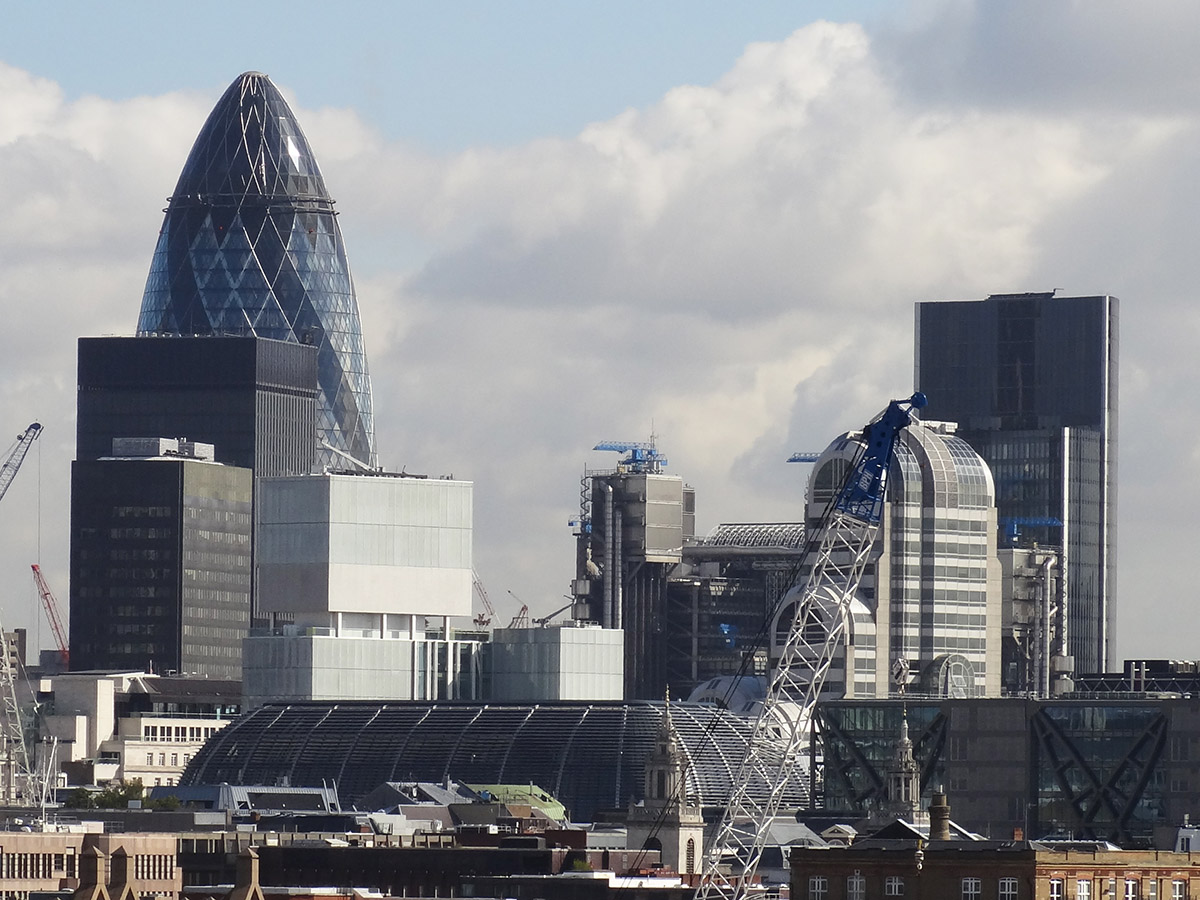 The TCA applies to goods, not services. One of the major concerns has been the implications of Brexit for financial services and the City of London. Before Brexit, financial institutions based in the UK had ‘passporting rights’. These allowed them to offer financial services across EU borders and to set up branches in EU countries easily. With the ending of the transition period in December 2020, these passporting rights have ceased. The EU has granted temporary ‘equivalence’ to such institutions until June 2022, but then it comes to an end and there is no prospect of deal on financial services in the near future. Indeed, the EU is actively trying to encourage more financial activity to move from the UK to the EU. Several financial institutions have already relocated all or part of their business from London to the EU.
The articles below examine these costs and many give examples of specific firms and how Brexit has impacted on them. As you will see, there are quite a lot of articles and you might just want to select a few. Or if this blog is being used for classes, the articles could be assigned to different students and used as the basis for discussion.
The future
Whilst the additional costs in terms of trade restrictions and paperwork are clear, it is too soon to know how well firms will be able to overcome them. Many of those who support Brexit argue that the UK now has freedom to impose lighter UK regulations on firms and that this could encourage economic growth. Other supporters of Brexit, however, argue that Brexit gives the UK government the opportunity to impose tougher environmental, safety and employment protection regulations. Again, it is too soon to know what direction the current and future governments will move.
 Then there is the question of trade deals with non-EU countries. How many will there be? When will they be signed? What will their terms be? So far, the deals signed have largely been just a roll-over of the deals the UK previously had with these countries as a member of the EU. The one exception is the deal with Australia. But the gains from that are tiny – an estimated gain of between 0.02 and 0.08 per cent of GDP from 2035 (compared with the estimated 4 per cent loss from leaving the EU’s Single Market). Also there are fears by the UK agricultural sector that cheaper food from Australia, produced under lower standards, could undercut UK farmers, especially after the end of a 15-year transitional period. So far, a trade deal with the USA seems a long way off.
Then there are uncertainties about the Northern Ireland Protocol, under which there is an effective border between Great Britain and the EU down the Irish Sea, with free trade across the Northern Ireland–Republic of Ireland border. Will it be rewritten? Will the UK renege on its treaty commitments to impose checks on goods flowing between Northern Ireland and Great Britain?
Difficulties with the Northern Ireland Protocol, highlight another uncertainty and that is the political relationships between the UK and the EU, which have come under considerable strain with various post-Brexit disputes. Could these difficulties damage trade further and, if so, by how much?
What is clear is that there is considerable uncertainty about the future, a future that for some time is likely to be affected by the pandemic and its aftermath in both the UK and the EU. As the OBR states:
It is too early to reach definitive conclusions because:
- The terms of the TCA are yet to be implemented in full, meaning trade barriers will rise further as more of the deal comes into force. For example, the introduction of full checks on UK imports has recently been delayed until 2022.
- The full effect of the referendum outcome and higher trade barriers will probably take several years to come through, with businesses needing considerable time to adjust.
- The pandemic has delivered a large shock to UK and global trade volumes over the past 18 months, making it difficult to disentangle the separate effect of leaving the EU.
- Finally, trade data tend to be relatively volatile and are revised frequently, rendering any initial conclusions subject to change as the data are revised.
Analysis
Articles
- Analysis shows Brexit caused £12 billion of lost trade in October
ITV News, Joel Hills (10/12/21)
- Brexit: One year on, the economic impact is starting to show
BBC News, Faisal Islam (24/12/21)
- Brexit: The economic impact a year on
BBC News, Douglas Fraser (21/12/21)
- Brexit: what the UK/EU customs changes mean for businesses from January 1
The Conversation, Karen Jackson (21/12/21)
- Prices could rise even more as Brexit import rules are toughened up in New Year
i, David Parsley (23/12/21)
- Brexit one year on: the impact on the UK economy
Financial Times, Chris Giles (23/12/21)
- Businesses struggle to prepare for UK’s post-Brexit import controls
Financial Times, Peter Foster, Marton Dunai and James Shotter (29/12/21)
- How the post-Brexit rules for EU trade are set to change at New Year
Internet Retailing, Chloe Rigby (17/12/21)
- Post-Brexit Guide: Five years since UK vote, where are we now – and how did we get here?
Euronews, Alasdair Sandford (20/12/21)
- A year since Brexit: Will new UK import controls complicate trade further?
Euronews, Alasdair Sandford (31/12/21)
- Brexit passporting: Little appetite among EU finance firms to stay in London as FCA applications disappoint
City A.M., Michiel Willems (30/12/21)
- Brexit red tape: More disruption to food supplies looming as EU is ‘not prepared’ for new UK import rules that take effect on 1 January
City A.M., Michiel Willems (30/12/21)
- Just a Year of Brexit Has Thumped U.K.’s Economy and Businesses
Bloomberg, Joe Mayes (22/12/21)
- Frosty Resignation Leaves Boris Johnson With Brexit Meltdown
Bloomberg, Therese Raphael (20/12/21)
- What a Year of Brexit Brought U.K. Companies: Higher Costs and Endless Forms
New York Times, Eshe Nelson (29/12/21)
- The anniversary of ‘getting Brexit done’ is more a wake than a celebration
Independent, Vince Cable (28/12/21)
- Brexit customs controls coming in January ‘disastrous’ for UK traders, business chiefs warn
Independent, Adam Forrest (24/12/21)
- Brexit: ‘the biggest disaster any government has ever negotiated’
The Guardian, Lisa O’Carroll (27/12/21)
- What the UK and hauliers can expect from long-delayed Brexit controls
The Guardian, Lisa O’Carroll (29/12/21)
- Brexit one year on: so how’s it going?
The Observer, Toby Helm (25/12/21)
Survey
Questions
- Summarise the reasons why the volume of trade between the UK and the EU is likely to be below the level it would have been if the UK had remained in the Single Market.
- How can economists disentangle the effects of Brexit from the effects of Covid? How is the ‘doppelgänger UK’ model used for this purpose?
- Are there any economic advantages of the UK’s exit from the EU? If so, what are they and how significant are they?
- The OBR forecasts that there will be a long-term reduction of 15 per cent in both UK imports from the EU and UK exports to the EU. What might cause this figure to be (a) greater than 15 per cent; (b) less than 15 per cent?
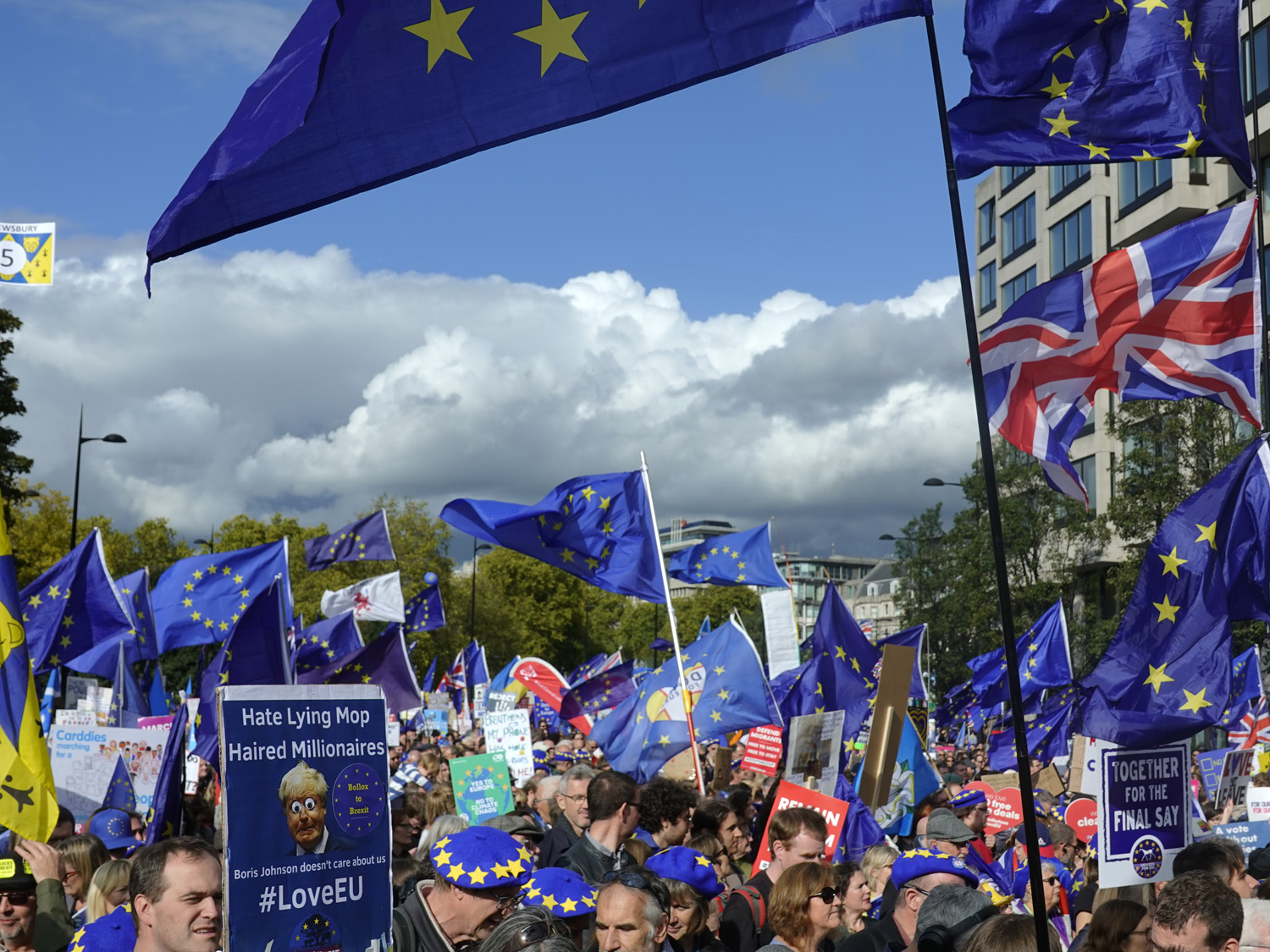 A general election has been called in the UK for 12 December. Central to the debates between the parties will be their policy on Brexit.
They range from the Liberal Democrats’, Plaid Cymru’s and Sinn Féin’s policy of cancelling Brexit and remaining in the EU, to the Scottish Nationalists’ and Greens’ policy of halting Brexit while a People’s Vote (another referendum) is held, with the parties campaigning to stay in the EU, to the Conservative Party’s policy of supporting the Withdrawal Agreement and Political Declaration negotiated between the Boris Johnson government and the EU, to the DUP which supports Brexit but not a version which creates a border between Great Britain and Northern Ireland, to the Brexit Party and UKIP which support leaving the EU with no deal (what they call a ‘clean break’) and then negotiating individual trade deals on a country-by-country basis.
The Labour Party also supports a People’s Vote, but only after renegotiating the Withdrawal Agreement and Political Declaration, so that if Brexit took place, the UK would have a close relationship with the single market and remain in a customs union. Also, various laws and regulations on environmental protection and workers’ rights would be retained. The referendum would take place within six months of the election and would be a choice between this new deal and remain.
But what are the economic costs and benefits of these various alternatives? Prior to the June 2016 referendum, the Treasury costed various scenarios. After 15 years, a deal would make UK GDP between 3.4% and 7.8% lower than if it remained in the EU, depending on the nature of the deal. No deal would make GDP between 5.4% and 9.5% lower.
Then in November 2018, the Treasury published analysis of the original deal negotiated by Theresa May in July 2018 (the ‘Chequers deal’). It estimated that GDP would be up to 3.9% lower after 15 years than it would have been if the UK had remained in the EU. In the case of a no-deal Brexit, GDP would be up to 9.3% lower after 15 years.
When asked for Treasury forecasts of the effects of Boris Johnson’s deal, the Chancellor, Sajid Javid, said that the Treasury had not been asked to provide forecasts as the deal was “self-evidently in our economic interest“.
Other forecasters, however, have analysed the effects of the Johnson deal. The National Institute for Economic and Social Research (NIESR), the UK’s longest established independent economic research institute, has estimated the costs of various scenarios, including the Johnson deal, the May deal, a no-deal scenario and also a scenario of continuing uncertainty with no agreement over Brexit. The NIESR estimates that, under the Johnson deal, with a successful free-trade agreement with the EU, in 10 years’ time UK GDP will be 3.5% lower than it would be by remaining in the EU. This represents a cost of £70 billion. The costs would arise from less trade with the EU, lower inward investment, slower growth in productivity and labour shortages from lower migration. These would be offset somewhat by savings on budget contributions to the EU.
Under Theresa May’s deal UK GDP would be 3.0% lower (and thus slightly less costly than Boris Johnson’s deal). Continuing in the current situation with chronic uncertainty about whether the UK would leave or remain would leave the UK 2% worse off after 10 years. In other words, uncertainty would be less damaging than leaving. The costs from the various scenarios would be in addition to the costs that have already occurred – the NIESR estimates that GDP is already 2.5% smaller than it would have been as a result of the 2016 Brexit vote.
Another report also costs the various scenarios. In ‘The economic impact of Boris Johnson’s Brexit proposals’, Professors Anand Menon and Jonathan Portes and a team at The UK in a Changing Europe estimate the effects of a decline in trade, migration and productivity from the various scenarios – again, 10 years after new trading arrangements are in place.  According to their analysis, UK GDP would be 4.9%, 6.4% and 8.1% lower with the May deal, the Johnson deal and no deal respectively than it would have been from remaining in the EU.
But how much reliance should we put on such forecasts? How realistic are their assumptions? What other factors could they have taken into account? Look at the two reports and at the articles discussing them and then consider the questions below which are concerned with the nature of economic forecasting.
Articles
- UK’s new Brexit deal worse than continued uncertainty – NIESR
Reuters, David Milliken (30/10/19)
- Brexit deal means ‘£70bn hit to UK by 2029′
BBC News, Faisal Islam (30/10/19)
- Boris Johnson’s Brexit deal worse for economy than Theresa May’s, new analysis shows
Politics Home, Matt Honeycombe-Foster (30/10/19)
- Boris Johnson’s Brexit deal ‘would cost UK economy £70bn’
The Guardian, Richard Partington (30/10/19)
- UK economy suffers ‘slow puncture’ as general election is called
ITV News, Joel Hills (30/10/19)
- Boris Johnson’s Brexit deal ‘would deliver £70bn hit to economy by 2029’
Sky News, Ed Conway (30/10/19)
- Boris Johnson’s Brexit deal won’t cost Britain £70bn by 2029
The Spectator, Ross Clark (30/10/19)
- Boris Johnson’s Brexit deal would make people worse off than Theresa May’s
The Guardian, Anand Menon and Jonathan Portes (13/10/19)
- How Boris Johnson’s hard Brexit would hit the UK economy
Financial Times, Chris Giles (13/10/19)
- Boris Johnson’s Brexit deal is worse for the UK economy than Theresa May’s, research suggests
CNBC, Elliot Smith (19/10/19)
Reports
Questions
- What are the arguments in favour of the assumptions and analysis of the two recent reports considered in this blog?
- What are the arguments against the assumptions and analysis of the two reports?
- How useful are forecasts like these, given the inevitable uncertainty surrounding (a) the outcome of negotiations post Brexit and (b) the strength of the global economy?
- If it could be demonstrated beyond doubt to everyone that each of the Brexit scenarios meant that UK GDP would be lower than if it remained in the EU, would this prove that the UK should remain in the EU? Explain.
- If economic forecasts turn out to be inaccurate, does this mean that economists should abandon forecasting?