 Inflation has surged worldwide as countries have come out of their COVID-19 lockdowns. The increases in prices combined with supply-chain problems has raised questions of what will happen to future prices and whether it will feed further inflation cycles.
Inflation targeting
Inflation is a key contributor to instability in an economy. It measures the rate of increases in prices over a given period of time and indicates what will happen to the cost of living for households. Because of its importance, many central banks aim to keep inflation low and steady by setting a target. The Bank of England, the Federal Reserve, and the European Central Bank all aim to keep inflation low at a target rate of 2 per cent.
Inflation-rate targeting has been successfully practised in a growing number of countries over the past few decades. However, measures to combat rising inflation typically contract the economy through reducing real aggregate demand (or at least its rate of growth). This is a concern when the economy is not experiencing a strong economic performance.
Current outlook
 Globally, rising inflation is causing concern as a surge in demand has been confronted by supply bottlenecks and rising prices of energy and raw materials. As the world emerges from the COVID-19 lockdowns, global financial markets have been affected in recent months by concerns around inflation. They have also been affected by the prospect of major central banks around the world being forced into the early removal of pandemic support measures, such as quantitative easing, before the economic recovery from the coronavirus is complete.
The Chief Economist at the Bank of England has warned that UK inflation is likely to rise ‘close to or even slightly above 5 per cent’ early next year, as he said the central bank would have a ‘live’ decision on whether to raise interest rates at its November meeting. Although consumer price inflation dipped to 3.1 per cent in September, the Bank of England has forecast it to exceed 4 per cent by the end of the year, 2 percentage points higher than its target. UK banks and building societies have already started to increase mortgage rates in response to rising inflation, signalling an end to the era of ultra-low borrowing costs and piling further pressure on household finances.
In the USA, shortages throughout the supply chains on which corporate America depends are also causing concern. These issues are translating into widespread inflationary pressure, disrupting operations and forcing companies to raise prices for customers. Pressure on every link in the supply chain, from factory closures triggered by COVID-19 outbreaks to trouble finding enough staff to unload trucks, is rippling across sectors, intensifying questions about the threat that inflation poses to robust consumer spending and rebounding corporate earnings. Reflecting concern over weaker levels of global economic growth despite rising inflationary pressures, US figures published at the end of October showed the world’s largest economy added just 194 000 jobs in September, far fewer than expected.
There are also fears raised over high levels of corporate debt, including in China at the embattled property developer Evergrande, where worries over its ability to keep up with debt payments have rippled through global markets. There are major concerns that Evergrande could pose risks to the wider property sector, with potential spill-overs internationally. However, it is argued that the British banking system has been shown in stress tests to be resilient to a severe economic downturn in China and Hong Kong.
Central bank responses
The sharpest consumer-price increases in years have evoked different responses from central banks. Many have raised interest rates, but two that haven’t are the most prominent in the global economy: the Federal Reserve and the European Central Bank. These differences in responses reflect differing opinions as to whether current price increases will feed further inflation cycles or simply peter out. For those large central banks, they are somewhat relying on households keeping faith in their track record of keeping inflation low. There is also an expectation that there are enough underutilised workers to ensure that wage inflation is kept low.
 However, other monetary authorities worry that they have not yet earned the record of keeping inflation low and are concerned about the risk of wage inflation. In addition, in poorer countries there is a larger share of spending that goes on essentials such as food and energy. These have seen some of the highest price increases, so policy makers are going to be keen to stamp down on the inflation.
The Federal Reserve is expected to announce that it will start phasing out its $120bn monthly bond-buying programme (quantitative easing) as it confronts more pronounced price pressures and predictions that interest rates will be lifted next year. However, no adjustments are expected to be made to the Fed’s main policy rate, which is tethered near zero. Whilst financial markets are betting on an rise in Bank Rate by the Bank of England as early as next month, spurred by comments from Governor Andrew Bailey in mid-October that the central bank would ‘have to act’ to keep a lid on inflation.
Outlook for the UK
 The Bank of England’s Chief Economist, Huw Pill, has warned that high rates of inflation could last longer than expected, due to severe supply shortages and rising household energy bills. He said inflationary pressures were still likely to prove temporary and would fall back over time as the economy adjusted after disruption caused by COVID and Brexit. However, he warned there were growing risks that elevated levels of inflation could persist next year.
The looming rise in borrowing costs for homeowners will add further pressure to family finances already stretched by higher energy bills and surging inflation. According to the Institute for Fiscal Studies, it is expected that households will face years of stagnating living standards, with predictions showing that households would on average be paying £3000 more each year in taxes by 2024/25, with the biggest impact felt by higher earners.
Investors are also reacting to concerns and have pulled $9.4bn out of UK-focused equity funds this year after hopes that a COVID-19 vaccination drive will fuel a vigorous economic recovery were overshadowed by questions about slow growth and high inflation. It is suggested that there is a general sense of caution about the UK when it comes to investing globally, driven by monetary, fiscal and trade uncertainties.
Given all the elements contributing to this outlook, The IMF has forecast that the UK will recover more slowly from the shocks of coronavirus than other G7 nations, with economic output in 2024 still 3 per cent below its pre-pandemic levels. Financial markets are predicting the Bank of England will lift interest rates as soon as the next MPC meeting. And while supply-chain bottlenecks and rising commodity prices are a global trend, the Bank’s hawkish stance has increased the possibility of a sharper slowdown in Britain than other developed markets, some analysts have said.
What next?
Some of the major central banks are poised to take centre stage when announcing their next monetary action, as it will reveal if they share the alarm about surging inflation that has gripped investors. Markets are betting that the Bank of England will begin raising interest rates, with Bank Rate expected to rise to around 1.25 per cent by the end of next year (from the current 0.1 per cent).
It is thought that the Fed will not raise interest rates just yet but will do so in the near future. Markets, businesses, and households globally will be waiting on the monetary decisions of all countries, as these decisions will shape the trajectory of the global economy over the next few years.
Articles
- Three Days Will Reveal Global Alert Level on Inflation: Eco Week
Bloomberg, Molly Smith and Craig Stirling (31/10/21)
- Inflation watch: Global food prices hit 10-year high
Al Jazeera (4/11/21)
- Fed sings the ‘transitory’ inflation refrain, unveils bond-buying ‘taper’
ReutersHoward Schneider and Ann Saphir (3/11/21)
- BoE chief economist warns UK inflation likely to hit 5%
Financial Times, Chris Giles (21/10/21)
- Inflation pressure now ‘brutal’ because of supply squeeze, US companies say
Financial Times, Andrew Edgecliffe-Johnson, Matthew Rocco, Obey Manayiti and Claire Bushey (23/10/21)
- Rising inflation could trigger global sell-off that would harm UK, says Bank
The Guardian, Richard Partington (8/10/21)
- Bank of England chief economist warns high inflation rates may persist in 2022
The Guardian, Richard Partington (7/10/21)
- Bank of England surprises markets by holding rates at record lows
CNBC, Elliot Smith (4/11/21)
 Bank of England resists pressure to raise interest rates as inflation spike looms
Sky News, Ed Conway (4/11/21)
Forecasts and commentary
Questions
- What is the definition of inflation?
- How is inflation measured?
- Using a diagram to aid your answers, discuss the difference between cost-push and demand-pull inflation.
- What are the demand-side and cost-side causes of the current rising inflation?
- Explain the impact an increase in interest rates has on the economy.
 On 25 November, the UK government published its Spending Review 2020. This gives details of estimated government expenditure for the current financial year, 2020/21, and plans for government expenditure and the likely totals for 2021/22.
The focus of the Review is specifically on the effects of and responses to the coronavirus pandemic. It does not consider the effects of Brexit, with or without a trade deal, or plans for taxation. The Review is based on forecasts by the Office for Budget Responsibility (OBR). Because of the high degree of uncertainty over the spread of the disease and the timing and efficacy of vaccines, the OBR gives three forecast values for most variables – pessimistic, central and optimistic.
 According to the central forecast, real GDP is set to decline by 11.3% in 2020, the largest one-year fall since the Great Frost of 1709. The economy is then set to ‘bounce back’ (somewhat), with GDP rising by 5.2% in 2021.
Unemployment will rise from 3.9% in 2019 to a peak of 7.5% in mid-2021, after the furlough scheme and other support for employers is withdrawn.
This blog focuses at the impact on government borrowing and debt and the implications for the future – both the funding of the debt and ways of reducing it.
Soaring government deficits and debt
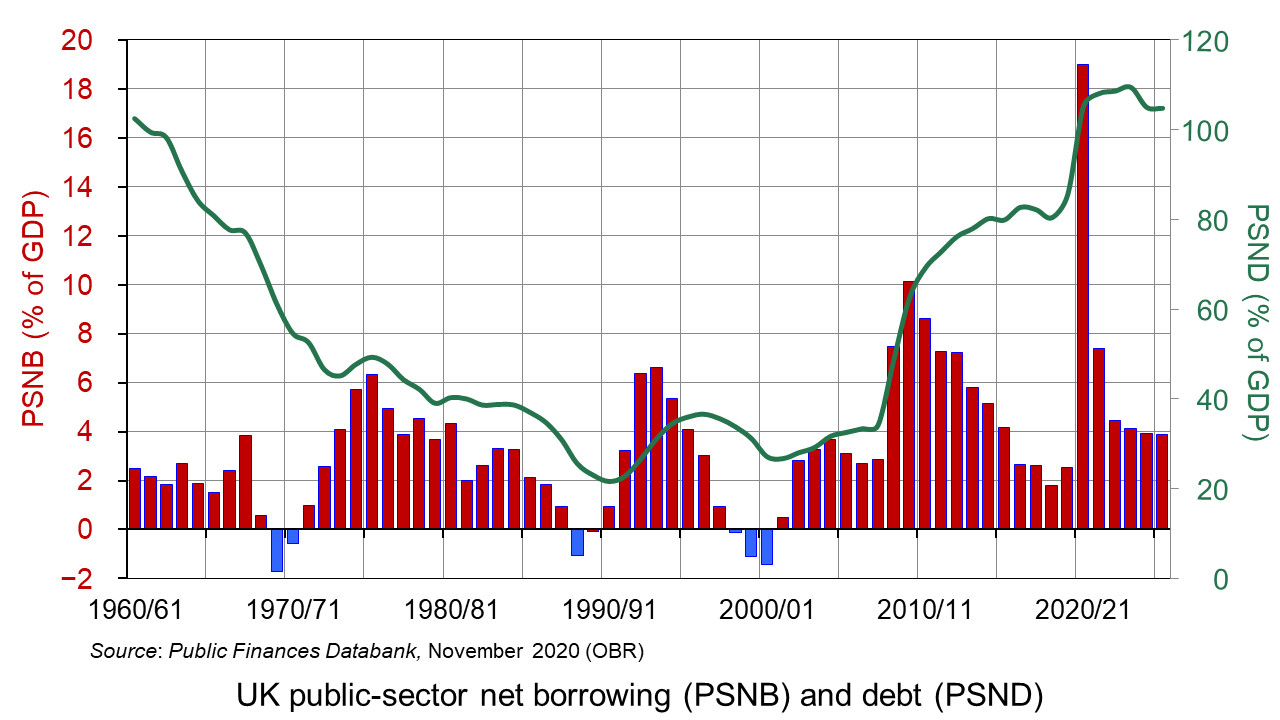
Government expenditure during the pandemic has risen sharply through measures such as the furlough scheme, the Self-Employment Income Support Scheme and various business loans. This, combined with falling tax revenue, as incomes and consumer expenditure have declined, has led to a rise in public-sector net borrowing (PSNB) from 2.5% of GDP in 2019/20 to a central forecast of 19% for 2020/21 – the largest since World War II. By 2025/26 it is still forecast to be 3.9% of GDP. The figure has also been pushed up by a fall in nominal GDP for 2020/21 (the denominator) by nearly 7%. (Click here for a PowerPoint of the above chart.)
The high levels of PSNB are pushing up public-sector net debt (PSNB). This is forecast to rise from 85.5% of GDP in 2019/20 to 105.2% in 2020/21, peaking at 109.4% in 2023/24.
The exceptionally high deficit and debt levels will mean that the government misses by a very large margin its three borrowing and debt targets set out in the latest (Autumn 2016) ‘Charter for Budget Responsibility‘. These are:
- to reduce cyclically-adjusted public-sector net borrowing to below 2% of GDP by 2020/21;
- for public-sector net debt as a percentage of GDP to be falling in 2020/21;
- for overall borrowing to be zero or in surplus by 2025/26.
But, as the Chancellor said in presenting the Review:
Our health emergency is not yet over. And our economic emergency has only just begun. So our immediate priority is to protect people’s lives and livelihoods.
Putting the public finances on a sustainable footing
Running a large budget deficit in an emergency is an essential policy for dealing with the massive decline in aggregate demand and for supporting those who have, or otherwise would have, lost their jobs. But what of the longer-term implications? What are the options for dealing with the high levels of debt?
1. Raising taxes. This tends to be the preferred approach of those on the left, who want to protect or improve public services. For them, the use of higher progressive taxes, such as income tax, or corporation tax or capital gains tax, are a means of funding such services and of providing support for those on lower incomes. There has been much discussion of the possibility of finding a way of taxing large tech companies, which are able to avoid taxes by declaring very low profits by diverting them to tax havens.
2. Cutting government expenditure. This is the traditional preference of those on the right, who prefer to cut the overall size of the state and thus allow for lower taxes. However, this is difficult to do without cutting vital services.  Indeed, there is pressure to have higher government expenditure over the longer term to finance infrastructure investment – something supported by the Conservative government.
A downside of either of the above is that they squeeze aggregate demand and hence may slow the recovery. There was much discussion after the financial crisis over whether ‘austerity policies’ hindered the recovery and whether they created negative supply-side effects by dampening investment.
3. Accepting higher levels of debt into the longer term. This is a possible response as long as interest rates remain at record low levels. With depressed demand, loose monetary policy may be sustainable over a number of years. Quantitative easing depresses bond yields and makes it cheaper for governments to finance borrowing. Servicing high levels of debt may be quite affordable.
The problem is if inflation begins to rise. Even with lower aggregate demand, if aggregate supply has fallen faster because of bankruptcies and lack of investment, there may be upward pressure on prices. The Bank of England may have to raise interest rates, making it more expensive for the government to service its debts.
Another problem with not reducing the debt is that if another emergency occurs in the future, there will be less scope for further borrowing to support the economy.
 4. Higher growth ‘deals’ with the deficit and reduces debt. In this scenario, austerity would be unnecessary. This is the ‘golden’ scenario – for the country to grow its way out of the problem. Higher output and incomes leads to higher tax revenues, and lower unemployment leads to lower expenditure on unemployment benefits. The crucial question is the relationship between aggregate demand and supply. For growth to be sustainable and shrink the debt/GDP ratio, aggregate demand must expand steadily in line with the growth in aggregate supply. The faster aggregate supply can grow, the faster can aggregate demand. In other words, the faster the growth in potential GDP, the faster can be the sustainable rate of growth of actual GDP and the faster can the debt/GDP ratio shrink.
One of the key issues is the degree of economic ‘scarring’ from the pandemic and the associated restrictions on economic activity. The bigger the decline in potential output from the closure of firms and the greater the deskilling of workers who have been laid off, the harder it will be for the economy to recover and the longer high deficits are likely to persist.
Another issue is the lack of labour productivity growth in the UK in recent years. If labour productivity does not increase, this will severely restrict the growth in potential output. Focusing on training and examining incentives, work practices and pay structures are necessary if productivity is to rise significantly. So too is finding ways to encourage firms to increase investment in new technologies.
Podcast and videos
Articles
- Initial reaction from IFS researchers on Spending Review 2020 and OBR forecasts
IFS Press Release, Paul Johnson, Carl Emmerson, Ben Zaranko, Tom Waters and Isabel Stockton (25/11/200
- Rishi Sunak is likely to increase spending – which means tax rises will follow
IFS, Newspaper Article, Paul Johnson (23/11/20)
- Economic and Fiscal Outlook Executive Summary
OBR (25/11/20)
- UK’s Sunak says public finances are on ‘unsustainable’ path
Reuters, David Milliken (26/11/20)
- Rishi Sunak warns ‘economic emergency has only just begun’
BBC News, Szu Ping Chan (25/11/20)
- UK will need £27bn of spending cuts or tax rises, watchdog warns
The Guardian, Phillip Inman (25/11/20)
- What is tomorrow’s Spending Review all about?
The Institute of Chartered Accountants in England and Wales (24/11/20)
- Spending Review 2020: the experts react
The Conversation, Drew Woodhouse, Ernestine Gheyoh Ndzi, Jonquil Lowe, Anupam Nanda, Alex de Ruyter and Simon J. Smith (25/11/20)
OBR Data
Questions
- What is the significance of the relationship between the rate of economic growth and the rate of interest for financing public-sector debt over the longer term?
- What can the government do to encourage investment in the economy?
- Using OBR data, find out what has happened to the output gap over the past few years and what is forecast to happen to it over the next five years. Explain the significance of the figures.
- Distinguish between demand-side and supply-side policies. How would you characterise the policies to tackle public-sector net debt in terms of this distinction? Do the policies have a mixture of demand- and supply-side effects?
- Choose two other developed countries. Examine how their their public finances have been affected by the coronavirus pandemic and the policies they are adopting to tackle the economic effects of the pandemic.
 In the current environment of low inflation and rising unemployment, the Federal Reserve Bank, the USA’s central bank, has amended its monetary targets. The new measures were announced by the Fed chair, Jay Powell, in a speech for the annual Jackson Hole central bankers’ symposium (this year conducted online on August 27 and 28). The symposium was an opportunity for central bankers to reflect on their responses to the coronavirus pandemic and to consider what changes might need to be made to their monetary policy targets and instruments.
The Fed’s previous targets
Previously, like most other central banks, the Fed had a long-run inflation target of 2%. It did, however, also seek to ‘maximise employment’. In practice, this meant seeking to achieve a ‘normal’ rate of unemployment, which the Fed regards as ranging from 3.5 to 4.7% with a median value of 4.1%. The description of its objectives stated that:
In setting monetary policy, the Committee seeks to mitigate deviations of inflation from its longer-run goal and deviations of employment from the Committee’s assessments of its maximum level. These objectives are generally complementary. However, under circumstances in which the Committee judges that the objectives are not complementary, it follows a balanced approach in promoting them, taking into account the magnitude of the deviations and the potentially different time horizons over which employment and inflation are projected to return to levels judged consistent with its mandate.
The new targets
 Under the new system, the Fed has softened its inflation target. It will still be 2% over the longer term, but it will be regarded as an average, rather than a firm target. The Fed will be willing to see inflation above 2% for longer than previously before raising interest rates if this is felt necessary for the economy to recover and to achieve its long-run potential economic growth rate. Fed chair, Jay Powell, in a speech on 27 August said:
Following periods when inflation has been running below 2%, appropriate monetary policy will likely aim to achieve inflation moderately above 2 per cent for some time.
Additionally, the Fed has increased its emphasis on employment. Instead of focusing on deviations from normal employment, the Fed will now focus on the shortfall of employment from its normal level and not be concerned if employment temporarily exceeds its normal level. As Powell said:
Going forward, employment can run at or above real-time estimates of its maximum level without causing concern, unless accompanied by signs of unwanted increases in inflation or the emergence of other risks that could impede the attainment of our goals
 The Fed will also take account of the distribution of employment and pay more attention to achieving a strong labour market in low-income and disadvantaged communities. However, apart from the benefits to such communities from a generally strong labour market, it is not clear how the Fed could focus on disadvantaged communities through the instruments it has at its disposal – interest rate changes and quantitative easing.
Assessment
Modern monetary theorists (see blog MMT – a Magic Money Tree or Modern Monetary Theory?) will welcome the changes, arguing that they will allow more aggressive expansion and higher government borrowing at ultra-low interest rates.
The problem for the Fed is that it is attempting to achieve more aggressive goals without having any more than the two monetary instruments it currently has – lowering interest rates and increasing money supply through asset purchases (quantitative easing). Interest rates are already near rock bottom and further quantitative easing may continue to inflate asset prices (such as share and property prices) without sufficiently stimulating aggregate demand. Changing targets without changing the means of achieving them is likely to be unsuccessful.
It remains to be seen whether the Fed will move to funding government borrowing directly, which could allow for a huge stimulus through infrastructure spending, or whether it will merely stick to using asset purchases as a way for introducing new money into the system.
Articles
- In landmark shift, Fed rewrites approach to inflation, labor market
Reuters, Jonnelle Marte, Ann Saphir and Howard Schneider (27/8/20)
- 5 Key Takeaways From Powell’s Jackson Hole Fed Speech
Bloomberg, Mohamed A. El-Erian (28/8/20)
- Fed adopts new strategy to allow higher inflation and welcome strong labor markets
Market Watch, Greg Robb (27/8/20)
- Fed to tolerate higher inflation in policy shift
Financial Times, James Politi and Colby Smith (27/8/20)
- Fed inflation shift raises questions about past rate rises
Financial Times, James Politi and Colby Smith (28/8/20)
- Dollar slides as bond market signals rising inflation angst
Financial Times, Adam Samson and Colby Smith (28/8/20)
- Wall Street shares rise after Fed announces soft approach to inflation
The Guardian, Larry Elliott (27/8/20)
- How the Fed Is Bringing an Inflation Debate to a Boil
Bloomberg, Ben Holland, Enda Curran, Vivien Lou Chen and Kyoungwha Kim (27/8/20)
- The live now, pay later economy comes at a heavy cost for us all
The Guardian, Phillip Inman (29/8/20)
- The world’s central banks are starting to experiment. But what comes next?
The Guardian, Adam Tooze (9/9/20)
Speeches
Questions
- Find out how much asset purchases by the Fed, the Bank of England and the ECB have increased in the current rounds of quantitative easing.
- How do asset purchases affect narrow money, broad money and aggregate demand? Is there a fixed money multiplier effect between the narrow money increases and aggregate demand? Explain.
- Why did the dollar exchange rate fall following the announcement of the new measures by Jay Powell?
- The Governor of the Bank of England, Andrew Bailey, also gave a speech at the Jackson Hole symposium. How does the approach to money policy outlined by Bailey differ from that outlined by Jay Powell?
- What practical steps, if any, could a central bank take to improve the relative employment prospects of disadvantaged groups?
- Outline the arguments for and against central banks directly funding government expenditure through money creation.
- What longer-term problems are likely to arise from central banks pursuing ultra-low interest rates for an extended period of time?
 The global economic impact of the coronavirus outbreak is uncertain but potentially very large. There has already been a massive effect on China, with large parts of the Chinese economy shut down. As the disease spreads to other countries, they too will experience supply shocks as schools and workplaces close down and travel restrictions are imposed. This has already happened in South Korea, Japan and Italy. The size of these effects is still unknown and will depend on the effectiveness of the containment measures that countries are putting in place and on the behaviour of people in self isolating if they have any symptoms or even possible exposure.
The OECD in its March 2020 interim Economic Assessment: Coronavirus: The world economy at risk estimates that global economic growth will be around half a percentage point lower than previously forecast – down from 2.9% to 2.4%. But this is based on the assumption that ‘the epidemic peaks in China in the first quarter of 2020 and outbreaks in other countries prove mild and contained.’ If the disease develops into a pandemic, as many health officials are predicting, the global economic effect could be much larger. In such cases, the OECD predicts a halving of global economic growth to 1.5%. But even this may be overoptimistic, with growing talk of a global recession.
Governments and central banks around the world are already planning measures to boost aggregate demand. The Federal Reserve, as an emergency measure on 3 March, reduced the Federal Funds rate by half a percentage point from the range of 1.5–1.75% to 1.0–1.25%. This was the first emergency rate cut since 2008.
Economic uncertainty
With considerable uncertainty about the spread of the disease and how effective containment measures will be, stock markets have fallen dramatically. The FTSE 100 fell by nearly 14% in the second half of February, before recovering slightly at the beginning of March.  It then fell by a further 7.7% on 9 March – the biggest one-day fall since the 2008 financial crisis. This was specifically in response to a plunge in oil prices as Russia and Saudi Arabia engaged in a price war. But it also reflected growing pessimism about the economic impact of the coronavirus as the global spread of the epidemic accelerated and countries were contemplating more draconian lock-down measures.
Firms have been drawing up contingency plans to respond to panic buying of essential items and falling demand for other goods. Supply-chain managers are working out how to respond to these changes and to disruptions to supplies from China and other affected countries.
Firms are also having to plan for disruptions to labour supply. Large numbers of employees may fall sick or be advised/required to stay at home. Or they may have to stay at home to look after children whose schools are closed.  For some firms, having their staff working from home will be easy; for others it will be impossible.
Some industries will be particularly badly hit, such as airlines, cruise lines and travel companies. Budget airlines have cancelled several flights and travel companies are beginning to offer substantial discounts. Manufacturing firms which are dependent on supplies from affected countries have also been badly hit. This is reflected in their share prices, which have seen large falls.
Longer-term effects
Uncertainty could have longer-term impacts on aggregate supply if firms decide to put investment on hold. This would also impact on the capital goods industries which supply machinery and equipment to investing firms. For the UK, already having suffered from Brexit uncertainty, this further uncertainty could prove very damaging for economic growth.
 While aggregate supply is likely to fall, or at least to grow less quickly, what will happen to the balance of aggregate demand and supply is less clear. A temporary rise in demand, as people stock up, could see a surge in prices, unless supermarkets and other firms are keen to demonstrate that they are not profiting from the disease. In the longer term, if aggregate demand continues to grow at past rates, it will probably outstrip the growth in aggregate supply and result in rising inflation. If, however, demand is subdued, as uncertainty about their own economic situation leads people to cut back on spending, inflation and even the price level may fall.
How quickly the global economy will ‘bounce back’ depends on how long the outbreak lasts and whether it becomes a serious pandemic and on how much investment has been affected. At the current time, it is impossible to predict with any accuracy the timing and scale of any such bounce back.
Articles
- Coronavirus: Global growth ‘could halve’ if outbreak intensifies
BBC News (2/3/20)
- Coronavirus: Eight charts on how it has shaken economies
BBC News, Lora Jones, David Brown & Daniele Palumbo (4/3/20)
- The economic ravages of coronavirus
BBC News, Douglas Fraser (7/3/20)
- What Coronavirus Could Mean for the Global Economy
Harvard Business Review, Philipp Carlsson-Szlezak, Martin Reeves and Paul Swartz (3/3/20)
- Coronavirus escalation could cut global economic growth in half – OECD
The Guardian, Richard Partington and Phillip Inman (2/3/20)
- U.S. Fed Cuts Rates, There Are Still Strategies The ECB Can Follow
Forbes, Stephen Pope (3/3/20)
- A coronavirus recession could be supply-side with a 1970s flavour
The Guardian, Kenneth Rogoff (3/3/20)
- Coronavirus will wreak havoc on the US economy
CNN, Mark Zandi (3/3/20)
- UK factories feel the effects of coronavirus spread – PMI
Reuters, William Schomberg (2/3/20)
- The first economic modelling of coronavirus scenarios is grim for Australia, the world
The Conversation, Australia, Warwick McKibbin and Roshen Fernando (3/3/20)
- Extraordinary complacency: the coronavirus and emerging markets
Financial Times, Geoff Dennis (2/3/20)
- Coronavirus Economic Impact On Global Economy
Seeking Alpha, Mark Bern (1/3/20)
- OECD warns coronavirus could halve global growth
Financial Times, Chris Giles, Martin Arnold and Brendan Greeley (2/3/20)
- BoE’s Carney sees ‘powerful and timely’ global response to coronavirus
Reuters, David Milliken, Elizabeth Howcroft (3/3/20)
eBook
Questions
- Using a supply and demand diagram, illustrate the fall in stock market prices caused by concerns over the effects of the coronavirus.
- Using either (i) an aggregate demand and supply diagram or (ii) a DAD/DAS diagram, illustrate how a fall in aggregate supply as a result of the economic effects of the coronavirus would lead to (a) a fall in real income and (i) a fall in the price level or (ii) a fall in inflation; (b) a fall in real income and (i) a rise in the price level or (ii) a rise in inflation.
- What would be the likely effects of central banks (a) cutting interest rates; (b) engaging in further quantitative easing?
- What would be the likely effects of governments running a larger budget deficit as a means of boosting the economy?
- Distinguish between stabilising and destabilising speculation. How would you characterise the speculation that has taken place on stock markets in response to the coronavirus?
- What are the implications of people being paid on zero-hour contracts of the government requiring workplaces to close?
- What long-term changes to working practices and government policy could result from short-term adjustments to the epidemic?
- Is the long-term macroeconomic impact of the coronavirus likely to be zero, as economies bounce back? Explain.
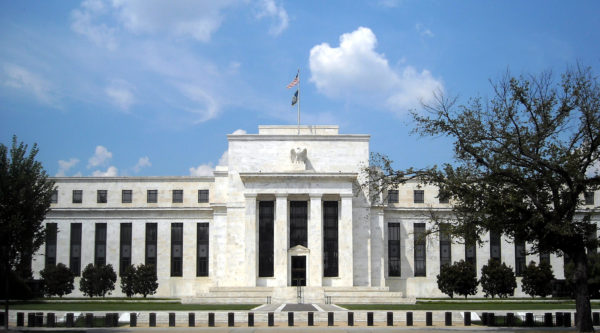 The monetary policy mandates of central banks have an impact on all our lives. While the terminology might not be familiar to many outside economics, their impact is, however, undeniably important. This is because they set out the objectives for the operation of monetary policy. Adjustments to interest rates or the growth of the money supply, which affect us all, reflect the mandate given to the central bank.
Since 1977 the mandate given to the Federal Reserve (the US central bank) by Congress has been to promote effectively the goals of maximum employment, stable prices, and moderate long-term interest rates. This mandate has become known as the dual mandate because it emphasises both employment and stable prices. Since 2012, the Federal Reserve’s Open Market Committee has issued an annual statemenent of its long-run goals. The latest was published in January 2019. Since this time, the Federal Reserve has explicitly set the ‘longer-run goal for inflation’ at 2 per cent. It has also emphasised that it would be ‘concerned’ if the inflation rate was persistently above or below this level.
In November 2018 the Federal Reserve began a review of its monetary policy strategy, its tools and how it communicates monetary policy. The review is being conducted within the guidelines that its statutory mandate gives and as well as the longer-term inflation goal of 2 per cent. However, one of the issues being addressed by the review is how the operation of monetary policy can avoid the rate of inflation frequently undershooting 2 per cent, as it has done since the financial crisis of the late 2000s and the introduction of the 2 per cent inflation rate target.
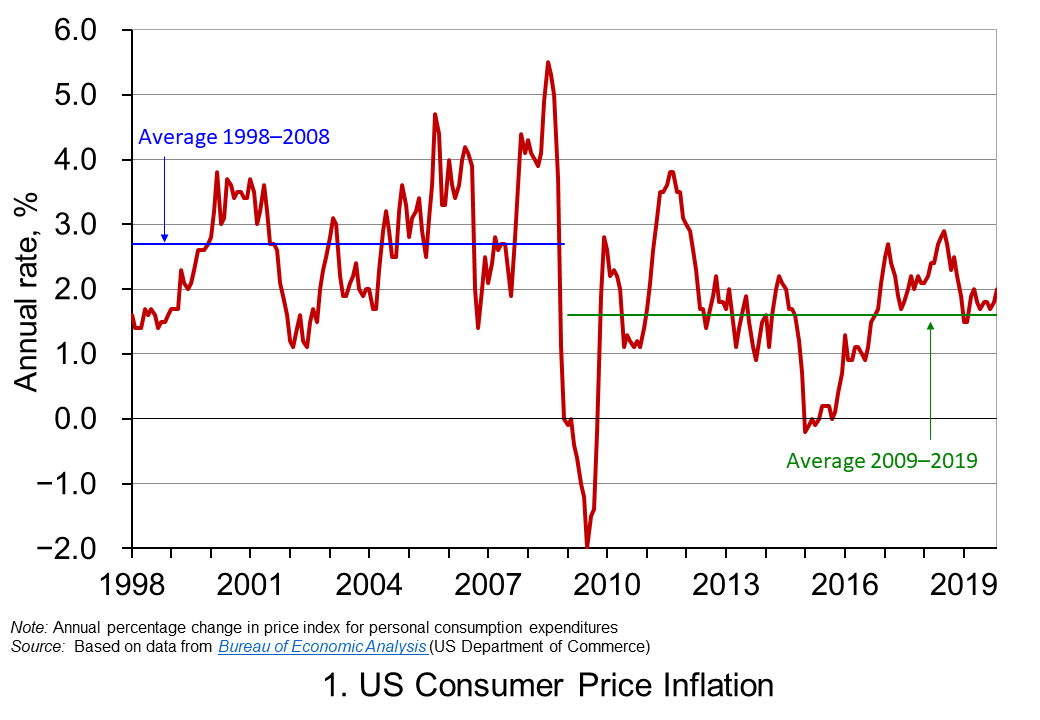 Chart 1 shows the annual rate of consumer price inflation in the US since 1998. It helps to illustrate the concern that low inflation rates can become entrenched. The chart shows that, while the average inflation rate from 1998 to 2008 was 2.7 per cent, from 2009 the average has been only 1.6 per cent. Interestingly, the average since 2012, when the explicit 2 per cent goal was introduced, to the present day is also 1.6 per cent. (Click here to download the PowerPoint chart.)
The concern going forward is that the natural or neutral rate of interest, which is the policy rate at which the rate of inflation is close to its target level and the level of output is close to its potential level, is now lower than in the recent past. Hence, when the next downturn occurs there is likely to be less room for cutting interest rates. Hence, the review is looking, in essence, to future-proof the conduct of monetary policy.
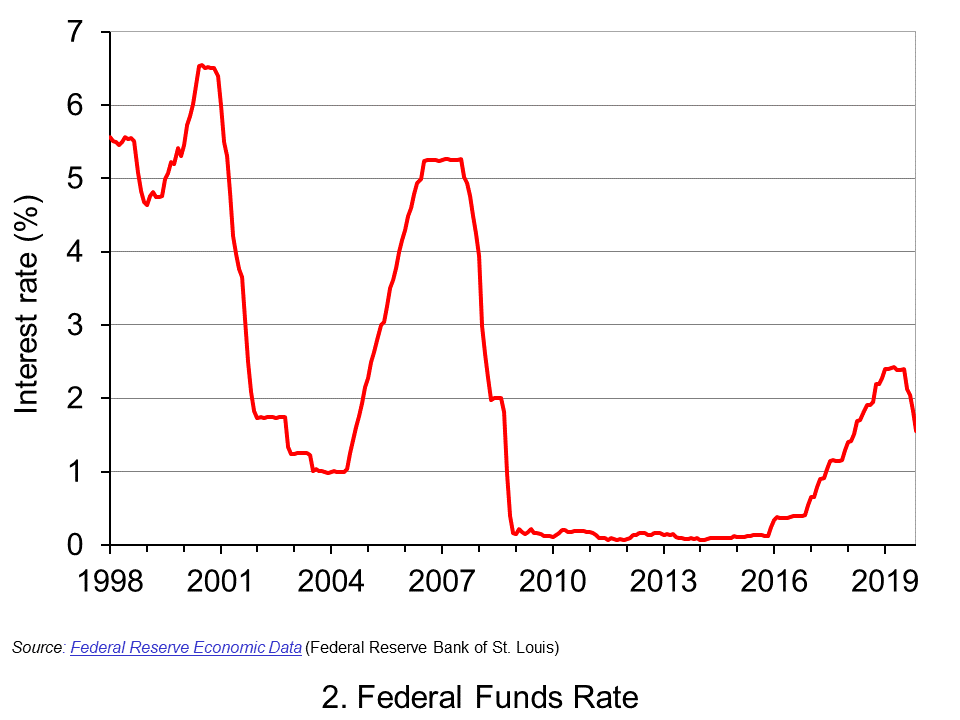 Chart 2 shows the Federal Fund rate since 1998. This is the rate at which commercial banks lend to each other the reserve balances they hold at the Federal Reserve in order to meet their reserve requirements. The Federal Reserve can affect this rate through buying or selling government securities. If it wants to drive up rates, it can sell holdings of government securities and reduce the money supply. If it wants to drive rates down, it can buy government securities and increase the money supply. The effects then ripple through to other interest rates and, in turn, aggregate demand and inflation. (Click here to download a copy of the PowerPoint chart.)
We can see from Chart 2 the dramatic cuts made by the Federal Reserve to interest rates as the financial crisis unfolded. The subsequent ‘normalisation’ of the Federal Funds rate in the 2010s saw the Federal Funds Rate rise to no higher than between 2.25 and 2.5 per cent. Then in 2019 the Federal Reserve began to cut rates again. This was despite historically-low unemployment rates. In November 2019 the unemployment rate fell to 3.5 per cent, its lowest since 1969. This has helped fuel the argument among some economists and financiers, which we saw earlier, that that the natural (or neutral) interest rate is now lower.
If the natural rate is lower, then this raises concerns about the effectiveness of monetary policy in future economic downturns. In this context, the review is considering ways in which the operation of monetary policy would be able to prevent the rate of inflation consistently undershooting its target. This includes a discussion of how the Fed can prevent inflationary expectations becoming anchored below 2 per cent. This is important because, should they do so, they help to anchor the actual rate of inflation below 2 per cent. One possibility being considered is an inflation make-up strategy. In other words, a period of below-target inflation rates would need to be matched by a period where inflation rates could exceed the 2 per cent target in order that the long-term average of 2 per cent is met.
An inflation make-up policy would work like forward guidance in that people and markets would know know that short-term interest rates would be kept lower for longer. This would then help to force longer-term interest rates lower as well as providing people and businesses with greater certainty that interest rates will be lower for longer. This could help to encourage spending, raise economic growth and prevent inflation from overshooting its target for any extensive period of time.
An inflation make-up strategy would, in part, help to cement the idea that the inflation target is effectively symmetrical and that 2 per cent is not an upper limit for the inflation rate. But, it would do more than that: it would allow the Fed to deliberately exceed the 2 per cent target.
An inflation make-up strategy does raise issues. For example, how would the Fed determine the magnitude of any inflation make-up and for how long would a looser monetary stance be allowed to operate? In other words, would an inflation make-up strategy be determined by a specific rule or formula? Or, would the principle be applied flexibly? Finally, could a simpler alternative be to raise the target rate itself, given the tendency to undershoot the 2 per cent target rate? If so, what should that the rate be?
We should know by the end of 2020 whether the Federal Reserve will adopt, when necessary, an inflation make-up monetary policy.
Articles
Questions
- What do you understand by the monetary policy mandate of a central bank?
- Explain the ways in which the monetary policy mandate of the central bank affects our everyday lives.
- Why are inflation-rate expectations important in determining actual inflation rates?
- Why is the Federal Reserve concerned about its ability to use monetary policy effectively during future economic downturns?
- Discuss the economic arguments for and against central banks operating strict inflation-rate targets.
- Does the case for adopting an inflation make-up monetary policy mandate show that the argument for inflation-rate targeting has been lost?
- What do you understand by the idea of a natural or neutral policy interest rate? Would the actual rate be expected to be above or below this if the rate of inflation was below its target level?