 Donald Trump is keen to lower US interest rates substantially and rapidly in order to provide a boost to the US economy. He is also keen to reduce the cost of living for US citizens and sees lower interest rates as a means of reducing the burden of debt servicing for both consumers and firms alike.
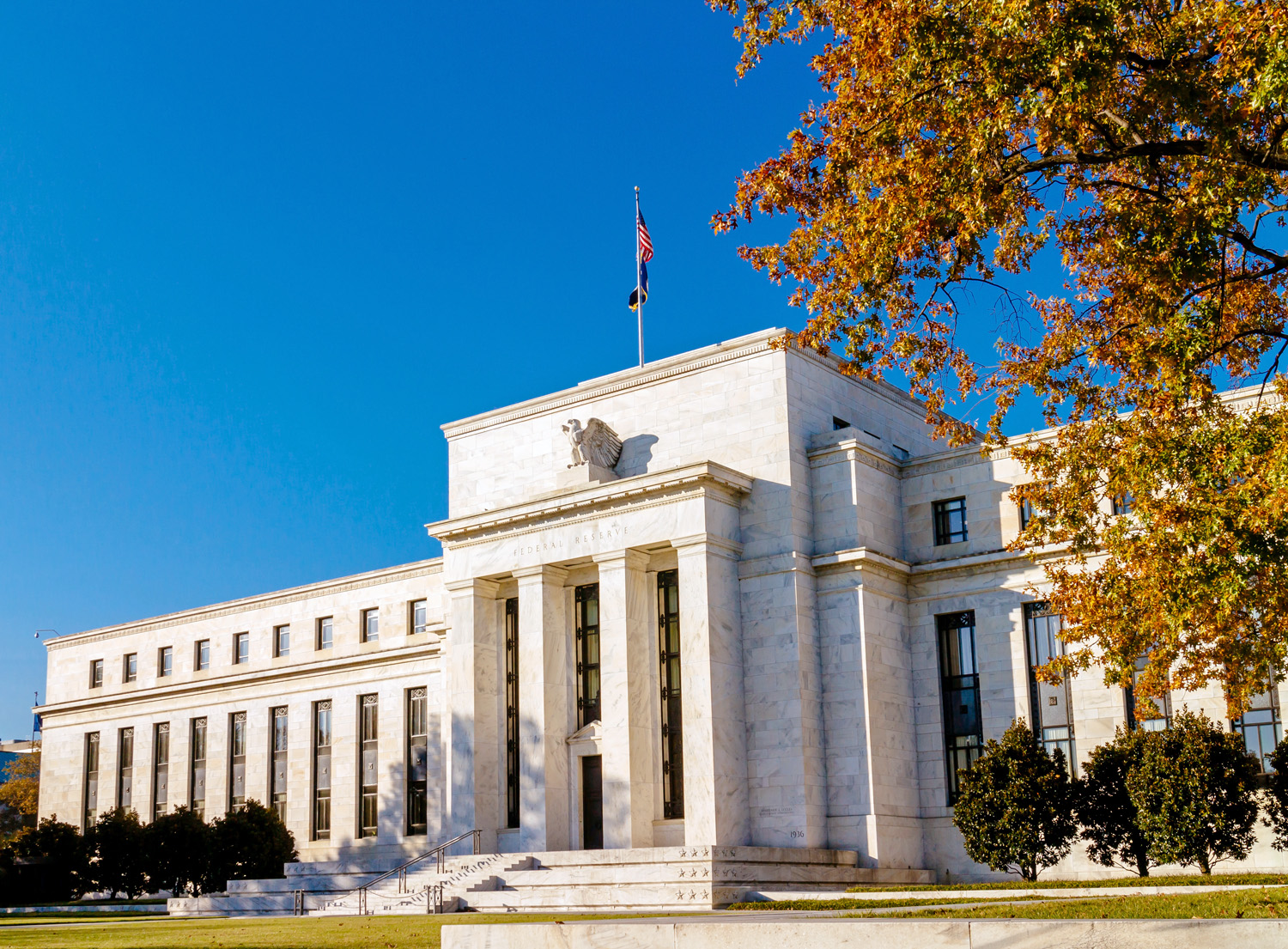
But interest rates are set by the US central bank, the Federal Reserve (the ‘Fed’), which is formally independent from government. This independence is seen as important for providing stability to the US economy and removing monetary policy from short-term political pressures to cut interest rates. Succumbing to political pressures would be likely to create uncertainty and damage long-term stability and growth.
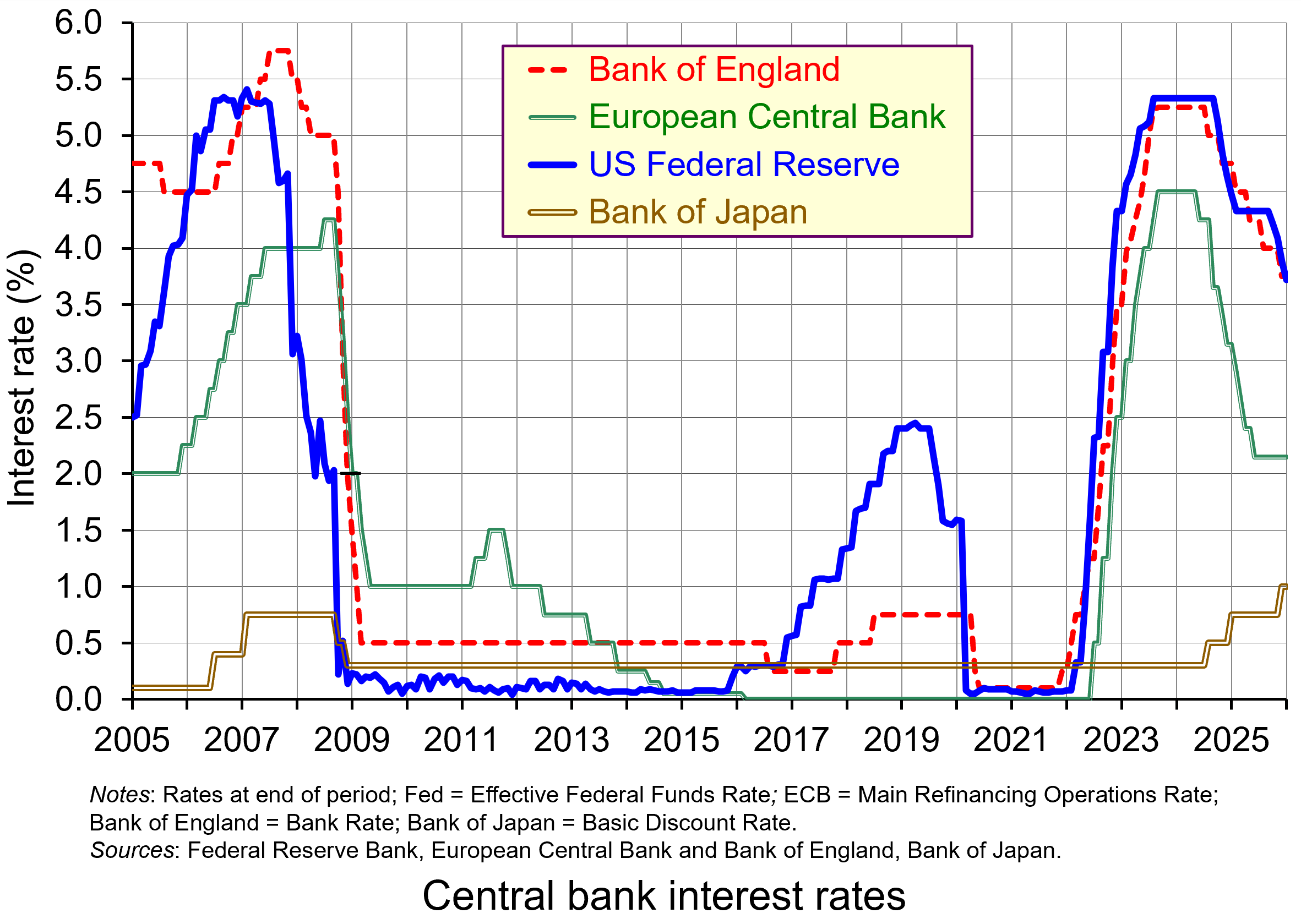
Yet President Trump is pushing the Fed to lower interest rates rapidly and despite three cuts in a row of 0.25 percentage points in the last part of 2025 (see chart below), he thinks this as too little and is annoyed by suggestions that the Fed is unlikely to lower rates again for a while. He has put great pressure on Jerome Powell, the Fed Chair, to go further and faster and has threatened to replace him before his term expires in May this year. He has also made clear that he is likely to appoint someone more willing to cutting rates.
The Federal Reserve headquarters in Washington is currently being renovated. The nine-year project is costing $2.5 billion and is due to be completed next year. President Trump has declared that the project’s costs are excessive and unnecessary.
On 11 January, Federal prosecutors confirmed that they were opening a criminal investigation into Powell, accusing him of lying to Congress in his June 2025 testimony regarding the scope and costs of the renovations.
Powell responded by posting a video in which he claimed that the real reason that he was being threatened with criminal charges was not because of the renovations but because the Fed had ignored President Trump’s pressure and had set interest rates:
based on our best assessment of what will serve the public, rather than following the preferences of the President. This is about whether the Fed will be able to continue to set interest rates based on evidence and economic conditions – or whether, instead, monetary policy will be directed by political pressure or intimidation.
The Fed’s mandate
 The Federal Reserve Board decides on monetary policy and then the Federal Open Market Committee (FOMC) decides how to carry it out. It decides on interest rates and asset sales or purchases. The FOMC meets eight times a year.
The Fed is independent of both the President and Congress, and its Chair is generally regarded as having great power in determining the country’s economic policy.
Since 1977, the Fed’s statutory mandate has been to promote the goals of stable prices and maximum employment. Because of the reference to both prices and employment, the mandate is commonly referred to as a ‘dual mandate’. Its inflation target is 2 per cent over the long run with ‘well anchored’ inflationary expectations.
The dual mandate is unlike that of the Bank of England, the European Central Bank, the Bank of Japan and most other central banks, which all have a single key mandate of achieving a target of a 2 per cent annual rate of consumer price inflation over a particular time period.
With a dual mandate, the two objectives may well conflict from time to time. Moreover, changes in monetary policy affect these objectives with a lag and potentially over different time horizons. Hence, an assessment may have to be made of which is the most pressing problem. This does give some leeway in setting interest rates somewhat lower than if there were a single inflation-rate target. Nevertheless, the assessment is in terms of how best to achieve the mandate and not to meet current political goals.
Statement by former Fed Chairs and Governors
On 12 January, three former Chairs of the Federal Reserve (Janet Yellen, Ben Bernanke and Alan Greenspan), four former Treasury Secretaries (Timothy Geithner, Jacob Lew, Henry Paulson and Robert Rubin) and seven other top former economic officials issued the following statement (see Substack link in the Articles section below):
The Federal Reserve’s independence and the public’s perception of that independence are critical for economic performance, including achieving the goals Congress has set for the Federal Reserve of stable prices, maximum employment, and moderate long-term interest rates. The reported criminal inquiry into Federal Reserve Chair Jay Powell is an unprecedented attempt to use prosecutorial attacks to undermine that independence. This is how monetary policy is made in emerging markets with weak institutions, with highly negative consequences for inflation and the functioning of their economies more broadly. It has no place in the United States whose greatest strength is the rule of law, which is at the foundation of our economic success.
Response of investors
 What will happen to the dollar, US bond prices, share prices and US inflation, and what will happen to investment, depends on how people respond to the threat to the Fed’s independence. Initially, there was little response from markets, with investors probably concluding that President Trump is unlikely to be able to sway FOMC members. What is more, several Republican lawmakers have begun criticising the Trump administration’s criminal investigation, making it harder for the President to influence Fed decisions.
Even if Powell is replaced, either in the short term or in May, by a chair keen to pursue the Trump agenda, that chair will still be just one of twelve voting members of the FOMC.
Seven are appointed by the President, but serve for staggered 14-year terms. Four have been appointed by President Trump, but the other three were appointed by President Biden, although one – Lisa Cook – is being indicted by the Supreme Court for mortgage fraud, with the hearing scheduled for January 21. She claims that this is a trumped-up charge to provide grounds for removing her from the Fed. If she is removed, President Trump could appoint a replacement minded to cut rates.
The other five members include the President of the New York Fed and four of the eleven other regional Fed Presidents serving in rotation. These four are generally hawkish and would oppose early rate cuts.
Thus it is unlikely that President Trump will succeed in pushing the Fed to lower interest rates earlier than they would have done. For that reason, markets have remained relatively sanguine.
 Nevertheless, Donald Trump’s actions could well cause investors to become more worried. Will he try to find other ways to undermine the Fed? Will his actions over Venezuela, Cuba, Greenland and Iran, let alone his policies towards Ukraine and Russia and towards Israel and Gaza, heighten global uncertainty? Will his actions towards Venezuela and his desire to take over Greenland embolden China to attempt to annex Taiwan, and Russia to continue to resist plans to end the war in Ukraine or to make stronger demands?
Such developments could cause investor confidence to wane and for stock markets to fall. Time will tell. I think we need a crystal ball!
Videos
 Statement from Federal Reserve Chair Jerome H. Powell
- Trump’s intimidation of Fed’s leadership threatens economic stability, Yellen says
- Janet Yellen says Powell probe ‘extremely chilling’ for Fed independence, market should be concerned
- Treasury Secretary Scott Bessent is reportedly unhappy with criminal investigation of Fed Chair Jerome Powell
Board of Governors of the Federal Reserve System, Jerome H. Powell, Chair (11/1/26)
PBS News, Janet Yellen and Amna Nawaz (12/1/26)
CNBC on YouTube, Janet Yellen and Sara Eisen (12/1/26)
CNN This Morning (13/1/26)
Articles
- Federal prosecutors open criminal investigation into the Fed and Jerome Powell
- The Fed just gave a rare look at its $2.5 billion renovation — right before Trump’s tour
- ‘A bone-headed move’: Trump’s shocking battle with Powell could badly backfire
- Why Powell is fighting back against Trump: The US economy is at stake
- Fed chair Powell hits out at ‘unprecedented’ probe by US justice department
- Justice department opens investigation into Jerome Powell as Trump ramps up campaign against Federal Reserve
- Some Republicans speak out against DoJ investigation into Fed chair
- Trump’s attempts to influence Fed risk 1970s-style inflation and global backlash
- Statement on the Federal Reserve
- Yellen says Powell probe ‘extremely chilling’ for Fed independence, market should be concerned
- Global central bankers unite in defense of Fed Chair Jerome Powell
- Trump attacks Powell again amid Fed independence fears: ‘That jerk will be gone soon’
- Former Fed chairs condemn criminal investigation into Jerome Powell
- Fed: Towards a very divided Fed in the coming months and quarters
- Treasury Yields Diverge as Powell Probe Rekindles Fed Independence Risk
- Instant View: Investors react as Trump-Fed feud escalates
- Fighting the Fed, Trump tries credit easing by decree
- Trump’s attacks on the Federal Reserve risk fuelling US inflation and ending dollar dominance
CNN, Bryan Mena (11/1/26)
CNN, Bryan Mena (24/7/25)
CNN, Matt Egan (12/1/26)
CNN, Bryan Mena (13/1/26)
BBC News, Ana Faguy and Osmond Chia (12/1/26)
The Guardian, Callum Jones (12/1/26)
The Guardian, Joseph Gedeon (12/1/26)
The Guardian, Richard Partington (12/1/26)
Substack, 14 signatories (12/1/26)
CNBC, Jeff Cox (12/1/26)
CNBC, Holly Ellyatt (13/1/26)
CNBC, Kevin Breuninger (13/1/26)
BBC News, Danielle Kaye (12/1/26)
CPR AM, Bastien Drut (28/11/25)
Investing.com, Khasay Hashimov (12/1/26)
Reuters (12/1/26)
Reuters, Mike Dolan (13/1/26)
The Conversation, Emre Tarim (13/1/26)
Questions
- What are the arguments for central bank independence?
- What are the arguments for control of monetary policy by the central government?
- Assess the above arguments.
- Find out what has happened to interest rates, the US stock market and the dollar since this blog was written.
- How do the fiscal decisions by government affect monetary policy?
- Compare the benefits of the dual mandate system of the Fed with those of the single mandate of the Bank of England and ECB.