 Let’s face it – no-one likes paying tax! After all, to see your monthly pay decline by £1000 through taxation and national insurance has got to hurt. Yet, taxation and national insurance contributions are essential sources of government revenue to finance benefits and public and merit goods.
However, with so much attention given to the UK’s ‘culture of dependency’, many people are increasingly angry with having to pay so much in taxation to see it being spent by the government on individuals who in some cases choose not to work and at the same time seeing other rich people paying so little in taxation. The increase in the top rate of tax received a lot of coverage. Although it did make the tax system more progressive, there were many concerns that it would lead to lower growth, a lack of innovation and enterprise and increased tax evasion and avoidance, as the super-rich were being hit with phenomenal tax bills. The post on the 50p income tax available here is worth looking at again to think about the effect that taxes have on incentives.
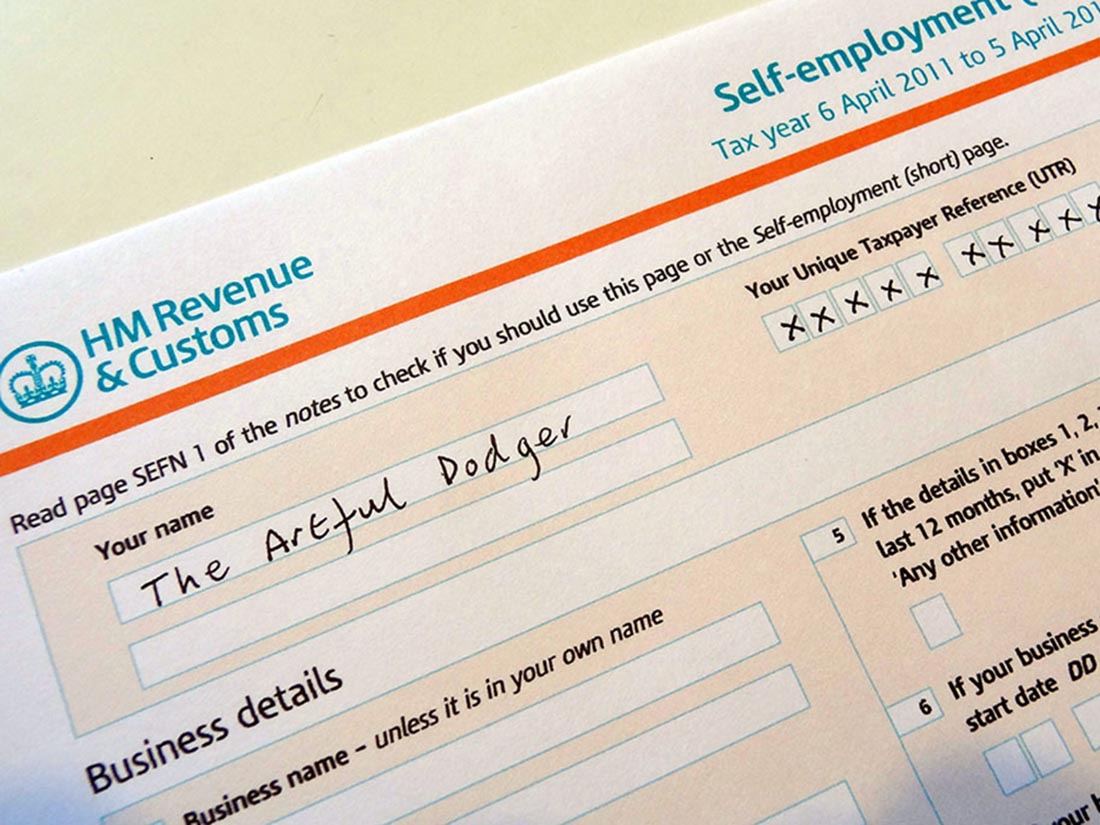
The issue of tax avoidance is by no means new, but with a large budget deficit in the UK, tax avoidance by the super-rich has become something that everyone has an opinion on. The average household has seen its income squeezed more and more, as the government continues its efforts to cut the deficit. The fact that the super rich are avoiding sometimes millions in taxation, while the average household struggles to pay even the basic rate of tax, creates a rather contentious issue. The Chief Secretary to the Treasury, Danny Alexander, has said that the basic rate of tax could be cut by 2p in the pound if tax avoidance came to an end. He commented to the BBC’s Sunday Politics Programme that:
‘We have to make sure that everybody, especially the rich and famous, are paying their fair share of tax…These sorts of schemes that save wealthy people potentially tens of millions of pounds in tax, they are paid for by everybody else… If we could narrow the tax gap in this country by a quarter we could reduce income tax for every basic rate payer by 2p in the pound.’
This would clearly have some very positive effects on some of the poorest people living in the UK.
There is a variety of tax avoidance schemes available and the one receiving the most attention at present is the Jersey-based K2 scheme, which Jimmy Carr and others are thought to be using. The Public Accounts Committee will be reporting on the problem of using private companies to pay salaries, as a means of avoiding income tax and national insurance contributions.
If tax avoidance could be stopped, or at least reduced, then not only could basic rate tax payers benefit, but it might go some way to cutting the budget deficit, giving the government more flexibility in stimulating the economy. According to HMRC, tax avoidance and evasion cost the economy some £42 billion – enough to pay off one-third of Britain’s budget deficit.
The following articles consider the problem of tax avoidance and then try answering the questions on the issue of taxation.
Five-point plan to curb tax cheating by big firms and super-rich Guardian (27/6/12)
Stop tax dodgers or there will be ‘riots on the streets’, warns top lawyer designing new anti-avoidance rules Mail Online, Julian Gavaghan (26/6/12)
Danny Alexander describes aggressive tax avoidance as ‘morally repugnant’ Guardian, Patrick Wintour (24/6/12)
Basic tax ‘could be cut by 2p’ if avoidance ended BBC News(24/6/12)
Danny Alexander says tax avoidance ‘adds 2p in every £1 to basic tax rate’ Independent, Oliver Wright (24/6/12)
Make tax returns public, urges peer The Press Association (28/6/12)
Tax officials reveal scale of probe Financial Times, Jim Pickard (27/6/12)
Questions
- What are the key principles of a good tax system?
- Explain how taxation affects the incentive to work?
- What is the difference between tax evasion and tax avoidance?
- Using indifference analysis, illustrate the effect of a cut in the basic rate of income tax. How does it affect the decision to work more or less? You should consider the income and substitution effects in your answer and which rate of tax (if any) an individual is paying.
- Why is tax avoidance of such concern at the moment? Think about the current state of the economy.
- What are taxes and national insurance contributions used to pay for?
- To what extent do you think tax avoidance is a natural consequence of any tax system?
 Youth unemployment has been one of the main headlines for some months, with data showing a record number of young people out of work.
As part of the government’s £1bn Youth Contract that aims to help young people back into work and help those unable to find employment, Nick Clegg has announced wage subsidies to firms hiring 18-24 year olds will be paid earlier.
Some of the costs of unemployment are obvious. For the individual who is unemployed, it means a lack of income and hence inability to buy goods and services. This then has wider implications for the economy. If people are unable to purchase goods and services, this contributes to a lower level of aggregate demand, which in times of recession, is hardly ideal.
Unemployment also means an inefficient use of resources, meaning the economy is operating below full capacity. Fewer people in work also implies lower tax revenues for the government, at the same time as higher unemployment benefit payments, contributing towards a growing budget deficit. This point is of particular concern, when it is young workers claiming benefits, as it could mean a life of dependency.
 There are also some longer-term consequences, in particular for those who have been out of work for some time. They lose their skills, making it harder to find a job and this can pose costs to employers and further costs to the government through re-training. As such, government initiatives to tackle youth unemployment have never been more important.
The wage subsidies that were announced back in November will now be paid when young people have been out of work for six months, instead of nine. This initiative aims to help reduce youth unemployment in areas where it is at its worst. Twenty local authorities have been identified as priorities for the government and will benefit from this scheme. As Nick Clegg said to CBI summit:
“Three months can make all the difference. When you feel like your banging your head against a brick wall, when you live in an area where opportunities are already few and far between, another 12 weeks of rejection letters, of being cut off, of sitting at home waiting, worrying, that can seriously knock the stuffing out of you, making it extremely difficult to pick yourself up …
So jobcentres will be able to make use of the subsidy before people are referred to the Work Programme, capitalising on their links with local employers, and they’ll also intensify support, so more training, more regular coaching, spending more time with young people to knock a CV into shape or prep ahead of an interview.”
There are critics of the scheme, who argue that it is too little, too late and that it will simply displace older workers, thereby creating worse unemployment for another group. Until the economy begins to grow and confidence returns to the markets, unemployment is likely to remain a frequent headline. The following articles consider the wage subsidy and the state of unemployment in the UK.
Wage subsidy could mean more jobs Independent Online, Business Report, Pierre Heistein (14/6/12)
Wage subsidies scheme moved forward The Press Association (27/6/12)
Wage subsidy plan for young workers brought forward BBC News (27/6/12)
Wage subsidies scheme moved forward Independent, Alan Jones (27/6/12)
Nick Clegg announces extra help for jobless in 20 troublespots Guardian, Juliette Jowit (27/6/12)
Young people’s prospects have ‘nose-dived’ says report BBC News, Judith Burns (25/6/12)
Economic gap between young and old significantly worse since 2008 – study Guardian, James Ball and Helene Mulholland (25/6/12)
Questions
- Why is unemployment such a big concern for the UK economy? What is so important about youth unemployment?
- Which factors have contributed towards such high youth unemployment?
- How will the wage subsidy encourage firms to take on more young people? Think about how a rational firm behaves when choosing between 2 workers.
- Why does the wage subsidy cause concern for organisations supporting the employment of older workers?
- To what extent do you agree with the Guardian article that says that young people have borne the brunt of the recession and subsequent government cuts?
- What other things have been undertaken in a bid to reduce unemployment and stimulate the economy?
- Think about the costs of unemployment. Categorise them into costs to (a) the individual, (b) friends and family, (c) the government and (d) the economy.
 With the deepening euro crisis, the slide back into recession in many developed countries and the slowing down of fast-growing developing countries, such as China and India, confidence is waning.
But just as pessimism increases, so too does uncertainty. The global economy is getting more and more difficult to forecast. So should economists give up trying to forecast? Should we rely on guesswork and hunch, or looking into crystal balls?
Bank of England representatives have been appearing before the Treasury Select Committee. And they have reiterated the consensus that things are getting more difficult to forecast. As Mervyn King said in his evidence:
There is just enormous uncertainty out there. I have no idea what is going to happen in the euro area.
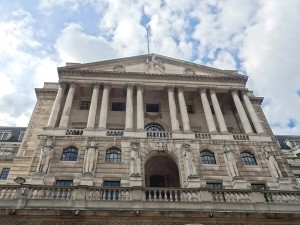 And this uncertainty is making people cautious, which, in turn, damages recovery. As Dr King went on to say:
There is no doubt that with the additional uncertainty this year there’s evidence of people behaving in a very defensive way, being unwilling to invest and of course the most extreme example of that would be if we were to get to a liquidity trap where essentially the main assets people wanted to hold were claims on the central bank.
Part of the reason for the uncertainty about global growth prospects is uncertainty about what European leaders will decide about the future of the eurozone. Another is uncertainty about how people will respond to the uncertainty of others. But predicting how others will predict is very difficult as they will themselves be predicting what others will predict. This dilemma was observed by Keynes when observing how investors on the stock market behaved, all trying to predict what others will do, and is known as the Keynesian Beauty Contest dilemma (see also).
So are governments and central banks powerless to counteract the uncertainty and pessimism? Can they restore confidence and growth? Members of the Bank of England’s Monetary Policy Committee believe that further action can be taken to stimulate aggregate demand. Further quantitative easing and cuts in interest rates could help as, according to Dr King, we are not yet in a liquidity trap.
UK Economic Outlook Uncertain Amid Euro Zone Crisis – BOE NASDAQ, Ilona Billington (26/6/12)
BOE King: UK Not In Liquidity Trap; No Limit On QE Market News International (26/6/12)
BOE King: Unity On Loose Policy; Not Half Way Through Crisis Market News International (26/6/12)
Full Text Of BOE MPC Dale At Treasury Select Committee Market News International (26/6/12)
Recovery still five years away, Mervyn King warns The Telegraph, Philip Aldrick (26/6/12)
Governor pessimistic on recovery ShareCast, Michael Millar (26/6/12)
Bank’s King says ‘pessimistic’ about worsening economy BBC News (26/6/12)
UK economic outlook getting worse, warns Bank of England Guardian, Phillip Inman (26/6/12)
Questions
- Why is it worth economists forecasting, even if those forecasts rarely turn out to be totally accurate?
- Why is it particularly difficult in current circumstances to forecast the state of the macroeconomy 12 months hence – let alone in two or three years?
- In what ways is the global macroeconomic situation deteriorating? What can national governments do about it?
- What limits the effectiveness of government action to deal with the current situation?
- What is meant by the liquidity trap? Are we close to being in such a situation today?
- Explain what is meant by the Keynesian Beauty Contest? How is this relevant today in explaining economic uncertainty and the difficulty of forecasting the economy?
 Recently there have been calls from business leaders and Conservative politicians to scrap the UK’s 50% income tax rate, which is paid on taxable incomes over £150,000. The 50% income tax rate is thus paid by top earners, who comprise around just 1% of taxpayers.
And yet the government receives about 30% of income tax revenue from this 1% – and this was before the introduction of the 50% rate in April 2010. (In fact, with the marginal national insurance rate of 2%, top earners are paying an effective marginal rate of 52%.)
One argument used by those who favour reducing the 50% rate is that the rich would pay more income tax, not less. There are four reasons given for this. The first is that people would be encouraged to work harder and/or seek promotion if they knew they would keep more of any rise in income. The second is that fewer rich people would be encouraged to leave the country or to relocate their businesses abroad. The third is that more people would be encouraged to work in or set up businesses in the UK. The fourth is that there would be less temptation to evade taxes by not declaring all income earned or to find clever ways of avoiding tax.
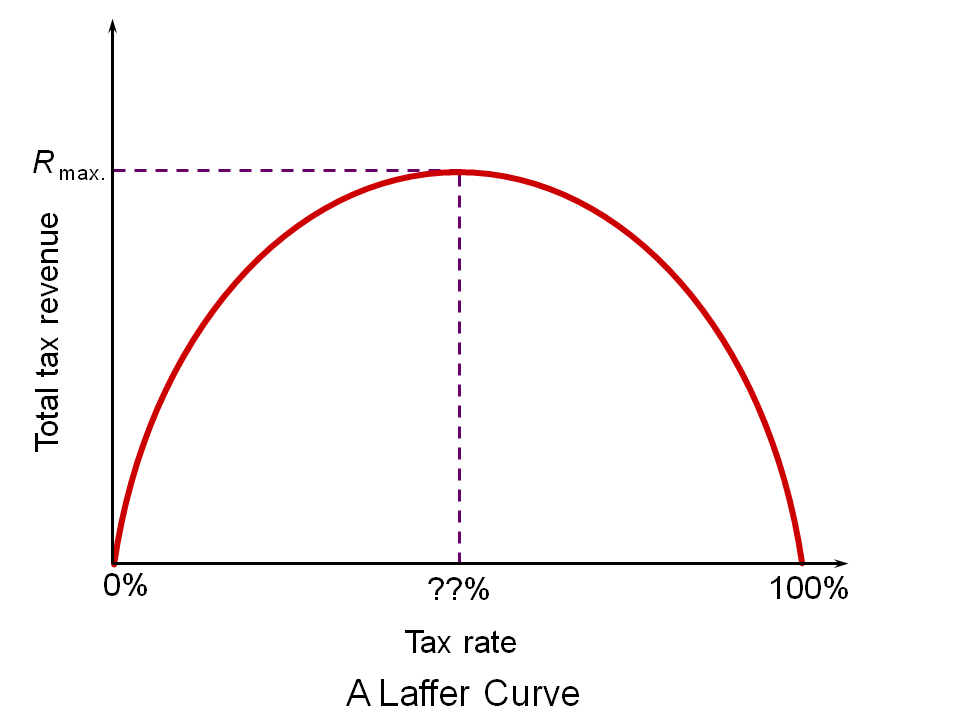
These arguments were put forward in the 1980s by Art Laffer, an adviser to President Reagan. His famous ‘Laffer curve’ (see Economics (8th edition) Box 10.3 or Economics (7th edition) Box 10.4) illustrated that tax revenues are maximised at a particular tax rate. The idea behind the Laffer curve is very simple. At a tax rate of 0%, tax revenue will be zero – but so too at a rate of 100%, since no-one would work if they had to pay all their income in taxes. As the tax rate rises from 0%, so tax revenue would rise. And so too, as the tax rate falls from 100%, the tax rate would rise. It follows that there will be some tax rate between 0% and 100% that maximises tax revenue.
Those arguing that a cut in the top rate of income tax would increase tax revenue are arguing that the 50% rate is beyond the peak of the Laffer curve. But this is an empirical issue. In other words, to assess the argument you would need to look at the evidence as, theoretically, the peak of the Laffer curve could be below or above 50%. Indeed, some argue that the peak is more likely to be at around 75%.
The following podcasts and articles consider the arguments. As you will see, the authors are not all agreed! Consider carefully their arguments and try to identify any flaws in their analysis.
Update
On 27 June 2012, Arthur Laffer appeared on the BBC Today Programme to discuss the Laffer curve and its implications for UK income tax policy. You can hear it from the link below
Podcasts
 Should the 50p tax rate be ditched? BBC Today Programme, John Redwood and Paul Johnson (3/3/12)
Arthur Laffer: Tax rate should ‘provide for growth’ BBC Today Programme (27/6/12)
Articles
Where’s the High Point on the Laffer Curve? And Where Are We? Business Insider, Angry bear Blog (3/3/12)
Tax cuts: we can have our cake and eat it The Telegraph, Ruth Porter (22/2/12)
‘Scrap the 50p tax rate’ say 500 UK entrepreneurs Management Today, Rebecca Burn-Callander (1/3/12)
The Laffer Curve Appears in the UK Forbes, Tim Worstall (22/2/12)
Memo to 50p tax trashers: Laffer Curve peaks at over 75 per cent Left Foot Forward, Alex Hern (1/3/12)
Questions
- Explain how a cut in income tax could lead to an increase in tax revenue.
- Distinguish between the income effect and the substitution effect of a tax cut. Which would have to be bigger if a tax cut were to increase tax revenue?
- If, in a given year, the top rate of tax were raised and tax revenue fell, would this prove that the economy was now past the peak of the Laffer curve?
- What would cause the Laffer curve to shift/change shape? To what extent could the government affect the shape of the Laffer curve?
- If the government retains the 50% top tax rate, what can it do to increase the revenue earned from people paying the top rate?
- What other objectives might the government have for having a high marginal income tax rate on top earners?
- Investigate the marginal income tax and national insurance (social protection) rates in other countries. How progressive are UK income taxes compared with those in other countries?
 Academic research is encouraged by universities. Indeed, the number and quality of research publications is the most important criterion for promotion in many universities.
Periodically university research in the UK is publicly assessed. The latest assessment is known as the Research Excellence Framework (REF) and will be completed in 2014. Most research that will be considered by the REF is published in peer-reviewed journals. Most of these journals are subscription based. Universities pay large amounts of money in subscriptions.
In recent years there has been much criticism by both academics and universities about the high cost of such subscriptions. In a movement dubbed the Academic Spring, pressure has mounted for journal articles to be made available free of charge – i.e. on open access.
The government too has been concerned that the results of publicly-funded research has been disappearing behind ‘paywalls’ and hence not available free to people outside the universities which subscribe to such journals. Indeed, no single university can afford licences for all the 25,000 peer-reviewed journals currently being published. As a result, the government set up a committee under the chair of Professor Janet Finch to examine alternative ways of making research more accessible. The committee has just published its report.
It advocates an expansion of open-access journals:
The principle that the results of research that has been publicly funded should be freely accessible in the public domain is a compelling one, and fundamentally unanswerable…
Instead of relying on subscription revenues provided by or on behalf of readers, most [open-access journals] charge a fee to authors…before an article is published. Access for readers is then free of charge, immediately on publication, and with very few restrictions on use and re-use.
Under this model, universities would essentially pay to have their academics’ articles published rather than paying to purchase the journal. Alternatively, research councils could fund the publication of articles based on research already funded by them.
Many people go further. They argue that authors ought to be able to have their published research in any journal made freely available, after an embargo period, through their university’s website.
So is the current pricing model the best for encouraging research and for disseminating its findings? Or is open access a better model – and if so, of what form? Or would it discourage publishers and lead, in the end, to less being published or to a less rigorous peer review process? The questions are ones of pricing, incentives, choices and investment – the questions that economists are qualified to consider.
Articles
Open access may require funds to be rationed Times Higher Education, Paul Jump (21/6/12)
Set science free from publishers’ paywalls New Scientist, Stephen Curry (19/6/12)
Scientists must make research an open book Independent, Martin Hickman (18/6/12)
Report calls on government to back open access science BBC News, Pallab Ghosh (19/6/12)
Open access is the future of academic publishing, says Finch report Guardian, Alok Jha (19/6/12)
Open access to science – its implications discussed in UK raport ZME Science (19/6/12)
UK move to ‘open access’ in publishing Phys.Org, Justin Norrie (20/6/12)
Report
Finch Group Report: Overview Research Information Network (June 2012)
Finch Group Report: Executive Summary Research Information Network (June 2012)
Finch Group Report: Full Report Research Information Network (June 2012)
Questions
- Explain the difference between the ‘gold’ and ‘green’ models of open-access journal article publishing?
- What externalities are involved in journal publication? What are the implications of this for socially efficient pricing?
- How could journal publication be made profitable under an open-access system?
- What are the incentive effects for (a) academics and (b) universities of ranking journals? Does the REF, whereby research articles are judged on their own merits, overcome problems of ranking journals?
- Does the existence of journal rankings allow the top journals in each discipline to maintain a position of market power? How is this likely to impact on journal or article pricing?
- How would university finances be affected by a move towards gold open access journals (a) in the short term; (b) in the long term?
- Would it be in universities’ interests to produce their own open-access journals?