The linked article below from The Economist looks at whether the election of Donald Trump, the effects of the Brexit vote and policies being pursued elsewhere in the world mark a new macroeconomic era. We may be about to witness rising inflation and the end of the era of tight fiscal policy and loose monetary policy. We might see a return of a more Keynesian approach to macreconomic policy.
According to the article, since the financial crisis of 2008, we have been witnessing economies stuck in a liquidity trap. In such cases, there is little scope for further reductions in interest rates. And increases in money supply, in the form of quantitative easing, tend to be held in idle balances, rather than being spent on goods and services. The idle balances take the form of increased bank reserves to rebuild their capital base and increased purchases of assets such as shares and property.
Even if people did believe that monetary policy would work to boost aggregate demand and result in higher inflation, then they would also believe that any such boost would be temporary as central banks would then have to tighten monetary policy to keep inflation within the target they had been set. This would limit spending increases, keeping the economy in the liquidity trap.
 With a liquidity trap, fiscal policy is likely to be much more effective than monetary policy in boosting aggregate demand. However, its scope to pull an economy out of recession and create sustained higher growth depends on the extent to which governments, and markets, can tolerate higher budget deficits and growing debt. With governments seeking to claw down deficits and ultimately debt, this severely limits the potential for using fiscal policy.
With the election of Donald Trump, we might be entering a new era of fiscal policy. He has promised large-scale infrastructure spending and tax cuts. Although he has also promised to reduce the deficit, he is implying that this will only occur when the economy is growing more rapidly and hence tax revenues are increasing.
Is Donald Trump a Keynesian? Or are such promises merely part of campaigning – promises that will be watered down when he takes office in January? We shall have to wait and see whether we are about to enter a new era of macroeconomic policy – an era that has been increasingly advocated by international bodies, such as the IMF and the OECD (see the blog post, OECD goes public).
Article
Slumponomics: Trump and the political economy of liquidity traps The Economist (10/11/16)
Questions
- Explain what is meant by ‘the liquidity trap’.
- Why is monetary policy relatively ineffective in a liquidity trap? Use a diagram to support your argument.
- Why is fiscal policy (in the absence of public-sector deficit targets) relatively effective in a liquidity trap? Again, use a diagram to support your argument.
- Examine how the Japanese government attempted to escape the liquidity trap? (Search this site for ‘Abenomics’.)
- In what ways may the depreciation of the pound since the Brexit vote help the UK to escape the liquidity trap?
- Could a different form of quantitative easing, known as ‘helicopter money’, whereby government or private spending is financed directly by new money, allow countries to escape the liquidity trap? (Search this site for ‘helicopter money’.)
- Why may a political upheaval be necessary for a country to escape the liquidity trap?
 The article below looks at the economy of Brazil. The statistics do not look good. Real output fell last year by 3.8% and this year it is expected to fall by another 3.3%. Inflation this year is expected to be 9.0% and unemployment 11.2%, with the government deficit expected to be 10.4% of GDP.
The article considers Keynesian economics in the light of the case of Brazil, which is suffering from declining potential supply, but excess demand. It compares Brazil with the case of most developed countries in the aftermath of the financial crisis. Here countries have suffered from a lack of demand, made worse by austerity policies, and only helped by expansionary monetary policy. But the effect of the monetary policy has generally been weak, as much of the extra money has been used to purchase assets rather than funding a growth in aggregate demand.
Different policy prescriptions are proposed in the article. For developed countries struggling to grow, the solution would seem to be expansionary fiscal policy, made easy to fund by lower interest rates. For Brazil, by contrast, the solution proposed is one of austerity. Fiscal policy should be tightened. As the article states:
Spending restraint might well prove painful for some members of Brazilian society. But hyperinflation and default are hardly a walk in the park for those struggling to get by. Generally speaking, austerity has been a misguided policy approach in recent years. But Brazil is a special case. For now, anyway.
The tight fiscal policies could be accompanied by supply-side policies aimed at reducing bureaucracy and inefficiency.
Article
Brazil and the new old normal: There is more than one kind of economic mess to be in The Economist, Free Exchange Economics (12/10/16)
Questions
- Explain what is meant by ‘crowding out’.
- What is meant by the ‘liquidity trap’? Why are many countries in the developed world currently in a liquidity trap?
- Why have central banks in the developed world found it difficult to stimulate growth with policies of quantitative easing?
- Under what circumstances would austerity policies be valuable in the developed world?
- Why is crowding out of fiscal policy unlikely to occur to any great extent in Europe, but is highly likely to occur in Brazil?
- What has happened to potential GDP in Brazil in the past couple of years?
- What is meant by the ‘terms of trade’? Why have Brazil’s terms of trade deteriorated?
- What sort of policies could the Brazilian government pursue to raise growth rates? Are these demand-side or supply-side policies?
- Should Brazil pursue austerity policies and, if so, what form should they take?
 There has been an interesting debate recently about whether the austerity policies being pursued in the UK are the correct ones. What would have happened if the government had pursued a more expansionary policy? Would the increase in borrowing, at least in the short term, have triggered a financial crisis?
Without austerity policies, would the eurozone crisis have led to a collapse in investor confidence in the UK, especially if Greece had been forced out of the euro?
On the one side, Kenneth Rogoff argues that increasing the UK’s budget deficit would have been dangerous and could have led to a flight from the pound. Generally, but with some reservations, he supports the fiscal policies that have been pursued by the Coalition.
I am certainly not arguing that the UK or other advanced countries handled the post-crisis period perfectly. There should have been more infrastructure spending, even more aggressive monetary policy and probably more ruthless bank restructuring. But there has to be a balance between stimulus and stability. To assume we always knew things would calm down, and to retrospectively calibrate policy advice accordingly, is absurd
Paul Krugman and Simon Wren-Lewis challenge Rogoff’s arguments. Paul Krugman uses a version of the IS-LM model to analyse the effect of a loss of international confidence in the UK following problems in the eurozone and worries about excessive UK borrowing.
In the model, the LM curve (labelled MP in Krugman’s diagrams) illustrates the effect of an increase in real GDP on interest rates with a particular monetary policy (e.g. an inflation target or a Taylor rule, 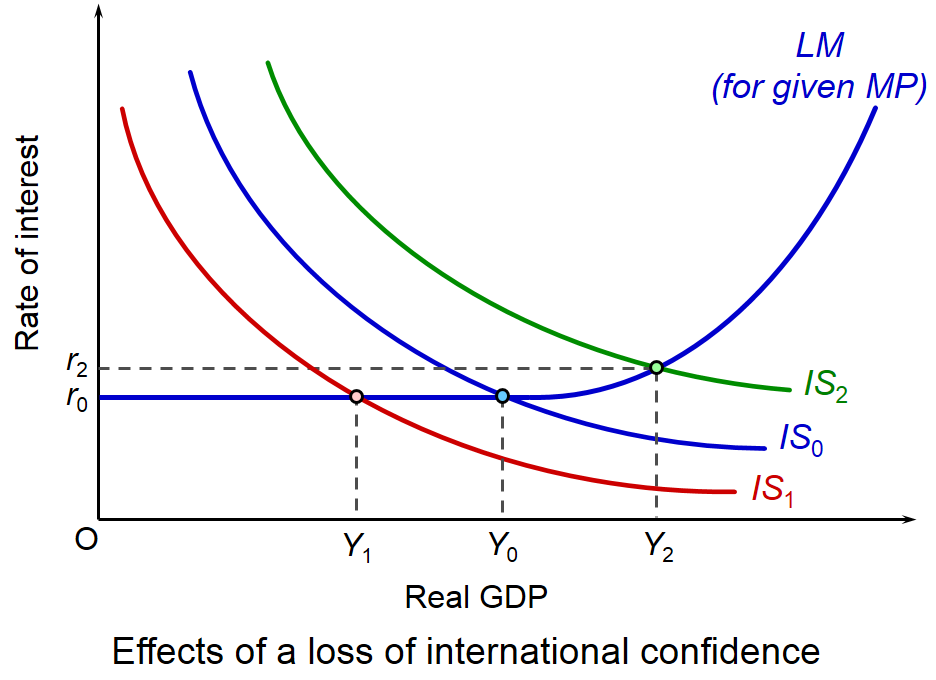 which involves a mix of two policy objectives: an inflation target and real GDP). As GDP rises, putting upward pressure on inflation, so the central bank will raise interest rates. Hence, like the traditional LM curve, the monetary-policy related LM curve will slope upwards, as shown in the diagram.
Initial equilibrium GDP is Y0. The rate of interest is at the minimum level, r0 (i.e. the rate of 0.5% that the Monetary Policy Committee has set since January 2009). This, in the model, is the liquidity trap, where any increase in money supply (a rightward shift in the LM curve) will have no effect on interest rates or GDP.
In Rogoff’s analysis of a crisis triggered by excessive borrowing and problems in the eurozone, the IS curve will shift to the left (as illustrated by curve IS1) as capital flows from the UK and confidence collapses. Real GDP will fall to Y1. This will be the outcome of fiscal expansion in the world of the early 2010s.
 Krugman argues that the opposite will occur. The outflow of capital will drive down the exchange rate. This will lead to an increase in exports and a decrease in imports. Aggregate demand thus rises and the IS curve will shift to the right (e.g. to IS2 in the diagram. Real GDP will rise (e.g. to Y2 in the diagram). If the rise in aggregate demand is sufficient, the economy will rise out of the liquidity trap and interest rates will rise (e.g. to r2 in the diagram).
Not surprisingly, Rogoff challenges this analysis, as you will see if you read his second paper below. He doesn’t criticise the model per se, but challenges Krugman’s assumptions. For example, a depreciation of sterling by some 20% since 2008 doesn’t seem to have had a major effect in stimulating exports (see the chart in the news item, A balancing act). And exports could well have declined if the eurozone economy had collapsed, given that exports to the eurozone account for around 44% of total UK exports.
Rogoff’s assumptions in turn can be challenged. Simon Wren-Lewis argues that, provided a credible long-term plan for deficit reduction is in place, maintaining a fiscal stimulus in the short run, to keep the recovery going that was beginning to emerge in 2010, would help to increase investor confidence, not undermine it. And, with a policy of quantitative easing, which involves the Bank of England buying central government debt, there is no problem of a lack of demand for UK gilts by the private sector.
What is clear from this debate is the willingness of both sides to accept points made by the other. It is an extremely civilised debate. In fact, it could be seen as a model of how academic debate should be conducted. There is none of the ‘shouting’ that has charaterised much of the pro- and anti-austerity lobbying since the financial crisis burst onto the world stage.
Britain should not take its credit status for granted Scholars at Harvard from Financial Times, Kenneth Rogoff (3/10/13)
Ken Rogoff on UK austerity mainly macro, Simon Wren-Lewis (3/10/13)
Phantom Crises (Wonkish) The Conscience of a Liberal, Paul Krugman (3/10/13)
Three Wrongs do not make a Right Scholars at Harvard from Financial Times, Kenneth Rogoff (7/10/13)
Is George Osborne really a hero of global finance? The Guardian, Robert Skidelsky (24/10/13)
Questions
- Explain how the policy-dependent LM curve illustrated in the diagram is derived.
- What would cause the policy-dependent LM curve to shift?
- Explain what is meant by the ‘liquidity trap’. Why does being in a liquidity trap make monetary policy ineffective?
- How would you determine whether or not the UK is currently in a liquidity trap?
- How is the level of (a) public-sector debt and (b) private sector debt owed overseas likely to affect the confidence of investors concerning the effects of an expansionary fiscal policy?
- Compare the UK’s total external debt with that of other countries (see the following tables from Principal Global Indicators, hosted by the IMF: External debt and Short-term external debt).
- What insurance policy (if any) does the UK have to protect against market panic about the viability of UK debt?
- What areas of agreement are there between Rogoff on the one side and Krugman and Wren-Lewis on the other?
 The ‘Classical’ Treasury view of the 1920s and 30s was that extra government spending or tax cuts were not the solution to depression and mass unemployment. Instead, it would crowd out private expenditure if the money supply were not allowed to rise as it would drive up interest rates. But if money supply were allowed to rise, this would be inflationary. The solution was to reduce budget deficits to increase confidence in public finances and to encourage private investment. Greater price and wage flexibility were the answer to markets not clearing.
Keynes countered these arguments by arguing that the economy could settle in a state of mass unemployment, with low confidence leading to lower consumer expenditure, lower investment, lower incomes and lower employment. The situation would be made worse, not better, by cuts in public expenditure or tax rises in an attempt to reduce the budget deficit. The solution was higher public expenditure to stimulate aggregate demand. This could be achieved by fiscal and monetary policies. Monetary policy alone could, however, be made ineffective by the liquidity trap. Extra money might simply be held rather than spent.
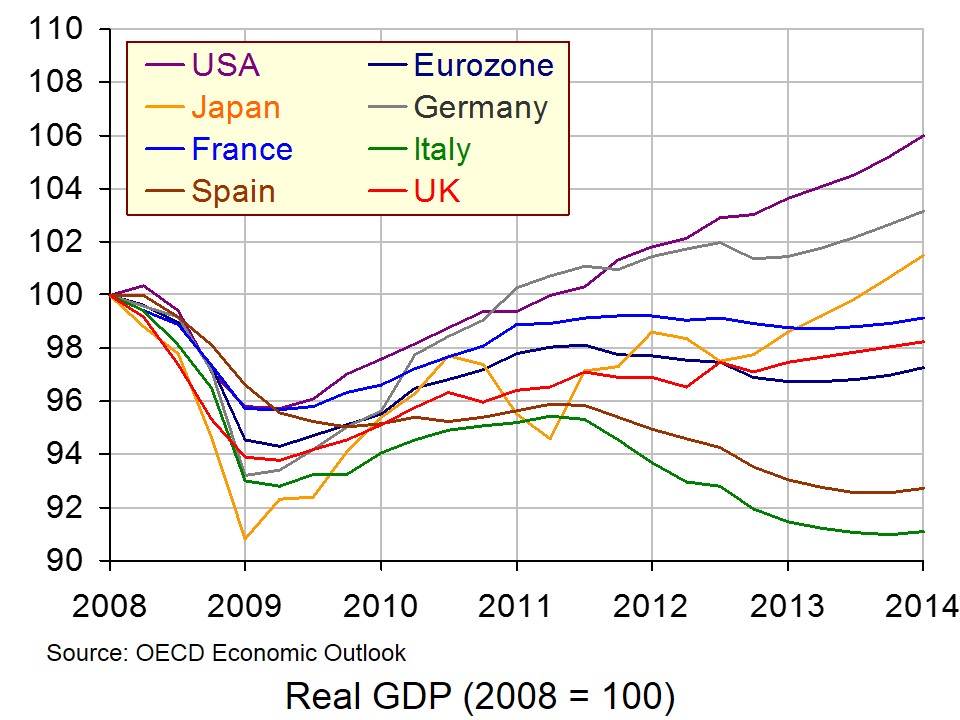 This old debate has been reborn since the financial crisis of 2007/8 and the subsequent deep recession and, more recently, the lack of recovery. (Click here for a PowerPoint of the chart.)
The articles below consider the current situation. Many economists, but certainly not all, take a Keynesian line that austerity policies to reduce public-sector deficits have been counter-productive. By dampening demand, such policies have reduced national income and slowed the recovery in both investment and consumer demand. This has at best slowed the rate of deficit reduction or at worst even increased the deficit, with lower GDP leading to a reduction in tax receipts and higher unemployment leading to higher government social security expenditure.
Although monetary policy has been very loose, measures such as record low interest rates and quantitative easing have been largely ineffective in stimulating demand. Economies are stuck in a liquidity trap, with banks preferring to build their reserves rather than to increase lending. This is the result partly of a lack of confidence and partly of pressure on them to meet Basel II and III requirements of reducing their leverage.
But despite the call from many economists to use fiscal policy and more radical monetary policy to stimulate demand, most governments have been pre-occupied with reducing their deficits and ultimately their debt. Their fear is that rising deficits undermine growth – a fear that was given weight by, amongst others, the work of Reinhart and Rogoff (see the blog posts Reinhart and Rogoff: debt and growth and It could be you and see also Light at the end of the tunnel – or an oncoming train?.
 But there is some movement by governments. The new Japanese government under Shinzo Abe is following an aggressive monetary policy to drive down the exchange rate and boost aggregate demand (see A J-curve for Japan?) and, more recently, the European Commission has agreed to slow the pace of austerity by giving the Netherlands, France, Spain, Poland, Portugal and Slovenia more time to bring their budget deficits below the 3% of GDP target.
Of course, whether or not expansionary fiscal and/or monetary policies should be used to tackle a lack of growth does not alter the argument that supply-side policies are also required in order to increase potential economic growth.
A Keynesian Victory, but Austerity Stands Firm The New York Times, Business Day, Eduardo Porter (21/5/13)
With Austerity Under Fire, Countries Seek a More Balanced Solution Knowledge@Wharton (22/5/13)
Keynes, Say’s Law and the Theory of the Business Cycle History of Economics Review 25.1-2, Steven Kates (1996)
Is Lord Keynes back in Brussels? The Conversation, Fabrizio Carmignani (31/5/13)
Keynes’s Biggest Mistake The New York Times, Business Day, Bruce Bartlett (7/5/13)
Keynes’s Not So Big Mistake The New York Times, The Conscience of a Liberal blog, Paul Krugman (7/5/13)
The Chutzpah Caucus The New York Times, The Conscience of a Liberal blog, Paul Krugman (5/5/13)
Keynes and Keynesianism The New York Times, Business Day, Bruce Bartlett (14/5/13)
Japan Is About To Prove Keynesian Economics Entirely Wrong Forbes, Tim Worstall (11/5/13)
The poverty of austerity exposed Aljazeera, Paul Rosenberg (24/5/13)
Britain is a lab rat for George Osborne’s austerity programme experiment The Guardian, Larry Elliott (26/5/13)
Eurozone retreats from austerity – but only as far as ‘austerity lite’ The Guardian, Larry Elliott (30/5/13)
Europe’s long night of uncertainty Daily Times (Pakistan), S P Seth (29/5/13)
Abenomics vs. bad economics The Japan Times Gregory Clark (29/5/13)
European countries to be allowed to ease austerity BBC News (29/5/13)
U.K. Should Restore Growth, Rebalance Economy IMF Survey (22/5/13)
Now everyone is a Keynesian again – except George Osborne The Observer, William Keegan (2/6/13)
Austerity Versus Growth (III): Fiscal Policy And Debt Sustainability Social Europe Journal, Stefan Collignon (30/5/13)
Questions
- Explain what is meant by Say’s Law and its implication for macroeconomic policy.
- Why have many governments, including the UK government, been reluctant to pursue expansionary fiscal policies?
- What is meant by the liquidity trap? What is the way out of this trap?
- In the first article above, Eduardo Porter argues that ‘moral views are getting in the way of reason’. What does he mean by this?
- Explain what are meant by the ‘paradox of thrift’ and the ‘fallacy of composition’. How are these two concepts relevant to the debate over austerity policies?
- What are the dangers in pursuing aggressive Keynesian policies?
- What are the dangers in not pursuing aggressive Keynesian policies?
 In a carefully argued article in the New Statesman, the UK Business Secretary, Vince Cable, considers the slow recovery in the economy and whether additional measures should be adopted. He sums up the current state of the economy as follows:
The British economy is still operating at levels around or below those before the 2008 financial crisis and roughly 15 per cent below an albeit unsustainable pre-crisis trend. There was next to no growth during 2012 and the prospect for 2013 is of very modest recovery.
Unsurprisingly there is vigorous debate as to what has gone wrong. And also what has gone right; unemployment has fallen as a result of a million (net) new jobs in the private sector and there is vigorous growth of new enterprises. Optimistic official growth forecasts and prophets of mass unemployment have both been confounded.
He argues that supply-side policies involving “a major and sustained commitment to skills, innovation and infrastructure investment” are essential if more rapid long-term growth is to be achieved. This is relatively uncontroversial.
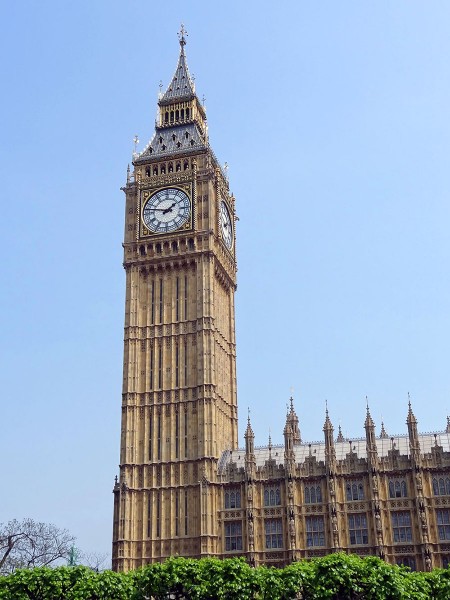 But he also considers the claim that austerity has kept the economy from recovering and whether policies to tackle the negative output gap should be adopted, even if this means a short-term increase in government borrowing.
But crude Keynesian policies of expanding aggregate demand are both difficult to implement and may not take into account the particular circumstance of the current extended recession – or depression – in the UK and in many eurozone countries. World aggregate demand, however, is not deficient. In fact it is expanding quite rapidly, and with the sterling exchange rate index some 20% lower than before the financial crisis, this should give plenty of opportunity for UK exporters.
Yet expanding UK aggregate demand is proving difficult to achieve. Consumers, worried about falling real wages and large debts accumulated in the years of expansion, are reluctant to increase consumption and take on more debts, despite low interest rates. In the light of dampened consumer demand, firms are reluctant to invest. This makes monetary policy particularly ineffective, especially when banks have become more risk averse and wish to hold higher reserves, and indeed are under pressure to do so.
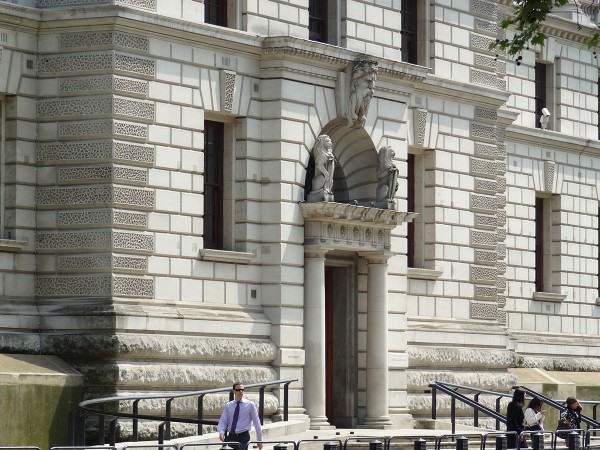 So what can be done? He argues that there is “some scope for more demand to boost output, particularly if the stimulus is targeted on supply bottlenecks such as infrastructure and skills.” In other words, he advocates policies that will simultaneously increase both aggregate demand and aggregate supply. Monetary policy, involving negative real interest rates and quantitative easing, has helped to prevent a larger fall in real aggregate demand and a deeper dive into recession, but the dampened demand for money and the desire by banks to build their reserves has meant a massive fall in the money multiplier. Perhaps monetary policy needs to be more aggressive still (see the blog post, Doves from above), but this may not be sufficient.
Which brings Dr Cable to the political dynamite! He advocates an increase in public investment on infrastructure (schools and colleges, hospitals, road and rail projects and housing, and considers whether this should be financed, not by switching government expenditure away from current spending, but by borrowing more.
Such a strategy does not undermine the central objective of reducing the structural deficit, and may assist it by reviving growth. It may complicate the secondary objective of reducing government debt relative to GDP because it entails more state borrowing; but in a weak economy, more public investment increases the numerator and the denominator.
 He raises the question of whether the balance of risks has changed: away from the risk of increased short-term borrowing causing a collapse of confidence to the risk of lack of growth causing a deterioration in public finances and this causing a fall in confidence. As we saw in the blog post Moody Blues, the lack of growth has already caused one ratings agency (Moody’s) to downgrade the UK’s credit rating. The other two major agencies, Standard & Poor’s and Fitch may well follow suit.
The day after Dr Cable’s article was published, David Cameron gave a speech saying that the government would stick to its plan of deficit reduction. Not surprisingly commentators interpreted this as a split in the Coalition. Carefully argued economics from Dr Cable it might have been, but political analysts have seen it as a hand grenade, as you will see from some of the articles below.
When the facts change, should I change my mind? New Statesman, Vince Cable (6/3/13)
Keynes would be on our side New Statesman, Vince Cable (12/1/11)
Exclusive: Vince Cable calls on Osborne to change direction New Statesman, George Eaton (67/3/13)
Vince Cable: Borrowing may not be as bad as slow growth BBC News (7/3/13)
Vince Cable makes direct challenge to Cameron over economic programme The Guardian, Nicholas Watt (7/3/13)
Vince Cable Says George Osborne Must Change Course And Borrow More To Revive Growth Huffington Post, Ned Simons (6/3/13)
David Cameron and Vince Cable at war over route to recovery Independent, Andrew Grice (6/3/13)
 Vince Cable: Borrowing may not be as bad as slow growth BBC News, James Landale (6/3/13)
David Cameron: We will hold firm on economy BBC News (7/3/13)
David Cameron: We will hold firm on economy BBC News (7/3/13)
Clegg Backs Cable Over Controversial Economy Comments LBC Radio, Nick Clegg (7/3/13)
It’s plain what George Osborne needs to do – so just get on and do it The Telegraph, Jeremy Warner (6/3/13)
Vince Cable’s plan B: a “matter of judgement” BBC News, Stephanie Flanders (7/3/13)
George Osborne needs to turn on the spending taps The Guardian, Phillip Inman (12/3/13)
Questions
- Why has monetary policy proved ineffective in achieving a rapid recovery from recession?
- Distinguish between discretionary fiscal policy and automatic fiscal stabilisers.
- Why has the existence of automatic fiscal stabilisers meant that the public-sector deficit has been difficult to bring down?
- In what ways has the balance of risks in using discretionary fiscal policy changed over the past three years?
- In what ways is the depression of the late 2000s/early 2010s (a) similar to and (b) different from the Great Depression of the early 1930s?
- In what ways is the structure of public-sector debt in the UK different from that in many countries in the eurozone? Why does this give the government more scope for expansionary fiscal policy?
- Why does the Office of Budget Responsibility’s estimates of the tax and government expenditure multipliers suggest that “if fiscal policy is to work in a Keynesian manner, it needs to be targeted carefully, concentrating on capital projects”?
- Why did Keynes argue that monetary policy is ineffective at the zero bound (to use Dr Cable’s terminology)? Are we currently at the zero bound? If so what can be done?
- Has fiscal tightening more than offset loose monetary policy?