 With relentless bombing of Iran by Israel and the USA, and with Iranian counterattacks on Gulf states, the costs of the war are mounting. The most obvious are in terms of human lives, injuries and suffering. But there are significant economic costs too. Some of these are immediate, such as the rising price of oil and hence the costs of fuel, or the fall in stock market prices. Some will be longer term, depending on how the war develops. For example, prices could rise more generally as supply chains are disrupted.
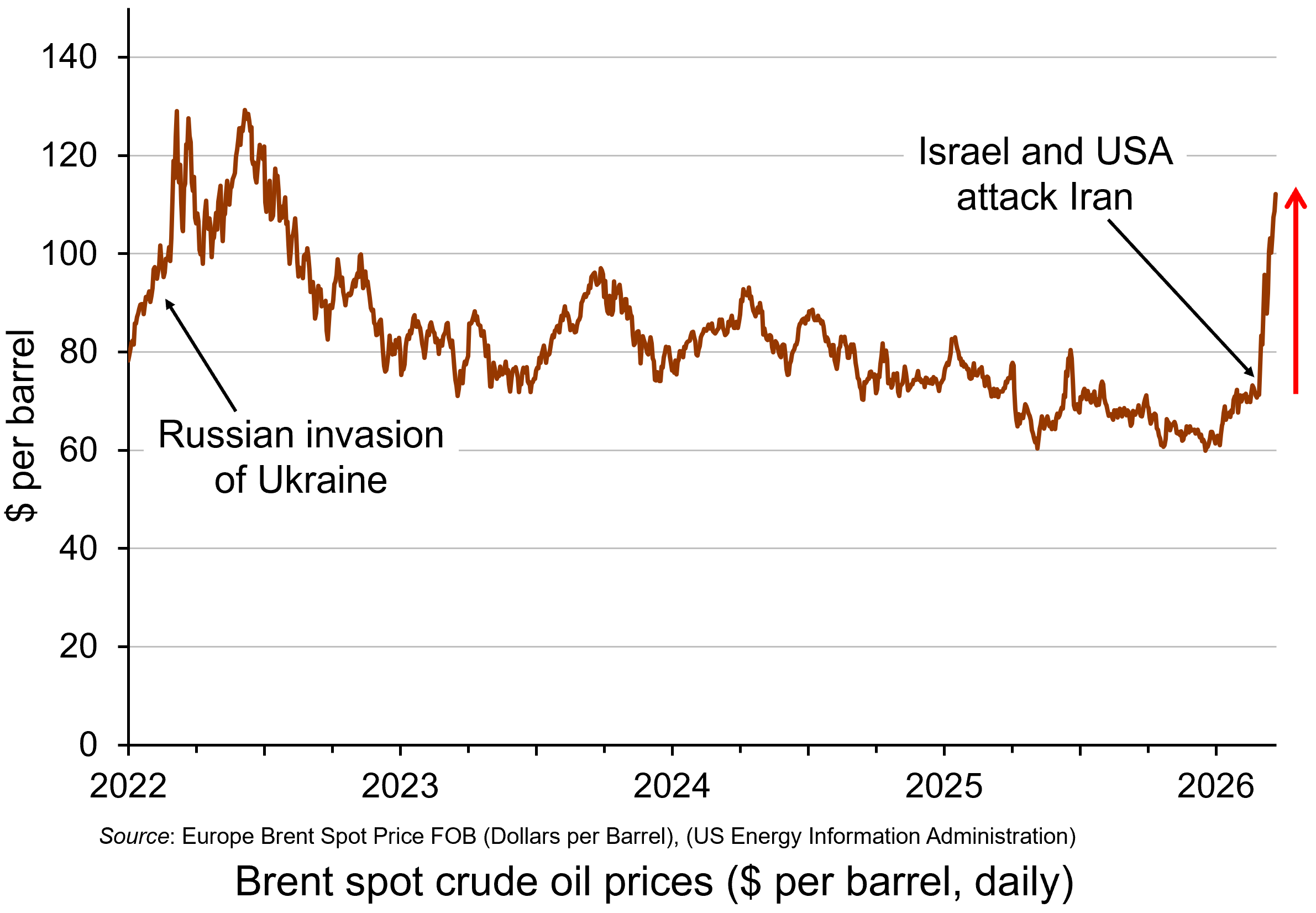 The impacts will vary across the world and across markets. The most obvious markets to be affected are those where significant supply comes from the Persian Gulf. Approximately 20% of total global oil consumption passes through the Strait of Hormuz, which connects the Persian Gulf with the Arabian Sea and the Indian Ocean.
Oil prices rose considerably in the days following the start of the war on 28 February, with Brent crude, a key measure of international oil prices, rising from $71.3 on 27 February to a peak of $119.4 per barrel by the morning of 9 March – a rise of 67%. It was possible that they would rise even further in the short term. However, prices fell back substantially later on 9 March after G7 finance ministers declared that the group ‘stands ready’ to release oil from strategic reserves if needed. By late in the day, the price had fallen to below $85. (Click here for a PowerPoint of the chart.)
However, despite the announcement on 11 March that 32 countries had agreed to release 400m barrels of oil reserves, oil prices began rising again and reached $100 on 12 March after three tankers had been struck in the Gulf, two of them close to the Strait of Hormuz. With Iran pledging to keep the Strait closed, there were worries that the release of oil reserves would provide only temporary relief. Just over 20m barrels of oil normally pass through the Strait of Hormuz. The 400m barrels released from storage is the equivalent, therefore, of only 20 days’ worth of lost oil from the Gulf.
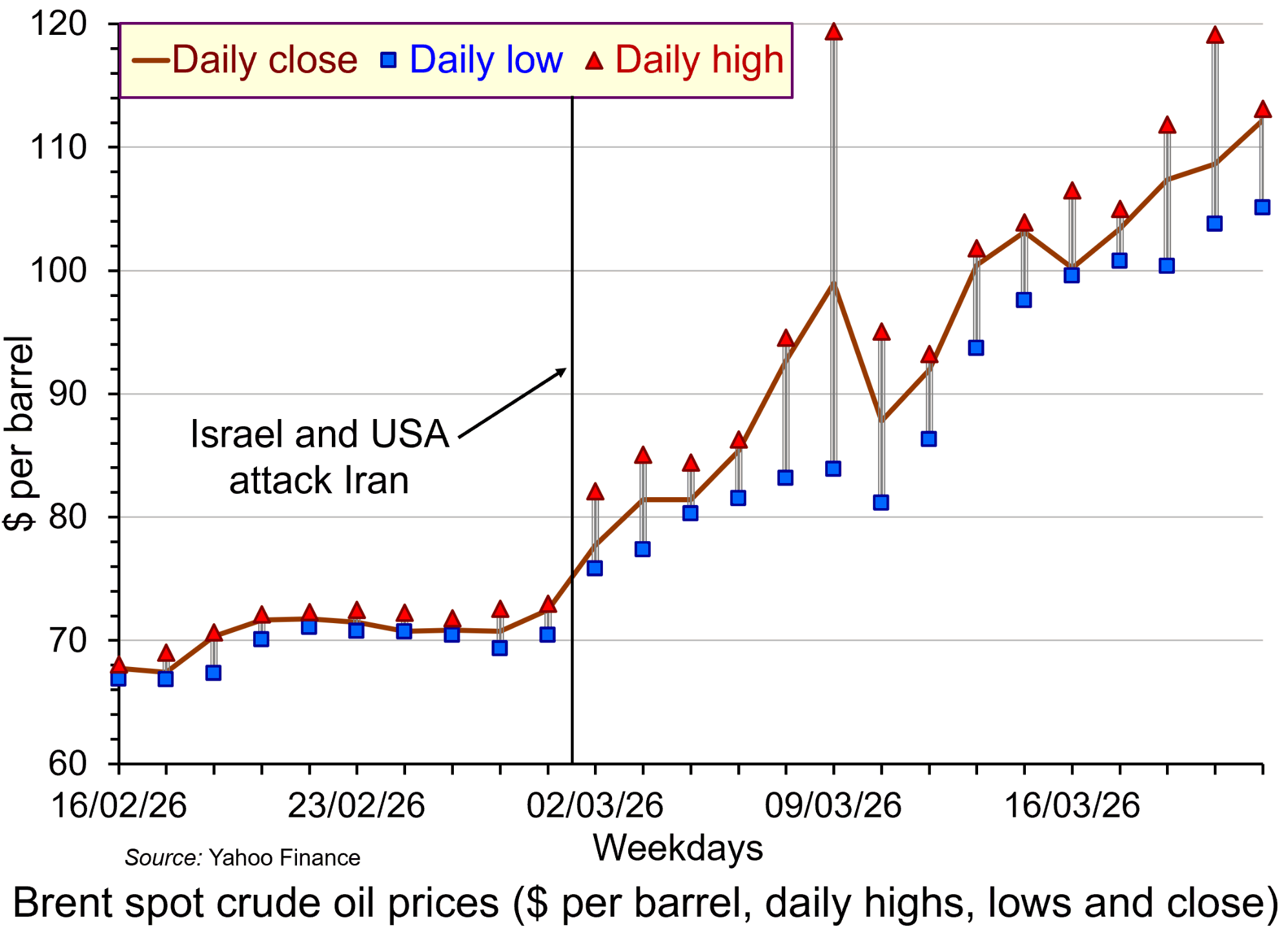 Not only did oil prices rise, but the price became much more volatile as markets reacted to the news on a continuous basis. Intra-day fluctuations in oil prices of several percentage points became typical, reflecting shifting expectations. The second chart shows daily fluctuations, with the highest and lowest prices for each day shown, along with the closing price. (Click here for a PowerPoint.)
The biggest fluctuation had been on 9 March when fears of the closing of the Strait of Hormuz saw the spot price of Brent crude rising to nearly $120 but falling to around $84 later in the day (a fall of around 30%) after the G7 announcement about releasing reserves.
There was another big fluctuation on 23 March. The previous day (Sunday), President Trump threatened to bomb Iran’s power plants if Iran did not allow free passage of ships through the Strait of Hormuz. Iran threatened to retaliate by striking Gulf countries’ energy and water systems. In early trading on Monday 23rd, Brent crude rose to over $114 per barrel. But later that day, Trump said that there had been constructive talks between the USA and Iran. The oil price immediately dropped to around $92 – a fall of 19% – before settling at around $100.
 Rising oil prices will drive up inflation. For those countries with a heavy dependence on Gulf oil, particularly countries in Asia, there could be significant supply problems. For oil exporters in the Persian Gulf, with tankers unable to traverse the Strait of Hormuz, the economic impact is huge. Oil exporters outside the Gulf, such as Russia, Norway and Canada, however, will gain from the higher prices. Clearly the size of these effects will depend on how long the conflict continues and how long the Strait of Hormuz remains closed.
And it is not just oil that is affected. Other products, such as liquified natural gas (LNG), petrochemicals, industrial materials, fertilizers, metals and minerals are transported through the Strait of Hormuz. Gulf countries import much of their food through the Strait. On 18 March, Israel struck Iran’s huge South Pars gas field off the Gulf coast. This is the largest gas field in the world and is a major source of export revenue for Iran. Iran responded by striking the Qatari gas hub in Ras Laffan. Donald Trump responded by threatening to ‘blow up’ the entire Iranian South Pars gas field if Iran made further strikes on Qatar. The effect of this escalation was to drive oil and gas prices up further. By the week ending 20 March, the oil price closed at just over $112 per barrel.
Cuts in supplies of oil and other products represent an adverse supply shock. Such shocks push up prices (cost-push inflation), while adversely affecting aggregate output. This can lead to stagflation – a combination of higher inflation and stagnation or even falling output. Central banks with a simple mandate to keep inflation to a target are likely to raise interest rates, or at least delay in reducing them. In the USA, with a dual mandate of controlling inflation but also maximising employment, the response may be less deflationary, depending on the judgement of the Federal Reserve.
Uncertainty
 There is great uncertainty about how long the conflict will last. There is also a lack of clarity and consistency from the US administration about its war aims. This uncertainty has affected financial markets, which have seen considerable volatility. Stock markets have seen widespread falls, with airline, travel and AI-heavy stocks being particularly vulnerable.
If the war is concluded relatively swiftly, the economic effects could be relatively small. If the war continues, and especially if the Gulf countries are drawn further into the conflict and if the conflict spreads to other countries, the economic effects could be much more substantial. A prolonged conflict could see oil prices remaining above $100 per barrel, potentially increasing global inflation by 1 percentage point or more. This would slow or halt the move by central banks to cut rates and thereby reduce global economic growth – potentially, as we have seen, leading to stagflation.
 The uncertainty was reflected in the decision of the Fed to keep interest rates unchanged at its meeting on 17/18 March. The Fed has the twin targets of keeping inflation close to 2% and maximising employment. Fed Chair, Jay Powell, acknowledged the current tension between the two goals: ‘upward risks for inflation and downward risks for employment, and that puts us in a difficult situation’. He also recognised that the future for inflation and the economy was highly uncertain as the war developed. This made interest rate setting difficult.
Then there is the issue of a potential new international refugee crisis. If the economic and political system in Iran deteriorates rapidly, this could trigger a wave of migration to neighbouring countries, such as Turkey, already hosting large numbers of refugees. Many could seek sanctuary further afield in Europe, with several countries already facing a backlash against immigration. The political and economic effects of this on host countries could be significant – but as yet, highly uncertain.
Articles
- Assessing the global economic impact of the Middle East war
ING, Carsten Brzeski, Warren Patterson, James Knightley and Deepali Bhargava (5/3/26)
- How will the Iran war affect the global economy?
Chatham House, Neil Shearing (6/3/26)
- ‘The stakes are enormous’: how a prolonged Iran war could shock the global economy
The Guardian, Richard Partington (22/3/26)
- Iran war is latest threat to a global economy rattled by Trump
Aljazeera, John Power (7/3/26)
- Why an Iran war inflation shock could wreck global economic recovery
The Guardian, Phillip Inman and Kalyeena Makortoff (8/3/26)
- Why has the Iran war sparked fears of stagflation for the global economy?
The Guardian, Luca Ittimani (9/2/26)
- Why surging oil prices are a shock for the global economy – but not yet a crisis
The Conversation, Stella Huangfu (3/3/26)
- Why the price of oil matters more than you might think
BBC News, Natalie Sherman and Mitchell Labiak (10/3/26)
- Strait of Hormuz: Factsheet
IEA (February 2026)
- Strait of Hormuz: Gulf states’ food security is at immediate risk but wider shortages could push up consumer prices globally
The Conversation, Gokcay Balci and Ebru Surucu-Balci (4/3/26)
- Faisal Islam: Oil price spiral may be slowed but not stopped by G7 emergency move
BBC News, Faisal Islam (9/3/26)
- What on earth is going on with the oil price?
BBC News, Jemma Crew (12/3/26)
- Asia scrambles to confront energy crisis unleashed by Iran war – with no end in sight
The Guardian, Callum Jones (12/3/26)
- The grim choice facing the Trump administration: Economic or naval collapse?
CNN, Phil Mattingly and Zachary Cohen (9/3/26)
- Israel strikes Iran’s South Pars gasfield hours after forces kill intelligence minister
The Guardian, Lorenzo Tondo and William Christou (18/3/26)
- What Fed Chair Jerome Powell said — and didn’t say — about the oil crisis
Yahoo Finance, Jake Conley (19/3/26)
- What strikes on the world’s largest natural gas sites could do to the global economy
CNN, Hanna Ziady (19/3/26)
- How the Iran Conflict May Fuel a New International Refugee Crisis
Forbes, Andy J Semotiuk (5/3/26)
- Iran’s neighbours brace for fallout as war threatens new refugee crisis
Aljazeera, Abid Hussain (17/3/26)
Data
Questions
- Who are the biggest gainers and losers from disruption to oil supplies from the Persian Gulf?
- Illustrate the effect of the current oil price shock on an aggregate demand and supply diagram (either static or dynamic).
- Why is the Iranian war likely to be less damaging to the European economy than the Ukrainian war has been?
- Why have AI-related stock prices been vulnerable to the uncertainty caused by the Iranian war?
- How have the Bank of England and the Federal Reserve Bank responded to higher oil prices and the broader economic effects of the war? Why might their responses be different in the coming months?
- What is the likely impact of the Iranian war on global economic recovery?
- How might the Iranian war affect global economic alliances?
- How is the current oil price shock likely to affect the eurozone? Will it be different from the oil price shock that followed the Russian invasion of Ukraine?
- What are the likely economic effects of large-scale migration caused by the war?
 We have examined inflation in several blogs in recent months. With inflation at levels not seen for 40 years, this is hardly surprising. One question we’ve examined is whether the policy response has been correct. For example, in July, we asked whether the Bank of England had raised interest rates too much, too late. In judging policy, one useful distinction is between demand-pull inflation and cost-push inflation. Do they require the same policy response? Is raising interest rates to get inflation down to the target rate equally applicable to inflation caused by excessive demand and inflation caused by rising costs, where those rising costs are not caused by rising demand?
In terms of aggregate demand and supply, demand-pull inflation is shown by continuing rightward shifts in aggregate demand (AD); cost-push inflation is shown by continuing leftward/upward shifts in short-run aggregate supply (SRAS). This is illustrated in the following diagram, which shows a single shift in aggregate demand or short-run aggregate supply. For inflation to continue, rather than being a single rise in prices, the curves must continue to shift.
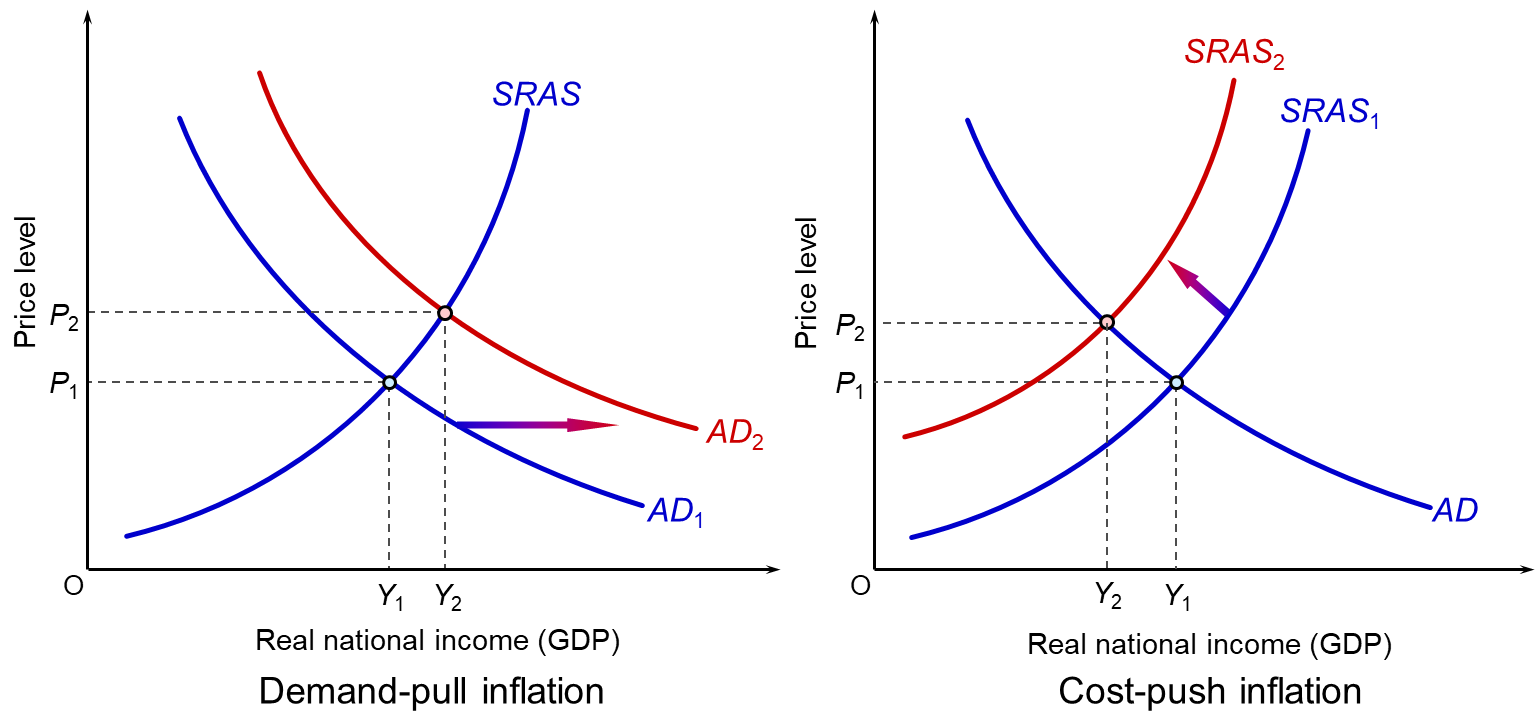
As you can see, the effects on real GDP (Y) are quite different. A rise in aggregate demand will tend to increase GDP (as long as capacity constraints allow). A rise in costs, and hence an upward shift in short-run aggregate supply, will lead to a fall in GDP as firms cut output in the face of rising costs and as consumers consume less as the cost of living rises.
The inflation experienced by the UK and other countries in recent months has been largely of the cost-push variety. Causes include: supply-chain bottlenecks as economies opened up after COVID-19; the war in Ukraine and its effects on oil and gas supplies and various grains; and avian flu and poor harvests from droughts and floods associated with global warming resulting in a fall in food supplies. These all led to a rise in prices. In the UK’s case, this was compounded by Brexit, which added to firms’ administrative costs and, according to the Bank of England, was estimated to cause a long-term fall in productivity of around 3 to 4 per cent.
The rise in costs had the effect of shifting short-run aggregate supply upwards to the left. As well as leading to a rise in prices and a cost-of-living squeeze, the rising costs dampened expenditure.
This was compounded by a tightening of fiscal policy as governments attempted to tackle public-sector deficits and debt, which had soared with the support measures during the pandemic. It was also compounded by rising interest rates as central banks attempted to bring inflation back to target.
Monetary policy response
 Central banks are generally charged with keeping inflation in the medium term at a target rate set by the government or the central bank itself. For most developed countries, this is 2% (see table in the blog, Should central bank targets be changed?). So is raising interest rates the correct policy response to cost-push inflation?
One argument is that monetary policy is inappropriate in the face of supply shocks. The supply shocks themselves have the effect of dampening demand. Raising interest rates will compound this effect, resulting in lower growth or even a recession. If the supply shocks are temporary, such as supply-chain disruptions caused by lockdowns during the pandemic, then it might be better to ride out the problem and not raise interest rates or raise them by only a small amount. Already cost pressures are easing in some areas as supplies have risen.
If, however, the fall in aggregate supply is more persistent, such as from climate-related declines in harvests or the Ukraine war dragging on, or new disruptions to supply associated with the Israel–Gaza war, or, in the UK’s case, with Brexit, then real aggregate demand may need to be reduced in order to match the lower aggregate supply. Or, at the very least, the growth in aggregate demand may need to be slowed to match the slower growth in aggregate supply.
Huw Pill, the Chief Economist at the Bank of England, in a podcast from the Columbia Law School (see links below), argued that people should recognise that the rise in costs has made them poorer. If they respond to the rising costs by seeking higher wages, or in the case of businesses, by putting up prices, this will simply stoke inflation. In these circumstances, raising interest rates to cool aggregate demand may reduce people’s ability to gain higher wages or put up prices.
Another argument for raising interest rates in the face of cost-push inflation is when those cost increases are felt more than in other countries. The USA has suffered less from cost pressures than the UK. On the other hand, its growth rate is higher, suggesting that its inflation, albeit lower than in the UK, is more of the demand-pull variety. Despite its inflation rate being lower than in the UK, the problem of excess demand has led the Fed to adopt an aggressive interest rate policy. Its target rate is 5.25% to 5.50%, while the Bank of England’s is 5.25%. In order to prevent short-term capital outflows and a resulting depreciation in the pound, further stoking inflation, the Bank of England has been under pressure to mirror interest rate rises in the USA, the eurozone and elsewhere.
Articles
Blogs on this site
Information and data
Questions
- How may monetary policy affect inflationary expectations?
- If cost-push inflation makes people generally poorer, what role does the government have in making the distribution of a cut in real income a fair one?
- In the context of cost-push inflation, how might the authorities prevent a wage–price spiral?
- With reference to the second article above, explain the ‘monetary policy conundrum’ faced by the Bank of Japan.
- If central banks have a single policy instrument, namely changes in interest rates, how may conflicts arise when there is more than one macroeconomic objective?
- Is Russia’s rise in inflation the result of cost or demand pressures, or a mixture of the two (see articles above)?
 Central bankers, policymakers, academics and economists met at the Economic Symposium at Jackson Hole, Wyoming from August 24–26. This annual conference, hosted by Kansas City Fed, gives them a chance to discuss current economic issues and the best policy responses. The theme this year was ‘Structural Shifts in the Global Economy’ and one of the issues discussed was whether, in the light of such shifts, central banks’ 2 per cent inflation targets are still appropriate.
Inflation has been slowing in most countries, but is still above the 2 peer cent target. In the USA, CPI inflation came down from a peak of 9.1% in June 2022 to 3.2% in July 2023. Core inflation, however, which excludes food and energy was 4.7%. At the symposium, in his keynote address the Fed Chair, Jay Powell, warned that despite 11 rises in interest rates since April 2022 (from 0%–0.25% to 5%–5.25%) having helped to bring inflation down, inflation was still too high and that further rises in interest rates could not be ruled out.
We are prepared to raise rates further if appropriate, and intend to hold policy at a restrictive level until we are confident that inflation is moving sustainably down toward our objective.
However, he did recognise the need to move cautiously in terms of any further rises in interest rates as “Doing too much could also do unnecessary harm to the economy.” But, despite the rises in interest rates, growth has remained strong in the USA. The annual growth rate in real GDP was 2.4% in the second quarter of 2023. Unemployment, at 3.5%, is low by historical standards and similar to the rate before the Fed began raising interest rates.
Raising the target rate of inflation?
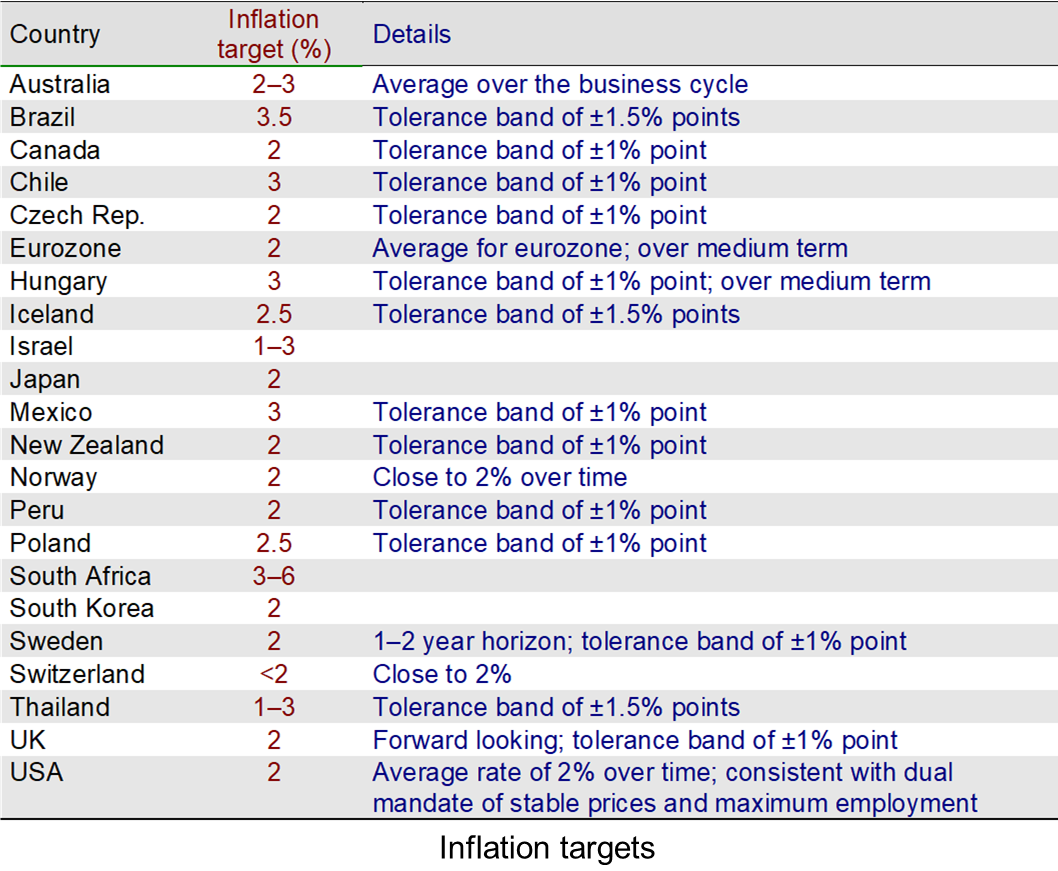 Some economists and politicians have advocated raising the target rate of inflation from 2 per cent to, perhaps, 3 per cent. Jason Furman, an economic policy professor at Harvard and formerly chief economic advisor to President Barack Obama, argues that a higher target has the benefit of helping cushion the economy against severe recessions, especially important when such there have been adverse supply shocks, such as the supply-chain issues following the COVID lockdowns and then the war in Ukraine. A higher inflation rate may encourage more borrowing for investment as the real capital sum will be eroded more quickly. Some countries do indeed have higher inflation targets, as the table shows.
Powell emphatically ruled out any adjustment to the target rate. His views were expanded upon by Christine Lagarde, the head of the European Central Bank. She argued that in a world of greater supply shocks (such as from climate change), greater frictions in markets and greater inelasticity in supply, and hence greater price fluctuations, it is important for wage increases not to chase price increases. Increasing the target rate of inflation would anchor inflationary expectations at a higher level and hence would be self-defeating. Inflation in the eurozone, as in the USA, is falling – it halved from a peak of 10.6% in 2022 to 5.3% in July this year. Given this and worries about recession, the ECB may not raise interest rates at its September meeting. However, Lagarde argued that interest rates needed to remain high enough to bring inflation back to target.
The UK position
 The Bank of England, too, is committed to a 2 per cent inflation target, even though the inflationary problems for the UK economy are greater that for many other countries. Greater shortfalls in wage growth have been more concentrated amongst lower-paid workers and especially in the public health, safety and transport sectors. Making up these shortfalls will slow the rate of inflationary decline; resisting doing so could lead to protracted industrial action with adverse effects on aggregate supply.
Then there is Brexit, which has added costs and bureaucratic procedures to many businesses. As Adam Posen (former member of the MPC) points out in the article linked below:
Even if this government continues to move towards more pragmatic relations with the EU, divergences in standards and regulation will increase costs and decrease availability of various imports, as will the end of various temporary exemptions. The base run rate of inflation will remain higher for some time as a result.
Then there is a persistent problem of low investment and productivity growth in the UK. This restriction on the supply side will make it difficult to bring inflation down, especially if workers attempt to achieve pay increases that match cost-of-living increases.
Sticking to the status quo
There seems little appetite among central bankers to adjust inflation targets. Squeezing inflation out of their respective economies is painful when inflation originates largely on the supply side and hence the problem is how to reduce demand and real incomes below what they would otherwise have been.
Raising inflation targets, they argue, would not address this fundamental problem and would probably simply anchor inflationary expectations at the higher level, leaving real incomes unchanged. Only if such policies led to a rise in investment would a higher target be justified and central bankers do not believe that it would.
Articles
- What happens in Jackson Hole doesn’t stay in Jackson Hole
CNN, Elisabeth Buchwald (26/8/23)
- Fed Chair Powell calls inflation ‘too high’ and warns that ‘we are prepared to raise rates further’
CNBC, Jeff Cox (25/8/23)
- Inflation? This man holds the key
Politico, Geoffrey Smith and Carlo Boffa (24/8/23)
- Global inflation pressures could become harder to manage in coming years, research suggests
Independent, Christopher Rugaber (27/8/23)
- Christine Lagarde warns of long-term inflation risks after global economic upheaval
Financial Times, Martin Arnold and Colby Smith (25/8/23)
- No appetite at Fed, ECB for changing inflation goal
Reuters, Ann Saphir, Howard Schneider and Balazs Koryani (25/8/23)
- Is it time for Fed to raise interest rate target to 3%? Experts weigh in
mint, Nishant Kumar (22/8/23)
- What is the UK inflation rate and why is it so high?
BBC News (16/8/23)
- If you think the UK’s high-inflation cycle has run its course, think again
The Observer, Adam Posen (26/8/23)
Data
Questions
- Use an aggregate demand and supply diagram (AD/AS or DAD/DAS) to illustrate inflation since the opening up of economies after the COVID lockdowns. Use another one to illustrate the the effects of central banks raising interest rates?
- Why is the world likely to continue experiencing bigger supply shocks and greater price volatility than before the pandemic?
- With hindsight, was increasing narrow money after the financial crisis and then during the pandemic excessive? Would it have been better to have used the extra money to fund government spending on infrastructure rather than purchasing assets such as bonds in the secondary market?
- What are the arguments for and against increasing the target rate of inflation?
- How do inflationary expectations influence the actual rate of inflation?
- Consider the arguments for and against the government matching pay increases for public-sector workers to the cost of living.
 Inflation has surged worldwide as countries have come out of their COVID-19 lockdowns. The increases in prices combined with supply-chain problems has raised questions of what will happen to future prices and whether it will feed further inflation cycles.
Inflation targeting
Inflation is a key contributor to instability in an economy. It measures the rate of increases in prices over a given period of time and indicates what will happen to the cost of living for households. Because of its importance, many central banks aim to keep inflation low and steady by setting a target. The Bank of England, the Federal Reserve, and the European Central Bank all aim to keep inflation low at a target rate of 2 per cent.
Inflation-rate targeting has been successfully practised in a growing number of countries over the past few decades. However, measures to combat rising inflation typically contract the economy through reducing real aggregate demand (or at least its rate of growth). This is a concern when the economy is not experiencing a strong economic performance.
Current outlook
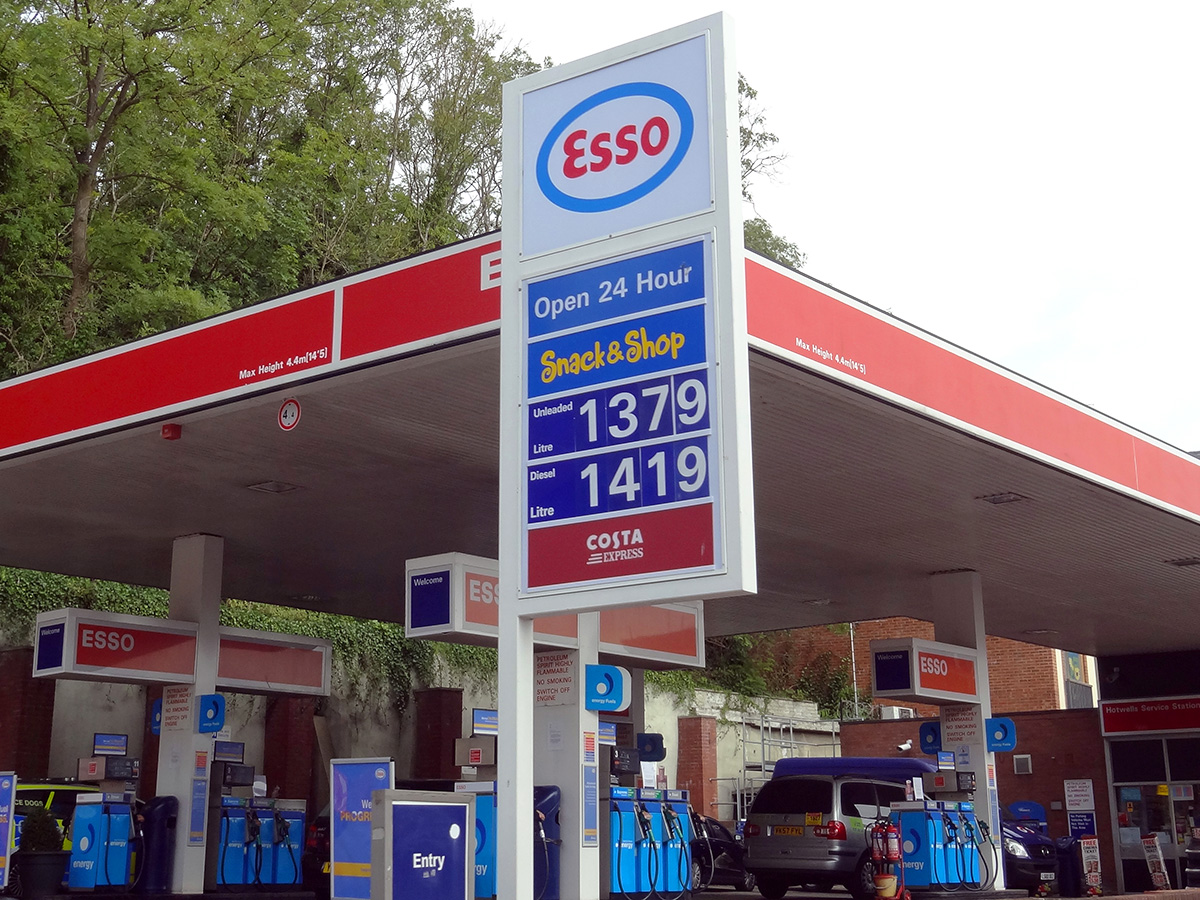 Globally, rising inflation is causing concern as a surge in demand has been confronted by supply bottlenecks and rising prices of energy and raw materials. As the world emerges from the COVID-19 lockdowns, global financial markets have been affected in recent months by concerns around inflation. They have also been affected by the prospect of major central banks around the world being forced into the early removal of pandemic support measures, such as quantitative easing, before the economic recovery from the coronavirus is complete.
The Chief Economist at the Bank of England has warned that UK inflation is likely to rise ‘close to or even slightly above 5 per cent’ early next year, as he said the central bank would have a ‘live’ decision on whether to raise interest rates at its November meeting. Although consumer price inflation dipped to 3.1 per cent in September, the Bank of England has forecast it to exceed 4 per cent by the end of the year, 2 percentage points higher than its target. UK banks and building societies have already started to increase mortgage rates in response to rising inflation, signalling an end to the era of ultra-low borrowing costs and piling further pressure on household finances.
In the USA, shortages throughout the supply chains on which corporate America depends are also causing concern. These issues are translating into widespread inflationary pressure, disrupting operations and forcing companies to raise prices for customers. Pressure on every link in the supply chain, from factory closures triggered by COVID-19 outbreaks to trouble finding enough staff to unload trucks, is rippling across sectors, intensifying questions about the threat that inflation poses to robust consumer spending and rebounding corporate earnings. Reflecting concern over weaker levels of global economic growth despite rising inflationary pressures, US figures published at the end of October showed the world’s largest economy added just 194 000 jobs in September, far fewer than expected.
There are also fears raised over high levels of corporate debt, including in China at the embattled property developer Evergrande, where worries over its ability to keep up with debt payments have rippled through global markets. There are major concerns that Evergrande could pose risks to the wider property sector, with potential spill-overs internationally. However, it is argued that the British banking system has been shown in stress tests to be resilient to a severe economic downturn in China and Hong Kong.
Central bank responses
The sharpest consumer-price increases in years have evoked different responses from central banks. Many have raised interest rates, but two that haven’t are the most prominent in the global economy: the Federal Reserve and the European Central Bank. These differences in responses reflect differing opinions as to whether current price increases will feed further inflation cycles or simply peter out. For those large central banks, they are somewhat relying on households keeping faith in their track record of keeping inflation low. There is also an expectation that there are enough underutilised workers to ensure that wage inflation is kept low.
 However, other monetary authorities worry that they have not yet earned the record of keeping inflation low and are concerned about the risk of wage inflation. In addition, in poorer countries there is a larger share of spending that goes on essentials such as food and energy. These have seen some of the highest price increases, so policy makers are going to be keen to stamp down on the inflation.
The Federal Reserve is expected to announce that it will start phasing out its $120bn monthly bond-buying programme (quantitative easing) as it confronts more pronounced price pressures and predictions that interest rates will be lifted next year. However, no adjustments are expected to be made to the Fed’s main policy rate, which is tethered near zero. Whilst financial markets are betting on an rise in Bank Rate by the Bank of England as early as next month, spurred by comments from Governor Andrew Bailey in mid-October that the central bank would ‘have to act’ to keep a lid on inflation.
Outlook for the UK
 The Bank of England’s Chief Economist, Huw Pill, has warned that high rates of inflation could last longer than expected, due to severe supply shortages and rising household energy bills. He said inflationary pressures were still likely to prove temporary and would fall back over time as the economy adjusted after disruption caused by COVID and Brexit. However, he warned there were growing risks that elevated levels of inflation could persist next year.
The looming rise in borrowing costs for homeowners will add further pressure to family finances already stretched by higher energy bills and surging inflation. According to the Institute for Fiscal Studies, it is expected that households will face years of stagnating living standards, with predictions showing that households would on average be paying £3000 more each year in taxes by 2024/25, with the biggest impact felt by higher earners.
Investors are also reacting to concerns and have pulled $9.4bn out of UK-focused equity funds this year after hopes that a COVID-19 vaccination drive will fuel a vigorous economic recovery were overshadowed by questions about slow growth and high inflation. It is suggested that there is a general sense of caution about the UK when it comes to investing globally, driven by monetary, fiscal and trade uncertainties.
Given all the elements contributing to this outlook, The IMF has forecast that the UK will recover more slowly from the shocks of coronavirus than other G7 nations, with economic output in 2024 still 3 per cent below its pre-pandemic levels. Financial markets are predicting the Bank of England will lift interest rates as soon as the next MPC meeting. And while supply-chain bottlenecks and rising commodity prices are a global trend, the Bank’s hawkish stance has increased the possibility of a sharper slowdown in Britain than other developed markets, some analysts have said.
What next?
Some of the major central banks are poised to take centre stage when announcing their next monetary action, as it will reveal if they share the alarm about surging inflation that has gripped investors. Markets are betting that the Bank of England will begin raising interest rates, with Bank Rate expected to rise to around 1.25 per cent by the end of next year (from the current 0.1 per cent).
It is thought that the Fed will not raise interest rates just yet but will do so in the near future. Markets, businesses, and households globally will be waiting on the monetary decisions of all countries, as these decisions will shape the trajectory of the global economy over the next few years.
Articles
- Three Days Will Reveal Global Alert Level on Inflation: Eco Week
Bloomberg, Molly Smith and Craig Stirling (31/10/21)
- Inflation watch: Global food prices hit 10-year high
Al Jazeera (4/11/21)
- Fed sings the ‘transitory’ inflation refrain, unveils bond-buying ‘taper’
ReutersHoward Schneider and Ann Saphir (3/11/21)
- BoE chief economist warns UK inflation likely to hit 5%
Financial Times, Chris Giles (21/10/21)
- Inflation pressure now ‘brutal’ because of supply squeeze, US companies say
Financial Times, Andrew Edgecliffe-Johnson, Matthew Rocco, Obey Manayiti and Claire Bushey (23/10/21)
- Rising inflation could trigger global sell-off that would harm UK, says Bank
The Guardian, Richard Partington (8/10/21)
- Bank of England chief economist warns high inflation rates may persist in 2022
The Guardian, Richard Partington (7/10/21)
- Bank of England surprises markets by holding rates at record lows
CNBC, Elliot Smith (4/11/21)
 Bank of England resists pressure to raise interest rates as inflation spike looms
Sky News, Ed Conway (4/11/21)
Forecasts and commentary
Questions
- What is the definition of inflation?
- How is inflation measured?
- Using a diagram to aid your answers, discuss the difference between cost-push and demand-pull inflation.
- What are the demand-side and cost-side causes of the current rising inflation?
- Explain the impact an increase in interest rates has on the economy.
In the current environment of low inflation and rising unemployment, the Federal Reserve Bank, the USA’s central bank, has amended its monetary targets. The new measures were announced by the Fed chair, Jay Powell, in a speech for the annual Jackson Hole central bankers’ symposium (this year conducted online on August 27 and 28). The symposium was an opportunity for central bankers to reflect on their responses to the coronavirus pandemic and to consider what changes might need to be made to their monetary policy targets and instruments.
The Fed’s previous targets
Previously, like most other central banks, the Fed had a long-run inflation target of 2%. It did, however, also seek to ‘maximise employment’. In practice, this meant seeking to achieve a ‘normal’ rate of unemployment, which the Fed regards as ranging from 3.5 to 4.7% with a median value of 4.1%. The description of its objectives stated that:
In setting monetary policy, the Committee seeks to mitigate deviations of inflation from its longer-run goal and deviations of employment from the Committee’s assessments of its maximum level. These objectives are generally complementary. However, under circumstances in which the Committee judges that the objectives are not complementary, it follows a balanced approach in promoting them, taking into account the magnitude of the deviations and the potentially different time horizons over which employment and inflation are projected to return to levels judged consistent with its mandate.
The new targets
 Under the new system, the Fed has softened its inflation target. It will still be 2% over the longer term, but it will be regarded as an average, rather than a firm target. The Fed will be willing to see inflation above 2% for longer than previously before raising interest rates if this is felt necessary for the economy to recover and to achieve its long-run potential economic growth rate. Fed chair, Jay Powell, in a speech on 27 August said:
Following periods when inflation has been running below 2%, appropriate monetary policy will likely aim to achieve inflation moderately above 2 per cent for some time.
Additionally, the Fed has increased its emphasis on employment. Instead of focusing on deviations from normal employment, the Fed will now focus on the shortfall of employment from its normal level and not be concerned if employment temporarily exceeds its normal level. As Powell said:
Going forward, employment can run at or above real-time estimates of its maximum level without causing concern, unless accompanied by signs of unwanted increases in inflation or the emergence of other risks that could impede the attainment of our goals
 The Fed will also take account of the distribution of employment and pay more attention to achieving a strong labour market in low-income and disadvantaged communities. However, apart from the benefits to such communities from a generally strong labour market, it is not clear how the Fed could focus on disadvantaged communities through the instruments it has at its disposal – interest rate changes and quantitative easing.
Assessment
Modern monetary theorists (see blog MMT – a Magic Money Tree or Modern Monetary Theory?) will welcome the changes, arguing that they will allow more aggressive expansion and higher government borrowing at ultra-low interest rates.
The problem for the Fed is that it is attempting to achieve more aggressive goals without having any more than the two monetary instruments it currently has – lowering interest rates and increasing money supply through asset purchases (quantitative easing). Interest rates are already near rock bottom and further quantitative easing may continue to inflate asset prices (such as share and property prices) without sufficiently stimulating aggregate demand. Changing targets without changing the means of achieving them is likely to be unsuccessful.
It remains to be seen whether the Fed will move to funding government borrowing directly, which could allow for a huge stimulus through infrastructure spending, or whether it will merely stick to using asset purchases as a way for introducing new money into the system.
Articles
- In landmark shift, Fed rewrites approach to inflation, labor market
Reuters, Jonnelle Marte, Ann Saphir and Howard Schneider (27/8/20)
- 5 Key Takeaways From Powell’s Jackson Hole Fed Speech
Bloomberg, Mohamed A. El-Erian (28/8/20)
- Fed adopts new strategy to allow higher inflation and welcome strong labor markets
Market Watch, Greg Robb (27/8/20)
- Fed to tolerate higher inflation in policy shift
Financial Times, James Politi and Colby Smith (27/8/20)
- Fed inflation shift raises questions about past rate rises
Financial Times, James Politi and Colby Smith (28/8/20)
- Dollar slides as bond market signals rising inflation angst
Financial Times, Adam Samson and Colby Smith (28/8/20)
- Wall Street shares rise after Fed announces soft approach to inflation
The Guardian, Larry Elliott (27/8/20)
- How the Fed Is Bringing an Inflation Debate to a Boil
Bloomberg, Ben Holland, Enda Curran, Vivien Lou Chen and Kyoungwha Kim (27/8/20)
- The live now, pay later economy comes at a heavy cost for us all
The Guardian, Phillip Inman (29/8/20)
- The world’s central banks are starting to experiment. But what comes next?
The Guardian, Adam Tooze (9/9/20)
Speeches
Questions
- Find out how much asset purchases by the Fed, the Bank of England and the ECB have increased in the current rounds of quantitative easing.
- How do asset purchases affect narrow money, broad money and aggregate demand? Is there a fixed money multiplier effect between the narrow money increases and aggregate demand? Explain.
- Why did the dollar exchange rate fall following the announcement of the new measures by Jay Powell?
- The Governor of the Bank of England, Andrew Bailey, also gave a speech at the Jackson Hole symposium. How does the approach to money policy outlined by Bailey differ from that outlined by Jay Powell?
- What practical steps, if any, could a central bank take to improve the relative employment prospects of disadvantaged groups?
- Outline the arguments for and against central banks directly funding government expenditure through money creation.
- What longer-term problems are likely to arise from central banks pursuing ultra-low interest rates for an extended period of time?