 Real GDP depends on two things: output per hour worked and the number of hours worked. On the surface, the UK economy is currently doing relatively well, with growth in 2014 of 2.8%. After several years of poor economic growth following the financial crisis of 2007/8, growth of 2.8% represents a return to the long-run average for the 20 years prior to the crisis.
But growth since 2010 has been entirely due to an increase in hours worked. On the one hand, this is good, as it has meant an increase in employment. In this respect, the UK is doing better than other major economies. But productivity has not grown and on this front, the UK is doing worse than other countries.
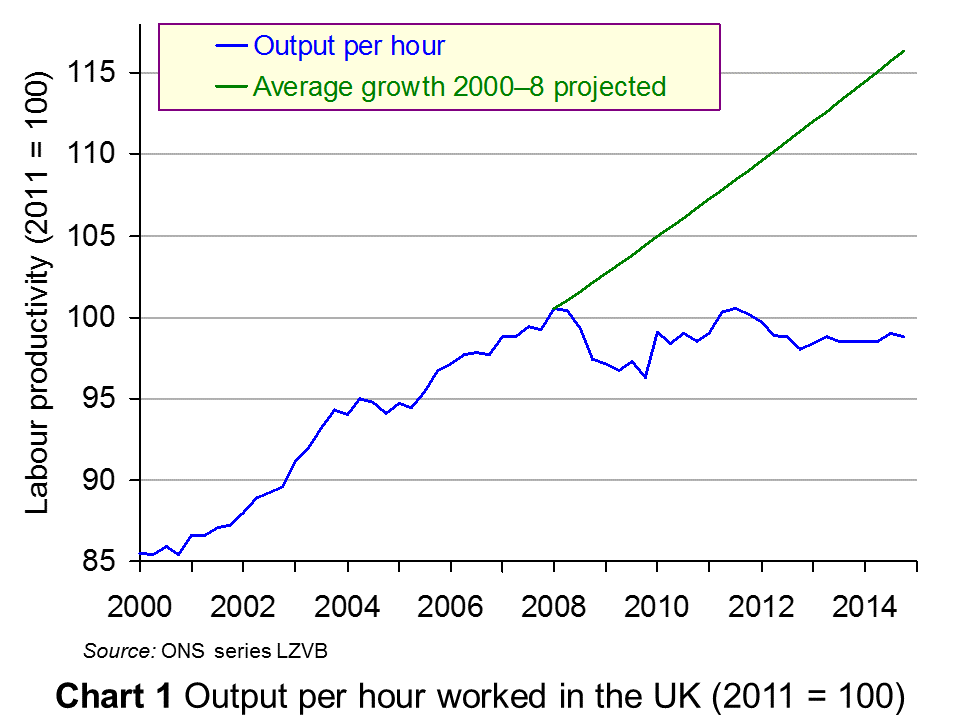 The first chart shows UK output per hour worked (click here for a PowerPoint). It is based on figures released by the ONS on 1 April 2015. Average annual growth in output per hour worked was 2.3% from 2000 to 2008. Since then, productivity growth has stalled and output per hour is now lower than at the peak in 2008.
The green line projects from 2008 what output per hour would have been if its growth had remained at 2.3%. It shows that by the end of 2014 output per hour would have been nearly 18% higher if productivity growth had been maintained.
 The second chart compares UK productivity growth with other countries (click here for a PowerPoint). Up to 2008, UK productivity was rising slightly faster than in the other five countries illustrated. Since then, it has performed worse than the other five countries, especially since 2011.
Productivity growth increases potential GDP. It also increases actual GDP if the productivity increase is not offset by a fall in hours worked. A rise in hours worked without a rise in productivity, however, even though it results in an increase in actual output, does not increase potential output. If real GDP growth is to be sustained over the long term, there must be an increase in productivity and not just in hours worked.
The articles below examines this poor productivity performance and looks at reasons why it has been so bad.
Articles
UK’s sluggish productivity worsened in late 2014 – ONS Reuters (1/4/15)
UK productivity growth is weakest since second world war, says ONS The Guardian, Larry Elliott (1/4/15)
UK productivity weakness worsening, says ONS Financial Times, Chris Giles (1/4/15)
Is the UK’s sluggish productivity a problem? Financial Times comment (1/4/15)
UK manufacturing hits eight-month high but productivity slump raises fears over sustainability of economic recovery This is Money, Camilla Canocchi (1/4/15)
Weak UK productivity unprecedented, ONS says BBC News (1/4/15)
Weep for falling productivity Robert Peston (1/4/15)
UK’s Falling Productivity Prevented A Massive Rise In Unemployment Forbes, Tim Worstall (2/4/15)
Data
Labour Productivity, Q4 2014 ONS (1/4/15)
AMECO database European Commission, Economic and Financial Affairs
Questions
- How can productivity be measured? What are the advantages and disadvantages of using specific measures?
- Draw a diagram to show the effects on equilibrium national income of (a) a productivity increase, but offset by a fall in the number of hours worked; (b) a productivity increase with hours worked remaining the same; (c) a rise in hours worked with no increase in productivity. Assume that actual output depends on aggregate demand.
- Is poor productivity growth good for employment? Explain.
- Why is productivity in the UK lower now than in 2008?
- What policies can be pursued to increase productivity in the UK?


