 On 2 November, the Bank of England raised Bank rate from 0.25% to 0.5% – the first rise since July 2007. But was now the right time to raise interest rates? Seven of the nine-person Monetary Policy Committee voted to do so; two voted to keep Bank Rate at 0.25%.
Raising the rate, on first sight, may seem a surprising decision as growth remains sluggish. Indeed, the two MPC members who voted against the rise argued that wage growth was too weak to justify the rise. Also, inflation is likely to fall as the effects of the Brexit-vote-induced depreciation of sterling on prices feeds through the economy. In other words, prices are likely to settle at the new higher levels but will not carry on rising – at least not at the same rate.
So why did the other seven members vote to raise Bank Rate. There are three main arguments:
|
|
| • |
Inflation, at 3%, is above the target of 2% and is likely to stay above the target if interest rates are not raised. |
| • |
There is little spare capacity in the economy, with low unemployment. There is no shortage of aggregate demand relative to output. |
| • |
With productivity growth being negligible and persistently below that before the financial crisis, aggregate demand, although growing slower than in the past, is growing excessively relative to the growth in aggregate supply. |
As the Governor stated at the press conference:
In many respects, the decision today is straightforward: with inflation high, slack disappearing, and the economy growing at rates above its speed limit, inflation is unlikely to return to the 2% target without some increase in interest rates.
But, of course, the MPC’s forecasts may turn out to be incorrect. Many things are hard to predict. These include: the outcomes of the Brexit negotiations; consumer and business confidence and their effects on consumption and investment; levels of growth in other countries and their effects on UK exports; and the effects of the higher interest rates on saving and borrowing and hence on aggregate demand.
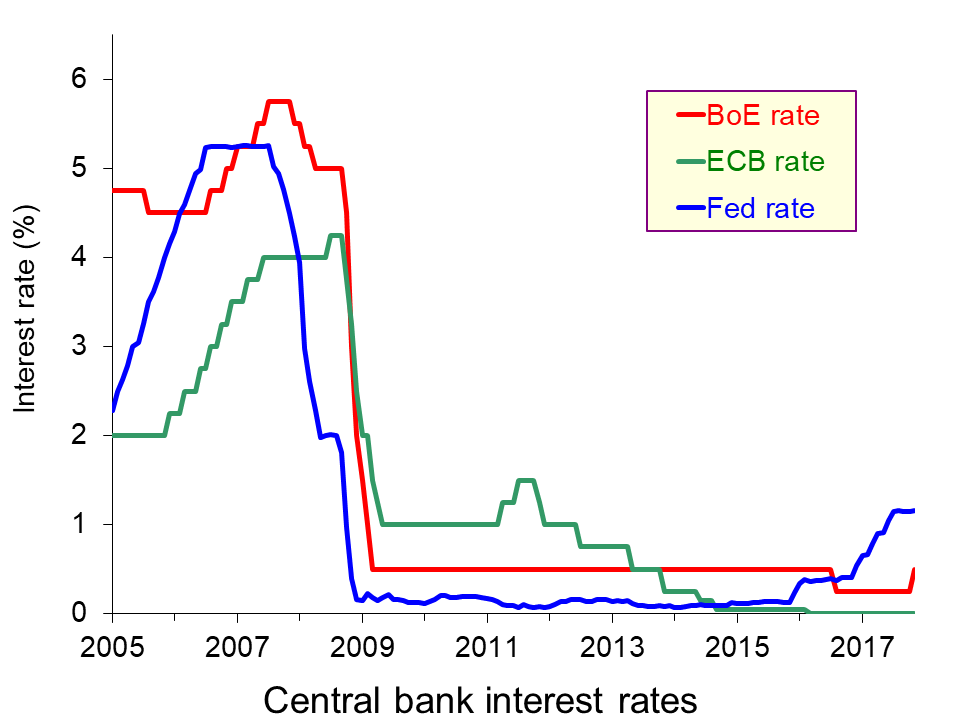 The Bank of England is well aware of these uncertainties. Although it plans two more rises in the coming months and then Bank Rate remaining at 1% for some time, this is based on its current assessment of the outlook for the economy. If circumstances change, the Bank will adjust the timing and total amount of future interest rate changes.
There are, however, dangers in the rise in interest rates. Household debt is at very high levels and, although the cost of servicing these debts is relatively low, even a rise in interest rates of just 0.25 percentage points can represent a large percentage increase. For example, a rise in a typical variable mortgage interest rate from 4.25% to 4.5% represents a 5.9% increase. Any resulting decline in consumer spending could dent business confidence and reduce investment.
Nevertheless, the Bank estimates that the effect of higher mortgage rates is likely to be small, given that some 60% of mortgages are at fixed rates. However, people need to refinance such rates every two or three years and may also worry about the rises to come promised by the Bank.
Articles
Bank of England deputy says interest rate rise means pain for households and more hikes could be in store Independent, Ben Chapman (3/11/17)
UK interest rates: Bank of England shrugs off Brexit nerves to launch first hike in over a decade Independent, Ben Chu (2/11/17)
 Bank of England takes slow lane after first rate hike since Reuters, David Milliken, William Schomberg and Julian Satterthwaite (2/11/17)
First UK rate rise in a decade will be a slow burn Financial Times, Gemma Tetlow (2/11/17)
The Bank of England’s Rate Rise Could Spook Britain’s Economy Bloomberg, Fergal O’Brien and Brian Swint (3/11/17)
Bank of England hikes rates for the first time in a decade CNBC, Sam Meredith (2/11/17)
Interest rates rise in Britain for the first time in a decade The Economist (2/11/17)
Bank of England publications
Bank of England Inflation Report Press Conference, Opening Remarks Financial Times on YouTube, Mark Carney (2/11/17)
Bank of England Inflation Report Press Conference, Opening Remarks Bank of England, Mark Carney (2/11/17)
Inflation Report Press Conference (full) Bank of England on YouTube (2/11/17)
Inflation Report Bank of England (November 2017)
Monetary Policy Summary and minutes of the Monetary Policy Committee meeting ending on 1 November 2017 Bank of England (2/11/17)
Questions
- Why did the majority of MPC members feel that now was the right time to raise interest rates whereas a month ago was the wrong time?
- Why did the exchange rate fall when the announcement was made?
- How does a monetary policy of targeting the rate of inflation affect the balance between aggregate demand and aggregate supply?
- Can monetary policy affect potential output, or only actual output?
- If recent forecasts have downgraded productivity growth and hence long-term economic growth, does this support the argument for raising interest rates or does it suggest that monetary policy should be more expansionary?
- Why does the MPC effectively target inflation in the future (typically in 24 months’ time) rather than inflation today? Note that Mark Carney at the press conference said, “… it isn’t so much where inflation is now, but where it’s going that concerns us.”
- To what extent can the Bank of England’s monetary policy be described as ‘discretionary’?
 With first Houston, then several Caribbean islands and Florida suffering dreadful flooding and destruction from Hurricanes Harvey and Irma, many are questioning whether more should be spent on flood prevention and reducing greenhouse gas emissions. Economists would normally argue that such questions are answered by conducting a cost–benefit analysis.
However, even if the size of the costs and benefits of such policies could be measured, this would not be enough to give the answer. Whether such spending is justified would depend on the social rate of discount. But what the rate should be in cost-benefit analyses is a highly contested issue, especially when the benefits occur a long time in the future.
I you ask the question today, ‘should more have been spent on flood prevention in Houston and Miami?’, the answer would almost certainly be yes, even if the decision had to have been taken many years ago, given the time it takes to plan and construct such defences.  But if you asked people, say, 15 years ago whether such expenditure should be undertaken, many would have said no, given that the protection would be provided quite a long time in the future. Also many people back then would doubt that the defences would be necessary and many would not be planning to live there indefinitely.
This is the familiar problem of people valuing costs and benefits in the future less than costs and benefits occurring today. To account for this, costs and benefits in the future are discounted by an annual rate to reduce them to a present value.
But with costs and benefits occurring a long time in the future, especially from measures to reduce carbon emissions, the present value is very sensitive to the rate of discount chosen. But choosing the rate of discount is fraught with difficulties.
Some argue that a social rate of discount should be similar to long-term market rates. But market rates reflect only the current generation’s private preferences. They do not reflect the costs and benefits to future generations. A social rate of discount that did take their interests into account would be much lower and could even be argued to be zero – or negative with a growing population.
Against this, however, has to be set the possibility that future generations will be richer than the current one and will therefore value a dollar (or any other currency) less than today’s generation.
 However, it is also likely, if the trend of recent decades is to continue, that economic growth will be largely confined to the rich and that the poor will be little better off, if at all. And it is the poor who often suffer the most from natural disasters. Just look, for example, at the much higher personal devastation suffered from hurricane Irma by the poor on many Caribbean islands compared with those in comparatively wealthy Florida.
A low or zero discount rate would make many environmental projects socially profitable, even though they would not be with a higher rate. The choice of rate is thus crucial to the welfare of future generations who are likely to bear the brunt of climate change.
But just how should the social rate of discount be chosen? The following two articles explore the issue.
Articles
How Much Is the Future Worth? Slate, Will Oremus (1/9/17)
Climate changes the debate: The impact of demographics on long-term discount rates Vox, Eli P Fenichel, Matthew Kotchen and Ethan T Addicott (20/8/17)
Questions
- What is meant by the social rate of discount?
- Why does the choice of a lower rate of social discount imply a more aggressive climate policy?
- How is the distribution of the benefits and costs of measures to reduce carbon emissions between rich and poor relevant in choosing the social rate of discount of such measures?
- How is the distribution of the benefits of such measures between current and future generations relevant in choosing the rate?
- How is uncertainty about the magnitude of the costs and benefits relevant in choosing the rate?
- What is the difference between Stern’s and Nordhaus’ analyses of the choice of social discount rate?
- Explain and discuss the ‘mortality-based approach’ to estimating social discount rates.
- What are the arguments ‘for economists analysing climate change through the lens of minimising risk, rather than maximizing utility’?
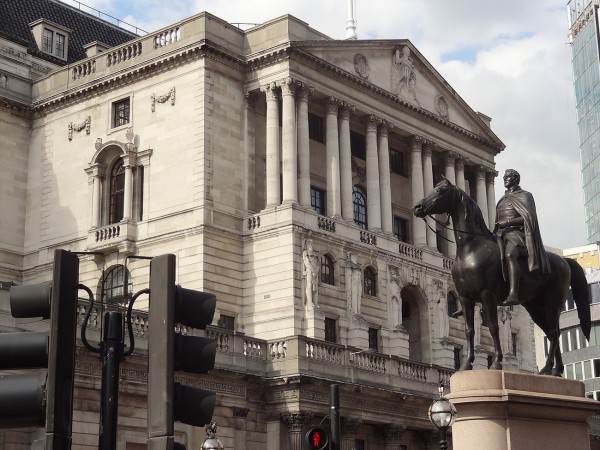 On the 15th June, the Bank of England’s Monetary Policy Committee decided to keep Bank Rate on hold at its record low of 0.25%. This was not a surprise – it was what commentators had expected. What was surprising, however, was the split in the MPC. Three of its current eight members voted to raise the rate.
At first sight, raising the rate might seem the obvious thing to do. CPI inflation is currently 2.9% – up from 2.7% in April and well above the target of 2% – and is forecast to go higher later this year. According to the Bank of England’s own forecasts, even at the 24-month horizon inflation is still likely to be a little above the 2% target.
Those who voted for an increase of 0.25 percentage points to 0.5% saw it as modest, signalling only a very gradual return to more ‘normal’ interest rates. However, the five who voted to keep the rate at 0.25% felt that it could dampen demand too much.
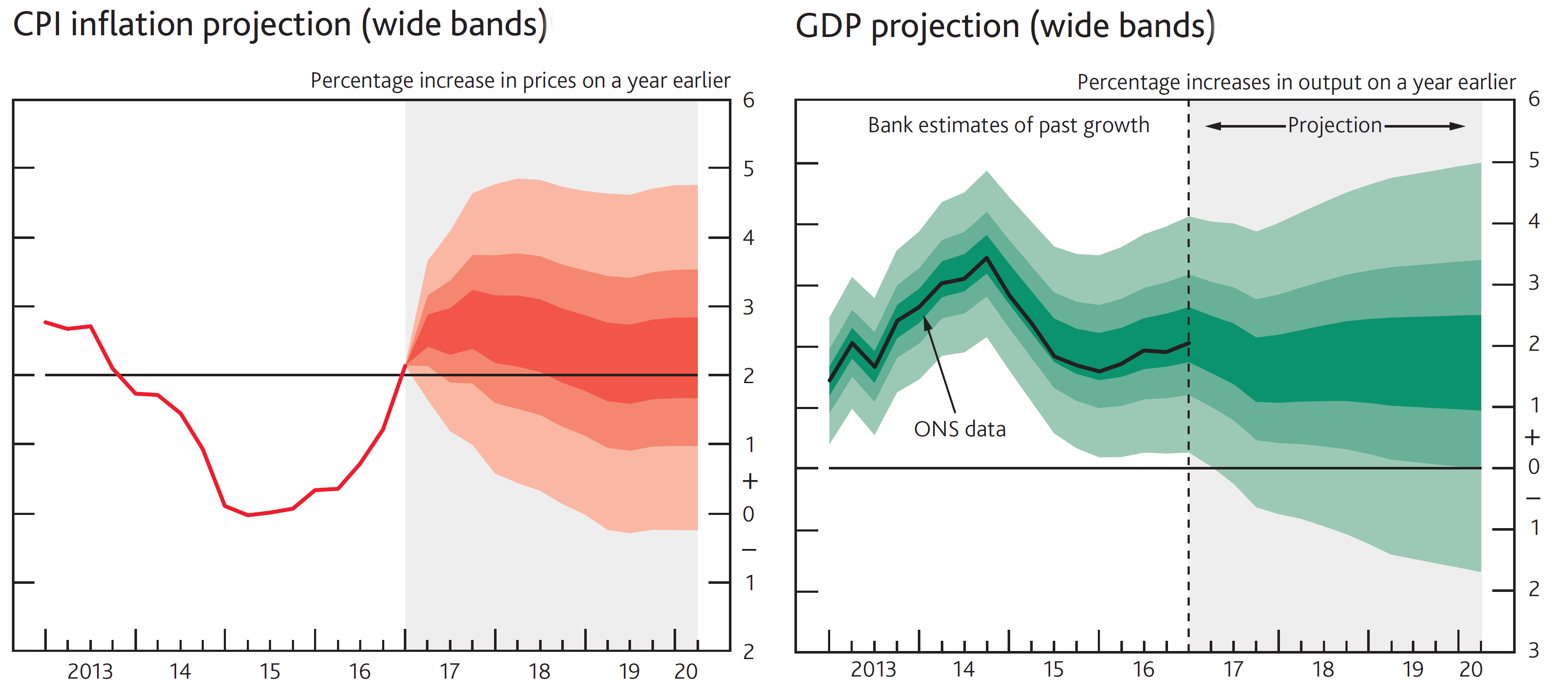
The key argument is that inflation is not of the demand-pull variety. Aggregate demand is subdued. Real wages are falling and hence consumer demand is likely to fall too. Thus many firms are cautious about investing, especially given the considerable uncertainties surrounding the nature of Brexit. The prime cause of the rise in inflation is the fall in sterling since the Brexit vote and the effect of higher import costs feeding through into retail prices. In other words, the inflation is of the cost-push variety. In such cirsumstances dampening demand further by raising interest rates would be seen by most economists as the wrong response. As the minutes of the MPC meeting state:
Attempting to offset fully the effect of weaker sterling on inflation would be achievable only at the cost of higher unemployment and, in all likelihood, even weaker income growth. For this reason, the MPC’s remit specifies that, in such exceptional circumstances, the Committee must balance any trade-off between the speed at which it intends to return inflation sustainably to the target and the support that monetary policy provides to jobs and activity.
The MPC recognises that the outlook is uncertain. It states that it stands ready to respond to circumstances as they change. If demand proves to be more resilient that it currently expects, it will raise Bank Rate. If not, it is likely to keep it on hold to continue providing a modest stimulus to the economy. However, it is unlikely to engage in further quantitative easing unless the economic outlook deteriorates markedly.
Articles
The Bank of England is moving closer to killing the most boring chart in UK finance right now Business Insider, Will Martin (16/6/17)
UK inflation hits four-year high of 2.9% Financial Times, Gavin Jackson and Chloe Cornish (13/6/17)
Surprise for markets as trio of Bank of England gurus call for interest rates to rise The Telegraph, Szu Ping Chan Tim Wallace (15/6/17)
Bank of England rate setters show worries over rising inflation Financial TImes, Chris Giles (15/6/17)
Three Bank of England policymakers in shock vote for interest rate rise Independent, Ben Chu (15/6/17)
Bank of England edges closer to increasing UK interest rates The Guardian, Katie Allen (15/6/17)
Bank of England doves right to thwart hawks seeking interest rate rise The Guardian, Larry Elliott (15/6/17)
Haldane expects to vote for rate rise this year BBC News (21/6/17)
Bank of England documents
Monetary policy summary Bank of England (15/6/17)
Monetary Policy Summary and minutes of the Monetary Policy Committee meeting ending on 14 June 2017 Bank of England (15/6/17)
Inflation Report, May 2017 Bank of England (11/5/16)
Questions
- What is the mechanism whereby a change in Bank Rate affects other interest artes?
- Use an aggregate demand and supply diagram to illustrate the difference between demand-pull and cost-push inflation.
- If the exchange rate remains at around 10–15% below the level before the Brexit vote, will inflation continue to remain above the Bank of England’s target, or will it reach a peak relatively soon and then fall back? Explain.
- For what reason might aggregate demand prove more buoyant that the MPC predicts?
- Would a rise in Bank Rate from 0.25% to 0.5% have a significant effect on aggregate demand? What role could expectations play in determining the nature and size of the effect?
- Why are real wage rates falling at a time when unemployment is historically very low?
- What determines the amount that higher prices paid by importers of products are passed on to consumers?
 The US Federal Reserve, like many other central banks, engaged in massive quantitative easing in the wake of the financial crisis of 2007/8. Over three rounds, QE1, QE2 and QE3, it accumulated $4.5 trillion of assets – mainly government bonds and mortgage-backed securities (see chart below: click here for a PowerPoint). But, unlike its counterparts in the UK, the eurozone and Japan, it has long ceased its programme of asset purchases.. In October 2014, it announced that QE was at an end. All that would be done in future would be to replace existing holdings of assets as they matured, keeping total holdings roughly constant.
But now this policy is set to change. The Fed is about to embark on a programme of ‘quantitative tightening’, already being dubbed ‘QT’. This involves the Fed reducing its holdings of assets, mainly government bonds and government-backed mortgage-related securities.
 This, however, for the time being will not include selling its holding of bonds or mortgage-backed securities. Rather, it will simply mean not buying new assets to replace ones when they mature, or only replacing part of the them. This was discussed by the 75 participants at the joint meeting of the Federal Open Market Committee (FOMC) and Board of Governors on 14–15 March.
As the minutes put it: “Many participants emphasized that reducing the size of the balance sheet should be conducted in a passive and predictable manner.”
A more active form of QT would involve selling assets before maturity and thus reducing the size of the Fed’s balance sheet more rapidly. But either way, reducing assets would put downward pressure on the money supply and support the higher interest rates planned by the FOMC.
The question is whether there is enough liquidity elsewhere in the system and enough demand for credit, and willingness of the banking system to supply credit, to allow a sufficient growth in broad money – sufficient, that is, to support continued growth in the economy. The answer to that question depends on confidence. The Fed, not surprisingly, is keen not to damage confidence and hence prefers a gradualist approach to reducing its holdings of assets bought during the various rounds of quantitative easing.
Articles
Fed’s asset shift to pose new test of economy’s recovery, resilience Reuters, Howard Schneider and Richard Leong (6/4/17)
Federal Reserve likely to begin cutting back $4.5 trillion balance sheet this year Washington Post, Ana Swanson (5/4/17)
Why the Fed’s debate about shrinking its balance sheet really, really matters Money Observer, Russ Mould (7/4/17)
The Fed and ECB keep a cautious eye on the exit Financial Times (7/4/17)
Get ready for the Fed’s next scary policy change CBS Money Watch, Anthony Mirhaydari (5/4/17)
The Fed wants to start shrinking its $4.5 trillion balance sheet later this year Business Insider, Akin Oyedele (5/4/17)
Inside the Fed’s March Meeting: The Annotated Minutes Bloomberg, Luke Kawa, Matthew Boesler and Alex Harris (5/4/17)
QE was great for asset prices – will ‘QT’ smash them? The Financial Review (Australia), Patrick Commins (7/4/17)
Shrinking the Fed’s balance sheet Brookings, Ben Bernanke (26/1/17)
Data
Selected data Board of Governors of the Federal Reserve System
Questions
- Distinguish between active and passive QT.
- If QE is a form of expansionary monetary policy, is QT a form of contractionary monetary policy?
- Could QT take place alongside an expansion of broad money?
- What dangers lie in the Fed scaling back its holdings of government (Treasury) bonds and mortgage-backed securities?
- Why is it unlikely that the Fed will reduce its holdings of securities to pre-crisis levels?
- Why are the Bank of England, the ECB and the Bank of Japan still pursuing a policy of QE?
- What are the implications for exchange rates of QT in the USA and QE elsewhere?
- Find out data for the monetary base, for narrow money (M1) and broader money (M2) in the USA. Are narrow and/or broad money correlated with Federal Reserve asset holdings?
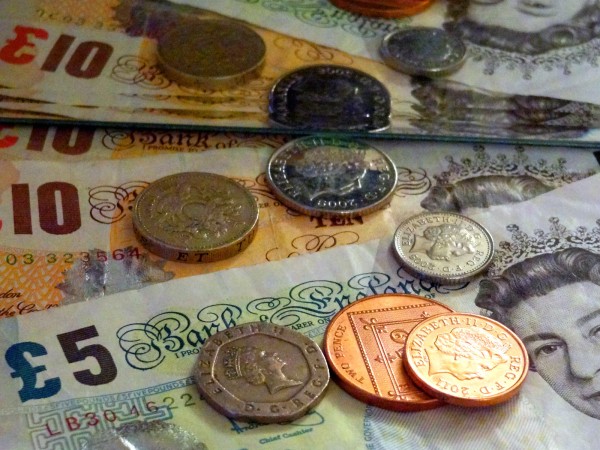 The latest figures from the ONS show that UK inflation rose to 2.3% for the 12 months to February 2017 – up from 1.9% for the 12 months to January. The rate is the highest since September 2013 and has steadily increased since late 2015.
The main price index used to measure inflation is now CPIH, as opposed to CPI. CPIH is the consumer prices index (CPI) adjusted for housing costs and is thus a more realsitic measure of the cost pressures facing households. As the ONS states:
CPIH extends the consumer prices index (CPI) to include a measure of the costs associated with owning, maintaining and living in one’s own home, known as owner occupiers’ housing costs (OOH), along with Council Tax. Both of these are significant expenses for many households and are not included in the CPI.
But why has inflation risen so significantly? There are a number of reasons.
 The first is a rise in transport costs (contributing 0.15 percentage points to the overall inflation rate increase of 0.4 percentage points). Fuel prices rose especially rapidly, reflecting both the rise in the dollar price of oil and the depreciation of the pound. In February 2016 the oil price was $32.18; in February 2017 it was $54.87 – a rise of 70.5%. In February 2016 the exchange rate was £1 = $1.43; in February 2017 it was £1 = $1.25 – a depreciation of 12.6%.
The second biggest contributor to the rise in inflation was recreation and culture (contributing 0.08 percentage points). A wide range of items in this sector, including both goods and services, rose in price. ‘Notably, the price of personal computers (including laptops and tablets) increased by 2.3% between January 2017 and February 2017.’ Again, a large contributing factor has been the fall in the value of the pound. Apple, for example, raised its UK app store prices by a quarter in January, having raised prices for iPhones, iPads and Mac computers significantly last autumn. Microsoft has raised its prices by more than 20% this year for software services such as Office and Azure. Dell, HP and Tesla have also significantly raised their prices.
The third biggest was food and non-alcoholic beverages (contributing 0.06 percentage points). ‘Food prices, overall, rose by 0.8% between January 2017 and February 2017, compared with a smaller rise of 0.1% a year earlier.’ Part of the reason has been the fall in the pound, but part has been poor harvests in southern Europe putting up euro prices. This is the first time that overall food prices have risen for more than two-and-a-half years.
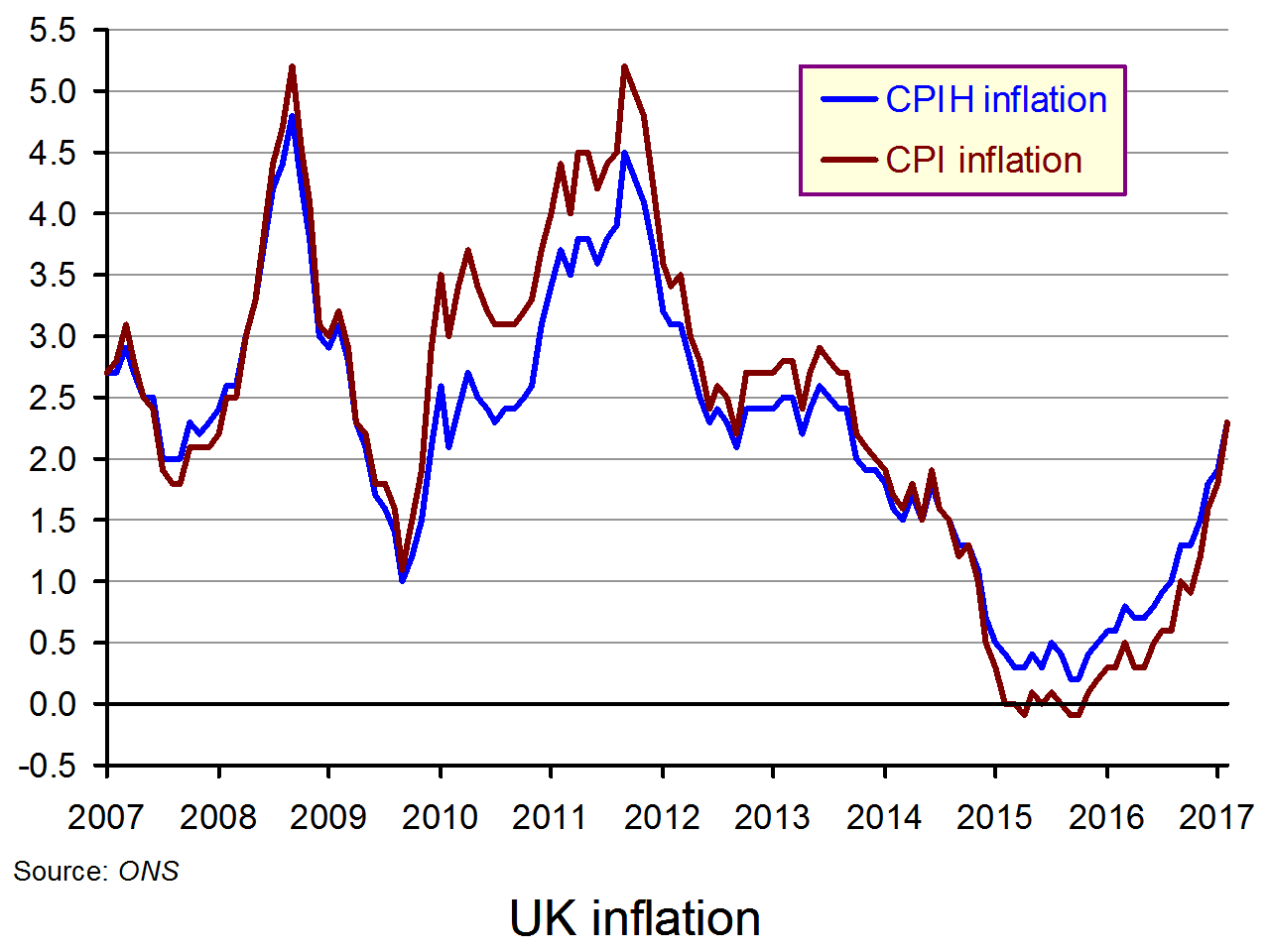 It is expected that inflation will continue to rise over the coming months as the effect of the weaker pound and higher raw material and food prices filter though. The current set of pressures could see inflation peaking at around 3%. If there is a futher fall in the pound or further international price increases, inflation could be pushed higher still – well above the Bank of England’s 2% target. (Click here for a PowerPoint of the chart.)
The higher inflation means that firms are facing a squeeze on their profits from two directions.
First, wage rises have been slowing and are now on a level with consumer price rises. It is likely that wage rises will soon drop below price rises, meaning that real wages will fall, putting downward pressure on spending and squeezing firms’ revenue.
Second, input prices are rising faster than consumer prices. In the 12 months to February 2017, input prices (materials and fuels) rose by 19.1%, putting a squeeze on producers. Producer prices (‘factory gate prices’), by contrast, rose by 3.7%. Even though input prices are only part of the costs of production, the much smaller rise of 3.7% reflects the fact that producer’s margins have been squeezed. Retailers too are facing upward pressure on costs from this 3.7% rise in the prices of products they buy from producers.
One of the worries about the squeeze on real wages and the squeeze on profits is that this could dampen investment and slow both actual and potential growth.
 So will the Bank of England respond by raising interest rates? The answer is probably no – at least not for a few months. The reason is that the higher inflation is not the result of excess demand and the economy ‘overheating’. In other words, the higher inflation is not from demand-pull pressures. Instead, it is from higher costs, which are in themselves likely to dampen demand and contribute to a slowdown. Raising interest rates would cause the economy to slow further.
Videos
UK inflation shoots above two percent, adding to Bank of England conundrum Reuters, William Schomberg, David Milliken and Richard Hunter (21/3/17)
Bank target exceeded as inflation rate rises to 2.3% ITV News, Chris Choi (21/3/17)
Steep rise in inflation Channel 4 News, Siobhan Kennedy (21/3/17)
U.K. Inflation Gains More Than Forecast, Breaching BOE Goal Bloomberg, Dan Hanson and Fergal O’Brien (21/3/17)
Articles
Inflation leaps in February raising prospect of interest rate rise The Telegraph, Julia Bradshaw (21/3/17)
Brexit latest: Inflation jumps to 2.3 per cent in February Independent, Ben Chu (21/3/17)
UK inflation rate leaps to 2.3% BBC News (21/3/17)
UK inflation: does it matter for your income, debts and savings? Financial Times, Chris Giles (21/3/17)
Rising food and fuel prices hoist UK inflation rate to 2.3% The Guardian, Katie Allen (21/3/17)
Reality Check: What’s this new measure of inflation? BBC News (21/3/17)
Data
UK consumer price inflation: Feb 2017 ONS Statistical Bulletin (21/3/17)
UK producer price inflation: Feb 2017 ONS Statistical Bulletin (21/3/17)
Inflation and price indices ONS datasets
Consumer Price Inflation time series dataset ONS datasets
Producer Price Index time series dataset ONS datasets
European Brent Spot Price US Energy Information Administration
Statistical Interactive Database – interest & exchange rates data Bank of England
Questions
- If pries rise by 10% and then stay at the higher level, what will happen to inflation (a) over the next 12 months; (b) in 13 months’ time?
- Distinguish between demand-pull and cost-push inflation. Why are they associated with different effects on output?
- If producers face rising costs, what determines their ability to pass them on to retailers?
- Why is the rate of real-wage increase falling, and why may it beome negative over the coming months?
- What categories of people are likely to lose the most from inflation?
- What is the Bank of England’s remit in terms of setting interest rates?
- What is likely to affect the sterling exchange rate over the coming months?
 On 2 November, the Bank of England raised Bank rate from 0.25% to 0.5% – the first rise since July 2007. But was now the right time to raise interest rates? Seven of the nine-person Monetary Policy Committee voted to do so; two voted to keep Bank Rate at 0.25%.