 First the good news. Employment is rising and unemployment is falling. Both claimant count rates and Labour Force Survey rates are down. Compared with a year ago, employment is up 279,092 to 29,869,489; LFS unemployment is down from 7.87% to 7.69%; and the claimant count rate is down from 4.7% to 4.0%.
Now the bad news. Even though more people are in employment, real wages have fallen. In other words, nominal wages have risen less fast than prices. Since 2009, real wages have fallen by 7.6% and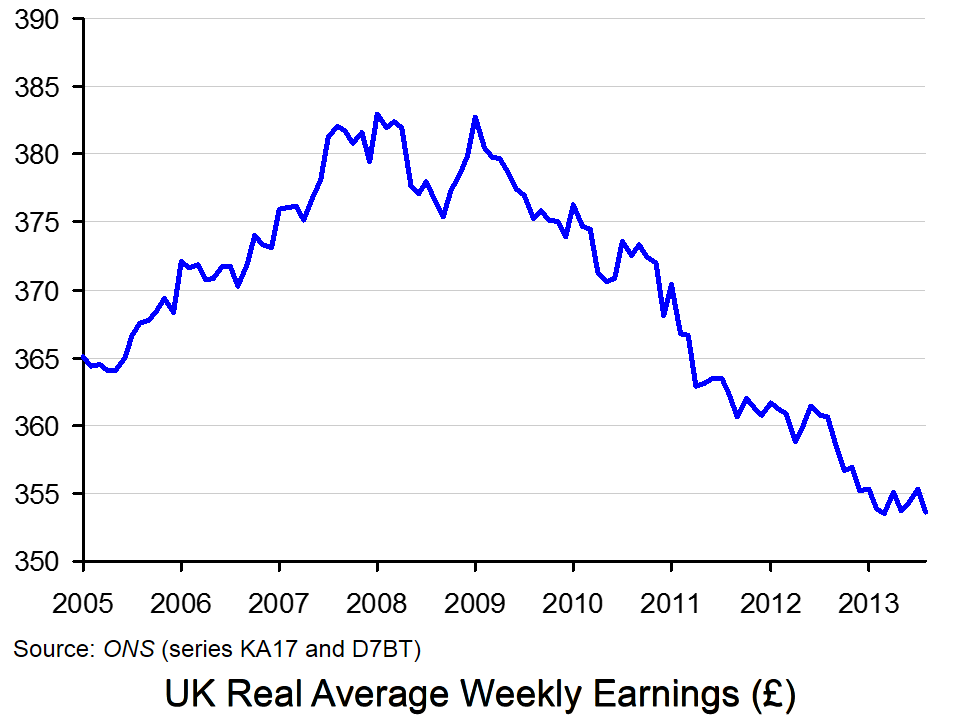 have continued to fall throughout this period. The first chart illustrates this. It shows average weekly wage rates in 2005 prices. (Click here for a PowerPoint of the chart.)
The fall in real wages is an average for the whole country. Many people, especially those on low incomes, have seen their real wages fall much faster than the average. For many there is a real ‘cost of living’ crisis.
But why have real wages fallen despite the rise in employment? The answer is that output per hour worked has declined. This is illustrated in the second chart, which compares UK output per worker with that of other G7 countries. UK productivity has fallen both absolutely and relative to other G7 countries, most of which have had higher rates of investment.
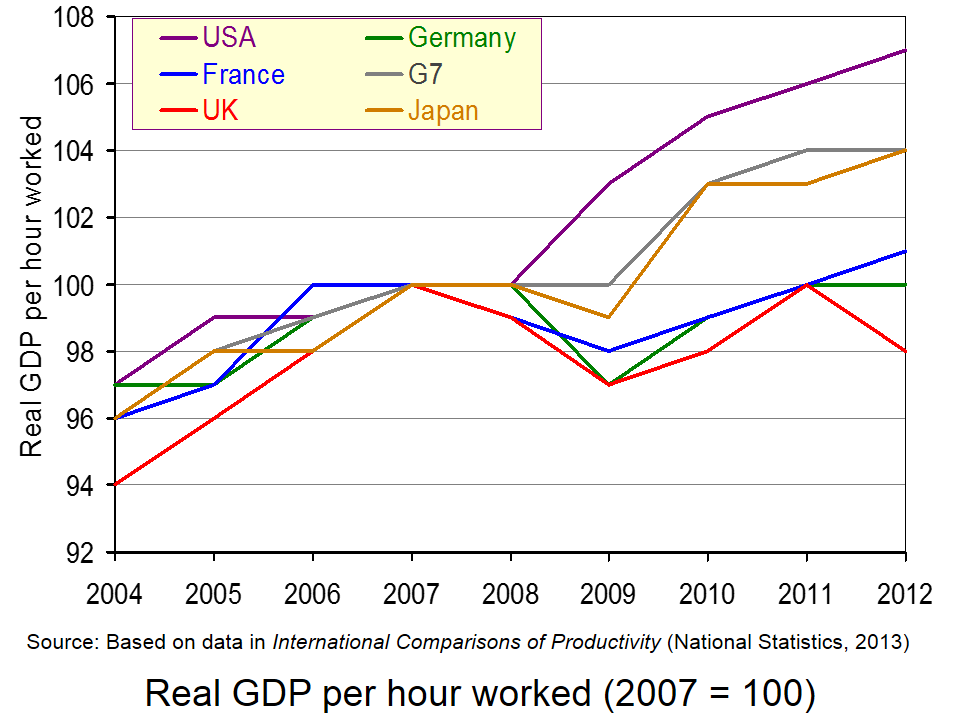 The falling productivity in the UK requires more people to be employed to produce the same level of output. Part of what seems to be happening is that many employers have been prepared to keep workers on in return for lower real wages, even if demand from their customers is falling. And many workers have been prepared to accept real wage cuts in return for keeping their jobs.
Another part of the explanation is that the jobs that have been created have been largely in low-skilled, low-wage sectors of the economy, such as retailing and other parts of the service sector.
But falling productivity is only part of the reason for falling real wages. The other part is rising prices. A number of factors have contributed to this. These include a depreciation of the exchange rate back in 2008, the effects of which took some time to filter through into higher prices in the shops; a large rise in various commodity prices; and a rise in VAT and various other administered prices.
So what is the answer to falling real wages? The articles below consider the problem and some of the possible policy alternatives.
Articles
Inflation, unemployment and UK ‘misery’ BBC News, Linda Yueh (16/10/13)
Employment is growing, but so are the wage slaves The Guardian, Larry Elliott (16/10/13)
Living standards – going down and, er, up BBC News, Nick Robinson (26/7/13)
Revealed: The cost of living is rising faster in the UK than anywhere in Europe, with soaring food and energy bills blamed Mail Online, Matt Chorley (16/10/13)
Cutting prices to raise living standards is just a waste of energy The Telegraph, Roger Bootle (6/10/13)
Downturn sees average real wages collapse to a record low Independent, Ben Chu (17/10/13)
Why living standards and public finances matter Financial Times, Gavin Kelly (29/9/13)
Social Mobility Tsar Alan Milburn Calls on Government to Boost Wages to End UK Child Poverty International Business Times, Ian Silvera (17/10/13)
Do incorrect employment growth figures explain low UK productivity? The Guardian, Katie Allen (23/10/13)
Data
Unemployment data ONS
Average Weekly Earnings dataset ONS
Consumer Prices Index ONS
International Comparison of Productivity ONS
Questions
- How are real wages measured?
- Why have real wage rates fallen in the UK since 2009?
- What factors should be included when measuring living standards?
- Why has employment risen and unemployment fallen over the past two years?
- What factors could lead to a rise in real wages in the future?
- What government policies could be adopted to raise real wages?
- Assess these policies in terms of their likely short-term success and long-term sustainability.
Letter writing has, in many walks of life, rather gone out of fashion. For instance, many of us of a slightly older disposition remember how putting pen to paper was an important part of courtship and the building of relationships. Well, one modern-day couple who are getting very used to an exchange of letters is the Governor of the Bank of England and the Chancellor of the Exchequer. The latest inflation numbers from the Office for National Statistics show that the annual rate of CPI inflation for July was 3.1%. While the inflation rate is down from the 3.2% recorded in June it remains more than 1 percentage point above the government’s central inflation rate target of 2%. Consequently, Mervyn King will again be writing to the Chancellor to explain why this is the case.
Since the turn of the year, the annual rate of CPI inflation has, with the exception of February, been consistently above 3%. Even February was a narrow escape for the Governor because inflation came in at exactly 3%! Another way of putting the recent inflation record into perspective is to note that over the first seven months of 2010 the average annual rate of CPI inflation has been 3.3%.
The slight fall in July’s annual inflation rate is attributed, in part, to falls during July in the prices of second-hand cars and petrol whereas these prices were rising a year ago. Furthermore, the average price of clothing and footwear fell by some 4.9% between June and July of this year as compared with a fall of 3.2% in the same period a year ago. The result is that the annual rate of price deflation for clothing and footwear went from 1.4% in June to 3.1% in July.
Of course, within the basket of consumer goods price patterns can vary significantly. One significant upward pressure on July’s overall annual inflation rate was the price of food and non-alcoholic beverages, especially vegetables. The average price of food and non-alcoholic beverages rose by 1% between June and July which has seen the annual rate of price inflation for food and non-alcoholic beverages rise from 1.9% in June to 3.4% in July.
The fact that July shows inflation running in excess of 3% will surprise very few. In the latest Inflation Report the Bank of England reports that the Monetary Policy Committee’s view is that ‘the forthcoming increase in VAT was expected to keep CPI inflation above the 2% target until the end of 2011’. The Committee then expects what it describes as a ‘persistent margin of spare capacity’ to force inflation to fall back. But, the Committee also feels that the prospects for inflation are ‘highly uncertain’. Therefore, it is difficult to gauge just how many more letters will be passing across London between the Governor and the Chancellor in the coming months. Nonetheless, it would be probably be advisable for the Governor to make sure that he has a sufficient supply of postage stamps at his disposal, just in case!
Articles
UK inflation rate slows again in July BBC News (17/8/10)
Bank of England’s King forced to write another letter to Osborne as prices stay high Telegraph (17/8/10)
Inflation falls to 3.1% in July Financial Times, Daniel Pimlott (17/8/10)
Dearer food keeps inflation high UK Press Association (17/8/10)
Bank ‘surprised’ at inflation strength Independent, Russell Lynch (17/8/10)
Letters
Letter from the Governor to the Chancellor and the Chancellor’s reply Bank of England (17/8/10)
Data
Latest on inflation Office for National Statistics (17/8/10)
Consumer Price Indices, Statistical Bulletin, July 2010 Office for National Statistics (17/8/10)
Consumer Price Indices, Time Series Data Office for National Statistics
For CPI (Harmonised Index of Consumer Prices) data for EU countries, see:
HICP European Central Bank
Questions
- What does the Bank of England mean by a ‘persistent margin of spare capacity’? By what economic term is this phenomenon more commonly known?
- Why do you think the current rate of inflation is above target despite the spare capacity in the economy?
- Since the annual rate of CPI inflation remains in ‘letter-writing territory’ would you expect the Monetary Policy Committee to be raising interest rates some time soon? Explain your answer.
- What impact might the persistence of above-target inflation have for the public’s expectations of inflation?
- What impact can we expect the increase in the standard rate of VAT next January to have on the annual rate of CPI inflation? Is such an effect on the rate of inflation a permanent one?
 First the good news. Employment is rising and unemployment is falling. Both claimant count rates and Labour Force Survey rates are down. Compared with a year ago, employment is up 279,092 to 29,869,489; LFS unemployment is down from 7.87% to 7.69%; and the claimant count rate is down from 4.7% to 4.0%.