 Have you ever woken in the night worrying about your finances? Most of us have. Our overall financial position undoubtedly exerts influence on our spending. Therefore, we would not expect our current spending levels to be entirely determined by our current income level.
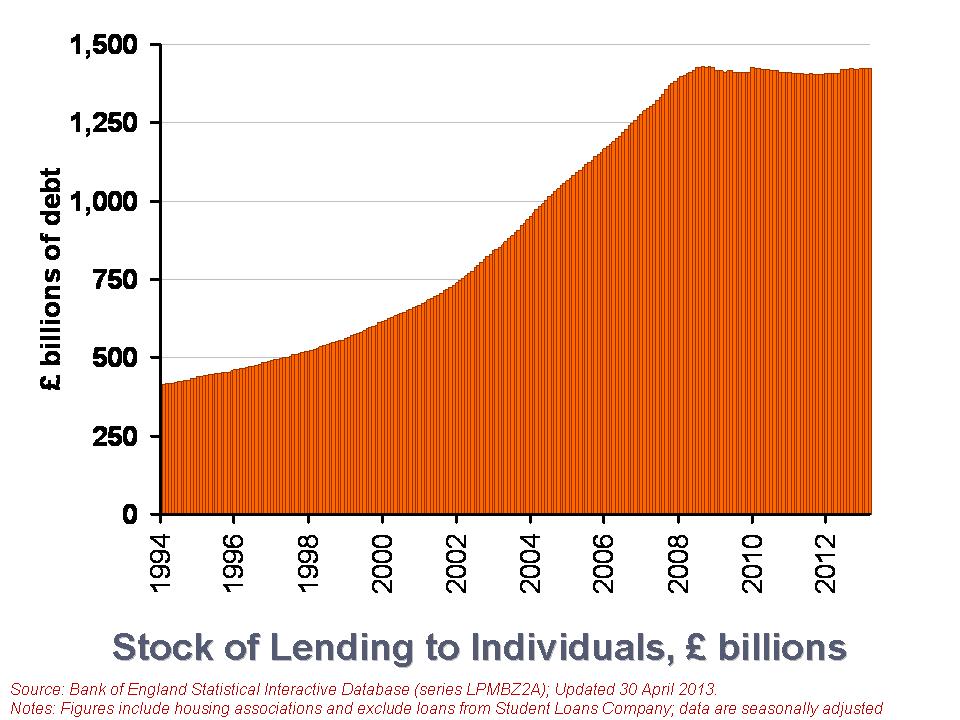
Our financial health, or what economists call our net financial wealth, can be calculated as the difference between our financial assets (savings) and our financial liabilities (debt). Between them, British households have amassed a stock of debt of £1.423 trillion, almost as much as annual GDP, which is around £1.5 trillion (click here to download the PowerPoint.) We look here at recent trends in loans by financial institutions to British households. We consider the effect that the financial crisis and the appetite of individuals for lending is having on the debt numbers.
There are two types of lending to individuals. The first is secured debt and refers to loans against property. In other words, secured debt is just another name for mortgage debt. The second type of lending is referred to as unsecured debt. This covers all other forms of loans involving financial institutions, including overdrafts, outstanding credit card debt and personal loans. The latest figures from the Bank of England’s Money and Credit show that as of 31 March 2013, the stock of debt owed by individuals in the UK (excluding loans involving the Student Loans Company) was £1.423 trillion. Of this, £1.265 trillion was secured debt while the remaining £157.593 billion was unsecured debt. From this, we can the significance of secured debt. It comprises 89 per cent of the stock of outstanding debt to individuals. The remaining 11 per cent is unsecured debt.
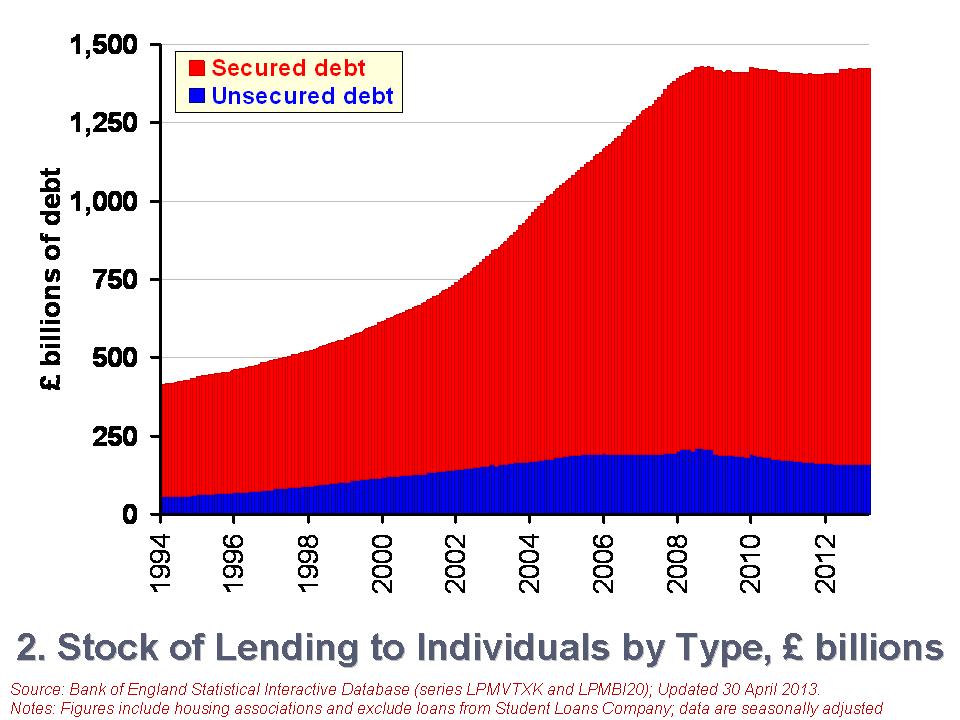 The second chart shows the growth in the stock of debt owed by individuals (click here to download the PowerPoint chart). In January 1994 the stock of secured debt stood at £358.75 billion and the stock of unsecured debt at £53.774 billion. 87 per cent of debt then was secured debt and, hence, little different to today. The total stock of debt has grown by 246 per cent between January 1994 and March 2013. Unsecured debt has grown by 197 per cent while secured debt has grown by 253 per cent.
However, more recently we see a different picture evolving, more especially in unsecured debt. Since October 2008, the monthly series of the stock of unsecured debt has fallen on 47 occasions and risen on only 7 occasions. In contrast, the stock of secured debt has fallen on only 12 occasions and often by very small amounts. Consequently, the stock of unsecured debt has fallen by 23.2 per cent between October 2008 and March 2013. In contrast, the stock of secured debt has risen by 3.5 per cent. The total stock of debt has fallen by 0.4 per cent over this period.
Another way of looking at changes in the stock of debt is to focus on what are known as net lending figures. This is simply the difference between the gross amount lent in a period and the amount repaid. The net lending figures will, of course, mirror changes in the total debt stock closely. For example, a negative net lending figure means that repayments are greater than gross lending. This will translate into a fall in the stock of debt. However, some difference occurs when debts have to be written off and not repaid.
 The third chart shows net lending figures since January 1994 (click here to download the PowerPoint chart). The chart captures the financial crisis very nicely. We can readily see a collapse of net lending by financial institutions to households. It is, of course, difficult to disentangle from the net lending figures those changes driven by changes in the supply of credit by financial institutions and those from changes in the demand for credit by individuals. But, we can be certain that the enormous change in credit levels in 2008 were driven by a massive reduction in the provision of credit.
To further put the net lending figures into context, consider the following numbers. Over the period from January 2000 to December 2007, the average amount of monthly net lending was £8.52 billion. In contrast, since January 2009 the average amount of net lending has been £691 million per month. Consider too the composition of this net lending. The average amount of net secured lending between January 2000 and December 2007 was £7.13 billion per month compared with £1.39 billion for net unsecured lending. Since January 2009, monthly net secured lending has averaged only £756 million while monthly net unsecured lending has averaged -£64.4 million. Therefore, repayments of unsecured lending have outstripped gross unsecured lending.
While further analysis is needed to fully understand the drivers of the net lending figures, it is, nonetheless, clear that the financial system of 2013 is very different to that prior to the financial crisis. This change is affecting the growth of the debt stock of households. This is most obviously the case with unsecured debt. The stock of unsecured debt in March 2013 is 24 per cent smaller than in its peak in September 2008. It is now the job of economists to understand the implications of how the new emerging patterns in household debt will affect our behaviour and overall economic activity.
Data
Money and Credit – March 2013 Bank of England
Statistical Interactive Database Bank of England
Articles
Bank of England extends lending scheme Financial Times, Chris Giles (24/4/13)
Markets insight: Europe and the US lines cross on household debt ratio Financial Times, Gillian Tett (9/5/13)
British families are the deepest in debt Telegraph, James Kirkup (14/5/13)
Total property debt of British households stands as £848bn Guardian, Hilary Osborne (13/5/13)
Household finances reach best level in three years – but are stuck below pre-crisis levels This is Money.co.uk, Matt West (17/5/13)
ONS says Welsh households have lowest debts in Britain BBC News (28/1/13)
Questions
- Outline the ways in which the financial system could impact on the spending behaviour of households.
- Why might the current level of income not always be the main determinant of a household’s spending?
- How might uncertainty affect spending and saving by households?
- Explain what you understand by net lending to individuals. How does net lending to individuals affect stocks of debt?
- Outline the main patterns seen in the stock of household debt over the past decade and discuss what you consider to be the principal reasons for these patterns.
- If you were updating this blog in a year’s time, how different would you expect the charts to look?
 Imagine that the team you support has made the final of a major competition or a your favourite band is playing a live concert this summer. You desperately want a ticket and are willing to pay the advertised price. They go on sale at 9.00am in the morning and you go on-line at 8.59am but unfortunately the webpage will not load. You keep pressing the refresh button but with no success. Eventually, annoyed and frustrated, you give up at 10.00am!
Tickets for sporting, musical or other live shows are initially sold by people who organise the events in two ways. They may choose to sell some or all of the tickets directly to the customer. For example you can buy tickets for a West End show from the box office in the theatre. With some football games it is still possible to buy tickets on the day at the stadium. Another approach is to sell some or all of the tickets via an authorised ticket agent. These businesses are usually members of STAR (The Society of Ticket Agents and Retailers) and the organisers of the sporting, musical or live show provide them with tickets to sell on their behalf. Some of the larger and well known agents such as Ticketmaster, Ticketline and Seetickets usually sell the tickets at face value although some booking fees are often added to the price. This initial sale of tickets by either the event organiser themselves or an agent acting on their behalf is referred to as the primary market.
For example, British Athletics sold all of its 130,000 tickets for its two day Anniversary Games on the 26th and 27th July via its authorised ticket agent in 75 minutes!! However an internet search for this event will quickly reveal that tickets are still available!! Unfortunately in most cases the advertised price will be far greater than the face value of the ticket. How is this possible? The answer is that the internet has helped a thriving secondary market for tickets to develop. The secondary market refers to situations where people who have already purchased tickets through the primary market re-sell them to other members of the public. Prior to the internet the main way of buying a ticket in the secondary market was to visit the venue on the day of the event and hunt for some-one willing to sell. However technology has dramatically reduced these transaction costs and made it much easier for potential buyers and sellers to make an exchange. For example companies such as Viagogo, Seatwave, GetMeIn and Stubhub have created websites that allow members of the public to buy and sell tickets. As Viagogo publish on their webpage:
You are buying tickets from a third party, Viagogo is not the ticket seller. Ticket prices are set by the seller and may be above or below face value.
Why does this secondary market exist? An economist would argue that it can only happen if the quantity of tickets demanded is greater than the quantity of tickets for sale at the price set by the event organiser. If this was not the case then customers would be able to buy tickets through the primary market on the day of the match, concert or show. The puzzle is to explain why prices do not rise in the primary market. If the quantity demanded of any product is greater than the quantity supplied then market forces should put upward pressure on prices. However it would appear that many of the event organisers appear to resist this incentive and consistently set prices below the level that would limit demand to the number of tickets available. This leaves an opportunity for sellers in the secondary market to sell tickets much closer to their market clearing rate. Navin Kekane, the business operations director of Stubhub, stated that
What we do is all about supply and demand, and you can sometimes find tickets at below face value.
Some of these companies in the secondary market have recently established formal partnerships with a number of English Premier League (EPL) football clubs and other major sporting bodies. For example Viagogo have signed deals with 10 EPL clubs while Stubhub have deals with 3 EPL clubs as well as Leicester Tigers and the Lawn Tennis Association.
However some observers have expressed grave reservations about the growth of the secondary market. For example Malcolm Clarke, chairman of the Football Supporters Federation, stated that
At the moment if you are fan trying to sell a spare ticket and are not authorised to do so then you face a criminal conviction, even if you sell at the face value.
But secondary ticketing exchanges, because they are authorised, are allowed to do so. Many clubs grant these agencies the right to allow the re-sale of tickets for their matches at above face value. I don’t think that can be right.
Joe Cohen, the founder of Seatwave counters that
Touts is an emotional, dehumanising word. The reality is that they are just speculators. No one likes speculators until you need something from them.
Some have called for more regulation of the secondary market. For example Sharon Hodgson, Labour MP for Washington and Sunderland West, unsuccessfully tried to get a Private Members Bill through Parliament which would have made it illegal to re-sell tickets for more than 10% above their face value.
Articles
Questions
- Give some potential advantages for a football club or sporting body of using an authorised ticket agent to sell tickets in the primary market.
- Using a demand and supply diagram explain what happens in a market if the price is continually set below its market clearing rate. Illustrate and explain how mutually beneficial trade can take place in the secondary market at prices above those in the primary market.
- Can you explain why it is less likely for a secondary market to exist for cinema tickets than a popular West End show?
- Can you think of any reasons why it might be in the interests of a profit maximising organiser of a sporting or music event to sell tickets below the market clearing rate.
- What non-price methods could be used to allocate tickets for popular events? Consider some of the advantages/disadvantages of using these non-price methods.
- Do you think it is in the interests of society to allow people to re-sell tickets at a price above their face value?
 A key debate for some months has been the UK’s membership of the European Union. The debate has centred around the desire to return some powers back to the UK, but this has extended into the possibility of a referendum on our membership of the preferential trading area. So, let’s take a step back and consider why any country would want to be a member of a preferential trading area.
Preferential trading areas can be as basic as a free trading area or as advanced as a currency, or even political union. The eurozone is clearly a currency union, but the European Union, of which the UK is a member, is a common market. A common market has no tariffs and quotas between the members, but in addition there are common external tariffs and quotas. The European union also includes the free movement of labour, capital and goods and services. Membership of a preferential trading area therefore creates benefits for the member countries. One such benefit is that of trade creation. Members are able to trade under favourable terms with other members, which yields significant benefits. Countries can specialise in the production of goods/services in which they have a comparative advantage and this enables greater quantities of output to be produced and then traded.
Other benefits include the greater competition created. By engaging in trade, companies are no longer competing just with domestic firms, but with foreign firms as well. This helps to improve efficiency, cut costs and thus lower prices benefiting consumers. However, from a firm’s point of view there are also benefits: they have access to a much wider market in which they can sell their goods without facing tariffs. This creates the potential for economies of scale to be achieved. Were the UK to completely exit the EU, this could be a significant loss for domestic firms and for consumers, who would no longer see the benefits of no tariffs on imported goods. Membership of a preferential trading area also creates benefits in terms of potential technology spillovers and is likely to have a key effect on a country’s bargaining power with the rest of the world. As is a similar argument to membership of a trade union, there is power in numbers.
There are costs of membership of a preferential trading area, but they are typically outweighed by the benefits. However, estimates suggest that the cost of EU regulation is the equivalent of 10% of UK GDP. Furthermore, while the UK certainly does trade with Europe, data suggests that only 13% of our GDP is dependent on such exports. The future is uncertain for the European Union and Britain’s membership. There are numerous options available besides simply leaving this preferential trading area, but they typically have one thing in common. They will create uncertainty and this is something that markets and investors don’t like. Vince Cable warned of this, saying:
There are large numbers of potential investors in the UK, who would bring employment here, who have been warned off because of the uncertainty this is creating.
The impact of the UK’s decision will be significant and not just for those living and working in the economy. The world is no interdependent that when countries exist (or typically enter) a preferential trading area the wider economic effects are significant. While any change in the UK’s relationship with the EU will take many months and years to occur and then further time to have an effect, the uncertainty created by the suggestion of a change in the relationship has already sent waves across the world. The following articles consider the wider single market and the current debate on UK membership.
European Union: if the ‘outs’ get their way, we’ll end up like Ukraine Guardian, Vince Cable (16/5/13)
Conservative MP James Wharton champions bill to guarantee EU referendum Independent, Andrew Grice (16/5/13)
Nick Clegg shifts ground over EU referendum The Guardian, Patrick Wintour (15/5/13)
Cameron tells EU rebels to back referendum law Reuters, Peter Griffiths (16/5/13)
The EU and the UK – the single market BBC Democracy (4/3/13)
Single market dilemmas on Europe BBC News, Stephanie Flanders (14/5/13)
Lord Wolfson: I back the single market – but not at any cost The Telegraph, Lord Wolfson (19/1/13)
EU focuses on returning single market to health Financial Times, James Fontanella-Khan (8/5/13)
Questions
- What other examples of preferential trading areas are there? How close are they to the arrangement of the European Union?
- In each of the above examples, explain the type of preferential trading area that it is.
- What are the benefits and costs of being a member of a preferential trading area such as the EU? How do these differ to being a member of a) a free trade area and (b) a customs union?
- What options are open to the UK in terms of re-negotiating its relationship with the EU? In each case, explain how the benefits and costs identified in question 3 would change.
- Why is the UK’s decision so important for the global economy? Would it be in the interests of other economies? Explain your answer.
 The link below is to an article by Bill Gates, founder of Microsoft. He argues that per-capita GDP is a poor indicator of development, especially in Sub-Saharan Africa.
The problems with using GDP as an indicator of the level of development of a country are well known and several alternative measures are in common use. Perhaps the best known is the United Nations Development Programme’s Human Development Index (HDI), where countries are given an HDI of between 0 and 1. HDI is the average of three indices based on three sets of variables: (i) life expectancy at birth, (ii) education (a weighted average of (a) the mean years that a 25-year-old person or older has spent in school and (b) the number of years of schooling that a 5-year-old child is expected to have over their lifetime) and (iii) real gross national income (GNY) per capita, measured in US dollars at purchasing-power parity exchange rates (see Box 27.1 in Economics 8th edition for more details).
 But although indicators such as this capture more elements of development than simple per-capita GNP or GNY, there are still serious shortcomings. A major problem is the lack of and inaccuracy of statistics, especially when applied to the rural subsistence and informal urban sectors. The problem is recognised and some countries are trying to address the problem (see the second article below), but the problem is huge. As Gates says:
It is clear to me that we need to devote greater resources to getting basic GDP numbers right. … National statistics offices across Africa need more support so that they can obtain and report timelier and more accurate data. Donor governments and international organisations such as the World Bank need to do more to help African authorities produce a clearer picture of their economies. And African policymakers need to be more consistent about demanding better statistics and using them to inform decisions.
Another problem is how you convert data into internationally comparable forms. For example, how are inflation, exchange rates, income distribution, the quality of health provision and education, etc. taken into account?
How GDP understates economic growth The Guardian, Bill Gates (8/5/13)
States’ GDP computation report out soon, says Nigeria statistics bureau Premium Times (Nigeria), Bassey Udo (9/5/13)
Michael Porter Presents New Alternative to GDP: The Social Progress Index (SPI) Triple Pundit, Raz Godelnik (13/4/13)
Questions
- By accessing the Human Development Index site, identify which countries have a much higher ranking by HDP than by per capita gross national income. Explain why.
- Why is expressing GNY in purchasing-power parity (PPP) terms likely to increase the GNY figures for the poorest countries?
- Explain the following quote from the Gates article: ‘I have long believed that GDP understates growth even in rich countries, where its measurement is quite sophisticated, because it is very difficult to compare the value of baskets of goods across different time periods’.
- Why is GNY per capita, even when expressed in PPP terms, likely to understate the level of development in subsistence economies?
- Explain whether the rate of growth of GNY per capita is likely to understate or overstate the rate of economic development of sub-Saharan African countries?
- Why are the challenges of calculating GDP or GNY particularly acute in sub-Saharan Africa?
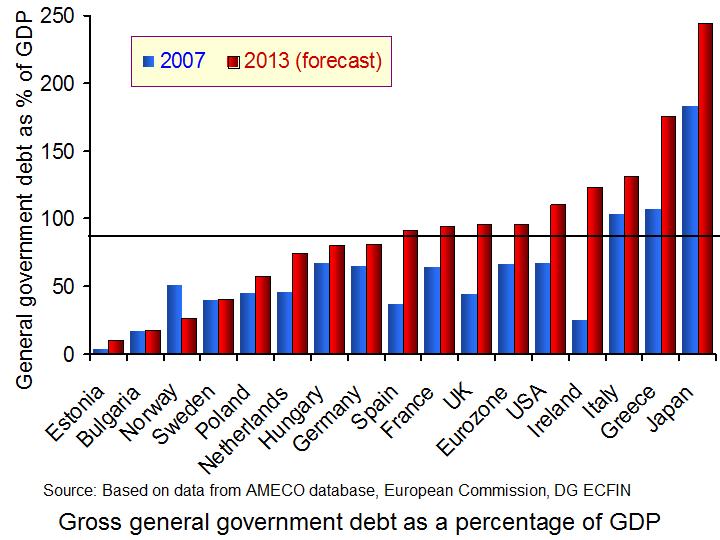 High levels of government debt and the adverse effect this has on the economy has been a key influencing factor in the fiscal consolidation efforts across the world. A key factor providing evidence in support of the connection between high government debts and low economic growth was a paper by two Harvard economists. However, the data used in their research has been called into question.
As we saw in a previous post, It could be you, Carmen Reinhart and Kenneth Rogoff presented a paper back in January 2010. Their research suggested that when a country’s debt increases above 90% of GDP, economic growth will slow considerably. (Click here for a PowerPoint of the above chart.) As you might expect, given the timing of this research, policymakers were intrigued. For those governments in favour of cuts in government spending and increases in taxation to bring the government debt down, this research was dynamite. It seemed to provide the evidence needed to confirm that if left to grow, government debt will have a significantly adverse effect on growth. Here was evidence in favour of austerity.
But, did a simple error create misleading information? A student at the University of Massachusetts Amherst was trying to replicate the results found by Reinhart and Rogoff, but was unable to do so. Thomas Herndon contacted the Harvard professors and they sent him the spreadsheets they had used in their calculations. Looking through it, an error in calculating the average GDP was spotted. However, the student and his supervisors also engaged in further research and came across other inconsistencies. This led to a draft working paper being published in April. The paper did find the same correlation between high debt levels and low growth, but the outstanding results found by Reinhart and Rogoff disappeared. Responding to the error, the Harvard professors said:
We are grateful to Herndon et al. for the careful attention to our original Growth in a Time of Debt AER paper and for pointing out an important correction to Figure 2 of that paper. It is sobering that such an error slipped into one of our papers despite our best efforts to be consistently careful. We will redouble our efforts to avoid such errors in the future. We do not, however, believe this regrettable slip affects in any significant way the central message of the paper or that in our subsequent work.
So, how might this correction and the implications affect government policy? Are we likely to see a reversal in austerity measures? Only time will tell.
Articles
Seminal economic paper on debt draws criticism Wall Street Journal, Brenda Cronin (16/4/13)
Reinhart, Rogoff … and Herndon: The student who caught out the Profs BBC News, Ruth Alexander (20/4/13)
Reinhart and Rogoff publish formal correction Financial Times, Robin Harding (8/5/13)
The 90% question The Economist (20/4/13)
Reinhart and Rogoff correct austerity research error BBC News (9/5/13)
Harvard’s Reinhart and Rogoff publish formal collection CNBC, Robin Harding (9/5/13)
Rogoff and Reinhart should show some remorse and reconsider austerity The Guardian, Heidi Moore (26/4/13)
The buck does not stop with Reinhart and Rogoff Financial Times, Lawrence Summers (5/5/13)
Meet Carmen Reinhart and Kenneth Rogoff, the Harvard professors who thought they had austerity licked – and Thomas Herndon, the student who proved them wrong Independent, Tim Walker (22/4/13)
Papers
Growth in a time of debt American Economic Review (May 2010)
Does high public debt consistently stifle economic growth? A critique of Reinhart and Rogoff Political Economy Research Institute, Herndon, Ash and Pollin (April 2013)
Questions
- How do high government debts arise?
- In order to reduce government debts, cuts in government spending and increases in taxation are advocated. How does theory suggest that these changes in fiscal policy will affect economic growth?
- What are the arguments (a) in favour of and (b) against austerity measures?
- How might the correction made by Reinhart and Rogoff affect policymakers and their austerity plans?
- What are the key messages from Reinhart and Rogoff’s paper?