10 of the 17 eurozone countries have agreed to adopt a financial transactions tax (FTT), often known as a ‘Tobin tax’ after James Tobin who first proposed such a tax back in 1972. The European Commission has backed the proposal, which involves levying a tax of 0.1% on trading in bonds and shares and 0.01% on trading in derivatives.
The 10 countries, France, Germany, Austria, Belgium, Greece, Italy, Portugal, Slovakia, Slovenia and Spain, and possibly also Estonia, hope to raise billions of euros from the tax, which will apply whenever at least one of the parties to a trade is based in one of the 10 (or 11) countries.
On several occasions in the past on this site we’ve examined proposals for such a tax: see, for example: Pressure mounts for a Tobin tax (update) (Nov 2011), A ‘Robin Hood’ tax (Feb 2010), Tobin or not Tobin: the tax proposal that keeps reappearing (Dec 2009) and A Tobin tax – to be or not to be? (Aug 2009). Tobin taxes are also considered in Economics (8th ed) (section 26.3) and Economics for Business (5th ed) (section 32.4).
As we noted last year in the blog Is the time right for a Tobin tax?, the tax is designed to be too small to affect trading in shares or other financial products for purposes of long-term investment. It would, however, dampen speculative trades that take advantage of tiny potential gains from very short-term price movements. Such trades account for huge financial flows between financial institutions around the world and tend to make markets more volatile. The short-term dealers are known as high-frequency traders (HFTs) and their activities now account for the majority of trading on exchanges. Most of these trades are by computers programmed to seek out minute gains and respond in milliseconds. And whilst they add to short-term liquidity for much of the time, this liquidity can suddenly dry up if HFTs become pessimistic.
Supporters of the tax claim that it will make a major contribution to tackling the deficit problems of many eurozone countries. Critics claim that it will dampen investment and growth and divert financial business away from the participating countries. The following articles look at the arguments.
EU Commission backs 10 countries’ transaction tax plan Reuters, Jan Strupczewski (23/10/12)
EU ‘Robin Hood’ tax gets the nod fin24 (23/10/12)
European financial transaction tax moves step closer The Guardian, Larry Elliott (23/10/12)
Financial transaction tax for 10 EU states BBC News (23/10/12)
Rejecting a Robin Hood tax would be a spectacular own goal The Guardian, Max Lawson (11/10/12)
More than 50 financiers back Robin Hood Tax The Robin Hood Tax (23/10/12)
Topical Focus – Transaction Taxes Tax-News (23/10/12)
Could a transactions tax be good for capitalism? BBC News, Robert Peston (3/10/11)
A Tax to Kill High Frequency Trading Forbes, Lee Sheppard (16/10/12)
Questions
- Explain how the proposed financial transactions tax will work.
- Why would many parties to trades who are not based in one of the 10 participating countries still end up paying the tax?
- What are likely to be the advantages and disadvantages of the proposed tax?
- Is it appropriate to describe the proposed FTT as a ‘Robin Hood Tax’?
- How does a financial transactions tax differ from the UK’s stamp duty reserve tax?
- Explain why the design of the stamp duty tax has prevented the flight of capital and trading from London. Could a Tobin tax be designed in such a way?
- What are HFTs and what impact do they have on the stability and liquidity of markets?
- Would it be desirable for the FTT to ‘kill off’ HFTs?
 Two of the biggest publishing companies, Pearson of the UK and Bertelsmann of Germany are to form a joint venture by merging their Penguin and Random House imprints. Bertelsmann will have a majority stake in the venture of 53% and Pearson will have 47%.
The Penguin imprint, with a turnover of just over £1bn, has an 11% share of the English language book publishing market. Random House has a 15% share, with turnover of around £1.5bn. The new ‘Penguin Random House’, as it will be called, will have nearly 26% of the market, which should give it considerable market power to combat various threats in the book publishing market.
One threat is from online retailers, such as Amazon, Apple and Google, which use their countervailing power to drive down the prices they pay to publishers. Another threat is from the rise of electronic versions of books. Although e-books save on printing costs, competition is driving down prices, including the prices of paper books, which may make publishers more reluctant to publish new titles in paper form.
There has been a mixed reception from authors: some are worried that an effective reduction in the number of major publishers from six to five will make it harder to get books published and may squeeze royalty rates; others feel that an increased market power of publishers to take on the online retailers will help to protect the interests of authors
The following videos and articles look at the nature of this joint venture and its implications for costs, revenues and publishing more generally.
Videos and webcasts
 Penguin and Random House merge to take on digital giants Channel 4 News, Matthew Cain (29/10/12)
Penguin and Random House confident merger will be approved BBC News, Will Gompertz (29/10/12)
Penguin Books and Random House to merge BBC News, Matt Cowan (29/10/12)
Articles
Random House and Penguin merge to take on Amazon, Apple Reuters, Kate Holton (29/10/12)
Pearson’s Penguin joins Random House Independent, Amy Thomson and Joseph de Weck (29/10/12)
Penguin and Random House sign merger deal Financial Times, Gerrit Wiesmann and Robert Budden (29/10/12)
March of the Penguin The Economist, Schumpeter blog (29/10/12)
Penguin chief: News Corp can’t derail Random House deal The Guardian, Mark Sweney (29/10/12)
Penguin and Random House confident merger will be approved BBC News, Anthony Reuben (29/10/12)
And so I bid Penguin a sad farewell Independent, Andrew Franklin (29/10/12)
Questions
- How does a joint venture differ from a merger?
- What types of economies of scale are likely to result from the joint venture?
- How are authors likely to be affected?
- Will the joint venture benefit the book reading public?
- The relationship between publishers and online retailers can be described as one of ‘bilateral oligopoly’. Explain what this means and why it is impossible to determine an ‘equilibrium’ wholesale price of books in such a market.
- What criteria would the competition authorities use to assess whether or not the joint venture should be permitted to proceed?
- What is likely to be the long-term outlook for Penguin Random House?
- Assess the benefits and costs of a News Corporation takeover of the Penguin division? This was an alternative offer to Pearson had it not gone with Bertelsmann. (News Corp. has the Harper Collins imprint.)
 The story of the UK economy over the past few years has been one of bad news and worse news. With a double-dip recession having kept confidence low in the UK, positive news for the economy was seemingly a distant hope of government ministers. However, official statistics show that that in the 3 months from July to September, the UK economy emerged from recession, with growth of 1.0%.
This positive GDP figure (click here for a PowerPoint of the chart below) was undoubtedly helped by the London Olympics over the summer, which may have added as much as 0.2 percentage points to GDP, according to the ONS. Millions arriving in London and other venues, spending money on countless things. Yet, other factors have also contributed to this welcome growth. Stephanie Flanders said:
The positive ‘surprise’ in these figures is largely to be found in the service sector, which is estimated to have growth by 1.3% in the third quarter, after shrinking by 0.1% in the three months before.
Further to this, in Stephanie Flanders’ ‘Stephanomics’, she says that ‘it confirms that the last three months of this latest recession were brought to you by the Queen. Or at least, the extra Bank Holiday to celebrate her Jubilee.’ The Bank of England suggests that the Jubilee took 0.5 percentage points from official GDP statistics. So, the news so far is positive, but the economy is far from being back to its pre-recession size.
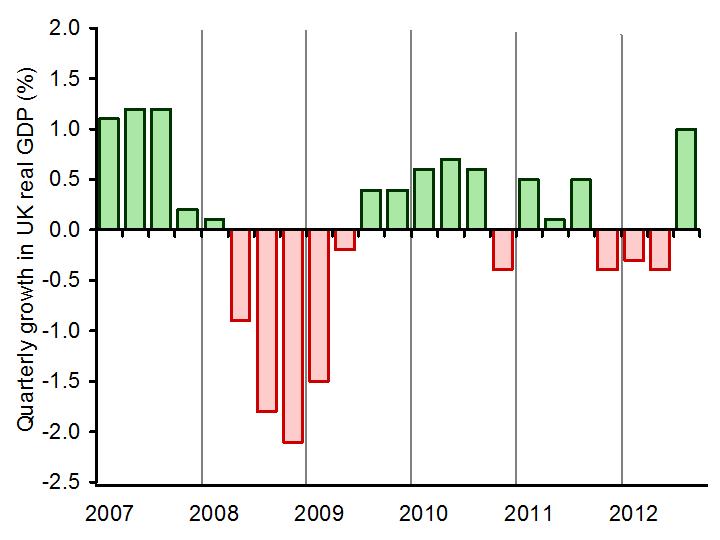
The 2008-2009 recession knocked 6.4% off the UK economy. Since then, the total growth (over the past 4 years) has reached only half of that – 3.2% and that includes the 1% figure just published. Thus, while we may be on ‘the right track’, there is still a long way to go. Economists differ in their interpretations of what this means for the overall recovery: some say that this is a sign of what’s to come; others argue that this recovery has been driven by one-off factors.
What is certain is that government policy over the next few months will be crucial in keeping the economy on the right growth path. The following articles consider the implications of this new economic data.
A special recovery BBC News, Stephanomics, Stephanie Flanders (25/10/12)
UK GDP rises 1pc: economist reaction The Telegraph (25/10/12)
Nick Clegg warns economic recovery will be ‘fitful’ The Guardian, Daniel Boffey (28/10/12)
GDP figures set to show UK economy has exited double-dip recession The Telegraph, Philip Aldrick, Emma Rowley and Jessica Winch (25/10/12)
UK economy returns to growth with help from Olympics BBC News (25/10/12)
U.K. posts quarterly gain in GDP, lifted by Olympics Wall Street Journal, Cassel-Bryan Low (25/10/12)
GDP figures show UK emerging from recession: full reaction The Guardian (25/10/12)
UK growth signals move out of recession Financial Times, Sarah O’Connor and George Parker (25/10/12)
Questions
- How do we define a recession?
- How is GDP calculated and what does it measure?
- Which factors have contributed towards lower GDP data towards the beginning of this year?
- Which factors have helped boost GDP in the 3 months from July to September?
- Why is there disagreement about the likelihood of positive GDP figures continuing throughout the rest of the year?
- Prior to the official release of the GDP figures, David Cameron hinted at positive news. Given that the market is so sensitive, what effect might this suggestion have had?
- Given this positive figure, what implications does this have for the government’s quantitative easing programme?
- If we translate this latest growth data onto an AD/AS diagram, how would you show what has recently happened?
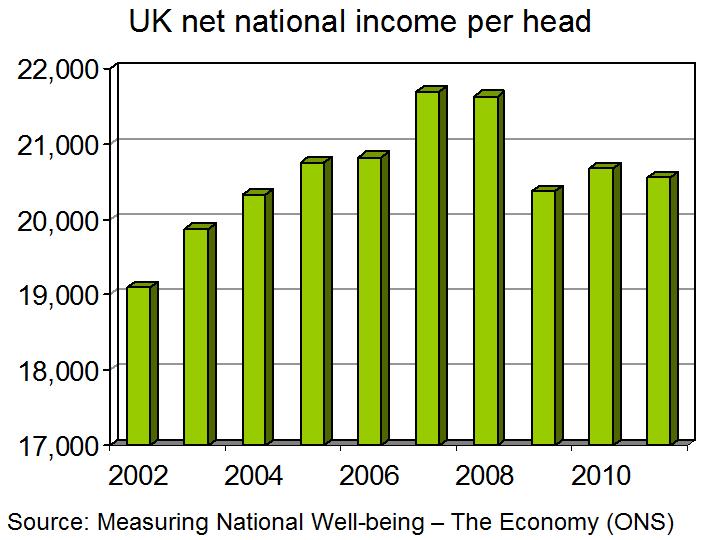 Although every recession is different (for example in terms of length and magnitude), they do tend to have a few things in common. The focus of this blog is on consumer income and how it is affected in the aftermath of (or even during) a recession. According to data from the ONS, real national income per head has fallen by more than 13% since the start of 2008.
This latest data from the Office of National Statistics shows that in the aftermath of the 2008 recession, UK incomes have fallen by much more than they did in the 2 previous recessions experienced in the UK (click here for a PowerPoint of the chart). We would normally expect consumer incomes to fall during and possibly directly after a recession, as national output falls and confidence tends to be and remain low. However, the crucial thing to consider with falling consumer incomes is how it affects purchasing power. If my income is cut by 50%, but prices fall by 80%, then I’m actually better off in terms of my purchasing power.

The data from the ONS is all about purchasing power and shows how UK consumer incomes have fallen at the same time as inflation having been relatively high. It is the combination of these two variables that has been ‘eating into the value of the cash that people were earning’. Comparing the incomes in the four years after the 2008 recession with similar periods following the early 1980s and 1990s recession, the ONS has shown that this most recent recession had a much larger effect on consumer well-being. Part of this may be due to the rapid growth in incomes prior to the start of the credit crunch.
It’s not just the working population that has seen their incomes fall since 2008 – the retired population has also seen a decline in income and according to a report from the Institute for Fiscal Studies, it is the wealthiest portion of older households that have taken the largest hit since 2007. According to the IFS, the average person over 50 has experienced a fall in their gross wealth of about 10%, or close to £60,000. Of course for these older households, the concern is whether they will be able to make up this lost wealth before they retire. The concern for everyone is how long until incomes and purchasing power increase back to pre-crisis levels. The following articles consider this latest data on economic well-being and the impact the recession has had.
UK wellbeing still below financial crisis levels Guardian, Larry Elliott and Randeep Ramesh (23/10/12)
National income per head ‘down 13% in four years’ BBC Newsd (23/10/12)
Financial crisis hits UK retirement income Financial Times, Norma Cohen (23/10/12)
Over 50s ‘left £160,000 out of pocket by the financial crisis’ The Telegraph, James Kirkup (23/10/12)
Those near retirement in UK hit hard by crisis Wall Street Journal, Paul Hannon (23/10/12)
Living standards down 13pc since start of recession The Telegraph (23/10/12)
Questions
- Why is net national income per head said to be the best measure of economic well-being?
- Why is it so important to take into account inflation when measuring wellbeing?
- What explanation can be given for the larger fall in consumer incomes following the 2008 recession relative to the previous 2 recessions?
- According to data from the IFS, the richest portion of older households have suffered the most in terms of lost wealth. Why is this the case?
- What is meant by purchasing power?
- GDP has fallen by about 7%, whereas national income per head, taking inflation into account is down by over 13%. What is the explanation for these 2 different figures?
- How can recessions differ from each other? Think about the length, the magnitude of each.
- Is GDP a good measure of economic well-being? Are there any other ways we can measure it?
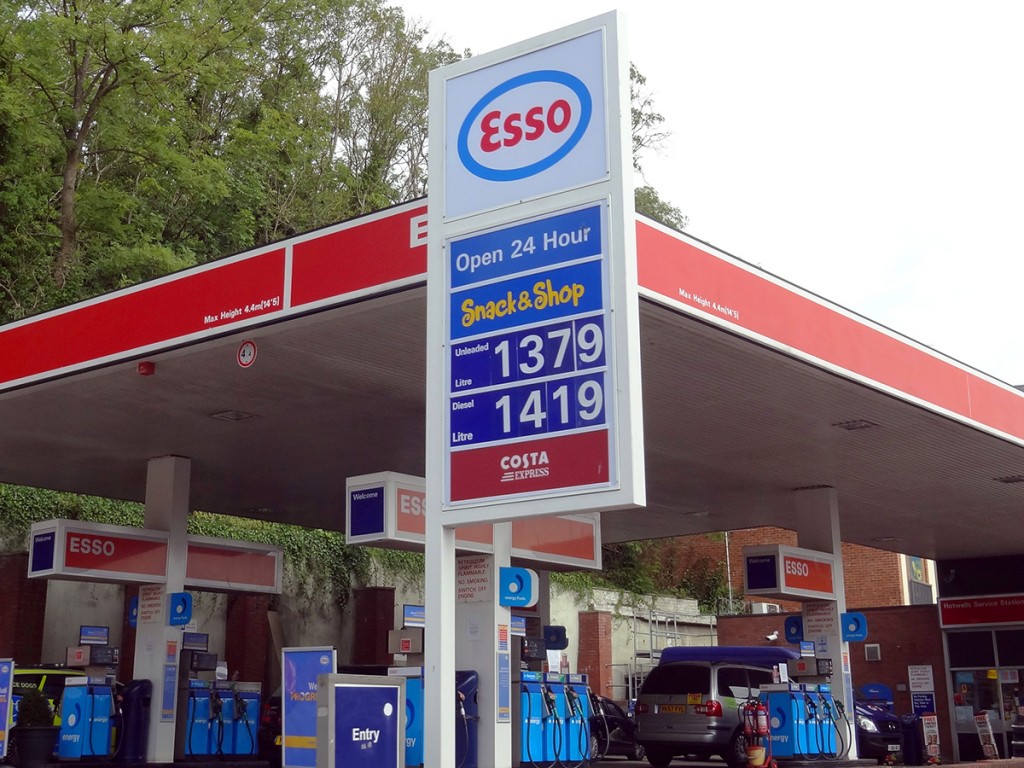 As resources become scarce, the price mechanism works to push up the price (see, for example, Box 9.11 in Economics 8th ed). If you look at the price of petrol over the past few decades, there has been a general upward trend – part of this is due to growth in demand, but part is due to oil being a scarce resource. Many millions have been spent on trying to find alternative fuels and perhaps things are now looking up!
Air Fuel Synthesis, a small British company, has allegedly managed to make ‘petrol from air’. Following this, the company has unsurprisingly received finance and investment offers from across the world. However, the entrepreneur Professor Marmont has said that he does not want any company from the oil industry to get a stake in this firm. This doesn’t mean that investment is not needed or on the cards, as in order to increase production of petrol from thin air financing is needed. Professors Marmont said:
We’ve had calls offering us money from all over the world. We’ve never had that before. We’ve made the first petrol with our demonstration plant but the next stage is to build a bigger plant capable of producing 1 tonne of petrol a day, which means we need between £5m and £6m
Whilst the process appears to be a reality, Air Fuel Synthesis is a long way from being able to produce en masse. However, it does offer an exciting prospect for the future of petrol and renewable energy resources in the UK. At the moment oil companies appear to be uninterested, but if this breakthrough receives the financing it needs and progress continues to be made, it will be interesting to see how the big oil companies respond. The following articles consider this break-through.
Company that made ‘petrol from air’ breakthrough would refuse investment from big oil Independent, Steve Connor (19/10/12)
British engineers create petrol from air and water Reuters, Alice Baghdijan (19/10/12)
Petrol from air: will it make a difference? BBC News, Jason Palmer (19/10/12)
British engineers produce amazing ‘petrol from air’ technology The Telegraph , Andrew Hough (18/10/12)
Questions
- Explain the way in which the price mechanism works as resources become scarce. Use a diagram to help your explanation.
- As raw materials become scarce, prices of the goods that use them to work or require them to be produced will be affected. Explain this interdependence between markets.
- Why is investment from an oil company such a concern for Professor Marmont?
- Why is there unlikely to be any impact in the short run from this new breakthrough?
- If such a technology could be put into practice, what effect might this have on the price of petrol?
- How might oil companies react to the growth in this technology?