 In two previous posts, one at the end of 2019 and one in July 2021, we looked at moves around the world to introduce a four-day working week, with no increase in hours on the days worked and no reduction in weekly pay. Firms would gain if increased worker energy and motivation resulted in a gain in output. They would also gain if fewer hours resulted in lower costs.
Workers would be likely to gain from less stress and burnout and a better work–life balance. What is more, firms’ and workers’ carbon footprint could be reduced as less time was spent at work and in commuting.
If the same output could be produced with fewer hours worked, this would represent an increase in labour productivity measured in output per hour.
The UK’s poor productivity record since 2008
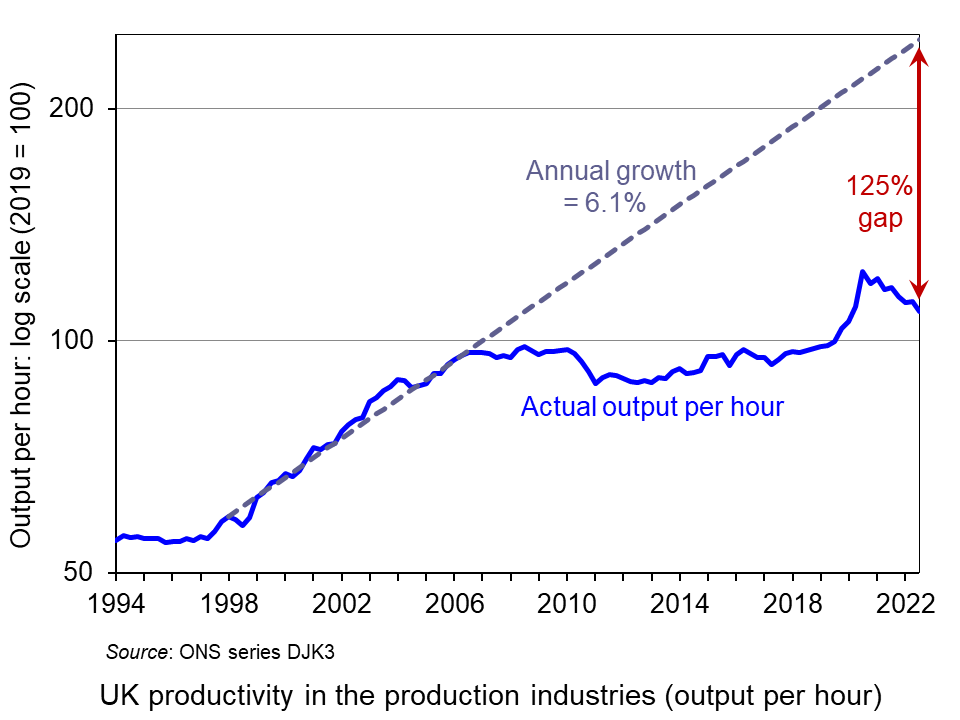 Since the financial crisis of 2007–8, the growth in UK productivity has been sluggish. This is illustrated in the chart, which looks at the production industries: i.e. it excludes services, where average productivity growth tends to be slower. (Click here for a PowerPoint of the chart.)
Prior to the crisis, from 1998 to 2007, UK productivity in the production industries grew at an annual rate of 6.1%. From 2007 to the start of the pandemic in 2020, the average annual productivity growth rate in these industries was a mere 0.5%.
It grew rapidly for a short time at the start of the pandemic, but this was because many businesses temporarily shut down or went to part-time working, and many of these temporary job cuts were low-wage/low productivity jobs. If you take services, the effect was even stronger as sectors such as hospitality, leisure and retail were particularly affected and labour productivity in these sectors tends to be low. As industries opened up and took on more workers, so average productivity fell back. In the four quarters to 2022 Q3 (the latest data available), productivity in the production industries fell by 6.8%.
If you project the average productivity growth rate from 1998 to 2007 of 6.1% forwards (see grey dashed line), then by 2022 Q3, output per hour in the production industries would have been 21/4 times (125%) higher than it actually was. This is a huge productivity gap.
 Productivity in the UK is lower than in many other competitor countries. According to the ONS, output per hour in the UK in 2021 was $59.14 in the UK. This compares with an average of $64.93 for the G7 countries, $66.75 in France, £68.30 in Germany, $74.84 in the USA, $84.46 in Norway and $128.21 in Ireland. It is lower, however, in Italy ($54.59), Canada ($53.97) and Japan ($47.28).
As we saw in the blog, The UK’s poor productivity record, low UK productivity is caused by a number of factors, not least the lack of investment in physical capital, both by private companies and in public infrastructure, and the lack of investment in training. Other factors include short-termist attitudes of both politicians and management and generally poor management practices. But one cause is the poor motivation of many workers and the feeling of being overworked. One solution to this is the four-day week.
Latest evidence on the four-day week
Results have just been released of a pilot programme involving 61 companies and non-profit organisations in the UK and nearly 3000 workers. They took part in a six-month trial of a four-day week, with no increase in hours on the days worked and no loss in pay for employees – in other words, 100% of the pay for 80% of the time. The trial was a success, with 91% of organisations planning to continue with the four-day week and a further 4% leaning towards doing so.
 The model adopted varied across companies, depending on what was seen as most suitable for them. Some gave everyone Friday off; others let staff choose which day to have off; others let staff work 80% of the hours on a flexible basis.
There was little difference in outcomes across different types of businesses. Compared with the same period last year, revenues rose by an average of 35%; sick days fell by two-thirds and 57% fewer staff left the firms. There were significant increases in well-being, with 39% saying they were less stressed, 40% that they were sleeping better; 75% that they had reduced levels of burnout and 54% that it was easier to achieve a good work–life balance. There were also positive environmental outcomes, with average commuting time falling by half an hour per week.
There is growing pressure around the world for employers to move to a four-day week and this pilot provides evidence that it significantly increases productivity and well-being.
Articles
- Results from world’s largest 4 day week trial bring good news for the future of work
4 Day Week Global, Charlotte Lockhart (21/2/23)
- Four-day week: ‘major breakthrough’ as most UK firms in trial extend changes
The Guardian, Heather Stewart (21/2/23)
- Senedd committee backs four-day working week trial in Wales
The Guardian, Steven Morris (24/1/23)
- ‘Major breakthrough’: Most firms say they’ll stick with a four-day working week after successful trial
Sky News, Alice Porter (21/2/23)
- Major four-day week trial shows most companies see massive staff mental health benefits and profit increase
Independent, Anna Wise (21/2/23)
- Four-day week: Which countries have embraced it and how’s it going so far?
euronews, Josephine Joly and Luke Hurst (23/2/23)
- Firms stick to four-day week after trial ends
BBC News, Simon Read, Lucy Hooker & Emma Simpson (21/2/23)
- The climate benefits of a four-day workweek
BBC Future Planet, Giada Ferraglioni and Sergio Colombo (21/2/23)
- Four-day working week: why UK businesses and workers will continue with new work pattern, plus pros and cons
National World, Rochelle Barrand (22/2/23)
- Most companies in UK four-day week trial to continue with flexible working
Financial Times, Daniel Thomas and Emma Jacobs (21/2/23)
- The pros and cons of a four-day working week
Financial Times, Editorial (13/2/23)
- Explaining the UK’s productivity slowdown: Views of leading economists
VoxEU, Ethan Ilzetzki (11/3/20)
- Why the promised fourth industrial revolution hasn’t happened yet
The Conversation, Richard Markoff and Ralf Seifert (27/2/23)
Questions
- What are the possible advantages of moving to a four-day week?
- What are the possible disadvantages of moving to a four-day week?
- What types of companies or organisations are (a) most likely, (b) least likely to gain from a four-day week?
- Why has the UK’s productivity growth been lower than that of many of its major competitors?
- Why, if you use a log scale on the vertical axis, is a constant rate of growth shown as a straight line? What would a constant rate of growth line look like if you used a normal arithmetical scale for the vertical axis?
- Find out what is meant by the ‘fourth industrial revolution’. Does this hold out the hope of significant productivity improvements in the near future? (See, for example, last link above.)
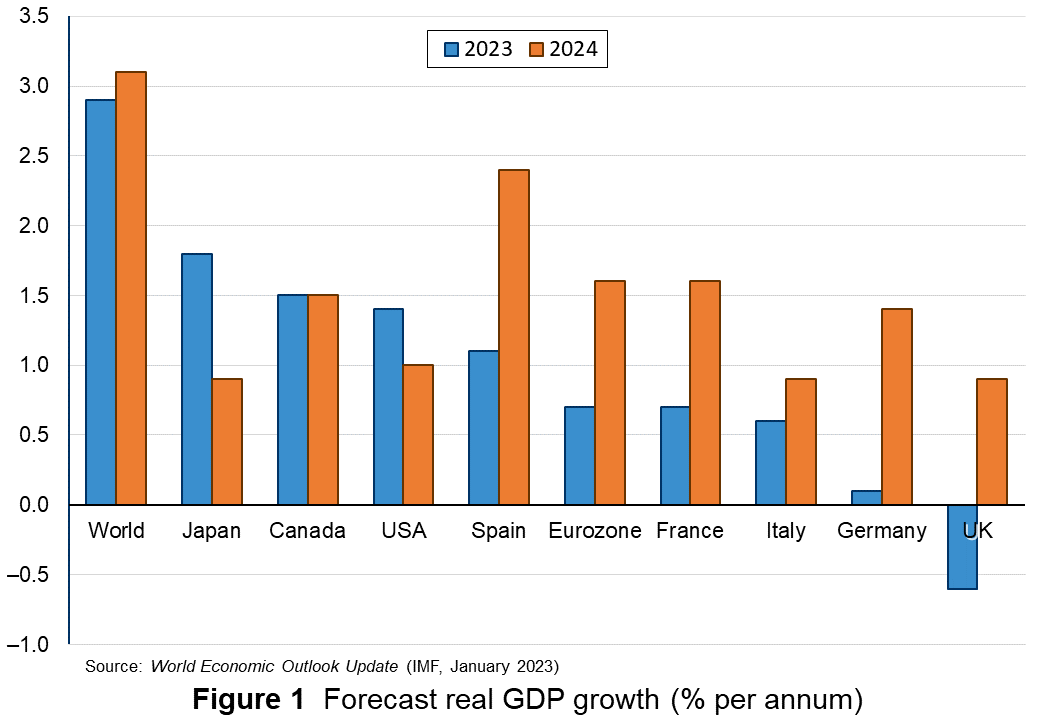 In its latest World Economic Outlook update, the IMF forecasts that the UK in 2023 will be the worst performing economy in the G7. Unlike all the other countries and regions in the report, only the UK economy is set to shrink. UK real GDP is forecast to fall by 0.6% in 2023 (see Figure 1: click here for a PowerPoint). In the USA it is forecast to rise by 1.4%, in Germany by 0.1%, in France by 0.7% and in Japan by 1.8%. GDP in advanced countries as a whole is forecast to grow by 1.2%, while world output is forecast to grow by 2.9%. Developing countries are forecast to grow by 4.0%, with China and India forecast to grow by 5.2% and 6.1%, respectively. And things are not forecast to be a lot better for the UK in 2024, with growth of 0.9% – bottom equal with Japan and Italy.
Low projected growth in the UK in part reflects the tighter fiscal and monetary policies being implemented to curb inflation, which is slow to fall thanks to tight labour markets and persistently higher energy prices. The UK is particularly exposed to high wholesale gas prices, with a larger share of its energy coming from natural gas than most countries.
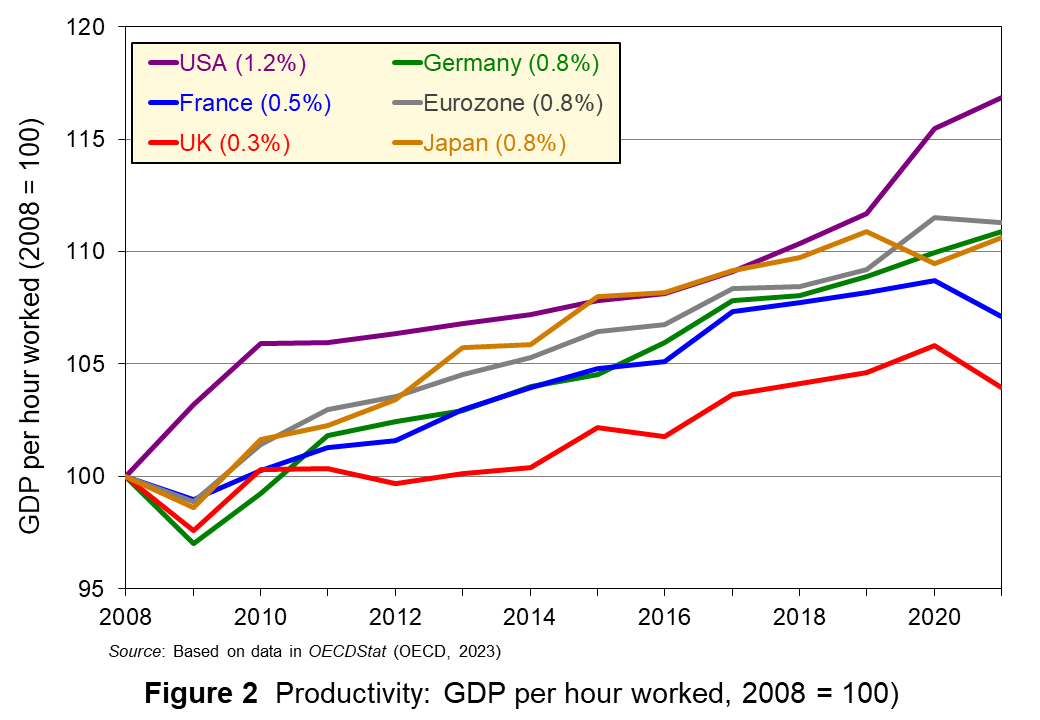 But the UK’s lower forecast growth relative to other countries reflects a longer-term problem in the UK and that is the slow rate of productivity growth. This is illustrated in Figure 2, which shows output (GDP) per hour worked in major economies, indexed at 100 in 2008 (click here for a PowerPoint). As you can see, the growth in productivity in the UK has lagged behind that of the other economies. The average annual percentage growth in productivity is shown next to each country. The UK’s growth in productivity since 2008 has been a mere 0.3% per annum.
Causes of low productivity/low productivity growth
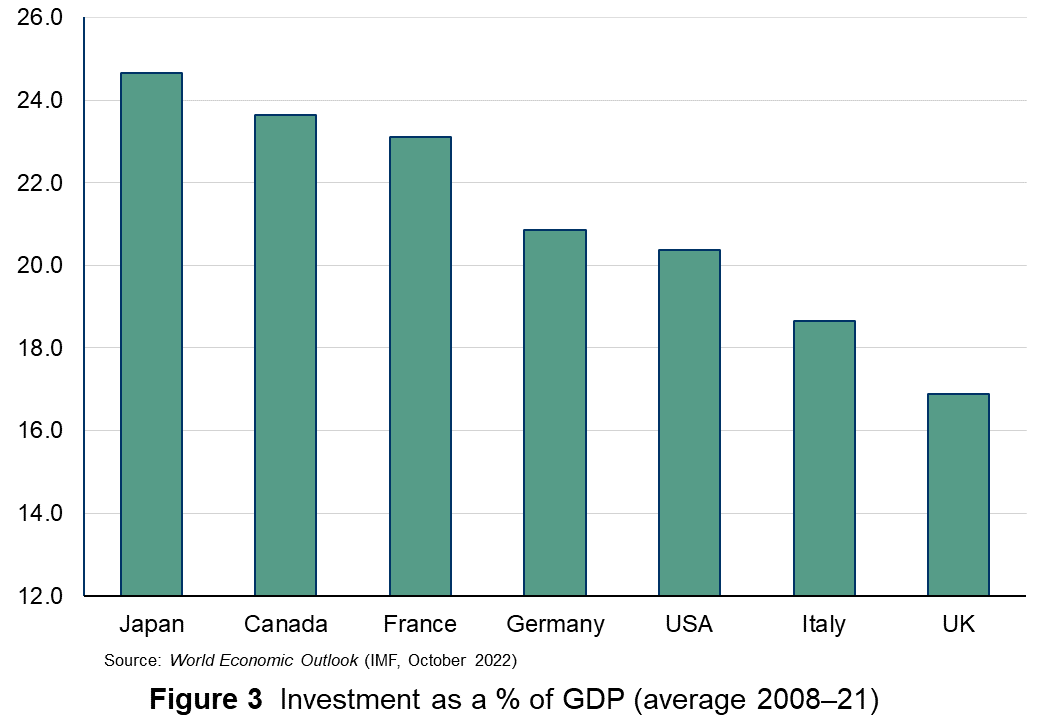 A major cause of low productivity growth is low levels of investment in physical capital. Figure 3 shows investment (gross capital formation) as a percentage of GDP for the G7 countries from the 2007–8 financial crisis to the year before the pandemic (click here for a PowerPoint). As you can see, the UK performs the worst of the seven countries.
Part of the reason for the low level of private investment is uncertainty. Firms have been discouraged from investing because of a lack of economic growth and fears that this was likely to remain subdued. The problem was compounded by Brexit, with many firms uncertain about their future markets, especially in the EU. COVID affected investment, as it did in all countries, but supply chain problems in the aftermath of COVID have been worse for the UK than many countries. Also, the UK has been particularly exposed to the effects of higher gas prices following the Russian invasion of Ukraine, as a large proportion of electricity is generated from natural gas and natural gas is the major fuel for home heating.
Part of the reason is an environment that is unconducive for investment. Access to finance for investment is more difficult in the UK and more costly than in many countries. The financial system tends to have a short-term focus, with an emphasises on dividends and short-term returns rather than on the long-term gains from investment. This is compounded by physical infrastructure problems with a lack of investment in energy, road and rail and a slow roll out of advances in telecoms.
To help fund investment and drive economic growth, in 2021 the UK government established a government-owned UK Infrastructure Bank. This has access to £22 billion of funds. However, as The Conversation article below points out:
According to a January 2023 report from Westminster’s Public Accounts Committee, 18 months after its launch the bank had only deployed ‘£1 billion of its £22 billion capital to 10 deals’, and had employed just 16 permanent staff ‘against a target of 320’. The committee also said it was ‘not convinced the bank has a strategic view of where it best needs to target its investments’.
Short-termism is dominant in politics, with ministers keen on short-term results in time for the next election, rather than focusing on the long term when they may no longer be in office. When the government is keen to cut taxes and find ways of cutting government expenditure, it is often easier politically to cut capital expenditure rather than current expenditure. The Treasury oversees fiscal policy and its focus tends to be short term. What is needed is a government department where the focus is on the long term.
One problem that has impacted on productivity is the relatively large number of people working for minimum wages or a little above. Low wages discourage firms from making labour-saving investment and thereby increasing labour productivity. It will be interesting to see whether the labour shortages in the UK, resulting from people retiring early post-COVID and EU workers leaving, will encourage firms to make labour-saving investment.
Another issue is company taxation. Until recently, countries have tended to compete corporate taxes down in order to attract inward investment. This was stemmed somewhat by the international agreement at the OECD that Multinational Enterprises (MNEs) will be subject to a minimum 15% corporate tax rate from 2023. The UK is increasing corporation tax from 19% to 25% from April 2023. It remains to be seen what disincentive effect this will have on inward investment. Although the new rate is similar to, or slightly lower, than other major economies, there are some exceptions. Ireland will have a rate of just 15% and is seen as a major alternative to the UK for inward investment, especially with its focus on cheaper green energy. AstraZeneca has just announced that instead of building its new ‘state-of-the-art’ manufacturing plant in England close to its two existing plats in NW England, it will build it in Ireland instead, quoting the UK’s ‘discouraging’ tax rates and price capping for drugs by the NHS.
 And it is not just physical investment that affects productivity, it is the quality of labour. Although a higher proportion of young people go to university (close to 50%) than in many other countries, the nature of the skills sets acquired may not be particularly relevant to employers.
What is more, relatively few participate in vocational education and training. Only 32% of 18-year olds have had any vocational training. This compares with other countries, such as Austria, Denmark and Switzerland where the figure is over 65%. Also a greater percentage of firms in other countries, such as Germany, employ people on vocational training schemes.
Another aspect of labour quality is the quality of management. Poor management practices in the UK and inadequate management training and incentives have resulted in a productivity gap with other countries. According to research by Bloom, Sadun & Van Reenen (see linked article below, in particular Figure A5) the UK has an especially large productivity gap with the USA compared with other countries and the highest percentage of this gap of any country accounted for by poor management.
Solutions
Increasing productivity requires a long-term approach by both business and government. Policy should be consistent, with no ‘chopping and changing’. The more that policy is changed, the less certain will business be and the more cautious about investing.
As far a government investment is concerned, capital investment needs to be maintained at a high level if significant improvements are to be made in the infrastructure necessary to support increased growth rates. As far as private investment is concerned, there needs to be a focus on incentives and finance. If education and training are to drive productivity improvements, then there needs to be a focus on the acquisition of transferable skills.
Such policies are not difficult to identify. Carrying them out in a political environment focused on the short term is much more difficult.
Podcasts
Articles
- UK to perform worst of major economies in 2023, says IMF – here’s how to achieve long-term growth
The Conversation, Michael Kitson (2/2/23)
- The UK economy has recovered from doom and recession before – and it can do so again: the Economy 2030 Inquiry
Resolution Foundation, Centre for Economic Performance and Nuffield Foundation, Krishan Shah (7/2/23)
- Minding the (productivity and income) gaps: the Economy 2030 Inquiry
Resolution Foundation, Centre for Economic Performance and Nuffield Foundation, Krishan Shah and Gregory Thwaites (3/2/23)
- How to fix the British economy
Financial Times, Tim Harford (3/2/23)
- Is the IMF right about the UK economy?
Financial Times, Chris Giles (31/1/23)
- Why is UK Productivity Low and How Can It Improve?
The National Institute of Economic and Social Research (NIESR), Issam Samiri and Stephen Millard (26/9/22)
- Britain’s productivity puzzle
LSE British Politics and Policy, Ben Clift and Sean McDaniel (7/9/22)
- Why is the UK So Unproductive Compared to Germany?
Agency Central (26/8/20)
- Smarter taxes could ease UK productivity crisis
Reuters, Francesco Guerrera (9/1/23)
- Diagnosing the UK productivity slowdown: which sectors matter and why?
The Bennett Institute for Public Policy, University of Cambridge, Lucy Hampton (20/1/23)
- Management as a Technology?
National Bureau of Economic Research, Nicholas Bloom, Raffaella Sadun & John Van Reenen (October 2017)
- Take AstraZeneca’s warning seriously. The UK is missing out in life sciences
The Guardian, Nils Pratley (9/2/23)
Data
Questions
- What features of the UK economic and political environment help to explain its poor productivity growth record?
- What are the arguments for and against making higher education more vocational?
- Find out what policies have been adopted in a country of your choice to improve productivity. Are there any lessons that the UK could learn from this experience?
- How could the UK attract more inward foreign direct investment? Would the outcome be wholly desirable?
- What is the relationship between inequality and labour productivity?
- What are the arguments for and against encouraging more immigration in the current economic environment?
- Could smarter taxes ease the UK’s productivity crisis?
 On 23 September, the new Chancellor of the Exchequer, Kwasi Kwarteng, announced his mini-Budget. It revealed big tax-cutting plans with the aim of stimulating economic growth. See the blog From Reaganomics to Trussonomics for details. However, the announcement triggered a crisis of confidence in the markets. The government says the measures will kickstart economic growth, but with the tax cuts funded through extra government borrowing, markets have raised alarm over the plans, sending the pound plunging.
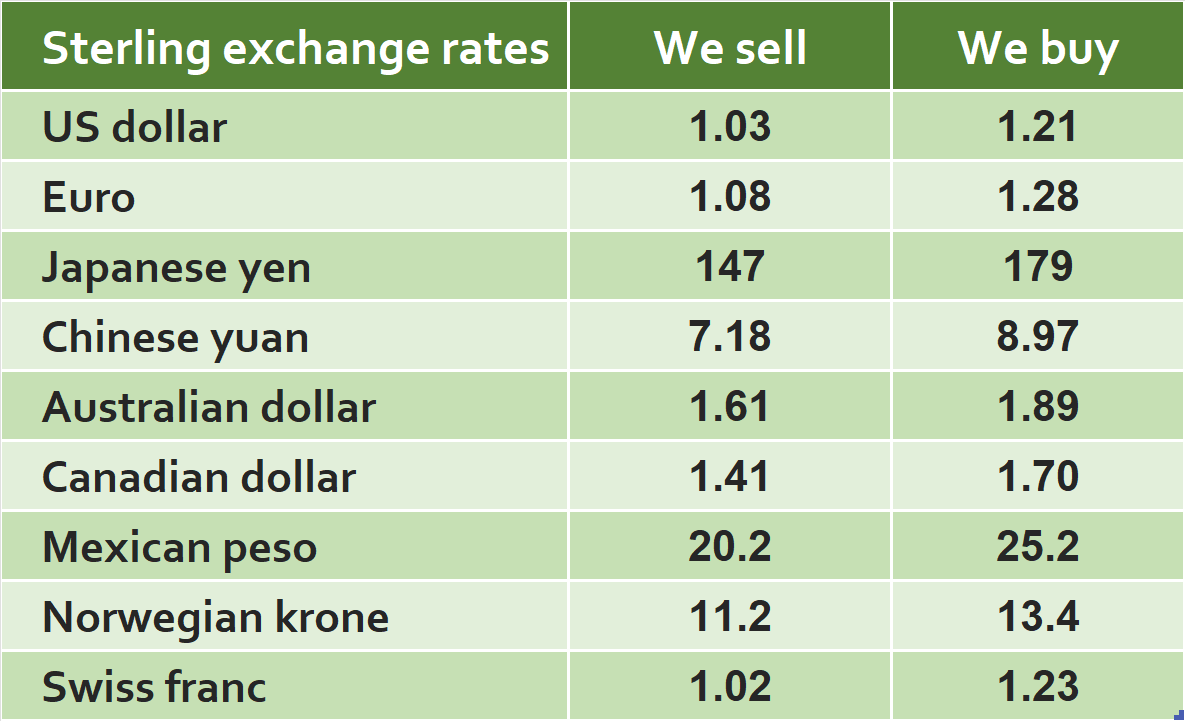
On Monday 26 September, traders in the UK awoke to see that the pound had fallen to the new lowest level on record against the dollar of $1.03. Although it came at a time when the markets expected the pound to weaken, the announcement pushed a fall in the pound beyond previous expectations. Concerns about where the extra money would come from to pay for the tax cuts were reflected in market movements. A weaker currency suggests investors’ faith in a country’s economic prospects is wavering.
What does a falling pound mean?
The pound’s value affects everyone – from shoppers to business owners and investors. The main impacts of the falling pound include:
- Higher prices. A fall in the value of the pound will increase the price of goods and services imported into the UK from overseas. When the pound is weak against the dollar, it costs more for companies in the UK to buy things such as food, raw materials or parts from abroad. Firms are likely then to pass on some or all those higher costs to their customers.
- Higher mortgage repayments. By increasing inflation, a falling pound is likely to push the Bank of England to raise interest rates to counter this. With two million people in the UK on a tracker or variable rate mortgage, monthly costs could increase substantially. Lenders are also likely to increase the rates charged on credit cards, bank loans or car loans.
- Further pressure on energy costs. The price of all of the gas that the UK uses is based on the dollar – even if the gas is produced in the UK. As oil prices are based on the dollar, petrol and diesel could also be more expensive for UK drivers as it costs more to be imported by fuel companies. Although the dollar price of oil has been falling in recent weeks, consumers are not likely to see the benefit at the pump due to the slide in the value of the pound.
- Stronger sales for UK firms who sell goods abroad. Some businesses in the UK could get a boost from a fall in the value of the pound. A cheaper pound makes it less expensive for people from around the globe to buy goods and services from British firms, making them more competitive.
- More expensive trips abroad. The plunge in the pound means that people’s holiday money won’t stretch as far, particularly for anyone planning a trip to the USA. The depreciation of the pound could also see airlines face sharply increased costs, with fuel and aircraft leases often denominated in dollars.
Threat to confidence
The Bank of England said a weaker outlook for the UK economy as well as a stronger dollar were putting pressure on sterling. However, market responses were clear that Kwarteng’s mini-Budget was threatening to undermine confidence in the UK. The pound plunged to its lowest since Britain went decimal in 1971, as belief in the UK’s economic management and assets evaporated.
By Tuesday 27 September, there were expectations that the Bank of England would have to raise interest rates to counter the extra spending in the mini-Budget. Economists from the City suggested the slump in the pound would not just force the Bank of England into raising rates at the next MPC announcement in November, but to intervene now by announcing an emergency interest rate rise to support the currency. This sent mortgage activity into a frenzy as brokers worked around the clock to help clients secure deals before lenders pulled their products or replaced them with more expensive ones. By the end of the week there were 40% fewer products available than before the mini-Budget.
The Bank of England
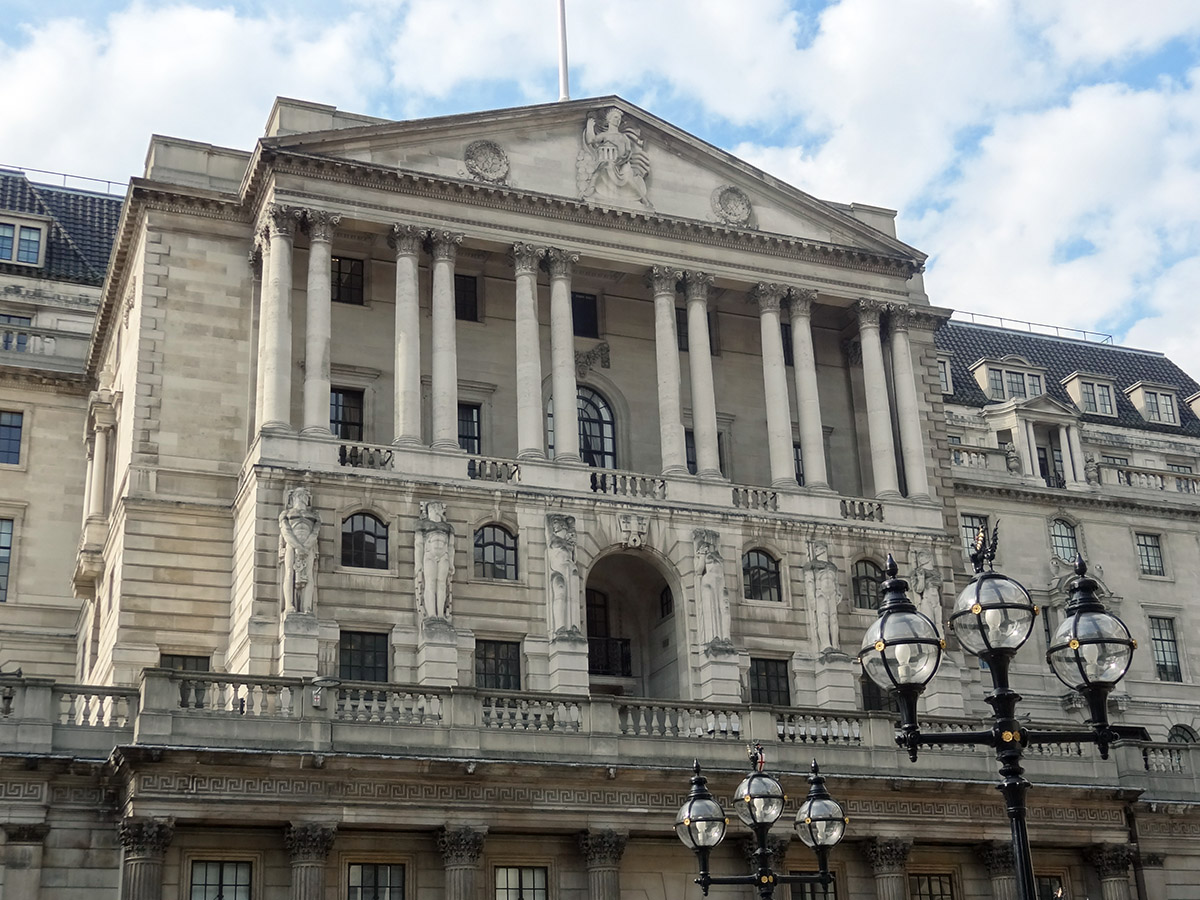 In August, the Bank predicted that the UK would go into recession, lasting some 15 months. It did so as it raised interest rates by the highest margin in 27 years (0.5 percentage points) in a bid to keep soaring prices under control. Higher interest rates can make borrowing more expensive, meaning people have less money to spend and prices will stop rising as quickly. The Bank of England is expected to raise interest rates by an even larger amount to combat the inflationary impact of the mini-Budget, as a weakening pound drives up costs of imports. The money markets are pricing a doubling of UK interest rates to more than 5% by next summer.
On Thursday 29 September the cost of government borrowing was rising to levels many economists thought were concerning. After the mini-Budget, the UK Debt Management Office, which borrows on behalf of the government by issuing new government bonds (‘gilts’), plans to raise an additional £72bn before next April, raising the financing remit in 2022/23 to £234bn. The investors in bonds are mainly large institutions, such as pension funds.
New bonds are issued at a fixed payment per annum based on the face value. If interest rates rise, then new bonds must pay a higher amount per annum to attract purchasers. Old bonds with a relatively low payment per year will fall in value. For example, if a £100 bond issued a while back paid £2 per annum (a nominal 2%) and interest rates on equivalent assets rose to 4%, the market price of the bond would fall to £50, as £2 per annum is 4% of £50. This percentage of the market price (as opposed to the face value) is known as the ‘yield’. With worries about the rise in government borrowing, bond prices fell and yields correspondingly rose. Investors were demanding much higher interest rates to lend to the UK government.
 The Investment Director at JM Finn compared investing in government bonds to sloths, they’re low risk and typically don’t move. This is because lending to the UK is usually considered as an ultra-safe bet. However, some bonds fell in price by 20% in two days (26–28 September).
There was concern that the mini-Budget threatened the financial health of Britain’s biggest pensions and insurance companies, which together manage trillions of pounds of people’s cash. These companies hold large amounts of UK government bonds and the fall in their price was significantly reducing the value of their assets.
The Bank of England thus announced that it would step in to calm markets, warning that continued volatility would be a ‘material risk to UK financial stability’. The Bank would start buying government bonds at an ‘urgent pace’ to help push their price back up and restore orderly market conditions. It would set aside £65bn to buy bonds over 13 working days. It is hoped that the Bank’s action will now ease the pressure on pension funds and insurance companies.
But the purchase of bonds increases money supply. This was the process by which money supply was increased during periods of quantitative easing (QE). Increasing money supply, while helping to dampen the rise in interest rates and stabilise the financial markets, is likely to lead to higher inflation. The Bank of England had previously planned to do the opposite: to engage in quantitative tightening (QT), which involves selling some of the stock of (old) bonds which the Bank had accumulated during the various rounds of QE.
Despite the Bank of England’s action which helped to curb the fall in the sterling exchange rate, some analysts warned it could fall further and could even reach parity with the dollar. There are concerns that the Bank is simply firefighting, rather than being able to solve the wider problems. There is now growing pressure on the government to make clear the financial cost of its tax cuts and spending plans.
Criticism from the IMF
 There has been widespread criticism of the government’s plan, with the International Monetary Fund warning on Tuesday 27 September that the measures were likely to fuel the cost-of-living crisis and increase inequality. The stinging rebuke from the IMF arrived at the worst moment for the UK government. The IMF works to stabilise the global economy and one of its key roles is to act as an early economic warning system. It said it understood the package aimed to boost growth, but it warned that the cuts could speed up the pace of price rises, which the UK’s central bank is trying to bring down. In an unusually outspoken statement, the IMF said the proposal was likely to increase inequality and add to pressures pushing up prices.
Mark Carney, the former Governor of the Bank of England also criticised the government, accusing them of ‘undercutting’ the UK’s key economic institutions. Mr Carney said that while the government was right to want to boost economic growth, ‘There is a lag between today and when that growth might come.’ He also criticised the government for undercutting various institutions that underpin the overall approach, including not having an OBR forecast.
What is next for the economy?
Before the announcement, the Bank had expected the economy to shrink in the last three months of 2022 and keep shrinking until the end of 2023. However, some economists believe the UK could already be in recession. The impacts of the mini-Budget have so far not alleviated fears of the UK diving into recession. However, the Governor of the Bank of England, Andrew Bailey, also warned that little could be done to stop the UK falling into a recession this year as the war in Ukraine continued. He added that it would ‘overwhelmingly be caused by the actions of Russia and the impact on energy prices’.
Despite the external pressures on the economy, it is clear that recent market activity has damaged confidence. The Bank has already said it will ‘not hesitate’ to hike interest rates to try to protect the pound and stem surging prices. Some economists have predicted the Bank of England will raise the interest rate from the current 2.25% to 5.75% by next spring.
The Bank’s action of emergency bond purchases helped provide Kwarteng with some respite from the financial markets after three days of turmoil, which included strong criticism of the mini-Budget from the International Monetary Fund, about 1000 mortgage products pulled and interest rates on UK government bonds hitting their highest level since 2008.
On 3 October, at the start of the Conservative Party annual conference, Kwarteng announced that the planned cut in the top rate of income tax from 45% to 40% would not go ahead. This showed that the government would change course if pressure was strong enough. That day, the sterling exchange rate against the dollar appreciated by around 0.5% to around $1.12.
But this was not enough. The pressure was still on the government. There were urgent calls from the House of Commons Treasury Select Committee to bring forward the government’s financial statement, which was not due until 23 November, by at least a month. The government was urged to publish growth forecasts as soon as possible to help calm the markets. In response, on 4 October the government agreed to bring the financial statement forward to late October along with the forecasts of its impacts from the OBR.
However, Truss and Kwarteng have so far resisted this pressure to bring analysis of their tax plans forward. They have refused independent analysis of their plans until more than six weeks after receiving them, despite more calls from Tory MPs for Downing Street to reassure the markets. The Prime Minister and Chancellor said they would only publish the independent forecasts on 23 November alongside a fiscal statement, despite them being ready on 7 October.
Longer term impacts
Amongst all the activity in the week following the mini-Budget, there are real concerns of the longer-term impacts the budget will have on the economy. Some experts predict that the lasting effects of the ‘mini’ Budget will be felt far beyond the trading floors. Large tax cuts the government claimed would boost growth have instead convinced markets the UK’s entire macroeconomic framework is under threat. Although this turmoil has been the short-term result, it’s important to step back and think about how the effects of this abrupt shift in economic policy will be felt far beyond the trading floors.
 Sterling’s partial recovery a few days after the mini-Budget reflects an increased confidence that there will be a large interest rate rise coming on November 3. However, the bleak economic outlook has removed any fiscal headroom the government may have had. The largest tax cuts in five decades need funding, while spooking the markets means another £12.5bn a year added to the debt interest bill. However, Kwarteng remains committed to debt falling eventually.
It is estimated that there needs to be a fiscal tightening of around £37–£47bn by 2026/27. Even more could be required to ensure that tax revenues cover day-to-day spending or for even a small margin for error. Many have therefore called for a U-turn on the measures announced in the mini-Budget beyond abolishing the cut to the top rate of income tax. Performing a U-turn on some of the tax cuts would make the fiscal tightening much more achievable. However, it could be politically detrimental. Much lower taxes will mean less public spending. Some suggest that this trade-off was ignored when those tax cuts were announced, but market pressure has now put it centre stage.
The Prime Minister has since admitted that mistakes were made in the controversial ‘mini’ Budget that sparked market turmoil in the last week of September. However, a day before reversing the cut in the top rate of income tax, she said she would not retreat on her plan to deliver £45bn of unfunded tax cuts, insisting it would help deliver growth, but admitted: ‘We should have laid the ground better and I have learned from that.’
Articles
- Pound hits all-time low against dollar after mini-budget rocks markets
The Guardian, Graeme Wearden (26/9/22)
- The pound: Why is it falling?
BBC News, Tom Edgington (27/9/22)
- Falling pound: What does it mean for me and my finances?
BBC News, Lora Jones (28/9/22)
- Bank of England steps in to calm markets
BBC News, Daniel Thomas and Noor Nanji (29/9/22)
- Government is undercutting UK institutions, says former Bank governor
BBC News, Dearbail Jordan (30/9/22)
- Bank of England in £65bn scramble to avert financial crisis
The Guardian, Larry Elliott, Pippa Crerar and Richard Partington (28/9/22)
 From mini-budget to market turmoil: Kwasi Kwarteng’s week – video timeline
The Guardian, Elena Morresi and Monika Cvorak plus sources as credited (30/9/22)
- Truss and Kwarteng resist pressure to bring analysis of their tax plans forward
The Guardian, Rowena Mason and Aubrey Allegretti (30/9/22)
- Mark Carney accuses Truss government of undermining Bank of England
The Guardian, Kalyeena Makortoff (29/9/22)
- Lasting effects of ‘mini’ Budget will be felt far beyond the trading floors
The Times, Torsten Bell (1/10/22)
- ‘Big impact’: UK economic chaos, pound plunge hit businesses
ABC News, Sylvia Hui and Kelvin Chan (30/9/22)
- Bank of England bonds rescue has two ugly implications: more inflation and an even weaker pound
The Conversation, Costas Milas (30/9/22)
- Sterling hits all-time low: two things can turn this around but neither is straightforward
The Conversation, Jean-Philippe Serbera (26/9/22)
Questions
- Explain how the announced tax cut will stimulate economic growth.
- What is the impact of the weakened pound on UK households and businesses?
- Draw a diagram illustrating the way in which the $/£ exchange rate is determined.
- How is UK inflation likely to be affected by a depreciation of sterling?
- Are there any advantages of having a lower pound?
 In her bid to become Conservative party leader, Liz Truss promised to make achieving faster economic growth her number-one policy objective. This would involve pursuing market-orientated supply-side policies.
These policies would include lower taxes on individuals to encourage people to work harder and more efficiently, and lower taxes on business to encourage investment. The policy would also involve deregulation, which would again encourage investment, both domestic and inward investment from overseas. These proposals echoed the policies pursued in the 1980s by President Ronald Reagan in the USA and Margaret Thatcher in the UK.
On September 23, the new Chancellor, Kwasi Kwarteng, presented a ‘mini-Budget’ – although the size of the changes made it far from ‘mini’. This, as anticipated, included policies intended to boost growth, including scrapping the 45% top rate of income tax, which is currently paid by people earning over £150 000 (a policy withdrawn on 3 October after massive objections), cutting the basic rate of income tax from 20% to 19%, scrapping the planned rise in corporation tax from 19% to 25%, scrapping the planned rise in national insurance by 1.25 percentage points, a cut in the stamp duty on house purchase and scrapping the limit placed on bankers’ bonuses. In addition, he announced the introduction of an unlimited number of ‘investment zones’ which would have lower business taxes, streamlined planning rules and lower regulation. The policies would be funded largely from extra government borrowing.
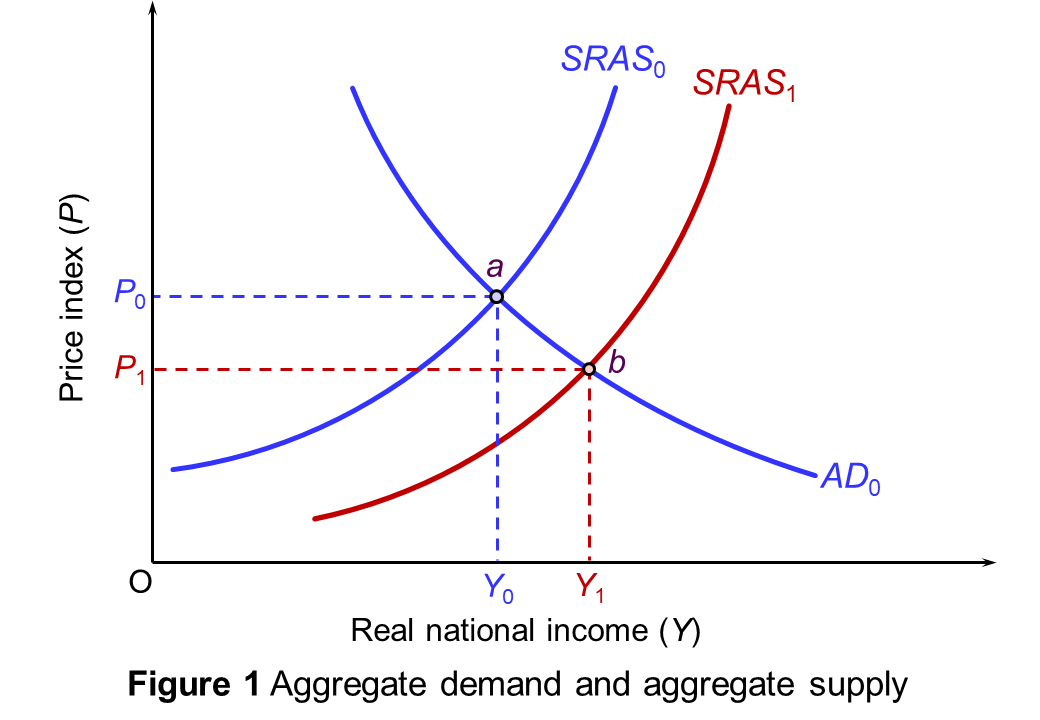 Theoretically, the argument is simple. If people do work harder and firms do invest more, then potential GDP will rise – a rise in aggregate supply. This can be shown on an aggregate demand and supply diagram. If the policy works, the aggregate supply curve will shift to the right. Real GDP will rise and there will be downward pressure on prices. In Figure 1, real GDP will rise from Y0 to Y1 and the price level will fall from P0 to P1. However, things are not as simple as this. Indeed, there are two major problems.
The first concerns whether tax cuts will incentivise people to work harder. The second concerns what happens to aggregate demand. I addition to this, the policies are likely to have a profound effect on income distribution.
Tax cuts and incentives
Cutting the top rate of income tax would have immediately given people at the top of the income scale a rise in post-tax income. This would have created a substitution effect and an income effect. Each extra pound that such people earn would be worth more in post-tax income – 60p rather than 55p. This would provide an incentive for people to substitute work for leisure as work is now more rewarding. This is the substitution effect. On the other hand, with the windfall of extra income, they now would have needed to work less in order to maintain their post-tax income at its previous level. They may well indeed, therefore, have decided to work less and enjoy more leisure. This is the income effect.
With the diminishing marginal utility of income, generally the richer people are, the bigger will be the income effect and the smaller the substitution effect. Thus, cutting the top rate of income tax may well have led to richer people working less. There is no evidence that the substitution effect would be bigger.
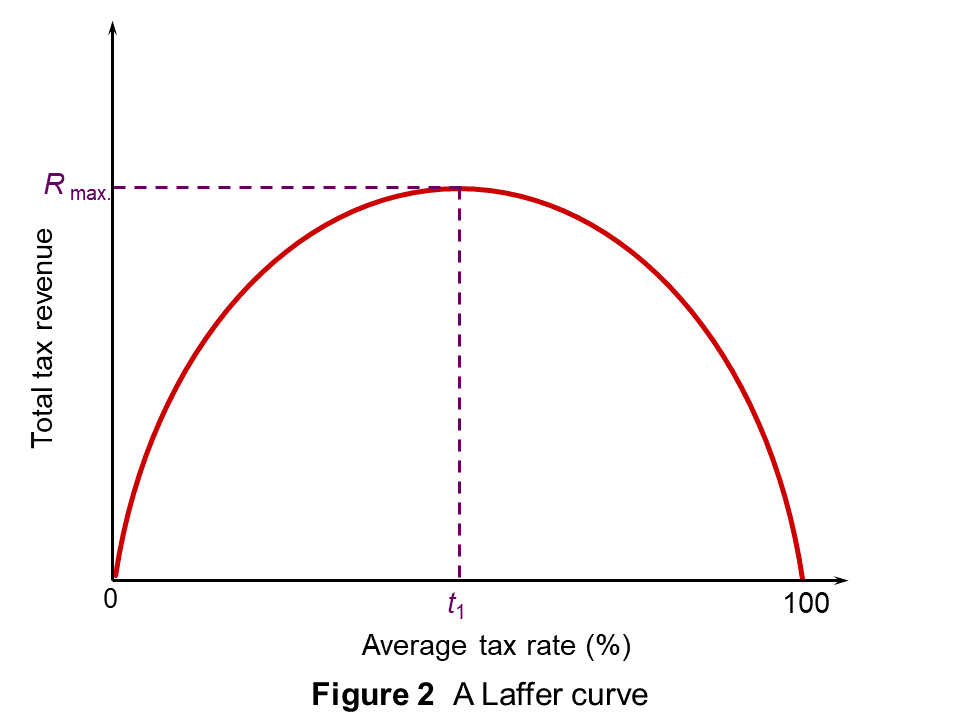 If top rates of income tax are already at a very high level, then cutting then may well encourage more work. After all, there is little incentive to work more if the current rate of tax is over 90%, say. Cutting them to 80% could have a big effect. This was the point made by Art Laffer, one of Ronald Reagan’s advisors. He presented his arguments in terms of the now famous ‘Laffer curve’, shown in Figure 2. This shows the total tax revenue raised at different tax rates.
If the average tax rate were zero, no revenue would be raised. As the tax rate is raised above zero, tax revenues will increase. The curve will be upward sloping. Eventually, however, the curve will peak (at tax rate t1). Thereafter, tax rates become so high that the resulting fall in output more than offsets the rise in tax rate. When the tax rate reaches 100 per cent, the revenue will once more fall to zero, since no one will bother to work.
If the economy were currently to the right of t1, then cutting taxes would increase revenue as there would be a major substitution effect. However, most commentators argue that the UK economy is to the left of t1 and that cutting the top rate would reduce tax revenues. Analysis by the Office for Budget Responsibility in 2012 suggested that t1 for the top rate of income tax was at around 48% and that cutting the rate below that would reduce tax revenue. Clearly according to this analysis, 40% is considerably below t1.
As far as corporation tax is concerned, the 19% rate is the lowest in the G20 and yet the UK suffers from low rates of both domestic investment and inward direct investment. There is no evidence that raising it somewhat, as previously planned, will cut investment. And as far as individual entrepreneurs are concerned, cutting taxes is likely to have little effect on the desire to invest and expand businesses. The motivation of entrepreneurs is only partly to do with the money. A major motivation is the sense of achievement in building a successful business.
Creating investment zones with lower taxes, no business rates and lower regulations may encourage firms to set up there. But much of this could simply be diverted investment from elsewhere in the country, leaving overall investment little changed.
To assess these questions, the government needs to model the outcomes and draw on evidence from elsewhere. So far this does not seem to have happened. They government did not even present a forecast of the effects of its policies on the public finances, something that the OBR normally presents at Budget time. This was one of the reasons for the collapse in confidence of sterling and gilts (government bonds) in the days following the mini-Budget.
Effects on aggregate demand
 Cutting taxes and financing them from borrowing will expand aggregate demand. In Figure 1, the AD curve will also shift to the right and this will push up prices. Inflation is already a serious problem in the economy and unfunded tax cuts will make it worse. Higher inflation will result in the Bank of England raising interest rates further to curb aggregate demand. But higher interest rates, by raising borrowing costs, are likely to reduce investment, which will have a negative supply-side effect.
The problem here is one of timing. Market-orientated supply-side policies, if they work to increase potential GDP, will take time – measured in years rather than months. The rise in aggregate demand will be much quicker and will thus precede the rise in supply. This could therefore effectively kill off the rise in supply as interest rates rise, the exchange rate falls and the economy is pushed towards recession. Indeed, the mini-Budget immediately sparked a run on the pound and the exchange rate fell.
The rising government debt may force the government to make cuts in public expenditure. Rather than cutting current expenditure on things such as nurses, teachers and benefits, it is easier to cut capital expenditure on things such as roads and other infrastructure. But this will have adverse supply-side effects.
Effects on income distribution
 Those advocating market-orientated supply-side policies argue that, by making GDP bigger, everyone can gain. They prefer to focus on the size of the national ‘pie’ rather than its distribution. If the rich initially gain, the benefits will trickle down to the poorest in society. This trickle-down theory was popular in the 1980s with politicians such as Margaret Thatcher and Ronald Reagan and, more recently, with Republican presidents, such as Goerge W Bush and Donald Trump. There are two problems with this, however.
The first, which we have already seen, is whether such policies actually do increase the size of the ‘pie’.
The second is how much does trickle down. During the Thatcher years, income inequality in the UK grew, as it did in the USA under Ronald Reagan. According to an IMF study in 2015 (see the link to the IMF analysis below), policies that increase the income share of the poor and the middle class do increase growth, while those that raise the income share of the top 20 per cent result in lower growth.
After the mini-Budget was presented, the IMF criticised it for giving large untargeted tax cuts that would heighten inequality. The poor would gain little from the tax cuts. The changes to income tax and national insurance mean that someone earning £20 000 per year will gain just £167 per year, while someone earning £200 000 will gain £5220. What is more, the higher interest rates and higher prices resulting from the lower exchange rate are likely to wipe out the modest gains to the poor.
Podcast
Articles
- At a glance: What’s in the mini-budget?
BBC News (23/9/22)
- Mini-budget: What it means for you and your finances
BBC News, Kevin Peachey (23/8/22)
- Will this huge tax cutting gamble pay off?
BBC News, Faisal Islam (23/9/22)
- Kwasi Kwarteng faces U-turn on tax or spending cuts
BBC News, Faisal Islam (28/9/22)
- Nearly 300 UK mortgage deals pulled in a day as pound’s fall heralds rate rise
The Guardian, Zoe Wood (27/9/23)
- Rationale behind abolition of 45p tax rate reflects failed ideology
The Guardian, Arun Advani, David Burgherr and Andy Summers (29/9/23)
- The UK’s ‘Trussonomics’ crashes the pound and leaves investors shaking their heads
CNN, Allison Morrow (26/9/23)
- Mini budget: will Kwasi Kwarteng’s plan deliver growth?
The Conversation, Steve Schifferes (23/9/23)
- Only a U-turn by the government or the Bank of England will calm UK financial markets
The Conversation, Campbell Leith (28/9/22)
- IMF gives damning verdict on Britain’s tax cuts
CNBC, Hannah Ward-Glenton (28/9/23)
- Lasting effects of ‘mini’ Budget will be felt far beyond the trading floors
Today News, Torsten Bell (1/10/23)
Analysis
- Causes and Consequences of Income Inequality: A Global Perspective
IMF Staff Discussion Notes, Era Dabla-Norris, Kalpana Kochhar, Nujin Suphaphiphat, Franto Ricka and Evridiki Tsounta (15/6/15)
- Mini-Budget response
Institute for Fiscal Studies, Stuart Adam, Isaac Delestre, Carl Emmerson, Paul Johnson, Robert Joyce, Isabel Stockton, Tom Waters, Xiaowei Xu and Ben Zaranko (23/9/22)
Questions
- Distinguish between market-orientated supply-side policies and interventionist ones. Consider the advantages and disadvantages of each.
- Explain why bond prices fell after the mini-Budget. What was the Bank of England’s response and why did this run counter to its plan for quantitative tightening?
- How might a tax-cutting Budget be designed to help the poor rather than the rich? Would this have beneficial supply-side effects?
- Find out about the 1972 tax-cutting Budget of Anthony Barber, the Chancellor in Ted Heath’s government, that led to the ‘Barber boom’ and then rampant inflation. Are there any similarities between the 1972 Budget and the recent mini-Budget?

Aggregate demand has been booming as the world bounces back from the pandemic. At the same time, aggregate supply is severely constrained. These supply constraints are making potential national income smaller – at least temporarily. The result is that many countries are heading for recession.
At the same time, supply constraints are causing prices to rise, especially energy and food prices. This cost-push inflation is made worse by the rises in aggregate demand.
The result is ‘stagflation’ – a recession, or stagnation, accompanied by high inflation. In the UK, the latest Bank of England Monetary Policy Report forecast that by the end of 2022, CPI inflation would be 13.1% and that in 2023, real GDP would fall by 1.5%.
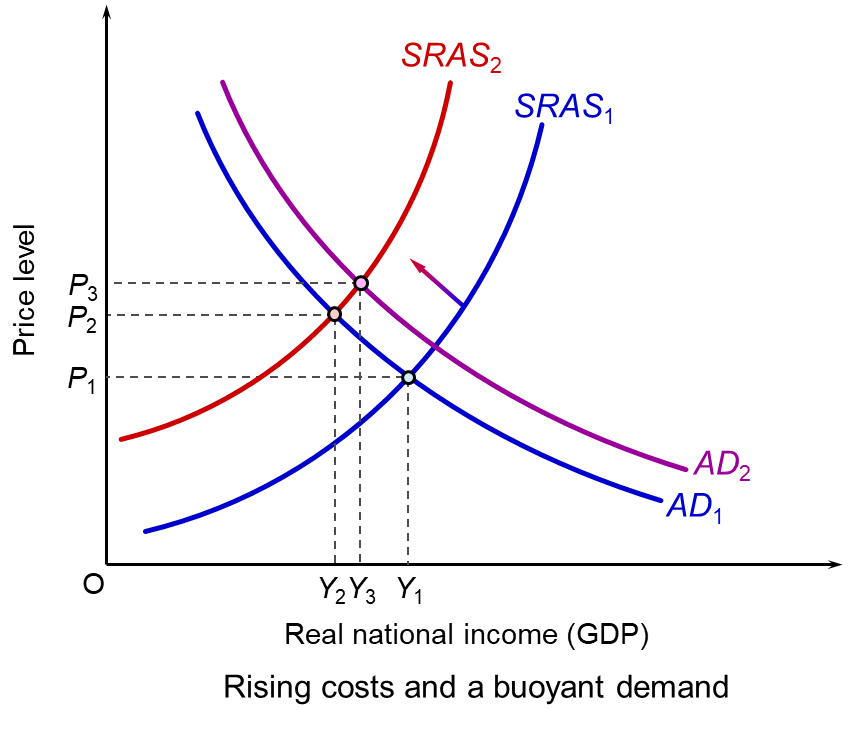 This effect of an adverse supply shock accompanied by relatively buoyant aggregate demand (at least initially) can be illustrated with an aggregate demand and supply diagram. The supply shock is illustrated by an upward shift to the left of the short-run aggregate supply curve (SRAS). (If the shock is a direct rise in prices, then it can be seen as a vertical upward shift. If it is a fall in the total amount supplied, then it can be seen as a horizontal leftward shift.) In the diagram, aggregate supply shifts from SRAS1 to SRAS2. The price level rises from P1 to P2. If costs go on rising or supply goes on falling then the curve will go on shifting upwards to the left.
If the government responds by increasing benefits or reducing taxes, then, other things being
equal, aggregate demand will rise. In the diagram, the AD curve will shift to the right, e.g. from AD1 to AD2. Real GDP only falls to Y3 not Y2. However, the price level rises further: from P2 to P3.
Why has aggregate supply fallen?
There are several factors that have contributed to the fall in aggregate supply/rise in costs.
- Stretched supply chains, which had been adversely affected by Covid. Congestion at container ports has led to delays, with warehouses and shops being short of stock.
- Labour shortages, with many people not returning to the labour force after being laid off or furloughed, or only returning part time, leaving firms needing more people. The problem has been particularly acute in the UK, with many EU citizens having returned to the EU after Brexit and the UK having to rely increasingly on staff from outside the EU.
 The war in Ukraine. This has had a major impact on the supply of natural gas and oil. The war has also led to a fall in grain and other food supplies from Ukraine, as ports have been blockaded and there have been disruptions to planting and harvesting.
- Climate change is causing more severe weather events, such as droughts in Europe and western USA. The droughts of 2022 will compound the problem of food shortages and food price inflation.
- In the UK, Brexit costs, such as increased administrative burdens and difficulties in both exporting and importing, have dampened production and hence adversely impacted on aggregate supply.
- Increased industrial action. As the cost of living soars, unions are demanding pay increases to match the rise in the cost of living. Pay rises further increase firms’ costs – and the bigger the pay rises, the bigger the rise in costs.
The problem with a fall in aggregate supply is that it reduces real GDP. People as a whole are poorer. To use a common analogy, the national ‘pie’ has shrunk. Giving everyone a bigger knife and fork (i.e. a rise in nominal aggregate demand) will not make people better off. It just compounds the problem of rising prices, as the diagram shows.
In the short term, with GDP shrinking, there is a major issue of distribution. If the poor are to be given help so that they are not made even poorer, then other people will have been made worse off. In other words, their nominal incomes must rise more slowly than prices.
Monetary policy
 Central banks generally have a mandate of keeping inflation close to 2% over the medium term. Their levers are changes in interest rates, underpinned by changes in the money supply – in extreme times by quantitative easing (creating money by buying assets with newly created money) or quantitative tightening (withdrawing money from the economy by selling assets). Central banks, faced by soaring inflation, have been raising interest rates. The Fed has recently raised the Federal Funds rate by 0.75 percentage points (75 basis points) and the Bank of England and the European Central Bank by 0.5 percentage points (50 basis points).
Raising interest rates reduces inflation by dampening aggregate demand. In the diagram, the AD curve shifts to the left (or shifts to the right less quickly). This will dampen inflation, as falling real demand will force firms to cut prices. But it will also force them to cut output and employment, thereby worsening the recession.
Central banks recognise this dilemma, but also recognise that if inflation is not brought rapidly under control, it could spiral upwards, with wages and prices chasing each other in a wage–price spiral, which only gets worse as inflationary expectations rise. The short-term pain of falling real income is a price worth paying for getting inflation under control.
Fiscal policy
In the short term, there is little that fiscal policy can do to raise real GDP. The focus, as it was during the pandemic, must therefore be in providing relief to those most in need.
In the UK, the energy price cap set by Ofgem will see likely energy bills for the typical household quadruple in just a year, from a little over £1000 per annum at January 2021 prices to over £4200 in predicted January 2023 prices. These higher prices partly reflect rising wholesale energy costs and partly the need for energy companies, in a process known as ‘backwardation’, to recoup hedging costs they have incurred so as not to be forced out of business.
 Relief for consumers can be in various forms. For example, the government could pay subsidies to energy suppliers to cap prices at a lower level, perhaps just for the poorest households. Or it could pay grants to help people with their bills. Again, these could be targeted to the poorest families, or paid on a sliding scale according to income. Or VAT on gas and electricity could be scrapped.
Generally the more people are entitled to help, the more expensive it is for the government and hence the less generous the help per family is likely to be.
Then there is the question of whether such measures should be accompanied by a rise in broadly-based tax, such as income tax, or whether the government should borrow more, which would be likely to push up interest rates and increase the cost of servicing government debt.
One topic of debate in the Conservative leadership contest is whether taxes should be cut to help people struggling with the cost of living. Whilst such a policy, if carefully targeted to investment, might increase aggregate supply over the longer term, in the short term it will increase aggregate demand and will add to inflationary pressures.
Targeting tax cuts to the poor is difficult. Cutting income tax rates has the opposite effect. The rich pay more income tax than the poor and will benefit most from a cut in rates. An alternative is to raise personal allowances. This will provide a bigger percentage help to income taxpayers on lower incomes, but provides no help at all for the poorest people who currently pay no income tax.
Conclusion
The supply shocks are making countries poorer. The focus in the short term, therefore, needs to be on income distribution and how to help those suffering the most.
To end on a note of optimism: the energy shocks are causing governments to invest in alternative sources, such as wind, solar and nuclear. When these come on line, it is expected that energy prices will fall.
As far as overall inflation is concerned, although the Bank of England is forecasting CPI inflation of 13.1% by Q4 2022, it is also forecasting that this will have fallen to 5.5% by Q4 2023 and to just 0.8% by Q3 2024. Fingers crossed.