We know two things about economic growth in a developed economy like the UK: it is positive over the longer term, but highly volatile in the short term. We can refer to these two facts as the twin characteristics of growth. The volatility of growth sees occasional recessions, i.e. two or more consecutive quarters of declining output. Since 1973, the UK has experienced six recessions.
Here we consider in a little more detail the growth numbers for the UK from the latest Quarterly National Accounts, focusing on the depth and duration of these six recessions. How do they compare?
The latest figures on British economic growth show that the UK economy grew by 0.9 per cent in the third quarter of 2012. However, when compared with the third quarter of 2011, output was essentially unchanged. This means that the annual rate of growth was zero. Perhaps even more telling is that output (real GDP) in Q3 2012 was still 3.0 per cent below its Q1 2008 level.
The chart helps to put the recent output numbers into an historical context. It shows both the quarter-to-quarter changes in real GDP (right-hand axis) and the level of output as measured by GDP at constant 2009 prices (left-hand axis). It captures nicely the twin characteristics of growth. Since 1970, the average rate of growth each quarter has been 0.6 per cent. This is equivalent to an average rate of growth of 2.35 per cent per year. The chart also allows us to pin-point periods of recessions.
One way of comparing recessions is to compare their ‘2 Ds’: depth and duration. The table shows the number of quarters each of the six recessions since 1973 lasted. It also shows how much smaller the economy was by the end of each recession. In other words, it shows the depth of each recession as measured by the percentage reduction in output (real GDP).
British recessions
Duration (quarters)
Depth (output lost, %)
1973Q3–74Q1
3
3.25
1975Q2–75Q3
2
1.76
1980Q1–81Q1
5
4.63
1990Q3–91Q3
5
2.93
2008Q2–09Q2
5
6.28
2011Q4–12Q2
3
0.90
We can see that three of the recessions lasted for five quarters. In the case of the recessions starting in 1975 and 2011 they occurred very shortly after a previous recession. Hence, we observe two so-called double-dip recessions.
The table reveals that the deepest recession by some distance was that in the late 2000s. As a result of this recession, UK output declined by 6.3 per cent. As the recent GDP numbers show, the UK has yet to recover the ‘lost output’ that followed the financial crisis.
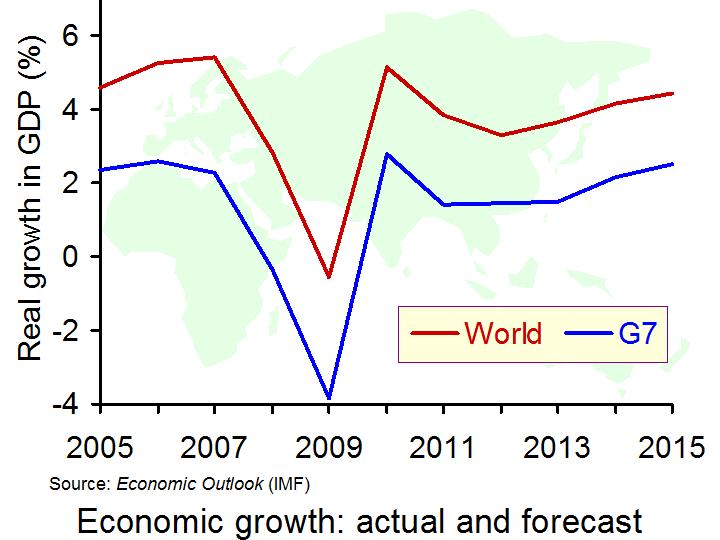
While the Western world has struggled with economic growth for the past 6 years, emerging economies such as China, Brazil and India have recorded some very high rates of growth. Throughout 2012, there were signs that these economies were not going to be the saviour of the global economy that we all thought. But, as we enter 2013, is it these economies that still hold the hope of the West for more positive figures and better economic times?
The article below from BBC News, in particular, considers the year ahead for the Asian economies and what it might mean for the Western world. Although these countries are by no means safeguarded against the impending approach of the US economy to their fiscal cliff or the ongoing eurozone crisis, they have seemed to be more insulated than the rest of the world. A crucial question to consider is whether this will continue. Furthermore, are the growth levels and policies of a country such as China sustainable? Can it continue to record such high growth rates in the face of the global economic situation?
The Japanese economy has been in serious trouble for a couple of decades, but measures to boost growth for this economy are expected. If these do occur, then western economies may feel some of their positive effects. At present, there is a degree of optimism as we enter the New Year, but how long this will last is anybody’s guess. The following articles consider the year ahead.
Why have the Asian economies been more insulated to the global economic conditions over the past few years, in comparison with the Western world?
What challenges will the global economy be facing over the coming year?
What challenges are the Asian economies facing? How different are they from the challenges you identified in question 3?
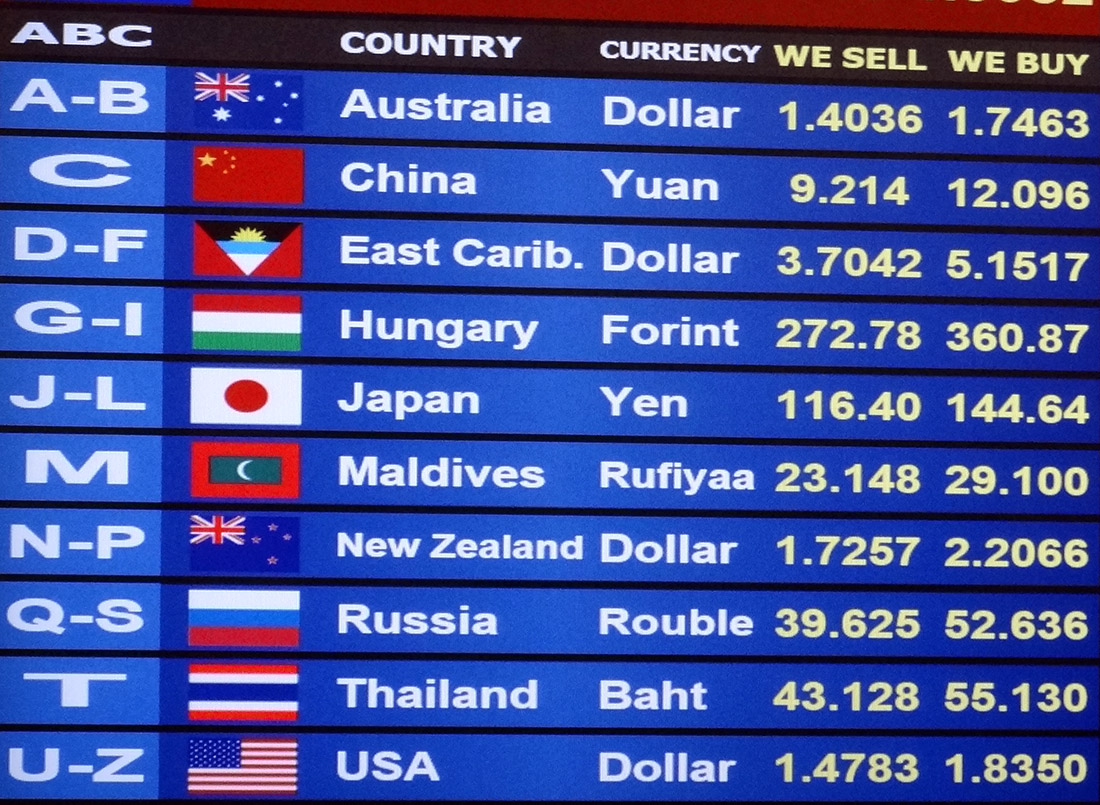
Why is the rate of exchange an important factor for an economy such as Japan?
What does a low exchange rate for the yen mean for European countries? Is it likely to be seen as a good or bad thing? What about for South Korea? Use a diagram to help you answer this question.
Why is the economic situation in countries such as China and India so important for the rest of the global economy? Use a diagram to illustrate this.
Pressure has been growing in the UK for people to be paid no less than a living wage. The Living Wage Foundation claims that this should be £8.55 per hour in London and £7.45 in the rest of the UK. The current minimum wage is £6.19.
There has been considerable support for a living wage across the political spectrum. Ed Miliband, the Labour leader, has stated that a Labour government would ensure that government employees were paid at least the living wage and that government contracts would go only to firms paying living wages. Other firms that paid less could be ‘named and shamed’. The living wage has also been supported by Boris Johnson, Conservative Mayor of London. The Prime Minister said that a living wage is ‘an idea whose time has come’, although many Conservatives oppose the idea.
The hourly living wage rate is calculated annually by the Centre for Research in Social Policy and is based on the basic cost of living. The London rate is calculated by the Greater London Authority.
Advocates of people being paid at least the living wage argue that not only would this help to reduce poverty, it would also help to reduce absenteeism and increase productivity by improving motivation and the quality of people’s work.
It would also bring in additional revenue to the government. According to a report by the Institute for Public Policy Research and the Resolution Foundation, if everyone were paid at least a living wage, this would increase the earnings of the low paid by some £6.5bn per year. Of this, some £3.6bn would go to the government in the form of higher income tax and national insurance payments and reduced spending on benefits and tax credits. Of this £6.5bn, an extra £1.3 billion would be paid to public-sector workers, leaving the Treasury with a net gain of £2.3bn.
But what would be the effect on employment? Would some firms be forced to reduce their workforce and by how much? Or would the boost to aggregate demand from extra consumer spending more than offset this and lead to a rise in employment?. The following articles look at the possible effects.
How would you set about determining what the living wage rate should be?
Distinguish between absolute and relative poverty. Would people being paid below a living wage be best described as absolute or relative poverty (or both or neither)?
What do you understand by the term ‘efficiency wage’? How is this concept relevant to the debate about the effects of firms paying a living wage?
Under what circumstances would raising the statutory minimum wage rate to the living wage rate result in increased unemployment? How is the wage elasticity of demand for labour relevant to your answer and how would this elasticity be affected by all firms having to pay at least the living wage rate?
What would be the macroeconomic effects of all workers being paid at least the living wage rate? What would determine the magnitude of these effects?
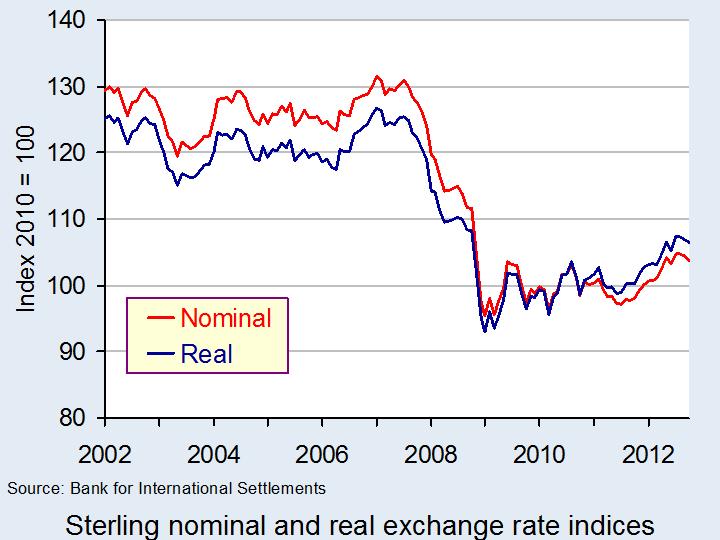
The UK is an island-economy. Therefore, trade is a crucial determinant of our economic performance. The competitiveness of our exports, in part, is affected by the exchange rate. Floating exchange rates are notoriously volatile. However, since the autumn of 2007 we have observed a significant depreciation of the UK exchange rate. In other words the number of units of many foreign currencies to the British pound has fallen. A depreciation helps to make our exports more competitive abroad. We detail the extent of this depreciation and any signs of a reversal in this pattern.
Rather than look at the British pound (or any currency) against the many foreign currencies separately we can look at the average exchange rate against a whole bundle of currencies. The average rate is calculated by weighting the individual exchange rates by the amount of trade between Britain and the other countries. This trade-weighted exchange rate is known as the effective exchange rate.
In analysing the competitiveness of the exchange rate, we can go one step further and adjust for the terms of trade. This means that we adjust for the average price of our exports relative to the average price of those goods we import. Therefore, as well as the nominal (actual) effective exchange rate we can calculate a real effective exchange rate. If the average price of our exports rises relative to the average price of imports, the real effective exchange rate rises relative to the nominal rate. It means that we are able to obtain a larger volume of imports from selling a given volume of exports.
The chart shows the nominal (actual) and real effective exchange rate for the British pound since 2002. The chart shows clearly how from the autumn of 2007 the effective exchange rate both in nominal and real terms began to fall sharply. Over the period from September 2007 to January 2009 the nominal effective exchange rate fell by 26 per cent. After adjusting for the relative price of exports to imports, we find the real effective exchange rate fell by 24 per cent. In other words, the British pound depreciated by close to one-quarter in just 16 months.
If we move the clock forward, we observe a mild appreciation of the British pound since July 2011. In nominal terms, the effective exchange rate has appreciated by 6.8 per cent while in real terms it has appreciated by 7.8 per cent. Nonetheless, if we compare September 2007 with October 2012, we find that the nominal effective exchange rate for the British pound is 19 per cent lower while the real effective exchange rate is approximately 13 per cent lower. This still constitutes a major competitive boost for our exporters.
Explain how the foreign demand for goods and assets generates a demand for British pounds. How will this demand be affected by the foreign currency price of the British pound, i.e. the number of foreign currency units per £1?
Explain how the demand by British residents for foreign goods and assets generates a supply of British pounds. How will this supply be affected by the foreign currency price of the British pound, i.e. the number of foreign currency units per £1?
What factors are likely to shift the demand and supply curves for British pounds on the foreign exchange markets?
Illustrate the effect of a decrease in the demand for British goods and assets on the exchange rate (i.e. the foreign currency price of the British pound) using a demand-supply diagram.
What is the difference between a nominal and a real effective exchange rate? Which of these is a better indicator of the competitiveness of our country’s exports?
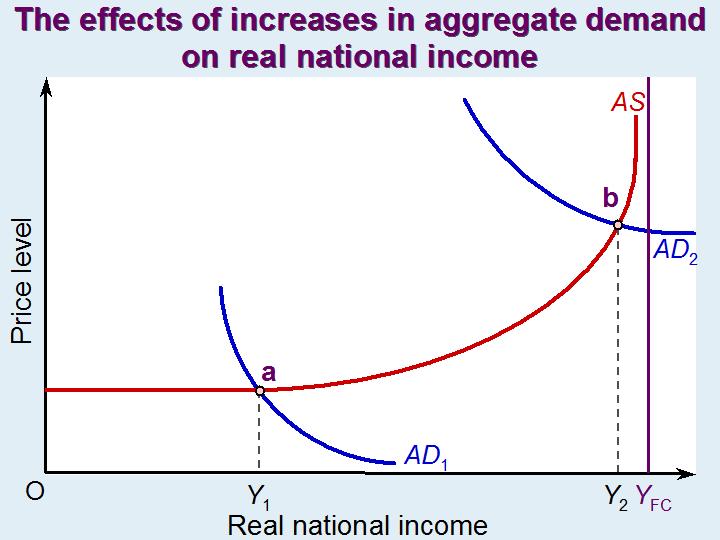
If aggregate demand were to expand, would there be sufficient spare capacity to allow aggregate supply to expand to meet the additional demand? This is the question addressed by the podcast and article below.
If there is plenty of spare capacity, policies to increase aggregate demand could help to take up the slack and thereby achieve economic growth – at least as long as spare capacity remains. In other words, in the short run the aggregate supply curve may be horizontal or only gently upward sloping at the current point of intersection with the aggregate demand curve. This is illustrated by point a in the diagram. A rightward shift in the aggregate demand curve would cause a movement along the aggregate supply curve to a new higher level of real national income (Y).
If, however, there is little or no spare capacity, an increase in nominal aggregate demand is likely to be purely inflationary, or virtually so. This would the case at point b in the diagram. Real national income cannot expand beyond the full-capacity level, YFC. Under such circumstances, any attempt by the government to stimulate economic growth should focus on the supply side and attempt to shift the aggregate supply curve to the right. Examples of supply-side policy include incentives to encourage research and development, incentives for the private sector to invest in new capacity and direct public investment in infrastructure.
Unemployment is not just caused by a lack of aggregate demand relative to aggregate supply. It may be the result of a mismatching of labour supply with the demand for labour. People may have the wrong qualifications or not be where the jobs are. Unemployment may co-exist with quite high levels of vacancies. There may be vacancies for highly qualified scientists, technicians or craftspeople and unemployment of people with low skills or skills no longer in high demand. The same may apply to capital equipment. There may be a shortage of high-tech equipment or equipment to produce goods in high demand and redundant older equipment or equipment in areas of declining demand.
Part of a comprehensive set of policies to tackle unemployment and achieve economic growth would be to focus on the whole balance of the economy and the matching of the demand and supply of inputs.
 We know two things about economic growth in a developed economy like the UK: it is positive over the longer term, but highly volatile in the short term. We can refer to these two facts as the twin characteristics of growth. The volatility of growth sees occasional recessions, i.e. two or more consecutive quarters of declining output. Since 1973, the UK has experienced six recessions.
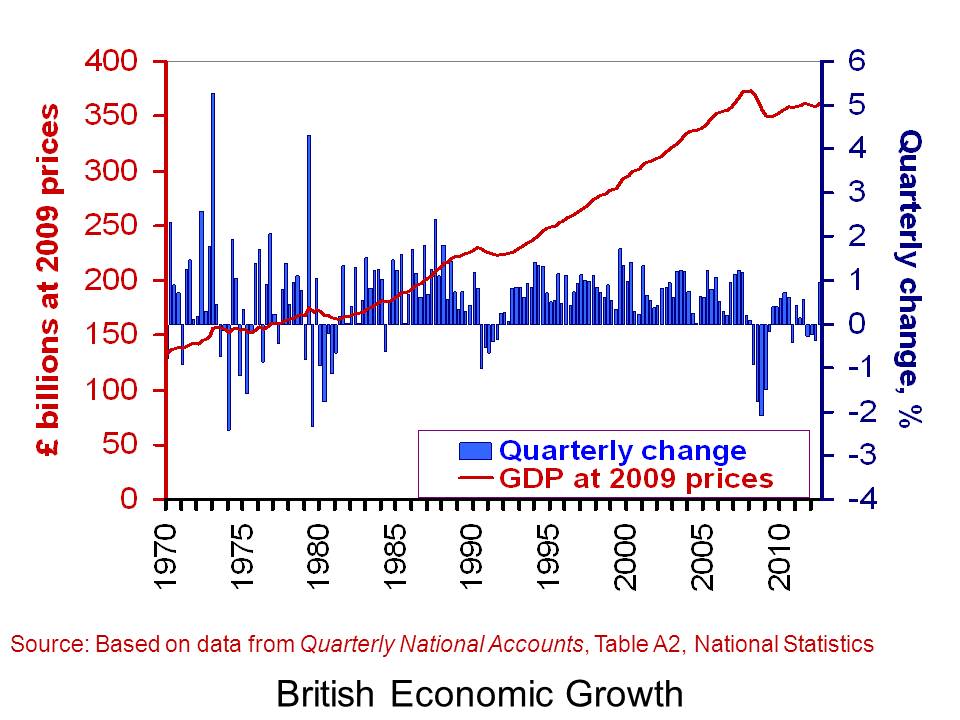 The chart helps to put the recent output numbers into an historical context. It shows both the quarter-to-quarter changes in real GDP (right-hand axis) and the level of output as measured by GDP at constant 2009 prices (left-hand axis). It captures nicely the twin characteristics of growth. Since 1970, the average rate of growth each quarter has been 0.6 per cent. This is equivalent to an average rate of growth of 2.35 per cent per year. The chart also allows us to pin-point periods of recessions.