 Conservative Party leaders are considering the benefits of an above-inflation rise in the minimum wage. This policy has been advocated by both the Labour Party and the Liberal Democrats as a means of helping the lowest paid workers. From 2008 to 2013, minimum wage rates fell 5.2% in real terms: in other words, nominal increases were less than the increase in both the RPI and CPI (see UK minimum wage: a history in numbers).
Advocates of a real rise in the minimum wage argue that not only would it help low-paid workers, many of whom are in severe financial difficulties, but it would benefit the Treasury. According to Policy Exchange, a free-market think tank closely aligned to the Conservative Party, increasing the minimum wage by 50p would save the Government an estimated £750m a year through higher tax revenues and lower benefit payments.
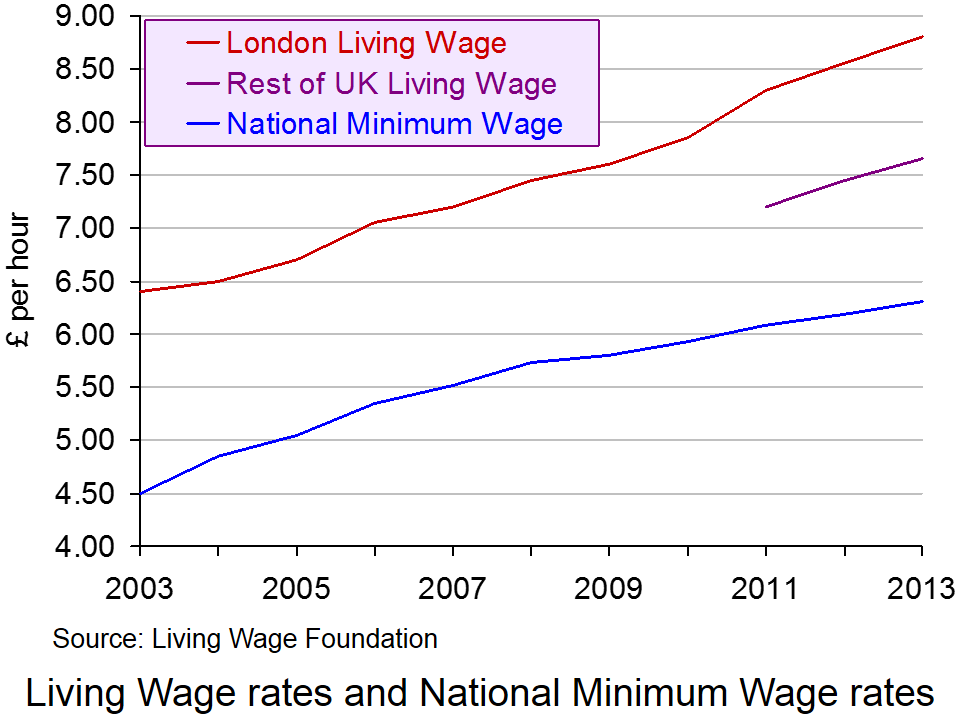 But even such a rise to £6.81 would still leave the minimum wage substantially below the living wage of £8.80 in London and £7.65 in the rest of the UK, as estimated by the Living Wage Foundation (see The cost of a living wage). Although many businesses are now paying at least the living wage, many others, especially small businesses, argue that a rise in the minimum wage above the rate of inflation would force them to consider cutting the number of employees or reducing hours for part-time workers.
Meanwhile, in the USA 13 states have raised their minimum wage rates from the 1st January 2014 (see). Some of the rises, however, were tiny: as little as 15 cents. In a couple of cases, the rise is $1. Currently 21 states and DC have minimum wage rates above the Federal level of $7.25 (approx. £4.40); 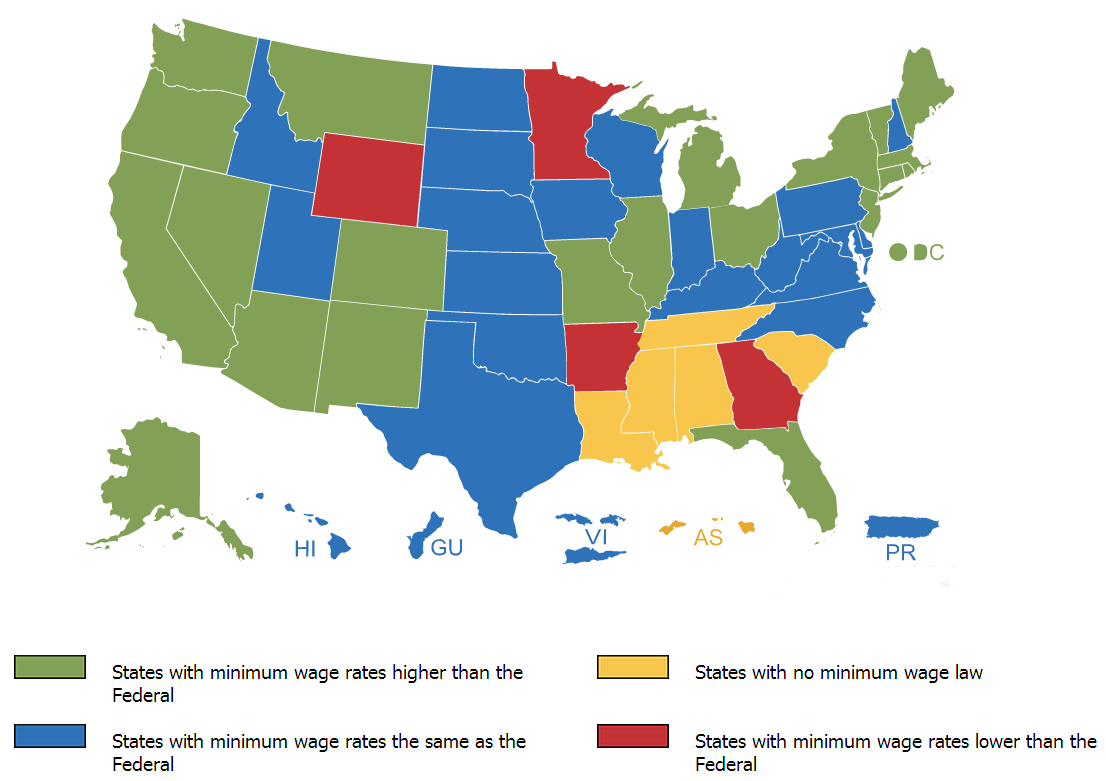 20 states have rates the same as the Federal level; 4 states have rates below the Federal level. At $9.32 per hour, Washington State has the highest state minimum wage; the lowest rates ($5.15) are in Georgia and Wyoming. In 5 states there is no minimum wage at all. As the ABC article below states:
The piecemeal increases at the local level are occurring amidst a national debate over low wages and income inequality. Fast food and retail workers have been staging protests and walking off work for more than a year, calling for better pay and more hours. Currently, fast food workers nationally earn an average of about $9 per hour.
Workers from McDonald’s, Wendy’s, Burger King and other fast food joints are calling for $15 per hour. Wal-Mart workers organizing as part of the union-backed OUR Walmart aren’t asking for a specific dollar amount increase, but they say it’s impossible to live on the wages they currently receive.
President Obama has been throwing his weight behind the issue. Earlier this month, the President said in a speech that it’s “well past the time to raise the minimum wage that in real terms right now is below where it was when Harry Truman was in office.” But such legislation has a bleaker outlook if it reaches the Republican-led House of Representatives. House Speaker John Boehner has said that raising the minimum wage leads to a pullback in hiring.
So what are the costs and benefits of a significant real rise is the minimum wage on either side of the Atlantic? The articles explore the issues.
Articles: UK
Lib Dems accuse Tories of ‘stealing’ their policy as George Osborne prepares to approve above-inflation rise in minimum wage Independent, Andrew Grice (7/1/14)
Lib Dems accuse Tories of ‘nicking’ party’s policy on low wages The Guardian, Nicholas Watt (7/1/14)
Cut housing benefit? A higher minimum wage would help The Guardian, Patrick Collinson (6/1/14)
Miliband prepares to wage war The Scotsman, Andrew Whitaker (8/1/14)
Increasing the minimum wage is only a half answer to poverty New Statesman, Helen Barnard (8/1/14)
Raise the bar: Economically and socially, Britain needs higher wages Independent (7/1/14)
Another Tory says there’s a ‘strong case’ for raising the minimum wage The Spectator, Isabel Hardman (8/1/14)
Fairness and the minimum wage Financial Times (7/1/14)
Osborne wants above-inflation minimum wage rise BBC News (16/1/14)
George Osborne backs minimum wage rise to £7 an hour The Guardian, Nicholas Watt, (16/1/14)
Minimum wage: in his efforts to defeat Labour, Osborne risks mimicking them The Telegraph, Benedict Brogan (16/1/14)
Minimum wage announcement is not just good economics The Guardian, Larry Elliott (16/1/14)
Articles: USA
13 states raising pay for minimum-wage workers USA Today, Paul Davidson (30/12/13)
Minimum wage increase: Wage to rise in 13 states on Jan. 1 ABC15 (30/12/13)
NJ minimum wage sees $1 bump on Jan. 1 Bloomberg Businessweek, Angela Delli Santi (31/12/13)
Minimum wage hike a job killer ctpost, Rick Torres (7/1/14)
A Business Owners Case For Raising The Minimum Wage Grundy Country Herald, David Bolotsky (7/1/14)
Raising the Minimum Wage Isn’t Just Good Politics. It’s Good Economics, Too. New Republic, Noam Scheiber (31/12/13)
Minimum wage rises across 13 US states Financial Times, James Politi (1/1/14)
Information
National Minimum Wage rates GOV.UK
UK minimum wage: a history in numbers Guardian Datablog
List of minimum wages by country Wikipedia
Questions
- Draw two diagrams to demonstrate the direct microeconomic effect of a rise in the minimum wage for two employers, both currently paying the minimum wage, where the first is operating in an otherwise competitive labour market and the other is a monopsonist.
- What is meant by the term ‘efficiency wage rate’? How is the concept relevant to the debate about the effects of raising the minimum wage rate?
- What are the likely macroeconomic effects of raising the minimum wage rate?
- What is the likely impact of raising the minimum wage rate on public finances?
- Is raising the minimum wage rate the best means of tackling poverty? Explain your answer.
 It is one year since the election of Shinzo Abe in Japan. He immediately embarked on a radical economic policy to stimulate the Japanese economy, which had suffered from years of stagnation. There have been three parts (or three arrows) to his policy: fiscal policy and monetary policy to stimulate aggregate demand and supply-side policy to increase productivity.
As the previous post explains:
 “The first arrow is monetary policy. The Bank of Japan has engaged in extensive quantitative easing through bond purchases in order to drive down the exchange rate (see A J-curve for Japan?), stimulate expenditure and increase the rate of inflation. A target inflation rate of 2% has been set by the Bank of Japan. Part of the problem for the Japanese economy over the years has been stagnant or falling prices. Japanese consumers have got used to waiting to spend in the hope of being able to buy at lower prices. Similarly, Japanese businesses have often delayed stock purchase. By committing to bond purchases of whatever amount is necessary to achieve the 2% inflation target, the central bank hopes to break this cycle and encourage people to buy now rather than later.
 The second arrow is fiscal policy. Despite having the highest debt to GDP ratio in the developed world, Japan is embarking on a large-scale programme of infrastructure investment and other public works. The package is worth over $100bn. The expansionary fiscal policy is accompanied by a longer-term plan for fiscal consolidation as economic growth picks up. In the short term, Japan should have no difficulty in financing the higher deficit, given that most of the borrowing is internal and denominated in yen.
 The third arrow is supply-side policy. On 5 June, Shinzo Abe unveiled a series of goals his government would like to achieve in order to boost capacity and productivity. These include increasing private-sector investment (both domestic and inward), infrastructure expenditure (both private and public), increasing farmland, encouraging more women to work by improving day-care facilities for children, and deregulation of both goods, capital and labour markets. The prime minister, however, did not give details of the measures that would be introduced to achieve these objectives. More details will be announced in mid-June.”
In the webcast and article below, Linda Yueh, the BBC’s Chief Business Correspondent, considers how effective the policies are proving and the challenges that remain.
Webcast
 Has Abenomics fixed Japan’s economic fortunes? BBC News, Linda Yueh (16/12/13)
Articles
Why Abenomics holds lessons for the West BBC News, Linda Yueh (13/12/13)
Japanese business confidence hits six-year high, Tankan survey shows The Guardian (16/12/13)
Data
World Economic Outlook Database IMF (Oct 2013)
Bank of Japan Statistics Bank of Japan
Economic Outlook Annex Tables OECD
Country statistical profile: Japan 2013 OECD (15/11/13)
Questions
- Demonstrate on (a) an aggregate demand and supply diagram and (b) a Keynesian 45° line diagram the effects of the three arrows (assuming they are successful) in meeting their objectives.
- Why has Japan found it so hard to achieve economic growth over the past 20 years?
- How has the Japanese economy performed over the past 12 months?
- What lessons can be learnt by the UK and eurozone countries from Japan’s three arrows?
- Why is the second arrow problematic, given the size of Japan’s general government debt? Does the proportion of Japanese debt owed overseas affect the argument?
- In what ways do the three arrows (a) support each other; (b) conflict with each other?
- Why is the structure of the labour market in Japan acting as a break on economic growth? What policies are being, or could be, pursued to tackle these structural problems?
 ‘Deflation could be replacing debt as the main problem – and there’s nothing to suggest the ECB is up to the job.’ So begins the linked article below by Barry Eichengreen, Professor of Economics and Political Science at the University of California, Berkeley.
The good news in this is that worries about debt in eurozone countries are gradually receding. Indeed, this week Ireland officially ended its reliance on a bailout (of €67.5 billion) from the EU and IMF and regained financial sovereignty (see also).
The bad news is that this does not mark the end of austerity. Indeed, many eurozone countries could get stuck in a deflationary trap, with austerity policies continuing to depress aggregate demand. Eurozone inflation is less than 1% and falling.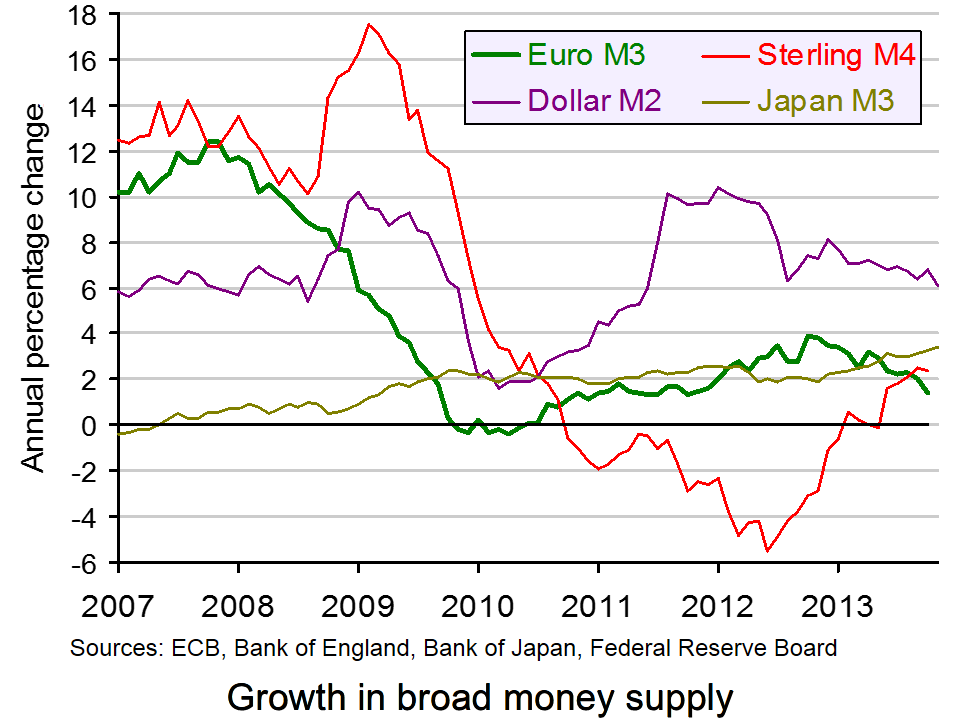 Broad money supply growth is now below that of the US dollar, the yen and sterling (see chart: click here for a PowerPoint).
The ECB has been far more cautious than central banks in other countries in acting to prevent recession and deflation. Unlike the USA, Japan and the UK, which have all engaged in extensive quantitative easing, the ECB had been reluctant to do so for fear of upsetting German opinion and taking the pressure off southern European countries to reform.
But as Eichengreen points out, the dangers of inaction could be much greater. What is more, quantitative easing is not the only option. The ECB could copy the UK approach of ‘funding for lending’ – not for housing, but for business.
Europe’s economic crisis could be mutating again The Guardian, Barry Eichengreen (10/12/13)
Questions
- What problems are created by falling prices?
- What effect would deflation have on debt and the difficulties in repaying that debt?
- What measures have already been adopted by the ECB to stimulate the eurozone economy? (Search previous articles on this site.)
- Why have such measures proved inadequate?
- What alternative policies are open to the ECB?
- What are the arguments for the ECB being given a higher inflation target (such as 3 or 4%)?
- What are the arguments for and against relaxing fiscal austerity in the eurozone at the current time?
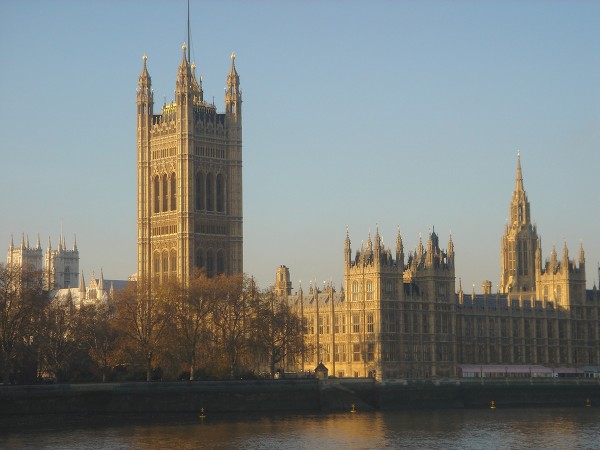 There has been an interesting debate recently about whether the austerity policies being pursued in the UK are the correct ones. What would have happened if the government had pursued a more expansionary policy? Would the increase in borrowing, at least in the short term, have triggered a financial crisis?
Without austerity policies, would the eurozone crisis have led to a collapse in investor confidence in the UK, especially if Greece had been forced out of the euro?
On the one side, Kenneth Rogoff argues that increasing the UK’s budget deficit would have been dangerous and could have led to a flight from the pound. Generally, but with some reservations, he supports the fiscal policies that have been pursued by the Coalition.
I am certainly not arguing that the UK or other advanced countries handled the post-crisis period perfectly. There should have been more infrastructure spending, even more aggressive monetary policy and probably more ruthless bank restructuring. But there has to be a balance between stimulus and stability. To assume we always knew things would calm down, and to retrospectively calibrate policy advice accordingly, is absurd
Paul Krugman and Simon Wren-Lewis challenge Rogoff’s arguments. Paul Krugman uses a version of the IS-LM model to analyse the effect of a loss of international confidence in the UK following problems in the eurozone and worries about excessive UK borrowing.
In the model, the LM curve (labelled MP in Krugman’s diagrams) illustrates the effect of an increase in real GDP on interest rates with a particular monetary policy (e.g. an inflation target or a Taylor rule, 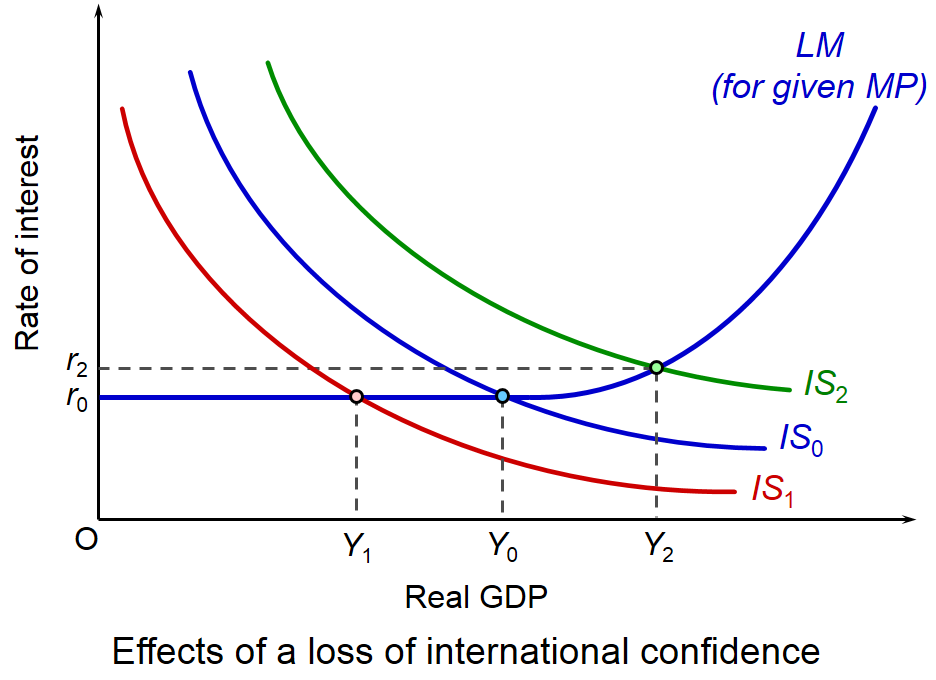 which involves a mix of two policy objectives: an inflation target and real GDP). As GDP rises, putting upward pressure on inflation, so the central bank will raise interest rates. Hence, like the traditional LM curve, the monetary-policy related LM curve will slope upwards, as shown in the diagram.
Initial equilibrium GDP is Y0. The rate of interest is at the minimum level, r0 (i.e. the rate of 0.5% that the Monetary Policy Committee has set since January 2009). This, in the model, is the liquidity trap, where any increase in money supply (a rightward shift in the LM curve) will have no effect on interest rates or GDP.
In Rogoff’s analysis of a crisis triggered by excessive borrowing and problems in the eurozone, the IS curve will shift to the left (as illustrated by curve IS1) as capital flows from the UK and confidence collapses. Real GDP will fall to Y1. This will be the outcome of fiscal expansion in the world of the early 2010s.
 Krugman argues that the opposite will occur. The outflow of capital will drive down the exchange rate. This will lead to an increase in exports and a decrease in imports. Aggregate demand thus rises and the IS curve will shift to the right (e.g. to IS2 in the diagram. Real GDP will rise (e.g. to Y2 in the diagram). If the rise in aggregate demand is sufficient, the economy will rise out of the liquidity trap and interest rates will rise (e.g. to r2 in the diagram).
Not surprisingly, Rogoff challenges this analysis, as you will see if you read his second paper below. He doesn’t criticise the model per se, but challenges Krugman’s assumptions. For example, a depreciation of sterling by some 20% since 2008 doesn’t seem to have had a major effect in stimulating exports (see the chart in the news item, A balancing act). And exports could well have declined if the eurozone economy had collapsed, given that exports to the eurozone account for around 44% of total UK exports.
Rogoff’s assumptions in turn can be challenged. Simon Wren-Lewis argues that, provided a credible long-term plan for deficit reduction is in place, maintaining a fiscal stimulus in the short run, to keep the recovery going that was beginning to emerge in 2010, would help to increase investor confidence, not undermine it. And, with a policy of quantitative easing, which involves the Bank of England buying central government debt, there is no problem of a lack of demand for UK gilts by the private sector.
What is clear from this debate is the willingness of both sides to accept points made by the other. It is an extremely civilised debate. In fact, it could be seen as a model of how academic debate should be conducted. There is none of the ‘shouting’ that has charaterised much of the pro- and anti-austerity lobbying since the financial crisis burst onto the world stage.
Britain should not take its credit status for granted Scholars at Harvard from Financial Times, Kenneth Rogoff (3/10/13)
Ken Rogoff on UK austerity mainly macro, Simon Wren-Lewis (3/10/13)
Phantom Crises (Wonkish) The Conscience of a Liberal, Paul Krugman (3/10/13)
Three Wrongs do not make a Right Scholars at Harvard from Financial Times, Kenneth Rogoff (7/10/13)
Is George Osborne really a hero of global finance? The Guardian, Robert Skidelsky (24/10/13)
Questions
- Explain how the policy-dependent LM curve illustrated in the diagram is derived.
- What would cause the policy-dependent LM curve to shift?
- Explain what is meant by the ‘liquidity trap’. Why does being in a liquidity trap make monetary policy ineffective?
- How would you determine whether or not the UK is currently in a liquidity trap?
- How is the level of (a) public-sector debt and (b) private sector debt owed overseas likely to affect the confidence of investors concerning the effects of an expansionary fiscal policy?
- Compare the UK’s total external debt with that of other countries (see the following tables from Principal Global Indicators, hosted by the IMF: External debt and Short-term external debt).
- What insurance policy (if any) does the UK have to protect against market panic about the viability of UK debt?
- What areas of agreement are there between Rogoff on the one side and Krugman and Wren-Lewis on the other?
 First the good news. Employment is rising and unemployment is falling. Both claimant count rates and Labour Force Survey rates are down. Compared with a year ago, employment is up 279,092 to 29,869,489; LFS unemployment is down from 7.87% to 7.69%; and the claimant count rate is down from 4.7% to 4.0%.
Now the bad news. Even though more people are in employment, real wages have fallen. In other words, nominal wages have risen less fast than prices. Since 2009, real wages have fallen by 7.6% and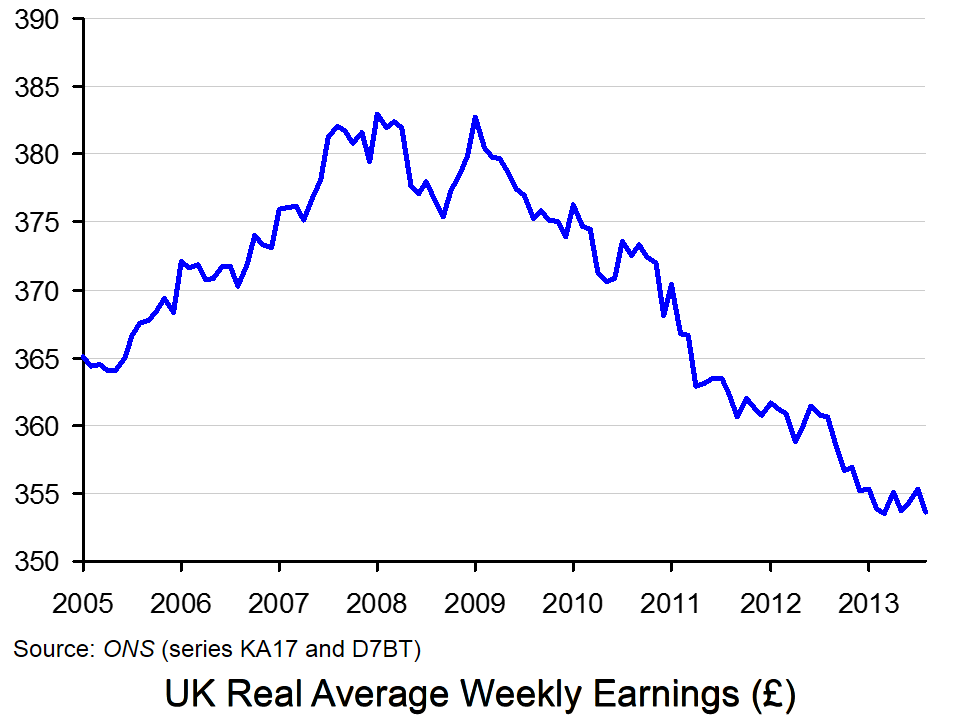 have continued to fall throughout this period. The first chart illustrates this. It shows average weekly wage rates in 2005 prices. (Click here for a PowerPoint of the chart.)
The fall in real wages is an average for the whole country. Many people, especially those on low incomes, have seen their real wages fall much faster than the average. For many there is a real ‘cost of living’ crisis.
But why have real wages fallen despite the rise in employment? The answer is that output per hour worked has declined. This is illustrated in the second chart, which compares UK output per worker with that of other G7 countries. UK productivity has fallen both absolutely and relative to other G7 countries, most of which have had higher rates of investment.
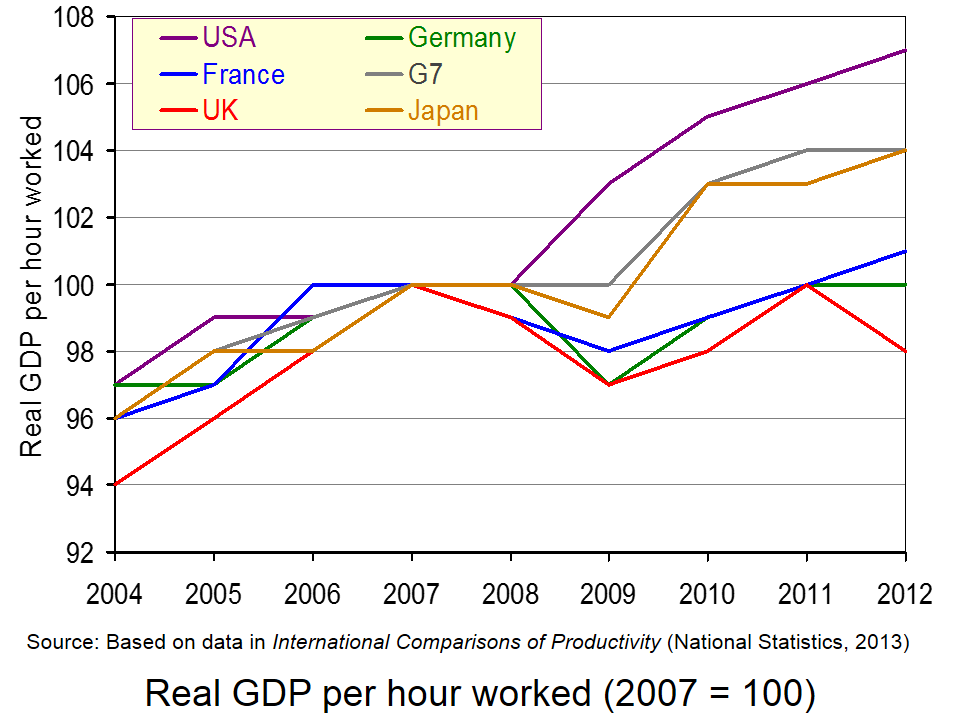 The falling productivity in the UK requires more people to be employed to produce the same level of output. Part of what seems to be happening is that many employers have been prepared to keep workers on in return for lower real wages, even if demand from their customers is falling. And many workers have been prepared to accept real wage cuts in return for keeping their jobs.
Another part of the explanation is that the jobs that have been created have been largely in low-skilled, low-wage sectors of the economy, such as retailing and other parts of the service sector.
But falling productivity is only part of the reason for falling real wages. The other part is rising prices. A number of factors have contributed to this. These include a depreciation of the exchange rate back in 2008, the effects of which took some time to filter through into higher prices in the shops; a large rise in various commodity prices; and a rise in VAT and various other administered prices.
So what is the answer to falling real wages? The articles below consider the problem and some of the possible policy alternatives.
Articles
Inflation, unemployment and UK ‘misery’ BBC News, Linda Yueh (16/10/13)
Employment is growing, but so are the wage slaves The Guardian, Larry Elliott (16/10/13)
Living standards – going down and, er, up BBC News, Nick Robinson (26/7/13)
Revealed: The cost of living is rising faster in the UK than anywhere in Europe, with soaring food and energy bills blamed Mail Online, Matt Chorley (16/10/13)
Cutting prices to raise living standards is just a waste of energy The Telegraph, Roger Bootle (6/10/13)
Downturn sees average real wages collapse to a record low Independent, Ben Chu (17/10/13)
Why living standards and public finances matter Financial Times, Gavin Kelly (29/9/13)
Social Mobility Tsar Alan Milburn Calls on Government to Boost Wages to End UK Child Poverty International Business Times, Ian Silvera (17/10/13)
Do incorrect employment growth figures explain low UK productivity? The Guardian, Katie Allen (23/10/13)
Data
Unemployment data ONS
Average Weekly Earnings dataset ONS
Consumer Prices Index ONS
International Comparison of Productivity ONS
Questions
- How are real wages measured?
- Why have real wage rates fallen in the UK since 2009?
- What factors should be included when measuring living standards?
- Why has employment risen and unemployment fallen over the past two years?
- What factors could lead to a rise in real wages in the future?
- What government policies could be adopted to raise real wages?
- Assess these policies in terms of their likely short-term success and long-term sustainability.
 Conservative Party leaders are considering the benefits of an above-inflation rise in the minimum wage. This policy has been advocated by both the Labour Party and the Liberal Democrats as a means of helping the lowest paid workers. From 2008 to 2013, minimum wage rates fell 5.2% in real terms: in other words, nominal increases were less than the increase in both the RPI and CPI (see UK minimum wage: a history in numbers).