 First the IMF in its World Economic Outlook, then the European Commission in its Economic Forecasts (see also) and now the OECD in its Economic Outlook (see also) – all three organisations in the latest issues of their 6-monthly publications are predicting slower global economic growth than they did 6 months previously. This applies both to the current year and to 2016. The OECD’s forecast for global growth this year is now 2.9%, down from the 3.7% it was forecasting a year ago. Its latest growth forecast for 2016 is 3.3%, down from the 3.9% it was forecasting a year ago.
Various reasons are given for the gloomier outlook. These include: a dramatic slowdown in global trade growth; slowing economic growth in China and fears over structural weaknesses in China; falling commodity prices (linked to slowing demand but also as a result of increased supply); austerity policies as governments attempt to deal with the hangover of debt from the financial crisis of 2007/8; low investment leading to low rates of productivity growth despite technological progress; and general fears about low growth leading to low spending as people become more cautious about their future incomes.
 The slowdown in trade growth (forecast to be just 2% in 2015) is perhaps the most worrying for future global growth. As Angel Gurría, OECD Secretary-General, states in his remarks at the launch of the latest OECD Economic Outlook:
‘Global trade, which was already growing slowly over the past few years, appears to have stagnated and even declined since late 2014, with the weakness centering increasingly on emerging markets, particularly China. This is deeply concerning as robust trade and global growth go hand in hand. In 2015 global trade is expected to grow by a disappointing 2%. Over the past five decades there have been only five other years in which trade growth has been 2% or less, all of which coincided with a marked downturn of global growth.’
So what policies should governments pursue to stimulate economic growth? According to Angel Gurría:
‘Short-term demand needs to be supported and structural reforms to be pursued with greater ambition than is currently the case. Three specific actions are key:
|
|
| • |
First, we need to resist and turn back rising protectionism. Trade strengthens competition and investment and revs up the “diffusion machine” – the spread of new technologies throughout the economy – which will ultimately lift productivity. |
| • |
Second, we need to step up structural reform efforts, which have weakened in recent years. And here, I mean the whole range of structural reforms – education, innovation, competition, labour and product market regulation, R&D, taxes, etc. |
| • |
Third, there is scope to adjust public spending towards investment. If done collectively by all countries, if the sector and projects chosen have high multipliers, and if combined with serious structural reforms, stronger public investment can give a boost to growth and employment and not increase the relative debt burden.’ |
 On this third point, the OECD Economic Outlook argues that ‘the rationale for such investments is that they could help to push economies onto a higher growth path than might otherwise be the case, at a time when private investment growth remains modest.’
‘Collective action to increase public investment can be expected to boost the initial domestic multiplier effects from the stimulus, since private investment and exports in each economy will benefit from stronger demand in other economies. …the multiplier effects from an investment-led stimulus are likely to be a little larger than from other forms of fiscal stimulus, since the former also has small, but positive, supply-side effects.
In other words, the OECD is calling for a relaxation of austerity policies, with public investment being used to provide a stimulus to growth. The higher growth will then lead to increased potential output, as well as actual output, and an increase in tax revenues.
These policy recommendations are very much in line with those of the IMF.
Videos and Webcasts
 OECD warns of global trade slowdown, trims growth outlook again Reuters (9/11/15)
OECD returns to revisionism with growth downgrade Euronews, Robert Hackwill (9/11/15)
OECD: Weak China Import Growth Leads Trade Slowdown Bloomberg, Catherine L Mann, OECD Chief Economist (9/11/15)
OECD Economic Outlook: Moving forward in difficult times OECD PowerPoint presentation, Catherine L Mann, OECD Chief Economist (9/11/15)
Press Conference OECD, Angel Gurría and Álvaro Pereira (9/11/15)
Articles
OECD cuts world growth forecast Financial Times, Ferdinando Giugliano (9/11/15)
OECD rings alarm bell over threat of global growth recession thanks to China slowdown Independent, Ben Chu (10/11/15)
OECD cuts global growth forecasts amid ‘deep concern’ over slowdown BBC News (9/11/15)
OECD fears slowdown in global trade amid China woes The Guardian, Katie Allen (9/11/15)
The global economy is slowing down. But is it recession – or protectionism? The Observer, Heather Stewart and Fergus Ryan (14/11/15)
Global growth is struggling, but it is not all bad news The Telegraph, Andrew Sentance (13/11/15)
OECD Publications
Economic Outlook Annex Tables OCED (9/11/15)
Press Release: Emerging market slowdown and drop in trade clouding global outlook OCED (9/11/15)
Data handout for press OECD (9/11/15)
OECD Economic Outlook, Chapter 3: Lifting Investment for Higher Sustainable Growth OCED (9/11/15)
OECD Economic Outlook: Full Report OECD (9/11/15)
Questions
- Is a slowdown in international trade a cause of slower economic growth or simply an indicator of slower economic growth? Examine the causal connections between trade and growth.
- How worried should we be about disappointing growth in the global economy?
- What determines the size of the multiplier effects of an increase in public investment?
- Why are the multiplier effects of an increase in public-sector investment likely to be larger in the USA and Japan than in the UK, the eurozone and Canada?
- How can monetary policy be supportive of fiscal policy to stimulate economic growth?
- Under what circumstances would public-sector investment (a) stimulate and (b) crowd out private-sector investment?
- How would a Keynesian economist respond to the recommendations of the OECD?
- How would a neoclassical/neoliberal economist respond to the recommendations?
- Are the OECD’s recommendations in line with the Japanese government’s ‘three arrows‘?
- What structural reforms are recommended by the OECD? Are these ‘market orientated’ or ‘interventionist’ reforms, or both? Explain.
 Here are two thought-provoking articles from The Guardian. They look at macroeconomic policy failures and at the likely consequences.
In first article, Larry Elliott, the Guardian’s Economics Editor, argues that Keynesian expansionary fiscal and monetary policy by the USA has allowed it to achieve much more rapid recovery than Europe, which, by contrast, has chosen to follow fiscal austerity policies and only recently mildly expansionary monetary policy through a belated QE programme.
In the UK, the recovery has been more significant than in the eurozone because of the expansionary monetary policies pursued by the Bank of England in its quantitative easing programme. ‘And when it came to fiscal policy, George Osborne quietly abandoned his original deficit reduction targets when the deleterious impact of an over-aggressive austerity strategy became apparent.’
So, according to Larry Elliott, Europe should ease up on austerity and governments should invest more though increased borrowing.
‘This is textbook Keynesian stuff. Unemployment is high, which means businesses are reluctant to invest. The lack of investment means that demand for new loans is weak. The weakness of demand for loans means that driving down the cost of borrowing through QE will have little impact. Therefore, it is up to the state to break into the vicious circle by investing itself, something it can do cheaply and – because there are so many people unemployed and businesses working well below full capacity – without the risk of inflation.’
In the second article, Paul Mason, the Economics Editor at Channel 4 News, points to the large increases in both public- and private- sector  debt since 2007, despite the recession. Such debt, he argues, is becoming unsustainable and hence the world could be on the cusp of another crash.
Mason quotes from the Bank for International Settlements Quarterly Review September 2015 – media briefing. In this briefing, Claudio Borio,
Head of the Monetary & Economic Department, argues that:
‘Since at least 2009, domestic vulnerabilities have developed in several emerging market economies (EMEs), including some of the largest, and to a lesser extent even in some advanced economies, notably commodity exporters. In particular, these countries have exhibited signs of a build-up of financial imbalances, in the form of outsize credit booms alongside strong increases in asset prices, especially property prices, supported by unusually easy global liquidity conditions. It is the coincidence of the reversal of these booms with external vulnerabilities that should be watched most closely.’
 We have already seen a fall in commodity prices, reflecting the underlying lack of demand, and large fluctuations in stock markets. The Chinese economy is slowing markedly, as are several other EMEs, and Europe and Japan are struggling to recover, despite their QE programmes. The USA is no longer engaging in QE and there are growing worries about a US slowdown as growth in the rest of the world slows. Mason, quoting the BIS briefing, states that:
‘In short, as the BIS economists put it, this is “a world in which debt levels are too high, productivity growth too weak and financial risks too threatening”. It’s impossible to extrapolate from all this the date the crash will happen, or the form it will take. All we know is there is a mismatch between rising credit, falling growth, trade and prices, and a febrile financial market, which, at present, keeps switchback riding as money flows from one sector, or geographic region, to another.’
So should there be more expansionary policy, or should rising debt levels be reduced by tighter monetary policy? Read the articles and then consider the questions.
I told you so. Obama right and Europe wrong about way out of Great Recession The Guardian, Larry Elliott (1/11/15)
Apocalypse now: has the next giant financial crash already begun? The Guardian, Paul Mason (1/11/15)
Questions
- To what extent do the two articles (a) agree and (b) disagree?
- How might a neo-liberal economist reply to the argument that what is needed is more expansionary fiscal and monetary policies?
- What is the transmission mechanism whereby quantitative easing affects real output? Is it a reliable mechanism for policymakers?
- What would make a financial crash less likely? Is this something that governments or central banks can influence?
- Why has productivity growth been so low in many countries? What would increase it?
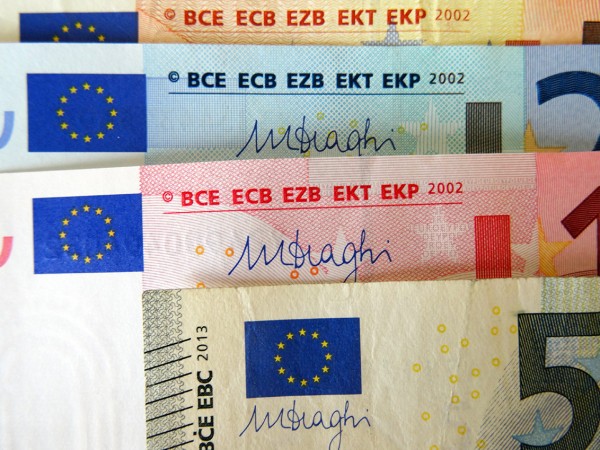 Mario Draghi, the ECB President, has indicated that the ECB is prepared to engage in further monetary stimulus. This is because of continuing weaknesses in the global economy and in particular in emerging markets.
Although the ECB at its meeting in Malta on 22 October decided to keep both interest rates and asset purchases (€60 billion per month) at current levels, Mario Draghi stated at the press conference that, at its next meeting on December 3rd, the ECB would be prepared to cut interest rates and re-examine the size, composition and duration of its quantitative easing programme. He stopped short, however, of saying that interest rates would definitely be cut or quantitative easing definitely increased. He said the following:
“The Governing Council has been closely monitoring incoming information since our meeting in early September. While euro area domestic demand remains resilient, concerns over growth prospects in emerging markets and possible repercussions for the economy from developments in financial and commodity markets continue to signal downside risks to the outlook for growth and inflation. Most notably, the strength and persistence of the factors that are currently  slowing the return of inflation to levels below, but close to, 2% in the medium term require thorough analysis.
In this context, the degree of monetary policy accommodation will need to be re-examined at our December monetary policy meeting, when the new Eurosystem staff macroeconomic projections will be available. The Governing Council is willing and able to act by using all the instruments available within its mandate if warranted in order to maintain an appropriate degree of monetary accommodation.”
Mario Draghi also argued that monetary policy should be supported by fiscal policy and structural policies (mirroring Japan’s three arrows). Structural policies should include actions to improve the business environment, including the provision of an adequate public infrastructure. This is vital to “increase productive investment, boost job creation and raise productivity”.
As far as fiscal policies are concerned, these “should support the economic recovery, while remaining in compliance with the EU’s fiscal rules”. In other words, fiscal policy should be expansionary, while staying within the limits set by the Stability and Growth Pact.
His words had immediate effects in markets. Eurozone government bond yields dropped to record lows and the euro depreciated 3% against the US dollar over the following 24 hours.
Webcasts
ECB Press Conference on YouTube, Mario Draghi (22/10/15)
Draghi reloads bazooka FT Markets, Ferdinando Guigliano (22/10/15)
Articles
Mario Draghi: ECB prepared to cut interest rates and expand QE The Guardian, Heather Stewart (22/10/15)
Draghi signals ECB ready to extend QE Financial Times, Claire Jones and Elaine Moore (22/10/15)
Dovish Mario Draghi sends bond yields to new lows Financial Times, Katie Martin (23/10/15)
What Draghi Said on QE, Policy Outlook, Global Risks and Inflation Bloomberg, Deborah Hyde (22/10/15)
ECB set to ‘re-examine’ stimulus policy at next meeting BBC News (22/10/15)
The global economy warrants a big dose of caution The Guardian, Larry Elliott (25/10/15)
ECB Press Conference
Introductory statement to the press conference (with Q&A) ECB, Mario Draghi (President of the ECB), Vítor Constâncio (Vice-President of the ECB) (22/10/15)
Questions
- Why is the ECB considering further expansionary monetary policy?
- What monetary measures can a central bank use to stimulate aggregate demand?
- Explain the effects of Mario Draghi’s announcement on bond and foreign exchange markets.
- What are the objectives of ECB monetary policy according to the its mandate?
- Should the ECB consider using quantitative easing to provide direct funding for infrastructure projects?
- What constraints does the EU’s Stability and Growth Pact impose on eurozone countries?
- What are the arguments for and against (a) the Bank of England and (b) the US Federal Reserve engaging in further QE?
- If the ECB does engage in an expanded QE programme, what will determine its effectiveness?
If you asked virtually any banker or economist a few years ago whether negative (nominal) interest rates were possible, the answer would almost certainly be no.
Negative real interest rates have been common at many points in time – whenever the rate of inflation exceeds the nominal rate of interest. People’s debts and savings are eroded by inflation as the interest due or earned does not keep pace with rising prices.
But negative nominal rates? Surely this could never happen? It was generally believed that zero (or slightly above zero) nominal rates represented a floor – ‘a zero lower bound’.
The reasoning was that if there were negative nominal rates on borrowing, you would effectively be paid by the bank to borrow.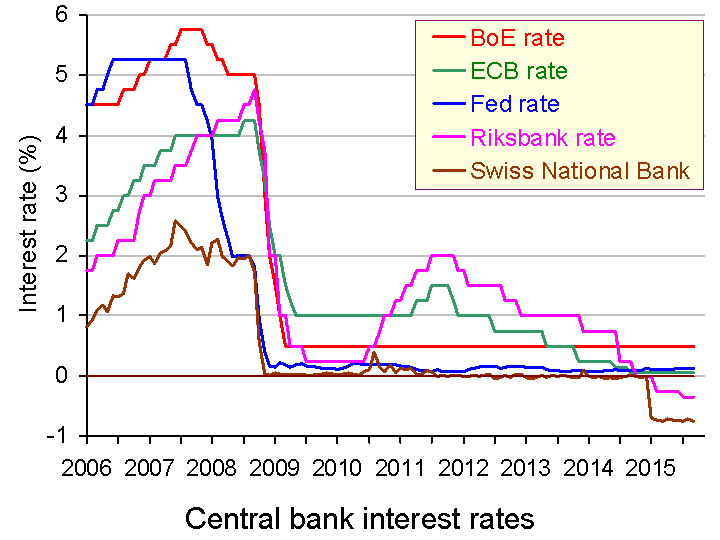 In such a case, you might as well borrow as much as you can, as you would owe less later and could pocket the difference.
A similar argument was used with savings. If nominal rates were negative, savers might as well withdraw all their savings from bank accounts and hold them as cash (perhaps needing first to buy a safe!) Given, however, that this might be inconvenient and potentially costly, some people may be prepared to pay banks for looking after their savings.
Central bank interest rates have been hovering just above zero since the financial crisis of 2008. And now, some of the rates have turned negative (see chart above). The ECB has three official rates:
|
|
| • |
The interest rate on the main refinancing operations (MRO), which provide the bulk of liquidity to the banking system. |
| • |
The rate on the deposit facility, which banks may use to make overnight deposits with the Eurosystem. |
| • |
The rate on the marginal lending facility, which offers overnight credit to banks from the Eurosystem. |
The first of these is the most important rate and remains above zero – just. Since September 2014, it has been 0.05%. This rate is equivalent to the Bank of England’s Bank Rate (currently still 0.5%) and the Fed’s Federal Funds Rate (currently still between 0% and 0.25%).
The third of the ECB’s rates is currently 0.3%, but the second – the rate on overnight deposits in the ECB by banks in the eurozone – is currently –0.2%.  In other words, banks have to pay the ECB for making these overnight deposits (deposits that can be continuously rolled over). The idea has been to encourage banks to lend rather than simply keeping unused liquidity.
In Nordic countries, the experiment with negative rates has gone further. With plenty of slack in the Swedish economy, negative inflation and an appreciating krona, the Swedish central bank – the Riksbank – cut its rates below zero.
Many City analysts believe that the Riksbank will continue cutting, reducing its key interest rate to minus 0.5% by the end of the year [it is currently 0.35%]. Switzerland’s is already deeper still, at minus 0.75%, while Denmark and the eurozone have joined them as members of the negative zone.
But the nominal interest rate on holding cash is, by definition, zero. If deposit rates are pushed below zero, then will more and more people hold cash instead?  The hope is that negative nominal interest rates on bank accounts will encourage people to spend. It might, however, merely encourage them to hoard cash.
The article below from The Telegraph looks at some of the implications of an era of negative rates. The demand for holding cash has been increasing in many countries and, along with it, the supply of banknotes, as the chart in the article shows. Here negative interest are less effective. In Nordic countries, however, the use of cash is virtually disappearing. Here negative interest rates are likely to be more effective in boosting aggregate demand.
Article
How Sweden’s negative interest rates experiment has turned economics on its head The Telegraph, Peter Spence (27/9/15)
Data
Central bank and monetary authority websites Bank for International Settlements
Central banks – summary of current interest rates global-rates.com
Questions
- Distinguish between negative real and negative nominal interest rates.
- What is the opportunity cost of holding cash – the real or the nominal interest rate forgone by not holding it in a bank?
- Are there any dangers of central banks setting negative interest rates?
- Why may negative interest rates be more effective in Sweden than in the UK?
- ‘Andy Haldane, a member of the Monetary Policy Committee (MPC) … suggested that to achieve properly negative rates, the abolition of cash itself might be necessary.’ Why?
- Why does Switzerland have notes of SF1000 and the eurozone of €500? Should the UK have notes of £100 or even £500?
- Why do some banks charge zero interest rates on credit cards for a period of time to people who transfer their balances from another card? Is there any incentive for banks to cut interest rates on credit cards below zero?
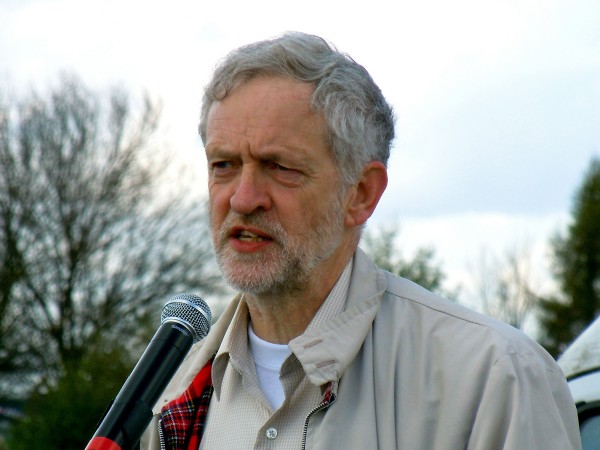 Jeremy Corbyn, the newly elected leader of the Labour Party, is proposing a number of radical economic policies. One that has attracted considerable attention is for a new form of QE, which has been dubbed ‘people’s quantitative easing’.
This would involve newly created money by the Bank of England being directly used to fund spending on large-scale housing, energy, transport and digital projects. Rather than the new money being used to purchase assets, as has been the case up to now, with the effect filtering only indirectly into aggregate demand and even more indirectly into aggregate supply, under the proposed scheme, both aggregate demand and aggregate supply would be directly boosted.
Although ‘conventional’ QE has worked to some extent, the effects have been uneven. Asset holders and those with large debts, such as mortgages, have made large gains from higher asset prices and lower interest rates. By contrast, savers in bank and building society accounts have seen the income from their savings decline dramatically. What is more, the indirect nature of the effects has meant time lags and uncertainty over the magnitude of the effects.
But despite the obvious attractiveness of the proposals, they have attracted considerable criticism. Some of these are from a political perspective, with commentators from the right arguing against an expansion of the state. Other criticisms focus on the operation and magnitude of the proposals
 One is that it would change the relationship between the Bank of England and the government. If the Bank of England created money to fund government projects, that would reduce or even eliminate the independence of the Bank. Independence has generally been seen as desirable to prevent manipulation of the central bank by the government for short-term political gain. Those in favour of people’s QE argue that the money would be directed into a National Investment Bank, which would then make the investment allocation decisions. The central bank would still be independent in deciding the amount of QE.
This leads to the second criticism and that is about whether further QE is necessary at the current time. Critics argue that while QE of whatever type was justified when the economy was in recession and struggling to recover, now would be the wrong time for further stimulus. Indeed, it could be highly inflationary. The economy is currently expanding. If banks respond by increasing credit, the velocity of circulation of narrow money could rise and broad money supply grow, providing enough money to underpin a growing economy.
Many advocates of people’s QE accept this second point and see it as a contingency plan in case the economy fails to recover and further monetary stimulus is deemed necessary. If further QE is not felt necessary by the Bank of England, then the National Investment Bank could fund investment through conventional borrowing.
The following articles examine people’s QE and look at its merits and dangers. Given the proposal’s political context, several of the articles approach the issue from a very specific political perspective. Try to separate the economic analysis in the articles from their political bias.
Jeremy Corbyn’s proposal
The Economy in 2020 Jeremy Corbyn (22/7/15)
Articles
People’s quantitative easing — no magic Financial Times, Chris Giles (13/8/15)
How Green Infrastructure Quantitative Easing would work Tax Research UK, Richard Murphy (12/3/15)
What is QE for the people? Money Week, Simon Wilson (22/8/15)
QE or not QE? A slippery slope to breaking the Bank EconomicsUK.com, David Smith (23/8/15)
We don’t need “People’s QE”, basic economic literacy is enough Red Box, Jonathan Portes (13/8/15)
Is Jeremy Corbyn’s policy of ‘quantitative easing for people’ feasible? The Guardian, Larry Elliott (14/8/15)
Corbynomics: Quantitative Easing for People (PQE) Huffington Post, Adnan Al-Daini (7/9/15)
Corbyn’s “People’s QE” could actually be a decent idea FT Alphaville, Matthew C. Klein (6/8/15)
Jeremy Corbyn’s ‘People’s QE’ would force Britain into three-year battle with the EU The Telegraph, Peter Spence (15/8/15)
Would Corbyn’s ‘QE for people’ float or sink Britain? BBC News, Robert Peston (12/8/15)
Strategic Quantitative Easing – public money for public benefit New Economics Foundation blog, Josh Ryan-Collins (12/8/15)
People’s QE and Corbyn’s QE Mainly Macro blog, Simon Wren-Lewis
You can print money, so long as it’s not for the people The Guardian, Zoe Williams (4/10/15)
Questions
- What is meant by ‘helicopter money’? How does it differ from quantitative easing as practised up to now?
- Is people’s QE the same as helicopter money?
- Can people’s QE take place alongside an independent Bank of England?
- What is meant by the velocity of circulation of money? What happened to the velocity of circulation following the financial crisis?
- How does conventional QE feed through into aggregate demand?
- Under what circumstances would people’s QE be inflationary?
 First the IMF in its World Economic Outlook, then the European Commission in its Economic Forecasts (see also) and now the OECD in its Economic Outlook (see also) – all three organisations in the latest issues of their 6-monthly publications are predicting slower global economic growth than they did 6 months previously. This applies both to the current year and to 2016. The OECD’s forecast for global growth this year is now 2.9%, down from the 3.7% it was forecasting a year ago. Its latest growth forecast for 2016 is 3.3%, down from the 3.9% it was forecasting a year ago.
 On this third point, the OECD Economic Outlook argues that ‘the rationale for such investments is that they could help to push economies onto a higher growth path than might otherwise be the case, at a time when private investment growth remains modest.’