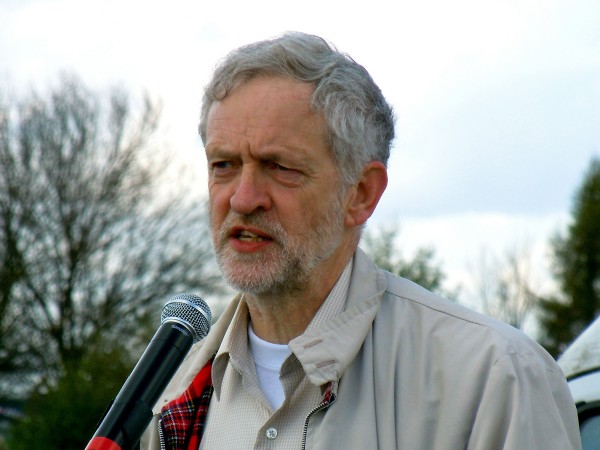
 Jeremy Corbyn, the newly elected leader of the Labour Party, is proposing a number of radical economic policies. One that has attracted considerable attention is for a new form of QE, which has been dubbed ‘people’s quantitative easing’.
This would involve newly created money by the Bank of England being directly used to fund spending on large-scale housing, energy, transport and digital projects. Rather than the new money being used to purchase assets, as has been the case up to now, with the effect filtering only indirectly into aggregate demand and even more indirectly into aggregate supply, under the proposed scheme, both aggregate demand and aggregate supply would be directly boosted.
Although ‘conventional’ QE has worked to some extent, the effects have been uneven. Asset holders and those with large debts, such as mortgages, have made large gains from higher asset prices and lower interest rates. By contrast, savers in bank and building society accounts have seen the income from their savings decline dramatically. What is more, the indirect nature of the effects has meant time lags and uncertainty over the magnitude of the effects.
But despite the obvious attractiveness of the proposals, they have attracted considerable criticism. Some of these are from a political perspective, with commentators from the right arguing against an expansion of the state. Other criticisms focus on the operation and magnitude of the proposals
 One is that it would change the relationship between the Bank of England and the government. If the Bank of England created money to fund government projects, that would reduce or even eliminate the independence of the Bank. Independence has generally been seen as desirable to prevent manipulation of the central bank by the government for short-term political gain. Those in favour of people’s QE argue that the money would be directed into a National Investment Bank, which would then make the investment allocation decisions. The central bank would still be independent in deciding the amount of QE.
This leads to the second criticism and that is about whether further QE is necessary at the current time. Critics argue that while QE of whatever type was justified when the economy was in recession and struggling to recover, now would be the wrong time for further stimulus. Indeed, it could be highly inflationary. The economy is currently expanding. If banks respond by increasing credit, the velocity of circulation of narrow money could rise and broad money supply grow, providing enough money to underpin a growing economy.
Many advocates of people’s QE accept this second point and see it as a contingency plan in case the economy fails to recover and further monetary stimulus is deemed necessary. If further QE is not felt necessary by the Bank of England, then the National Investment Bank could fund investment through conventional borrowing.
The following articles examine people’s QE and look at its merits and dangers. Given the proposal’s political context, several of the articles approach the issue from a very specific political perspective. Try to separate the economic analysis in the articles from their political bias.
Jeremy Corbyn’s proposal
The Economy in 2020 Jeremy Corbyn (22/7/15)
Articles
People’s quantitative easing — no magic Financial Times, Chris Giles (13/8/15)
How Green Infrastructure Quantitative Easing would work Tax Research UK, Richard Murphy (12/3/15)
What is QE for the people? Money Week, Simon Wilson (22/8/15)
QE or not QE? A slippery slope to breaking the Bank EconomicsUK.com, David Smith (23/8/15)
We don’t need “People’s QE”, basic economic literacy is enough Red Box, Jonathan Portes (13/8/15)
Is Jeremy Corbyn’s policy of ‘quantitative easing for people’ feasible? The Guardian, Larry Elliott (14/8/15)
Corbynomics: Quantitative Easing for People (PQE) Huffington Post, Adnan Al-Daini (7/9/15)
Corbyn’s “People’s QE” could actually be a decent idea FT Alphaville, Matthew C. Klein (6/8/15)
Jeremy Corbyn’s ‘People’s QE’ would force Britain into three-year battle with the EU The Telegraph, Peter Spence (15/8/15)
Would Corbyn’s ‘QE for people’ float or sink Britain? BBC News, Robert Peston (12/8/15)
Strategic Quantitative Easing – public money for public benefit New Economics Foundation blog, Josh Ryan-Collins (12/8/15)
People’s QE and Corbyn’s QE Mainly Macro blog, Simon Wren-Lewis
You can print money, so long as it’s not for the people The Guardian, Zoe Williams (4/10/15)
Questions
- What is meant by ‘helicopter money’? How does it differ from quantitative easing as practised up to now?
- Is people’s QE the same as helicopter money?
- Can people’s QE take place alongside an independent Bank of England?
- What is meant by the velocity of circulation of money? What happened to the velocity of circulation following the financial crisis?
- How does conventional QE feed through into aggregate demand?
- Under what circumstances would people’s QE be inflationary?
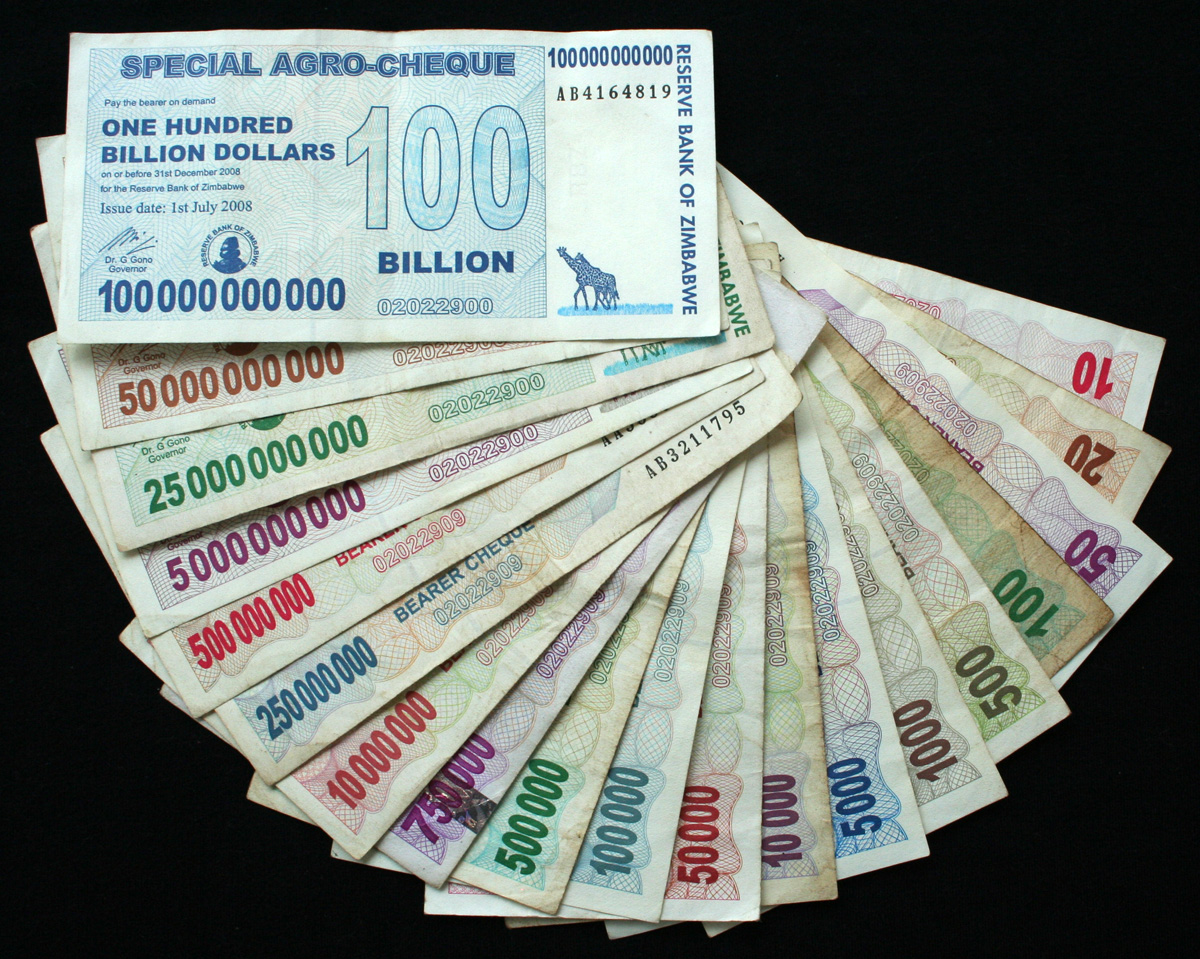
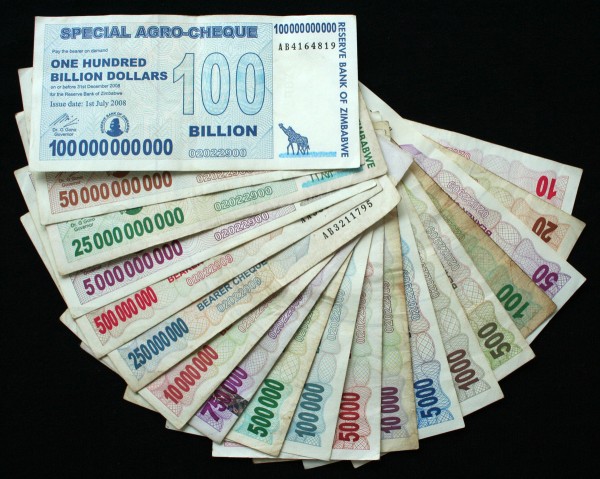 In the late 2000s, Zimbabwe experienced hyperinflation. As a post on this site in January 2009 said, two estimates of the inflation rate were made: one of 5 sextillion per cent (5 and 21 zeros); the other of 6.5 quindecillion novemdecillion per cent (65 and 107 zeros). In January 2009, in a last attempt to save the Zimbabwean currency, a new series of banknotes was issued, including a Z$100 trillion note.
Prices were typically being adjusted at least twice a day and people had to carry large bags of money around even to buy a couple of simple items. The currency was virtually worthless. As the Guardian article below states:
Hyperinflation in Zimbabwe left pensions, wages and investments worthless and spread poverty as everyday items became unaffordable. It also caused severe cash shortages, because the government could not afford to print bank notes to keep pace with inflation.
The solution was to allow other currencies, mainly the US dollar and the South African rand, to be used alongside the local currency. Although the Zimbabwean currency was still legal tender, it effectively went out of use. Prices stabilised and since then inflation has been in single figures.
 But many people still have stocks of the virtually worthless old currency, either in cash or in savings accounts. The Zimbabwean government has now said that it will exchange Zimbabwean dollar notes for US dollars at the rate of US$1 = Z$250tn (250,000,000,000). People have until September to do so. Up to now, they have mainly been used to sell as souvenirs to tourists! For people with Zimbabwean dollars in their bank accounts, they will get a minimum of US$5. For amounts beyond Z$175,000tn they will get an additional US dollar for each Z$35,000tn.
Historical examples of hyperinflation
As case study 15.5 in Economics 9e’s MyEconLab points out, several countries experienced hyperinflation after the First World War. In Austria and Hungary prices were several thousand times their pre-war level. In Poland they were over 2 million times higher, and in the USSR several billion times higher.
Germany in the 1920s
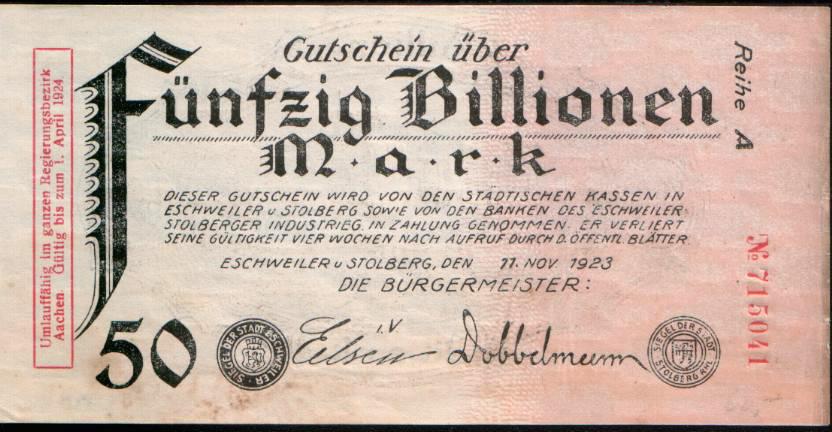
But even these staggering rates of inflation seem insignificant beside those of Germany. Following the chaos of the war, the German government resorted to printing money, not only to meet its domestic spending requirements in rebuilding a war-ravaged economy, but also to finance the crippling war reparations imposed on it by the allies in the Treaty of Versailles.
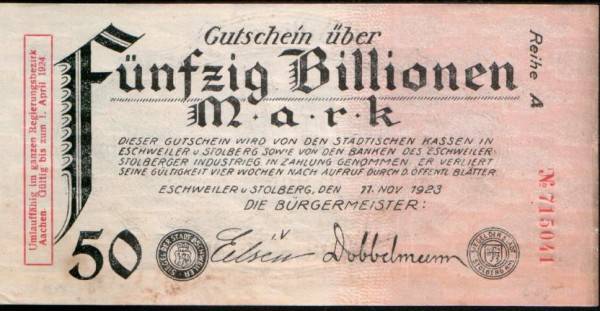 From mid 1921 the rate of monetary increase soared and inflation soared with it. By autumn 1923 the annual rate of inflation had reached a mind-boggling 7,000,000,000,000 per cent! As price increases accelerated, people became reluctant to accept money: before they knew it, the money would be worthless. People thus rushed to spend their money as quickly as possible. But this in turn further drove up prices. (The note shown above is in old billions, where a billion was a million million. So the note was for 50,000,000,000,000 marks.)
For many Germans the effect was devastating. People’s life savings were wiped out. Others whose wages were not quickly adjusted found their real incomes plummeting. Many were thrown out of work as businesses, especially those with money assets, went bankrupt. Poverty and destitution were widespread.
By the end of 1923 the German currency was literally worthless. In 1924, therefore, it was replaced by a new currency – one whose supply was kept tightly controlled by the government.
Serbia and Montenegro 1993–5
After the break-up of Yugoslavia in 1992, the economy of the remaining part of Yugoslavia (Serbia and Montenegro) collapsed. The government relied more and more on printing money to finance public expenditure. Prices soared.
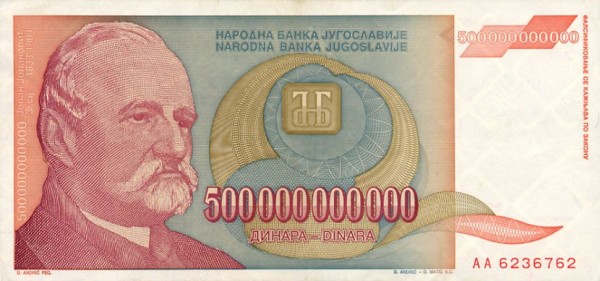 The government attempted to control the inflation by imposing price controls. But these simply made production unprofitable and output fell further. The economy nosedived. Unemployment exceeded 30 per cent.
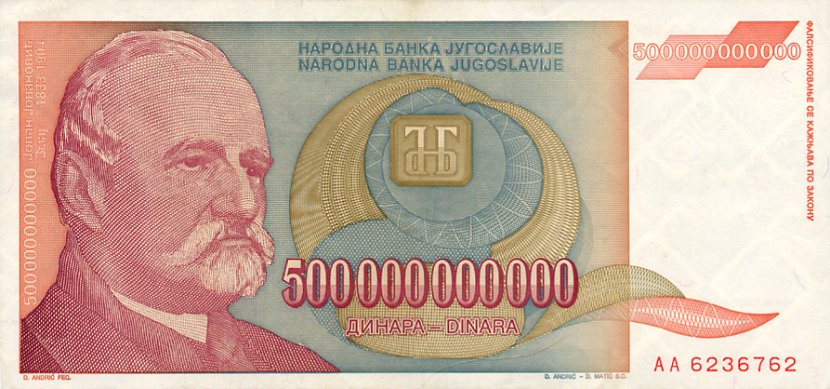
In October 1993, the government created a new currency, the new dinar, worth one million old dinars. In other words, six zeros were knocked off the currency. But this did not solve the problem. Between October 1993 and January 1994, prices rose by 5 quadrillion per cent (5 and fifteen zeros). Normal life could not function. Shops ran out of produce; savings were wiped out; barter replaced normal market activity.
At the beginning of January 1994 a ‘new new dinar’ was introduced, worth 1 billion new dinars. On 24 January this was replaced by a ‘novi dinar’ pegged 1 to 1 against the Deutsche Mark. This was worth approximately 13 million new new dinars. The novi dinar remained pegged to the Deutsche Mark and inflation was quickly eliminated.
Articles
Zimbabweans get chance to swap ‘quadrillions’ for a few US dollars The Guardian (13/6/15)
 175 Quadrillion Zimbabwean Dollars Are Now Worth $5 Bloomberg, Godfrey Marawanyika and Paul Wallace (11/6/15)
Zimbabwe is paying people $5 for 175 quadrillion Zimbabwe dollars Washington Post, Matt O’Brien (12/6/15)
Zimbabwe dollars phased out BBC News Africa (12/6/15)
Zimbabwe ditches its all but worthless currency Financial Times (12/6/15)
Zeroing in Thomson Reuters, Breaking News, Edward Hadas (12/6/15)
Old articles
Could inflation fell Mugabe? BBC News (28/7/08)
ZIMBABWE: Inflation at 6.5 quindecillion novemdecillion percent IRIN (21/1/09)
The Worst Episode of Hyperinflation in History: Yugoslavia 1993-94 Roger Sherman Society, Thayer Watkins (31/7/08)
Questions
- Why have several governments in the past been prepared to allow hyperinflation to develop?
- Itemise the types of cost imposed on people by hyperinflation.
- Does anyone gain from hyperinflation?
- What are the solutions to hyperinflation?
- What difficulties are there in eliminating hyperinflation? What costs are imposed on people in the process?
- Why might the causes of hyperinflation be described as always political?
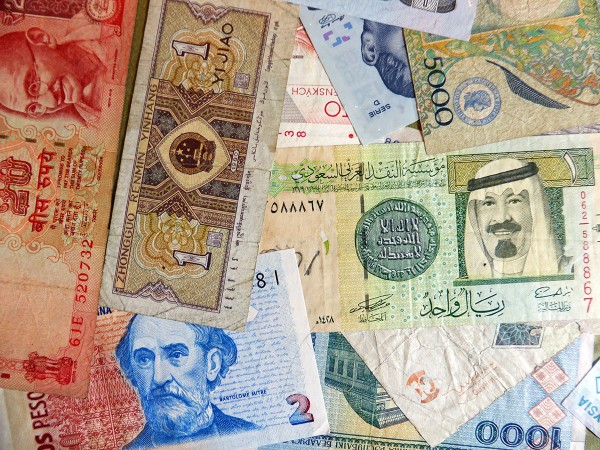 ‘The world is sinking under a sea of debt, private as well as public, and it is increasingly hard to see how this might end, except in some form of mass default.’ So claims the article below by Jeremy Warner. But just how much has debt grown, both public and private? And is it of concern?
The doomsday scenario is that we are heading for another financial crisis as over leveraged banks and governments could not cope with a collapse in confidence. Bank and bond interest rates would soar and debts would be hard to finance. The world could head back into recession as credit became harder and more expensive to obtain. Perhaps, in such a scenario, there would be mass default, by banks and governments alike. This could result in a plunge back into recession.
The more optimistic scenario is that private-sector debt is under control and in many countries is falling (see, for example, chart 1 in the blog Looking once again through Minsky eyes at UK credit numbers for the case of the UK). Even though private-sector debt could rise again as the world economy grows, it would be affordable provided that interest rates remain low and banks continue to build the requisite capital buffers under the Basel III banking regulations.
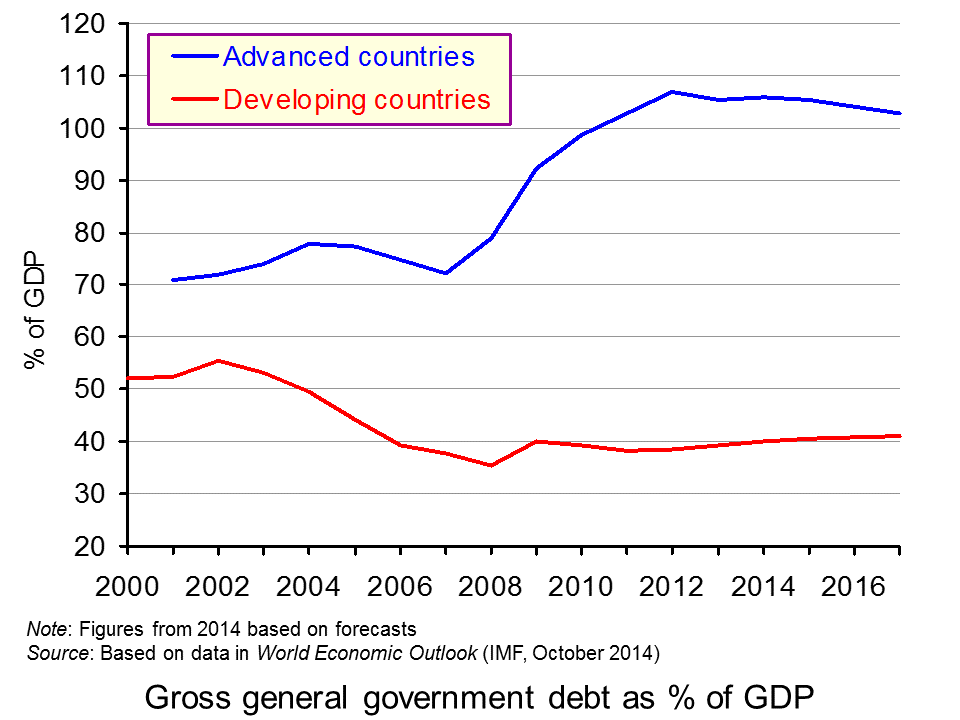 As far as public-sector debt is concerned, as a percentage of GDP its growth has begun to decline in advanced countries as a whole and, although gently rising in developing and emerging economies as a whole, is relatively low compared with advanced countries (see chart). Of course, there are some countries that still face much larger debts, but in most cases they are manageable and governments have plans to curb them, or at least their growth.
But there have been several warnings from various economists and institutes, as we saw in the blog post, Has the problem of excess global debt been tackled? Not according to latest figures. The question is whether countries can grow their way out of the problem, with a rapidly rising denominator in the debt/GDP ratios.
Only mass default will end the world’s addiction to debt The Telegraph, Jeremy Warner (3/3/15)
Questions
- What would be the impact of several countries defaulting on debt?
- What factors determine the likelihood of sovereign defaults?
- What factors determine the likelihood of bank defaults?
- What is meant by ‘leverage’ in the context of (a) banks; (b) nations?
- What are the Basel III regulations? What impact will they have/are they having on bank leverage?
- Expand on the arguments supporting the doomsday scenario above.
- Expand on the arguments supporting the optimistic scenario above.
- What is the relationship between economic growth and debt?
- Explain how the explosion in global credit might merely be ‘the mirror image of rising output, asset prices and wealth’.
- Is domestic inflation a good answer for a country to the problems of rising debt denominated (a) in the domestic currency; (b) in foreign currencies?
In recent times the notion that the financial sytem can be destabilising seems blindingly obvious. And, yet, for some time macroeconomic models of the economy tended to regard the financial system as benevolent. It served our interests. We were the masters; it was our servant. Now of course we accept that credit cycles can be destabilising. Policymakers, especially central banks, follow keenly the latest private-sector credit data. Here we look back at previous patterns in private-sector debt and crucially at what patterns are currently emerging.
First a bit of theory. The idea of credit cycles is not new. But the financial crisis of the late 2000s has helped to reignite analysis and interest. Economists are trying to gain a better understanding of the relationship between flows of credit and the state of the economy and, in particular, why might flows increase as the level of real GDP rises – why might they be endogenous variables in models of the determination of GDP. One possibility is the financial accelerator. This is the idea that as real GDP rises banks perceive lending to be less risky. After all, real incomes will tend to rise and collateral values (against which borrowing can be secured) are likely to be rising too.
Another possibility is growing exuberance as the economy grows. This has gained in popularity as an idea, with economists revisiting the work of Hyman Minsky (1919–96), an American economist. Here success breeds failure as the balance sheets of people and businesses deteriorate as they become increasingly burdened with debt. The balance sheets are said to be congested leading to a point when a deleveraging starts. A balance sheet recession then follows.
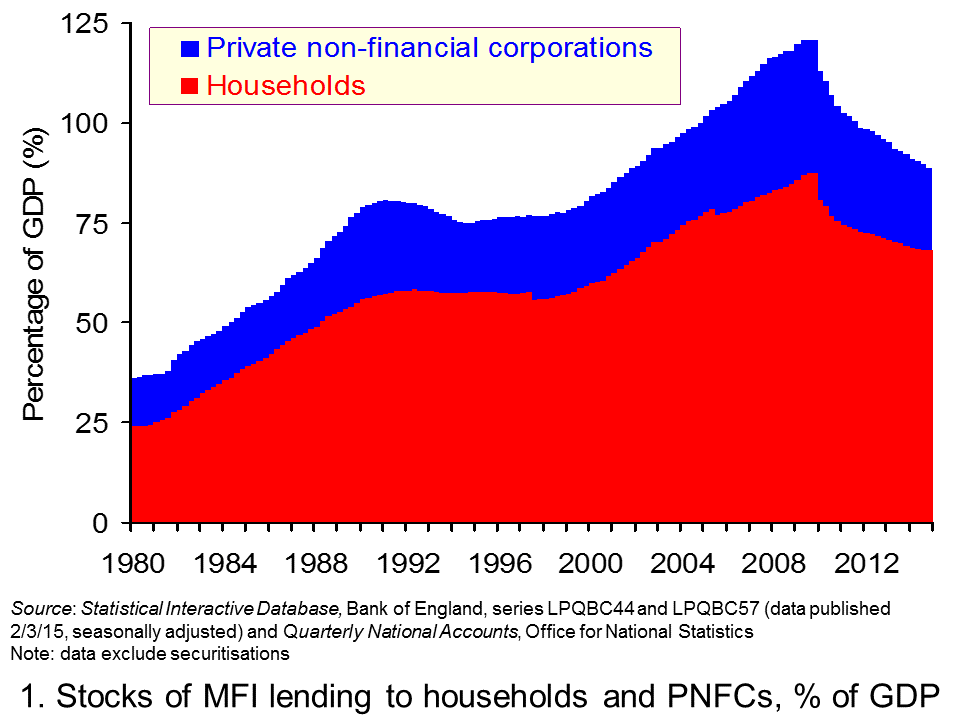 Now for the data. Consider first the stocks of debt acquired by households and private non-financial corporations from MFIs (Monetary Financial Institutions). The first chart shows debt stocks as a percentage of GDP. It illustrates nicely the phenomenon of financialisation. In essence, this is the increasing importance of MFIs to the economy. At the end of 2014, these two sectors had debt stocks outstanding equivalent to 90 per cent of GDP. In fact, this is down from a peak of 129 per cent in September 2009. (Click here for a PowerPoint of the chart.)
The growth in debt, especially in the 1990s and for much of the 2000s, was through financial innovation. In particular, the bundling of assets, such as mortgages, to form financial instruments which could then be purchased by investors helped to provide financial institutions with further funds for lending. This is the process of securitisation. Some argue that this was part of a super-cycle which works alongside the normal credit cycle, albeit over a much lengthier period. It can be argued that these cycles coincided during the 1990s and for much of the 2000s until financial distress hit. The distress was hastened by central banks raising interest rates to dampen the rising rate of inflation, partly attributable to rising global commodity prices, including oil.
Some refer to 2008 as a Minsky moment. Overstretched balance sheets needed repairing. But, the collective act of repair actually caused financial well-being to worsen as asset prices and aggregate demand fell.
The global response to the events of the financial crisis has been for policy-makers to pay more attention to the aggregate level of credit provision. The Bank of England’s Financial Policy Committee (FPC) has responsibility for monitoring and helping to ensure the soundness of the UK financial system.
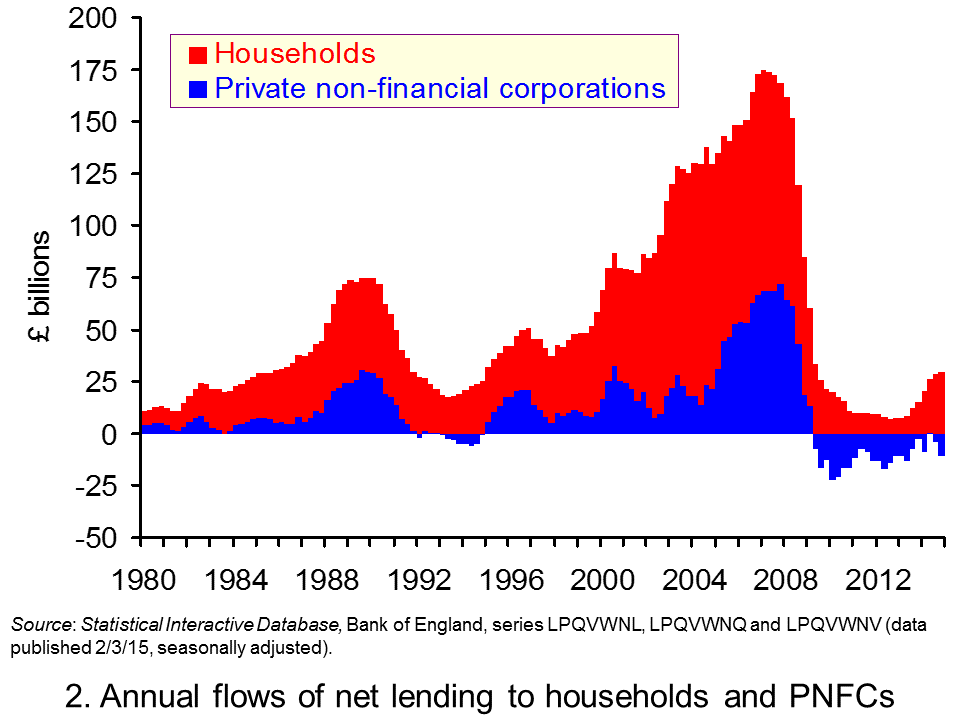 Undoubtedly, the FPC will have constructed a chart similar to our second chart. (Click here for a PowerPoint of the chart). This chart suggests some caution: the need for casting a ‘Minsky eye’ on lending patterns. Over 2014, the UK household sector undertook net lending (i.e. after deducting repayments) of £30 billion. While nothing like the £100 billion or so in 2007, this does mark something of a step up. Indeed it is almost exactly double the flow in 2013. In the months ahead we will continue to monitor the credit data. You can bet that the FPC will do too!
Articles
Comment: Household debt threatens return to spending Herald Scotland, Bill Jamieson (2/3/15)
Household debt rising at fastest rate for 10yrs moneyfacts.co.uk (10/2/15)
Housing starting to rally after home loan approvals rise in January London Evening Standard, Ben Chu (2/3/15)
Data
Bankstats (Monetary and Financial Statistics) – Latest Tables Bank of England
Statistical Interactive Database Bank of England
Questions
- What is meant by the term the business cycle?
- What does it mean for the determinants of the business cycle to be endogenous? What about if they are exogenous?
- Outline the ways in which the financial system can impact on the spending behaviour of households. Repeat the exercise for businesses.
- How might uncertainty affect spending and saving by households and businesses?
- What does it mean if bank lending is pro-cyclical?
- Why might lending be pro-cyclical?
- How might the differential between borrowing and saving interest rates vary over the business cycle?
- Explain what you understand by net lending to households or firms. How does net lending affect their stock of debt?
 The eurozone is certainly in trouble and, despite the efforts of world leaders to create confidence, it appears that most announcements are having the opposite effect. The risk of deflation has now emerged to be very true; the powerhouse of Europe ‘needs to do more’ and the euro has fallen following Mario Draghi’s recent comments. So, just how bad are things in the eurozone?
Mario Draghi suggested that as a means of stimulating the eurozone economies, a process of quantitative easing may soon need to begin. However, rather than reassuring investors that action was being taken to improve the economic performance in the region, it appears to have had the opposite effect. Following his comments, the euro fell to its lowest level since the middle of 2010.
Quantitative easing has seen much use in the aftermath of the financial crisis and the aim in the eurozone would be to put a stop to the continuing price decreases. The eurozone has now entered deflation and, while the aim of this economic area has always been low prices, deflation is not good news. The downward pressure on prices has been largely driven by oil prices falling and prices in other areas remaining relatively stable.
Quantitative easing would inject money into the eurozone, thus creating growth (or at least that’s the idea) and pushing up prices. One of Mario Draghi’s comments was:
‘We are making technical preparations to alter the size, pace and composition of our measures in early 2015.’
 So, while it’s not certain that the QE policy will be used, it seems pretty likely, especially as this policy has been floating around for almost a year.
A key question is, will it work? The quantity theory of money does suggest that an increase in the money supply will lead to inflationary pressures, unless its velocity of circulation falls. But will it actually stimulate aggregate demand and economic growth? If there is more money in the banking system and hence more money available for lending then it may well stimulate investment and consumption. However, if consumers and firms are not confident about the effectiveness of the policy or about the future of the economy, then will the fact that more money is available for lending actually encourage them to borrow? In this case will there merely be a fall in the velocity of circulation?
The comments by Mario Draghi have also caused the euro to fall to its lowest level since 2010. The graph included in the CNBC article provides an interesting view of the path of the euro. Marc Chandler, from Brown Brothers Harriman said:
‘I’d say there’s a good chance it [the euro] gets there [parity with the dollar] before the election next November (2016) … We know the Fed’s going to be raising rates sooner or later, and the ECB is going to be easing sooner or later. I just see a steady grind lower.’
The outlook of the euro therefore doesn’t look too good by all accounts. It is now a waiting game to see if the policy of quantitative easing is implemented and whether or not it has the desired effect. The following articles consider this topic.
Eurozone economy slows further BBC News (6/1/15)
Eurozone falls into deflation for first time since October 2009 Financial Times, Claire Jones (7/1/15)
Eurozone officially falls into deflation, piling pressure on ECB The Telegraph, Marion Dakers (7/1/15)
Eurozone consumer prices fall for first time in five years Nasdaq, Brian Blackstone and Paul Hannon (7/1/15)
Draghi comments send euro to lowest level since 2010 BBC News (2/1/15)
Oil slump drags Eurozone into deflation The Guardian, Graeme Wearden (7/1/15)
Eurozone prices fall more than expected in December Reuters (7/1/15)
Eurozone lurches into deflation after oil price crashes Independent, Russell Lynch (7/1/15)
German inflation hits five-year low as Eurozone prepares for QE The Telegraph, Mehreen Khan (5/1/15)
Euro slide could take it to parity with dollar CNBC, Patti Domm (7/1/15)
Questions
- Why is deflation a cause for concern when normally the main problem is inflation that is too high?
- What is the quantity theory of money and how does it suggest an increase in the money supply will affect prices?
- If quantitative easing is implemented, is it likely to have the desired effect? Explain why or why not.
- Why has the euro been affected by Mario Draghi’s comments? Use a diagram to help your explanation.
- How will quantitative easing help to stimulate economic growth across the Eurozone? Are there any other policies that would be effective?
- Oil prices have had a big influence on the deflationary pressures in the Eurozone. If oil prices increased again, would this be sufficient to create inflation?
 One is that it would change the relationship between the Bank of England and the government. If the Bank of England created money to fund government projects, that would reduce or even eliminate the independence of the Bank. Independence has generally been seen as desirable to prevent manipulation of the central bank by the government for short-term political gain. Those in favour of people’s QE argue that the money would be directed into a National Investment Bank, which would then make the investment allocation decisions. The central bank would still be independent in deciding the amount of QE.