 The coronavirus pandemic and the climate emergency have highlighted the weaknesses of free-market capitalism.
Governments around the world have intervened massively to provide economic support to people and businesses affected by the pandemic through grants and furlough schemes. They have also stressed the importance of collective responsibility in abiding by lockdowns, social distancing and receiving vaccinations.
The pandemic has also highlighted the huge inequalities around the world. The rich countries have been able to offer much more support to their people than poor countries and they have had much greater access to vaccines. Inequality has also been growing within many countries as rich people have gained from rising asset prices, while many people find themselves stuck in low-paid jobs, suffering from poor educational opportunities and low economic and social mobility.
The increased use of working from home and online shopping has accelerated the rise of big tech companies, such as Amazon and Google. Their command of the market makes it difficult for small companies to compete – and competition is vital if capitalism is to benefit societies. There have been growing calls for increased regulation of powerful companies and measures to stimulate competition. The problem has been recognised by governments, central banks and international agencies, such as the IMF and the OECD.
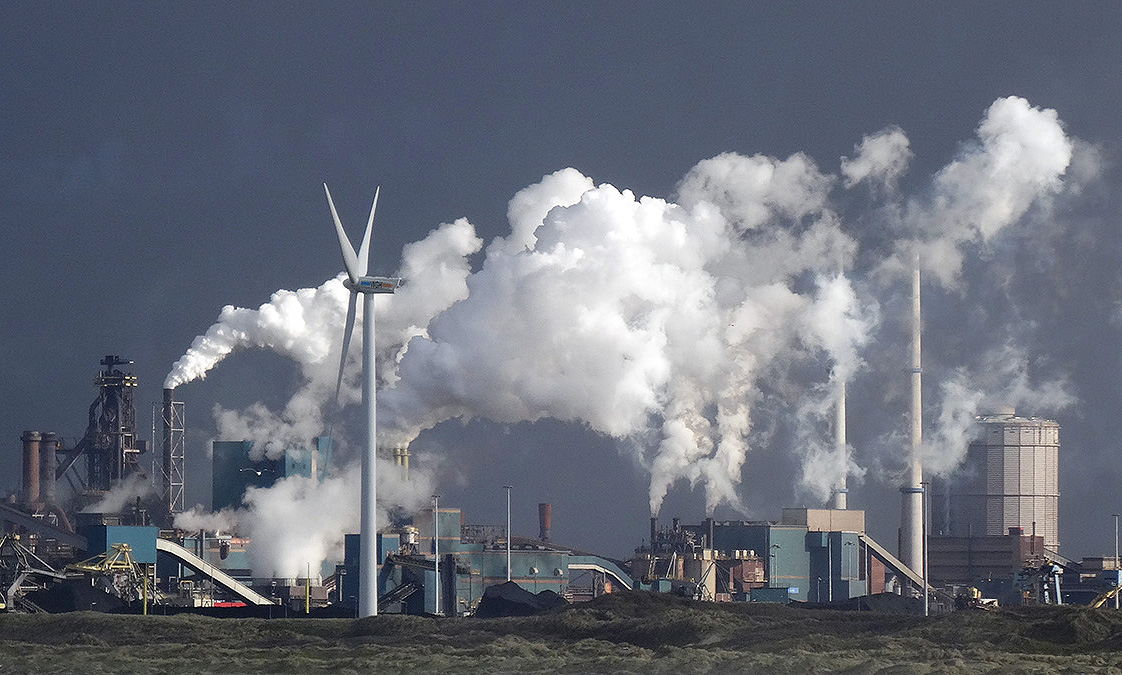 At the same time as the world has been grappling with the pandemic, global warming has contributed to extreme heat and wildfires in various parts of the world, such as western North America, the eastern Mediterranean and Siberia, and major flooding in areas such as western Europe and China. Governments again have intervened by providing support to people whose property and livelihoods have been affected. Also there is a growing urgency to tackle global warming, with some movement, albeit often limited, in implementing policies to achieve net zero carbon emissions by some specified point in the future. Expectations are rising for concerted action to be agreed at the international COP26 climate meeting in Glasgow in November this year.
An evolving capitalism
So are we seeing a new variant of capitalism, with a greater recognition of social responsibility and greater government intervention?
 Western governments seem more committed to spending on socially desirable projects, such as transport, communications and green energy infrastructure, education, science and health. They are beginning to pursue more active industrial and regional policies. They are also taking measures to tax multinationals (see the blog The G7 agrees on measures to stop corporate tax avoidance). Many governments are publicly recognising the need to tackle inequality and to ‘level up’ society. Active fiscal policy, a central plank of Keynesian economics, has now come back into fashion, with a greater willingness to fund expenditure by borrowing and, over the longer term, to use higher taxes to fund increased government expenditure.
But there is also a growing movement among capitalists themselves to move away from profits being their sole objective. A more inclusive ‘stakeholder capitalism’ is being advocated by many companies, where they take into account the interests of a range of stakeholders, from customers, to workers, to local communities, to society in general and to the environment. For example, the Council for Inclusive Capitalism, which is a joint initiative of the Vatican and several world business and public-sector leaders, seeks to make ‘the world fairer, more inclusive, and sustainable’.
If there is to be a true transformation of capitalism from the low-tax free-market capitalism of neoclassical economists and libertarian policymakers to a more interventionist mixed market capitalism, where capitalists pursue a broader set of objectives, then words have to be matched by action. Talk is easy; long-term plans are easy; taking action now is what matters.
Articles and videos
- Why the next stage of capitalism is coming
BBC Future, Matthew Wilburn King (27/5/21)
- During the pandemic, a new variant of capitalism has emerged
The Guardian, Larry Elliott (30/7/21)
- When it comes to social and environmental justice, words don’t cut it
GreenBiz, C J Clouse (28/4/21)
 Introducing the Council for Inclusive Capitalism with the Vatican
Inclusive Capitalism (7/12/20)
- The State and Direction of Inclusive Capitalism
Saïd Business School, Ford Foundation and Deloitte Social Impact practice, Richard Barker, Mary Johnstone-Louis, Colin Mayer, Pradeep Prabhala, Noah Rimland Flower, Theodore Roosevelt Malloch, Tony Siesfeld and Peter Tufano (2018)
- Rising Market Power—A Threat to the Recovery?
IMF Blog, Kristalina Georgieva, Federico J Díez, Romain Duval and Daniel Schwarz (15/3/21)
- The Pandemic Alone Can’t Transform Capitalism
Jacobin, Ramaa Vasudevan (30/7/21)
- Down to earth: How entrepreneurs can collaborate to rejuvenate capitalism
EU-Startups, Luca Sabia (4/8/21)
Questions
- How similar is the economic response of Western governments to the pandemic to their response to the financial crisis of 2007–8?
- What do you understand by ‘inclusive capitalism’? How can stakeholders hold companies to account?
- What indicators are there of market power? Why have these been on the rise?
- How can entrepreneurs contribute to ‘closing the inequality gap for a more sustainable and inclusive form of society’?
- What can be done to hold governments to account for meeting various social and environmental objectives? How successful is this likely to be?
- Can inequality be tackled without redistributing income and wealth from the rich to the poor?
 In a post at the end of 2019, we looked at moves around the world to introduce a four-day working week, with no increase in hours on the days worked and no reduction in weekly pay. Firms would gain if increased worker energy and motivation resulted in a gain in output. They would also gain if fewer hours resulted in lower costs.
Workers would be likely to gain from less stress and burnout and a better work–life balance. What is more, firms’ and workers’ carbon footprint could be reduced.
In New Zealand, Unilever has begun a one-year experiment to allow all 81 of its employees to work one day less each week and no more hours per day. This, it argues, might boost productivity and improve employees’ work-life balance.
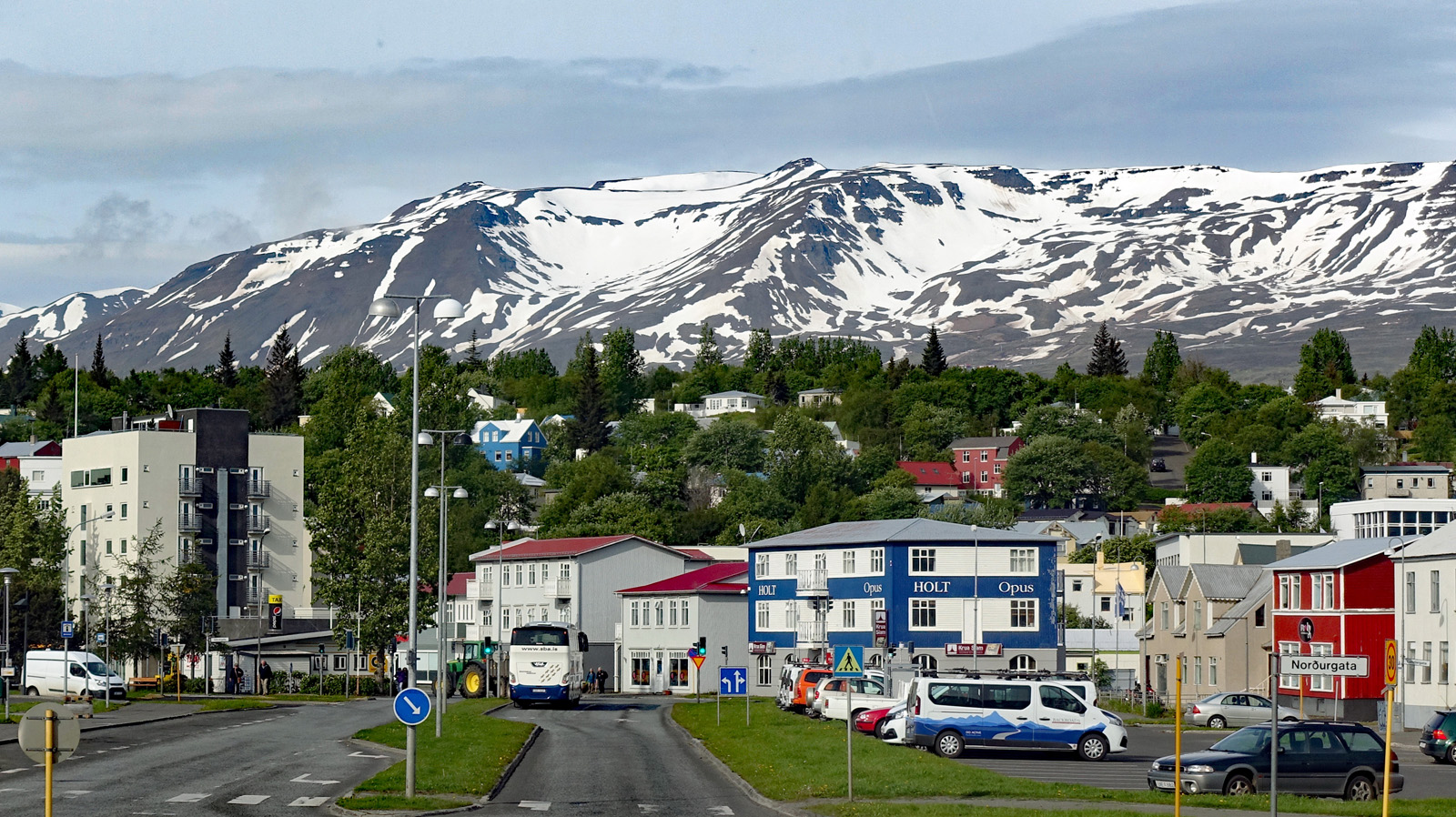 The biggest experiment so far has been in Iceland. From 2015 to 2019 more than 2500 people took part in a pilot programme (about 1 per cent of Iceland’s working population). This involved reducing the working week to four days and reducing hours worked from 40 hours per week to 35 or 36 hours with no reduction in weekly pay.
Analysis of the results of the trial, published in July 2021, showed that output remained the same or improved in the majority of workplaces.
As a result of agreements struck with unions since the end of the pilot programme, 86% of Iceland’s workforce have either moved to shorter hours for the same pay or will gain the right to do so.
Many companies and public-sector employers around the world are considering reducing hours or days worked. With working patterns having changed for many employees during the pandemic, employers may now be more open to rethinking ways of deploying their workforce more productively. And this may involve rethinking worker motivation and welfare.
Articles
Report
Questions
- Distinguish between different ways of measuring labour productivity.
- Summarise the results of the Iceland pilot.
- In what ways may reducing working hours reduce a firm’s total costs?
- What are the advantages and disadvantages of the government imposing (at some point in the future) a maximum working week or a four-day week?
- What types of firm might struggle in introducing a four-day week or a substantially reduced number of hours for full-time employees?
- What external benefits and costs might arise from a shorter working week?
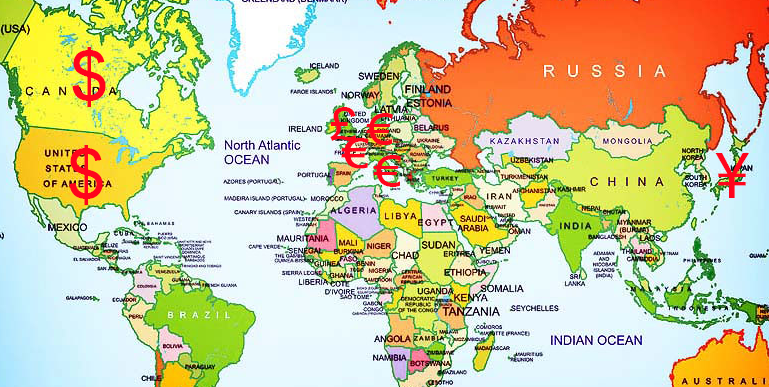 At a meeting of the G7 finance ministers in London from 4–5 June, it was agreed to adopt a minimum corporate tax rate of 15% and to take measures to prevent multinational companies using tax havens to avoid paying taxes. It was also agreed that part of the taxes paid should go to the countries where sales are made and not just to those where the companies are based.
This agreement is the first step on the road to a comprehensive global agreement. The next step is a meeting of the finance ministers and central bank governors of the G20 countries in Venice from 9 to 10 July. The G7 ministers hope that their agreement will be adopted by this larger group, which includes other major economies such as Russia, China, India, Brazil, Australia, South Korea and South Africa.
Later in July, the proposals will be put to a group of 139 countries and jurisdictions at a meeting co-ordinated by the OECD. It is hoped that this meeting will finalise an international agreement with precise details on corporate tax rules. It follows work by the OECD on reforming international taxation under its Framework on Base Erosion and Profit Shifting (BEPS).
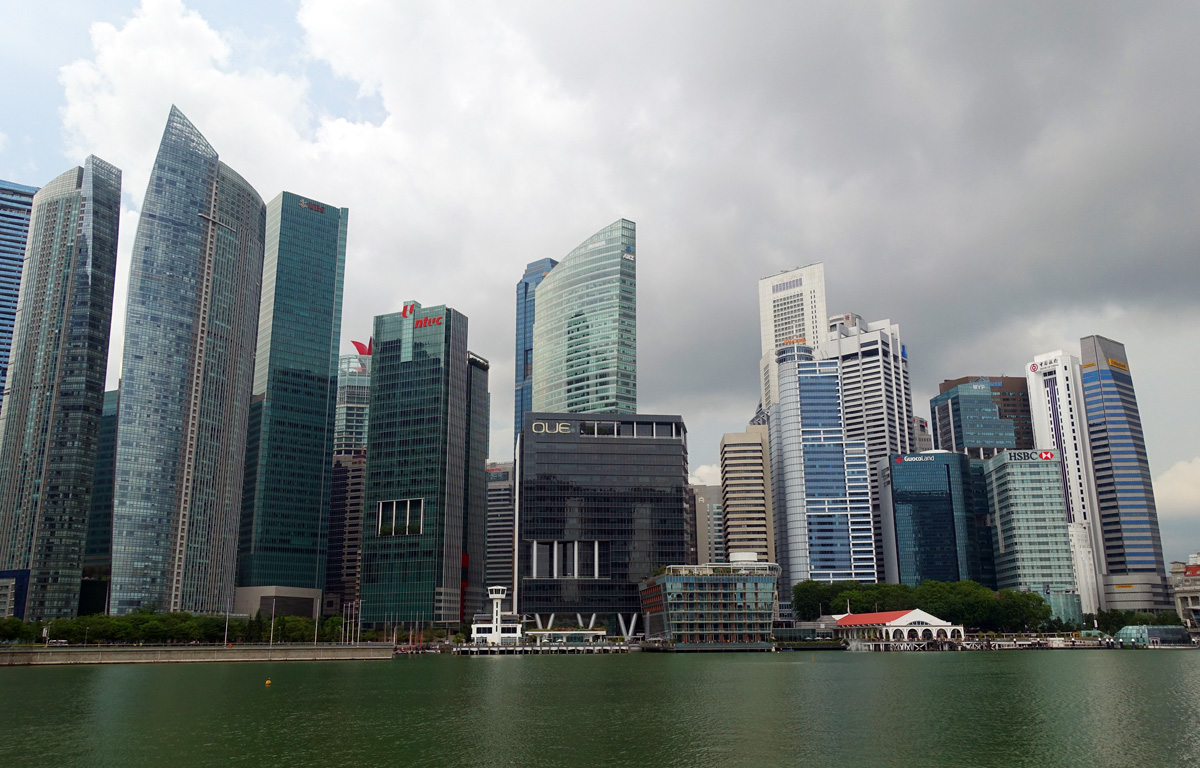 These meetings follow growing concerns about the ability of multinational companies to avoid taxes by basing regional headquarters in low-tax countries, such as Luxembourg or Singapore, and declaring their profits there, despite having only a tiny proportion of their sales in these countries.
The desire to attract multinational profits has led to a prisoners’ dilemma situation, whereby countries have been competing against each other to offer lower taxes, even though it reduces global corporate tax revenues.
With many countries having seen a significant rise in government deficits as result of the COVID-19 pandemic and the support measures put in place, there has been a greater urgency to reach international agreement on corporate taxes. The G7 agreement, if implemented, will provide a significant increase in tax revenue.
Details of the G7 agreement
The agreement has two parts or ‘pillars’.
Pillar 1 allows countries to tax large multinationals earning global profits of more than 10% if these companies are not based there but earn revenues there. Countries will be given tax rights over at least 20% of the profits earned there which exceed the 10% margin. The level of profits determined for each country will be based on the proportion of revenues earned there.
Pillar 2 sets a minimum corporate tax rate of 15% for each of the seven countries, which call on other countries to adopt the same minimum. The hope is that the G20 countries will agree to this and then at the OECD meeting in July a global agreement will be reached. If a country chooses to charge a rate below 15%, then a top-up tax can be applied by the home country to bring the total rate up to the 15%.
It is possible that these proposals will be strengthened/amended at the G20 and OECD meetings. For example, the 15% minimum rate may be raised. Indeed, the USA had initially proposed a 25% rate and then 21%, and several EU countries such as France, have been pushing for a substantially higher rate.
Analysis
The agreement was hailed as ‘historic’ by Rishi Sunak, the UK Chancellor of the Exchequer. This is true in that it is the first time there has been an international agreement on minimum corporate tax rates and locating part of tax liability according to sales. What is more, the rules may be strengthened at the G20 and/or OECD meetings.
There have been various criticisms of the agreement, however. The first is that 15% is too low and is well below the rates charged in many countries. As far as the UK is concerned, the IPPR think tank estimates that the deal will raise £7.9bn whereas a 25% rate would raise £14.7bn.
 Another criticism is that the reallocation of some tax liabilities to countries where sales are made rather than where profits are booked applies only to profits in excess of 10%. This would therefore not affect companies, such as Amazon, with a model of large-scale low-margin sales and hence profits of less than 10%.
Also there is the criticism that a 20% reallocation is too low and would thus provide too little tax revenue to poor countries which may record large sales but where little or no profits are booked.
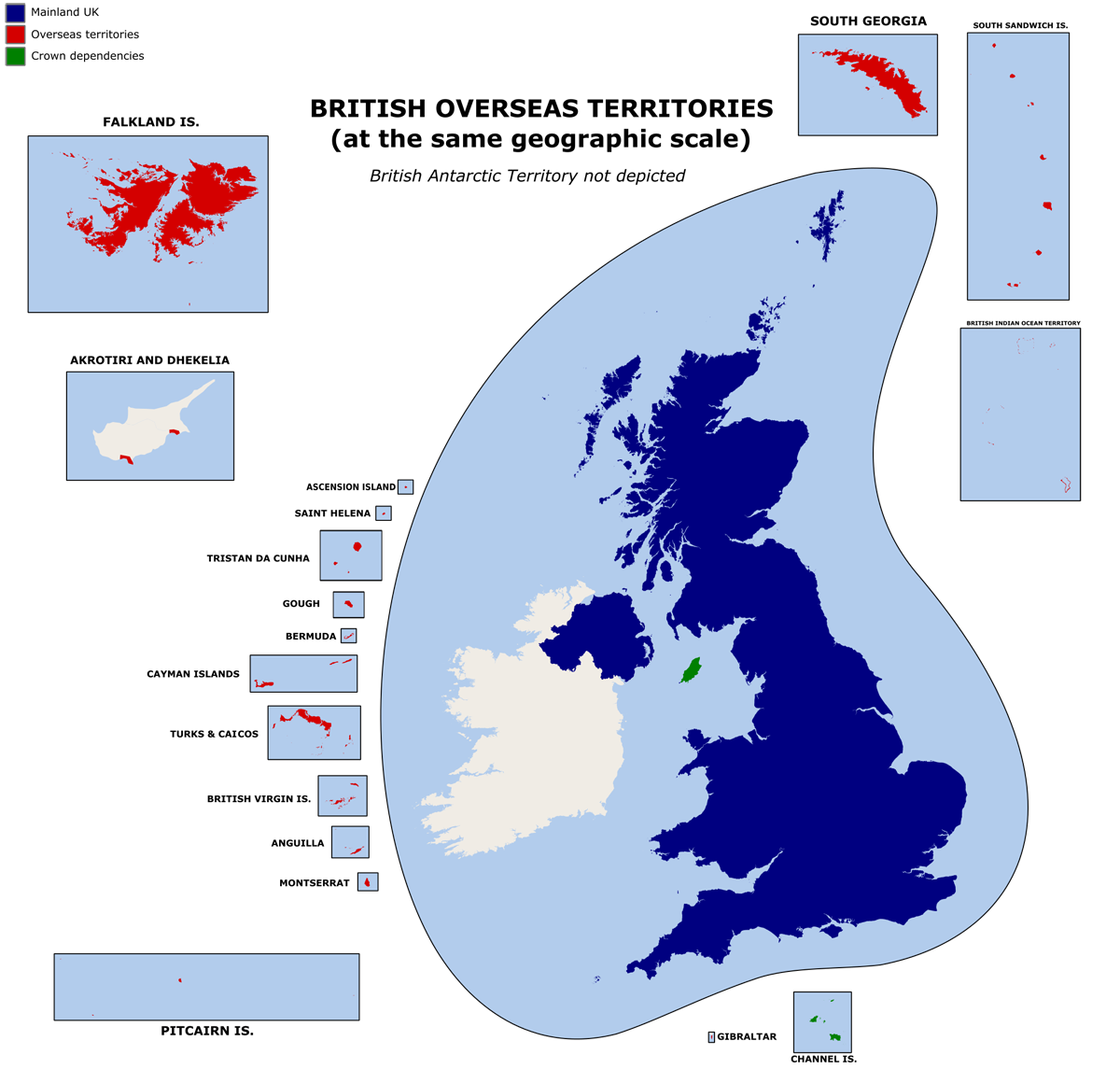 The UK was one of the more reluctant countries to sign up to a deal that would have a significant impact on tax havens in various British overseas territories and crown dependencies, such as the British Virgin islands, Bermuda, the Cayman Islands, the Channel Islands and Isle of Man. The agreement also calls into question whether the announced UK freeports can go ahead. Although these are largely concerned with waiving tariffs and other taxes on raw materials and parts imported into the freeport, which are then made into finished or semi-finished products within the freeport for export, they are still seen by many as not in the spirit of the G7 agreement.
What is more, the UK has been pushing for financial services to be exempted from Pillar 1 of the deal, which would otherwise see taxes partly diverted from the UK to other countries where such firms do business. For example, HSBC generates more than half its income from China and Standard Chartered operates mostly in Asia and Africa.
Update: July 2021
The G7 plan was agreed by the finance ministers of the G20 countries on July 11 in Venice. By that point, 130 of the 139 countries which are part of the Inclusive Framework of the OECD and which represent more than 90% of global GDP, had signed up to the plan and it was expected that there would be a global agreement reached at the OECD meeting later in the month. The other nine countries were Ireland, Hungary and Estonia in the EU and Kenya, Nigeria, Peru, Sri Lanka, Barbados and Saint Vincent and the Grenadines. Several of these countries use low corporate taxes to encourage inward investment and are seen as tax havens.
Videos
Articles
- G-7 nations reach historic deal on global tax reform
CNBC, Silvia Amaro, Joanna Tan and Emma Newburger (5/6/21)
- Rishi Sunak hails ‘historic’ breakthrough as G7 ministers agree global tech tax deal
The Telegraph, Lucy Burton and Edward Malnick (5/6/21)
- G7 backs Biden’s sweeping overhaul of global tax system
CNN, Tara John and Kevin Liptak (5/6/21)
- ‘Historic’ G7 deal to stop global corporate tax avoidance welcomed by tech giants Google and Facebook
Sky News, Ajay Nair (6/6/21)
- Finance Leaders Reach Global Tax Deal Aimed at Ending Profit Shifting
New York Times, Alan Rappeport (5/6/21)
- G7 strikes historic agreement on taxing multinationals
Financial Times, Chris Giles (5/6/21)
- G7 tax deal is ‘starting point’ on road to global reform
LAPM Journal, Chris Giles and Delphine Strauss (FT) (6/6/21)
- G7 tax deal doesn’t go far enough, campaigners say
BBC News (6/6/21)
- Rishi Sunak announces ‘historic agreement’ by G7 on tax reform
The Observer, Phillip Inman and Michael Savage (5/6/21)
- G7 deal is as much about balance of power as global tax reform
The Guardian, Richard Partington (6/6/21)
- Global G7 deal may let Amazon off hook on tax, say experts
The Guardian, Jasper Jolly (6/6/21)
- Explainer: G7 tax deal – what was agreed and what does it mean for Ireland?
The Irish Times, Cliff Taylor (5/6/21)
- G7 deal: UK is badly conflicted between offshore tax havens and Biden’s global tax drive
The Conversation, Atul K. Shah (4/6/21)
- G7 tax dodging deal ‘sets bar so low companies can just step over it’
Independent, Emily Goddard (6/6/21)
- UK pushes for City of London to be exempt from G7 tax plan
The Guardian, Phillip Inman and Richard Partington (9/6/21)
- The global pandemic, sustainable economic recovery, and international taxation
Independent Commission for the Reform of International Corporate Taxation (May 2020)
- G20 finance ministers back deal to tax companies
BBC News (11/7/21)
Questions
- How are multinationals currently able to avoid paying corporate taxes in many countries, even though their sales may be high there?
- If the deal is accepted at the OECD meeting in July, would it still be in the interests of low-tax countries to charge tax rates below the agreed minimum rate?
- Why was the UK reluctant to accept the 21% rate proposed by the Biden administration?
- Find out about the digital services tax that has been adopted by many countries, including EU countries and the UK, and why it will be abolished once a minimum corporate tax comes into force.
- Argue the case for and against taxing the whole of multinational profits in countries where they earn revenue in proportion to the company’s total global revenue. Would such a system benefit developing countries?
- Should financial services, such as those provided by City of London firms, be exempted from the deal?
 The OECD has recently published its six-monthly Economic Outlook. This assesses the global economic situation and the prospects for the 38 members of the OECD.
It forecasts that the UK economy will bounce back strongly from the deep recession of 2020, when the economy contracted by 9.8 per cent. This contraction was deeper than in most countries, with the USA contracting by 3.5 per cent, Germany by 5.1 per cent, France by 8.2 per cent, Japan by 4.7 per cent and the OECD as a whole by 4.8 per cent. But, with the success of the vaccine roll-out, UK growth in 2021 is forecast by the OECD to be 7.2 per cent, which is higher than in most other countries. The USA is forecast to grow by 6.8 per cent, Germany by 3.3 per cent, France by 5.8 per cent, Japan by 2.6 per cent and the OECD as a whole by 5.3 per cent. Table 1 in the Statistical Annex gives the figures.
This good news for the UK, however, is tempered by some worrying features.
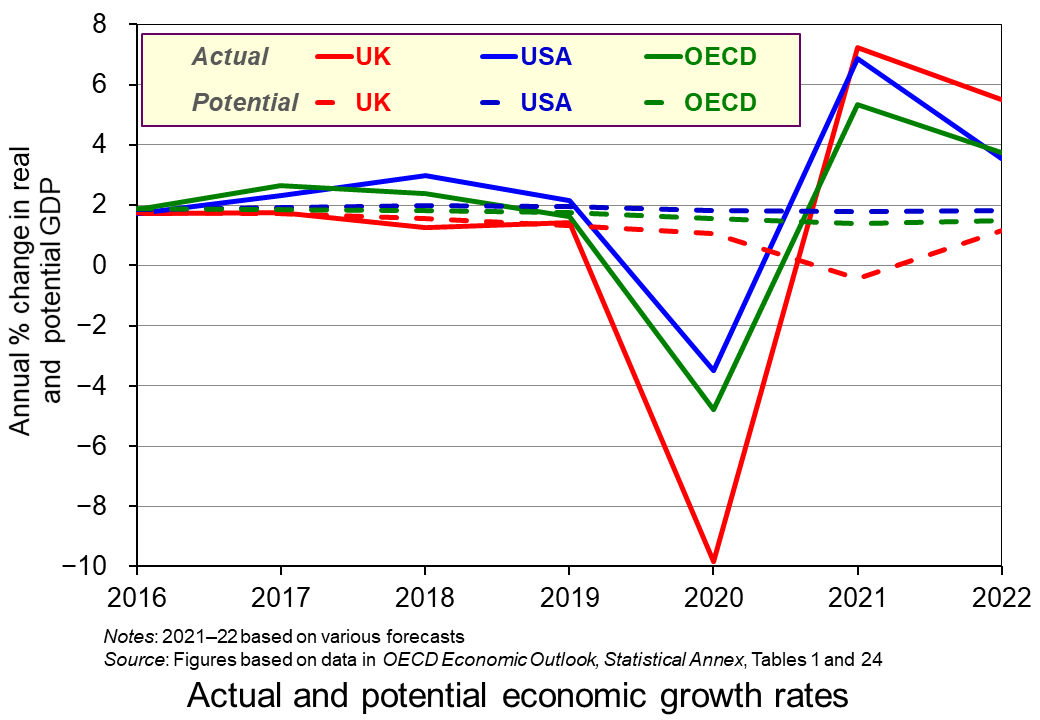 The OECD forecasts that potential economic growth will be negative in 2021, with capacity declining by 0.4 per cent. Only two other OECD countries, Italy and Greece, are forecast to have negative potential economic growth (see Table 24 in the Statistical Annex). A rapid increase in aggregate demand, accompanied by a decline in aggregate supply, could result in inflationary pressures, even if initially there is considerable slack in some parts of the economy.
Part of the reason for the supply constraints are the additional barriers to trade with the EU resulting from Brexit. The extra paperwork for exporters has added to export costs, and rules-of-origin regulations add tariffs to many exports to the EU (see the blog A free-trade deal? Not really). Another supply constraint linked to Brexit is the shortage of labour in certain sectors, such as hospitality, construction and transport. With many EU citizens having left the UK and not being replaced by equivalent numbers of new immigrants, the problem is likely to persist.
 The scarring effects of the pandemic present another problem. There has been a decline in investment. Even if this is only temporary, it will have a long-term impact on capacity, unless there is a compensating rise in investment in the future. Many businesses have closed and will not re-open, including many High Street stores. Moves to working from home, even if partially reversed as the economy unlocks, will have effects on the public transport industry. Also, people may have found new patterns of consumption, such as making more things for themselves rather than buying them, which could affect many industries. It is too early to predict the extent of these scarring effects and how permanent they will be, but they could have a dampening effect on certain sectors.
Inflation
So will inflation take off, or will it remain subdued? At first sight it would seem that inflation is set to rise significantly. Annual CPI inflation rose from 0.7 per cent in March 2021 to 1.5 per cent in April, with the CPI rising by 0.6 per cent in April alone. What is more, the housing market has seen a large rise in demand, with annual house price inflation reaching 10.2 per cent in March.
But these rises have been driven by some one-off events. As the economy began unlocking, so spending rose dramatically. While this may continue for a few months, it may not persist, as an initial rise in household spending may reflect pent-up demand and as the furlough scheme comes to an end in September.
 As far as as the housing market is concerned, the rise in demand has been fuelled by the stamp duty ‘holiday’ which exempts residential property purchase from Stamp Duty Land Tax for properties under £500 000 in England and Northern Ireland and £250 000 in Scotland and Wales (rather than the original £125 000 in England and Northern Ireland, £145 000 in Scotland and £180 000 in Wales). In England and Northern Ireland, this limit is due to reduce to £250 000 on 30 June and back to £125 000 on 30 September. In Scotland the holiday ended on 31 March and in Wales is due to end on 30 June. As these deadlines are passed, this should see a significant cooling of demand.
Finally, although the gap between potential and actual output is narrowing, there is still a gap. According to the OECD (Table 12) the output gap in 2021 is forecast to be −4.6 per cent. Although it was −11.4 per cent in 2020, a gap of −4.6 per cent still represents a significant degree of slack in the economy.
At the current point in time, therefore, the Bank of England does not expect to have to raise interest rates in the immediate future. But it stands ready to do so if inflation does show signs of taking off.
Articles
- United Kingdom Economic Snapshot
OECD Economic Outlook (May 2021)
- UK growth forecast upgraded but pandemic economic ‘scar’ will be worst of all G7 nations, says OECD
Sky News, Ed Conway (31/5/21)
- OECD Predicts UK Economic Growth Amid Vaccine Success And Lockdown Easing
Minutehack Emma Bowden (1/6/21)
- UK growth upgraded, but OECD warns of deepest economic scar in G7
The Guardian, Graeme Wearden (31/5/21)
- UK set for stronger post-Covid recovery, says OECD
BBC News (31/5/21)
- British exports worth billions have faced EU tariffs since Brexit
BBC News, Faisal Islam (28/5/21)
- Post-Brexit: Businesses hit by labour shortages call for Brexit rules to be relaxed
Channel 4 News, Paul McNamara (2/6/21)
- Bank of England monitors UK housing boom as it weighs inflation risk
The Guardian, Larry Elliott (1/6/21)
- House prices jump 10.9% as ‘race for space’ intensifies
BBC News (1/6/21)
- Global food prices post biggest jump in decade
Financial Times, Emiko Terazono and Judith Evans (3/6/21)
- Why house prices are rising so fast in a pandemic
BBC News, Kevin Peachey and Daniele Palumbo (2/6/21)
- Inflation: why it could surge after the pandemic
The Conversation, Ian Crowther (23/4/21)
- Inflation might well keep rising in 2021 – but what happens after that?
The Conversation, Brigitte Granville (31/5/21)
- Slack in the Economy, Not Inflation, Should Be Bigger Worry
Institute for New Economic Thinking, Claudia Fontanari, Antonella Palumbo, and Chiara Salvatori (19/5/21)
Data, Forecasts and Analysis
Questions
- What determines the rate of (a) actual economic growth; (b) potential economic growth?
- What is meant by an output gap? What would be the implications of a positive output gap?
- Why are scarring effects of the pandemic likely to be greater in the UK than in most other countries?
- If people believed that inflation was likely to continue rising, how would this affect their behaviour and how would it affect the economy?
- What are the arguments for and against having a stamp duty holiday when the economy is in recession?
 In a series of five podcasts, broadcast on BBC Radio 4 in the first week of January 2021, Amol Rajan and guests examine different aspects of inequality and consider the concept of fairness.
As the notes to the programme state:
The pandemic brought renewed focus on how we value those who have kept shelves stacked, transport running and the old and sick cared for. So is now the time to bring about a fundamental shift in how our society and economy work?
The first podcast, linked below, examines the distribution of wealth in the UK and how it has changed over time. It looks at how rising property and share prices and a lightly taxed inheritance system have widened inequality of wealth.
It also examines rising inequality of incomes, a problem made worse by rising wealth inequality, the move to zero-hour contracts, gig working and short-term contracts, the lack of social mobility, austerity following the financial crisis of 2007–9 and the lockdowns and restrictions to contain the coronavirus pandemic, with layoffs, people put on furlough and more and more having to turn to food banks.
Is this rising inequality fair? Should fairness be considered entirely in monetary terms, or should it be considered more broadly in social terms? These are issues discussed by the guests. They also look at what policies can be pursued. If the pay of health and care workers, for example, don’t reflect their value to our society, what can be done to increase their pay? If wealth is very unequally distributed, should it be redistributed and how?
The questions below are based directly on the issues covered in the podcast in the order they are discussed.
Podcast
Questions
- In what ways has Covid-19 been the great ‘unequaliser’?
- What scarring/hysteresis effects are there likely to be from the pandemic?
- To what extent is it true that ‘the more your job benefits other people, the less you get paid’?
- How has the pandemic affected inter-generational inequality?
- How have changes in house prices skewed wealth in the UK over the past decade?
- How have changes in the pension system contributed to inter-generational inequality?
- How has quantitative easing affected the distribution of wealth?
- Why is care work so poorly paid and how can the problem be addressed?
- How desirable is the pursuit of wealth?
- How would you set about defining ‘fairness’?
- Is a mix of taxation and benefits the best means of tackling economic unfairness?
- How would you set about deciding an optimum rate of inheritance tax?
- How do you account for the growth of in-work poverty?
- In what ways could wealth be taxed? What are the advantages and disadvantages of such taxes?