 The Autumn Statement, delivered annually by the Chancellor of the Exchequer in late November or early December, is rather like a second Budget. In his statement, the Chancellor presents new forecasts for the UK economy by the Office for Budget Responsibility (OBR) and announces various policy changes in the light of the forecasts.
So what does this OBR say? Its headline reads, “Government borrowing revised higher as weaker economy hits revenues” and this is followed by the statement:
The OBR has revised up its forecasts for public-sector borrowing over the next five years, as a weaker outlook for the economy reduces tax revenues. As a result, the Government no longer seems likely to achieve its target of reducing public-sector net debt in 2015–16.
 The chart shows OBR forecasts for public-sector net borrowing made in June 2010 (its first forecast after the OBR was formed by the Coalition government), in March 2012 and in December 2012. The current forecast clearly shows borrowing set to decline more slowly than in the earlier forecasts. Click here for a PowerPoint of the chart. (Note that the effects of transferring the pension assets of the Royal Mail to the Treasury and the effects of not paying interest to the Bank of England on government bonds purchased under quantitative easing programmes have not been included in order to make the three forecasts consistent.)
So with a weaker economy and slower recovery than previously forecast, what are George Osborne’s options? He and his colleagues, along with various economists, argue for sticking to Plan A. This means continuing with austerity measures in order to get the public-sector deficit down. But with government borrowing having fallen more slowly than forecast, this means further government expenditure cuts, such as reductions in benefits, cuts in grants to local authorities and reductions in pensions relief. Even so, achieving his two targets – (1) eliminating the cyclically adjusted current (as opposed to capital) budget deficit by 2015/16 (the so-called ‘fiscal mandate’), and (2) public-sector debt falling as a proportion of GDP by 2015/16 – will both be missed. They were extended by a year in the Budget last March. They have now been extended by a further year to 2017/18.
The opposition and many other economists argue that Plan A has failed. Austerity has prevented the economy from growing and has thus meant a slower reduction in the deficit as tax revenues have not grown nearly as much as hoped for. A more expansionary policy would allow the deficit to be reduced more quickly, especially if extra government expenditure were focused on infrastructure and other capital spending.
 It could be argued that George Osborne’s Autumn Statement moves some way in this direction – a Plan A+. He is making deeper cuts in welfare and government departmental spending in order to divert monies into capital spending. For example, there will be £1bn of extra expenditure on roads; £1bn extra on schools; £270m on FE colleges; and £600m extra for scientific research. Also, by extending the period of austerity to 2017/18, this has meant that he has not had to make even deeper cuts. What is more, he is increasing income tax allowances and cutting the rate of corporation tax by 1% more than originally planned and scrapping the planned 3p per litre rise in road fuel duty. He hopes to make up any lost tax revenue from these measures by HMRC clamping down on tax evasion.
But by sticking to his broad austerity strategy, and with many parts of the global economy having weakened, it looks as if the UK economy is in for several more years of sluggish growth. Winter is going to be long.
Webcasts and Podcasts
 Autumn Statement: George Osborne scraps 3p fuel duty rise BBC News, Carole Walker (5/12/12)
Autumn Statement: OBR says deficit ‘shrinking more slowly’ BBC News, Robert Chote (5/12/12)
Autumn Statement: Headlines from George Osborne’s speech BBC News, Andrew Neil (5/12/12)
Autumn Statement: Flanders, Robinson and Peston reactio BBC News, Stephanie Flanders, Nick Robinson and Robert Peston (5/12/12)
Boosting the British Budget CNN, Jim Boulden (5/12/12)
Autumn statement 2012: key points – video analysis The Guardian, Larry Elliott, Jill Treanor, Patrick Collinson and Damian Carrington (5/12/12)
Articles
Autumn Statement 2012: the full speech The Telegraph (5/12/12)
Autumn Statement: Benefit squeeze as economy slows BBC News (5/12/12)
Autumn Statement: At-a-glance summary of key points BBC News (5/12/12/)
Austerity to last until 2018, admits George Osborne Independent, Oliver Wright
Autumn statement: George Osborne reveals benefits cut Channel 4 News (5/12/12/)
Autumn Statement 2012: Cut welfare, create jobs – a very Tory statement The Telegraph, Damian Reece (5/12/12)
Autumn statement 2012: economy weaker than expected, Osborne says The Guardian, Heather Stewart (5/12/12)
Analysis: Even the ‘autumn’ bit seemed optimistic BBC News, Chris Mason (5/12/12)
George Osborne’s autumn statement 2012: reaction The Guardian, Julia Kollewe (5/12/12)
Candid Osborne avoids political risk Financial Times, Janan Ganesh (5/12/12)
Autumn statement: Why George Osborne’s Budget won’t be a game changer The Telegraph, Allister Heath (4/12/12/)
Autumn statement 2012: expert verdict The Guardian, Richard Murphy, Dominic Raab, Ann Pettifor, Gavin Kelly, Prateek Buch and Mark Serwotka (5/12/12/)
The alternative autumn statement Channel 4 News (5/12/12)
Autumn Statement 2012: man cannot live by deficit reduction alone The Telegraph, Roger Bootle (5/12/12)
Autumn statement: cuts are just a sideshow The Guardian, John Redwood (5/12/12)
What does the Autumn Statement mean for business? Economia, David Mellor (5/12/12)
Autumn Statement Reaction: UK AAA ‘safe for today’ Investment Week (5/12/12)
Autumn Statement: A wintry statement of reality BBC News, Stephanie Flanders (4/12/12)
What has changed? BBC News, Stephanie Flanders (6/12/12)
UK warned on debt ‘credibility’ over AAA rating BBC News (5/12/12)
Data
Autumn statement 2012 in charts The Guardian, Simon Rogers (5/12/12/)
Who suffers most from Britain’s austerity? How the figures stack up The Guardian, Tom Clark (5/12/12)
Economic and fiscal outlook charts and tables – December 2012 OBR (5/12/12)
Economic and fiscal outlook supplementary economy tables – December 2012 OBR (5/12/12)
Forecasts for the UK economy HM-Treasury
OBR, Treasury and IFS links
Economic and fiscal outlook – December 2012 OBR (5/12/12)
Autumn Statement 2012 HM Treasury (5/12/12)
Autumn Statement 2012 IFS
Questions
- Distinguish between ‘stocks’ and ‘flows’. Define (a) public-sector net borrowing (PSNB) and (b) the public-sector net debt (PSND) and explain whether each one is a stock or a flow.
- Summarise the measures announced by George Osborne in his Autumn Statement.
- What are his arguments for not adopting a more expansionary fiscal policy?
- Assess his arguments.
- What is meant by the ‘output gap’? What are the OBR’s forecasts about the output gap and what are the implications?
- How has quantitative easing affected PSNB and PSND?
- Distinguish between the cyclical and structural deficit. What implications does this distinction have for fiscal policy?
 If aggregate demand were to expand, would there be sufficient spare capacity to allow aggregate supply to expand to meet the additional demand? This is the question addressed by the podcast and article below.
If there is plenty of spare capacity, policies to increase aggregate demand could help to take up the slack and thereby achieve economic growth – at least as long as spare capacity remains. In other words, in the short run the aggregate supply curve may be horizontal or only gently upward sloping at the current point of intersection with the aggregate demand curve. This is illustrated by point a in the diagram. A rightward shift in the aggregate demand curve would cause a movement along the aggregate supply curve to a new higher level of real national income (Y).
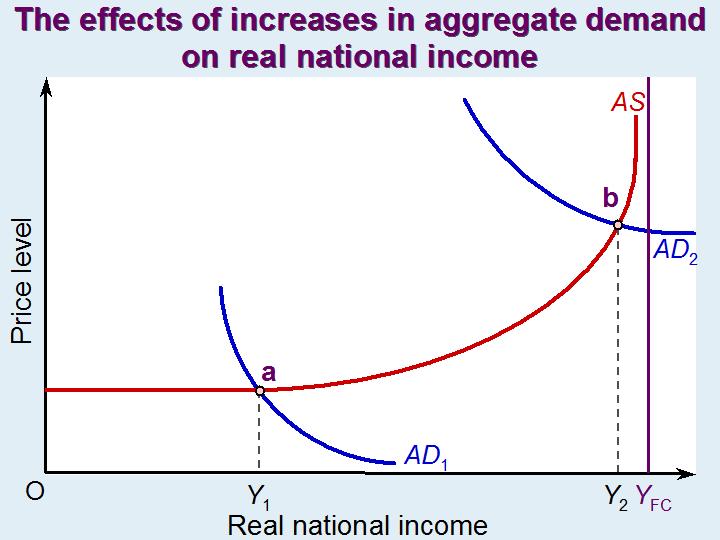
If, however, there is little or no spare capacity, an increase in nominal aggregate demand is likely to be purely inflationary, or virtually so. This would the case at point b in the diagram. Real national income cannot expand beyond the full-capacity level, YFC. Under such circumstances, any attempt by the government to stimulate economic growth should focus on the supply side and attempt to shift the aggregate supply curve to the right. Examples of supply-side policy include incentives to encourage research and development, incentives for the private sector to invest in new capacity and direct public investment in infrastructure.
Unemployment is not just caused by a lack of aggregate demand relative to aggregate supply. It may be the result of a mismatching of labour supply with the demand for labour. People may have the wrong qualifications or not be where the jobs are. Unemployment may co-exist with quite high levels of vacancies. There may be vacancies for highly qualified scientists, technicians or craftspeople and unemployment of people with low skills or skills no longer in high demand. The same may apply to capital equipment. There may be a shortage of high-tech equipment or equipment to produce goods in high demand and redundant older equipment or equipment in areas of declining demand.
Part of a comprehensive set of policies to tackle unemployment and achieve economic growth would be to focus on the whole balance of the economy and the matching of the demand and supply of inputs.
Podcast
Is there ‘spare capacity’ in the economy? BBC Today Programme, Evan Davis and Andrew Sentance (4/12/12)
Article
OBR’s supply pessimism could be the ruin of this government The Telegraph, Roger Bootle (25/11/12)
Data
Claimant count and vacancies dataset ONS (14/11/12)
Labour Market Statistics, November 2012 ONS (14/11/12)
Actual weekly hours worked ONS (14/11/12)
Usual weekly hours worked ONS (14/11/12)
Questions
- Distinguish between ‘unemployment’, ‘underemployment’ and ‘disguised unemployment’?
- To what extent does the level of unemployment provide a good measure of spare capacity?
- Is the UK economy suffering from a deflationary gap? If so, how would you measure the size of that gap?
- If there is substantial spare capacity, is expansionary fiscal policy the best means of achieving economic growth?
- What policies are likely to have both a positive supply-side effect and a positive demand-side effect?
- What constraints does the government face in attempting to boost aggregate demand?
- Why might policies designed to stimulate aggregate demand also increase supply capacity?
- What policies would you recommend for tackling the mismatching of the demand and supply of inputs?
 Unemployment is a term that economists and non-economists are familiar with, even if the non-economists perhaps have a less stringent definition of what we term unemployment. Typically, we say you are unemployed if you are of working age and available for work at the current wage rate, but are not in work. Another important and related concept is that of underemployment, which according to the ONS, is a growing problem in the economy.
Latest figures released by the ONS show that just over 10% of all workers in the UK would like to work more hours each week. This is essentially what underemployment is and it typically affects part-time workers who want to move closer to a full-time job, but are unable to find the necessary hours from their employer. As the economic situation in the UK worsened after the financial crisis, unemployment increased rapidly. Some people went from working full-time to part-time and others simply lost their job. As the economy started to stabilize, people began returning to work, but many found that part-time employment was the only option, despite wanting to work many more hours at the going wage rate. As the ONS said:
During this period [the economic downturn] many workers moved from full-time to part-time roles and many of those returning to work after a period of unemployment could only find part-time jobs … Of the extra one million underemployed workers in 2012 compared with 2008, three-quarters were in part-time posts.
The increase in underemployment has levelled off and though the recession has been a key contributing factor to the higher levels of underemployment, it’s important to note that it can be caused by a few things, as outlined by the ONS.
• employers only being able to offer a few hours of work each week
• workers, such as bar staff, being in jobs where they are only required for a few hours a day
• personal circumstances changing so that someone now wants to work more hours than before
• people settling for a part-time job as second-best when they would much rather have a full-time one
 Although many people are happy with their part-time jobs and hence would not see themselves as underemployed, for those who are underemployed, the fact that they cannot find sufficient hours seems to indicate an inefficiency within the economy, especially if long-term unemployment or underemployment emerges. This problem is particularly relevant amongst the young and those in low-skilled jobs. However, it is also an increasing problem amongst the self-employed.
The implications of underemployment are far-reaching. Naturally it adversely affects an individual’s financial situation, which at the current time with rising household bills can have devastating consequences. There are also wider effects such as the economic implications in terms of economic growth and inefficiency, as well as a potential increased strain on the tax and benefits system. Given these far-reaching consequences, it is an issue that everyone should be concerned about. The following articles consider the growth of underemployment in the UK economy.
Underemployed workers jump by 1m since financial crisis Telegraph, Rebecca Clancy (28/11/12)
Underemployment affects 10.5% of UK workforce (including video) BBC News (28/11/12)
Economic crash leaves an extra 1million workers under-employed and wanting more hours Mail Online (28/11/12)
UK is underemployed: should we be surprised? BBC News, Stephanomics, Stephanie Flanders (28/11/12)
Unemployment affects 1 in 10 workers, ONS says Guardian, Mark King (28/11/12)
One in 10 workers no underemployed Financial Times, Brian Groom (28/11/12)
Underemployment rises to affect one in ten workers Channel 4 News (28/11/12)
Questions
- What is the difference between unemployment and underemployment? Is one worse than the other?
- Why did underemployment initially begin to rise after the financial crisis and what factors helped to slow the increase?
- How can underemployment be measured? Is it likely to be accurate?
- Part-time work has risen in recent decades, as part of a more flexible labour market. Do you think this is a good thing or does it add to the problem of underemployment?
- What are the economic implications of underemployment? You should think about the effects on an individual, their family, society and the wider economy.
- How can someone who is self-employed be classed as underemployed?
- What action, if any, can be taken by the government to tackle the rising problem of underemployment?
 Ministers are considering introducing a minimum price of 45p per unit of alcohol on all drinks sold in England and Wales. The Scottish government has already passed legislation for a minimum price of 50p per unit in Scotland. This, however, is being challenged in the Scottish courts and is being examined by the European Commission.
As we saw in a previous blog, Alcohol minimum price, the aim is to prevent the sale of really cheap drinks in supermarkets and other outlets. Sometimes supermarkets sell alcoholic drinks at less than average cost as a ‘loss leader’ in order to encourage people to shop there. Two-litre bottles of strong cider can be sold for as little as £2. Sometimes they offer multibuys which are heavily discounted. The idea of minimum pricing is to stop these practices without affecting ‘normal’ prices.
The effect of a 45p minimum price per unit would give the following typical minimum prices (depending on strength):
|
Strength |
Size |
Minimum price |
| Wine |
12.5% |
750ml |
£4.22 |
| Beer/lager (normal) |
4.5% |
pint (568ml) |
£1.15 |
| Beer/lager (strong) |
7.5% |
pint (568ml) |
£1.92 |
| Beer/lager (normal) |
4.5% |
2 litres |
£4.05 |
| Beer/lager (strong) |
7.5% |
2 litres |
£6.75 |
| Cider (normal) |
5% |
pint (568ml) |
£1.28 |
| Cider (strong) |
8% |
pint (568ml) |
£2.04 |
| Cider (normal) |
5% |
2 litres |
£4.50 |
| Cider (strong) |
8% |
2 litres |
£7.20 |
| Whisky |
40% |
700ml |
£12.60 |
| Vodka |
37.5% |
700ml |
£11.81 |