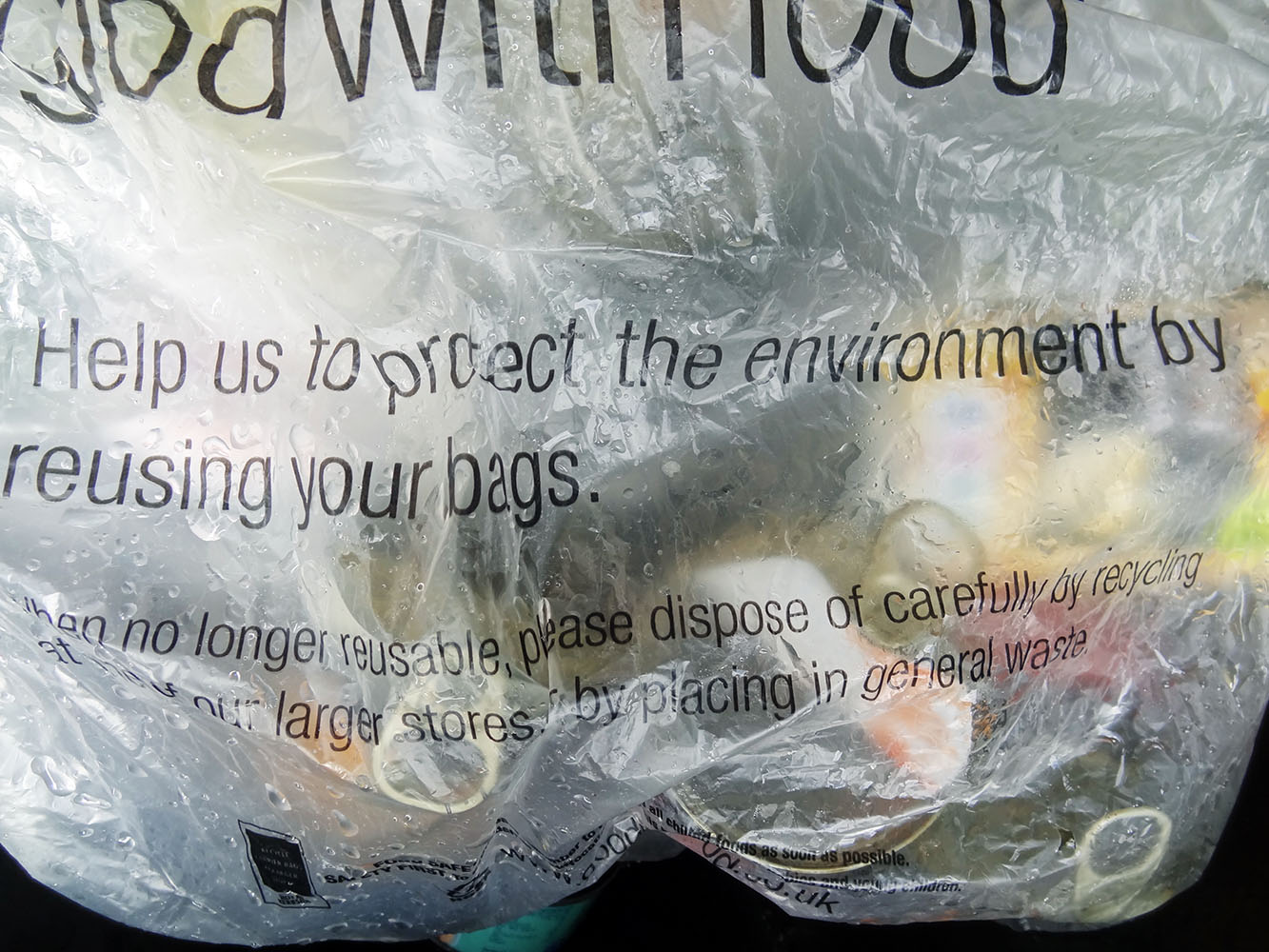
 A campaign to introduce a tax on disposable plastic bags in England has been launched by various pressure groups, including The Campaign to Protect Rural England (CPRE), Keep Britain Tidy, the Marine Conservation Society and Surfers Against Sewage. Plastic bags, they maintain, litter streets and the countryside and pollute the seas, where they cause considerable damage to marine life.
They propose a tax of 5p per bag, which would be passed on to consumers. Such a levy has already been introduced in Wales in October 2011. As a result, plastic bag use in Wales has dropped dramatically (see also the full report from the Welsh Government). The Scottish Government and the Northern Ireland Assembly are also planning introducing similar charges.
Many other governments have introduced taxes, charges or bans on plastic bags and many more are considering introducing such measures. Ireland introduced a 15 euro cent charge on single-use plastic bags as far back as 2002 and saw a 94% reduction in plastic bag use (328 per person per year to 21). The charge was raised to 22 euro cents in 2007 after bag use rose to 30 per person.
Other countries have banned plastic bags altogether: some, such as Rwanda and Somalia have banned all plastic bags; others, such as China and South Africa have banned very thin bags; others, such as Italy, have banned non-biodegradable ones.
In the USA, various states or districts have introduced levies and in the EU, where more than four billion bags are thrown away each year, the European Commission will soon publish proposals for limiting the use of plastic bags.
So what are the arguments for limiting the use of plastic bags? Why is it not enough to leave things simply to the market? And if the use of plastic bags is to be reduced, what’s the most efficient way of doing so? Are there any problems with alternatives to plastic bags? The following articles and reports consider these questions?
Articles
England urged to pick up Wales’ plastic bag levy businessGreen, Jessica Shankleman (1/8/12)
Wales’ plastic bag charge yields massive green savings businessGreen, Jessica Shankleman (5/7/12)
 Supermarkets ‘should charge £1 a bag’ BBC Today Programme, Samantha Harding and Judith Holder (2/8/12)
Environmentalists team up to push for bag tax in England Plastics News, Anthony Clark (1/8/12)
Break the Bag Habit Keep Britain Tidy (1/8/12)
Plastic bag use ‘up for second year running’ Guardian, Rebecca Smithers (5/7/12)
Plastic bag use in Wales plummets due to 5p charge, figures show Guardian, Adam Vaughan (4/7/12)
Carrier bag charge ‘effective and popular’ figures reveal ITV News (4/7/12)
What should be done about plastic bags? BBC News Magazine, Chris Summers (19/3/12)
Irish bag tax hailed success BBC News, Chris Summers (20/8/02)
The Big Fix The Math Behind Sacking Disposable Bags Atlantic Cities, Nate Berg (26/9/11)
Fremantle moves to ban plastic bags ABC News, Lucy Martin (23/7/12)
Bans Plastic Bag Ban Report, Ted Duboise (updated)
Vote With Your Dollars, and Also Vote New York Times, Gernot Wagner (30/7/12)
Reports
Evaluation Of The Introduction Of The Single-Use Carrier Bag Charge In Wales: Attitude Change And Behavioural Spillover, Wouter Poortinga, Lorraine Whitmarsh and Christine Suffolk Report to Welsh Government by Cardiff University (June 2012)
Life cycle assessment of supermarket carrierbags: a review of the bags available in 2006 Environment Agency, Joanna Marchant (25/7/11)
Stakeholder consultation on options to reduce the use of plastic carrier bags … EC Environment (19/3/12)
Questions
- Draw a diagram demonstrating the externalities involved in the use of plastic bags. Show the marginal private and social costs and benefits and the socially efficient level of consumption.
- How would you set about establishing the amount of consumer surplus from the use of plastic bags at a zero price?
- Compare the relative social efficiency of a tax on plastic bags with a ban on plastic bags.
- Would education be an effective alternative to taxing plastic bags?
- Why might it be difficult to get supermarkets and other retailers to agree to a voluntary ban on giving out free plastic bags?
- Why might it be extremely difficult in practice to establish the socially efficient price for plastic bags?
 New data released on 25/7/12 by the Office for National Statistics showed that the UK economy shrank by a further 0.7% in the second quarter of 2012. This makes it the third quarter in a row in which GDP has fallen – and it is the steepest fall of the three. Faced with this, should the government simply maintain the status quo, or does it need to take new action?
The construction sector declined the most steeply, with construction output 5.2% down on the previous quarter, which in turn was 4.9% down on the quarter previous to that. The output of the production industries as a whole fell by 1.3% and the service sector fell by 0.1%. (For a PowerPoint of the following chart, click here.)
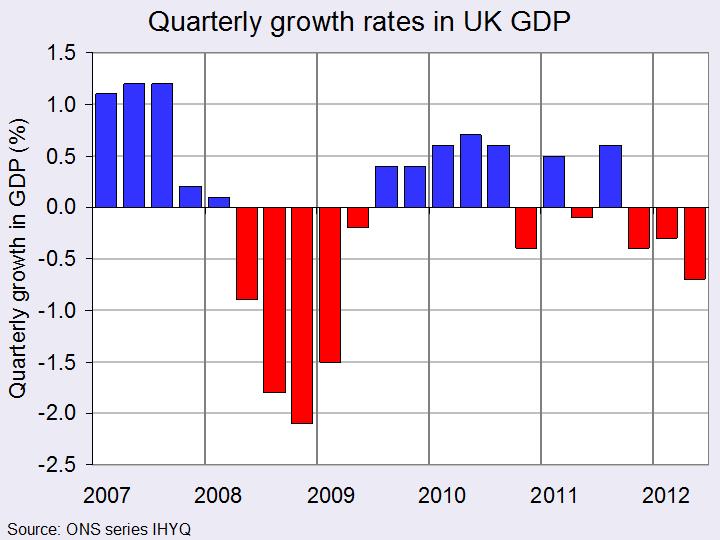
The immediate cause of the decline in GDP has been a decline in real aggregate demand, but the reasons for this are several. Consumer demand has fallen because of the squeeze on real wages, partly the result of low nominal pre-tax wage increases and partly the result of inflation and tax rises; the government’s austerity programme is holding back a growth in government expenditure; export growth has been constrained by a slowing down in the global economy and especially in the eurozone, the UK’s major trading partner; and investment is being held back by the pessimism of investors about recovery in the economy and difficulties in raising finance.
So what can be done about it?
Monetary policy is already being used to stimulate demand, but to little effect (see Pushing on a string. Despite record low interest rates and a large increase in narrow money through quantitative easing, broad money is falling as bank lending remains low. This is caused partly by a reluctance of banks to lend as they seek to increase their capital and liquidity ratios, and partly by a reluctance of people to borrow as individuals seek to reduce their debts and as firms are pessimistic about investing. But perhaps even more quantitative easing might go some way to stimulating lending.
Fiscal policy might seem the obvious alternative. The problem here is that the government is committed to reducing the public-sector deficit and is worried that if it eases up on this commitment, this would play badly with credit rating agencies. Indeed, on 27/7/12, Standard & Poor’s, one of the three global credit rating agencies, confirmed the UK’s triple A rating, but stated that “We could lower the ratings in particular if the pace and extent of fiscal consolidation slows beyond what we currently expect.” Nevertheless, critics of the government maintain that this is a risk worth taking.
The following articles look at the causes of the current double-dip recession, the deepest and most prolonged for over 100 years. They also look at what options are open to the government to get the economy growing again.
Articles
Britain shrinks again The Economist (25/7/12)
Shock 0.7% fall in UK GDP deepens double-dip recession Guardian, Larry Elliott (25/7/12)
UK GDP figures: expert panel verdict Guardian, Frances O’Grady, Will Hutton, Sheila Lawlor, Vicky Pryce and John Cridland (25/7/12)
GDP shock fall: UK growth in 2012 ‘inconceivable’, warn economists The Telegraph, Angela Monaghan (25/7/12)
UK recession deepens after 0.7% fall in GDP BBC News (25/7/12)
UK economy: Why is it shrinking? BBC News (25/7/12)
UK GDP: A nasty surprise and a puzzle BBC News, Stephanie Flanders (25/7/12)
Tough choices for Mr Osborne BBC News, Stephanie Flanders (26/7/12)
David Cameron in pledge to control UK’s debt Independent, Andrew Woodcock and James Tapsfield (26/7/12)
David Cameron defends economic policies BBC News (26/7/12)
The GDP number is awful – and it’s the product of the Government’s amateur policies, not the euro crisis The Telegraph, Thomas Pascoe (25/7/12)
UK recession: have we heard it all before? Guardian, Duncan Weldon (25/7/12)
US economic growth slows in second quarter BBC News (27/7/12)
GDP data trigger debate on economy Financial Times, Norma Cohen and Sarah O’Connor (25/7/12)
Does weak UK growth warrant more QE? Financial Times (25/7/12)
The recession: Osborne’s mess Guardian editorial (25/7/12)
Data
Gross Domestic Product, Preliminary Estimate, Q2 2012 ONS (25/7/12)
Preliminary Estimate of GDP – Time Series Dataset 2012 Q2 ONS (25/7/12)
Questions
- What are the causes of the deepening of the current recession in the UK?
- Search for data on other G7 countries and compare the UK’s performance with that of the other six countries (see, for example, the OECD’s StatExtracts.
- Compare the approach of George Osborne with that of Neville Chamberlain in 1932, during the Great Depression.
- Does weak UK growth warrant more quantitative easing by the Bank of England?
- To what extent can fiscal policy be used to stimulate the economy without deepening the public-sector deficit in the short term?
- What is meant by ‘crowding out’? If fiscal policy were used to stimulate demand, to what extent would this cause crowding out?
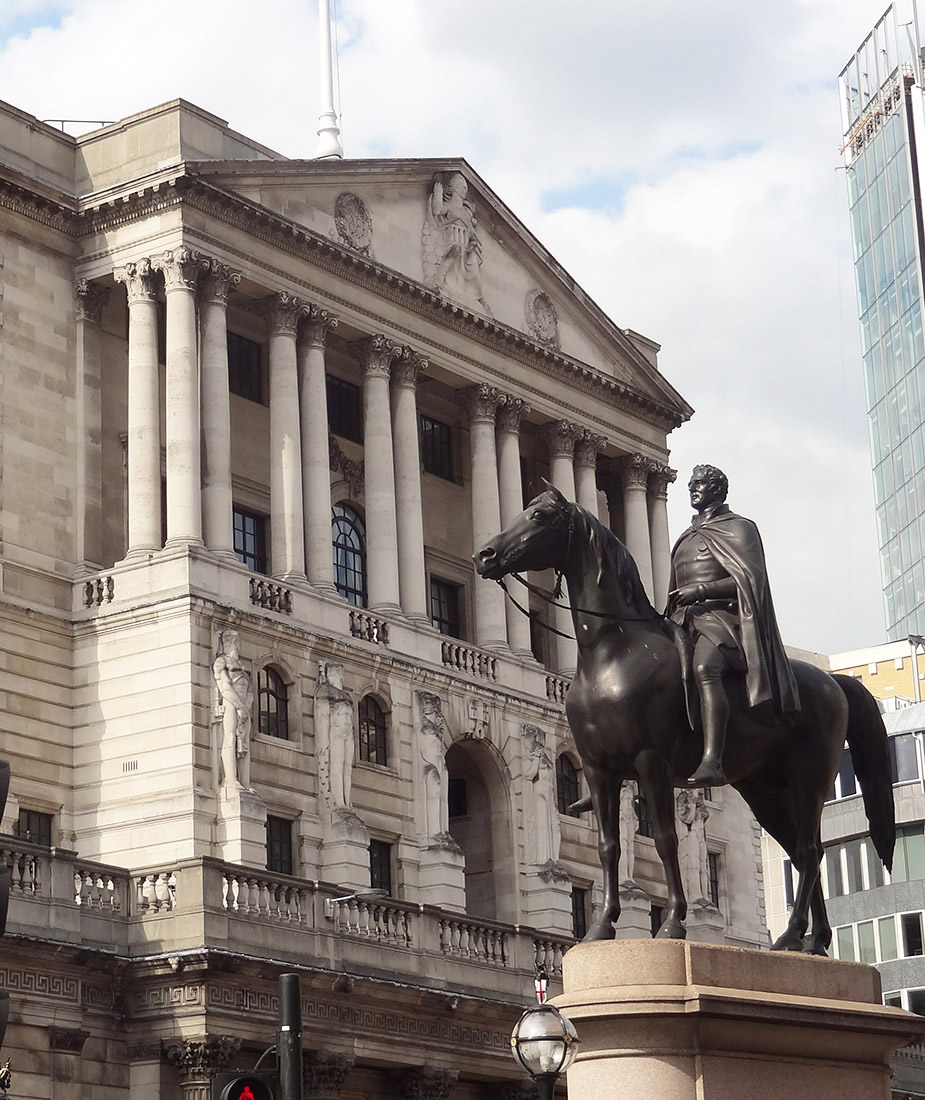 With the UK and eurozone economies in recession and with business and consumer confidence low, the Bank of England and the ECB have sprung into action.
The ECB has cut its main refinancing rate from 1% to an all-time low of 0.75%. Meanwhile, the Bank of England has embarked on a further round of quantitative easing (QE). The MPC voted to inject a further £50 billion through its asset purchase scheme, bring the total to £375 billion since QE began in March 2009.
And it is not just in Europe that monetary policy is being eased. In Australia and China interest rates have been cut. In the USA, there have been further asset purchases by the Fed and it is expected that the Japanese central bank will cut rates very soon, along with those in Korea, Indonesia and Sri Lanka.
But with consumers seeming reluctant to spend and businesses being reluctant to invest, will the new money in the UK and elsewhere actually be lent and spent? Or will it simply sit in banks, boosting their liquidity base, but doing little if anything to boost aggregate demand?
And likewise in the eurozone, will a 25 basis point reduction in interest rates (i.e. a 0.25 percentage point reduction) do anything to boost borrowing and spending?
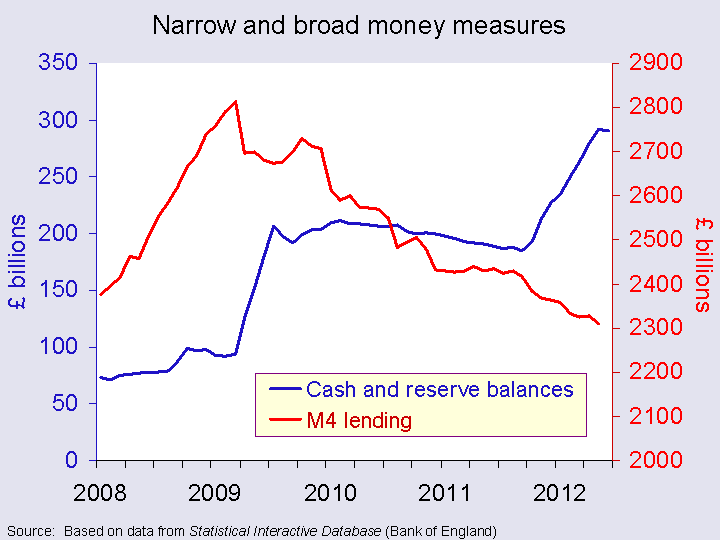 It is like pushing on a string – a term used by Keynesians to refer to the futile nature of monetary policy when people are reluctant to spend. Indeed the evidence over the past few years since QE started is that despite narrow money having risen massively, M4 lending has declined (see chart).
For a PowerPoint of the chart, click here.
The following articles look at the conundrum
Articles
Draghi-King Push May Mean Bigger Step Into Zero-Rate Era BloombergBusinessweek, Simon Kennedy (4/7/12)
QE and rate cut as central banks play stimulus card Independent, Ben Chu (6/7/12)
QE is welcome, but not enough Independent, Leader (6/7/12)
Interest rates cut to spur growth China Daily, Wang Xiaotian, Ding Qingfen and Gao Changxin (6/7/12)
Rate cuts shake global confidence Sydney Morning Herald, Eric Johnston, Clancy Yeates and Peter Cai (7/7/12)
Global Policy Easing Presses Asia to Cut Rates BloombergBusinessweek, Sharon Chen and Justina Lee (6/7/12)
Economic slowdown raises alarm in China, Europe Globe and Mail, Kevin Carmichael (5/7/12)
Bank of England sets sail with QE3 BBC News, Stephanie Flanders (5/7/12)
The twilight of the central banker The Economist (26/6/12)
The case for truly bold monetary policy Financial Times, Martin Wolf (28/6/12)
Questions
- Is the world economy in a liquidity trap?
- What advice would you give politicians around the world seeking to boost consumer and business confidence?
- Are we witnessing “The twilight of the central banker”? (See The Economist article above.)
- Explain the following extracts from the Martin Wolf article: “In a monetary system, based on fiat (or man-made) money, the state guarantees the money supply in the interests of the public. In normal times, however, actual supply is a byproduct of lending activities of banks. It is, in brief, the product of privately operated printing presses… In the last resort, the power to create money rests properly with the state. When private sector supply is diminishing, as now, the state not only can, but should, step in, with real urgency.”
- Should monetary policy in the UK be combined with fiscal policy in providing a stimulus at a time when the government can borrow ultra cheaply from the Bank of England? Does this apply to other governments around the world?
- Why did Asian share prices fall despite the stimulus?
 Barclays’ Chief Executive, Bob Diamond, has resigned following revelations that Barclays staff had been involved in rigging the LIBOR in the period 2005–9, including the financial crisis of 2007–9.
So what is the LIBOR; how is it set; what were the reasons for Barclays (and other banks, as will soon be revealed) attempting to manipulate the rate; and what were the consequences?
The LIBOR, or London interbank offered rate, is the average of what banks report that they would have to pay to borrow from one another in the inter-bank market. Separate LIBORs are calculated for 15 different lending periods: overnight, one week, one month, two months, three months, six months, etc. The rates are set daily as the average of submissions made to Thomson Reuters by some 15 to 20 banks (a poll overseen by the British Bankers’ Association). Thomson Reuters then publishes the LIBORs, along with all of the submissions from individual banks which are used to calculate it.
Many interest rates around the world are based on LIBORs, or their European counterpart, EURIBORs. They include bond rates, mortgage rates, overdraft rates, etc. Trillions of dollars worth of such assets are benchmarked to the LIBORs. Thus manipulating LIBORs by even 1 basis point (0.01%) can result in millions of dollars worth of gains (or losses) to banks.
 The charge, made by the Financial Services Authority, is that Barclays staff deliberately under- or overstated the rate at which the bank would have to borrow. For example, when interbank loans were drying up in the autumn of 2008, Barclays staff were accused of deliberately understating the rate at which they would have to borrow in order to persuade markets that the bank was facing less difficulty than it really was and thereby boost confidence in the bank. In other words they were accused of trying to manipulate LIBORs down by lying.
As it was the LIBORs were rising well above bank rate. The spread for the one-month LIBOR was around 1 to 1.2% above Bank Rate. Today it is around 0.1 to 0.15% above Bank Rate. Without lying by staff in Barclays, RBS and probably other banks too, the spread in 2008 may have been quite a bit higher still.
The following articles look at the issue, its impact at the time and the aftermath today.
Articles
A Libor primer The Globe and Mail, Kevin Carmichael (3/7/12)
60 second guide to Libor Which? (3/7/12)
Explaining the Libor interest rate mess CNN Money (3/7/12)
Fixing Libor Financial Times (27/6/12)
LIBOR in the News: What it is, Why it’s Important Technorati, John Sollars (2/7/12)
Libor rigging ‘was institutionalised at major UK bank’ The Telegraph, Philip Aldrick (1/7/12)
Barclays ‘attempted to manipulate interest rates’ BBC News, Robert Peston (27/6/12)
The Libor Conspiracy: Were the Bank of England and Whitehall in on it? Independent, Oliver Wright, James Moore , Nigel Morris (4/7/12)
Fixing LIBOR The Economist (10/3/12)
Cleaning up LIBOR? The Economist (14/5/12)
Eagle fried The Economist, Schumpeter (27/6/12)
Barclays looks like the victim Financial Post, Terence Corcoran (3/7/12)
Inconvenient truths about Libor BBC News, Stephanie Flanders (4/7/12)
Timeline: Barclays’ widening Libor-fixing scandal BBC News (5/7/12)
The elusive truth about Barclays’ lie BBC News, Robert Peston (4/7/12)
Rate Fixing Scandal Is International: EU’s Almunia CNBC, Shai Ahmed (4/7/12)
Bank-Bonus Culture to Blame for Barclays Scandal The Daily Beast, Alex Klein (3/7/12)
Libor scandal ‘damaging’ for City BBC Today Programme, Andrew Lilico and Mark Boleat (5/7/12)
Data
Libor rate fixing: see each bank’s submissions Guardian Data Blog, Simon Rogers (3/7/12)
Sterling interbank rates Bank of England
Questions
- Using data from the Bank of England (see link above), chart two or three LIBOR rates against Bank rate from 2007 to the present day.
- For what reason would individuals and firms lose from banks manipulating LIBOR rates?
- Why would LIBOR manipulation be more ‘effective’ if banks colluded in their submissions about their interest rates?
- Why might the Bank of England and the government have been quite keen for the LIBOR to have been manipulated downwards in 2008?
- To what extent was the LIBOR rigging scandal an example of the problem of asymmetric information?
- In the light of the LIBOR rigging scandal, should universal banks be split into separate investment and retail banks, rather than erecting some firewall around their retail banking arm?
- What are the arguments for and against making attempts to manipulate LIBOR rates a criminal offences?
 Eurozone leaders met at a summit in Brussels on 28 and 29 June. Expectations ahead of the summit were low that any significant progress would be made on supporting eurozone banks and governments, on achieving more effective bank regulation or stimulating economic growth.
For once, EU leaders surprised markets by reaching a more comprehensive agreement than anticipated. The agreement has five key elements:
1. The use of funds from the soon-to-be launched eurozone bailout fund, the European Stability Mechanism (ESM), to lend to banks directly. Previously, funds had been made available to national governments to lend to their banks. This, however, increased the debts of the national governments, such as Spain, which made it harder for them to meet deficit and debt targets.
2. The setting up of a new banking supervisory body to impose common standards, such as capital adequacy requirements, on banks across the eurozone.
3. The use of the eurozone bailout fund to buy government bonds on the secondary market, provided governments are sticking to agreed deficit reduction measures. This would help to reduce interest rates on government bonds in countries such as Spain, Italy and Greece, currently having to pay interest rates 5 or 6 percentage points above those on German bonds.
4. A €120bn growth package to target EU money at small businesses, youth unemployment and infrastructure improvements. Most of the money would be from existing funds, such as EU Structural Funds, which are currently unused. There would be some additional funds, however, including €10bn to boost the lending capacity of the European Investment Bank.
5. A 10-year ‘roadmap’ towards greater fiscal union, including the creation of a eurozone treasury, which could limit overall spending by national governments.
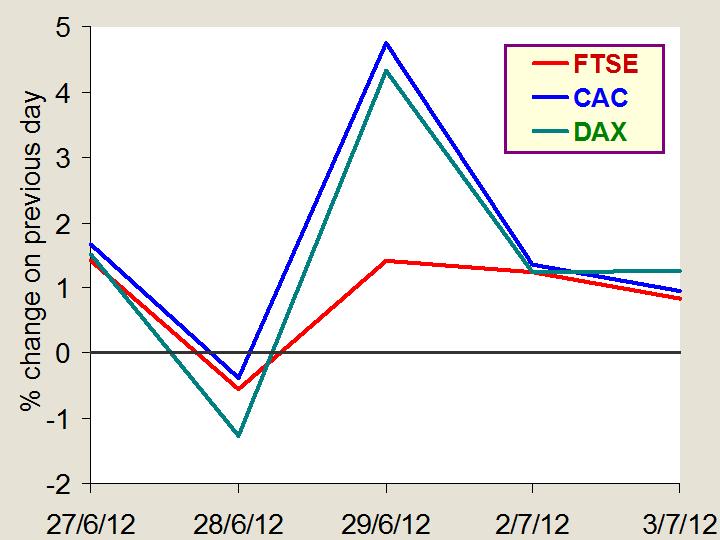 Generally the agreement has been greeted positively, with stock markets in the eurozone and across the world rising significantly. But will the measures be enough to reassure investors over the coming weeks? Will they cure the problems of the eurozone or are they just one more, albeit larger, sticking plaster?
The following webcasts, podcasts and articles look at the agreement and the resulting prospects for the eurozone.
Webcasts and podcasts
Eurozone bends the rules to save single currency euronews (29/6/12)
Markets Like Euro Crisis Deal, Merkel Defensive Associated Press (29/6/12)
Eurozone crisis: ‘Breakthrough’ at summit BBC News, Gavin Hewitt (29/6/12)
EU summit outcome exceeds – low – expectations euronews (29/6/12)
Italy and Spain are main beneficiaries after EU summit euronews (30/6/12)
EU bank aid deal ‘better than expected, worse than needed’ euronews (29/6/12)
New eurozone deal ‘not enough’ BBC Today Programme, James Shugg (29/6/12)
Eurozone: ‘Massive concession’ from Angela Merkel BBC Today Programme, Gavin Hewitt and Robert Peston (29/6/12)
Articles
Eurozone bank bailout deal throws lifeline to Spain and Italy Guardian, Ian Traynor and Phillip Inman (29/6/12)
Spain lifeline after EU allows direct access to eurozone bailout funds Guardian (29/6/12)
Less disunion The Economist, Charlemagne’s notebook (29/6/12)
Eurozone agrees on bank recapitalisation BBC News (29/6/12)
Merkel defends compromise deal on eurozone banks BBC News (29/6/12)
A first, tentative step to salvation for the eurozone Independent, Leading article (29/6/12)
Analysis – Sharing a vision may be Europe’s biggest challenge Reuters, Alan Wheatley (3/7/12)
Eurozone bank agreement welcomed FT Adviser, Rebecca Clancy & Bradley Gerrard (2/7/12)
The real victor in Brussels was Merkel Financial Times, Wolfgang Münchau (1/7/12)
Finns, Dutch cast first doubt on EU summit deal EurActiv (3/7/12)
A Euro deal from Brussels BBC News, Stephanie Flanders (29/6/12)
Document
Conclusions of the European Council (28/29 June 2012) European Council (29/6/12)
Questions
- What are the advantages of the ESF lending to banks directly? Are there any problems associated with the proposal?
- To what extent will the measures solve the problems of the eurozone? What else might need to be done?
- Are there any potential moral hazards contained in the proposals and how are they likely to be tackled?
- Explain the concept of ‘seniority’ in the following statement: “the debt owed by Spain to the EFSF, if and when it is transferred to the ESM, will not gain seniority”. Why might this be good for private financiers?
- If governments’ bonds are to be purchased by the ESM, what conditions are likely to be attached?
 A campaign to introduce a tax on disposable plastic bags in England has been launched by various pressure groups, including The Campaign to Protect Rural England (CPRE), Keep Britain Tidy, the Marine Conservation Society and Surfers Against Sewage. Plastic bags, they maintain, litter streets and the countryside and pollute the seas, where they cause considerable damage to marine life.