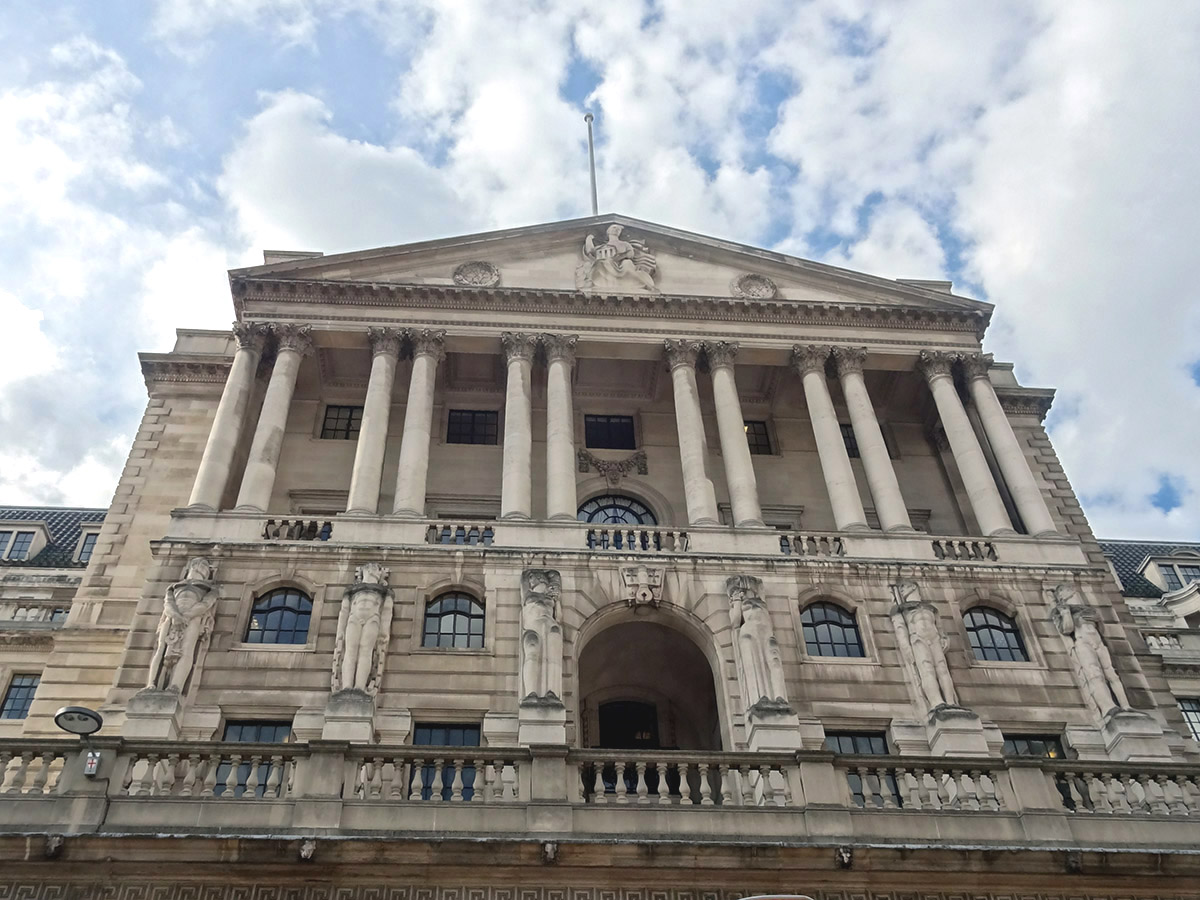
Barclays’ Chief Executive, Bob Diamond, has resigned following revelations that Barclays staff had been involved in rigging the LIBOR in the period 2005–9, including the financial crisis of 2007–9.
So what is the LIBOR; how is it set; what were the reasons for Barclays (and other banks, as will soon be revealed) attempting to manipulate the rate; and what were the consequences?
The LIBOR, or London interbank offered rate, is the average of what banks report that they would have to pay to borrow from one another in the inter-bank market. Separate LIBORs are calculated for 15 different lending periods: overnight, one week, one month, two months, three months, six months, etc. The rates are set daily as the average of submissions made to Thomson Reuters by some 15 to 20 banks (a poll overseen by the British Bankers’ Association). Thomson Reuters then publishes the LIBORs, along with all of the submissions from individual banks which are used to calculate it.
Many interest rates around the world are based on LIBORs, or their European counterpart, EURIBORs. They include bond rates, mortgage rates, overdraft rates, etc. Trillions of dollars worth of such assets are benchmarked to the LIBORs. Thus manipulating LIBORs by even 1 basis point (0.01%) can result in millions of dollars worth of gains (or losses) to banks.
 The charge, made by the Financial Services Authority, is that Barclays staff deliberately under- or overstated the rate at which the bank would have to borrow. For example, when interbank loans were drying up in the autumn of 2008, Barclays staff were accused of deliberately understating the rate at which they would have to borrow in order to persuade markets that the bank was facing less difficulty than it really was and thereby boost confidence in the bank. In other words they were accused of trying to manipulate LIBORs down by lying.
As it was the LIBORs were rising well above bank rate. The spread for the one-month LIBOR was around 1 to 1.2% above Bank Rate. Today it is around 0.1 to 0.15% above Bank Rate. Without lying by staff in Barclays, RBS and probably other banks too, the spread in 2008 may have been quite a bit higher still.
The following articles look at the issue, its impact at the time and the aftermath today.
Articles
A Libor primer The Globe and Mail, Kevin Carmichael (3/7/12)
60 second guide to Libor Which? (3/7/12)
Explaining the Libor interest rate mess CNN Money (3/7/12)
Fixing Libor Financial Times (27/6/12)
LIBOR in the News: What it is, Why it’s Important Technorati, John Sollars (2/7/12)
Libor rigging ‘was institutionalised at major UK bank’ The Telegraph, Philip Aldrick (1/7/12)
Barclays ‘attempted to manipulate interest rates’ BBC News, Robert Peston (27/6/12)
The Libor Conspiracy: Were the Bank of England and Whitehall in on it? Independent, Oliver Wright, James Moore , Nigel Morris (4/7/12)
Fixing LIBOR The Economist (10/3/12)
Cleaning up LIBOR? The Economist (14/5/12)
Eagle fried The Economist, Schumpeter (27/6/12)
Barclays looks like the victim Financial Post, Terence Corcoran (3/7/12)
Inconvenient truths about Libor BBC News, Stephanie Flanders (4/7/12)
Timeline: Barclays’ widening Libor-fixing scandal BBC News (5/7/12)
The elusive truth about Barclays’ lie BBC News, Robert Peston (4/7/12)
Rate Fixing Scandal Is International: EU’s Almunia CNBC, Shai Ahmed (4/7/12)
Bank-Bonus Culture to Blame for Barclays Scandal The Daily Beast, Alex Klein (3/7/12)
 Libor scandal ‘damaging’ for City BBC Today Programme, Andrew Lilico and Mark Boleat (5/7/12)
Data
Libor rate fixing: see each bank’s submissions Guardian Data Blog, Simon Rogers (3/7/12)
Sterling interbank rates Bank of England
Questions
- Using data from the Bank of England (see link above), chart two or three LIBOR rates against Bank rate from 2007 to the present day.
- For what reason would individuals and firms lose from banks manipulating LIBOR rates?
- Why would LIBOR manipulation be more ‘effective’ if banks colluded in their submissions about their interest rates?
- Why might the Bank of England and the government have been quite keen for the LIBOR to have been manipulated downwards in 2008?
- To what extent was the LIBOR rigging scandal an example of the problem of asymmetric information?
- In the light of the LIBOR rigging scandal, should universal banks be split into separate investment and retail banks, rather than erecting some firewall around their retail banking arm?
- What are the arguments for and against making attempts to manipulate LIBOR rates a criminal offences?
 Eurozone leaders met at a summit in Brussels on 28 and 29 June. Expectations ahead of the summit were low that any significant progress would be made on supporting eurozone banks and governments, on achieving more effective bank regulation or stimulating economic growth.
For once, EU leaders surprised markets by reaching a more comprehensive agreement than anticipated. The agreement has five key elements:
1. The use of funds from the soon-to-be launched eurozone bailout fund, the European Stability Mechanism (ESM), to lend to banks directly. Previously, funds had been made available to national governments to lend to their banks. This, however, increased the debts of the national governments, such as Spain, which made it harder for them to meet deficit and debt targets.
2. The setting up of a new banking supervisory body to impose common standards, such as capital adequacy requirements, on banks across the eurozone.
3. The use of the eurozone bailout fund to buy government bonds on the secondary market, provided governments are sticking to agreed deficit reduction measures. This would help to reduce interest rates on government bonds in countries such as Spain, Italy and Greece, currently having to pay interest rates 5 or 6 percentage points above those on German bonds.
4. A €120bn growth package to target EU money at small businesses, youth unemployment and infrastructure improvements. Most of the money would be from existing funds, such as EU Structural Funds, which are currently unused. There would be some additional funds, however, including €10bn to boost the lending capacity of the European Investment Bank.
5. A 10-year ‘roadmap’ towards greater fiscal union, including the creation of a eurozone treasury, which could limit overall spending by national governments.
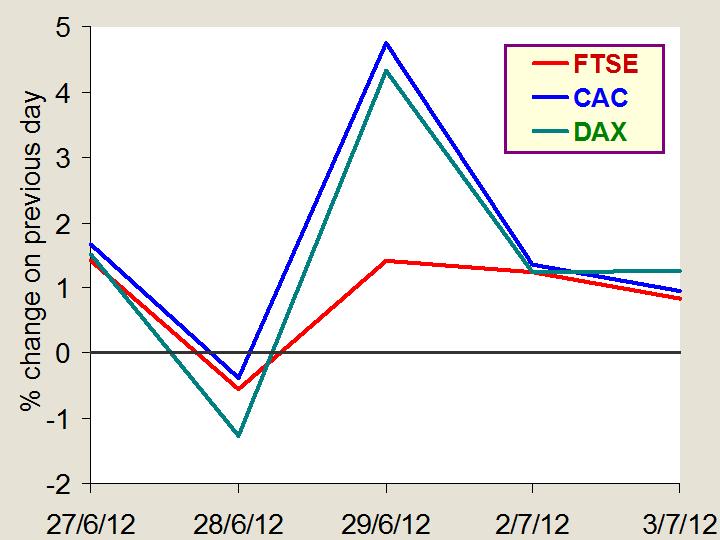 Generally the agreement has been greeted positively, with stock markets in the eurozone and across the world rising significantly. But will the measures be enough to reassure investors over the coming weeks? Will they cure the problems of the eurozone or are they just one more, albeit larger, sticking plaster?
The following webcasts, podcasts and articles look at the agreement and the resulting prospects for the eurozone.
Webcasts and podcasts
Eurozone bends the rules to save single currency euronews (29/6/12)
Markets Like Euro Crisis Deal, Merkel Defensive Associated Press (29/6/12)
Eurozone crisis: ‘Breakthrough’ at summit BBC News, Gavin Hewitt (29/6/12)
EU summit outcome exceeds – low – expectations euronews (29/6/12)
Italy and Spain are main beneficiaries after EU summit euronews (30/6/12)
EU bank aid deal ‘better than expected, worse than needed’ euronews (29/6/12)
New eurozone deal ‘not enough’ BBC Today Programme, James Shugg (29/6/12)
Eurozone: ‘Massive concession’ from Angela Merkel BBC Today Programme, Gavin Hewitt and Robert Peston (29/6/12)
Articles
Eurozone bank bailout deal throws lifeline to Spain and Italy Guardian, Ian Traynor and Phillip Inman (29/6/12)
Spain lifeline after EU allows direct access to eurozone bailout funds Guardian (29/6/12)
Less disunion The Economist, Charlemagne’s notebook (29/6/12)
Eurozone agrees on bank recapitalisation BBC News (29/6/12)
Merkel defends compromise deal on eurozone banks BBC News (29/6/12)
A first, tentative step to salvation for the eurozone Independent, Leading article (29/6/12)
Analysis – Sharing a vision may be Europe’s biggest challenge Reuters, Alan Wheatley (3/7/12)
Eurozone bank agreement welcomed FT Adviser, Rebecca Clancy & Bradley Gerrard (2/7/12)
The real victor in Brussels was Merkel Financial Times, Wolfgang Münchau (1/7/12)
Finns, Dutch cast first doubt on EU summit deal EurActiv (3/7/12)
A Euro deal from Brussels BBC News, Stephanie Flanders (29/6/12)
Document
Conclusions of the European Council (28/29 June 2012) European Council (29/6/12)
Questions
- What are the advantages of the ESF lending to banks directly? Are there any problems associated with the proposal?
- To what extent will the measures solve the problems of the eurozone? What else might need to be done?
- Are there any potential moral hazards contained in the proposals and how are they likely to be tackled?
- Explain the concept of ‘seniority’ in the following statement: “the debt owed by Spain to the EFSF, if and when it is transferred to the ESM, will not gain seniority”. Why might this be good for private financiers?
- If governments’ bonds are to be purchased by the ESM, what conditions are likely to be attached?
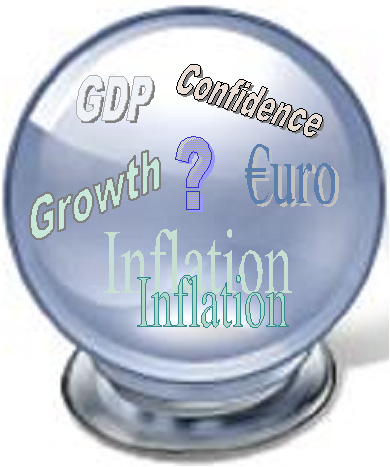 With the deepening euro crisis, the slide back into recession in many developed countries and the slowing down of fast-growing developing countries, such as China and India, confidence is waning.
But just as pessimism increases, so too does uncertainty. The global economy is getting more and more difficult to forecast. So should economists give up trying to forecast? Should we rely on guesswork and hunch, or looking into crystal balls?
Bank of England representatives have been appearing before the Treasury Select Committee. And they have reiterated the consensus that things are getting more difficult to forecast. As Mervyn King said in his evidence:
There is just enormous uncertainty out there. I have no idea what is going to happen in the euro area.
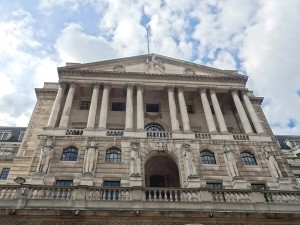 And this uncertainty is making people cautious, which, in turn, damages recovery. As Dr King went on to say:
There is no doubt that with the additional uncertainty this year there’s evidence of people behaving in a very defensive way, being unwilling to invest and of course the most extreme example of that would be if we were to get to a liquidity trap where essentially the main assets people wanted to hold were claims on the central bank.
Part of the reason for the uncertainty about global growth prospects is uncertainty about what European leaders will decide about the future of the eurozone. Another is uncertainty about how people will respond to the uncertainty of others. But predicting how others will predict is very difficult as they will themselves be predicting what others will predict. This dilemma was observed by Keynes when observing how investors on the stock market behaved, all trying to predict what others will do, and is known as the Keynesian Beauty Contest dilemma (see also).
So are governments and central banks powerless to counteract the uncertainty and pessimism? Can they restore confidence and growth? Members of the Bank of England’s Monetary Policy Committee believe that further action can be taken to stimulate aggregate demand. Further quantitative easing and cuts in interest rates could help as, according to Dr King, we are not yet in a liquidity trap.
UK Economic Outlook Uncertain Amid Euro Zone Crisis – BOE NASDAQ, Ilona Billington (26/6/12)
BOE King: UK Not In Liquidity Trap; No Limit On QE Market News International (26/6/12)
BOE King: Unity On Loose Policy; Not Half Way Through Crisis Market News International (26/6/12)
Full Text Of BOE MPC Dale At Treasury Select Committee Market News International (26/6/12)
Recovery still five years away, Mervyn King warns The Telegraph, Philip Aldrick (26/6/12)
Governor pessimistic on recovery ShareCast, Michael Millar (26/6/12)
Bank’s King says ‘pessimistic’ about worsening economy BBC News (26/6/12)
UK economic outlook getting worse, warns Bank of England Guardian, Phillip Inman (26/6/12)
Questions
- Why is it worth economists forecasting, even if those forecasts rarely turn out to be totally accurate?
- Why is it particularly difficult in current circumstances to forecast the state of the macroeconomy 12 months hence – let alone in two or three years?
- In what ways is the global macroeconomic situation deteriorating? What can national governments do about it?
- What limits the effectiveness of government action to deal with the current situation?
- What is meant by the liquidity trap? Are we close to being in such a situation today?
- Explain what is meant by the Keynesian Beauty Contest? How is this relevant today in explaining economic uncertainty and the difficulty of forecasting the economy?
 Recently there have been calls from business leaders and Conservative politicians to scrap the UK’s 50% income tax rate, which is paid on taxable incomes over £150,000. The 50% income tax rate is thus paid by top earners, who comprise around just 1% of taxpayers.
And yet the government receives about 30% of income tax revenue from this 1% – and this was before the introduction of the 50% rate in April 2010. (In fact, with the marginal national insurance rate of 2%, top earners are paying an effective marginal rate of 52%.)
One argument used by those who favour reducing the 50% rate is that the rich would pay more income tax, not less. There are four reasons given for this. The first is that people would be encouraged to work harder and/or seek promotion if they knew they would keep more of any rise in income. The second is that fewer rich people would be encouraged to leave the country or to relocate their businesses abroad. The third is that more people would be encouraged to work in or set up businesses in the UK. The fourth is that there would be less temptation to evade taxes by not declaring all income earned or to find clever ways of avoiding tax.
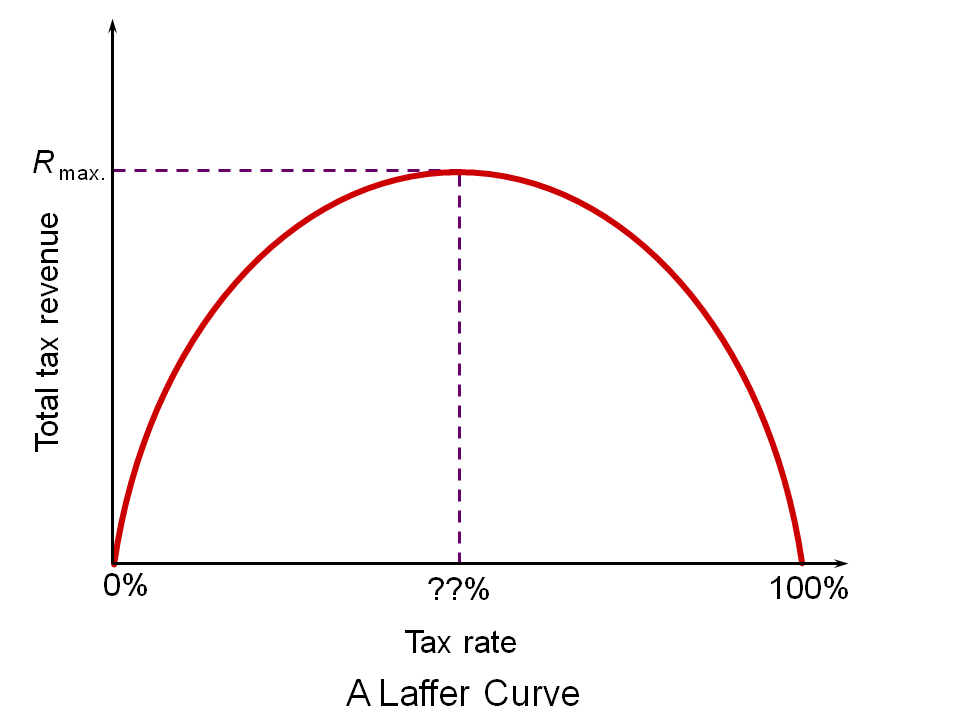
These arguments were put forward in the 1980s by Art Laffer, an adviser to President Reagan. His famous ‘Laffer curve’ (see Economics (8th edition) Box 10.3 or Economics (7th edition) Box 10.4) illustrated that tax revenues are maximised at a particular tax rate. The idea behind the Laffer curve is very simple. At a tax rate of 0%, tax revenue will be zero – but so too at a rate of 100%, since no-one would work if they had to pay all their income in taxes. As the tax rate rises from 0%, so tax revenue would rise. And so too, as the tax rate falls from 100%, the tax rate would rise. It follows that there will be some tax rate between 0% and 100% that maximises tax revenue.
Those arguing that a cut in the top rate of income tax would increase tax revenue are arguing that the 50% rate is beyond the peak of the Laffer curve. But this is an empirical issue. In other words, to assess the argument you would need to look at the evidence as, theoretically, the peak of the Laffer curve could be below or above 50%. Indeed, some argue that the peak is more likely to be at around 75%.
The following podcasts and articles consider the arguments. As you will see, the authors are not all agreed! Consider carefully their arguments and try to identify any flaws in their analysis.
Update
On 27 June 2012, Arthur Laffer appeared on the BBC Today Programme to discuss the Laffer curve and its implications for UK income tax policy. You can hear it from the link below
Podcasts
Should the 50p tax rate be ditched? BBC Today Programme, John Redwood and Paul Johnson (3/3/12)
Arthur Laffer: Tax rate should ‘provide for growth’ BBC Today Programme (27/6/12)
Articles
Where’s the High Point on the Laffer Curve? And Where Are We? Business Insider, Angry bear Blog (3/3/12)
Tax cuts: we can have our cake and eat it The Telegraph, Ruth Porter (22/2/12)
‘Scrap the 50p tax rate’ say 500 UK entrepreneurs Management Today, Rebecca Burn-Callander (1/3/12)
The Laffer Curve Appears in the UK Forbes, Tim Worstall (22/2/12)
Memo to 50p tax trashers: Laffer Curve peaks at over 75 per cent Left Foot Forward, Alex Hern (1/3/12)
Questions
- Explain how a cut in income tax could lead to an increase in tax revenue.
- Distinguish between the income effect and the substitution effect of a tax cut. Which would have to be bigger if a tax cut were to increase tax revenue?
- If, in a given year, the top rate of tax were raised and tax revenue fell, would this prove that the economy was now past the peak of the Laffer curve?
- What would cause the Laffer curve to shift/change shape? To what extent could the government affect the shape of the Laffer curve?
- If the government retains the 50% top tax rate, what can it do to increase the revenue earned from people paying the top rate?
- What other objectives might the government have for having a high marginal income tax rate on top earners?
- Investigate the marginal income tax and national insurance (social protection) rates in other countries. How progressive are UK income taxes compared with those in other countries?
 Academic research is encouraged by universities. Indeed, the number and quality of research publications is the most important criterion for promotion in many universities.
Periodically university research in the UK is publicly assessed. The latest assessment is known as the Research Excellence Framework (REF) and will be completed in 2014. Most research that will be considered by the REF is published in peer-reviewed journals. Most of these journals are subscription based. Universities pay large amounts of money in subscriptions.
In recent years there has been much criticism by both academics and universities about the high cost of such subscriptions. In a movement dubbed the Academic Spring, pressure has mounted for journal articles to be made available free of charge – i.e. on open access.
The government too has been concerned that the results of publicly-funded research has been disappearing behind ‘paywalls’ and hence not available free to people outside the universities which subscribe to such journals. Indeed, no single university can afford licences for all the 25,000 peer-reviewed journals currently being published. As a result, the government set up a committee under the chair of Professor Janet Finch to examine alternative ways of making research more accessible. The committee has just published its report.
It advocates an expansion of open-access journals:
The principle that the results of research that has been publicly funded should be freely accessible in the public domain is a compelling one, and fundamentally unanswerable…
Instead of relying on subscription revenues provided by or on behalf of readers, most [open-access journals] charge a fee to authors…before an article is published. Access for readers is then free of charge, immediately on publication, and with very few restrictions on use and re-use.
Under this model, universities would essentially pay to have their academics’ articles published rather than paying to purchase the journal. Alternatively, research councils could fund the publication of articles based on research already funded by them.
Many people go further. They argue that authors ought to be able to have their published research in any journal made freely available, after an embargo period, through their university’s website.
So is the current pricing model the best for encouraging research and for disseminating its findings? Or is open access a better model – and if so, of what form? Or would it discourage publishers and lead, in the end, to less being published or to a less rigorous peer review process? The questions are ones of pricing, incentives, choices and investment – the questions that economists are qualified to consider.
Articles
Open access may require funds to be rationed Times Higher Education, Paul Jump (21/6/12)
Set science free from publishers’ paywalls New Scientist, Stephen Curry (19/6/12)
Scientists must make research an open book Independent, Martin Hickman (18/6/12)
Report calls on government to back open access science BBC News, Pallab Ghosh (19/6/12)
Open access is the future of academic publishing, says Finch report Guardian, Alok Jha (19/6/12)
Open access to science – its implications discussed in UK raport ZME Science (19/6/12)
UK move to ‘open access’ in publishing Phys.Org, Justin Norrie (20/6/12)
Report
Finch Group Report: Overview Research Information Network (June 2012)
Finch Group Report: Executive Summary Research Information Network (June 2012)
Finch Group Report: Full Report Research Information Network (June 2012)
Questions
- Explain the difference between the ‘gold’ and ‘green’ models of open-access journal article publishing?
- What externalities are involved in journal publication? What are the implications of this for socially efficient pricing?
- How could journal publication be made profitable under an open-access system?
- What are the incentive effects for (a) academics and (b) universities of ranking journals? Does the REF, whereby research articles are judged on their own merits, overcome problems of ranking journals?
- Does the existence of journal rankings allow the top journals in each discipline to maintain a position of market power? How is this likely to impact on journal or article pricing?
- How would university finances be affected by a move towards gold open access journals (a) in the short term; (b) in the long term?
- Would it be in universities’ interests to produce their own open-access journals?
 The charge, made by the Financial Services Authority, is that Barclays staff deliberately under- or overstated the rate at which the bank would have to borrow. For example, when interbank loans were drying up in the autumn of 2008, Barclays staff were accused of deliberately understating the rate at which they would have to borrow in order to persuade markets that the bank was facing less difficulty than it really was and thereby boost confidence in the bank. In other words they were accused of trying to manipulate LIBORs down by lying.