 Real GDP depends on two things: output per hour worked and the number of hours worked. On the surface, the UK economy is currently doing relatively well, with growth in 2014 of 2.8%. After several years of poor economic growth following the financial crisis of 2007/8, growth of 2.8% represents a return to the long-run average for the 20 years prior to the crisis.
But growth since 2010 has been entirely due to an increase in hours worked. On the one hand, this is good, as it has meant an increase in employment. In this respect, the UK is doing better than other major economies. But productivity has not grown and on this front, the UK is doing worse than other countries.
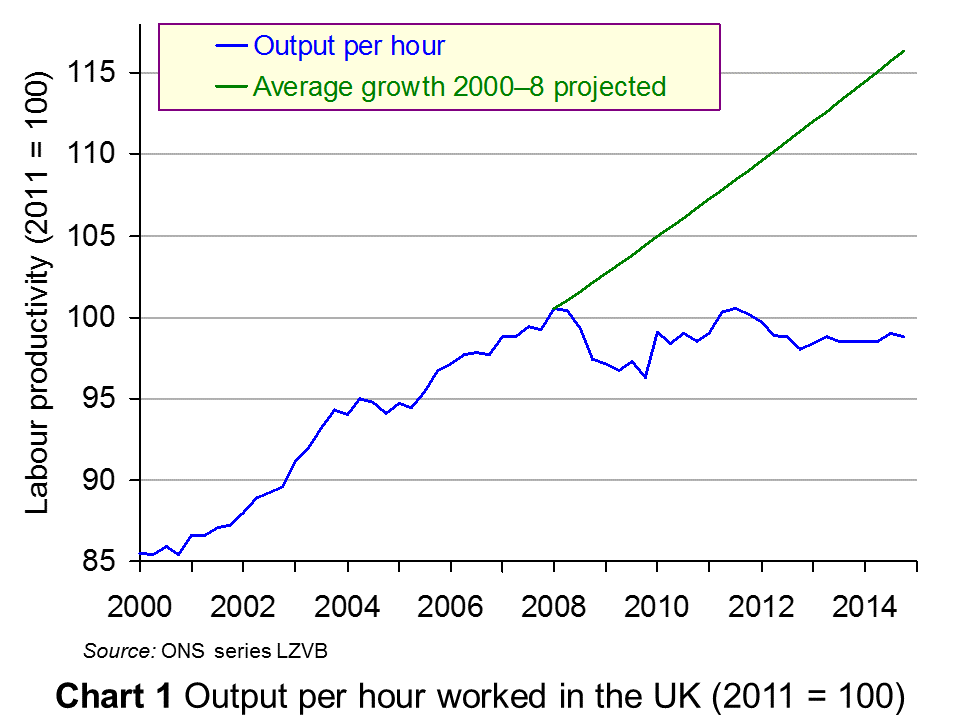 The first chart shows UK output per hour worked (click here for a PowerPoint). It is based on figures released by the ONS on 1 April 2015. Average annual growth in output per hour worked was 2.3% from 2000 to 2008. Since then, productivity growth has stalled and output per hour is now lower than at the peak in 2008.
The green line projects from 2008 what output per hour would have been if its growth had remained at 2.3%. It shows that by the end of 2014 output per hour would have been nearly 18% higher if productivity growth had been maintained.
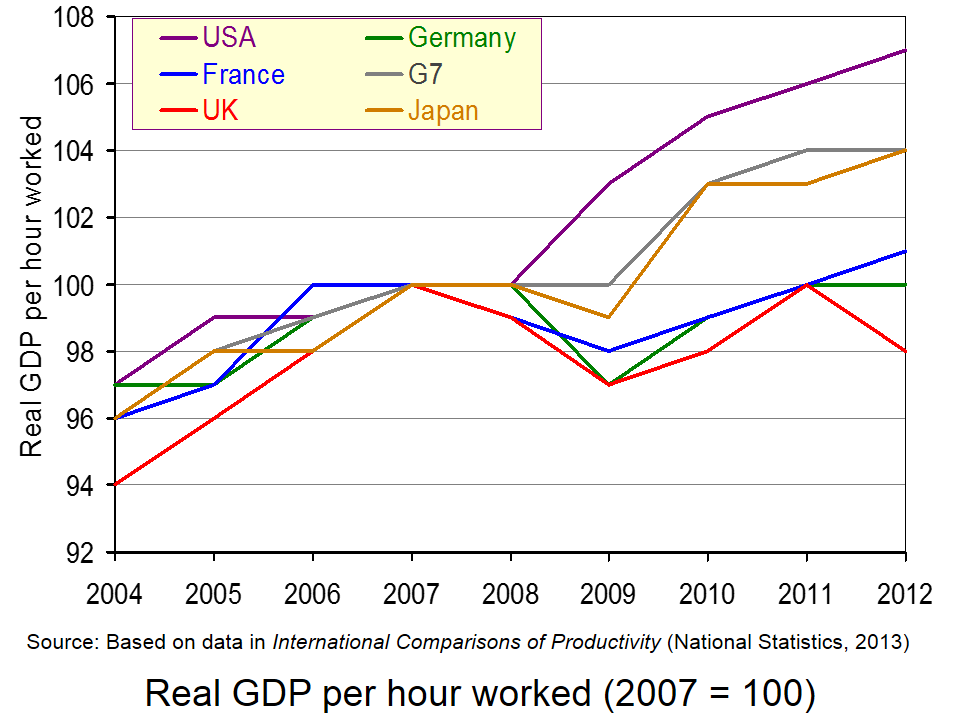
 The second chart compares UK productivity growth with other countries (click here for a PowerPoint). Up to 2008, UK productivity was rising slightly faster than in the other five countries illustrated. Since then, it has performed worse than the other five countries, especially since 2011.
Productivity growth increases potential GDP. It also increases actual GDP if the productivity increase is not offset by a fall in hours worked. A rise in hours worked without a rise in productivity, however, even though it results in an increase in actual output, does not increase potential output. If real GDP growth is to be sustained over the long term, there must be an increase in productivity and not just in hours worked.
The articles below examines this poor productivity performance and looks at reasons why it has been so bad.
Articles
UK’s sluggish productivity worsened in late 2014 – ONS Reuters (1/4/15)
UK productivity growth is weakest since second world war, says ONS The Guardian, Larry Elliott (1/4/15)
UK productivity weakness worsening, says ONS Financial Times, Chris Giles (1/4/15)
Is the UK’s sluggish productivity a problem? Financial Times comment (1/4/15)
UK manufacturing hits eight-month high but productivity slump raises fears over sustainability of economic recovery This is Money, Camilla Canocchi (1/4/15)
Weak UK productivity unprecedented, ONS says BBC News (1/4/15)
Weep for falling productivity Robert Peston (1/4/15)
UK’s Falling Productivity Prevented A Massive Rise In Unemployment Forbes, Tim Worstall (2/4/15)
Data
Labour Productivity, Q4 2014 ONS (1/4/15)
AMECO database European Commission, Economic and Financial Affairs
Questions
- How can productivity be measured? What are the advantages and disadvantages of using specific measures?
- Draw a diagram to show the effects on equilibrium national income of (a) a productivity increase, but offset by a fall in the number of hours worked; (b) a productivity increase with hours worked remaining the same; (c) a rise in hours worked with no increase in productivity. Assume that actual output depends on aggregate demand.
- Is poor productivity growth good for employment? Explain.
- Why is productivity in the UK lower now than in 2008?
- What policies can be pursued to increase productivity in the UK?
 First the good news. Employment is rising and unemployment is falling. Both claimant count rates and Labour Force Survey rates are down. Compared with a year ago, employment is up 279,092 to 29,869,489; LFS unemployment is down from 7.87% to 7.69%; and the claimant count rate is down from 4.7% to 4.0%.
Now the bad news. Even though more people are in employment, real wages have fallen. In other words, nominal wages have risen less fast than prices. Since 2009, real wages have fallen by 7.6% and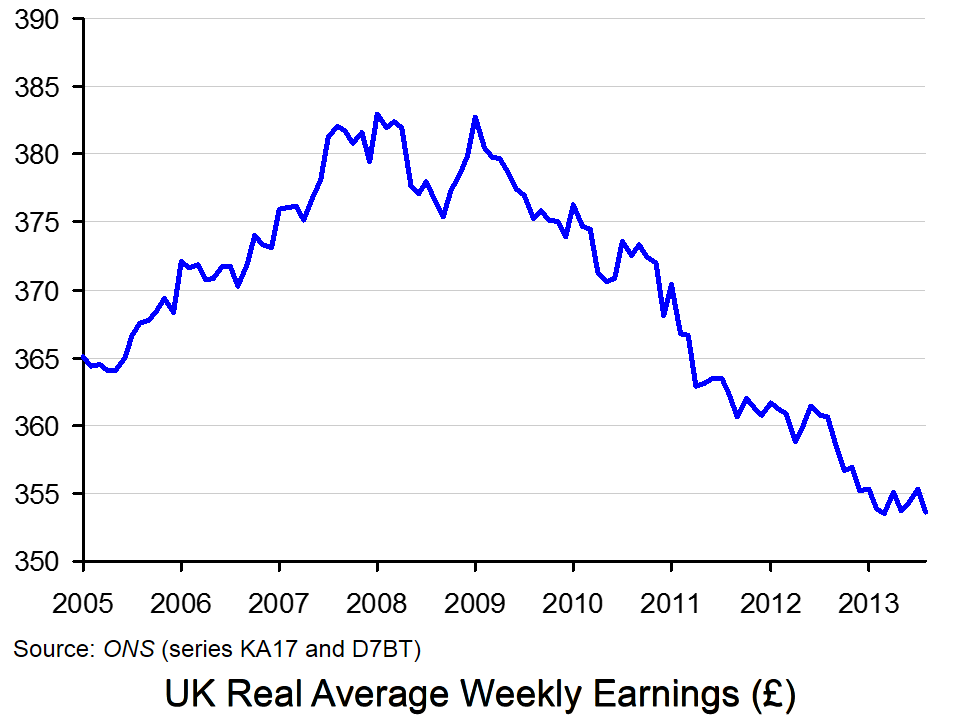 have continued to fall throughout this period. The first chart illustrates this. It shows average weekly wage rates in 2005 prices. (Click here for a PowerPoint of the chart.)
The fall in real wages is an average for the whole country. Many people, especially those on low incomes, have seen their real wages fall much faster than the average. For many there is a real ‘cost of living’ crisis.
But why have real wages fallen despite the rise in employment? The answer is that output per hour worked has declined. This is illustrated in the second chart, which compares UK output per worker with that of other G7 countries. UK productivity has fallen both absolutely and relative to other G7 countries, most of which have had higher rates of investment.
 The falling productivity in the UK requires more people to be employed to produce the same level of output. Part of what seems to be happening is that many employers have been prepared to keep workers on in return for lower real wages, even if demand from their customers is falling. And many workers have been prepared to accept real wage cuts in return for keeping their jobs.
Another part of the explanation is that the jobs that have been created have been largely in low-skilled, low-wage sectors of the economy, such as retailing and other parts of the service sector.
But falling productivity is only part of the reason for falling real wages. The other part is rising prices. A number of factors have contributed to this. These include a depreciation of the exchange rate back in 2008, the effects of which took some time to filter through into higher prices in the shops; a large rise in various commodity prices; and a rise in VAT and various other administered prices.
So what is the answer to falling real wages? The articles below consider the problem and some of the possible policy alternatives.
Articles
Inflation, unemployment and UK ‘misery’ BBC News, Linda Yueh (16/10/13)
Employment is growing, but so are the wage slaves The Guardian, Larry Elliott (16/10/13)
Living standards – going down and, er, up BBC News, Nick Robinson (26/7/13)
Revealed: The cost of living is rising faster in the UK than anywhere in Europe, with soaring food and energy bills blamed Mail Online, Matt Chorley (16/10/13)
Cutting prices to raise living standards is just a waste of energy The Telegraph, Roger Bootle (6/10/13)
Downturn sees average real wages collapse to a record low Independent, Ben Chu (17/10/13)
Why living standards and public finances matter Financial Times, Gavin Kelly (29/9/13)
Social Mobility Tsar Alan Milburn Calls on Government to Boost Wages to End UK Child Poverty International Business Times, Ian Silvera (17/10/13)
Do incorrect employment growth figures explain low UK productivity? The Guardian, Katie Allen (23/10/13)
Data
Unemployment data ONS
Average Weekly Earnings dataset ONS
Consumer Prices Index ONS
International Comparison of Productivity ONS
Questions
- How are real wages measured?
- Why have real wage rates fallen in the UK since 2009?
- What factors should be included when measuring living standards?
- Why has employment risen and unemployment fallen over the past two years?
- What factors could lead to a rise in real wages in the future?
- What government policies could be adopted to raise real wages?
- Assess these policies in terms of their likely short-term success and long-term sustainability.
 Real GDP depends on two things: output per hour worked and the number of hours worked. On the surface, the UK economy is currently doing relatively well, with growth in 2014 of 2.8%. After several years of poor economic growth following the financial crisis of 2007/8, growth of 2.8% represents a return to the long-run average for the 20 years prior to the crisis.