 The global economic impact of the coronavirus outbreak is uncertain but potentially very large. There has already been a massive effect on China, with large parts of the Chinese economy shut down. As the disease spreads to other countries, they too will experience supply shocks as schools and workplaces close down and travel restrictions are imposed. This has already happened in South Korea, Japan and Italy. The size of these effects is still unknown and will depend on the effectiveness of the containment measures that countries are putting in place and on the behaviour of people in self isolating if they have any symptoms or even possible exposure.
The OECD in its March 2020 interim Economic Assessment: Coronavirus: The world economy at risk estimates that global economic growth will be around half a percentage point lower than previously forecast – down from 2.9% to 2.4%. But this is based on the assumption that ‘the epidemic peaks in China in the first quarter of 2020 and outbreaks in other countries prove mild and contained.’ If the disease develops into a pandemic, as many health officials are predicting, the global economic effect could be much larger. In such cases, the OECD predicts a halving of global economic growth to 1.5%. But even this may be overoptimistic, with growing talk of a global recession.
Governments and central banks around the world are already planning measures to boost aggregate demand. The Federal Reserve, as an emergency measure on 3 March, reduced the Federal Funds rate by half a percentage point from the range of 1.5–1.75% to 1.0–1.25%. This was the first emergency rate cut since 2008.
Economic uncertainty
With considerable uncertainty about the spread of the disease and how effective containment measures will be, stock markets have fallen dramatically. The FTSE 100 fell by nearly 14% in the second half of February, before recovering slightly at the beginning of March.  It then fell by a further 7.7% on 9 March – the biggest one-day fall since the 2008 financial crisis. This was specifically in response to a plunge in oil prices as Russia and Saudi Arabia engaged in a price war. But it also reflected growing pessimism about the economic impact of the coronavirus as the global spread of the epidemic accelerated and countries were contemplating more draconian lock-down measures.
Firms have been drawing up contingency plans to respond to panic buying of essential items and falling demand for other goods. Supply-chain managers are working out how to respond to these changes and to disruptions to supplies from China and other affected countries.
Firms are also having to plan for disruptions to labour supply. Large numbers of employees may fall sick or be advised/required to stay at home. Or they may have to stay at home to look after children whose schools are closed.  For some firms, having their staff working from home will be easy; for others it will be impossible.
Some industries will be particularly badly hit, such as airlines, cruise lines and travel companies. Budget airlines have cancelled several flights and travel companies are beginning to offer substantial discounts. Manufacturing firms which are dependent on supplies from affected countries have also been badly hit. This is reflected in their share prices, which have seen large falls.
Longer-term effects
Uncertainty could have longer-term impacts on aggregate supply if firms decide to put investment on hold. This would also impact on the capital goods industries which supply machinery and equipment to investing firms. For the UK, already having suffered from Brexit uncertainty, this further uncertainty could prove very damaging for economic growth.
 While aggregate supply is likely to fall, or at least to grow less quickly, what will happen to the balance of aggregate demand and supply is less clear. A temporary rise in demand, as people stock up, could see a surge in prices, unless supermarkets and other firms are keen to demonstrate that they are not profiting from the disease. In the longer term, if aggregate demand continues to grow at past rates, it will probably outstrip the growth in aggregate supply and result in rising inflation. If, however, demand is subdued, as uncertainty about their own economic situation leads people to cut back on spending, inflation and even the price level may fall.
How quickly the global economy will ‘bounce back’ depends on how long the outbreak lasts and whether it becomes a serious pandemic and on how much investment has been affected. At the current time, it is impossible to predict with any accuracy the timing and scale of any such bounce back.
Articles
- Coronavirus: Global growth ‘could halve’ if outbreak intensifies
BBC News (2/3/20)
- Coronavirus: Eight charts on how it has shaken economies
BBC News, Lora Jones, David Brown & Daniele Palumbo (4/3/20)
- The economic ravages of coronavirus
BBC News, Douglas Fraser (7/3/20)
- What Coronavirus Could Mean for the Global Economy
Harvard Business Review, Philipp Carlsson-Szlezak, Martin Reeves and Paul Swartz (3/3/20)
- Coronavirus escalation could cut global economic growth in half – OECD
The Guardian, Richard Partington and Phillip Inman (2/3/20)
- U.S. Fed Cuts Rates, There Are Still Strategies The ECB Can Follow
Forbes, Stephen Pope (3/3/20)
- A coronavirus recession could be supply-side with a 1970s flavour
The Guardian, Kenneth Rogoff (3/3/20)
- Coronavirus will wreak havoc on the US economy
CNN, Mark Zandi (3/3/20)
- UK factories feel the effects of coronavirus spread – PMI
Reuters, William Schomberg (2/3/20)
- The first economic modelling of coronavirus scenarios is grim for Australia, the world
The Conversation, Australia, Warwick McKibbin and Roshen Fernando (3/3/20)
- Extraordinary complacency: the coronavirus and emerging markets
Financial Times, Geoff Dennis (2/3/20)
- Coronavirus Economic Impact On Global Economy
Seeking Alpha, Mark Bern (1/3/20)
- OECD warns coronavirus could halve global growth
Financial Times, Chris Giles, Martin Arnold and Brendan Greeley (2/3/20)
- BoE’s Carney sees ‘powerful and timely’ global response to coronavirus
Reuters, David Milliken, Elizabeth Howcroft (3/3/20)
eBook
Questions
- Using a supply and demand diagram, illustrate the fall in stock market prices caused by concerns over the effects of the coronavirus.
- Using either (i) an aggregate demand and supply diagram or (ii) a DAD/DAS diagram, illustrate how a fall in aggregate supply as a result of the economic effects of the coronavirus would lead to (a) a fall in real income and (i) a fall in the price level or (ii) a fall in inflation; (b) a fall in real income and (i) a rise in the price level or (ii) a rise in inflation.
- What would be the likely effects of central banks (a) cutting interest rates; (b) engaging in further quantitative easing?
- What would be the likely effects of governments running a larger budget deficit as a means of boosting the economy?
- Distinguish between stabilising and destabilising speculation. How would you characterise the speculation that has taken place on stock markets in response to the coronavirus?
- What are the implications of people being paid on zero-hour contracts of the government requiring workplaces to close?
- What long-term changes to working practices and government policy could result from short-term adjustments to the epidemic?
- Is the long-term macroeconomic impact of the coronavirus likely to be zero, as economies bounce back? Explain.
 With many countries experiencing low growth some 12 years after the financial crisis and with new worries about the effects of the coronavirus on output in China and other countries, some are turning to a Keynesian fiscal stimulus (see Case Study 16.6 on the student website). This may be in the form of tax cuts, or increased government expenditure or a combination of the two. The stimulus would be financed by increased government borrowing (or a reduced surplus).
The hope is that there will also be a longer-term supply-side effect which will boost potential national income. This could be through tax reductions creating incentives to invest or work more efficiently; or it could be through increased capacity from infrastructure spending, whether on transport, energy, telecommunications, health or education.
In the UK, the former Chancellor, Sajid Javid, had adopted a fiscal rule similar to the Golden Rule adopted by the Labour government from 1997 to 2008. This stated that, over the course of the business cycle, the government should borrow only to invest and not to fund current expenditure. Javid’s rule was that the government would balance its current budget by the middle of this Parliament (i.e. in 2 to 3 years) but that it could borrow to invest, provided that this did not exceed 3% of GDP. Previously this limit had been set at 2% of GDP by the former Chancellor, Philip Hammond. Using his new rule, it was expected that Sajid Javid would increase infrastructure spending by some £20 billion per year. This would still be well below the extra promised by the Labour Party if they had won the election and below what many believe Boris Johnson Would like.
 Sajid Javid resigned at the time of the recent Cabinet reshuffle, citing the reason that he would have been required to sack all his advisors and use the advisors from the Prime Minister’s office. His successor, the former Chief Secretary to the Treasury, Rishi Sunak, is expected to adopt a looser fiscal rule in his Budget on March 11. This would result in bigger infrastructure spending and possibly some significant tax cuts, such as a large increase in the threshold for the 40% income tax rate.
A Keynesian stimulus would almost certainly increase the short-term economic growth rate as inflation is low. However, unemployment is also low, meaning that there is little slack in the labour market, and also the output gap is estimated to be positive (albeit only around 0.2%), meaning that national income is already slightly above the potential level.
 Whether a fiscal stimulus can increase long-term growth depends on whether it can increase capacity. The government hopes that infrastructure expenditure will do just that. However, there is a long time lag between committing the expenditure and the extra capacity coming on stream. For example, planning for HS2 began in 2009. Phase 1 from London to Birmingham is currently expected to be operation not until 2033 and Phase 2, to Leeds and Manchester, not until 2040, assuming no further delays.
Crossrail (the new Elizabeth line in London) has been delayed several times. Approved in 2007, with construction beginning in 2009, it was originally scheduled to open in December 2018. It is now expected to be towards the end of 2021 before it does finally open. Its cost has increased from £14.8 billion to £18.25 billion.
Of course, some infrastructure projects are much quicker, such as opening new bus routes, but most do take several years.
The first five articles look at UK policy. The rest look at Keynesian fiscal policies in other countries, including the EU, Russia, Malaysia, Singapore and the USA. Governments seem to be looking for a short-term boost to aggregate demand that will increase short-term GDP, but also have longer-term supply-side effects that will increase the growth in potential GDP.
Articles
Questions
- Illustrate the effect of an expansionary fiscal policy with a Keynesian Cross (income and expenditure) diagram or an injections and withdrawals diagram.
- What is meant by the term ‘output gap’? What are the implications of a positive output gap for expansionary Keynesian policy?
- Assess the benefits of having a fiscal rule that requires governments to balance the current budget but allows borrowing to invest.
- Would there be a problem following such a rule if there is currently quite a large positive output gap?
- To what extent are the policies being proposed in Russia, the EU, Malaysia and Singapore short-term demand management policies or long-term supply-side policies?
 Since the financial crisis of 2008–9, the UK has experienced the lowest growth in productivity for the past 250 years. This is the conclusion of a recent paper published in the National Institute Economics Review. Titled, Is the UK Productivity Slowdown Unprecedented, the authors, Nicholas Crafts of the University of Sussex and Terence C Mills of Loughborough University, argue that ‘the current productivity slowdown has resulted in productivity being 19.7 per cent below the pre-2008 trend path in 2018. This is nearly double the previous worst productivity shortfall ten years after the start of a downturn.’
According to ONS figures, productivity (output per hour worked) peaked in 2007 Q4. It did not regain this level until 2011 Q1 and by 2019 Q3 was still only 2.4% above the 2007 Q4 level. This represents an average annual growth rate over the period of just 0.28%. By contrast, the average annual growth rate of productivity for the 35 years prior to 2007 was 2.30%.
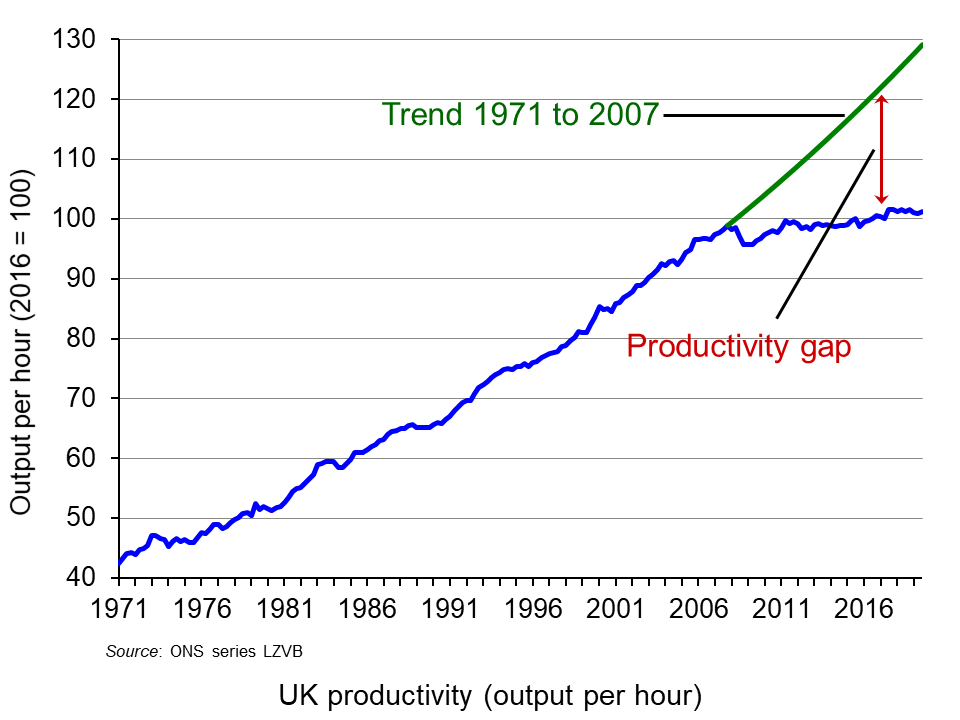 The chart illustrates this and shows the productivity gap, which is the amount by which output per hour is below trend output per hour from 1971 to 2007. By 2019 Q3 this gap was 27.5%. (Click here for a PowerPoint of the chart.) Clearly, this lack of growth in productivity over the past 12 years has severe implications for living standards. Labour productivity is a key determinant of potential GDP, which, in turn, is the major limiter of actual GDP.
Crafts and Mills explore the reasons for this dramatic slowdown in productivity. They identify three primary reasons.
 The first is a slowdown in the impact of developments in ICT on productivity. The office and production revolutions that developments in computing and its uses had brought about have now become universal. New developments in ICT are now largely in terms of greater speed of computing and greater sophistication of software. Perhaps with an acceleration in the development of artificial intelligence and robotics, productivity growth may well increase in the relatively near future (see third article below).
The second cause is the prolonged impact of the banking crisis, with banks more cautious about lending and firms more cautious about borrowing for investment. What is more, the decline in investment directly impacts on potential output, and layoffs or restructuring can leave people with redundant skills. There is a hysteresis effect.
The third cause identified by Crafts and Mills is Brexit. Brexit and the uncertainty surrounding it has resulted in a decline in investment and ‘a diversion of top-management time towards Brexit planning and a relative shrinking of highly-productive exporters compared with less productive domestically orientated firms’.
Articles
Paper
Questions
- How suitable is output (GDP) per hour as a measure of labour productivity?
- Compare this measure of productivity with other measures.
- According to Crafts and Mills, what is the size of the impact of each of their three explanations of the productivity slowdown?
- Would you expect the growth in productivity to return to pre-2007 levels over the coming years? Explain.
- Explain the underlying model for obtaining trend productivity growth rates used by Crafts and Mills.
- Explain and comment on each of the six figures in the Crafts and Mills paper.
- What policies should the government adopt to increase productivity growth?
 Confidence figures suggest that sentiment weakened across several sectors in June with significant falls recorded in retail and construction. This is consistent with the monthly GDP estimates from the ONS which suggest that output declined in March and April by 0.1 per cent and 0.4 per cent respectively. The confidence data point to further weakness in growth down the line. Furthermore, it poses the risk of fuelling a snowball effect with low growth being amplified and sustained by low confidence.
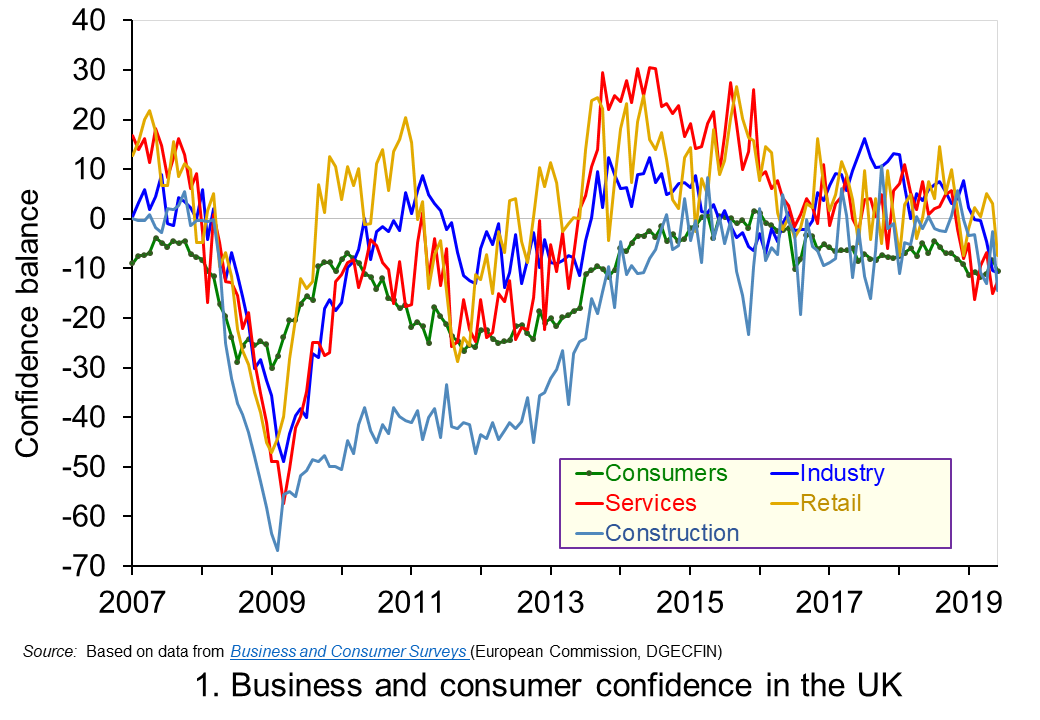 Chart 1 shows the confidence balances reported by the European Commission each month since 2007. It highlights the collapse in confidence across all sectors around the time of the financial crisis before a strong and sustained recovery in the 2010s. However, in recent months confidence indicators have eased significantly, undoubtedly reflecting the heightened uncertainty around Brexit. (Click here to download a PowerPoint copy of the chart.)
Between June 2016 and June 2019, the confidence balances have fallen by at least 8 percentage points. In the case of the construction the fall is 14 points while in the important service sector, which contributes about 80 per cent of the economy’s national income, the fall is as much as 15 points.
Changes in confidence are thought, in part, to reflect levels of economic uncertainty. In particular, they may reflect the confidence around future income streams with greater uncertainty pulling confidence down. This is pertinent because of the uncertainty around the UK’s future trading relationships following the 2016 referendum which saw the UK vote to leave the EU. In simple terms, uncertainty reduces the confidence people and businesses have when forming expectations of what they can expect to earn in the future.
Greater uncertainty and, hence, lower confidence tend to make people and businesses more prudent. The caution that comes from prudence counteracts the inherent tendency of many of us to be impatient. This impatience generates an impulse to spend now. On the other hand, prudence encourages us to take actions to increase net worth, i.e. wealth. This may be through reducing our exposure to debt, perhaps by looking to repay debts or choosing to borrow smaller sums than we may have otherwise done. Another option may be to increase levels of saving. In either case, the effect of greater prudence is the postponement of spending. Therefore, in times of high uncertainty, like those of present, people and businesses would be expected to want to have greater financial resilience because they are less confident about what the future holds.
To this point, the saving ratio – the proportion of disposable income saved by households – has remained historically low. In Q1 2019 the saving ratio was 4.4 per cent, well below its 60-year average of 8.5 per cent. This appears to contradict the idea that households respond to uncertainty by increasing saving. However, at least in part, the squeeze seen over many years following the financial crisis on real earnings, i.e. inflation-adjusted earnings, restricted the ability of many to increase saving. With real earnings having risen again over the past year or so, though still below pre-crisis levels, households may have taken this opportunity to use earnings growth to support spending levels rather than, as we shall see shortly, looking to borrow.
Another way in which the desire for greater financial resilience can affect behaviour is through the appetite to borrow. In the case of consumers, it could reduce borrowing for consumption, while in the case of firms it could reduce borrowing for investment, i.e. spending on capital, such as that on buildings and machinery. The reduced appetite for borrowing may also be mirrored by a tightening of credit conditions by financial institutions if they perceive lending to be riskier or want to increase their own financial capacity to absorb future shocks.
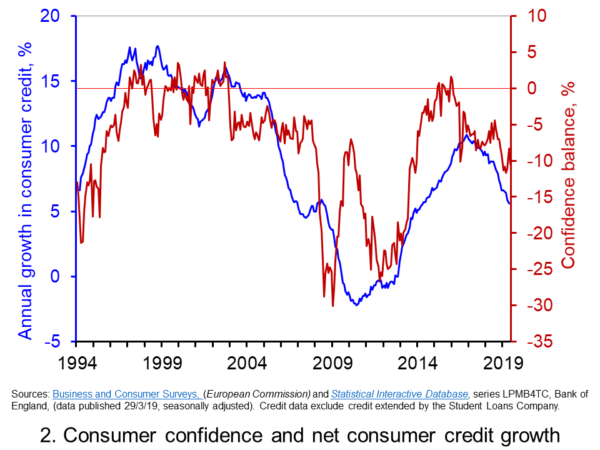 Chart 2 shows consumer confidence alongside the annual rate of growth of consumer credit (net of repayments) to individuals by banks and building societies. Consumer credit is borrowing by individuals to finance current expenditure on goods and services and it comprises borrowing through credit cards, overdraft facilities and other loans and advances, for example those financing the purchase of cars or other large ticket items. (Click here to download a PowerPoint copy of the chart.)
The chart allows us to view the confidence-borrowing relationship for the past 25 years or so. It suggests a fairly close association between consumer confidence and consumer credit growth. Whether changes in confidence occur ahead of changes in borrowing is debatable. However, the easing of confidence following the outcome of the EU referendum vote in June 2016 does appear to have led subsequently to an easing in the annual growth of consumer credit. From its peak of 10.9 per cent in the autumn of 2016, the annual growth rate of consumer credit dropped to 5.6 per cent in May 2019.
The easing of credit growth helps put something of a brake on consumer spending. It is, however, unlikely to affect all categories of spending equally. Indeed, the ONS figures for May on retail sales shows a mixed picture for the retail sector. Across the sector as a whole, the 3 month-on-3 month growth rate for the volume of purchases stood at 1.6 per cent, having fallen as low as 0.1 percent in December of last year. However, the 3 month-on-3 month growth rate for spending volumes in department stores, which might be especially vulnerable to a slowdown in credit, fell for the ninth consecutive month.
Going forward, the falls in confidence might be expected to lead to further efforts by the household sector, as well as by businesses, to ensure their financial resilience. The vulnerability of households, despite the slowdown in credit growth, so soon after the financial crisis poses a risk for a hard landing for the sector. After falls in national output in March and April, the next monthly GDP figures to be released on 10 July will be eagerly anticipated.
Articles
Questions
- Which of the following statements is likely to be more accurate: (a) Confidence drives economic activity or (b) Economic activity drives confidence?
- Explain the difference between confidence as a source of economic volatility as compared to an amplifier of volatility?
- Discuss the links between confidence, economic uncertainty and financial resilience.
- Discuss the ways in which people and businesses could improve their financial resilience to adverse shocks.
- What are the potential dangers to the economy of various sectors being financially distressed or exposed?
 Latest resesarch from the independent American think tank The Conference Board paints a worrying picture about the growth of UK labour productivity. While global growth in labour productivity has weakened following the financial crisis, its weakness in the UK is singled out in the Board’s 2019 Productivity Brief. It finds that amongst large mature economies the decline in labour productivity growth rates has been greatest in the UK. This has important implications for the country’s longer-term well-being and, specifically, it peoples’ living standards.
The UK saw the growth in real GDP (national output) fall from 1.8 per cent in 2017 to 1.4 per cent in 2018. The Conference Board predicts that this will fall further to 0.8 per cent in 2019. In the context of living standards, the growth in real GDP per capita is particularly important. An increase in the population will, other things being equal, lower living standards because more people will be sharing a given amount of real national income. The growth in real GDP per capita fell from 1.1 per cent in 2017 to 0.7 per cent in 2018 and is predicted to fall to just 0.1 per cent in 2019.
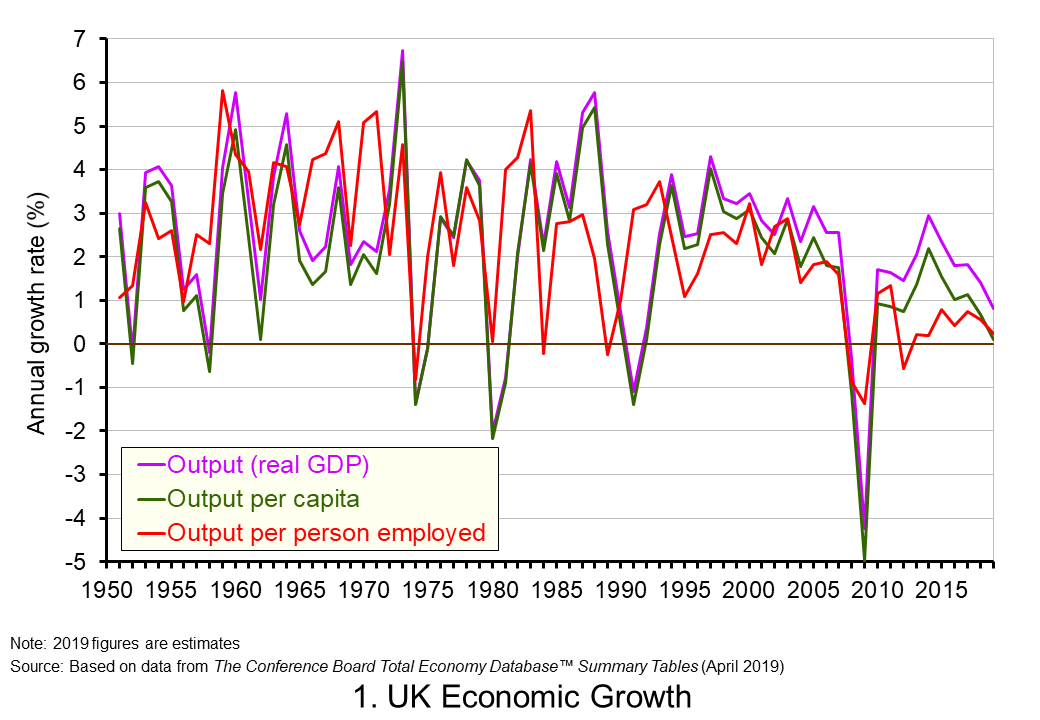 Chart 1 shows the annual rates of growth in real GDP and real GDP per capita from the 1950s. The average growth rates are 2.4 and 1.9 per cent respectively. The other series shown is the annual growth in real GDP per person employed. This is a measure of the growth in labour productivity. Its average annual growth rate is also 1.9 per cent. This illustrates the intrinsic long-run relationship between labour productivity growth and the growth rate of GDP per capita and hence in general living stanadards. (Click here to download a PowerPoint copy of the chart.)
In the short term, rates of growth in output per worker (labour productivity) and GDP per capita (general living standards) can be less similar. For example, when unemployment rates rise labour productivity rates may be little affected despite GDP per capita falling. Nonetheless, the important point here is the close long-run relationship between the growth in labour productivity and GDP per capita. This then raises an important question: what factors contribute to the growth in output and labour productivity?
An approach known as growth accounting helps to identify four key contributors to the growth of total output. The first is the quantity of labour, commonly measured in labour hours. The second is the quality of labour, also known as labour composition. Third is capital services which are physical inputs into production and include machinery, structures and IT capital. Capital services are affected by quantity and quality, but, unlike labour, it is practically more difficult to separate out these dimensions. Fourth, is Total Factor Productivity (TFP).
TFP it is essentially the residual contribution to output growth that cannot be explained by changes in the quantity and quality of the individual inputs. Hence, in principle, it is capturing changes in how effectively the labour and capital inputs are being employed and combined in production. The Conference Board’s Productivity Brief describes the growth in TFP as providing ‘a more accurate picture of the overall efficiency by which capital, labour and skills are combined in the production process’.
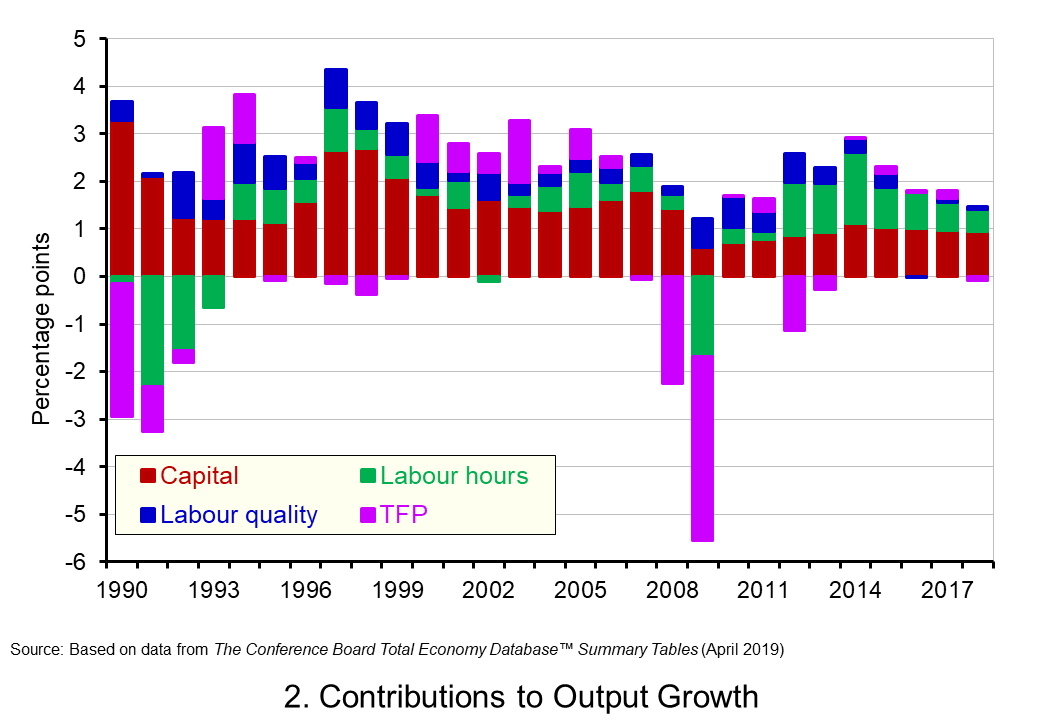 Chart 2 shows Conference Board estimates of the percentage point contribution of these four sources of growth since 1990. Over this period, output growth averaged 2 per cent per year. The contribution of capital services and, hence, what is known as capital accumulation is particularly significant at 1.5 percentage points per year. This has been significantly larger than the contribution of labour hours which averaged only 0.3 percentage points per year since 1990. This evidences the importance played by capital deepening for output growth in the UK. (Click here to download a PowerPoint copy of the chart.)
Capital deepening captures the growth in capital services relative to the growth in the labour input. It takes on even greater significance when we think about the growth in labour productivity since, after all, this is the growth in output relative to the quantity of labour. It is significant though that since 2015 the growth of capital services has contributed only 1 percentage point to output growth while the growth of labour hours has contributed an average of 0.7 percentage points. This points to a slowdown in capital deepening and hence in the growth of labour productivity.
Chart 2 also illustrates the importance of TFP growth to overall output growth. It is also important (along with capital deepening and the growth in labour quality) for the growth in labour productivity. Interestingly, we observe significant fluctuations in the growth of TFP. This is thought to reflect fluctuations in the utilisation of inputs. For example, if the utilisation of inputs falls (rises) when output falls (increases) this will be mirrored by a disproportionately large fall (increase) in TFP. In the longer-term, however, changes in TFP capture aspects of technological progress and advancement that enable more effective production methods and techniques to be deployed. In other words, the growth of TFP captures the ability of production to benefit from the advancement in ideas, products, processes and know-how.
A decline in the growth in TFP growth following the financial crisis is found quite widely in mature economies. The annual rate of growth of TFP across mature economies fell from 0.5 per cent year in 2000-2007 to 0.2 per cent in 2010-2017. In the UK this fall was from 0.5 per cent to -0.1 per cent. Hence, the decline in TFP growth of 0.6 percentage points between 2010 and 2017 was double the 0.3 percentage point fall across all mature economies. In 2018 the Conference Board estimate that TFP in the UK fell by 0.1 percent further exacerbating the downward pressure on labour productivity.
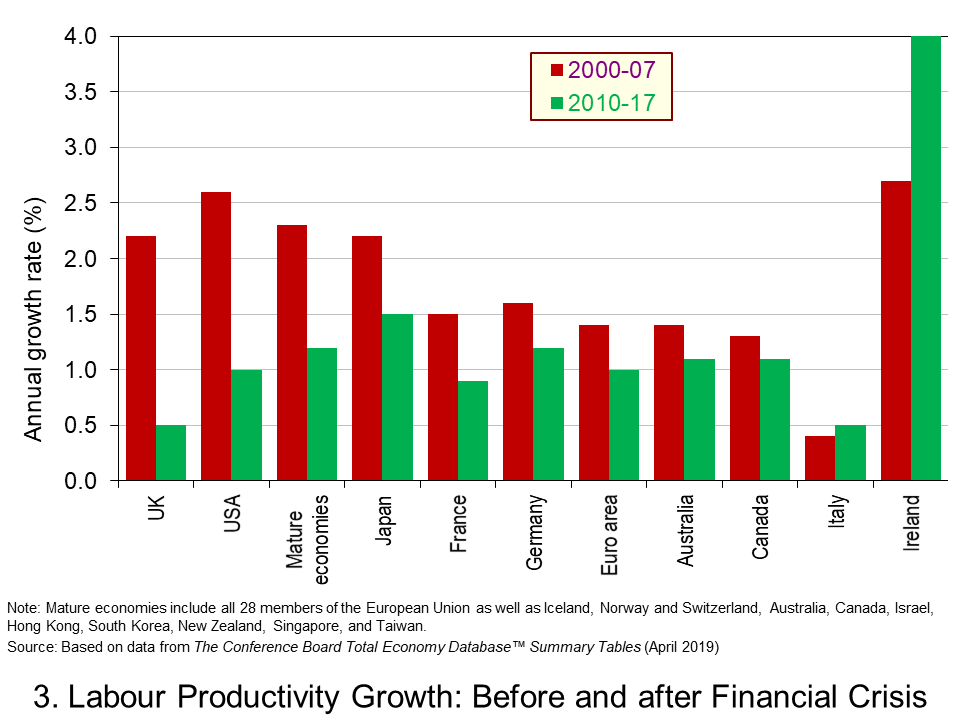 As our final chart shows, it is the magnitude to which labour productivity has eased following the financial crisis that sets the UK apart. While across all mature economies the growth of output per labour hour (another measure of labour productivity growth) fell from an average of 2.3 per cent per year in 2000-2007 to 1.2 per cent in 2010-2017, in the UK the fall was from 2.2 per cent to 0.5 per cent per year. (Click here to download a PowerPoint copy of the chart.)
While the productivity problem facing the UK is not new, the latest figures comes as a very timely reminder of the extent of the problem. To some extent the uncertainty around Brexit and the negative impact on capital accumulation has only helped to exacerbate the problem. But, this may mask a more systemic problem facing the UK. Getting to the root of this problem matters. It matters most significantly for our long-term wellbeing and prosperity. The productivity gap with our major industrial competitors is a gap that policymakers need not only to be mindful of but one that needs closing.
Articles
Questions
- What do you understand by the term labour productivity. How could we measure it?
- Why is it important to look at the growth of output per capita when assessing the benefits of long-term growth?
- Why is labour productivity important for the long-term well-being of a country?
- What do you understand by the method of growth accounting?
- What is the distinction between capital accumulation and capital deepening?
- What might explain why the growth of labour productivity has been lower in the years following the post-financial crisis?
- What do you understand by Total Factor Productivity (TFP)?
- What does the long-term growth of TFP attempt to capture?
- If you were an economic advisor to the government, what types of policy initiatives might you recommend for a government concerned about low rates of growth of labour productivity?