 In a carefully argued article in the New Statesman, the UK Business Secretary, Vince Cable, considers the slow recovery in the economy and whether additional measures should be adopted. He sums up the current state of the economy as follows:
The British economy is still operating at levels around or below those before the 2008 financial crisis and roughly 15 per cent below an albeit unsustainable pre-crisis trend. There was next to no growth during 2012 and the prospect for 2013 is of very modest recovery.
Unsurprisingly there is vigorous debate as to what has gone wrong. And also what has gone right; unemployment has fallen as a result of a million (net) new jobs in the private sector and there is vigorous growth of new enterprises. Optimistic official growth forecasts and prophets of mass unemployment have both been confounded.
He argues that supply-side policies involving “a major and sustained commitment to skills, innovation and infrastructure investment” are essential if more rapid long-term growth is to be achieved. This is relatively uncontroversial.
 But he also considers the claim that austerity has kept the economy from recovering and whether policies to tackle the negative output gap should be adopted, even if this means a short-term increase in government borrowing.
But crude Keynesian policies of expanding aggregate demand are both difficult to implement and may not take into account the particular circumstance of the current extended recession – or depression – in the UK and in many eurozone countries. World aggregate demand, however, is not deficient. In fact it is expanding quite rapidly, and with the sterling exchange rate index some 20% lower than before the financial crisis, this should give plenty of opportunity for UK exporters.
Yet expanding UK aggregate demand is proving difficult to achieve. Consumers, worried about falling real wages and large debts accumulated in the years of expansion, are reluctant to increase consumption and take on more debts, despite low interest rates. In the light of dampened consumer demand, firms are reluctant to invest. This makes monetary policy particularly ineffective, especially when banks have become more risk averse and wish to hold higher reserves, and indeed are under pressure to do so.
 So what can be done? He argues that there is “some scope for more demand to boost output, particularly if the stimulus is targeted on supply bottlenecks such as infrastructure and skills.” In other words, he advocates policies that will simultaneously increase both aggregate demand and aggregate supply. Monetary policy, involving negative real interest rates and quantitative easing, has helped to prevent a larger fall in real aggregate demand and a deeper dive into recession, but the dampened demand for money and the desire by banks to build their reserves has meant a massive fall in the money multiplier. Perhaps monetary policy needs to be more aggressive still (see the blog post, Doves from above), but this may not be sufficient.
Which brings Dr Cable to the political dynamite! He advocates an increase in public investment on infrastructure (schools and colleges, hospitals, road and rail projects and housing, and considers whether this should be financed, not by switching government expenditure away from current spending, but by borrowing more.
Such a strategy does not undermine the central objective of reducing the structural deficit, and may assist it by reviving growth. It may complicate the secondary objective of reducing government debt relative to GDP because it entails more state borrowing; but in a weak economy, more public investment increases the numerator and the denominator.
 He raises the question of whether the balance of risks has changed: away from the risk of increased short-term borrowing causing a collapse of confidence to the risk of lack of growth causing a deterioration in public finances and this causing a fall in confidence. As we saw in the blog post Moody Blues, the lack of growth has already caused one ratings agency (Moody’s) to downgrade the UK’s credit rating. The other two major agencies, Standard & Poor’s and Fitch may well follow suit.
The day after Dr Cable’s article was published, David Cameron gave a speech saying that the government would stick to its plan of deficit reduction. Not surprisingly commentators interpreted this as a split in the Coalition. Carefully argued economics from Dr Cable it might have been, but political analysts have seen it as a hand grenade, as you will see from some of the articles below.
When the facts change, should I change my mind? New Statesman, Vince Cable (6/3/13)
Keynes would be on our side New Statesman, Vince Cable (12/1/11)
Exclusive: Vince Cable calls on Osborne to change direction New Statesman, George Eaton (67/3/13)
Vince Cable: Borrowing may not be as bad as slow growth BBC News (7/3/13)
Vince Cable makes direct challenge to Cameron over economic programme The Guardian, Nicholas Watt (7/3/13)
Vince Cable Says George Osborne Must Change Course And Borrow More To Revive Growth Huffington Post, Ned Simons (6/3/13)
David Cameron and Vince Cable at war over route to recovery Independent, Andrew Grice (6/3/13)
 Vince Cable: Borrowing may not be as bad as slow growth BBC News, James Landale (6/3/13)
David Cameron: We will hold firm on economy BBC News (7/3/13)
David Cameron: We will hold firm on economy BBC News (7/3/13)
Clegg Backs Cable Over Controversial Economy Comments LBC Radio, Nick Clegg (7/3/13)
It’s plain what George Osborne needs to do – so just get on and do it The Telegraph, Jeremy Warner (6/3/13)
Vince Cable’s plan B: a “matter of judgement” BBC News, Stephanie Flanders (7/3/13)
George Osborne needs to turn on the spending taps The Guardian, Phillip Inman (12/3/13)
Questions
- Why has monetary policy proved ineffective in achieving a rapid recovery from recession?
- Distinguish between discretionary fiscal policy and automatic fiscal stabilisers.
- Why has the existence of automatic fiscal stabilisers meant that the public-sector deficit has been difficult to bring down?
- In what ways has the balance of risks in using discretionary fiscal policy changed over the past three years?
- In what ways is the depression of the late 2000s/early 2010s (a) similar to and (b) different from the Great Depression of the early 1930s?
- In what ways is the structure of public-sector debt in the UK different from that in many countries in the eurozone? Why does this give the government more scope for expansionary fiscal policy?
- Why does the Office of Budget Responsibility’s estimates of the tax and government expenditure multipliers suggest that “if fiscal policy is to work in a Keynesian manner, it needs to be targeted carefully, concentrating on capital projects”?
- Why did Keynes argue that monetary policy is ineffective at the zero bound (to use Dr Cable’s terminology)? Are we currently at the zero bound? If so what can be done?
- Has fiscal tightening more than offset loose monetary policy?
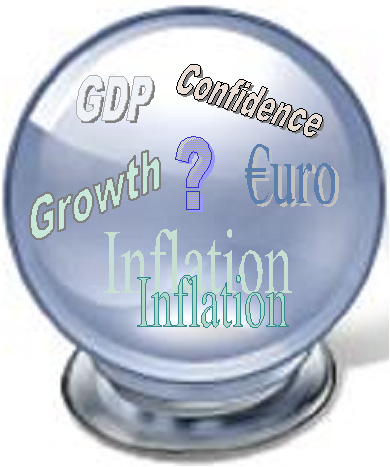 What lies ahead for economic growth in 2013 and beyond? And what policies should governments adopt to aid recovery? These are questions examined in four very different articles from The Guardian.
The first is by Nouriel Roubini, Professor of Economics at New York University’s Stern School of Business. He was one of the few economists to predict the collapse of the housing market in the USA in 2007 and the credit crunch and global recession that followed. He argues that continuing attempts by banks, governments and individuals to reduce debt and leverage will mean that the advanced economies will struggle to achieve an average rate of economic growth of 1%. He also identifies a number of other risks to the global economy.
 In contrast to Roubini, who predicts that ‘stagnation and outright recession – exacerbated by front-loaded fiscal austerity, a strong euro and an ongoing credit crunch – remain Europe’s norm’, Christine Lagarde, head of the IMF and former French Finance Minister, predicts that the eurozone will return to growth. ‘It’s clearly the case’, she says, ‘that investors are returning to the eurozone, and resuming confidence in that market.’ Her views are echoed by world leaders meeting at the World Economic Forum in Davos, Switzerland, who are generally optimistic about prospects for economic recovery in the eurozone.
The third article, by Aditya Chakrabortty, economics leader writer for The Guardian, looks at the policies advocated at the end of World War II by the Polish economist, Michael Kalecki and argues that such policies are relevant today. Rather than responding to high deficits and debt by adopting tough fiscal austerity measures, governments should adopt expansionary fiscal policy, targeted at expanding infrastructure and increasing capacity in the economy. That would have an expansionary effect on both aggregate demand and aggregate supply. Sticking with austerity will result in continuing recession and the ‘the transfer of wealth and power into ever fewer hands.’
 But while in the UK and the eurozone austerity policies are taking hold, the new government in Japan is adopting a sharply expansionary mix of fiscal and monetary policies – much as Kalecki would have advocated. The Bank of Japan will engage in large-scale quantitative easing, which will become an open-ended commitment in 2014, and is raising its inflation target from 1% to 2%. Meanwhile the Japanese government has decided to raise government spending on infrastructure and other government projects.
So – a range of analyses and policies for you to think about!
Risks lie ahead for the global economy The Guardian, Nouriel Roubini (21/1/13)
Eurozone showing signs of recovery, says IMF chief The Guardian, Graeme Wearden (14/1/13)
Austerity? Call it class war – and heed this 1944 warning from a Polish economist The Guardian, Aditya Chakrabortty (14/1/13)
Bank of Japan bows to pressure with ‘epoch-making’ financial stimulus The Guardian, Phillip Inman (22/1/13)
Questions
- What are the dangers facing the global economy in 2013?
- Make out a case for sticking with fiscal austerity measures.
- Make out a case for adopting expansionary fiscal policies alongside even more expansionary monetary policies.
- Is is possible for banks to increase their capital-asset and liquidity ratios, while at the same time increasing lending to business and individuals? Explain.
- What are the implications of attempts to reduce public-sector deficits and debt on the distribution of income? Would it be possible to devise austerity policies that did not have the effect you have identified?
- What will be the effect of the Japanese policies on the exchange rate of the yen with other currencies? Will this be beneficial for the Japanese economy?
 Pressure has been growing in the UK for people to be paid no less than a living wage. The Living Wage Foundation claims that this should be £8.55 per hour in London and £7.45 in the rest of the UK. The current minimum wage is £6.19.
There has been considerable support for a living wage across the political spectrum. Ed Miliband, the Labour leader, has stated that a Labour government would ensure that government employees were paid at least the living wage and that government contracts would go only to firms paying living wages. Other firms that paid less could be ‘named and shamed’. The living wage has also been supported by Boris Johnson, Conservative Mayor of London. The Prime Minister said that a living wage is ‘an idea whose time has come’, although many Conservatives oppose the idea.
The hourly living wage rate is calculated annually by the Centre for Research in Social Policy and is based on the basic cost of living. The London rate is calculated by the Greater London Authority.
Advocates of people being paid at least the living wage argue that not only would this help to reduce poverty, it would also help to reduce absenteeism and increase productivity by improving motivation and the quality of people’s work.
 It would also bring in additional revenue to the government. According to a report by the Institute for Public Policy Research and the Resolution Foundation, if everyone were paid at least a living wage, this would increase the earnings of the low paid by some £6.5bn per year. Of this, some £3.6bn would go to the government in the form of higher income tax and national insurance payments and reduced spending on benefits and tax credits. Of this £6.5bn, an extra £1.3 billion would be paid to public-sector workers, leaving the Treasury with a net gain of £2.3bn.
But what would be the effect on employment? Would some firms be forced to reduce their workforce and by how much? Or would the boost to aggregate demand from extra consumer spending more than offset this and lead to a rise in employment?. The following articles look at the possible effects.
Articles
Living wage for all workers would boost taxes and GDP Independent, Nigel Morris (28/12/12)
Living wage could save £2bn – think tank research BBC News (28/12/12)
‘Living wage’ would save money, says study Financial Times, Helen Warrell (28/12/12)
Why the Resolution Foundation and IPPR can go boil their heads Adam Smith Institute, Tim Worstall (30/12/12)
Living wage for public servants moves a step closer The Observer,
Yvonne Roberts and Toby Helm (15/12/12/)
Living wage: Ed Miliband pledge over government contracts BBC News (5/11/12)
‘London Living Wage’ increased to £8.55 by mayor BBC News (5/11/12)
Q&A: The living wage BBC News (5/11/12)
Scrooges in UK firms must pay a Living Wage This is Money, John Sentamu (23/12/12)
Report
What price a living wage? IPPR and The Resolution Foundation, Matthew Pennycook (May 2012)
Questions
- How would you set about determining what the living wage rate should be?
- Distinguish between absolute and relative poverty. Would people being paid below a living wage be best described as absolute or relative poverty (or both or neither)?
- What do you understand by the term ‘efficiency wage’? How is this concept relevant to the debate about the effects of firms paying a living wage?
- Under what circumstances would raising the statutory minimum wage rate to the living wage rate result in increased unemployment? How is the wage elasticity of demand for labour relevant to your answer and how would this elasticity be affected by all firms having to pay at least the living wage rate?
- What would be the macroeconomic effects of all workers being paid at least the living wage rate? What would determine the magnitude of these effects?
 UK Unemployment figures for the July to September period have just been published. Perhaps surprisingly, the rate has fallen to 7.8% from 8.0% in the previous 3-month period. What is more, there have been similar 0.2 percentage-point falls in each of the two 3-month periods prior to that (see chart below).
This would normally suggest that the economy has been growing strongly and faster than the growth in potential output. But, despite positive economic growth in quarter 3 (see A positive turn of events?), the economy has been experiencing a prolonged period of low or negative growth.
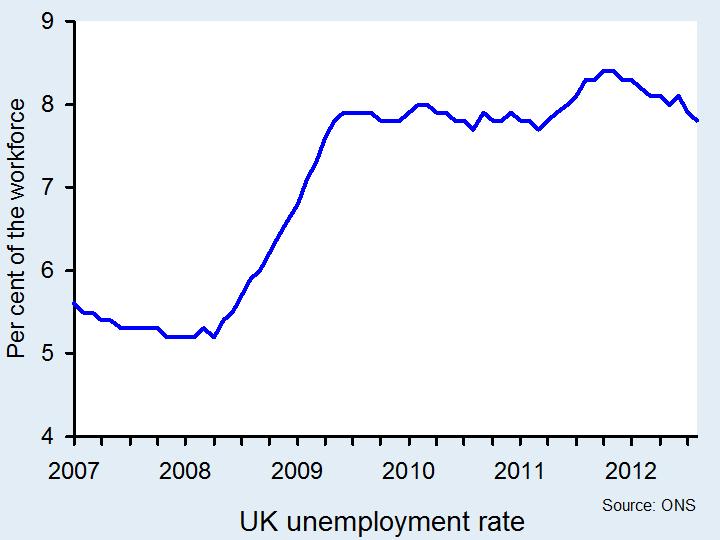
So what is the explanation for the fall in unemployment? (For a PowerPoint of the chart, click here)
One reason is a greater flexibility in the labour market than in previous recessions. People are more willing to accept below inflation wage increases, or even nominal wage cuts, in return for greater job security. Others are prepared to reduce their hours.
The other reason is a fall in productivity (i.e. output per hour worked). One explanation is that people are not working so hard because, with a lack of demand, there is less pressure on them to be productive; a similar explanation is that firms are ‘hoarding’ labour in the hope that the market will pick up again.

Another explanation is that employment growth has often occurred in the low productivity industries, such as labour-intensive service industries; another is that when people leave their jobs they are replace by less productive workers on lower wages; another is that workers are making do with ageing equipment, whose productivity is falling, because firms cannot afford to invest in new equipment. An range of possible explanations is given on page 33 of the Bank of England’s November 2012 Inflation Report.
But with many predicting that growth will be negative again in 2012 quarter 4, the fall in unemployment may not continue. Britain may join many other countries in Europe and experience rising unemployment as well as falling output.
Articles
Government hails fall in jobless total The Guardian, Hélène Mulholland (14/11/12)
UK unemployment figures: analysis The Guardian, Larry Elliott (14/11/12)
Jobless claims rise as Olympics effect wanes The Telegraph, Rachel Cooper and Louisa Peacock (14/11/12)
UK unemployment falls to 2.51 million, ONS says BBC News (14/11/12)
Unemployment continuing to fall BBC News, Stephanie Flanders (14/11/12)
Britain’s recession: Harsh but fair? BBC News, Stephanie Flanders (17/10/12)
The UK productivity puzzle (cont’d) BBC News, Stephanie Flanders (20/9/12)
UK jobs: The plot thickens BBC News, Stephanie Flanders (15/8/12)
Data
Unemployment: the key UK data and benefit claimants for every constituency Guardian Data Blog
Labour Market Statistics, November 2012 ONS
Video Summary: Latest on the Labour Market, November 2012 ONS
Labour Productivity, Q2 2012 ONS
International Comparisons of Productivity, First estimates for 2011 ONS
Questions
- What possible explanation are there for the latest fall in unemployment?
- What has been happening to employment, both full time and part time?
- What are the different ways of measuring productivity? Why will they be affected differently by a fall in the average number of hours worked?
- Why might it be in firms’ interests to maintain the level of their workforce despite falling sales?
- Assume that there has been a fall in aggregate demand. Compare the resulting effect on consumption of (a) a fall in wages rates; (b) a rise in unemployment. How might the design of the benefit system affect the answer?
 Should the object of monetary policy be simply one of keeping inflation within a target range? In a speech given on 9 October, the Governor of the Bank of England, Sir Mervyn King, questioned whether the interest-rate setting policy of the Monetary Policy Committee (MPC) has been too narrow.
He considered whether interest rates should have been higher before the financial crisis and crash of 2007–9. This could have helped to reduce the asset price bubble and discouraged people from taking out excessive loans.
But then there is the question of the exchange rate. Would higher interest rates have pushed the exchange rate even higher, with damaging effects on exports? Today the trade weighted exchange rate is some 20% lower than before the crash. The government hopes that this will encourage a growth in exports and help to fuel recovery in demand. But as Dr King said, “The strategy of reducing domestic spending and relying more on external demand is facing a real problem because not everyone can do it at the same time.”
 Then there is the question of economic growth. Should a target rate of growth be part of the MPC’s target? Should the MPC adopt a form of Taylor rule which targets a weighted average of the inflation rate and the rate of economic growth?
Certainly monetary policy today in the UK and many other countries is very different from five years ago. With interest rates being close to zero, there is little scope for further reductions; after all, nominal rates cannot fall below zero, otherwise people would be paid for borrowing money! So the focus has shifted to the supply of money. Several attempts have been made to control the money supply through programmes of quantitative easing. Indeed many economists expect further rounds of quantitative easing in the coming months unless there is a substantial pick up in aggregate demand.
So what should be the targets of monetary policy? The following articles look at Dr King’s speech and at various alternatives to a simple inflation target.
Articles
Mervyn King says must face up to monetary policy’s limits’ Reuters, David Milliken and Sven Egenter (9/10/12)
Bank of England’s Mervyn King defends low interest rates pre-crisis The Telegraph, Emma Rowley (9/10/12)
Banks should have had a leverage cap before crash, says Mervyn King The Guardian, Heather Stewart and Phillip Inman (9/10/12)
King Says BOE Must Keep Targeting Inflation as Tool Revamp Looms Bloomberg, Scott Hamilton and Svenja O’Donnell (9/10/12)
After 20 years, time to change Merv’s medicine? Channel 4 News blogs, Faisal Silam (9/10/12)
King signals inflation not primary focus Financial Times, Norma Cohen and Sarah O’Connor (9/10/12)
Should Bank start the helicopter? BBC News, Stephanie Flanders (12/10/12)
Speech
Twenty years of inflation targeting Bank of England speeches, Mervyn King (9/10/12)
Questions
- What are the arguments for using monetary policy to target a particular rate of inflation?
- Would it ever be a good idea to adjust the targeted rate of inflation up or down and if so when and why?
- Explain how a Taylor rule would work and in what ways it is superior or inferior to pursuing a simple inflation target.
- Are attempts to control the money supply through quantitative easing (or tightening) consistent or inconsistent with pursuing an inflation target? Explain.
- What are the arguments for and against abandoning targeting in monetary policy and replacing it with discretionary policy that takes a number of different macroeconomic indicators into account?