 Following the financial crisis, all sectors of the economy continue to repair their balance sheets. As well as households, non-financial corporations and government, this is true of the banking sector. In part, the repairing and rebalancing of their balance sheets is being brought about by regulatory pressures. The objective is to make banks more resilient to shocks and less susceptible to financial distress.
The need for banks to repair and rebalance their balance sheets is significant because of their systemic importance to the modern-day economy. Financial institutions that are systemically important to national economies are know as SIFIs (systemically important financial institutions) while those of systemic importance to the global economy are know as G-SIFIs or G-SIBs (global systemically important banks). The increasing importance of financial institutions to economic activity is known as financialisation.
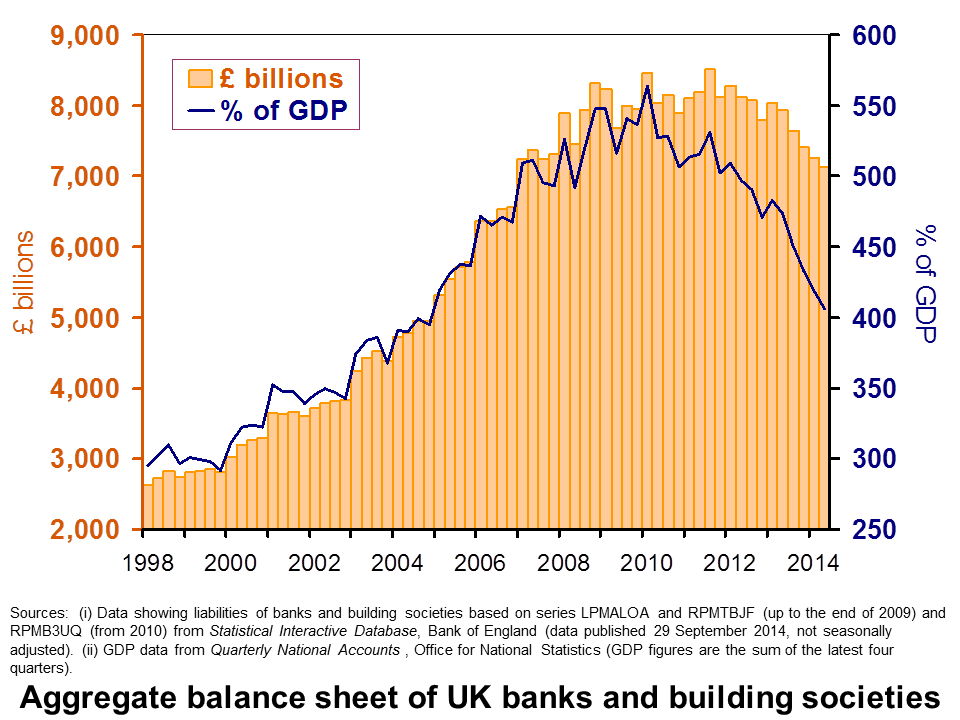 One way of measuring the degree of financialisation here in the UK is to consider the aggregate size of the balance sheet of resident UK banks and building societies (including foreign subsidiaries operating here). The chart shows that the balance sheet grew from £2.6 trillion in 1998 Q1 to £8.5 trillion in 2010 Q1. Another way of looking at this is to consider this growth relative to GDP. This reveals that the aggregate balance sheet of banks and building societies grew over this period from 3 times annual GDP to a staggering 5.6 times GDP. (Click here for a PowerPoint of the chart.)
But, now consider the aggregate banking balance sheet in the 2010s. This reveals a shrinking balance sheet. At the end of the second quarter of this year (2014 Q2) it had fallen back to £7.1 trillion or 4 times GDP. As a share of GDP, this was the smallest the aggregate balance sheet had been since 2005 Q1.
Does a shrinking balance sheet matter? This is where the analysis becomes tricky and open to debate. If the smaller size is consistent with a more stable financial system then undoubtedly that is a good thing. But, size is not that all matters. The composition of the balance sheet matters too. This requires an analysis of, among other things, the liquidity of assets (i.e. assets that can be readily turned in a given amount of cash), the reliability of the income flow from assets and the resources available to withstand periods of slow economic growth, including recessions, or periods of financial difficulty.
As we have identified before (see Financialisation: Banks and the economy after the crisis), the financial crisis could herald new norms for the banking system with important implications for the economy. If so, we may need to become accustomed to consistently lower flows of credit and not to the levels that we saw prior to the financial crisis of the late 2000s. However, an alternative view is that we are merely experiencing a pause before the next expansionary phase of the credit cycle. This is consistent with the financial instability hypothesis (see Keeping a Minsky-eye on credit) which argues that credit cycles are an integral part of modern financialised economies. Only time will tell which view will turn out to be right.
Articles
‘Cleaning up bank balance sheets is key’ Irish Examiner, John Walsh (10/10/14)
More action needed at European banks: Fitch Courier Mail, (17/10/14)
Bank lending to small businesses falls by £400m The Telegraph, Rebecca Burn-Callander (20/10/14)
Bank lending to SMEs falls by £400m SME insider, Lindsey Kennedy (21/10/14)
Record world debt could trigger new financial crisis, Geneva report warns The Guardian, Phillip Inman (29/10/14)
RBS shares jump as bank’s bad debts improve The Guardian, Jill Treanor (30/10/14)
Data
Statistical Interactive Database Bank of England
Questions
- Using examples, demonstrate your understanding of financialisation.
- Draw up a list of the alternative ways in which we might measure financialisation.
- What factors are likely to explain the recent reduction in the aggregate balance sheet of resident banks and building societies in the UK?
- How might we go about assessing whether the aggregate level of lending by financial institutions is sustainable?
- How might we go about assessing whether the level of lending by individual financial institutions is sustainable?
- How would reduced flows of credit be expected to impact on the economy both in the short term and in the longer term?
- Are credit cycles inevitable?
- Of what significance are credit cycles in explaining the business cycle?
 The latest GDP numbers from the Office for National Statistics contained in Quarterly National Accounts, Q2 2014 show the economy’s output expanded by 0.9 per cent in the second quarter. This follows on the back of a 0.7 per cent increase in output in Q1 2014. The economy’s output is now thought to be 0.7 per cent above its Q1 2008 peak. Yet, the data show very different profiles for the four principal industrial sectors. The service sector appears to be ploughing ahead while the rest (production, construction and agriculture) lag behind.
 Chart 1 shows quarterly economic growth since 1980s (click here for a PowerPoint of the chart). It illustrates nicely the inherent volatility of economies – one of the threshold concepts in economics. The average quarterly rate of growth since 1980 has been 0.5 per cent. On the face of it, a quarterly growth number of 0.9 per cent would appear very robust. Of course, this has to been set in the context of the 2008/9 recession. UK output peaked in Q1 2008 (£414.424 billion at 2011 prices). The revised data now show that there followed 5 quarters of declining output (previously, data suggested the duration of the recession was 6 quarters). During this period output shrank 6 per cent (GDP at 2011 prices had fallen by Q2 2009 to £389.388 billion ).
Chart 1 highlights two earlier downturns. First, there is the recession of the early 1980s. We can see the 5-quarter recession that commenced in Q1 1980. By the end of this recession output had shrunk by 4.5 per cent. Second, there is the recession of the early 1990s which commenced in Q3 1990. Again, this recession lasted five quarters. By the time the economy had come out of recession it had shrunk 2.2 per cent.
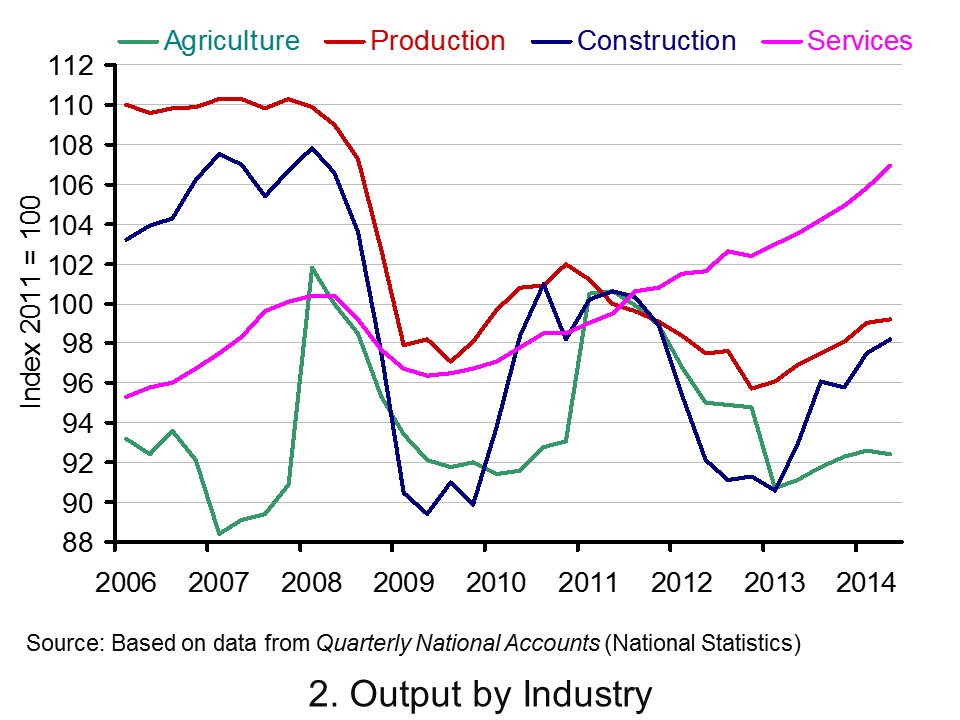 Consider now Chart 2 (click here for a PowerPoint of the chart). It allows us to analyse more recent events by tracking how industrial output has evolved since 2006. It suggests an unbalanced recovery. From it, we observe that in Q2 2014 service-sector output was 6.5 per cent higher than in Q1 2008. However, a very different picture emerges for the other principal industrial types. Output across the production industries remains 9.7 per cent lower, 9.2 per cent lower in agriculture and 8.9 per cent lower in the construction sector.
In short, the British economy continues to struggle to rebalance its industrial base. The business cycle remains heavily dependent on the service sector.
Articles
UK GDP revised up: what the economists say Guardian, Katie Allen (30/9/14)
UK economy grew 0.9% in second quarter, says ONS BBC News, Katie Allen (9/5/14)
UK GDP: Did the UK economy do well after all? Independent, Ben Chu (30/9/14)
UK economy grew 0.9% Herald, Ian McConnell (1/10/14)
Economy tracker: GDP BBC News (30/9/14).
Data
Quarterly National Accounts, Q2 2014 Dataset Office for National StatisticsQuarterly National Accounts, Q2 2014, Statistical Release Office for National Statistics
Questions
- What is the difference between nominal and real GDP? Which of these helps to track changes in economic output?
- Looking at Chart 1 above, summarise the key patterns in real GDP since the 1980s.
- What is a recession?
- What are some of the problems with the traditional definition of a recession?
- Can a recession occur if nominal GDP is actually rising? Explain your answer.
- What factors lead to economic growth being so variable?
- What factors might explain the very different patterns seen since the late 2000s in the volume of output of the four main industrial sectors?
- What different interpretations could there be of a ‘rebalancing’ of the UK economy?
- What other data might we look at to analyse whether the UK economy is ‘rebalancing’?.
- Produce a short briefing paper exploring the prospects for economic growth in the UK over the next 12 to 18 months.
- What is the difference between GVA and GDP?
- Explain the arguments for and against using GDP as a measure of a country’s economic well-being.
 Economic journalists, commentators and politicians have been examining the possible economic effects of a Yes vote in the Scottish independence referendum on 18 September. For an economist, there are two main categories of difficulty in examining the consequences. The first is the positive question of what precisely will be the consequences. The second is
  the normative question of whether the likely effects will be desirable or undesirable and how much so.
The first question is largely one of ‘known unknowns’. This rather strange term was used in 2002 by Donald Rumsfeld, US Secretary of Defense, in the context of intelligence about Iraq. The problem is a general one about forecasting the future. We may know the types of thing that are likely happen, but the magnitude of the outcome cannot be precisely known because there are so many unknowable things that can influence it.
Here are some known issues of Scottish independence, but with unknown consequences (at least in precisely quantifiable terms). The list is certainly not exhaustive and you could probably add more questions yourself to the list.
|
|
| • |
Will independence result in lower or higher economic growth in the short and long term? |
| • |
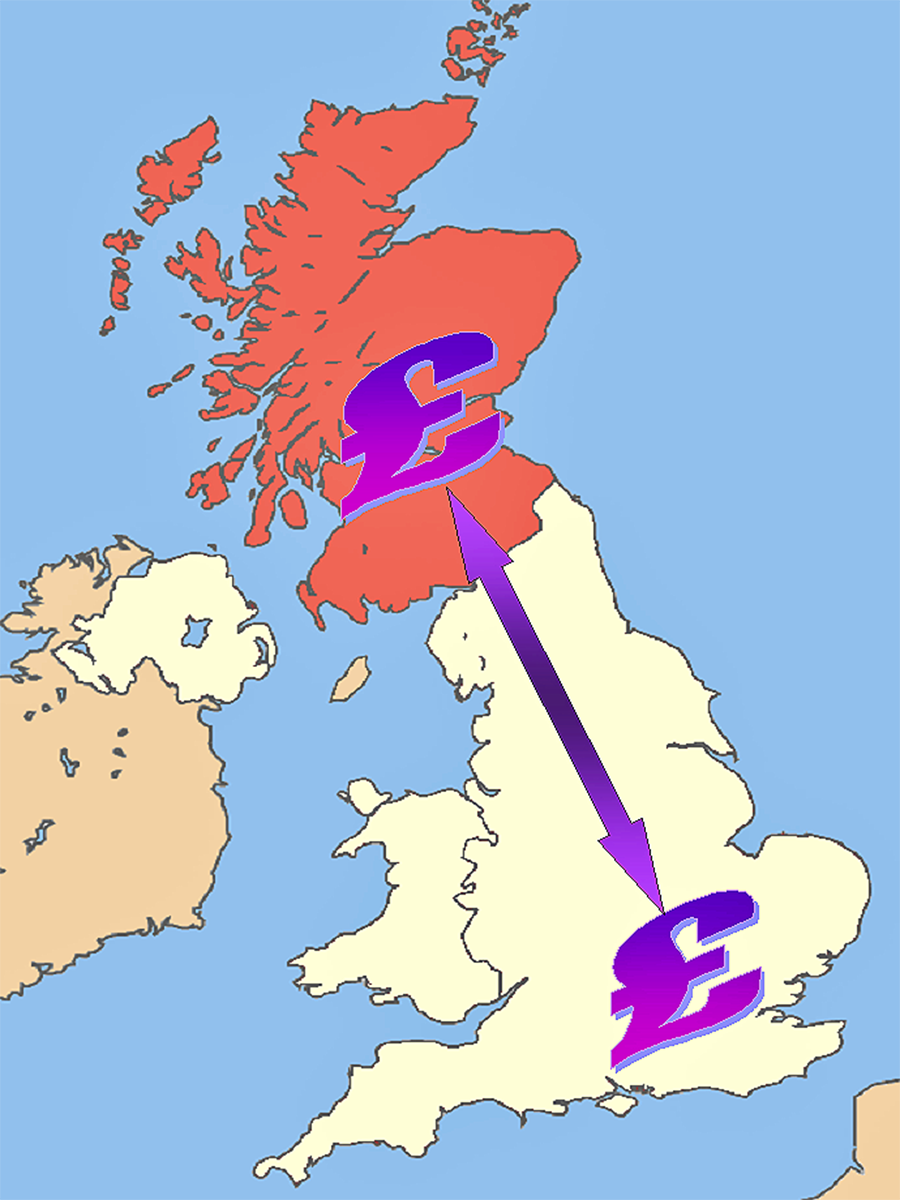
Will there be a currency union, with Scotland and the rest of the UK sharing the pound and a central bank? Or will Scotland merely use the pound outside a currency union? Would it prefer to have its own currency or join the euro over the longer term? |
| • |
What will happen to the sterling exchange rate with the dollar, the euro and various other countries? |
| • |
How will businesses react? Will independence encourage greater inward investment in Scotland or will there be a net capital outflow? And either way, what will be the magnitude of the effect? |
| • |
How will assets, such as oil, be shared between Scotland and the rest of the UK? And how will national debt be apportioned? |
| • |
How big will the transition costs be of moving to an independent Scotland? |
| • |
How will independence impact on Scottish trade (a) with countries outside the UK and (b) with the rest of the UK? |
| • |
What will happen about Scotland’s membership of the EU? Will other EU countries, such as Spain (because of its concerns about independence movements in Catalonia and the Basque country), attempt to block Scotland remaining in or rejoining the EU? |
| • |
What will happen to tax rates in Scotland, with the new Scottish government free to set its own tax rates? |
| • |
What will be the consequences for Scottish pensions and the Scottish pensions industry? |
| • |
What will happen to the distribution of income in Scotland? How might Scottish governments behave in terms of income redistribution and what will be its consequences on output and growth? |
Of course, just because the effects cannot be known with certainty, attempts are constantly being made to quantify the outcomes in the light of the best information available at the time. These are refined as circumstances change and newer data become available.
 But forecasts also depend on the assumptions made about the post-referendum decisions of politicians in Scotland, the rest of the UK and in major trading partner countries. It also depends on assumptions about the reactions of businesses. Not surprisingly, both sides of the debate make assumptions favourable to their own case.
Then there is the second category of question. Even if you could quantify the effects, just how desirable would they be? The issue here is one of the weightings given to the various costs and benefits. How would you weight distributional consequences, given that some people will gain or lose more than others? What social discount rate would you apply to future costs and benefits?
Then there are the normative and largely unquantifiable costs and benefits. How would you assess the desirability of political consequences, such as greater independence in decision-making or the break-up of a union dating back over 300 years? But these questions about nationhood are crucial issues for many of the voters.
Articles
Scottish Independence would have Broad Impact on UK Economy NBC News, Catherine Boyle (9/9/14)
Scottish independence: the economic implications The Guardian, Angela Monaghan (7/9/14)
Scottish vote: Experts warn of potential economic impact BBC News, Matthew Wall (9/9/14)
The economics of Scottish independence: A messy divorce The Economist (21/2/14)
Dispute over economic impact of Scottish independence Financial Times, Mure Dickie, Jonathan Guthrie and John Aglionby (28/5/14)
10 economic benefits for a wealthier independent Scotland Michael Gray (6/3/14)
Scottish independence, UK dependency New Economics Foundation (NEF), James Meadway (4/9/14)
Scottish Jobs and the World Economy Scottish Economy Watch, Brian Ashcroft (25/8/14)
Scottish yes vote: what happens to the pound in your pocket? Channel 4 News (9/9/14)
What price Scottish independence? BBC News, Robert Peston (12/9/14)
What price Scottish independence? BBC News, Robert Peston (7/9/14)
Economists can’t tell Scots how to vote BBC News, Robert Peston (16/9/14)
Books and Reports
The Economic Consequences of Scottish Independence Scottish Economic Society and Helmut Schmidt Universität, David Bell, David Eiser and Klaus B Beckmann (eds) (August 2014)
The potential implications of independence for businesses in Scotland Oxford Economics, Weir (April 2014)
Questions
- What is a currency union? What implications would there be for Scotland being in a currency union with the rest of the UK?
- If you could measure the effects of independence over the next ten years, would you treat £1m of benefits or costs occurring in ten years’ time the same as £1m of benefits and costs occurring next year? Explain.
- Is it inevitable that events occurring in the future will at best be known unknowns?
- If you make a statement that something will occur in the future and you turn out to be wrong, was your statement a positive one or a normative one?
- What would be the likely effects of Scottish independence on the current account of the balance of payments (a) for Scotland; (b) for the rest if the UK?
- How does inequality in Scotland compare with that in the rest of the UK and in other countries? Why might Scottish independence lead to a reduction in inequality? (See the chapter on inequality in the book above edited by David Bell, David Eiser and Klaus B Beckmann.)
- One of the problems in assessing the arguments for a Yes vote is uncertainty over what would happen if there was a majority voting No. What might happen in terms of further devolution in the case of a No vote?
- Why is there uncertainty over the amount of national debt that would exist in Scotland if it became independent?
 At the end of January 2014, we looked at the problem of deflation and in particular at the fortunes of Japan, as its CPI was rising. As the blog explained, the Japanese economy, rather than being plagued by high inflation has been plagued by deflation and many suggest this is even worse.
In December 2013, Japan’s core consumer prices were growing faster than expected. The data gave the economy a much needed boost, following increases in government spending aimed at stimulating aggregate demand. This in turn pushed up prices, such that they achieved their fastest rate of growth in 5 years. Now, more recent date from May 2014 shows that the trend has continued. Prices in Japan have now increase at their fastest rate in 23 years, rising 3.2% and beating the forecasts of 3.1%. This means that prices have no risen in Japan for 11 consecutive months. Numerous policies have contributed towards this impressive trend for an economy plagued by deflation for 2 decades. Boosts in the money supply, increases in government spending, a rise in sales tax are just some of the contributing factors.
 Although the economy is certainly over the problem of deflation, some are now concerned that such price rises may reduce consumer spending. An ironic twist, given that barely a year ago the concern about low consumer spending was due to deflation. The next 12 months will be a key indicator of how consumers will respond to this unusual inflation data – after all inflation and high prices have been pretty uncommon. The following articles consider the update on the Japanese economy.
Japan inflation rate hits 23 year high (including video) BBC News (30/5/14)
Japan April core CPI rises to 23-year high after sales tax rise Reuters (29/5/14)
Japan inflation accelerates Wall Street Journal, Takashi Nakamichi (30/5/14)
Japan’s consumer inflation set to reach five year high The Guardian (18/4/14)
Japan’s inflation at highest rate for 23 years The Telegraph, Rebecca Clancy (30/5/14)
Japan inflation quickens to fastest since 1991 Bloomberg, Toru Fujioka (30/5/14)
Japaense inflation rises at fastest pace in over five years at 1.3% in December 2013 Independent, Russel Lynch (31/1/14)
Questions
- Why is deflation a problem?
- Using an AD/AS diagram, illustrate the problem of expectations and how this contributes to stagnant growth.
- Japanese policies have helped create a rise in the CPI. Which policies have been effective in creating rising prices?
- Explain how the sales tax has contributed towards higher prices.
- With prices rising, there are now concerned that consumer spending may decline. Using a diagram, explain why this may be the case.
- In the previous blog, we analysed the Indian economy and said that high inflation was something that was contributing towards lower growth. How is that low inflation or deflation can also contribute towards low growth?
 The expansion of the BRIC economies has both advantages and disadvantages for Western countries. Their consistently high growth rates have created a much wider market place for Western firms and a much needed additional source of consumer demand, especially in times of recession. Countries such as China have had double digit growth rates, with others like India experiencing growth rates of just under 10%. But are these impressive growth rates now beginning to fall?
For the last 2 years, the growth rate in the Indian economy has been sub-5%, with growth in the 2013-14 financial year at 4.7%. Though some sectors, including agriculture have experienced buoyant growth, it is other sectors that have been holding this economy back. Manufacturing contracted at an annualised rate of 1.4% over the quarter, while mining contracted by 0.4%. With a growth rate of just under 5%, one might think that this was good – after all many Western economies have only recently entered positive growth. However, the Indian economy has a rapidly growing population and it is estimated that 10 million additional jobs each year must be created. It is this figure that requires such a high growth rate – estimated at around 8%. Thus, the sub-5% growth recorded for 2 years is insufficient to sustain the required job creation.
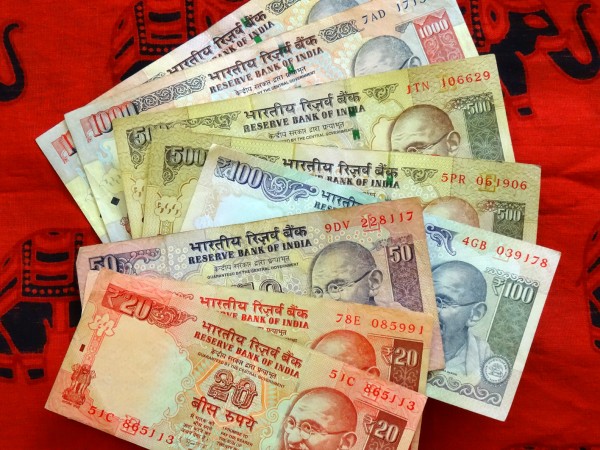
There are many factors that appear to be holding growth back. High inflation has been a problem for some years and the Indian currency has been relatively weak and volatile. Together, these issues have created an environment of uncertainty and if there’s one thing that investors don’t like, it’s uncertainty. This has therefore led to a lack of investment in the economy, which is a key component of aggregate demand and hence a key source of economic growth. Furthermore, interest rates rose last year, thereby pushing up the cost of borrowing and the rate of credit growth has also slowed. These factors collectively have led to lower foreign investment, domestic investment and spending, which have all contributed towards more subdued growth than in the past. Glenn Levine, a senior economist at Moody’s said:
India’s economy continues to grow well below potential as a combination of supply‐side constraints and the adverse effects of an underperforming government weigh on capital expenditure and hiring … It will be a while before the Indian economy is expanding above 6% again.
However, many economists remain optimistic about the prospects of Asia’s third-largest economy. Inflation appears to be under control and the currency has gained strength. Many believe that more investment supporting government policies will be the kick start the economy needs and this will in turn encourage firms to begin investment. It may be the new leader of this country, Narendra Modo, that will jump start the economy. The Prime Minister is expected to back policies to stimulate growth, who will direct more spending at infrastructure, simplify taxes and introduce policies to attract foreign investment. Adi Godrej, Chairman of the Godrej group said:
As soon as investors see the first signals of growth-supportive policies, you will see a definite turnaround on the ground.
The coming months will be crucial in determining how quickly the Indian economy is likely to see a return to near double digit growth. The new government has indeed promised policies to boost the economy, but the annual budget will confirm whether this promise is likely to be kept. Given the dependence of Indian jobs on a fast growth rate and the dependence of the Western world on the continued growth of the BRICs in creating a wider market for our exports, the fortunes of India are extremely important. The following articles consider this economy.
Indian economy grew at 4.7% in 2013-14 The Times of India (30/5/14)
India’s economic growth disappoints BBC News (30/5/14)
India’s GDP grows 4.7% in fiscal year, missing government forecast Wall Street Journal, Anant Vijay Kala (30/5/14)
India’s economy expands 4.7pct in fiscal year 2013/14 Reuters (30/5/14)
India’s economy still underwhelms CNN Money, Charles Riley, Alanna Petroff (30/5/14)
FY14 GDP growth at 4.7%; India sees worst slowdown in 25 years The Economic Times (30/5/14)
India growth below 5% adds pressure on Modi to spur investment Bloomberg, Unni Krishnan (30/5/14)
Jim Armitage: ‘Modinomics’ in India has helped growth, but not for all Independent, Jim Armitage (17/5/14)
Questions
- Using a diagram, explain how economic growth can be created through (a) demand-side measures and (b) supply-side measures.
- Why would higher interest rates reduce growth?
- Why does high inflation create uncertainty and what impact does this have on business investment?
- India has experienced a weak and volatile currency and this has contributed towards a lack of foreign investment and low growth. Using a diagram, explain why this could be the case.
- What sort of government policies would you recommend for the Indian economy if you had become the new Prime Minister and your primary objective was to boost economic growth?
- Why is the expansion of the BRIC economies, of which India is one, so important for Western economies?
 Following the financial crisis, all sectors of the economy continue to repair their balance sheets. As well as households, non-financial corporations and government, this is true of the banking sector. In part, the repairing and rebalancing of their balance sheets is being brought about by regulatory pressures. The objective is to make banks more resilient to shocks and less susceptible to financial distress.