 First the IMF in its World Economic Outlook, then the European Commission in its Economic Forecasts (see also) and now the OECD in its Economic Outlook (see also) – all three organisations in the latest issues of their 6-monthly publications are predicting slower global economic growth than they did 6 months previously. This applies both to the current year and to 2016. The OECD’s forecast for global growth this year is now 2.9%, down from the 3.7% it was forecasting a year ago. Its latest growth forecast for 2016 is 3.3%, down from the 3.9% it was forecasting a year ago.
Various reasons are given for the gloomier outlook. These include: a dramatic slowdown in global trade growth; slowing economic growth in China and fears over structural weaknesses in China; falling commodity prices (linked to slowing demand but also as a result of increased supply); austerity policies as governments attempt to deal with the hangover of debt from the financial crisis of 2007/8; low investment leading to low rates of productivity growth despite technological progress; and general fears about low growth leading to low spending as people become more cautious about their future incomes.
 The slowdown in trade growth (forecast to be just 2% in 2015) is perhaps the most worrying for future global growth. As Angel Gurría, OECD Secretary-General, states in his remarks at the launch of the latest OECD Economic Outlook:
‘Global trade, which was already growing slowly over the past few years, appears to have stagnated and even declined since late 2014, with the weakness centering increasingly on emerging markets, particularly China. This is deeply concerning as robust trade and global growth go hand in hand. In 2015 global trade is expected to grow by a disappointing 2%. Over the past five decades there have been only five other years in which trade growth has been 2% or less, all of which coincided with a marked downturn of global growth.’
So what policies should governments pursue to stimulate economic growth? According to Angel Gurría:
‘Short-term demand needs to be supported and structural reforms to be pursued with greater ambition than is currently the case. Three specific actions are key:
|
|
| • |
First, we need to resist and turn back rising protectionism. Trade strengthens competition and investment and revs up the “diffusion machine” – the spread of new technologies throughout the economy – which will ultimately lift productivity. |
| • |
Second, we need to step up structural reform efforts, which have weakened in recent years. And here, I mean the whole range of structural reforms – education, innovation, competition, labour and product market regulation, R&D, taxes, etc. |
| • |
Third, there is scope to adjust public spending towards investment. If done collectively by all countries, if the sector and projects chosen have high multipliers, and if combined with serious structural reforms, stronger public investment can give a boost to growth and employment and not increase the relative debt burden.’ |
 On this third point, the OECD Economic Outlook argues that ‘the rationale for such investments is that they could help to push economies onto a higher growth path than might otherwise be the case, at a time when private investment growth remains modest.’
‘Collective action to increase public investment can be expected to boost the initial domestic multiplier effects from the stimulus, since private investment and exports in each economy will benefit from stronger demand in other economies. …the multiplier effects from an investment-led stimulus are likely to be a little larger than from other forms of fiscal stimulus, since the former also has small, but positive, supply-side effects.
In other words, the OECD is calling for a relaxation of austerity policies, with public investment being used to provide a stimulus to growth. The higher growth will then lead to increased potential output, as well as actual output, and an increase in tax revenues.
These policy recommendations are very much in line with those of the IMF.
Videos and Webcasts
 OECD warns of global trade slowdown, trims growth outlook again Reuters (9/11/15)
OECD returns to revisionism with growth downgrade Euronews, Robert Hackwill (9/11/15)
OECD: Weak China Import Growth Leads Trade Slowdown Bloomberg, Catherine L Mann, OECD Chief Economist (9/11/15)
OECD Economic Outlook: Moving forward in difficult times OECD PowerPoint presentation, Catherine L Mann, OECD Chief Economist (9/11/15)
Press Conference OECD, Angel Gurría and Álvaro Pereira (9/11/15)
Articles
OECD cuts world growth forecast Financial Times, Ferdinando Giugliano (9/11/15)
OECD rings alarm bell over threat of global growth recession thanks to China slowdown Independent, Ben Chu (10/11/15)
OECD cuts global growth forecasts amid ‘deep concern’ over slowdown BBC News (9/11/15)
OECD fears slowdown in global trade amid China woes The Guardian, Katie Allen (9/11/15)
The global economy is slowing down. But is it recession – or protectionism? The Observer, Heather Stewart and Fergus Ryan (14/11/15)
Global growth is struggling, but it is not all bad news The Telegraph, Andrew Sentance (13/11/15)
OECD Publications
Economic Outlook Annex Tables OCED (9/11/15)
Press Release: Emerging market slowdown and drop in trade clouding global outlook OCED (9/11/15)
Data handout for press OECD (9/11/15)
OECD Economic Outlook, Chapter 3: Lifting Investment for Higher Sustainable Growth OCED (9/11/15)
OECD Economic Outlook: Full Report OECD (9/11/15)
Questions
- Is a slowdown in international trade a cause of slower economic growth or simply an indicator of slower economic growth? Examine the causal connections between trade and growth.
- How worried should we be about disappointing growth in the global economy?
- What determines the size of the multiplier effects of an increase in public investment?
- Why are the multiplier effects of an increase in public-sector investment likely to be larger in the USA and Japan than in the UK, the eurozone and Canada?
- How can monetary policy be supportive of fiscal policy to stimulate economic growth?
- Under what circumstances would public-sector investment (a) stimulate and (b) crowd out private-sector investment?
- How would a Keynesian economist respond to the recommendations of the OECD?
- How would a neoclassical/neoliberal economist respond to the recommendations?
- Are the OECD’s recommendations in line with the Japanese government’s ‘three arrows‘?
- What structural reforms are recommended by the OECD? Are these ‘market orientated’ or ‘interventionist’ reforms, or both? Explain.
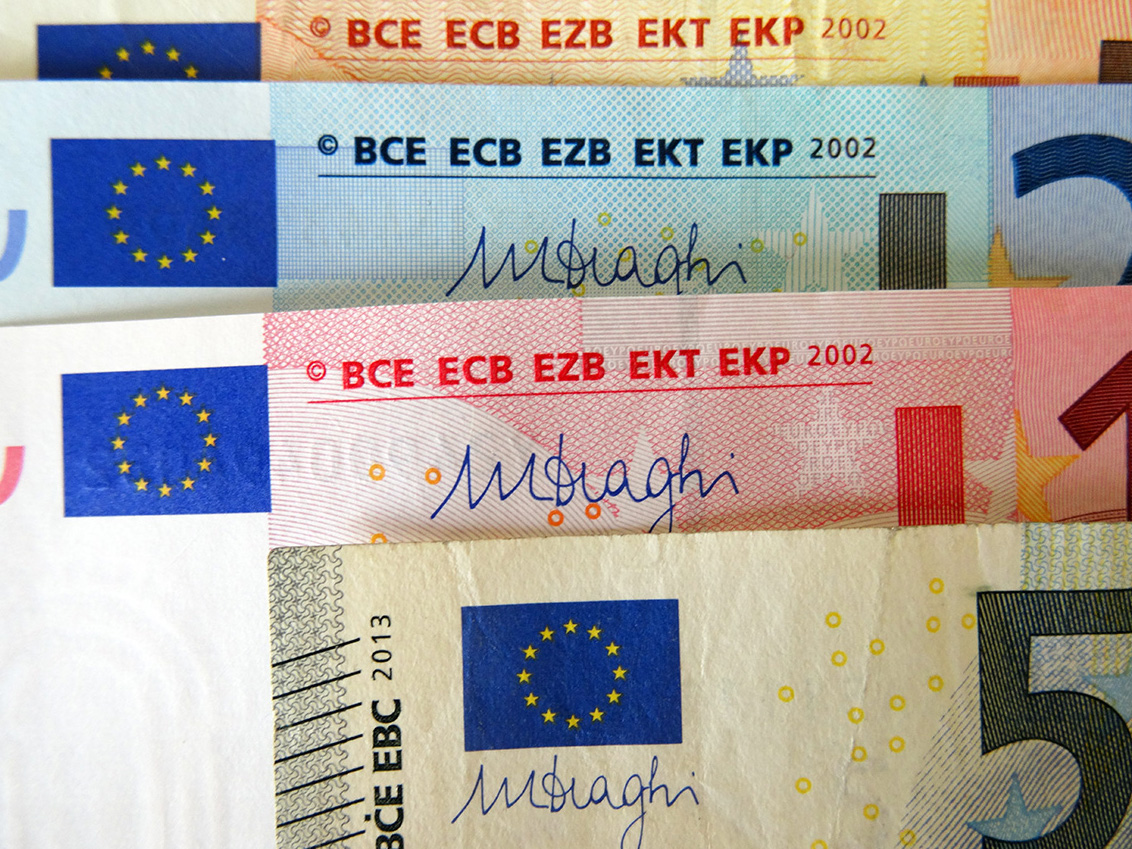
 Mario Draghi, the ECB President, has indicated that the ECB is prepared to engage in further monetary stimulus. This is because of continuing weaknesses in the global economy and in particular in emerging markets.
Although the ECB at its meeting in Malta on 22 October decided to keep both interest rates and asset purchases (€60 billion per month) at current levels, Mario Draghi stated at the press conference that, at its next meeting on December 3rd, the ECB would be prepared to cut interest rates and re-examine the size, composition and duration of its quantitative easing programme. He stopped short, however, of saying that interest rates would definitely be cut or quantitative easing definitely increased. He said the following:
“The Governing Council has been closely monitoring incoming information since our meeting in early September. While euro area domestic demand remains resilient, concerns over growth prospects in emerging markets and possible repercussions for the economy from developments in financial and commodity markets continue to signal downside risks to the outlook for growth and inflation. Most notably, the strength and persistence of the factors that are currently  slowing the return of inflation to levels below, but close to, 2% in the medium term require thorough analysis.
In this context, the degree of monetary policy accommodation will need to be re-examined at our December monetary policy meeting, when the new Eurosystem staff macroeconomic projections will be available. The Governing Council is willing and able to act by using all the instruments available within its mandate if warranted in order to maintain an appropriate degree of monetary accommodation.”
Mario Draghi also argued that monetary policy should be supported by fiscal policy and structural policies (mirroring Japan’s three arrows). Structural policies should include actions to improve the business environment, including the provision of an adequate public infrastructure. This is vital to “increase productive investment, boost job creation and raise productivity”.
As far as fiscal policies are concerned, these “should support the economic recovery, while remaining in compliance with the EU’s fiscal rules”. In other words, fiscal policy should be expansionary, while staying within the limits set by the Stability and Growth Pact.
His words had immediate effects in markets. Eurozone government bond yields dropped to record lows and the euro depreciated 3% against the US dollar over the following 24 hours.
Webcasts
ECB Press Conference on YouTube, Mario Draghi (22/10/15)
Draghi reloads bazooka FT Markets, Ferdinando Guigliano (22/10/15)
Articles
Mario Draghi: ECB prepared to cut interest rates and expand QE The Guardian, Heather Stewart (22/10/15)
Draghi signals ECB ready to extend QE Financial Times, Claire Jones and Elaine Moore (22/10/15)
Dovish Mario Draghi sends bond yields to new lows Financial Times, Katie Martin (23/10/15)
What Draghi Said on QE, Policy Outlook, Global Risks and Inflation Bloomberg, Deborah Hyde (22/10/15)
ECB set to ‘re-examine’ stimulus policy at next meeting BBC News (22/10/15)
The global economy warrants a big dose of caution The Guardian, Larry Elliott (25/10/15)
ECB Press Conference
Introductory statement to the press conference (with Q&A) ECB, Mario Draghi (President of the ECB), Vítor Constâncio (Vice-President of the ECB) (22/10/15)
Questions
- Why is the ECB considering further expansionary monetary policy?
- What monetary measures can a central bank use to stimulate aggregate demand?
- Explain the effects of Mario Draghi’s announcement on bond and foreign exchange markets.
- What are the objectives of ECB monetary policy according to the its mandate?
- Should the ECB consider using quantitative easing to provide direct funding for infrastructure projects?
- What constraints does the EU’s Stability and Growth Pact impose on eurozone countries?
- What are the arguments for and against (a) the Bank of England and (b) the US Federal Reserve engaging in further QE?
- If the ECB does engage in an expanded QE programme, what will determine its effectiveness?
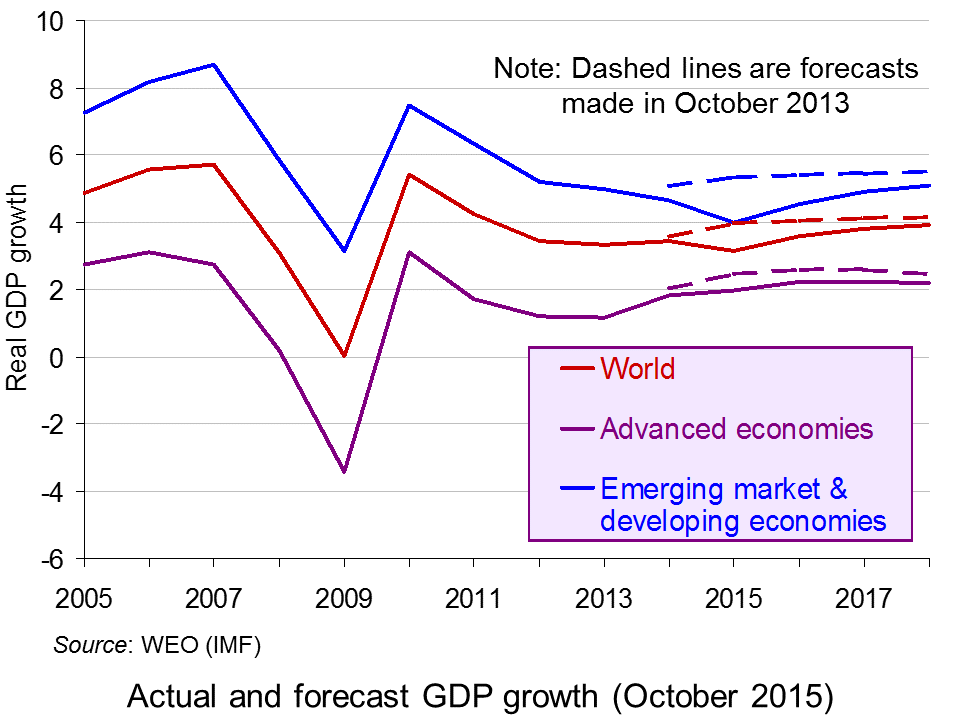
 The International Monetary Fund has just published its six-monthly World Economic Outlook (WEO). The publication assesses the state of the global economy and forecasts economic growth and other indicators over the next few years. So what is this latest edition predicting?
Well, once again the IMF had to adjust its global economic growth forecasts down from those made six months ago, which in turn were lower than those made a year ago. As Larry Elliott comments in the Guardian article linked below:
Every year, economists at the fund predict that recovery is about to move up a gear, and every year they are disappointed. The IMF has over-estimated global growth by one percentage point a year on average for the past four years.
In this latest edition, the IMF is predicting that growth in 2015 will be slightly higher in developed countries than in 2014 (2.0% compared with 1.8%), but will continue to slow for the fifth year in emerging market and developing countries (4.0% in 2015 compared with 4.6% in 2014 and 7.5% in 2010).
In an environment of declining commodity prices, reduced capital flows to emerging markets and pressure on their currencies, and increasing financial market volatility, downside risks to the outlook have risen, particularly for emerging market and developing economies.
So what is the cause of this sluggish growth in developed countries and lower growth in developing countries? Is lower long-term growth the new norm? Or is this a cyclical effect – albeit protracted – with the world economy set to resume its pre-financial-crisis growth rates eventually?
 To achieve faster economic growth in the longer term, potential national output must grow more rapidly. This can be achieved by a combination of more rapid technological progress and higher investment in both physical and human capital. But in the short term, aggregate demand must expand sufficiently rapidly. Higher short-term growth will encourage higher investment, which in turn will encourage faster growth in potential national output.
But aggregate demand remains subdued. Many countries are battling to cut budget deficits, and lending to the private sector is being constrained by banks still seeking to repair their balance sheets. Slowing growth in China and other emerging economies is dampening demand for raw materials and this is impacting on primary exporting countries, which are faced with lower exports and lower commodity prices.
Quantitative easing and rock bottom interest rates have helped somewhat to offset these adverse effects on aggregate demand, but as the USA and UK come closer to raising interest rates, so this could dampen global demand further and cause capital to flow from developing countries to the USA in search of higher interest rates. This will put downward pressure on developing countries’ exchange rates, which, while making their exports more competitive, will make it harder for them to finance dollar-denominated debt.
As we have seen, long-term growth depends on growth in potential output, but productivity growth has been slower since the financial crisis. As the Foreword to the report states:
The ongoing experience of slow productivity growth suggests that long-run potential output growth may have fallen broadly across economies.  Persistently low investment helps explain limited labour productivity and wage gains, although the joint productivity of all factors of production, not just labour, has also been slow. Low aggregate demand is one factor that discourages investment, as the last World Economic Outlook report showed. Slow expected potential growth itself dampens aggregate demand, further limiting investment, in a vicious circle.
But is this lower growth in potential output entirely the result of lower demand? And will the effect be permanent? Is it a form of hysteresis, with the effect persisting even when the initial causes have disappeared? Or will advances in technology, especially in the fields of robotics, nanotechnology and bioengineering, allow potential growth to resume once confidence returns?
Which brings us back to the short and medium terms. What can be done by governments to stimulate sustained recovery? The IMF proposes a focus on productive infrastructure investment, which will increase both aggregate demand and aggregate supply, and also structural reforms. At the same time, loose monetary policy should continue for some time – certainly as long as the current era of falling commodity prices, low inflation and sluggish growth in demand persists.
Articles
Uncertainty, Complex Forces Weigh on Global Growth IMF Survey Magazine (6/10/15)
A worried IMF is starting to scratch its head The Guardian, Larry Elliott (6/10/15)
Storm clouds gather over global economy as world struggles to shake off crisis The Telegraph, Szu Ping Chan (6/10/15)
Five charts that explain what’s going on in a miserable global economy right now The Telegraph, Mehreen Khan (6/10/15)
IMF warns on worst global growth since financial crisis Financial Times, Chris Giles (6/10/15)
Global economic slowdown in six steps Financial Times, Chris Giles (6/10/15)
IMF Downgrades Global Economic Outlook Again Wall Street Journal, Ian Talley (6/10/15)
WEO publications
World Economic Outlook, October 2015: Adjusting to Lower Commodity Prices IMF (6/10/15)
Global Growth Slows Further, IMF’s latest World Economic Outlook IMF Podcast, Maurice Obstfeld (6/10/15)
Transcript of the World Economic Outlook Press Conference IMF (6/10/15)
World Economic Outlook Database IMF (October 2015 edition)
Questions
- Look at the forecasts made in the WEO October editions of 2007, 2010 and 2012 for economic growth two years ahead and compare them with the actual growth experienced. How do you explain the differences?
- Why is forecasting even two years ahead fraught with difficulties?
- What factors would cause a rise in (a) potential output; (b) potential growth?
- What is the relationship between actual and potential economic growth?
- Explain what is meant by hysteresis. Why may recessions have a permanent negative effect, not only on trend productivity levels, but on trend productivity growth?
- What are the current downside risks to the global economy?
- Why have commodity prices fallen? Who gains and who loses from lower commodity prices? Does it matter if falling commodity prices in commodity importing countries result in negative inflation?
- To what extent can exchange rate depreciation help commodity exporting countries?
- What is meant by the output gap? How have IMF estimates of the size of the output gap changed and what is the implication of this for actual and potential economic growth?
 What will production look like in 20 years time? Will familiar jobs in both manufacturing and the services be taken over by robots? And if so, which ones? What will be the effect on wages and on unemployment? Will most people be better off, or will just a few gain while others get by with minimum-wage jobs or no jobs at all?
The BBC has been running a series looking at new uses for robots and whether they will take people’s jobs? This complements three reports: one by Boston Consulting one by Deloitte and an earlier one by Deloitte and Michael Osborne and Carl Frey from Oxford University’s Martin School. As Jane Wakefield, the BBC’s technology reporter states:
Boston Consulting Group predicts that by 2025, up to a quarter of jobs will be replaced by either smart software or robots, while a study from Oxford University has suggested that 35% of existing UK jobs are at risk of automation in the next 20 years.
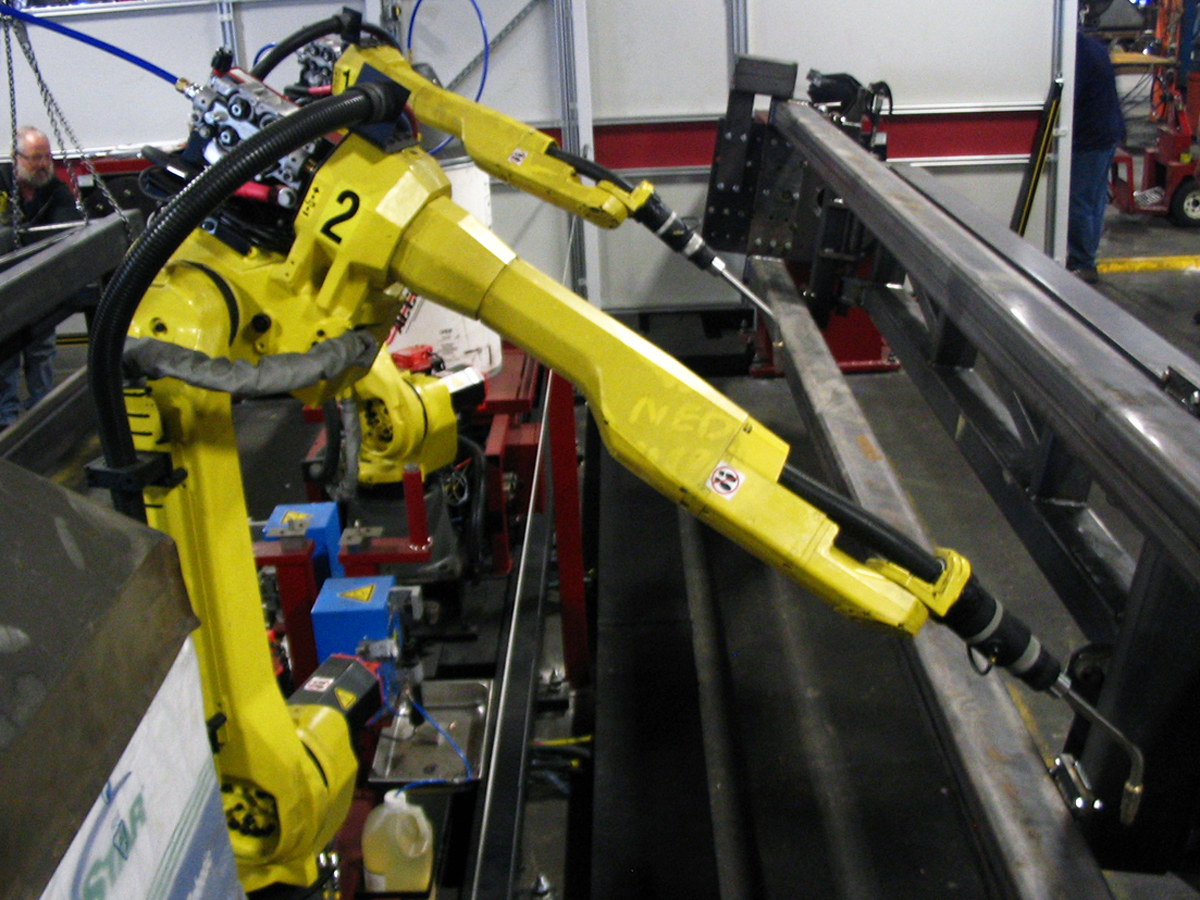
Jobs at threat from machines include factory work, office work, work in the leisure sector, work in medicine, law, education and other professions, train drivers and even taxi and lorry drivers. At present, in many of these jobs machines work alongside humans. For example, robots on production lines are common, and robots help doctors perform surgery and provide other back-up services in medicine.
A robot may not yet have a good bedside manner but it is pretty good at wading through huge reams of data to find possible treatments for diseases.
Even if robots don’t take over all jobs in these fields, they are likely to replace an increasing proportion of many of these jobs, leaving humans to concentrate on the areas that require judgement, creativity, human empathy and finesse.
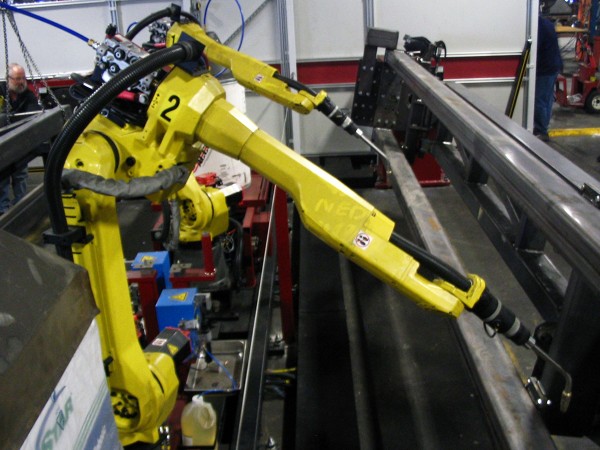 These developments raise a number of questions. If robots have a higher marginal revenue product/marginal cost ratio than humans, will employers choose to replace humans by robots, wholly or in part? How are investment costs factored into the decision? And what about industrial relations? Will employers risk disputes with employees? Will they simply be concerned with maximising profit or will they take wider social concerns into account?
Then there is the question of what new jobs would be created for those who lose their jobs to machines. According to the earlier Deloitte study, which focused on London, over 80% of companies in London say that over the next 10 years they will be most likely to take on people with skills in ‘digital know-how’, ‘management’ and ‘creativity’.
 But even if new jobs are created through the extra spending power generated by the extra production – and this has been the pattern since the start of the industrial revolution some 250 years ago – will these new jobs be open largely to those with high levels of transferable skills? Will the result be an ever widening of the income gap between rich and poor? Or will there be plenty of new jobs throughout the economy in a wide variety of areas where humans are valued for the special qualities they bring? As the authors of the later Deloitte paper state:
The dominant trend is of contracting employment in agriculture and manufacturing being more than offset by rapid growth in the caring, creative, technology and business services sectors.
The issues of job replacement and job creation, and of the effects on income distribution and the balance between work and leisure, are considered in the following videos and articles, and in the three reports.
Videos
What is artificial intelligence? BBC News, Valery Eremenko (13/9/15)
What jobs will robots take over? BBC News, David Botti (15/8/14)
Could a robot do your job? BBC News, Rory Cellan-Jones (14/9/15)
Intelligent machines: The robots that work alongside humans BBC News, Rory Cellan-Jones (14/9/15)
Intelligent machines: Will you be replaced by a robot? BBC News, John Maguire (14/9/15)
Will our emotions change the way adverts work? BBC News, Dan Simmons (24/7/15)
Could A Robot Do My Job? BBC Panorama, Rohan Silva (14/9/15)
Articles
Technology has created more jobs in the last 144 years than it has destroyed, Deloitte study finds Independent, Doug Bolton (18/8/15)
Technology has created more jobs than it has destroyed, says 140 years of data The Guardian, Katie Allen (18/8/15)
Will a robot take your job? BBC News (11/9/15)
Intelligent Machines: The jobs robots will steal first BBC News, Jane Wakefield (14/9/15)
Robots Could Take 35 Per Cent Of UK Jobs In The Next 20 Years Says New Study Huffington Post, Thomas Tamblyn (14/9/15)
The new white-collar fear: will robots take your job? The Telegraph, Rohan Silva (12/9/15)
Does technology destroy jobs? Data from 140 years says no Catch news, Sourjya Bhowmick (11/9/15)
Reports
Takeoff in Robotics Will Power the Next Productivity Surge in Manufacturing Boston Consulting Group (10/2/15)
Agiletown: the relentless march of technology and London’s response Deloitte (November 2014)
Technology and people: The great job-creating machine Deloitte, Ian Stewart, Debapratim De and Alex Cole (August 2015)
Questions
- Which are the fastest growing and fastest declining occupations? To what extent can these changes be explained by changes in technology?
- What type of unemployment is caused by rapid technological change?
- Why, if automation replaces jobs, have jobs increased over the past 250 years?
- In what occupations is artificial intelligence (AI) most likely to replace humans?
- To what extent are robots and humans complementary rather than substitute inputs into production?
- “Our analysis of more recent employment data also reveals a clear pattern to the way in which technology has affected work.” What is this pattern? Explain.
- Why might AI make work more interesting for workers?
- Using a diagram, show how an increase in workers’ marginal productivity from working alongside robots can result in an increase in employment. Is this necessarily the case? Explain.
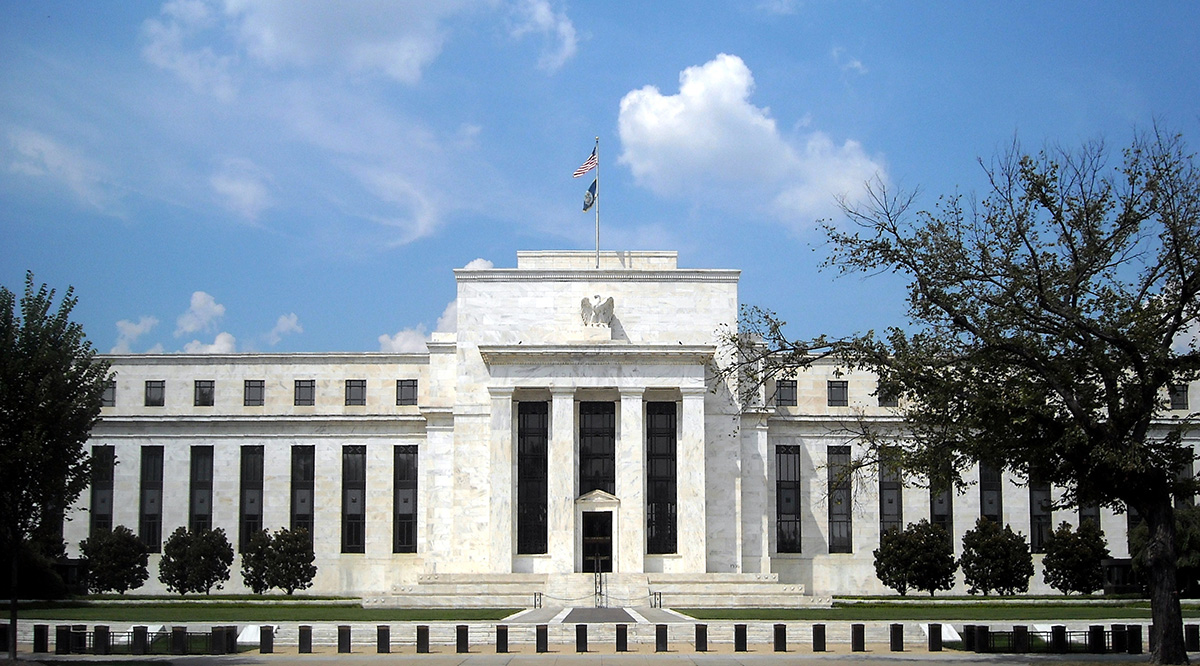
 Interest rates are the main tool of monetary policy and have a history of being an effective tool in creating macroeconomic stability. There has been much discussion since the end of the financial crisis concerning when interest rates would rise in the US (and the UK) and for the US, the case is stronger, given its rate of growth, which has averaged at 2.2% per annum since June 2009.
As in the UK, the question of ‘will rates rise?’ has a clear and certain answer: Yes. The more challenging question is ‘when?’. Much of the macroeconomic data for the US is promising, with positive economic growth (and relatively strong in comparison to the UK and Eurozone), a low unemployment rate and inflation of 0.3%. This last figure is ‘too low’, but it comes in at a much more attractive 1.2% if you exclude food and energy costs and there is an argument for doing this, given the price of oil. The data on unemployment and growth might suggest that the economy is at a stage where a rate rise could be managed, but the inflation data indicates that low interest rates might be needed to keep inflation above 0%. Furthermore, there are concerns that the low unemployment figure is somewhat misleading, given that under-employment is quite high at 10.3% and there are still many who are long-term unemployed, having been out of work for more than 6 months.
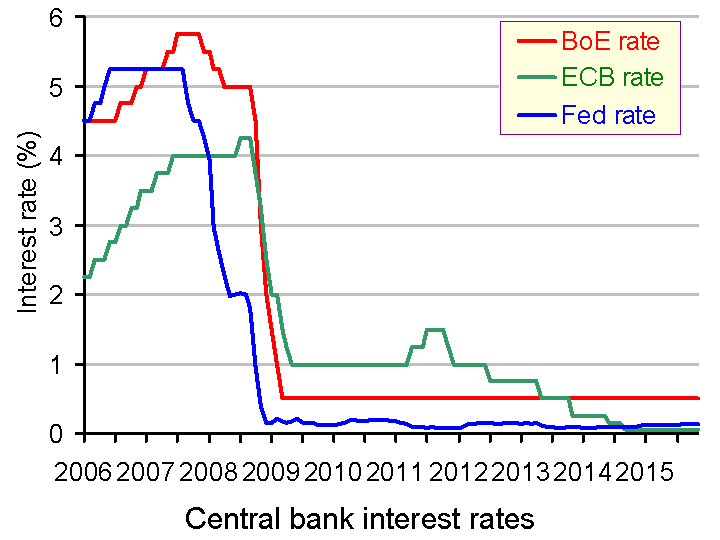
Interest rates can be a powerful tool in affecting the components of aggregate demand (AD) and hence the macroeconomic variables. If interest rates fall, it can help to stimulate AD by reducing borrowing costs for consumers and businesses, reducing the incentive to save, cutting variable rate mortgage payments and depreciating the exchange rate. Collectively these effects can stimulate an economy and hence create economic growth, reduce unemployment and push up prices. However, interest rates have been at almost 0% since the financial crisis, so the only way is up. Reversing the aforementioned effects could then spell trouble, if the economy is not in a sufficiently strong position.
For many, the strength of the US economy, while relatively good, is not yet good enough to justify a rate rise. It may harm investment, growth and unemployment and none of these variables are sufficiently high to warrant a rate rise, especially given the slowdown in the emerging markets. Karishma Vaswani, from BBC News said:
“The current global hand-wringing and head-holding over whether the US Fed will or won’t raise interest rates later has got investors here in Asia worried about what this means for their economies.
The Fed has become the favourite whipping boy of Asia’s central bankers, with cries from India to Indonesia to “just get on with it”.”
There are many, including Professor John Taylor from Stanford University and a former senior Treasury official, a rate rise is well over-due. The market is expecting one and has been for some time and these expectations aren’t going away, so ‘just get on with it.’ Janet Yellen, the Chair of the Federal Reserve is in a tricky situation. She knows that whatever is decided, markets around the world will react – no pressure then! The following articles consider the interest rate debate.
Articles
FTSE slides ahead of Fed interest rates decision The Telegraph, Tara Cunningham (17/9/15)
US’s interest rate rise dilemma BBC News, Andrew Walker (17/9/15)
US interest rate rise: how it could affect your savings and your mortgage Independent (17/9/15)
All eyes on Federal Reserve as it prepares for interest rate announcement The Guardian, Rupert Neate (16/9/15)
Federal Reserve meeting: Will US interest rates rise and should they? The Telegraph, Peter Spence (16/9/15)
Markets push US rate rise bets into 2016 as China woes keep Fed on hold: as it happened The Telegraph, Szu Ping Chan (17/9/15)
Federal Reserve puts rate rise on hold The Guardian (17/9/15)
US central bank leave interest rates unchanged BBC News (17/5/15)
Fed leaves interest rates unchanged Wall Street Journal, Jon Hilsenrath (17/9/15)
Asian markets mostly rally, US Futures waver ahead of Fed interest rate decision International Business Times, Aditya Tejas (17/9/15)
Data
Selected US interest rates Board of Governors of the Federal Reserve System (see, for example, Federal Funds Effective rate (monthly))
Questions
- What happened to US interest rates in September?
- Present the main arguments for keeping interest rates on hold.
- What were the arguments in favour of raising interest rates and do they differ depending on whether interest rates rise slowly or very rapidly?
- How did stock markets around the world react to Janet Yellen’s announcement? Is it good news for the UK?
- Using a diagram to support your explanation, outline why interest rates are such a powerful tool of monetary policy and how they affect the main macroeconomic objectives.
- Do you think other central banks will take note of the Fed’s decision, when they make their interest rate decisions in the coming months? Explain your answer.
 First the IMF in its World Economic Outlook, then the European Commission in its Economic Forecasts (see also) and now the OECD in its Economic Outlook (see also) – all three organisations in the latest issues of their 6-monthly publications are predicting slower global economic growth than they did 6 months previously. This applies both to the current year and to 2016. The OECD’s forecast for global growth this year is now 2.9%, down from the 3.7% it was forecasting a year ago. Its latest growth forecast for 2016 is 3.3%, down from the 3.9% it was forecasting a year ago.
 On this third point, the OECD Economic Outlook argues that ‘the rationale for such investments is that they could help to push economies onto a higher growth path than might otherwise be the case, at a time when private investment growth remains modest.’