 In the blog Japan’s interesting monetary policy as deflation fears grow we detailed the aggressive monetary measures of Japan’s central bank to prevent a deflationary mindset becoming again established. In January it introduced a negative interest rate on some deposits placed with it by commercial banks. This is in addition to it massive quantitative easing programme to boost the country’s money supply. Despite this, the latest consumer price inflation data show inflation now running at zero per cent.
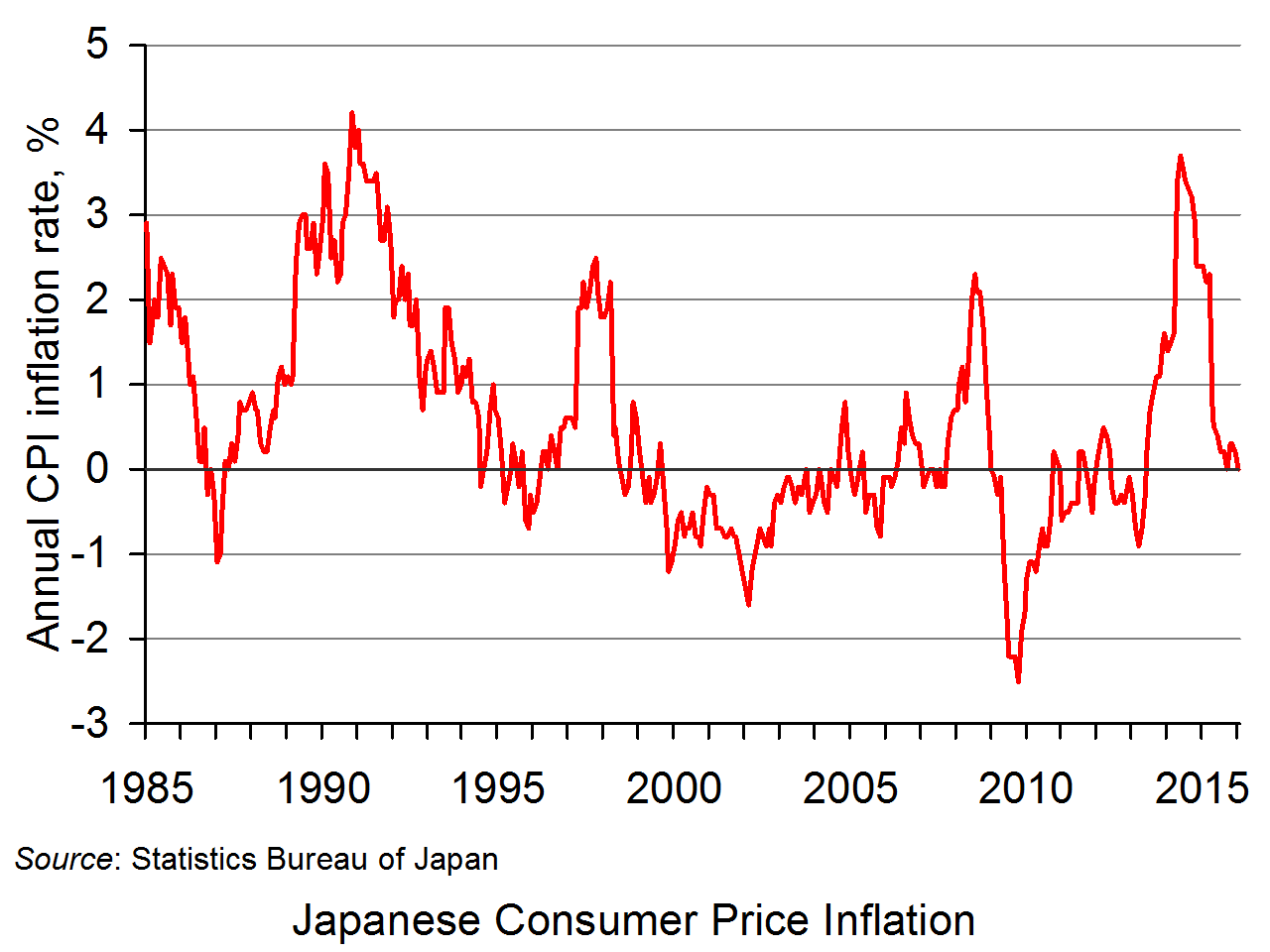 As the chart shows, since the mid 1990s there have been protracted periods of Japanese price deflation (click here to download a PowerPoint file of the chart). In January 2013 Japan introduced a 2 per cent CPI inflation target. This was accompanied by a massive expansion of its quantitative easing programme, through purchases of government bonds from investors.
Following this substantial monetary loosening, buoyed too by a loosening of fiscal policy, the rate of inflation rose. It reached 3.7 per cent in May 2014.
However, through 2015 the rate of inflation began to fall sharply, partly the result of falling commodity prices, especially oil. The latest inflation data show that the annual rate of CPI inflation in January 2016 fell to zero percent. In other words, consumer prices were on average at the levels seen in January 2015.
 The latest inflation numbers appear give further credence to the fear of the Bank of Japan that deflation is set to return. The introduction of a negative deposit rate was the latest move to prevent deflation. As well as encouraging banks to lend, the move is intended to affect expectations of inflation. By adopting such an aggressive monetary stance the central bank is looking to prevent a deflationary mindset becoming re-established. Hence, by increasing the expectations of the inflation rate and by raising wage demands the inflation rate will rise.
The loosening of monetary policy through a negative interest rate follows the acceleration of the quantitative easing programme announced in October 2015 to conduct Open Market Operations so as to increase the monetary base annually by ¥80 trillion.
The decline of Japan’s inflation rate to zero may yet mean that further monetary loosening might be called for. Eradicating a deflationary mindset is proving incredibly difficult. Where next for Japan’s monetary authorities?
Data
Consumer Price Index Statistics Bureau of Japan
New Articles
Japan’s inflation drops to zero in January MarketWatch, Takashi Nakamichi (25/2/16)
Japan inflation falls back to zero in January: govt AFP (26/2/16)
With pause in inflation, many brace for retreat Nikkei Asian Review (27/2/16)
Japan’s inflation rate has fallen again – to 0% Business Insider Australia, David Scutt (26/2/16)
Previous Articles
Bank of Japan adopts negative interest rate policy CNBC, Nyshka Chandran (29/1/16)
Japan adopts negative interest rate in surprise move BBC News (29/1/16)
Bank of Japan shocks markets by adopting negative interest rates The Guardian, Justin McCurry (29/1/16)
Japan stuns markets by slashing interests rates into negative territory The Telegraph, Mehreen Khan (29/1/16)
Japan introduces negative interest rate to boost economy The Herald, (29/1/16)
Questions
- What is deflation?
- What are the dangers of deflation? Why is the Bank of Japan keen to avoid expectations of deflation becoming re-established?
- To what extent are national policy-makers able to exert pressure over the rate of inflation?
- What does a negative interest rate on deposits mean for depositors?
- What effect is the Bank of Japan hoping that a negative deposit rate will have on the Japanese economy? How would such effects be expected to occur?
- What effect might the Bank of Japan’s actions be expected to have on the structure of interest rates in the economy?
- How might the negative interest rate effect how people wish to hold their wealth?
 On 20 February, the UK Prime Minister, David Cameron, announced the date for the referendum on whether the UK should remain in or leave the EU. It will be on 23 June. The announcement followed a deal with EU leaders over terms of UK membership of the EU. He will argue strongly in favour of staying in the EU, supported by many in his cabinet – but not all.
Two days later, Boris Johnson, the Mayor of London, said that he would be campaigning for the UK to leave the EU.
In the meantime, Mr Johnson’s announcement, the stance of various politicians and predictions of the outcome of the referendum are having effects on markets.
One such effect is on the foreign exchange market. As the Telegraph article below states:
The pound suffered its biggest drop against the dollar in seven years after London Mayor Boris Johnson said he will campaign for Britain to leave the European Union [‘Brexit’].
Sterling fell by as much as 2.12pc to $1.4101 against the dollar on Monday afternoon, putting it on course for the biggest one day drop since February 2009. Experts said the influential Mayor’s decision made a British exit from the bloc more likely.
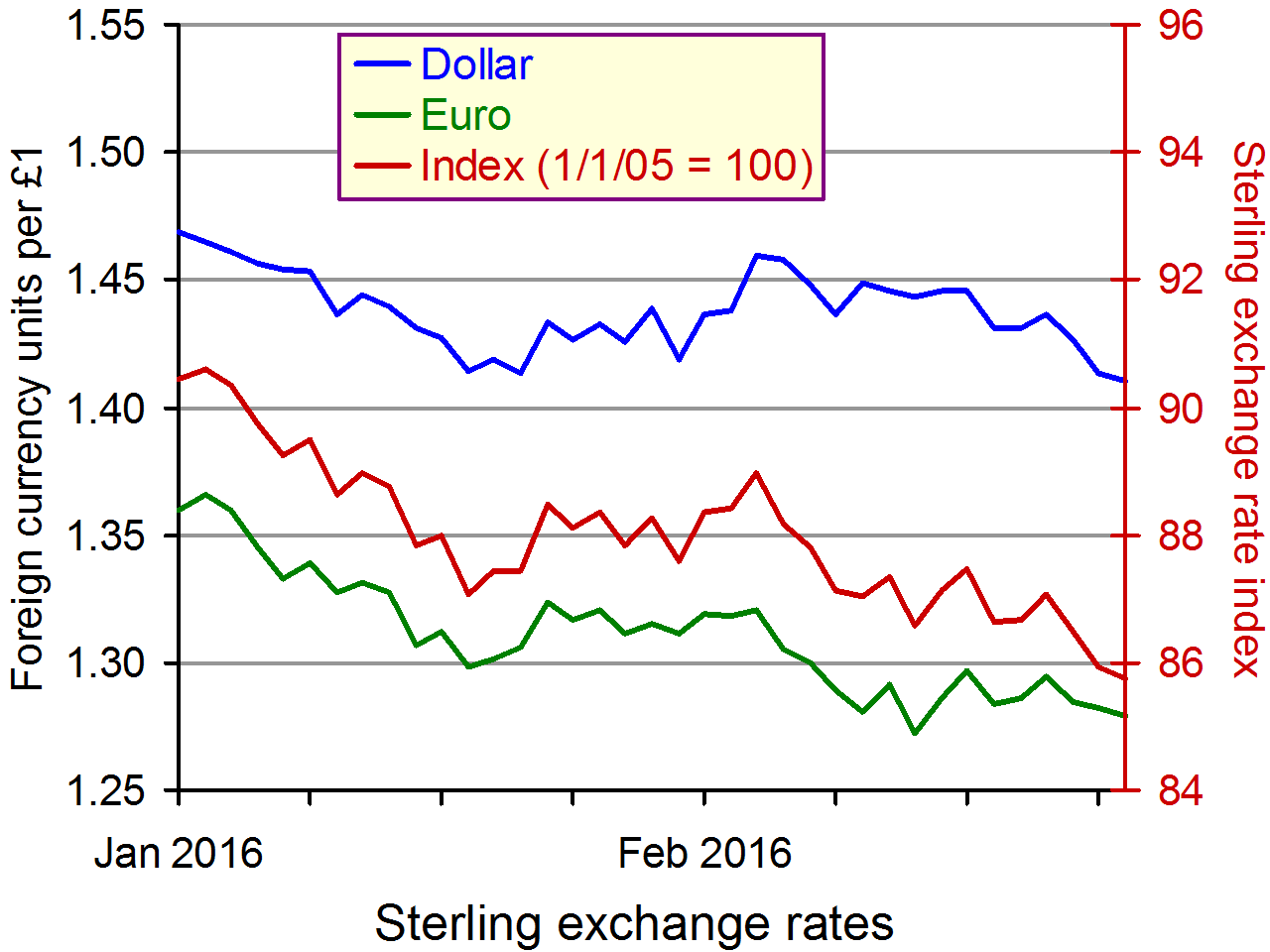
The pound also fell by as much as 1.2pc to €1.2786 against the euro and hit a two-year low against Japan’s yen.
This follows depreciation that has already taken place this year as predictions of possible Brexit have grown. The chart shows that from the start of the year to 23 February the sterling trade weighted index fell by 5.3% (click here for a PowerPoint).
But why has sterling depreciated so rapidly? How does this reflect people’s concerns about the effect of Brexit on the balance of payments and business more generally? Read the articles and try answering the questions below.
Articles
 Pound in Worst Day Since Banking Crisis as `Brexit’ Fears Bite Bloomberg, Eshe Nelson (21/2/16)
Pound hits 7-year low on Brexit fears Finiancial Times, Michael Hunter and Peter Wells (22/2/16)
Pound in freefall as Boris Johnson sparks Brexit fears The Telegraph, Szu Ping Chan (22/2/16)
Pound falls below $1.39 as economists warn Brexit could hammer households The Telegraph, Peter Spence (24/2/16)
Why is the pound falling and what does it mean for households and businesses? The Telegraph, Szu Ping Chan (23/2/16)
Pound heading for biggest one-day fall since 2009 on Brexit fears BBC News (22/2/16)
Cameron tries to sell EU deal after London mayor backs Brexit Euronews, Guy Faulconbridge and Michael Holden (22/2/16)
EU referendum: Sterling suffers biggest fall since 2010 after Boris Johnson backs Brexit International Business Times, Dan Cancian (22/2/16)
Exchange rate data
Spot exchange rates against £ sterling Bank of England
Questions
- What are the details of the deal negotiated by David Cameron over the UK’s membership of the EU?
- Why did sterling depreciate in (a) the run-up to the deal on UK EU membership and (b) after the announcement of the date of the referendum?
- Why did the FTSE100 rise on the first trading day after the Prime Minister’s announcement?
- What is the relationship between the balance of trade and the exchange rate?
- What are meant by the ‘six-month implied volatility in sterling/dollar’ and the ‘six-month risk reversals’?
- Why is it difficult to estimate the effect of leaving the EU on the UK’s balance of trade?
 In the UK, petrol prices have fallen significantly over the past couple of years and currently stand in some places at below £1 per litre. For UK residents, this price is seen as being cheap, but if we compare it to prices in Venezuela, we get quite a different picture. Prices are increasing here for the first time in 20 years from $0.01 per litre to $0.60 per litre – around 40 pence, while lower grade petrol increases to $0.10 per litre.
Venezuela has oil fields in abundance, but has not used this natural resource to its full potential to bolster the struggling economy. The price of petrol has been heavily subsidised for decades and the removal of this subsidy is expected to save around $800 million per year.
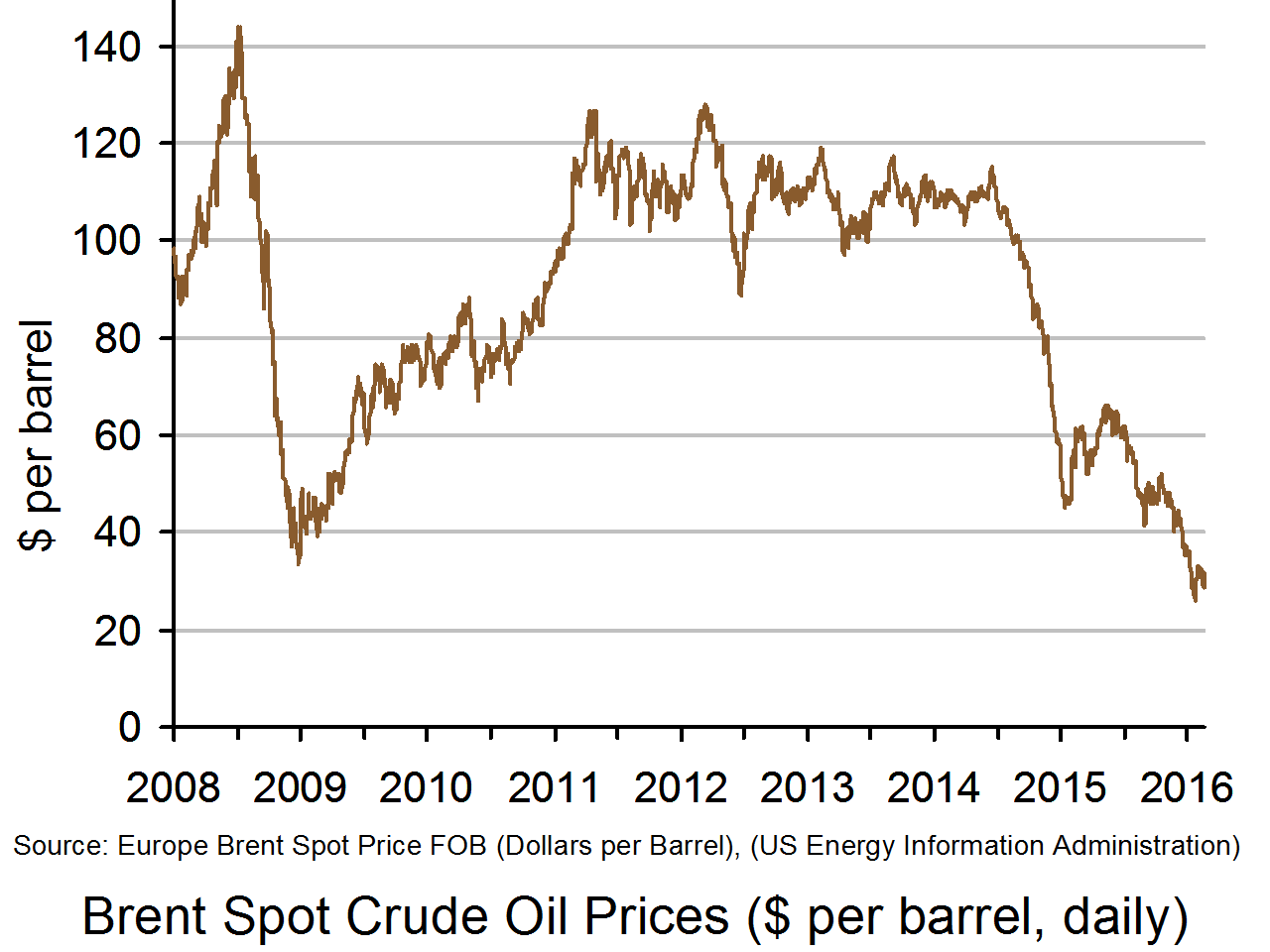 This will be important for the economy, given its poor economic growth, high inflation and shortages of some basic products. Venezuela relies on oil as the main component of its export revenues and so it has been hit very badly, by such low oil prices. The money from this reduced subsidy will be used to help social programmes across the country, which over time should help the economy.
In addition to this reduced subsidy on petrol prices, Venezuela’s President has also taken steps to devalue the exchange rate. This will help to boost the economy’s competitiveness and so is another policy being implemented to help the economy. However, some analysts have said that these changes don’t go far enough, calling them ‘small steps’, ‘nowhere near what is required’ and ‘late and insufficient’. The following articles consider the Venezuelan crisis and policies.
Venezuela raises petrol price for first time in 20 years BBC News (18/02/16)
Venezuela president raises fuel price by 6,000% and devalues bolivar to tackle crisis The Guardian, Sibylla Brodzinsky (18/02/16)
Venezuela’s Maduro devalues currency and raises gasoline prices Financial Times, Andres Schipani (18/02/16)
Venezuela hikes gasoline price for first time in 20 years The Economic Times (18/02/16)
Venezuela hikes fuel prices by 6000%, devalues currency to tackle economic crisis International Business Times, Avaneesh Pandey (18/02/16)
Market dislikes Venezuela reforms but debt rallies again Reuters (18/02/16)
Questions
- Why are oil prices so important for the Venezuelan economy?
- How will they affect the country’s export revenues and hence aggregate demand?
- Inflation in Venezuela has been very high recently. What is the cause of such high inflation? Illustrate this using an aggregate demand/aggregate supply diagram.
- How will a devaluation of the currency help Venezuela? How does this differ from a depreciation?
- Petrol prices have been subsidised in Venezuela for 20 years. Show how this government subsidy has affected petrol prices. Now that this subsidy is being reduced, how will this affect prices – show this on your diagram.
- Why are many analysts suggesting that these policies are insufficient to help the Venezuelan economy?
 Sustained economic growth in Japan remains elusive. Preliminary Quarterly Estimates of GDP point to the Japanese economy having contracted by 0.4 per cent in the final quarter of 2015. This follows on from growth of 0.3 per cent in the third quarter, a contraction of 0.3 per cent in the second and growth of 1 per cent in the first quarter. Taken as a whole output in 2015 rose by 0.4 per cent compared to zero growth in 2014. The fragility of growth means that over the past 20 years the average annual rate of growth in Japan is a mere 0.8 per cent.
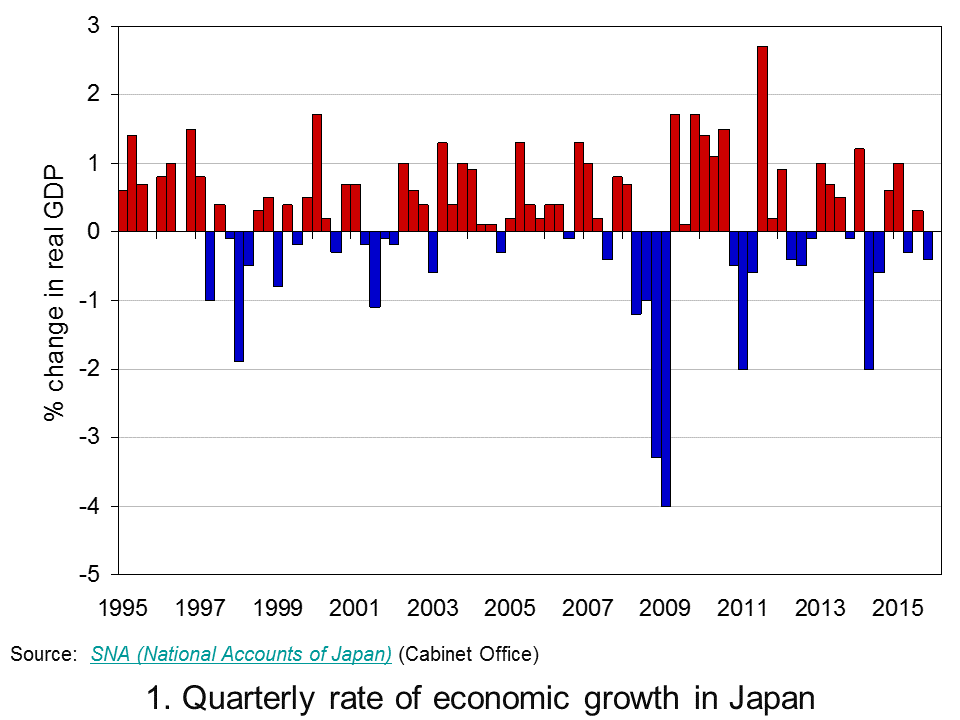 Chart 1 shows the quarter-to-quarter change in real GDP in Japan since the mid 1990s (Click here to download a PowerPoint of the chart). While economies are known to be inherently volatile the Japanese growth story over the past twenty or years so is one both of exceptional volatility and of repeated bouts of recession. Since the mid 1990s Japan has experienced 6 recessions, four since 2008.
Of the four recessions since 2008, the deepest was that from 2008 Q2 to 2009 Q1 which saw the economy shrink by 9.2 per cent. This was followed by a recession from 2010 Q4 to 2011 Q2 when the economy shrunk by 3.1 per cent, then from 2012 Q2 to 2012 Q4 when the economy shrunk by 0.9 per cent and from 2014 Q2 to 2014 Q3 when output fell another 2.7 per cent. As a result of these four recessionary periods the economy’s output in 2015 Q4 was actually 0.4 per cent less than in 2008 Q1.
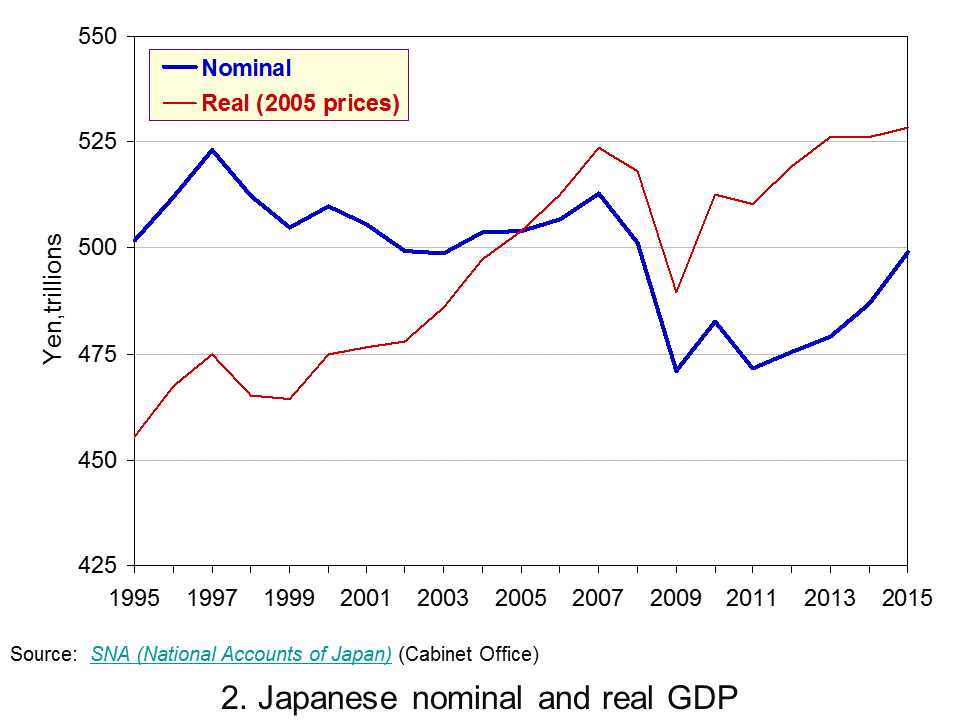 Chart 2 shows the annual levels of nominal (actual) and real (constant-price) GDP in trillions of Yen (¥) since 1995. (Click here to download a PowerPoint of the chart). Over the period actual GDP has fallen from ¥502 trillion to ¥499 trillion (about £3 trillion at the current exchange rate) while GDP at constant 2005 prices has risen from ¥455 trillion to ¥528 trillion.
Chart 2 reveals an interesting phenomenon: the growth in real GDP at the same time as a fall in nominal GDP. So why has the actual value of GDP fallen slightly between 1995 and 2005? The answer is quite simple: deflation.
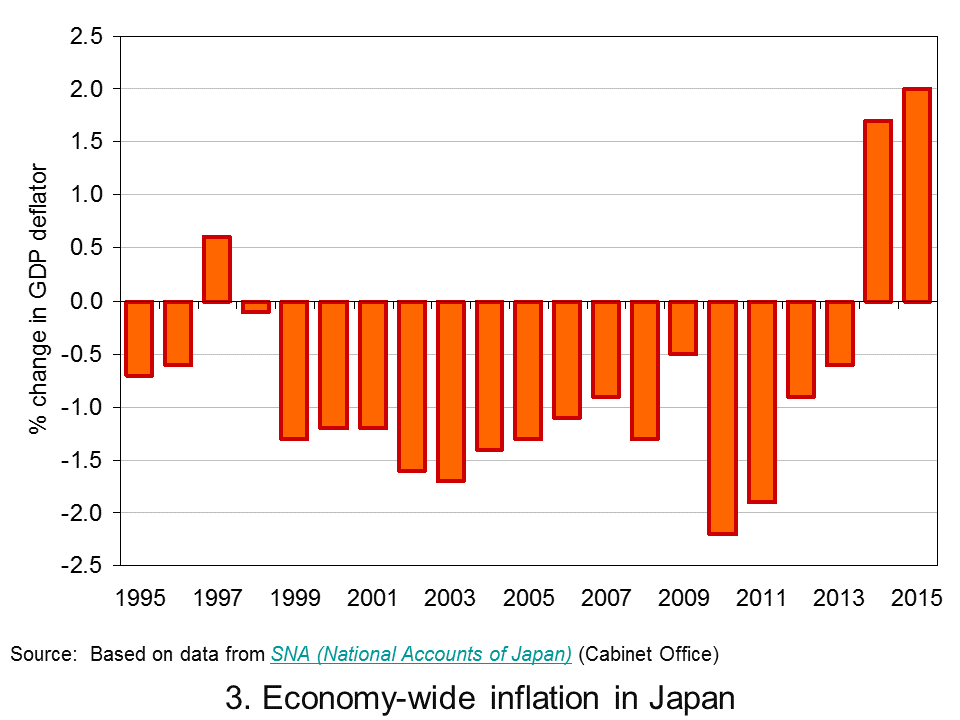 Chart 3 shows a protracted period of economy-wide deflation from 1999 to 2013. (Click here to download a PowerPoint of the chart). Over this period the GDP deflator fell each year by an average of 1.0 per cent. 2014 and 2015 saw a pick up in economy-wide inflation. However, the quarterly profile through 2015 shows the pace of inflation falling quite markedly. As we saw in Japan’s interesting monetary stance as deflation fears grow, policymakers are again concerned about the possibility of deflation and the risks that poses for growth.
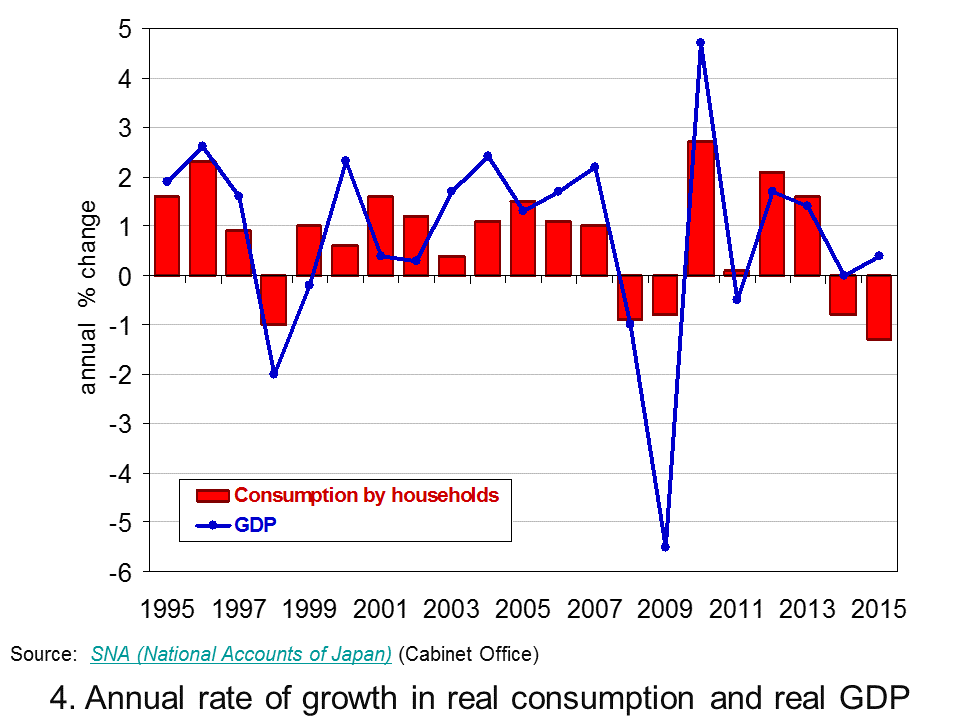 As Chart 4 helps to demonstrate, a significant factor behind the latest slowdown in Japan’s growth is household spending. (Click here to download a PowerPoint of the chart). In 2015 household spending accounted for about 57 per cent by value of GDP in Japan. In the last quarter of 2015 real household spending fell by 0.9 per cent while across 2015 as a whole real household spending fell by 1.3 per cent. This follows on from a 0.8 per cent decrease in spending by households in 2014.
The recent marked weakening of household spending is a significant concern for the short term growth prospects of the Japanese economy. The roller coaster ride continues, unfortunately it appears that the ride is again downwards.
Data
Quarterly Estimates of GDP Japanese Cabinet Office
Japan and the IMF IMF Country Reports
Economic Outlook Annex Tables OECD
Articles
Japan’s economy contracts in fourth quarter BBC News, (15/2/16)
Japanese economy shrinks again, raising expectations of more stimulus Telegraph, Szu Ping Chan (15/2/16)
Japan’s economy shrinks again as Abenomics is blown off course Guardian, Justin McCurry (15/2/16)
Japan’s economy contracts in latest setback for Abe policies New Zealand Herald, (15/2/16)
Japan’s ‘Abenomics’ on the ropes as yen soars, markets plunge Daily Mail, (15/2/16)
Japan economy shrinks more than expected, highlights lack of policy options CNBC, Leika Kihara and Tetsushi Kajimoto (15/2/16)
Questions
- Why is the distinction between nominal and real important in analysing economic growth?
- How do we define a recession?
- Of what importance is aggregate demand to the volatility of economies?
- Why are Japanese policymakers concerned about the prospects of deflation?
- What policy options are available to policymakers trying to combat deflation?
- Why is the strength of household consumption important in affecting the path of an economy?
- Why has Japan experienced an increase in real GDP but a fall in nominal GDP between 1995 and 2015?
 The perceived wisdom is that nominal interest rates have a lower zero bound. The Swedish central bank (the Ricksbank) has effectively been charging financial institutions to deposit money at the central bank since 2009. On 29 January 2016 the Central Bank of Japan also introduced a negative interest rate on deposits. The -0.1 per cent rate currently applies to a portion of the reserves held by financial institutions at the central bank. The move is another attempt to pump energy into a struggling economy.
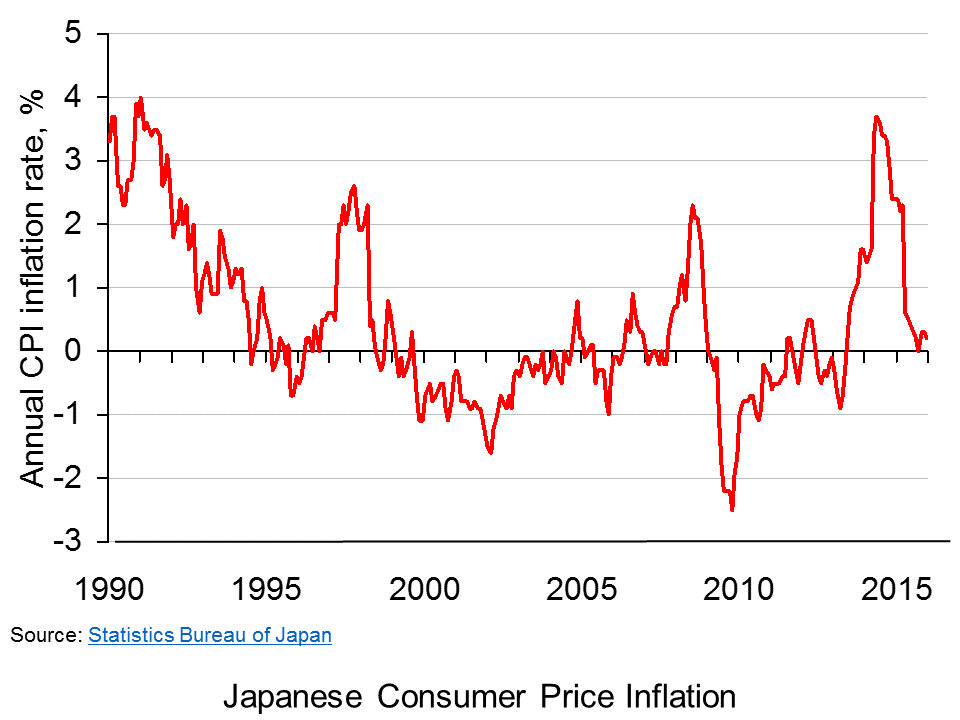 As the chart shows, since the mid 1990s there have been protracted periods of Japanese price deflation. In January 2013 Japan introduced a 2 per cent CPI inflation target. This was accompanied by a massive expansion of its quantitative easing programme, principally through purchases of government bonds from investors. Following the monetary loosening, buoyed too by a loosening of fiscal policy, the rate of inflation rose. It reached 3.7 per cent in May 2014.
However, through 2015 the rate of inflation began to fall sharply, partly the result of falling commodity prices, especially oil. Now there appears to be an increasing fear at the Bank of Japan that deflation may be set to return. The introduction of a negative deposit rate is intended to prevent deflation. In particular by affecting expectations of inflation. The hope is to prevent a deflationary mindset becoming re-established.
 The further loosening of monetary policy through a negative interest rate follows on the heels of an acceleration of quantitative easing last October. Back then, the Bank of Japan said that it would conduct Open Market Operations so that the monetary base would increase annually be ¥80 trillion. This was reaffirmed in its 29 January announcement. For an economy that has experienced four recessionary contractions since 2008 and with provisional estimates suggesting that it contracted by 0.4 per cent in the final quarter of 2015, it remains to be seen whether further monetary loosening might yet be called for.
Data
Consumer Price Index Statistics Bureau of Japan
Articles
Bank of Japan adopts negative interest rate policy CNBC, Nyshka Chandran (29/1/16)
Japan adopts negative interest rate in surprise move BBC News (29/1/16)
Bank of Japan shocks markets by adopting negative interest rates Guardian, Justin McCurry (29/1/16)
Japan stuns markets by slashing interests rates into negative territory Telegraph, Mehreen Khan (29/1/16)
Japan introduces negative interest rate to boost economy The Herald, (29/1/16)
Questions
- What does a negative interest rate on deposits mean for depositors?
- What effect is the Bank of Japan hoping that a negative deposit rate will have on the Japanese economy? How would such effects be expected to occur?
- What effect might the Bank of Japan’s actions be expected to have on the structure of interest rates in the economy?
- How might the negative interest rate effect how people wish to hold their wealth?
- What are the dangers of deflation? Why is the Bank of Japan keen to avoid expectations of deflation becoming re-established?
- To what extent are national policy-makers able to exert pressure over the rate of inflation?
 In the blog Japan’s interesting monetary policy as deflation fears grow we detailed the aggressive monetary measures of Japan’s central bank to prevent a deflationary mindset becoming again established. In January it introduced a negative interest rate on some deposits placed with it by commercial banks. This is in addition to it massive quantitative easing programme to boost the country’s money supply. Despite this, the latest consumer price inflation data show inflation now running at zero per cent.
 The latest inflation numbers appear give further credence to the fear of the Bank of Japan that deflation is set to return. The introduction of a negative deposit rate was the latest move to prevent deflation. As well as encouraging banks to lend, the move is intended to affect expectations of inflation. By adopting such an aggressive monetary stance the central bank is looking to prevent a deflationary mindset becoming re-established. Hence, by increasing the expectations of the inflation rate and by raising wage demands the inflation rate will rise.
 of the quantitative easing programme announced in October 2015 to conduct Open Market Operations so as to increase the monetary base annually by ¥80 trillion.