 Ten years ago (on 9 August 2007), the French bank BNP Paribas sparked international concern when it admitted that it didn’t know what many of its investments in the US sub-prime property market were worth and froze three of its hedge funds. This kicked off the financial crisis and the beginning of the credit crunch.
In September 2007 there was a run on the Northern Rock bank in the UK, forcing the Bank of England to provide emergency funding. Northern Rock was eventually nationalised in February 2008. In July 2008, the US financial authorities had to provide emergency assistance to America’s two largest mortgage lenders, Fannie Mae and Freddie Mac.
Then in September 2008, the financial crisis really took hold. The US bank, Lehman Brothers, filed for bankruptcy, sending shock waves around the global economy. In the UK, Lloyds TSB announced that it was taking over the UK’s largest mortgage lender, Halifax Bank Of Scotland (HBOS), after a run on HBOS shares.
Later in the month, Fortis, the huge Belgian banking, finance and insurance company, was partly nationalised to prevent its bankruptcy. Also the UK government was forced to take control of mortgage-lender, Bradford & Bingley’s, mortgages and loans, with the rest of the business sold to Santander.
Early in October 2008, trading was suspended in the main Icelandic banks. Later in the month, the UK government announced a £37 billion rescue package for Royal Bank of Scotland (RBS), Lloyds TSB and HBOS. Then in November it partially nationalised RBS by taking a 58% share in the bank. Meanwhile various other rescue packages and emergency loans to the banking sector were taking place in other parts of the world. See here for a timeline of the financial crisis.

So, ten years on from the start of the crisis, have the lessons of the crisis been learnt. Could a similar crisis occur again?
The following articles look at this question and the answers are mixed.
On the positive side, banks are much more highly capitalised than they were ten years ago. Moves by the Basel Committee on Banking Supervision in its Basel III regulatory framework have ensured that banks are much more highly capitalised and operate with higher levels of liquidity. What is more, banks are generally more cautious about investing in highly complex and risky collateralised assets.
On the negative side, increased flexibility in labour markets, although helping to keep unemployment down, has allowed a huge squeeze on real wages as austerity measures have dampened the economy. What is more, household debt is rising to possibly unsustainable levels. Over the past year, unsecured debt (e.g. personal loans and credit card debt) have risen by 10% and yet (nominal) household incomes have risen by only 1.5%. While record low interest rates make such loans relatively affordable, when interest rates do eventually start to rise, this could put a huge strain on household finances. But if households start to rein in their borrowing, this would put downward pressure on aggregate demand and jeopardise economic growth.
Articles
- The crisis: 10 years in three chart
BBC News, Simon Jack (9/8/17)
 Darling: ‘Alarm bells ringing’ for UK economy
BBC News (9/8/17)
- Alistair Darling warns against ‘complacency’ 10 years on from financial crisis
The Telegraph (9/8/17)
- A decade after the financial crisis consumers are still worried
Independent, Kate Hughes (9/8/17)
- Bankers still do not understand complex reasons behind financial crash, senior politician warns
Independent, Ashley Cowburn (9/8/17)
- We let the 2007 financial crisis go to waste
The Guardian, Torsten Bell (9/8/17)
- Bank of England warns of complacency over big rise in personal debt
The Guardian, Larry Elliott (24/7/17)
- On the 10th anniversary of the global financial meltdown, here’s what’s changed
USA Today, Kim Hjelmgaard (8/8/17)
- Financial crisis: Ten years ago today the tremors started
Irish Times (9/8/17)
- If We Are Racing to the Pre-Crisis Bubble, Here Are 12 Charts To Watch
Bloomberg, Sid Verma (9/8/17)
Videos
Questions
- Explain what are meant by ‘collateralised debt obligations (CDOs)’.
- What part did CDOs play in the financial crisis of 2007–8?
- In what ways is the current financial situation similar to that in 2007–8?
- In what ways is it different?
- Explain the Basel III banking regulations.
- To what extent has the Bank of England exceeded the minimum Basel III requirements?
- Explain what is meant by ‘stress testing’ the banks? Does this ensure that there can never be a repeat of the financial crisis?
- Why is it desirable for central banks eventually to raise interest rates to a level of around 2–3%? Why might it be difficult for central banks to do that?
 Following the financial crisis, all sectors of the economy continue to repair their balance sheets. As well as households, non-financial corporations and government, this is true of the banking sector. In part, the repairing and rebalancing of their balance sheets is being brought about by regulatory pressures. The objective is to make banks more resilient to shocks and less susceptible to financial distress.
The need for banks to repair and rebalance their balance sheets is significant because of their systemic importance to the modern-day economy. Financial institutions that are systemically important to national economies are know as SIFIs (systemically important financial institutions) while those of systemic importance to the global economy are know as G-SIFIs or G-SIBs (global systemically important banks). The increasing importance of financial institutions to economic activity is known as financialisation.
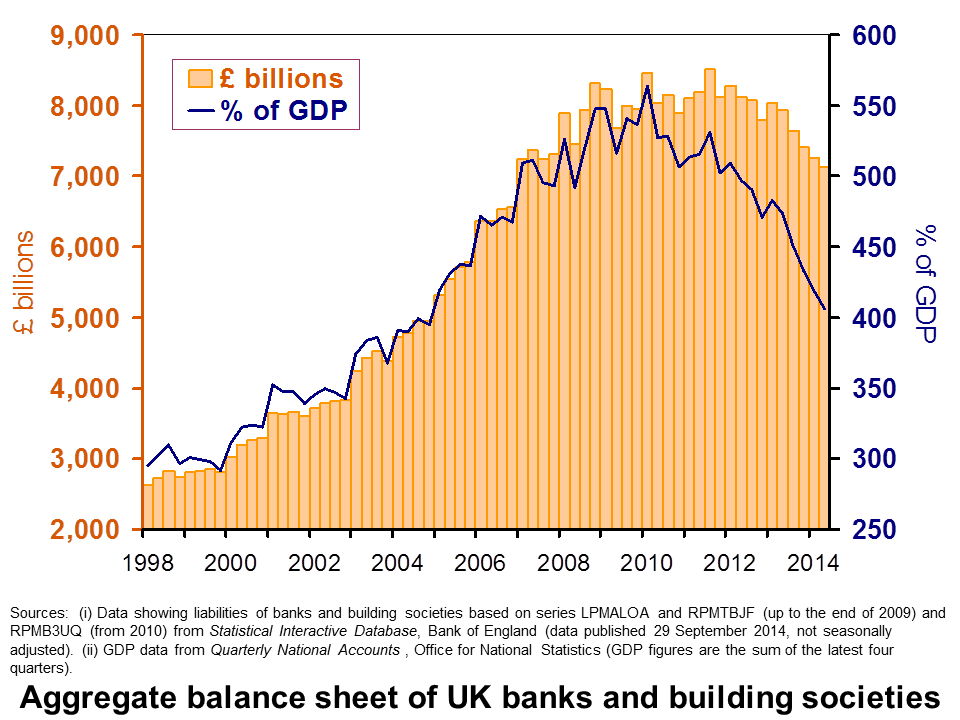 One way of measuring the degree of financialisation here in the UK is to consider the aggregate size of the balance sheet of resident UK banks and building societies (including foreign subsidiaries operating here). The chart shows that the balance sheet grew from £2.6 trillion in 1998 Q1 to £8.5 trillion in 2010 Q1. Another way of looking at this is to consider this growth relative to GDP. This reveals that the aggregate balance sheet of banks and building societies grew over this period from 3 times annual GDP to a staggering 5.6 times GDP. (Click here for a PowerPoint of the chart.)
But, now consider the aggregate banking balance sheet in the 2010s. This reveals a shrinking balance sheet. At the end of the second quarter of this year (2014 Q2) it had fallen back to £7.1 trillion or 4 times GDP. As a share of GDP, this was the smallest the aggregate balance sheet had been since 2005 Q1.
Does a shrinking balance sheet matter? This is where the analysis becomes tricky and open to debate. If the smaller size is consistent with a more stable financial system then undoubtedly that is a good thing. But, size is not that all matters. The composition of the balance sheet matters too. This requires an analysis of, among other things, the liquidity of assets (i.e. assets that can be readily turned in a given amount of cash), the reliability of the income flow from assets and the resources available to withstand periods of slow economic growth, including recessions, or periods of financial difficulty.
As we have identified before (see Financialisation: Banks and the economy after the crisis), the financial crisis could herald new norms for the banking system with important implications for the economy. If so, we may need to become accustomed to consistently lower flows of credit and not to the levels that we saw prior to the financial crisis of the late 2000s. However, an alternative view is that we are merely experiencing a pause before the next expansionary phase of the credit cycle. This is consistent with the financial instability hypothesis (see Keeping a Minsky-eye on credit) which argues that credit cycles are an integral part of modern financialised economies. Only time will tell which view will turn out to be right.
Articles
‘Cleaning up bank balance sheets is key’ Irish Examiner, John Walsh (10/10/14)
More action needed at European banks: Fitch Courier Mail, (17/10/14)
Bank lending to small businesses falls by £400m The Telegraph, Rebecca Burn-Callander (20/10/14)
Bank lending to SMEs falls by £400m SME insider, Lindsey Kennedy (21/10/14)
Record world debt could trigger new financial crisis, Geneva report warns The Guardian, Phillip Inman (29/10/14)
RBS shares jump as bank’s bad debts improve The Guardian, Jill Treanor (30/10/14)
Data
Statistical Interactive Database Bank of England
Questions
- Using examples, demonstrate your understanding of financialisation.
- Draw up a list of the alternative ways in which we might measure financialisation.
- What factors are likely to explain the recent reduction in the aggregate balance sheet of resident banks and building societies in the UK?
- How might we go about assessing whether the aggregate level of lending by financial institutions is sustainable?
- How might we go about assessing whether the level of lending by individual financial institutions is sustainable?
- How would reduced flows of credit be expected to impact on the economy both in the short term and in the longer term?
- Are credit cycles inevitable?
- Of what significance are credit cycles in explaining the business cycle?
In the blogs The capital adequacy of UK banks and A co-operative or a plc? we focus on how British banks continue to look to repair their balance sheets. To do so, banks need to ‘re-balance’ their balance sheets. This may involve them holding more reserves and equity capital and/or a less risky and more liquid profile of assets. The objective is to make banks more resilient to shocks and less susceptible to financial distress.
This will take time and even then the behaviour of banks ought to look like quite different from that before the financial crisis. All of this means that we will need to learn to live with new banking norms which could have fundamental consequences for economic behaviour and activity.
The increasing importance of financial institutions to economic activity is known as financialisation. It is not perhaps the nicest word, but, in one way or another, we all experience it. I am writing this blog in a coffee shop in Leicester having paid for my coffee and croissant by a debit card. I take it for granted that I can use electronic money in this way. Later I am going shopping and I will perhaps use my credit card. I take this short term credit for granted too. On walking down from Leicester railway station to the coffee shop I walked past several estate agents advertising properties for sale. The potential buyers are likely to need a mortgage. In town, there are several construction sites as Leicester’s regeneration continues. These projects need financing and such projects often depend on loans secured from financial institutions.
 We should not perhaps expect economic relationships to look as they did before the financial crisis. The chart shows how levels of net lending by financial institutions to households have dramatically fallen since the financial crisis. (Click here for PowerPoint of chart.)
Net lending measures the amount of lending by financial institutions after deducting repayments. These dramatically smaller flows of credit do matter for the economy and they do affect important macroeconomic relationships.
Consider the consumption function. The consumption function is a model of the determinants of consumer spending. It is conventional wisdom that if we measure the growth of consumer spending over any reasonably long period of time it will basically reflect the growth in disposable income. This is less true in the short run and this is largely because of the financial system. We use the financial system to borrow and to save. It allow us to smooth our consumption profile making spending rather less variable. We can save during periods when income growth is strong and borrow when income growth is weak or income levels are actually falling. All of this means that in the short term consumption is less sensitive to changes in disposable income that it would otherwise be.
 The financial crisis means new norms for the banking system and, hence, for the economy. One manifestation of this is that credit is much harder to come by. In terms of our consumption function this might mean consumption being more sensitive to income changes that it would otherwise be. In other words, consumption is potentially more volatile as a result of the financial crisis. But, the point is more general. All spending activity, whether by households or firms, is likely to be more sensitive to economic and financial conditions than before. For example, firms’ capital spending will be more sensitive to their current financial health and crucially to their flows of profits.
We can expect particular markets and sectors to be especially affected by new financial norms. An obvious example is the housing market which is very closely tied to the mortgage market. But, any market or sector that traditionally is dependent on financial institutions for finance will be affected. This may include, for example, small and medium-sized enterprises or perhaps organsiations that invest heavily in R&D. It is my view that economists are still struggling to understand what the financial crisis means for the economy, for particular sectors of the economy and for the determination of key economic relationships, such as consumer spending and capital spending. What is for sure, is that these are incredibly exciting times to study economics and to be an economist.
Data
Statistical Interactive Database Bank of England
Articles
Cut in net lending to non-financial firms raises credit worries Herald Scotland, Mark Williamson (25/5/13)
Loans to business continue to shrink despite Funding for Lending Scheme Wales Online, Chris Kelsey (3/6/13)
Factbox – Capital shortfalls for five UK banks, mutuals Standard Chartered News (20/6/13)
UK banks ordered to plug £27.1bn capital shortfall The Guardian, Jill Treanor (20/6/13)
Barclays, Co-op, Nationwide, RBS and Lloyds responsible for higher-than-expected capital shortfall of £27.1bn The Telegraph, Harry Wilson (20/6/13)
UK banks need to plug £27bn capital hole, says PRA BBC News (20/6/13)
Barclays and Nationwide forced to strengthen BBC News, Robert Peston (20/6/13)
Five Banks Must Raise $21 Billion in Fresh Capital: BOE Bloomberg, Ben Moshinsky (20/6/13)
Co-operative Bank to list on stock market in rescue deal The Guardian, Jill Treanor (17/6/13)
Troubled Co-operative Bank unveils rescue plan to plug £1.5bn hole in balance sheet Independent, Nick Goodway (17/6/13)
Co-op Bank announces plan to plug £1.5bn hole Which?(17/6/13)
The Co-operative Bank and the challenge of finding co-op capital The Guardian, Andrew Bibby (13/6/13)
Co-op Bank seeks to fill £1.5bn capital hole Sky News (17/6/13)
Central banks told to head for exit Financial Times, Claire Jones (23/6/13)
Stimulating growth threatens stability, central banks warn The Guardian (23/6/13)
BIS Press Release and Report
Making the most of borrowed time: repair and reform the only way to growth, says BIS in 83rd Annual Report BIS Press Release (23/6/13)
83rd BIS Annual Report 2012/2013 Bank for International Settlements (23/6/13)
Questions
- What is meant by equity capital?
- How can banks increase the liquidity of their assets?
- Explain how Basel III is intended to increase the financial resilence of banks.
- What do you understand by the term ‘financialisation’? Use examples to illustrate this concept.
- How might we expect the financial crisis to affect the detemination of spending by economic agents?
- Using an appropriate diagram, explain how a reduction in capital spending could affect economic activity? Would this be just a short-term effect?
- What does it mean if we describe households as consumption-smoothers? How can households smooth their spending?
 Barclays’ Chief Executive, Bob Diamond, has resigned following revelations that Barclays staff had been involved in rigging the LIBOR in the period 2005–9, including the financial crisis of 2007–9.
So what is the LIBOR; how is it set; what were the reasons for Barclays (and other banks, as will soon be revealed) attempting to manipulate the rate; and what were the consequences?
The LIBOR, or London interbank offered rate, is the average of what banks report that they would have to pay to borrow from one another in the inter-bank market. Separate LIBORs are calculated for 15 different lending periods: overnight, one week, one month, two months, three months, six months, etc. The rates are set daily as the average of submissions made to Thomson Reuters by some 15 to 20 banks (a poll overseen by the British Bankers’ Association). Thomson Reuters then publishes the LIBORs, along with all of the submissions from individual banks which are used to calculate it.
Many interest rates around the world are based on LIBORs, or their European counterpart, EURIBORs. They include bond rates, mortgage rates, overdraft rates, etc. Trillions of dollars worth of such assets are benchmarked to the LIBORs. Thus manipulating LIBORs by even 1 basis point (0.01%) can result in millions of dollars worth of gains (or losses) to banks.
 The charge, made by the Financial Services Authority, is that Barclays staff deliberately under- or overstated the rate at which the bank would have to borrow. For example, when interbank loans were drying up in the autumn of 2008, Barclays staff were accused of deliberately understating the rate at which they would have to borrow in order to persuade markets that the bank was facing less difficulty than it really was and thereby boost confidence in the bank. In other words they were accused of trying to manipulate LIBORs down by lying.
As it was the LIBORs were rising well above bank rate. The spread for the one-month LIBOR was around 1 to 1.2% above Bank Rate. Today it is around 0.1 to 0.15% above Bank Rate. Without lying by staff in Barclays, RBS and probably other banks too, the spread in 2008 may have been quite a bit higher still.
The following articles look at the issue, its impact at the time and the aftermath today.
Articles
A Libor primer The Globe and Mail, Kevin Carmichael (3/7/12)
60 second guide to Libor Which? (3/7/12)
Explaining the Libor interest rate mess CNN Money (3/7/12)
Fixing Libor Financial Times (27/6/12)
LIBOR in the News: What it is, Why it’s Important Technorati, John Sollars (2/7/12)
Libor rigging ‘was institutionalised at major UK bank’ The Telegraph, Philip Aldrick (1/7/12)
Barclays ‘attempted to manipulate interest rates’ BBC News, Robert Peston (27/6/12)
The Libor Conspiracy: Were the Bank of England and Whitehall in on it? Independent, Oliver Wright, James Moore , Nigel Morris (4/7/12)
Fixing LIBOR The Economist (10/3/12)
Cleaning up LIBOR? The Economist (14/5/12)
Eagle fried The Economist, Schumpeter (27/6/12)
Barclays looks like the victim Financial Post, Terence Corcoran (3/7/12)
Inconvenient truths about Libor BBC News, Stephanie Flanders (4/7/12)
Timeline: Barclays’ widening Libor-fixing scandal BBC News (5/7/12)
The elusive truth about Barclays’ lie BBC News, Robert Peston (4/7/12)
Rate Fixing Scandal Is International: EU’s Almunia CNBC, Shai Ahmed (4/7/12)
Bank-Bonus Culture to Blame for Barclays Scandal The Daily Beast, Alex Klein (3/7/12)
Libor scandal ‘damaging’ for City BBC Today Programme, Andrew Lilico and Mark Boleat (5/7/12)
Data
Libor rate fixing: see each bank’s submissions Guardian Data Blog, Simon Rogers (3/7/12)
Sterling interbank rates Bank of England
Questions
- Using data from the Bank of England (see link above), chart two or three LIBOR rates against Bank rate from 2007 to the present day.
- For what reason would individuals and firms lose from banks manipulating LIBOR rates?
- Why would LIBOR manipulation be more ‘effective’ if banks colluded in their submissions about their interest rates?
- Why might the Bank of England and the government have been quite keen for the LIBOR to have been manipulated downwards in 2008?
- To what extent was the LIBOR rigging scandal an example of the problem of asymmetric information?
- In the light of the LIBOR rigging scandal, should universal banks be split into separate investment and retail banks, rather than erecting some firewall around their retail banking arm?
- What are the arguments for and against making attempts to manipulate LIBOR rates a criminal offences?
 Paul Volcker was Chair of the US Federal Reserve from 1979 to 1987. He was also Chair of the Economic Recovery Advisory Board under President Barack Obama from February 2009 to January 2011. In the webcast and articles below, he reflects on the current state of the world financial system – from regulation, to the euro crisis, to world imbalances, to the system of floating exchange rates.
He argues that global financial systems are vulnerable to breakdowns. What is needed is reform to the system, and for that there needs to be consensus by politicians, regulators and central banks.
But, in the absence of international consensus on some key points, reform will be greatly weakened, if not aborted. The freedom of money, financial markets and people to move – and thus to escape regulation and taxation – might be an acceptable, even constructive, brake on excessive official intervention, but not if a deregulatory race to the bottom prevents adoption of needed ethical and prudential standards.
Perhaps most important is a coherent, consistent approach to dealing with the imminent failure of “systemically important” institutions. Taxpayers and governments alike are tired of bailing out creditors for fear of the destructive contagious effects of failure – even as bailouts encourage excessive risk-taking.
According to Volcker, countries must be prepared to surrender some sovereignty. Policies must be co-ordinated internationally and there must be stronger regulation by international bodies, such as the IMF and stronger concerted action by global organisations, such as the G20.
 Left to their own devices, in an era of floating exchange rates, countries may pursue policies that exacerbate global imbalances.
Not so long ago, we were comforted by theorising that floating exchange rates would mediate international adjustments in a timely and orderly way. But, in the real world, many countries, particularly but not limited to small, open economies, simply find it impractical or undesirable to permit their currency to float.
We are left with the certainty, however awkward, that active participation in an open world economy requires some surrender of economic sovereignty. Or, to put the point more positively, it requires a willingness to co-ordinate policies more effectively.
Webcast
Volcker Urges Global Monetary System Overhaul BloombergBusinessweek (31/5/12)
Articles
Is global financial reform possible? Guardian, Paul Volcker (6/6/12)
Volcker Urges Global Financial System Overhaul After Crisis BloombergBusinessweek, Robyn Meredith and Shamim Adam (31/5/12)
Questions
- What reforms, according to Volcker, need to be implemented in order for the euro to function effectively without crises?
- What can the USA do to ease the euro crisis?
- What are Volcker’s views on the regulation of the US banking system?
- How are incentive structures in banks related to speculative activities?
- Should banks be allowed to fail?
- What financial imbalances exist between countries?
- What international monetary reforms are required?
- What light can game theory shed on the difficulty of achieving global policy co-ordination?
- Is an international system of floating exchange rates appropriate given the size of international financial flows?
 Ten years ago (on 9 August 2007), the French bank BNP Paribas sparked international concern when it admitted that it didn’t know what many of its investments in the US sub-prime property market were worth and froze three of its hedge funds. This kicked off the financial crisis and the beginning of the credit crunch.