 Recently, a flurry of bankruptcies among non-bank financial intermediaries (NBFIs) in the USA has drawn attention to the risks associated with alternative credit channels in the shadow-banking sector – lending which is not financed with deposits. There is concern that this could be the start of a wave of bankruptcies among such NBFIs, especially given concerns about a potential downswing in the economic cycle – a time when defaults are more likely.
While providing alternative sources of funding, the opacity of lending in the shadow-banking sector means it is not clear what risks NBFIs face themselves and, more significantly, what risks they pose to the financial system as a whole. There is particular concern about the impact on regulated banks.
Already, JP Morgan Chase in its third quarter earnings report announced a $170m charge stemming from the bankruptcy of Tricolor, which specialised in sub-prime car financing. Mid-sized banks, Western Alliance and Zions Bancorp, have reported losses from loans to a group of distressed real estate funds. This has highlighted the interconnectedness between NBFIs and regulated banking, and the potential for problems in the shadow-banking sector to have a direct impact on mainstream banks.
In this blog, we will trace the secular trends in the financial systems of more advanced economies which have given rise to alternative credit channels and, in turn, to potential banking crises. We will explain the relationship between regulated banks and shadow banks, analysing the risks involved, the potential impact on the financial system and the policy implications.
What are the secular trends in banking?
The traditional model of commercial banking involved taking deposits and using them to finance loans to households and firms. However, cycles of banking crises, regulatory changes and financial innovation over the past 50 years produced new models.
First, banks diversified away from direct lending to providing other banking services – on-balance sheet activities, such as investing in financial securities, and off-balance sheet activities, such as acting as agents in the sale of financial securities.
Second, alternative credit channels based on financial markets have grown in significance.
 In the 1980s, international regulations around traditional banking activities – taking deposits and making loans – were being formalised by the Bank for International Settlements (BIS) under what became known as the Basel framework (see, for example, Economics section 18.2 or Economics for Business section 28.2). For the first time, this stipulated liquidity and capital requirements for international banks relating to their traditional lending activities. However, at the same time the deregulation of financial markets and financial innovation provided banks with opportunities to derive revenues from a range of other financial services.
After the financial crisis, liquidity and capital requirements for banks were tightened further through the Basel III regulations. Commercial banks had to have even higher levels of capital as a buffer for bad debts associated with direct lending. A higher level of capital to cover potential losses increases the marginal cost of lending, since each pound of additional loan requires additional capital. This reduced the marginal return, and consequently, the incentive to lend directly.
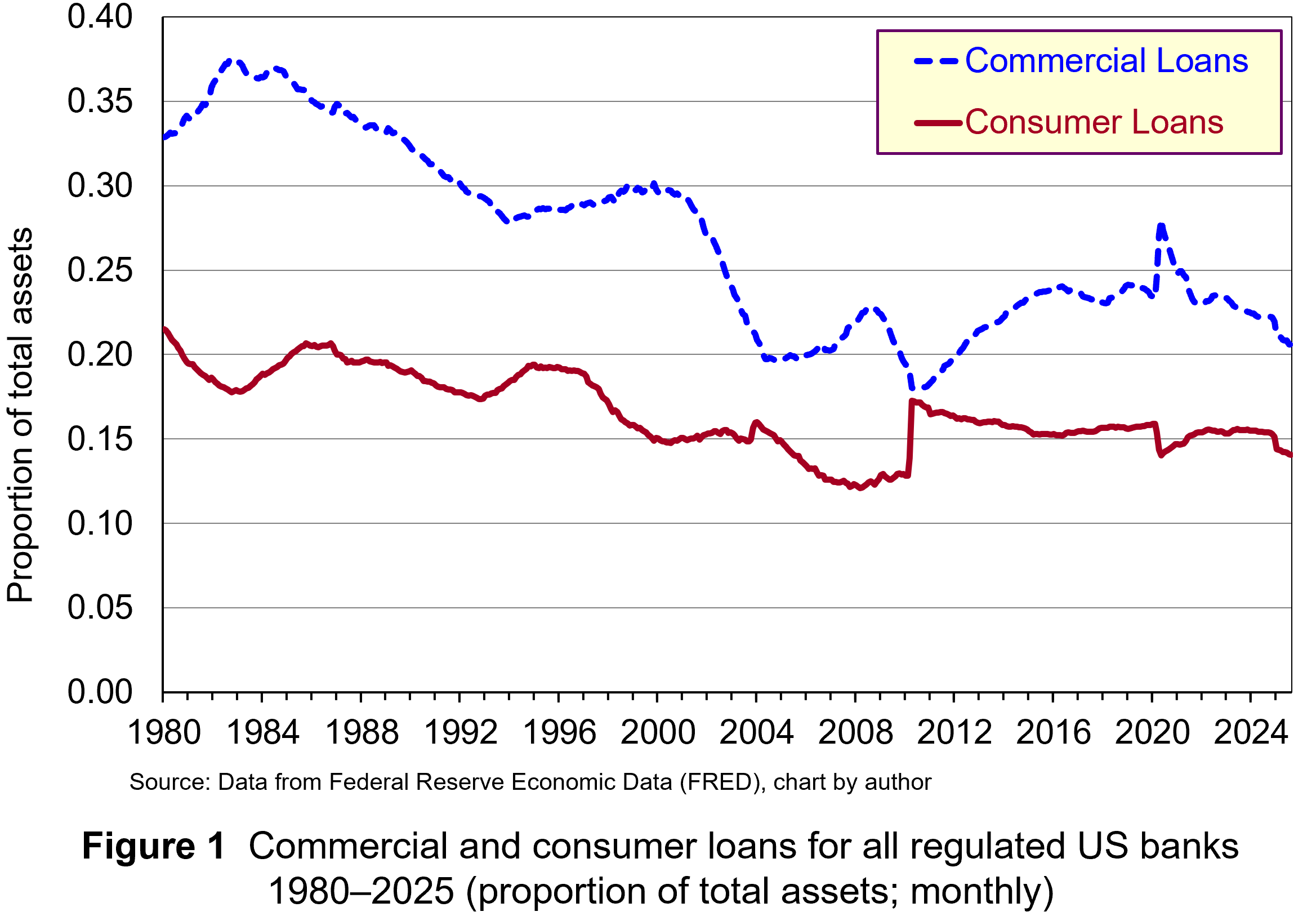 These regulatory developments created an incentive to pursue activities which do not require as much capital, since their marginal cost is lower and potential return is higher. Consequently, banks have placed less emphasis on lending and more on purchasing short-term and long-term financial securities and generating non-interest income from off-balance sheet activities. For instance, research by the Bank of England found that during the 1980s, interest income accounted for more than two-thirds of total income for large international banks. In contemporary times, non-interest income tends to be greater than interest income. Figure 1 illustrates the declining proportion of total assets represented by commercial and consumer loans for all regulated US banks. (Click here for a PowerPoint.)
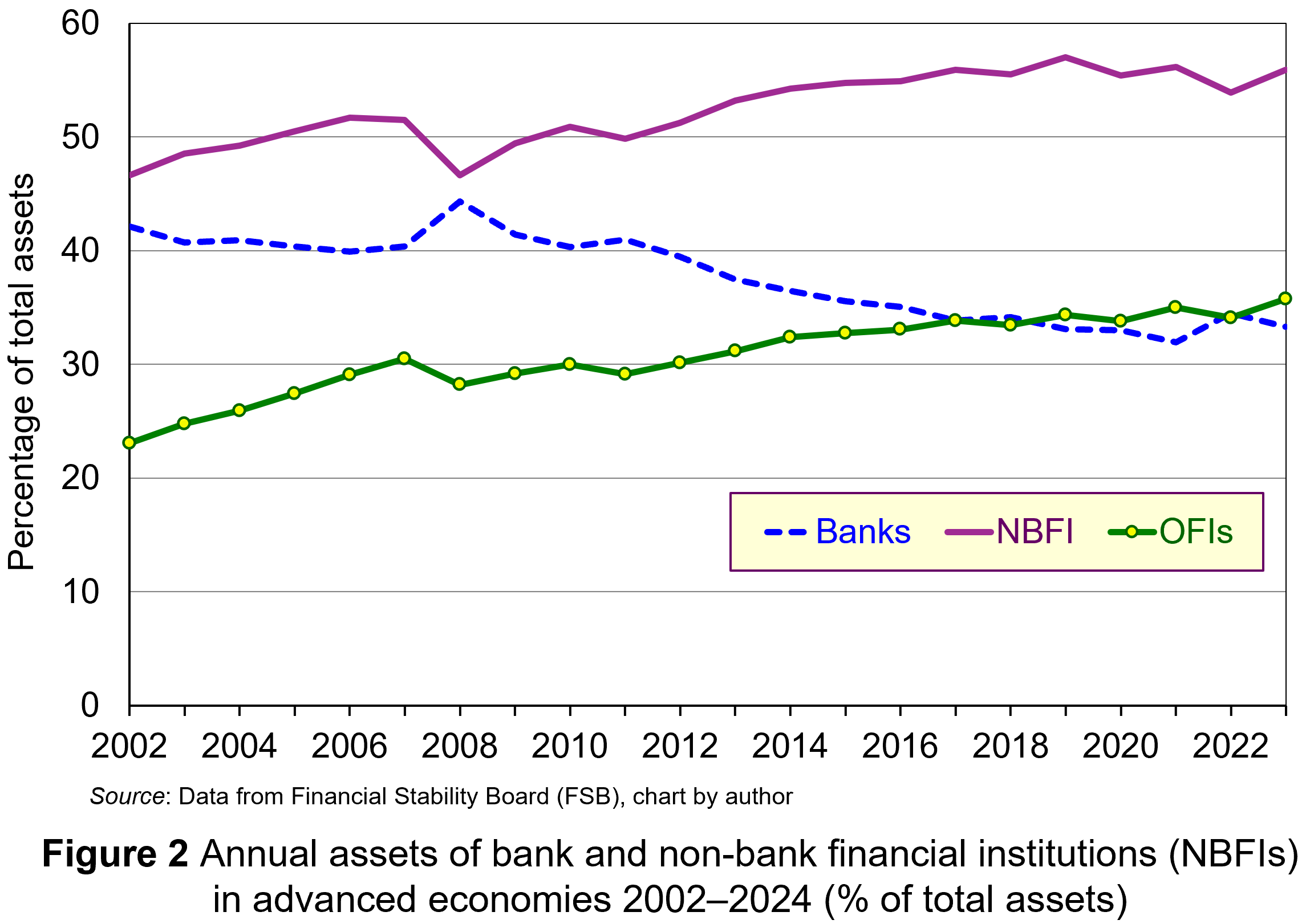 With banks originating less lending, activity has migrated to different avenues in the shadow-banking sector. This sector has always existed, but deregulation and financial innovation created opportunities for the growth of shadow banking – lending which is not financed with deposits. Traditionally, non-bank financial intermediaries (NBFIs), such as pension funds, hedge funds and insurance companies, use funds from investors to buy securities through financial markets. However, new types of NBFIs have emerged which originate loans themselves, notably private credit institutions. As Figure 2 illustrates, a lot of the expansion in the activities of NBFIs has been the due to increased lending by these institutions (defined as ‘other financial institutions (OFIs)). Note that the NBFI line includes OFIs. (Click here for a PowerPoint.)
Since, NBFIs operate outside conventional regulatory frameworks, their credit intermediation and maturity transformation are not subject to the same capital requirements or oversight that banks are. As a result, they do not need to have the same level of capital to insulate against loan losses. Therefore, lending in the shadow-banking sector has a lower marginal cost compared to equivalent lending in the banking sector. Consequently, it generates a higher rate of return. This can explain the large growth in the assets of OFIs illustrated in Figure 2.
Risks in shadow banking
 Banking involves trade-offs and this is the case whether the activities happen in the regulated or shadow-banking sector. Increasing lending increases profitability. But as lending continues to increase, at some point the risk-return profile becomes less favourable since institutions are lending to increasingly higher-risk borrowers and for higher-risk projects.
In downturns, when rates of defaults rise, such risks become apparent. Borrowers fail and default, causing significant loan losses for lenders. With lower levels of capital, NBFIs will have a lower buffer to insulate investors from these losses, increasing the likelihood of default.
Is this a problem? Well, for a long-time regulators thought not. It was thought that failures in the shadow-banking sector would have no implications for deposit-holders in regulated banks and the payments mechanism. Unfortunately, current developments in the USA have highlighted that this is unlikely to be the case.
The connections between regulated and shadow banking
 The financial system is highly interconnected, and each successive financial crisis has shown that systemic risks lurk in obscure places. On the face of it, NBFIs appear separate from regulated banks. But banks’ new business models have not removed them from the lending channel, merely changed their role. Short-term financing used to be conducted and funded by banks. Now, it is conducted by NBFIs, but still financed by banks. Long-term loan financing is no longer on banks’ balance sheets. However, while the lending is conducted by NBFIs, it is largely funded by banks.
NBFIs cannot be repositories of liquidity. Since they do not have deposits and are not part of the payments system, they have no access to official liquidity backstops. So, they do so indirectly by using deposit-taking banks as liquidity insurance. Banks provide this liquidity in a variety of ways:
- Investing in the securities issued by private capital funds;
- Providing bridge financing to credit managers to securitise credit card receivables;
- Providing prime broker financing to a hedge fund engaged in proprietary trading.
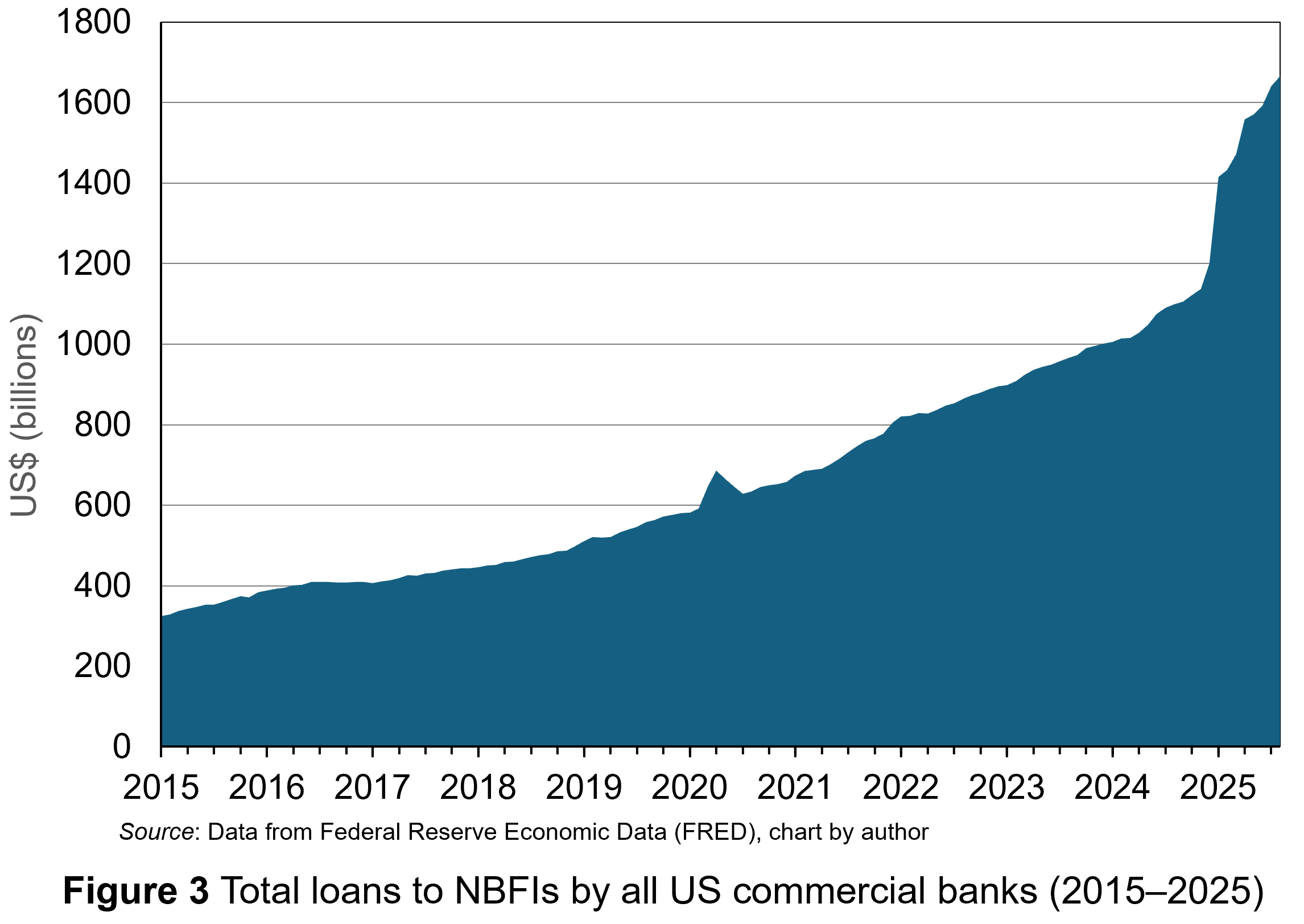 Furthermore, banks have increasingly made loans to NBFIs. Data for US commercial banks lending to the shadow-banking sector are publicly available only since 2015. But, as Figure 3 illustrates, it has seen a steady upward trend with a surge in activity in 2025. (Click here for a PowerPoint.)
Banks had an incentive to diversify into these activities since they are a source of revenue requiring less regulatory capital. The model requires risk and return to follow capital out of the banking system into the shadow-banking sector. However, while risky capital and its associated expected return have moved in the shadow-banking system, not all of the liquidity and credit default risk may have done so. Ultimately, some of that risk may be borne by the deposit-holders of the banks.
This is not an issue if banks are fully aware of the risks. However, problems arise when banks do not know the full risks they are taking.
There are reasons why this may be the case. Credit markets involve significant asymmetric information between lenders and borrowers. This creates conditions for the classic problems of moral hazard and adverse selection.
Moral hazard is a hidden action problem, whereby borrowers take greater risks because they share the possible downside losses with the lender. Adverse selection is the hidden information problem, whereby lenders do not have full information about the riskiness of borrowers or their activities.
The economics of information suggests that banks exploit scale, scope and learning economies to overcome the costs associated with asymmetric information in lending. However, that applies to direct lending when banks have full information about credit default risk on their loan book. When banks finance lending indirectly through NBFIs, there is an extension of the intermediation chain, and while banks may know the NBFIs, they will have much less information about the risks associated with the lending they are ‘underwriting’. This heightens their problems of asymmetric information associated with credit default risk.
What are the risks at present?
 The level of debt in the global economy is at unprecedented levels. Data from the International Monetary Fund (IMF) show that it rose to $351 trillion dollars in 2024, approximately 235% of weighted global gross domestic product (GDP). It is in this environment that private credit channels through NBFIs have been expanding. With this, it is more likely that NBFIs’ trade-off between credit risk and return has tilted greatly in favour of the former. Some point to the recent collapse of Tricolor and First Brands – both intermediary financing companies funded by private credit – as evidence of elevated levels of risk.
Many are pointing out that the failures observed in the USA so far have a whiff of fraud associated with them, with suggestions of multiple loans being secured against the same working capital. However, such behaviour is symptomatic of ‘late-cycle’ lending, where the incentive to squeeze more profit from lending in a more competitive environment leads to short-cuts – short-cuts that banks, at one stage removed along the intermediation chain, will have less information about.
It is in a downturn that such risks become apparent. Widening credit spreads and the reduced availability of credit causes financial stress for higher-risk borrowers. Inevitably, that higher risk will lead to higher defaults, more provision for loan losses and write-downs in the value of loan assets.
While investors in NBFIs are first in line to bear the losses, they are not the only ones exposed. At moments of stress, the credit lines that banks have provided get drawn and that increases the exposure of banks to the risks associated with NBFIs and whoever they have lent to. As NBFIs fail, the financing provided by banks will not be repaid and they will thus have to absorb losses associated with the lending of the NBFIs. So, while it appears that risk has left the banking system, it hasn’t. Ultimately, the liquidity and credit default risk of the non-bank sector is financed by bank deposits.
Furthermore, the opaqueness of the exposure of banks to risks in the shadow-banking sector may have issues for the wider financial system. In 2008, banks became wary of lending to each other during the financial crisis because they didn’t know the exposure of counterparty institutions to losses from securitised debt instruments. Now, as more and more banks reveal exposures to NBFIs, concerns about the unknown position of other banks may produce a repeat of the credit crunch which occurred then. A seizing up of credit markets will worsen any downturn. However, unlike 2008, the financial resources available to central banks and governments to deal with any consequences are severely limited.
Only time and the path of the US economy will reveal the extent of any contagion related to lending in the shadow-banking sector. However, central banks are already worried about the risks associated with the shadow-banking sector and have been taking steps to identify and ameliorate them. Events in the USA over the past few weeks may accelerate the process and bring more of that lending within the regulatory cordon.
Articles
- Bank chief says US firm collapses ring ‘alarm bells’
BBC News, Michael Sheils McNamee (21/10/25)
- BoE finds non-bank financial firms pose wider risks in crisis periods
Reuters, Lawrence White (2/12/24)
- Global Debt Remains Above 235% of World GDP
IMF Blogs, Vitor Gaspar, Carlos Eduardo Goncalves and Marcos Poplawski-Ribeiro (17/9/25)
- IMF sounds alarm about high global public debt, urges countries to build buffers
Reuters, Andrea Shalal (15/10/25)
- Major international banks performance 1980-91
Quarterly Bulletin 1992 Q3, Bank of England (1/9/92)
- Shadow Banking System: Definition, Examples, and How It Works
Investopedia, Michael Bromberg (18/10/24)
- What is private credit, and should we be worried by the collapse of US firms?
The Guardian, Kalyeena Makortoff (18/10/25)
Academic paper
Data
Questions
- Explain why the need to hold more capital raises its cost for banks.
- Why does this reduce the lending they undertake?
- What is the attraction of ‘off-balance sheet transactions’ for regulated banks?
- Analyse the asymmetric information that banks face when providing liquidity to non-bank financial institutions (NBFIs).
- Examine the dangers for the financial system associated with regulated banks’ exposure to NBFIs?
- Discuss some policy recommendations regarding bank lending to NBFIs.
 March 2023 saw the failure of Silicon Valley Bank (SVB), a regional US bank based in California that focused on financial services for the technology sector. It also saw the forced purchase of global-banking giant, Credit Suisse, by rival Swiss bank, UBS. These events fuelled concerns over the banking sector’s financial well-being, with fears for other financial institutions and the wider economy.
Yet it is not the only sector where concerns abound over financial well-being. The cost-of-living crisis, the hike in interest rates and the economic slowdown continue to have an adverse impact on the finances of households and businesses. Furthermore, many governments face difficult fiscal choices in light of the effects of recent economic shocks, such as COVID and the Russian invasion of Ukraine, on the public finances.
Balance sheets and flow accounts
When thinking about the financial well-being of people, business and governments it is now commonplace for economists to reference balance sheets. This may seem strange to some since it is easy to think of balance sheets as the domain of accountants or those working in finance. Yet balance sheets, and the various accounts that lie behind them, are essential in analysing financial well-being and, therefore, in helping to understand economic behaviour and outcomes. Hence, it is important for economists to embrace them too.
 A balance sheet is a record of stocks of assets and liabilities of individuals or organisations. Behind these stocks are accounts capturing flows, including income, expenditure, saving and borrowing. There are three types of flow accounts: income, financial and capital. Together, the balance sheets and flow accounts provide important insights into the overall financial position of individuals or organisations as well as the factors contributing to changes in their financial well-being.
The stock value of a sector’s or country’s non-financial assets and its net financial worth (i.e. the balance of financial assets over liabilities) is referred to as its net worth. Non-financial assets include produced assets, such as dwellings and other buildings, machinery and computer software, and non-produced assets, largely land.
An increase in the net worth of the sectors or the whole country implies greater financial well-being, while a decrease implies greater financial stress. Yet a deeper understanding of financial well-being also requires an analysis of the composition of the balance sheets as well as their potential vulnerabilities from shocks, such as interest rate rises, falling asset prices or borrowing constraints.
UK net worth
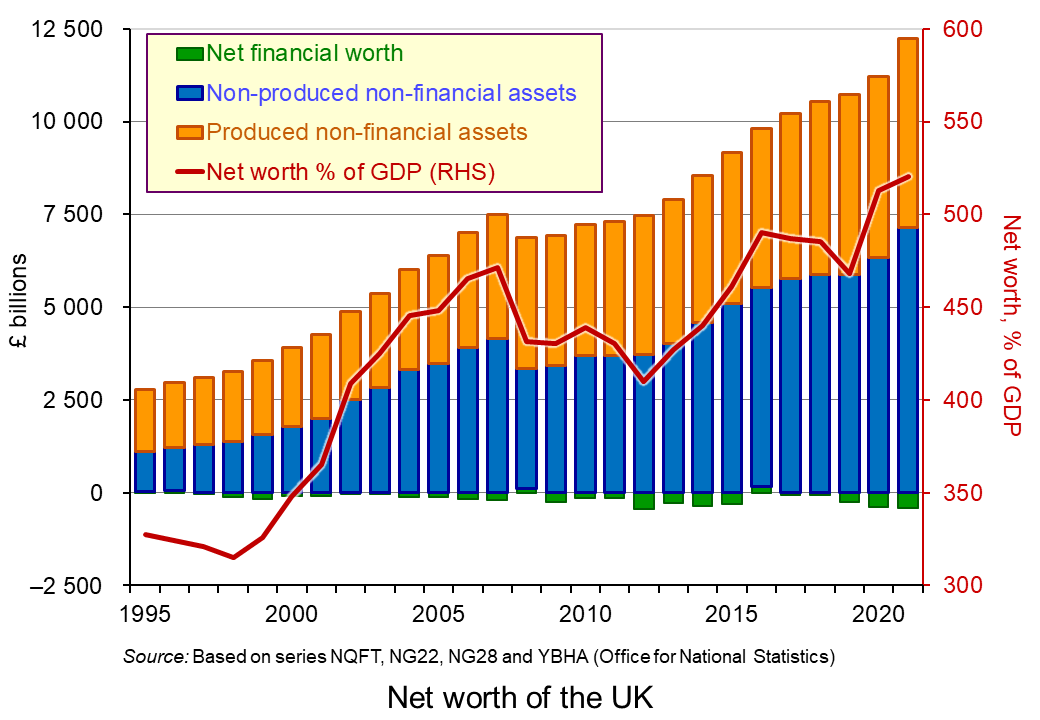 The chart shows the UK’s stock of net worth since 1995, alongside its value relative to annual national income (GDP) (click here for a PowerPoint). In 2021, the net worth of the UK was £11.8 trillion, equivalent to 5.2 times the country’s annual GDP. This marked an increase of £1.0 trillion or 9 per cent over 2020. This was driven largely by an increase in land values (non-produced non-financial assets).
In contrast, the stock of net worth fell in both 2008 and 2009 at the height of the financial crisis and the ensuing economic slowdown, which contributed to the country’s net worth falling by over 8 per cent.
The chart shows that net financial assets continue to make a negative contribution to the country’s net worth. In 2021 financial liabilities exceeded financial assets by the equivalent of 19 per cent of annual national income.
Non-financial corporations and the public sector together had financial liabilities in excess of financial assets of £3.4 trillion and £2.5 trillion respectively. However, once non-financial assets are accounted for, non-financial corporations had a positive net worth of £607 billion, although their value was not sufficient to prevent the public sector having a negative net worth of £1.2 trillion. Meanwhile, households had a positive net worth of £11.4 trillion and financial corporations a negative net worth of £4.9 billion.
Vulnerabilities and the balance sheets
The collapse of Silicon Valley Bank (SVB) resulted from balance sheet distress. Some argue that this distress can be attributed to a mismanagement of the bank’s liquidity position, which saw the bank use the surge in funds, on the back of buoyant activity among technology companies, to purchase long-dated bonds while, at the same time, reducing the share of assets held in cash. However, as the growth of the technology sector slowed as pandemic restrictions eased and, crucially, as central banks, including the Federal Reserve, began raising rates, the value of these long-dated bonds fell. This is because there is a negative relationship between interest rates and bond prices. Bonds pay a fixed rate of interest and so as other interest rates rise, bonds become less attractive to savers, pushing down their price. As depositors withdrew funds, Silicon Valley Bank found itself increasingly trying to generate liquidity from assets whose value was falling.
A major problem with balance sheet distress is contagion. This can occur, in part, because of what is known as ‘counterparty risk’. This simply refers to the idea that one party’s well-being is tied directly to that of another. However, the effects on economies from counterparty risks can be amplified by their impact on general credit conditions, confidence and uncertainty. This helps to explain why the US government stepped in quickly to guarantee SVB deposits.
There is, however, a ‘moral hazard’ problem here: if central banks are always prepared to step in, it can signal to banks that they are too big to fail and disincentivise them for adopting appropriate risk management strategies in the first place.
Subsequently, First Citizens Bank acquired the commercial banking business of SVB, while its UK subsidiary was acquired by HSBC for £1.
Interest rates and financial well-being
In light of the failures of SVB and Credit Suisse, the raising of interest rates by inflation-targeting central banks has raised concerns about the liquidity and liabilities positions of banks and non-bank financial institutions, such as hedge funds, insurers and pension funds. As we have seen, higher interest rates push down the value of bonds, which form a major part of banks’ balance sheets. The problem for central banks is that, if this forced them to make large-scale injections of liquidity by buying bonds (quantitative easing), it would make the fight against inflation more difficult. Quantitative easing is the opposite of tightening monetary policy and thus credit conditions, which are seen as necessary to control inflation.
 Yet the raising of interest rates has implications for the financial well-being of other sectors too since they also are affected by the effects on asset values and debt-servicing costs. For example, raising interest rates has a severe impact on the cashflow of UK homeowners with large variable-rate mortgages. This can substantially affect their spending. The UK has a high proportion of homeowners on variable-rate mortgages or fairly short-term fixed-rate mortgages. Also for a large number of households their mortgages are high relative to their incomes.
In short, falling asset values and increasing debt-servicing costs from rising interest rates in response to rising inflation tends to dampen spending in the economy. The effects will be larger the more burdened with debt people and businesses are, and the less liquidity they have to access. This has the potential to lead to a financial consolidation in order to restore the well-being of balance sheets. This involves cutting borrowing and spending.
Such a consolidation could be exacerbated if financial institutions become distressed and if it were to result in even larger numbers of people and businesses facing greater restrictions in accessing credit. These balance sheet pressures will continue to weigh on the policy responses of central banks as they attempt to navigate economies out of the current inflationary pressures.
Articles
Questions
- What is recorded on a balance sheet? Explain with reference to the household sector.
- What is meant by net worth? Does an increase in net worth mean that an individual’s or sector’s financial well-being has increased?
- What is meant by ‘liquidity-constrained’ individuals or businesses? What factors might explain how liquidity constraints arise?
- It is sometimes argued that there is a predator-prey relationship between income and debt. How could such a relationship arise and what is its importance for the economy?
- Why might a deterioration of a country’s balance sheets have both national and international consequences?
- Explain the possible trade-offs facing central banks when responding to inflationary pressures.
 Some firms in the high-Covid, tier 3 areas in England are being forced to shut by the government. These include pubs and bars not serving substantial meals. Similarly, pubs in the central belt of Scotland must close. But how should such businesses and their employees be supported?
As we saw in the blog, The new UK Job Support Scheme: how much will it slow the rise in unemployment?, the government will support such businesses by paying two-thirds of each employees’ salary (up to a maximum of £2100 a month) and will give cash grants to the businesses of up to £3000 per month.
This support has been criticised by local leaders, such as those in Greater Manchester, as being insufficient. Workers, they argue, will struggle to pay their bills and the support for firms will be too little to prevent many closing for good. What is more, many firms and their employees in the supply chain, such as breweries, will get no support. Greater Manchester resisted being put into tier 3 unless the level of support was increased. However, tier 3 status was imposed on the authority on 20 October despite lack of agreement with local politicians on the level of support.
Jim O’Neill, Vice Chair of the Northern Powerhouse partnership, has argued that the simplest way of supporting firms forced to close is to guarantee their revenue. He stated that:
The government would be sensible to guarantee the revenues of businesses it is forcing to shut. It is easier, fairer and probably less costly in the long run – and a proper test of the government’s confidence that in the New Year two of the seven vaccines the UK has signed up to will work.
This would certainly help firms to survive and allow them to pay their employees. But would guaranteeing revenues mean that such firms would see an increase in profits? The questions below explore this issue.
Articles
Questions
- Identify the fixed and variable costs for a pub (not owned by a brewery).
- If a pub closed down but the wages of workers continued to be paid in full, what cost savings would be made?
- If a pub closed down but was given a monthly grant by the government equal to its previous monthly total revenue but had to pay the wages of it workers in full, what would happen to its profits?
- On 19 October, the Welsh government introduced a two-week lockdown for Wales. Under these restrictions, all non-essential retail, leisure, hospitality and tourism businesses had to close. Find out what support was on offer for such firms and their workforce and compare it to other parts of the UK.
- What type of support for leisure and hospitality businesses forced by the government to close would, in your opinion, be optimal? Justify your answer.
- Is there any moral hazard from the government providing support for businesses made unprofitable by the Covid-19 crisis? Explain.
 With university fees for home students in England of £9250 per year and with many students receiving maintenance loans of around £9000 per year, many students are graduating with debts in excess of £50 000. Loans are repaid at a marginal rate of 9% on incomes over £25 716.
Many students also study for a masters degree. The average fee for a taught, classroom-based masters (MA) is £7392 and for a laboratory-based masters (MSc) is £8167 but can be considerably higher at some prestigious universities where demand is high. Government loans of up to £10 906 are available to contribute towards fees and maintenance. These are paid back at a marginal rate of 6% for people earning over £21 000, giving a combined marginal rate of 15% for first and masters degrees.
For high earners on the 40% income tax rate, the combined marginal rate of payment out of income is 40% tax, plus 2% national insurance, plus 15% for those with undergraduate and masters loans. This gives a combined marginal rate of 57%.
 Average student debt in England is higher even than in the USA, where the average is $37 000. US university courses are more expensive than in the UK, costing an average of $34 000 per year in tuition alone. But undergraduates can borrow less. They can borrow between $5500 and $12 500 per year in federal loans towards both fees and maintenance, and some private loans are also available. Most students do some paid work during their studies to make up the difference or rely on parents contributing. Parental contributions mean that students from poor families end up owing more. According to a Guardian article:
Race is a huge factor. Black students owe an average of $7400 more than white students when they graduate, the Brookings Institution found. After graduation, the debt gap continues to widen. Four years after graduation, black graduates owe an average of nearly $53 000 – nearly double that of white graduates.
Student debt looks to become one of the key issues in the 2020 US presidential election.
Pressure to cancel student fees and debt in the USA
Most of the Democratic candidates are promising to address student fees and debt. Student debt, they claim, places an unfair burden on the younger generation and makes it hard for people to buy a house, or car or other major consumer durables. This also has a dampening effect on aggregate demand.
The most radical proposal comes from Bernie Sanders. He has vowed, if elected, to abolish student fees and to cancel all undergraduate and graduate debt of all Americans. Other candidates are promising to cut fees and/or debt.
Although most politicians and commentators agree that the USA has a serious problem of student debt, there is little agreement on what, if anything, to do about it. There are already a number of ways in which student debt can be written off or reduced. For example, if you work in the public sector for more than 10 years, remaining debt will be cancelled. However, none of the existing schemes is as radical as that being proposed by many Democrats.
 Criticisms of the Democrats’ plans are mainly of two types.
The first is the sheer cost. Overall debt is around $1.6tn. What is more, making student tuition free would place a huge ongoing burden on government finances. Bernie Sanders proposes introducing a financial transactions tax on stock trading. This would be similar to a Tobin tax (sometimes dubbed a ‘Robin Hood tax’) and would include a 0.5% tax on stock transactions, a 0.1% tax on bond trades and a 0.005% tax on transactions in derivatives. He argues that the public bailed out the financial sector in 2008 and that it is now the turn of the financial sector to come to the aid of students and graduates.
The other type of criticism concerns the incentive effects of the proposal. The core of the criticism is that loan forgiveness involves moral hazard.
The moral hazard of loan forgiveness
The argument is that cancelling debt, or the promise to do so, encourages people to take on more debt. Generally, moral hazard occurs when people are protected from the consequences of their actions and are thus encouraged to make riskier decisions. For example, if you are ensured against theft, you may be less careful with your belongings. As the Orange County Register article linked below states:
If the taxpayers pay the debts of everyone with outstanding student loans, how will that affect the decisions made by current students thinking about their choices for financing higher education? What’s the message? Borrow as much as you can and wait for the debt to be canceled during the next presidential primary campaign?
 Not only would more students be encouraged to go to college, but they would be encouraged to apply for more costly courses if they were free.
Universities would be encouraged to exaggerate their costs to warrant higher fees charged to the government. The government (federal, state or local) would have to be very careful in auditing courses to ensure costs were genuine. Universities could end up being squeezed for finance as government may try to cut payments by claiming that courses were overpriced.
Even if fees were not abolished, cancelling debts would encourage students to take on larger debt, if that was to be cleared at some point in the future. What is more, students (or their parents) who could afford to pay, would choose to borrow the money instead.
But many countries do have free or highly subsidised higher education. Universities are given grants which are designed to reflect fair costs.
Articles
Videos
Questions
- Assess the arguments for abolishing or substantially reducing student fees.
- Assess the arguments against abolishing or substantially reducing student fees.
- Assess the arguments for writing off or substantially reducing student debt.
- Assess the arguments against writing off or substantially reducing student debt.
- If it were decided to cancel student debt, would it be fair to pay students back for any debt they had already paid off?
- Does tackling the problem of student debt necessarily lead to a redistribution of wealth/income?
- Give some other examples of moral hazard.
- If student fees were abolished, would there be any problem of adverse selection? If so, how could this be overcome?
- Find out what the main UK parties are advocating about student fees and debt in the nations of the UK for home and non-home students. Provide a critique of each of their policies.
 It was argued in an earlier blog on the Greek debt crisis that a deus ex machina was needed to find a resolution to the impasse between Greece and its creditors. The most likely candidate for such as role was the IMF.
Three days before the Greek referendum on whether or not to accept the Troika’s proposals, the IMF has stepped onto the stage. To the undoubted surprise of the other two partners in the Troika (the European Commission and the ECB), the IMF argues that Greece’s debts are unsustainable and that much more is needed than a mere bailout (which simply rolls over the debt).
According to the IMF, Greece needs €52bn of extra funds between October 2015 and December 2018, large-scale debt relief, a 20-year grace period before making any debt repayments and then  debt repayments spread over the following 20 years. In return, Greece should commit to supply-side reforms to cut out waste, reduce bureaucracy, improve tax collection methods and generally improve the efficiency of the economic system.
It would also have to agree to the previously proposed primary budget surplus (i.e. the budget surplus excluding debt repayments) of 1 per cent of GDP this year, rising to 3.5 per cent in 2018.
So it this what commentators have been waiting for? What will be the reaction of the Greeks and the other two partners in the Troika? We shall see.
Articles
IMF says Greece needs extra €50bn in funds and debt relief The Guardian. Phillip Inman, Larry Elliott and Alberto Nardelli (2/7/15)
IMF: 3rd Greek bailout would cost €52bn. Or more? Financial Times, Peter Spiegel (2/7/15)
IMF: Greece needs to reform for sustainable debt, financing needs rising CNBC, Everett Rosenfeld (2/7/15)
The IMF has made an obvious point about Greece’s huge debt. Here’s why it still matters Quartz, Jason Karaian (3/7/15)
Greece: when is it time to forgive debt? The Conversation, Jagjit Chadha (2/7/15)
IMF Analysis
Greece: Preliminary Draft Debt Sustainability Analysis IMF (2/7/15)
Preliminary Debt Sustainability Analysis for Greece IMF (25/6/15)
Questions
- To which organisations is Greece indebted? What form to the debts take?
- To what extent is Greece’s current debt burden the result of design faults of the euro?
- What are the proposals of the IMF? What effect will they have on the Greek economy if accepted?
- How would the IMF proposals affect aggregate demand (a) directly; (b) compared with the proposals previously on the table that Greece rejected on 26 June?
- What would be the effects of Greek exit from the euro (a) for Greece; (b) for other eurozone countries?
- What bargaining chips can Greece deploy in the negotiations?
- Explain what is meant by ‘moral hazard’. Where in possible outcomes to the negotiations may there be moral hazard?
- What has been the impact of Greek austerity measures on the distribution of income and wealth in Greece?
- What are the practicalities of pursuing supply-side policies in Greece without further dampening aggregate demand?