 The growth rates of the Western world have been somewhat volatile for the past decade, with negative growth sending economies into recession and then varying degrees of economic recovery. Growth rates elsewhere have been very high, in particular in countries such as China and India. The future of economic growth in the west is hotly debated and whether the western world has been forever changed by the credit crunch remains to be seen.
The article below from the BBC, written by Robert Peston, the Economics Editor, addresses the question of the future of the western world. Opinions differ as to whether the west is finally recovering from the recession and financial instability or if the credit crunch and subsequent recession is just the beginning of many years of economic stagnation. The article in particular focuses on the yield curve and the trends in government debt or gilts. This tends to be a key indicator of the expectations of the future of an economy and how confident investors are in its likely trajectory. Though technical in places, this article provides some interesting stances on what we might expect in the coming 2-3 decades for economic performance in the West.
Note that John also looks at this article in his blog Cloudy Skies Ahead?
The end of growth in the West? BBC News, Robert Peston (26/9/14)
Questions
- Which factors affect the economic growth of a nation?
- Confidence from consumers, firms and investors is always argued to be crucial to the future economic growth and in many cases, the recovery of an economy. Explain why this factor is so important.
- What is the yield curve and what does it show?
- How can the yield curve be used to offer predictions about the future strength of an economy?
- Why are governments seen as the safest place to lend?
- If Larry Summers is correct in saying that it is a negative equilibrium interest rate that is needed to generate full employment growth, what does this suggest about the future economic performance of the western world?
- In the article, there is a list of some of the key things that make investors anxious. Review each of these factors and explain why it is so important in generating anxiety.
 One of the key prices in any economy is that of oil. Whenever oil prices change, it can have a knock-on effect on a range of other markets, as oil, or some variation, is used as an input into the production of countless products. The main products that consumers will see affected are energy prices and petrol prices..
Although on the supply-side, we see a large cartel in the form of OPEC, it is still the case that the forces of demand and supply directly affect the market price. Key things such as the demand for heating, economic growth, fears of war and disruption will change the demand and supply of oil. The possibility of militant strikes in oil producers, such as Syria, would normally reduce supply and push up the market price. However, we have actually seen oil prices drop much faster than we have in two years, dropping below $100 per barrel since September 5th. The slowdown of economic growth in Asia, together with the return of Libyan production at a level greater than expected have helped to push prices down and have offset the fears of global production.
 The market forces pushing prices down, while good for consumers and firms that use crude oil or one of its by-products, are clearly bad for oil producers. (Click here for a PowerPoint of the chart.) Countries are urging OPEC to halt its production and thereby shift supply upwards to the left putting a stop to the downward oil price trend. Several countries are concerned about the impact of lower prices, and one country that may be significantly affected is Russia. Some are suggesting that the impact could be as big as 4% of Russia’s GDP, taking into account the ongoing political crisis with Ukraine.
The market for oil is highly susceptible to changes in both demand and supply-side factors. Microeconomic changes will have an impact, but at the same time any global macroeconomic factors can have significant effects on the global price. Expectations are crucial and as countries release information about the size of the oil stocks and inventories, it is adding to the downward pressure on prices. Some oil experts have predicted that prices could get as low as $80 per barrel before OPEC takes significant action, influenced heavily by countries like Saudi Arabia. The following articles consider this global market.
Articles
Iran urges OPEC to halt oil price slide Financial Times, Anjli Raval (26/9/14)
Oil overflow: as prices slump, producers grapple with a new reality The Globe and Mail, Shawn McCarthy and Jeff Lewis (27/9/14)
Weak demand, plentiful supply drive decline in oil prices International Distribution (26/9/14)
Oil prices plunging despite ISIS CNN Money, Paul R La Monica (25/9/14)
Oil prices fall on EIA report of big U.S. crude stocks build Reuters, Robert Gibbons (17/9/14)
Sanctions and weaker oil prices could cost Russia 4% of GDP – official RT (25/9/14)
Data
Spot oil prices Energy Information Administration
Weekly European Brent Spot Price Energy Information Administration (Note: you can also select daily, monthly or annual.)
Annual Statistical Bulletin OPEC
Questions
- What are the key factors on the microeconomic side that affect (a) demand and (b) supply of oil?
- Explain the key macroeconomic factors that are likely to have an impact on global demand and supply of oil.
- Militant action in some key oil producing countries has caused fears of oil disruption. Why is that oil prices don’t reflect these very big concerns?
- Use a demand and supply diagram to explain the answer you gave to question 3.
- What type of intervention could OPEC take to stabilise oil prices?
- Why is the Russian economy likely to be adversely affected by the trend in oil prices?
- Changes in the global macroeconomy will directly affect oil prices. Is there a way that changes in oil prices can also affect the state of the global economy?
 The French economy is flatlining. It has just recorded the second quarter of zero economic growth, with growth averaging just 0.02% over the past 12 months. What is more, the budget deficit is rising, not falling. In April this year, the French finance minister said that the deficit would fall from 4.3% in 2013 to 3.8% in 2014 and to the eurozone ceiling of 3% in 2015. He is now predicting that it will rise this year to 4.4% and not reach the 3% target until 2017.
The deficit is rising because a flatlining economy is not generating sufficient tax revenues. What is more, expenditure on unemployment benefits and other social protection is rising as unemployment has risen, now standing at a record 10.3%.
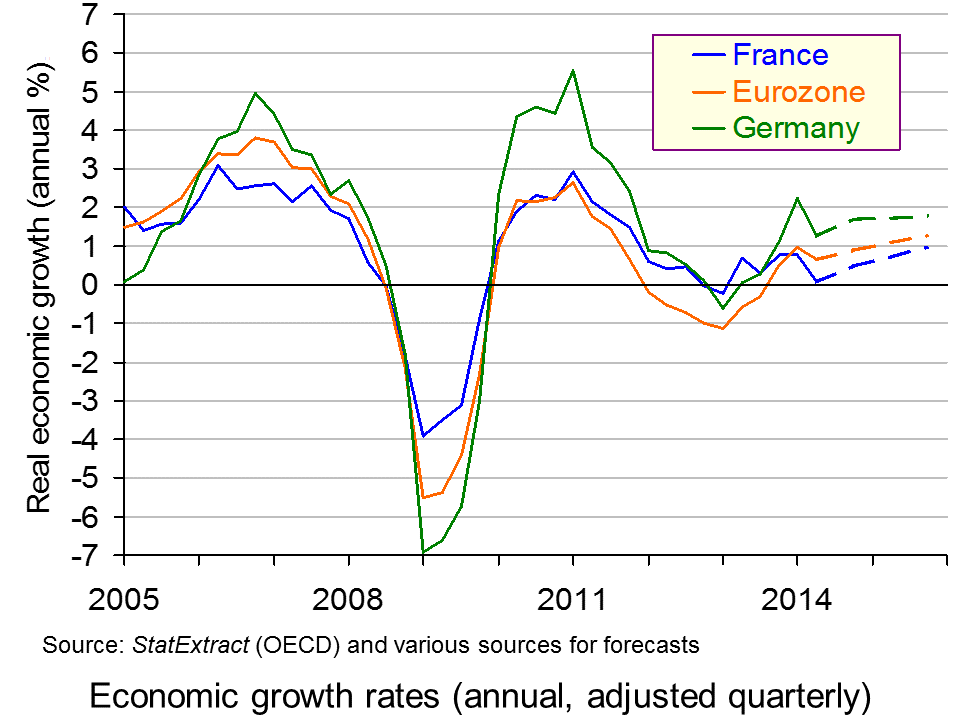
And it is not just the current economic situation that is poor; the outlook is poor too. The confidence of French companies is low and falling, and investment plans are muted. President Hollande has pledged to cut payroll taxes to help firms, but so far this has not encouraged firms to invest more.
So what can the French government do? And what can the EU as a whole do to help revive not just the French economy but most of the rest of the eurozone, which is also suffering from zero, or near zero, growth?
There are two quite different sets of remedies being proposed.

The first comes from the German government and increasingly from the French government too. This is to stick to the austerity plans: to get the deficit down; to reduce the size of government in order to prevent crowding out; and to institute market-orientated supply-side policies that are business friendly, such as reducing business regulation. Business leaders in France, who generally back this approach, have called for reducing the number of public holidays and scrapping the maximum 35-hour working week. They are also seeking reduced business taxes, financed by reducing various benefits.
Increasingly President Hollande is moving towards a more business-friendly set of policies. Under his government’s ‘Responsibility Pact’, a €40 billion package of tax breaks for business will be financed through €50 billion of cuts in public spending. To carry through these policies he has appointed an ex-investment banker, Emmanuel Macron, as economy minister. He replaces Arnaud Montebourg, who roundly criticised government austerity policy and called for policies to boost aggregate demand.
This brings us to the alternative set of remedies. These focus on stimulating aggregate demand through greater infrastructure investment and cutting taxes more generally (not just for business). The central argument is that growth must come first and that this will then generate the tax revenues and reductions in unemployment that will then allow the deficit to be brought down. Only when economic growth is firmly established should measures be taken to cut government expenditure in an attempt to reduce the structural deficit.
There are also compromise policies being proposed from the centre. These include measures to stimulate aggregate demand, mainly through tax cuts, accompanied by supply-side policies, whether market orientated or interventionist.
As Europe continues to struggle to achieve recovery, so the debate is getting harsher. Monetary policy alone may not be sufficient to bring recovery. Although the ECB has taken a number of measures to stimulate demand, so far they have been to little avail. As long as business confidence remains low, making increased liquidity available to banks at interest rates close to zero will not make banks more willing to lend to business, or businesses more willing to borrow. Calls for an end, or at least a temporary halt, to austerity are thus getting louder. At the same time, calls for sticking to austerity and tackling excessive government spending are also getting louder.
Articles
Hollande entrusts French economy to ex-banker Macron Reuters, Ingrid Melander and Jean-Baptiste Vey (26/8/14)
France’s new Minister of the Economy Emmanuel Macron described by left-wingers as a ‘copy-and-paste Tony Blair’ Independent, John Lichfield (28/8/14)
Merkel praises France’s economic reform plans after Berlin talks with PM Valls Deutsche Welle (22/9/14)
French economy flat-lines as business activity falters Reuters, Leigh Thomas (23/9/14)
French public finances: Rétropédalage The Economist (13/9/14)
French employer group urges ‘shock therapy’ for economy Reuters (24/9/14)
Last chance to save France: loosen 35-hour week and cut public holidays, say bosses The Telegraph (24/9/14)
‘Sick’ France’s economy is stricken by unemployment ‘fever’ The Telegraph (17/9/14)
France’s economics ills worsen but all remedies appear unpalatable The Observer, Larry Elliott and Anne Penketh (31/8/14)
The Fall of France The New York Times, Paul Krugman (28/8/14)
Why Europe is terrified of deflation Salon, Paul Ames (20/9/14)
Europe’s Greater Depression is worse than the 1930s The Washington Post, Matt O’Brien (14/8/14)
Worse than the 1930s: Europe’s recession is really a depression The Washington Post, Matt O’Brien (20/8/14)
Eurozone business growth slows in September, PMI survey finds BBC News (23/9/14)
Europe must ‘boost demand’ to revive economy, US warns BBC News (21/9/14)
Valls says France would never ask Germany to solve its problems Reuters, Annika Breidthardt and Michelle Martin (23/9/14)
The euro-zone economy: Asset-backed indolence The Economist (11/9/14)
Data
Annual macro-economic database (AMECO) Economic and Financial Affairs DG, European Commission
Business and Consumer Surveys Times Series Economic and Financial Affairs DG, European Commission
StatExtracts OECD
Statistics database European Central Bank
Questions
- What types of supply-side reforms would be consistent with the German government’s vision of solving Europe’s low growth problem?
- How could a Keynesian policy of reflation be consistent with getting France’s deficit down to the 3% of GDP limit as specified in the Stability and Growth Pact (see)?
- What is meant by (a) financial crowding out and (b) resource crowding out? Would reflationary fiscal policy in France lead to either form of crowding out? How would it be affected by the monetary stance of the ECB?
- Give examples of market-orientated and interventionist supply-side policies.
- What is meant by the terms ‘cyclical budget deficit’ and ‘structural budget deficit’. Could demand-side policy affect the structural deficit?
- Using the European Commission’s Business and Consumer Surveys find our what has happened to business and consumer confidence in France over the past few months.
- How important is business and consumer confidence in determining economic growth in (a) the short term and (b) the long term?
 The Office for National Statistics (ONS) reported that the quantity of retail sales in the UK was 3.9% higher in August than it had been in July. However strong price competition meant that the value of these sales increased by only 0.4%. What were the key factors driving the big increase in the quantity of sales? Was it simply the response of consumers to falling prices?
The data indicated that there was strong demand for goods associated with the housing market such as carpets, fridges and cookers. Spending on furniture increased very rapidly with sales rising by 24% over a 12 month period. Flat packed furniture proved to be particularly popular with consumers.
There was also strong demand for electrical goods and more specifically vacuum cleaners. The ONS estimated that a boom in the sale of vacuum cleaners in August was responsible for 25% of the increase in retail sales.
Why did the sales of vacuum cleaners increase so rapidly in August? Did UK households suddenly decide to keep their houses cleaner? The sales data shows that certain types of vacuum cleaners sold in much larger numbers than others.
For example, Tesco reported a 44% increase in the sales of 2,000 watt vacuum cleaners in the last two weeks in August while the Co-op reported an increase of 38%. Referring to the last weekend in August, the head of small domestic appliances at the on-line retailer ao.com stated that
We saw a huge surge in sales of corded vacuums over 1,600 watts over the weekend, with sales quadrupling.
There were also reports that a significant number of customers were buying more than one vacuum cleaner with these larger motors.
The key reason for the sudden surge in demand was the implementation of new regulations by the European Union as part of its energy efficiency directive. The ultimate objective of this directive is to reduce climate change. The specific policy that appears to have had such a big impact on consumers in the UK was the ban imposed on firms in the EU from making or importing vacuum cleaners that have motors above 1600 watts. This ban came into effect on the 1st September 2014.
A spokesperson for the consumer group Which? stated in August that
If you’re in the market for a powerful vacuum, you should act quickly, before all the models currently sell out. A Best Buy 2,200-watt vacuum costs around £27 a year to run in electricity – only around £8 more than the best scoring 1,600-watt we’ve tested.
The EU plans to reduce the maximum permitted wattage in vacuum cleaners to 900 watts in 2017. Restrictions have already been imposed on bigger electrical appliances such as televisions, washing machines and refrigerators. The EUs Ecodesign directive may also be extended to a range of smaller electrical appliances such as toasters and hair dressers in the future. It’ll be interesting to see if consumers respond in the same way to regulations imposed by the EU in the future.
Ten days left to vacuum up a powerful cleaner BBC (21/08/14)
Housing boom, food discounting and vacuum ban boost UK spending The Guardian, Larry Elliott, Phillip Inman, Lisa Bachelor (18/9/14)
UK retail sales boosted by vacuum cleaner sales BBC (18/9/14)
Retailers sell out of vacuum cleaners ahead of EU ban The Telegraph, Elliot Pinkham (30/8/14)
Power surge! Fourfold rise in sales of super vacuums: Some customers buying two or more models to beat new EU regulations Daily Mail, Andrew Levy (1/9/14)
Energy Efficiency Directive European Commission (accessed on 24/9/14)
Vacuum cleaner splurge pushes up UK retail sales The Guardian, Phillip Inman (18/9/14)
Questions
- Using a demand and supply diagram, illustrate what has happened in the market for high wattage vacuum cleaners in August. Pay particular attention in your answer to the role of expectations.
- What did your previous diagram predict would happen to the price of high wattage vacuum cleaners in August? Did this in fact happen?
- A fully informed rational consumer may purchase a higher wattage vacuum cleaner if they consider that the improvement in cleaning performance is greater than the extra cost of purchasing and using the cleaner. Can you provide an economic rationale for banning the sale of these machines in these circumstances?
- Using a demand and supply diagram illustrate the impact of banning the sale of a product in a competitive market.
 Officials from Rugby Union’s Aviva Premiership recently announced that the salary cap used by the league would increase from £4.76 million to £5.1 million per team for the 2015-16 season. It is not the only professional sports league to use this type of regulation. The NFL currently has a salary cap of $133 million/team while in the NBA it is set at $63 million/team. What is the rationale for placing restrictions on the amount an organisation can pay its employees? How do these caps work in practice?
A salary cap is a regulation that limits the amount that an organisation can pay its employees. Sanctions are usually imposed if the ceiling is broken.
It is hard to imagine this type of policy being introduced in most industries. For example there may have been a number of calls for much greater regulation of the big six firms in the energy market with the Labour party suggesting that prices should be frozen for 20 months. However in amongst all the calls for more intervention, nobody has suggested that limits should be placed on the wages that these firms pay their staff.
One example where the authorities are thinking of intervening on pay is the proposal by the European Union to introduce a cap on the size of bonuses that can be paid by firms in the banking industry. However this is more of a constraint on the method of remuneration rather than an absolute limit on the level of pay. If the policy was introduced there would be nothing preventing firms from increasing basic salaries in order to make up for any shortfall caused by the reduction in bonuses.
There is one sector of the economy where salary caps are widely used – professional team sports. There are a number of different ways they have been implemented. For example the Football Association once placed a limit on the amount that a club could pay an individual player. This was originally set at £4/week in 1901 and increased to £20/week before it was finally abolished in 1961.
In recent times it has been far more common for salary caps in professional sports leagues to place limits on the size of a team’s total wage bill rather than the amount that can be paid to an individual player. This is the case in the Aviva Premiership, the NFL and the NBA. Perhaps it would be more accurate to refer to these policies as a cap on payrolls rather than on salaries.
The Aviva Premiership gives the following 4 reasons for having the payroll cap that it first introduced in 1999:
|
|
| • |
To ensure the financial viability of the clubs; |
| • |
To ensure a competitive Aviva Premiership Rugby competition; |
| • |
To control inflationary pressures on clubs’ costs; |
| • |
To provide a level playing field for the clubs. |
It is claimed that the policy has helped the league to achieve these objectives as (a) more clubs are now breaking even and (b) compared with other rugby competitions it has the greatest number of games that finish with less than one score between the teams.
There are a number of different ways that a payroll cap can be implemented. With an absolute payroll scheme all the teams in the league, no matter what their size, face the same constraint. This is the policy adopted by the NFL, NBA and the Aviva Premiership. An alternative is to implement a percentage payroll cap. Examples of these can be found in League 1 and League 2 of the English Football League. League 1 teams can spend up to 60% of their turnover on wages while League 2 teams can spend up to 55% of their turnover on wages. Obviously this means that well supported clubs with a larger turnover can spend more on players’ wages than less well supported clubs with a smaller turnover.
Another way that payroll caps differ is whether they are ‘hard’ caps or ‘soft’ caps. With a ‘hard’ cap there are no exceptions to the scheme. All the teams’ payrolls must remain within the same limit set by the league officials. With a ‘soft’ cap the authorities identify some exceptions that enable clubs to exceed the limit. The payroll cap used in rugby union is an example of a soft cap and works in the following way.
There are a number of elements to the scheme:
|
|
| • |
The senior salary cap; |
| • |
Excluded players; |
| • |
The academy credits. |
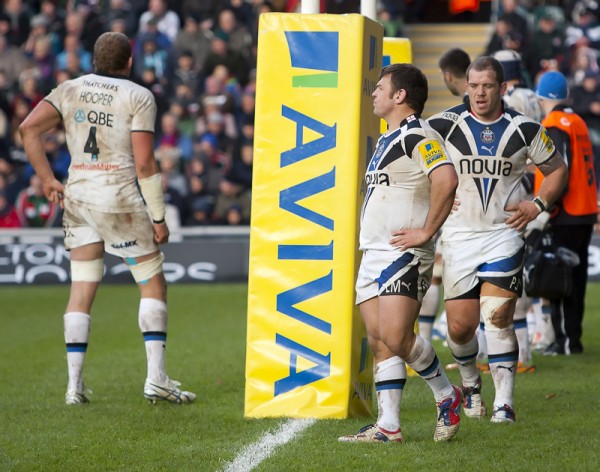 The senior salary cap is the major part of the regulation and the Aviva Premiership announced that this would increase from £4.76 million per team in the current season to £5.1 million per team for 2015-16. The Academy credits enable teams to exceed this £5.1 million limit if they train and develop younger players. The teams have to prove that they have young players that meet the following criteria:
|
|
| • |
They are under the age of 24 before the season started; |
| • |
They joined the youth academy before their eighteenth birthday; |
| • |
They earn more than £30,000 per year. |
For a player who meets these conditions it is only their salary in excess of £30,000/year that is considered. For example if a young player was paid £50,000/year then only £20,000 of his wages would count towards the team’s payroll cap. The first £30,000 would not count. The Aviva Premiership recently announced that a home grown player credit would replace the academy credits. Under the new scheme the upper age limit will be removed and clubs can claim up to £400,000 in allowances. This means that teams could spend up to £5.5 million a year on wages if they train and develop younger players.
However other exceptions means that teams can exceed even this figure. The payroll cap arrangements allow teams to identify one player whose wages are not included when the payroll cap is calculated. In order to be nominated the exempted player has to meet certain criteria. In the 2015-16 season teams will be allowed to have two excluded players.
Sir Iain McGeechan has suggested that these changes will increase the effective salary cap to £7 million/year with some star players earning £1 million/season. However this would still be below the level of the basic salary cap in the French Rugby Union Super 14 League which is €10 million per season (approximately £8.5 million)
Premiership salary cap will leave small clubs playing catch-up The Telegraph (20/9/14)
Bath line up move for Australian Will Genia as new salary cap regulations come into effectThe Telegraph (15/9/14)
The salary cap in Rugby Union Law in Sport (15/4/14)
Barwell blasts salary cap ‘cheats’ ESPN (1/3/13)
Salary Cap changes confirmed Premiership Rugby (17/9/14)
What is meant by a salary cap in Sport and would this ever be used in English football? In Brief (accessed on 22/9/14)
Questions
- Draw a diagram to illustrate the impact of a salary cap on a perfectly competitive market and explain your answer.
- Which teams in the Aviva Premiership would be in favour of the increase in the salary cap and which teams would be opposed? Explain your answer.
- Do you think that an absolute or percentage salary cap would be more effective at maintaining competitive balance in a league? Which teams would be more in favour of an absolute salary cap?
- Why do think some leagues have introduced a ‘soft’ rather than a ‘hard’ salary caps?
- To what extent do you think that salary/payroll caps are consistent with European single market principles about the free movement of people?
- Officials from the Aviva Premiership provide the clubs with a long list of payments which must be counted as part of a player’s salary. These include holiday costs, school fees, payment for off-field activities on behalf of the club, payments in kind and signing on fees. Why do you think that the authorities provide such a large list?
- Find out the criteria that must be met in order for a player to be exempted from the team’s payroll calculations. Provide some reasons why you think these criteria were used.