 The enormous amounts of money broadcasters are willing to pay for the rights to show live football astonish most people. The figures have continued to rise despite the impact of a recession, slow economic growth and static or falling real incomes.
The deal to broadcast live games in the English Premier League (EPL) for the three seasons from 2007-10 was 65% higher than the agreement that ran from 2004-07. The recession did appear to slow growth down as the contract covering the seasons 2010-13 was only 5% higher than the previous one. However the total size of this deal was still a staggering £1.78billion or approximately £593 million per season. BSkyB was the most successful bidder in all of these auctions for live TV rights and successfully saw off competition from ITV Digital, ESPN and Setanta.
However in the last few years, BT Sport has entered the bidding process and has provided BSkyB with much stronger competition than its previous rivals. As a result, BskyB had to pay £2.3 billion in order to outbid BT Sport in the most recent auction.  The three-year deal beginning in the 2013-14 season gives BSkyB the rights to show 116 lives matches each year. BT Sport also paid £738 million for the rights to show 38 live matches a season. In total this means that the EPL earns approximately £1billion per season from the sale of broadcasting rights in the domestic market – an increase of 70%!
The Champions and Europa League also auction the rights to broadcast live matches and there was a real shock when BT Sport recently announced that it had secured the exclusive rights to show all 350 live games in these competitions. Once again the figure it paid – just under £900 million for a three-year deal – took most people by surprise. It represented a 125% increase on the previous three-year deal with BSkyB and ITV. What was also surprising was that there was only one round in the sealed bid auction which suggests that BT Sport’s offer was well in excess of the one submitted by BSkyB.
Most of the initial reaction to this new deal has focused on its implications for the number of matches that will be available free to air: i.e. without having to pay for a subscription channel. The BT Sport contract does specify that the Champions League final and at least one match involving each British team will be shown free to air each season. However, this will be a significant reduction in the number of free to air games currently shown by ITV.
The new deal may also have implications for competitive balance in the EPL. This concept was discussed in a previous blog on this New Site Parachute payment problems for the English Football League and refers to how equally the most talented players are distributed amongst the teams in a league. This distribution will be heavily influenced by the degree to which the revenues of the teams in the league vary. Commenting on this latest contract Liverpool’s former managing director Christian Purslow stated that:
The fundamental effect of the BT deal will be additional wealth for England’s big teams. You will now have six teams (Manchester City, Chelsea and Manchester United, Arsenal, Liverpool and Spurs) playing for four Champions league places with the other 14 teams playing for survival. Never again will the likes of Everton, Newcastle or Villa get near the top – the difference in revenues will simply be too great.
To understand this statement one has to examine how the Champions League distributes the revenue it raises back to the teams that participate in the tournament. One part of the distribution mechanism is determined by the sporting performance of the teams in the competition. For example all 32 teams that make it to the group stages of the Champions League receive a minimum of €8.6 million. Each win in the group games earns a team an additional €1 million while a draw earns €500,000. The teams that make it to the last 16 receive an additional payment of €3.5 million, the quarter finalists earn an additional €3.9 million while the semi-finalists each receive €4.9 million. For example in the 2012-13 season, Manchester United received prize money of €16.1 million for reaching the last 16, whereas Bayern Munich received €35.9 million of prize money for winning the competition. If broadcasting revenues for the Champions League increase across the whole of Europe then the size of the prizes will almost certainly increase.
Teams also receive a share of the broadcasting revenue generated by the Champions League known as the market pool. The total size of the market pool allocated to the teams in any particular country depends on the value of the deal between the broadcasters in that country and UEFA. In the 2012-13 season the total market pool to be divided between the four English teams in the Champions League was €86.6 million. This was the second highest figure behind Italy. In contrast the four Portuguese teams had just over €7 million from the market pool to share between them because the value of the broadcasting deal in that country was so much lower. The market pool is split between the clubs based on (a) their finishing position in the domestic league the previous season and (b) how many games they played in the Champions League from the group stage onwards. FC BATE Borisov were the only representative from Belarus so did not have to share the market pool with any other team. Unfortunately for them the size of the market pool was only €290,000. Manchester United received a market pool payment of €19.45 million.
Given the dramatic increase in value of the broadcasting rights the size of the market pool for the English teams will rise significantly in 2015-16 season. The battle in the 2014-15 EPL season for the four Champions League places will be even stronger and more intense than ever. As a result, the competition for the services of the most talented players will probably push up their wages to ever higher levels.
Monopoly money: Football’s TV war makes the rich unreachable’ BBC Sport (17/11/13)
Champions League TV deal in focus BBC Business (11/11/13)
Champions League: BT Sport wins £897 football rights deal BBC Sport (9/11/13)
Top Soccer Leagues Get 25% Rise in TV Rights Sales, Report Says Bloomberg (11/11/13)
BSkyB could face Premier League premium The Guardian (11/11/13)
Clubs benefit from Champions League revenue UEFA (23/7/13)
Sky pleaded with football officials to reopen champions league talks The Telegraph (11/11/13).
Questions
- What is a sealed bid auction? How does it compare with different types of auctions?
- Suggest some reasons why BT Sport were willing to pay so much more than BSkyB for the broadcasting rights for the Champions League.
- Do you think that the potentially higher revenues for the top clubs might actually reduce attendances at their matches? Explain your answer.
- Explain how the potentially higher future revenues for teams participating in the Champions League in 2015-16 can be discounted in order to give them a present value.
- Draw a diagram to illustrate the impact of the new broadcasting deal on the marginal revenue product of the most talented players.
- Is the labour market for the most talented players competitive or is it an oligopsony? What implications does this have their wages? How does your answer change if the labour market is a bilateral monopoly?
 A bumper harvest should be good news for farmers – but not if it drives down prices. This is the position facing many Australian farmers. After a relatively wet summer a year ago and a mild winter this year, crop yields have soared. But the prices farmers can get in wholesale markets have been so low that many have resorted to setting up their own farm shops or selling in farmers’ markets or from the backs of ‘utes’ (utility vehicles, i.e. pickup trucks) or at roadside stalls.
And the supply problem is not just one of increased domestic supply: cheap food imports, often of inferior quality, have been flooding into Australia. Increasing food exports,  especially to Asia, would help Australian farmers, but here again there is competition in these markets from other countries.
The problem of increased Australian supply is even more serious for Australian farmers in areas where harvests have not been so good. Australia is a huge country and conditions, although generally favourable this year, have been poor in some areas. Here farmers face the double disaster of low output and low prices.
Australian dairy farmers too are facing problems of falling prices. Price deregulation and the monopsony power of supermarkets have driven down  the price of milk and other dairy products. Since deregulation in 2000, the number of dairy farms has halved, as many smaller family farms go out of business and larger ‘industrial-scale’ farms grow.
So are there any solutions? The BBC article looks at things being done in Tasmania to help small farmers, but questions whether small farmers have much of a future more generally in Australia?
Articles
Australia’s small farmers struggling with low prices BBC News, Phil Mercer (31/10/13)
Commodity prices edge lower in October Sky News Australia (1/11/13)
Low prices spoil perfect season for Australian farmers ABC News, Eric Tlozek and Courtney Wilson (18/9/13)
Agri-businesses taking over the farm The Guardian (Australia) (6/11/13)
Data
Commodity prices Index Mundi
Agriculture in Australia Wikipedia
Farm inputs & costs Dairy Australia
Questions
- How does the fallacy of composition relate to the ‘problem’ of good harvests?
- How price elastic is the demand for specific crops likely to be? Why may individual farmers face an elasticity of demand close to infinity?
- Illustrate the problem for small farmers in Australia with a demand and supply diagram.
- Is there any way in which farmers, either individually or collectively, can make their demand less elastic?
- Comment on the following statement by a sugar cane farmer: “We’ve got that much money tied up (in the business) we just can’t walk away”. Under what circumstances would it make sense to ‘walk away’?
- How does the monopsony power of supermarkets influence the prices farmers receive?
- Discuss ways in which the federal government in Australia could support farmers.
 Each year in November, the Living Wage Foundation publishes figures for the hourly living wage that is necessary for people to meet basic bills. The rate for London is calculated by the Greater London Authority and for the rest of the UK by the Centre for Research in Social Policy at Loughborough University.
The 2013 update was published on 4 November. The Living Wage was estimated to be £8.80 in London and £7.65 in the rest of the UK.
Two things need to be noted about the Living Wage rate. The first is that the figure is an average and thus does not take into account the circumstances of an individual household. Clearly households differ in terms of their size, the number of wage earners and dependants, the local costs of living, etc. Second, the figures have been reduced from what is regarded as the ‘reference’ living wage, which is estimated to be £9.08 outside London. The reason for this is that people earning higher incomes have seen their living standards squeezed since 2009, with prices rising faster than average post-tax-and-benefit wages. Thus, the Living Wage is capped to reflect the overall decline in living standards. As the Working Paper on rates outside London explains:
From 2012 onwards, two kinds of limit have been put on the amount that the Living Wage as applied can rise in any one year. The first limits the increase in the net income (after taxes and benefits) requirement for each household on which the living wage calculation is based, relative to the rise in net income that would be achieved by someone on average earnings. The second limits the increase in the living wage itself (representing gross income) relative to the increase in average earnings.
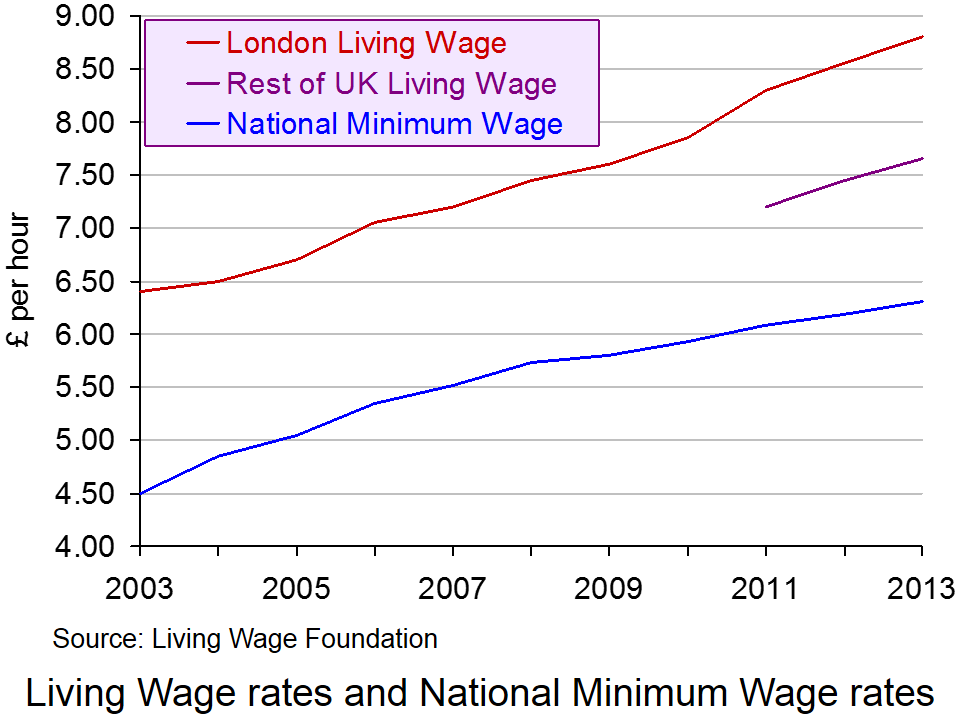 Nevertheless, despite this capping of the living wage, it is still significantly higher than the UK National Minimum Wage, which currently stands at £6.31 for those aged 21 and over. This can be seen from the chart (click here for a PowerPoint).
Paying the Living Wage is voluntary for employers, but as The Guardian reports:
A total of 432 employers are now signed up to the campaign, up from 78 this time last year, including Legal & General, KPMG, Barclays, Oxfam, Pearson, the National Portrait Gallery and First Transpennine Express, as well as many smaller businesses, charities and town halls. Together they employ more than 250,000 workers and also commit to roll out the living wage in their supply chain.
But as The Observer reports:
The number of people who are paid less than a ‘living wage’ has leapt by more than 400,000 in a year to over 5.2 million, amid mounting evidence that the economic recovery is failing to help millions of working families.
A report for the international tax and auditing firm KPMG also shows that nearly three-quarters of 18-to-21-year-olds now earn below this level – a voluntary rate of pay regarded as the minimum to meet the cost of living in the UK. The KPMG findings highlight difficulties for ministers as they try to beat back Labour’s claims of a “cost of living crisis”.
According to the report, women are disproportionately stuck on pay below the living wage rate, currently £8.55 in London and £7.45 elsewhere. Some 27% of women are not paid the living wage, compared with 16% of men. Part-time workers are also far more likely to receive low pay than full-time workers, with 43% paid below living-wage rates compared with 12% of full-timers.
But although paying a living wage may be desirable in terms of equity, many firms, especially in the leisure and retailing sectors, claim that they simply cannot afford to pay the living wage and, if they were forced to, would have to lay off workers.
The point they are making is that it is not economical to pay workers more than their marginal revenue product. But this raises the question of whether a higher wage would encourage people to work more efficiently. If it did, an efficiency wage may be above current rates for many firms. It also raises the question of whether productivity gains could be negotiated in exchange for paying workers a living wage
These arguments are discussed in the following podcast.
Podcast
 Higher ‘productivity’ will increase living wage BBC Today Programme, Priya Kothari and Steve Davies (4/11/13)
Articles
UK living wage rises to £7.65 an hour The Guardian (4/11/13)
More than 5 million people in the UK are paid less than the living wage The Observer, Toby Helm (2/11/13)
Increasing numbers of Scots are paid less than living wage Herald Scotland (2/11/13)
Labour would give tax rebates to firms that pay living wage Independent, Jane Merrick (3/11/13)
Employers praise Ed Miliband’s living wage proposal Independent, Andy McSmith (3/11/13)
Miliband’s living wage tax break will raise prices, warns CBI chief The Telegraph, Tim Ross (3/11/13)
Living Wage rise provides a boost for low paid workers BBC News (4/11/13)
Information and Reports
What is the Living Wage? Living Wage Foundation
The Living Wage Centre for Research in Social Policy, Loughborough University
Living wage Mayor of London
One in five UK workers paid less than the Living Wage KPMG News Release (3/11/13)
Number of workers paid less than the Living Wage passes 5 million KPMG News Release (3/11/13)
Living Wage Research for KPMG Markit (October 2012)
Questions
- How is the Living Wage calculated?
- What are the reasons for announcing a Living Wage figure that is lower than a reference living wage? Assess these reasons.
- If there are two separate figures for the Living Wage for London and the rest of the UK, would it be better to work out a living wage for each part, or even location, of the UK?
- Why might it be in employers’ interests to pay at least the Living Wage? Does this explain why more and more employers are volunteering to pay it?
- Assess the Labour Party’s pledge, if they win the next election, that ‘firms which sign up to the living wage will receive a tax rebate of up to £1000 for every low-paid worker who gets a pay rise, funded by tax and national insurance revenue from the higher wages’.
- Which is fairer: to pay everyone at least the Living Wage or to use tax credits to redistribute incomes to low-income households?
 First the good news. Employment is rising and unemployment is falling. Both claimant count rates and Labour Force Survey rates are down. Compared with a year ago, employment is up 279,092 to 29,869,489; LFS unemployment is down from 7.87% to 7.69%; and the claimant count rate is down from 4.7% to 4.0%.
Now the bad news. Even though more people are in employment, real wages have fallen. In other words, nominal wages have risen less fast than prices. Since 2009, real wages have fallen by 7.6% and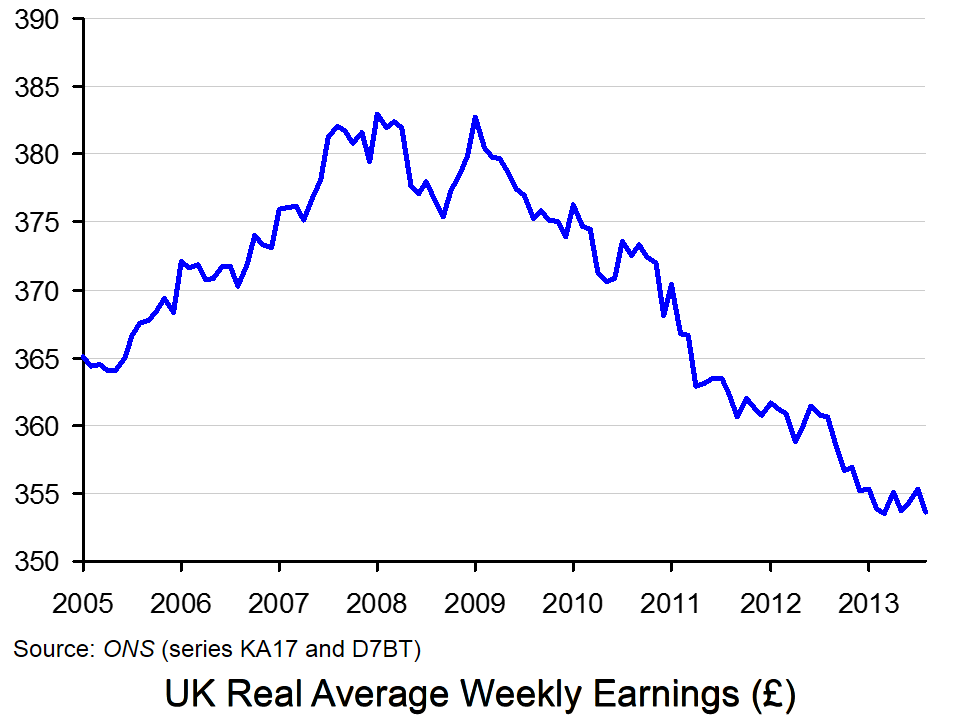 have continued to fall throughout this period. The first chart illustrates this. It shows average weekly wage rates in 2005 prices. (Click here for a PowerPoint of the chart.)
The fall in real wages is an average for the whole country. Many people, especially those on low incomes, have seen their real wages fall much faster than the average. For many there is a real ‘cost of living’ crisis.
But why have real wages fallen despite the rise in employment? The answer is that output per hour worked has declined. This is illustrated in the second chart, which compares UK output per worker with that of other G7 countries. UK productivity has fallen both absolutely and relative to other G7 countries, most of which have had higher rates of investment.
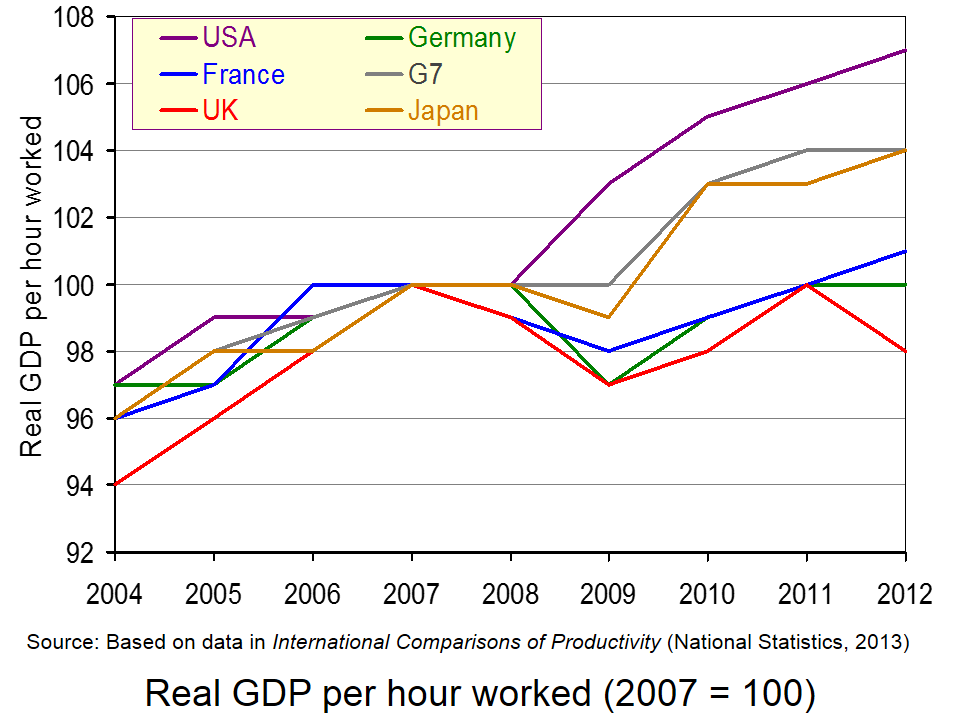 The falling productivity in the UK requires more people to be employed to produce the same level of output. Part of what seems to be happening is that many employers have been prepared to keep workers on in return for lower real wages, even if demand from their customers is falling. And many workers have been prepared to accept real wage cuts in return for keeping their jobs.
Another part of the explanation is that the jobs that have been created have been largely in low-skilled, low-wage sectors of the economy, such as retailing and other parts of the service sector.
But falling productivity is only part of the reason for falling real wages. The other part is rising prices. A number of factors have contributed to this. These include a depreciation of the exchange rate back in 2008, the effects of which took some time to filter through into higher prices in the shops; a large rise in various commodity prices; and a rise in VAT and various other administered prices.
So what is the answer to falling real wages? The articles below consider the problem and some of the possible policy alternatives.
Articles
Inflation, unemployment and UK ‘misery’ BBC News, Linda Yueh (16/10/13)
Employment is growing, but so are the wage slaves The Guardian, Larry Elliott (16/10/13)
Living standards – going down and, er, up BBC News, Nick Robinson (26/7/13)
Revealed: The cost of living is rising faster in the UK than anywhere in Europe, with soaring food and energy bills blamed Mail Online, Matt Chorley (16/10/13)
Cutting prices to raise living standards is just a waste of energy The Telegraph, Roger Bootle (6/10/13)
Downturn sees average real wages collapse to a record low Independent, Ben Chu (17/10/13)
Why living standards and public finances matter Financial Times, Gavin Kelly (29/9/13)
Social Mobility Tsar Alan Milburn Calls on Government to Boost Wages to End UK Child Poverty International Business Times, Ian Silvera (17/10/13)
Do incorrect employment growth figures explain low UK productivity? The Guardian, Katie Allen (23/10/13)
Data
Unemployment data ONS
Average Weekly Earnings dataset ONS
Consumer Prices Index ONS
International Comparison of Productivity ONS
Questions
- How are real wages measured?
- Why have real wage rates fallen in the UK since 2009?
- What factors should be included when measuring living standards?
- Why has employment risen and unemployment fallen over the past two years?
- What factors could lead to a rise in real wages in the future?
- What government policies could be adopted to raise real wages?
- Assess these policies in terms of their likely short-term success and long-term sustainability.
 For all households, energy is considered an essential item. As electricity and gas prices rise and fall, many of us don’t think twice about turning on the lights, cooking a meal or turning on the heating. We may complain about the cost and want prices brought down, but we still pay the bills. But, is there anything that can be done about high energy prices? And if there is, should anything be done?
The worlds of politics and economics are closely linked and Ed Miliband’s announcement of his party’s plans to impose a 20-month freeze on energy prices if elected in 2015 showed this relationship to be as strong as ever. The price freeze would certainly help average households reduce their cost of living by around £120 and estimates suggest businesses would save £1800 over this 20 month period. The energy companies have come in for a lot of criticism, in particular relating to their control of the industry. The sector is dominated by six big companies – your typical oligopoly, and this makes it very difficult for new firms to enter. Thus competition is restricted. But is a price freeze a good policy?
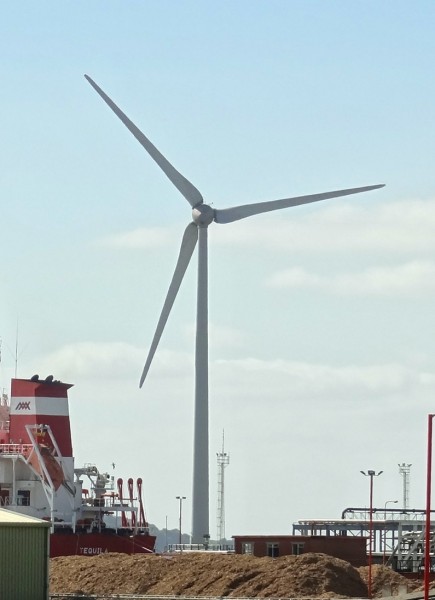 Part of the prices we pay go towards investment in cleaner and more environmentally friendly sources of energy. Critics suggest that any price freeze would deprive the energy sector of much needed investment, meaning our energy bills will be higher in the future. Furthermore, some argue this price freeze suggests that Labour is abandoning its environmental policy. Energy shortages have been a concern, especially with the cold weather the UK experienced a few years ago. This issue may reappear with price freezes. As Angela Knight, from Energy UK, suggests:
Freezing the bill may be superficially attractive, but it will also freeze the money to build and renew power stations, freeze the jobs and livelihoods of the 600,000-plus people dependent on the energy industry and make the prospect of energy shortages a reality, pushing up the prices for everyone.
There is a further concern and that is that large energy companies will be driven from the UK. This thought was echoed by many companies, in particular the British Gas owner Centrica, commenting that:
If prices were to be controlled against a background of rising costs it would simply not be economically viable for Centrica to continue to operate and far less to meet the sizeable investment challenge that the industry is facing…The impact of such a policy would be damaging for the country’s long-term prosperity and for our customers.
Share prices naturally fluctuate with global events and a political announcement such as this was inevitably going to cause an effect. But, perhaps the effect was not expected to be as big as the one we saw. 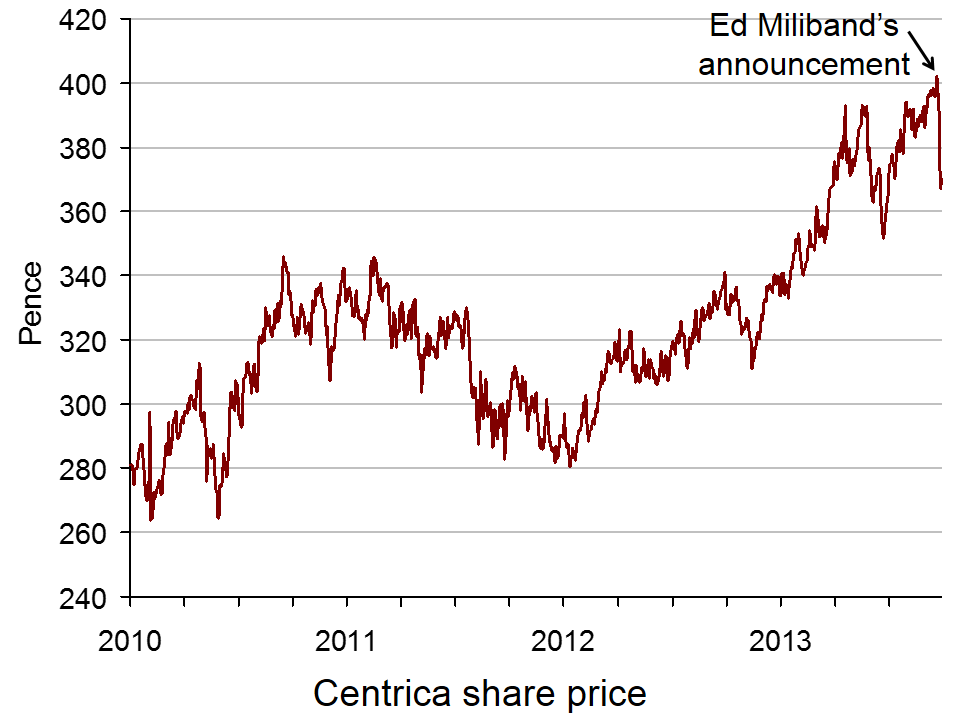 Share prices for Centrica and SSE fell following the announcement – perhaps no great shock – but then they continued to fall. The market value tumbled by 5% and share prices kept falling. This has led to Ed Miliband being accused of ‘economic vandalism’ by a major shareholder of Centrica, which is hardly surprising, given the estimated cost of such a price freeze would be £4.5 billion.
The economic implications of such a move are significant. The announcement itself has caused massive changes in the FTSE and if such a move were to go ahead if Labour were elected in 2015, there would be serious consequences. While families would benefit, at least in the short term, there would inevitably be serious implications for businesses, the environmental policy of the government, especially relating to investment and the overall state of the economy. The following articles consider the aftermath of Ed Miliband’s announcement.
Miliband stands firm in battle over fuel bills plan The Guardian, Patrick Wintour and Terry Macalister (25/9/13)
Michael Fallon calls Miliband’s energy prices pledge ‘dangerous’ Financial Times, Elizabeth Rigby and Jim Pickard (26/9/13)
Britain’s labour treads narrow path between populism and prudence Reuters (26/9/12)
Ed Miliband’s radical reforms will make the energy market work for the many Independent (26/9/13)
Has Labour fallen out of love with Business? BBC News (26/9/13)
Top Centrica shareholder Neil Woodford accuses Labour leader Ed Miliband of economic vandalism The Telegraph, Kamal Ahmed (25/9/13)
Centrica and SSE slide after Labour price freeze pledge The Guardian (26/9/13)
Ed Miliband’s energy price freeze pledge is a timely but risky move The Guardian, Rowena Mason (24/9/13)
Questions
- Why are energy prices such a controversial topic?
- How are energy prices currently determined? Use a diagram to illustrate your answer. By adapting this diagram, illustrate the effect of a price control being imposed. How could it create an energy shortage? What impact would this have after the 20-month price freeze
- Why would there be adverse effects on energy companies if prices were frozen and costs increased? Use a diagram to illustrate the problem and use your answer to explain why energy companies might leave the UK.
- How would frozen energy prices help households and businesses?
- Why were share prices in Centrica and SSE adversely affected?
- Is there an argument for regulating other markets with price controls?
- Why is there such little competition in the energy sector?
 The enormous amounts of money broadcasters are willing to pay for the rights to show live football astonish most people. The figures have continued to rise despite the impact of a recession, slow economic growth and static or falling real incomes.
 For example all 32 teams that make it to the group stages of the Champions League receive a minimum of €8.6 million. Each win in the group games earns a team an additional €1 million while a draw earns €500,000. The teams that make it to the last 16 receive an additional payment of €3.5 million, the quarter finalists earn an additional €3.9 million while the semi-finalists each receive €4.9 million. For example in the 2012-13 season, Manchester United received prize money of €16.1 million for reaching the last 16, whereas Bayern Munich received €35.9 million of prize money for winning the competition. If broadcasting revenues for the Champions League increase across the whole of Europe then the size of the prizes will almost certainly increase.