 Many Chinese people have taken to investing on the Chinese stock market, seeing it as a way of making a lot of money quickly. From October 2014 to June this year the market soared, rising by 126% from 2290 to 5166.
More and more people used their savings to buy stocks and China now has over 90 million individual investors. And it was not just savings that were invested. Increasingly people have been borrowing money to invest, seeing it as an easy way of making money. Unlike stock markets in developed countries, where the majority of shares are held by financial organisations, such as pension funds, holdings by individuals account for about 80% of stocks on the Chinese market.
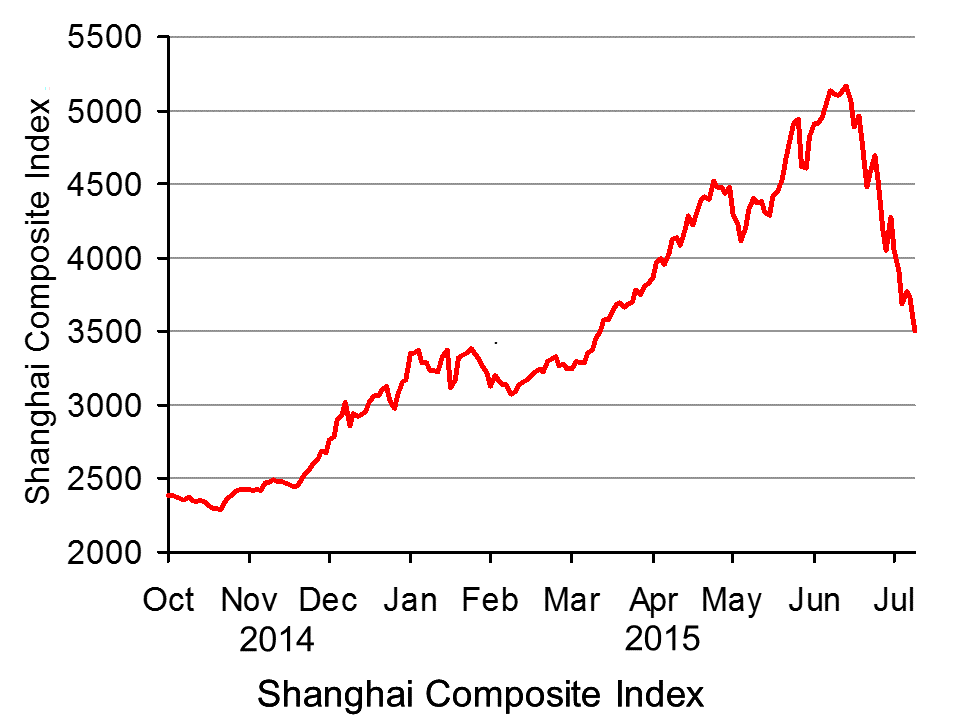 But since mid-June, share prices have plummeted by 32% (see chart). People have thus seen a huge fall in the value of their savings, while many others have found their shareholdings worth less than their debts. The fall, like the rise that preceded it, has been driven by speculation, fuelled by first optimism and then pessimism.
The Chinese government is worried that the fall might dampen investment and economic growth. It has thus has been supplying liquidity to various institutions to buy shares, but this has had little effect and is dismissed by many as meddling. What is more it could expose companies which take advantage of the liquidity to greater risk.
So serious has been the rout, that over 50% of listed companies have halted trading on the mainland Chinese stock exchanges.
So just why has there been this bubble and why has it burst? What implications will it have for (a) China and (b) the rest of the world? The following articles explore the issues.

China’s stock market fall hits small investors BBC News Magazine, John Sudworth (7/7/15)
 China Stocks Plunge as State Support Fails to Revive Confidence Bloomberg (8/7/15)
Chinese stocks are crashing Business Insider UK, Myles Udland, David Scutt (8/7/15)
Shanghai stocks plunge, over 1,200 Chinese companies halt trading Economic Times of India (8/7/15)
Everyone freaking out about China’s stock-market crash is missing one thing Business Insider UK, Elena Holodny (7/7/15)
China’s stock market has lost nearly a third of its value in a month Vox, Timothy B. Lee (8/7/15)
Chinese leaders may be undermined as investors suffer stock market slide The Guardian, Emma Graham-Harrison (8/7/15)
Opinion: China’s stock-market crash is just beginning MarketWatch, Howard Gold (8/7/15)
What does China’s stock market crash tell us? BBC News (22/7/15)
Questions
- What is meant by a ‘bubble’? Has the recent performance of the Shanghai Stock Market been an example of a bubble?
- Is the current fall in share prices in China an example of overshooting? Explain how you would decide.
- Distinguish between stabilising and destabilising speculation. Why does destabilising speculation not go on for ever?
- What is meant by the ‘stock market wealth effect’? How is the fall in the Chinese stock market likely to affect consumption and investment in China? How does the proportion of assets held in the form of shares affect the magnitude of the effect?
- What are the likely implications of the fall in the Chinese stock market for the rest of the world?
- Why has the Hong Kong stock market not behaved in the same way as the Shanghai market?
- What have the Chinese authorities been doing to arrest the fall in share prices? How likely are they to succeed?
 With worries about Greek exit from the eurozone, with the unlikelihood of further quantitative easing in the USA and the UK, with interest rates likely to rise in the medium term, and with Chinese growth predicted to be more moderate, many market analysts are forecasting that stock markets are likely to fall in the near future. Indeed, markets are already down over the past few weeks. Since late April/early May, the FTSE is down 4.5%; the German DAX index is down 7.0%; the French CAC40 index is down 6.9%; and the US Dow Jones index is down 2.3%. But does this give us an indication of what is likely to happen over the coming months?
If stock markets were perfectly efficient, then all possible information about the future will already have been taken into account and will all be reflected in current share prices. It would be impossible to ‘get ahead of the game’.
It is only if market participants have imperfect information and if you have better information than other people that you can are likely to predict correctly what will happen. Even then, the markets might be buffeted by random and hence unpredictable shocks.
 Some people correctly predicted things in the past: such as crashes or booms. But in many cases, this was luck and their subsequent predictions have proved to be wrong. When financial advisers or newspaper columnists give advice, they are often wrong. If they were reliably right, then people would follow their advice and markets would rapidly adjust to their predictions.
If Greece were definitely to exit the euro, if interest rates were definitely to rise in the near future, if it became generally believed that stock markets were overvalued, then stock markets would probably fall. But these things may not happen. After all, people have been predicting a rise in interest rates from their ultra-low levels for many months – and it hasn’t happened yet, and may not happen for some time to come – but it may!
If you want to buy shares, you might just as well buy them at random – or randomly sell any you already have. As Tetlock says, quoted in the Nasdaq article:
“Even the most astute observers will fail to outperform random prediction generators – the functional equivalent of dart-throwing chimps.”
And yet, people do believe that they can predict what is going to happen to stock markets – if not precisely, then at least roughly. Are they deluded, or can looking calmly at likely political and economic events put them one step ahead of other people who perhaps behave more reactively and emotionally?
Bond rout spells disaster for stock markets as global credit kraken awakens The Telegraph, John Ficenec (14/6/15)
Comment: Many imponderables for markets The Scotsman, Bill Jamieson (14/6/15)
How Ignoring Stock Market Forecasts Will make you a better investor Forbes, Ky Trang Ho (6/6/15)
The Predictions Racket Nasdaq, AdviceIQ, Jason Lina (21/5/15)
Questions
- Why may a return of rising interest rates lead to a ‘meltdown in equity prices’? Why might it not?
- Why have bond yields fallen dramatically since 2008?
- Why are bond yields rising again now and what significance might this have (or have had) for equity markets?
- Why may following the crowd often lead to buying high and selling low?
- Is there an asymmetry between buying and selling behaviour in stock markets?
- Will ignoring stock market forecasts make people better investors?
- “The stock market prices suggest that investors believe both the Federal Reserve and the Bank of England are bluffing about raising interest rates. That may be so, but it is an extremely risky game of chicken for investors to play.” Explain and discuss.
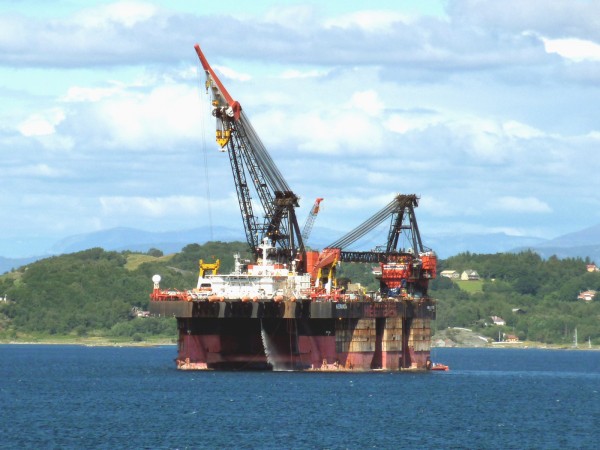 The Budget takes place on 17th March 2015 and as always there is much speculation as to what it will and won’t include. One industry that is eagerly awaiting Osborne’s Budget is the North Sea oil and gas industry. Tax cuts and rises may well play a key role in the Budget, but this is one sector where a possibly large tax cut is expected.
The tax paid by this industry is very high compared to others, potentially reaching 80%. The tax rate was increased some years ago and it is now thought that it may come back down. One key factor is oil prices: with such huge decreases in the price of oil relative to when the tax on the industry was increased, the industry is now asking for these tax rises to be reversed. The industry has suggested that a 10% tax cut is a possibility and this would make a big difference for the industry.
Danny Alexander, the chief secretary to the Treasury, said:
“We’ve been very clear that the direction of travel for tax in the North Sea needs to be downwards … And that needs to be even stronger given the low oil price we see at the moment. We want people to have the confidence to invest for the long term future of the North Sea … And so George Osborne and I have been listening very carefully to what the industry has been saying …People will have to wait and see what we say on Wednesday [Budget day], but I hope very much that it will give the North Sea that confidence that we all want to see for one of Britain’s most important industries.”
We may also see further changes for this industry, such as allowances to encourage further investment, as costs of investment are extremely high and this has led to many years of under-investment. These changes are hoped to regenerate this industry. Any change in tax allowances or tax rates will have an impact on tax revenue and it is not necessarily the case that an increase in tax will lead to a rise in revenue or a fall in revenue. The relationship between tax rates and tax revenues can be very complex. The following articles consider this particular issue and what the Budget will do for this industry.
North sea oil groups set for tax breaks in budget Financial Times, Christopher Adams and George Parker (16/3/15)
What does the Budget 2015 mean for the North sea oil industry? The Telegraph, Andrew Critchlow (16/3/15)
Britain needs oil tax cuts to attract North Sea Investment Reuters, Karolin Schaps and Claire Milhench (16/3/15)
Treasury paves way for major tax cut for North sea BBC News, Kamal Ahmed (16/3/15)
Home of Brent Oil benchmark seeks help as investment slumps Bloomberg, Firat Kayakiran (17/3/15)
Questions
- If a tax is imposed on an industry, what type of effect might this have on costs of production? Use a diagram to support your answer.
- In the BBC News article, North Sea Oil is referred to as a cash cow. What does this mean?
- If taxes are cut for the North Sea Oil industry, how will this affect its costs and what might it doe for investment?
- What will happen to tax revenues if taxes are cut? Use the Laffer curve to help your answer.
- How has the North Sea Oil industry been affected by falling oil prices? Does this offer a justification for a tax cut?
 Many UK coal mines closed in the 1970s and 80s. Coal extraction was too expensive in the UK to compete with cheap imported coal and many consumers were switching away from coal to cleaner fuels. Today many shale oil producers in the USA are finding that extraction has become unprofitable with oil prices having fallen by some 50% since mid-2014 (see A crude indicator of the economy (Part 2) and The price of oil in 2015 and beyond). So is it a bad idea to invest in fossil fuel production? Could such assets become unusable – what is known as ‘stranded assets‘?
In a speech on 3 March 2015, Confronting the challenges of tomorrow’s world, delivered at an insurance conference, Paul Fisher, Deputy Governor of the Bank of England, warned that a switch to both renewable sources of energy and actions to save energy could hit investors in fossil fuel companies.
‘One live risk right now is of insurers investing in assets that could be left ‘stranded’ by policy changes which limit the use of fossil fuels. As the world increasingly limits carbon emissions, and moves to alternative energy sources, investments in fossil fuels and related technologies – a growing financial market in recent decades – may take a huge hit. There are already a few specific examples of this having happened.
… As the world increasingly limits carbon emissions, and moves to alternative energy sources, investments in fossil fuels and related technologies – a growing financial market in recent decades – may take a huge hit. There are already a few specific examples of this having happened.’
Much of the known reserves of fossil fuels could not be used if climate change targets are to be met. And investment in the search for new reserves would be of little value unless they were very cheap to extract. But will climate change targets be met? 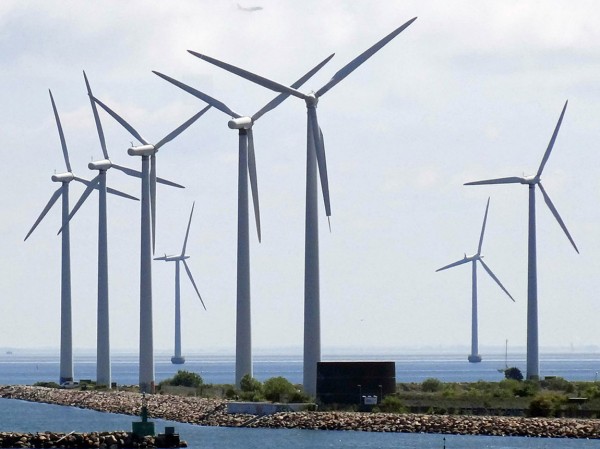 That is hard to predict and depends on international political agreements and implementation, combined with technological developments in fields such as clean-burn technologies, carbon capture and renewable energy. The scale of these developments is uncertain. As Paul Fisher said in his speech:
‘Tomorrow’s world inevitably brings change. Some changes can be forecast, or guessed by extrapolating from what we know today. But there are, inevitably, the unknown unknowns which will help shape the future. … As an ex-forecaster I can tell you confidently that the only thing we can be certain of is that there will be changes that no one will predict.’
The following articles look at the speech and at the financial risks of fossil fuel investment. The Guardian article also provides links to some useful resources.
Articles
Bank of England warns of huge financial risk from fossil fuel investments The Guardian, Damian Carrington (3/3/15)
PRA warns insurers on fossil fuel assets Insurance Asset Risk (3/3/15)
Energy trends changing investment dynamics UPI, Daniel J. Graeber (3/3/15)
Speech
Confronting the challenges of tomorrow’s world Bank of England, Paul Fisher (3/3/15)
Questions
- What factors are taken into account by investors in fossil fuel assets?
- Why might a power station become a ‘stranded asset’?
- How is game theory relevant in understanding the process of climate change negotiations and the outcomes of such negotiations?
- What social functions are filled by insurance?
- Why does climate change impact on insurers on both sides of their balance sheets?
- What is the Prudential Regulation Authority (PRA)? What is its purpose?
- Explain what is meant by ‘unknown unknowns’. How do they differ from ‘known unknowns’?
- How do the arguments in the article and the speech relate to the controversy about investing in fracking in the UK?
- Explain and comment on the statement by World Bank President, Jim Yong Kim, that sooner rather than later, financial regulators must address the systemic risk associated with carbon-intensive activities in their economies.
 House prices are always a good signal for the strength or direction of the economy. While there will always be certain areas that are more sought after than others and such differences will be reflected in relative house prices, the regional divide that we currently see in the UK is quite astonishing.
Prior to the financial crisis, house prices had been rising across the county, but in the year following the financial crisis, they declined by 19 per cent. It was only in 2013, when prices began to increase and, perhaps more importantly, when the variation in regional house prices began to increase significantly. In mid-2014, the UK’s annual house price inflation rate was 11.7 per cent, but the rates in London and the South East were 19.1 and 12.2 per cent, respectively. Elsewhere in the UK, the average rate was 7.9 per cent.
These regional differences have continued and figures show that the current differential between the cheapest and most expensive regional average house price is now over £350,000. In particular, data from the Land Registry shows that the average house price in London is £458,283, while in the North East, it is only £97,974.
Those people who own a house in London have benefited from such high house prices, in many cases finding that their equity in their house has grown significantly. Furthermore, any home-owners selling their house in London and moving elsewhere are benefiting from lower house prices outside London.
However, most first-time buyers looking for a house in London are being competed out of the market, finding themselves unable to gain a mortgage and deposit for the amount that they require. The opposite is, of course, happening in other parts of the country. First-time buyers are more able to enter the property market, but home-owners are finding that they have much less equity in their house.
This has also caused other problems, in particular in the labour market. Workers who are moving to jobs in London are finding the house price differentials problematic. Although wage rates are often higher in London than in other parts of the country, the house price differential is significantly bigger. This means that if someone is offered a job in London, they may find it impossible to find a house of similar size in London compared to where they had been. After all, an average family home in the North East can be purchased for under £100,000, whereas an average family home in London will cost almost £500,000.
The housing market is problematic because of particular characteristics.
Supply tends to be relatively fixed, as it can take a long time to build new houses and hence to boost supply. Furthermore, the UK has a relatively dense population, with limited available land, and so planning restrictions have to be kept quite tight, which is another reason why supply can be difficult to increase.
On the demand-side, we are seeing a change in demographics, with more single-person households; people living longer; second home purchases and many other factors. 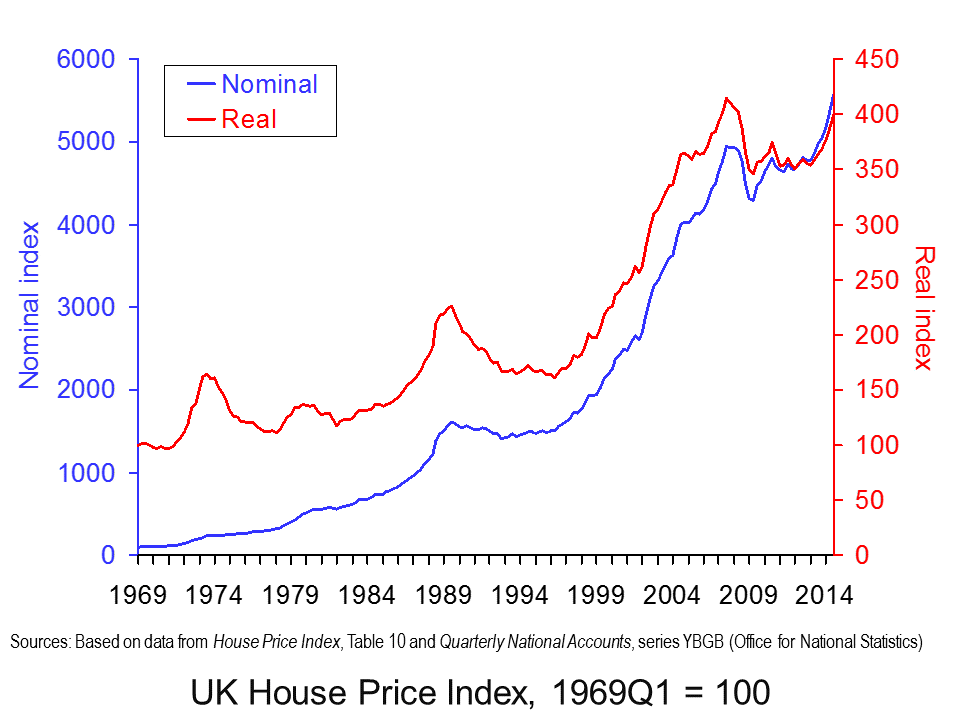 These things tend to push up demand and, with restricted supply, house prices rise. Furthermore, with certain areas being particularly sought after, perhaps due to greater job availability, ease of commuting, schools, etc., house price differentials can be significant.
The Conservatives, together with the other main parties, have promised to build more houses to help ease the problem, but this really is a long-run solution.
The Bank of England will undoubtedly have a role to play in the future of the housing market. The affordability of mortgages is very dependent on interest rate changes by the Bank’s Monetary Policy Committee.
Although house prices in London have recently fallen a little, the housing cost gap between living in London and other areas is unlikely to close by much as long as people continue to want to live in the capital. The following articles consider the housing market and its regional variations.
Articles
London’s homeowners have made £144,000 on average since 2009 International Business Times, Sean Martin (20/2/15)
Wide gap in regional house prices, Land Registry figures show BBC News, Kevin Peachey (27/2/15)
Mapped: 10 years of Britain’s house price boom (and bust) The Telegraph, Anna White (27/2/15)
Oxford houses less affordable than London Financial Times, Kate Allen (26/2/15)
January’s UK house prices show unexpected climb The Guardian (5/2/15)
House prices since 2008: best and worst regions The Telegraph, Tom Brooks-Pollock (22/8/14)
House prices hit new record high of £274k with six regions now past pre-crisis peak – but the North lags behind This is Money, Lee Boyce (14/10/14)
Data
House price indices: Data Tables ONS
Links to sites with data on UK house prices Economic Data freely available online, The Economics Network
Regional House Prices Q4 2014 Lloyds Banking Group
Questions
- What are the main factors that determine the demand for housing? In each case, explain what change would shift the demand curve for housing to the right or the left.
- Which factors determine supply? Which way will they shift the supply curve?
- Put the demand and supply for housing together and use that to explain the recent trends we have seen in house prices.
- Use your answers to question 1 – 3 to explain why house prices in London are so much higher than those in the North East of England.
- Why are interest rates such an important factor in the housing market?
- Explain the link between house prices and the labour market.
- Do you think government policy should focus on reducing regional variations in house prices? What types of policies could be used?
 Many Chinese people have taken to investing on the Chinese stock market, seeing it as a way of making a lot of money quickly. From October 2014 to June this year the market soared, rising by 126% from 2290 to 5166.