 Most real-world markets are a long way from the perfect information setting assumed in perfectly competitive markets. Many industries therefore rely heavily on word of mouth to increase demand. This is especially true in the digital age where information can spread extremely rapidly and many websites encourage consumer ratings and reviews. Here, information becomes more and more valuable as it is shared with other people.
However, the economist Joshua Gans has suggested that traditional business models are not well suited to fully exploiting the benefits of the sharing of information. This is because, whilst enthusiastic consumers spread the word, the seller has traditionally acted as a gate-keeper, maintaining complete control over who obtains the product. The problem is that this creates a friction which can dampen momentum for the product from building.
In contrast, Gans describes a novel alternative strategy that was used by the band the XX when they released their second album earlier this year. As is becoming more and more common, the band premiered the album as an online stream. However, what was unique about the XX’s approach was that they gave the stream to a single superfan. They hoped that this chosen fan would initiate the spreading of the stream amongst other fans. After a worrying delay in which he enjoyed his monopoly ownership, this is what he eventually did. Just 24 hours later the stream had been player millions of times and the site crashed under the burden.
Of course, one reason why suppliers may need close control is to be able to charge for the product. If the sharing information must involve giving something away for free, it typically makes no commercial sense. However, Gans also points out that recommendations are more credible if the information has been costly to obtain. Otherwise, it may simply be cheap talk and therefore carry little value.
The balancing act for suppliers is therefore to introduce a hurdle cost in obtaining the information whilst trying to ensure that, once it has been passed on, the recipient encounters as little friction as possible in making use of it. Gans suggests that alternative business models can be developed which achieve this balance. If these can profitably encourage the sharing of information a win-win situation for sellers and buyers is created.
Furthermore, Gans is experimenting with selling his new book about sharing information under an example of one such model. Having bought the e-book for $4.99 you will find a coupon at the back which you can pass on to a friend or family member which allows them to buy their own copy of the book for a mere $0.99. However, as he points out, there is a potential danger to this strategy:
“All my readers could form a collective and potentially buy one copy for $4.99 and then a million for $0.99.”
He has said that he plans to be report back on how the book has sold on his blog at a later date, so it will be interesting to see whether or not the experiment was successful.
The folly of replicating the physical world HBR Blog Network, Joshua Gans (17/11/10)
A shared pricing experiment for my book Digitopoly, Joshua Gans (05/10/12)
Information wants to be…..shared O’Reilly Tools of Change for Publishing, Joe Wikert (16/10/12)
Questions
- Why will the problems described above not arise in the model of perfect competition?
- What type of industries are most likely to rely on word of mouth?
- In what type of industries is the friction described above most likely to happen?
- Describe the dangers with the strategy Gans is adopting for selling his book?
- Explain whether you think these dangers are likely to arise in practice.
- How might the business model be modified to avoid these dangers?
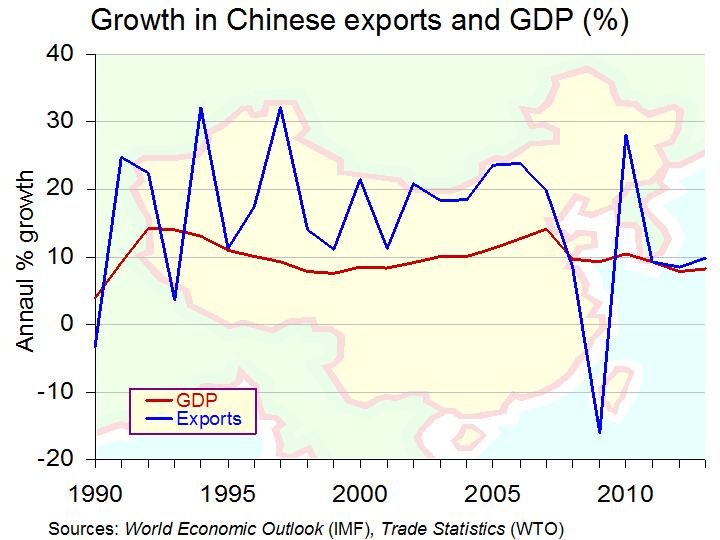 China has been one of the success stories of the past 20 years, with rapid growth in domestic and export demand. This has created the second largest economy in the world. From 1992 to 2007 annual GDP growth averaged 10.7% and annual export growth averaged 18.9% (see chart).
However, with the credit crunch and ensuing recession, growth rates in China have fallen somewhat. Annual GDP growth has averaged 9.6% and annual export growth has averaged 7.4%. Such growth rates may not seem bad, given that many Western economies have been struggling to achieve any growth, but they have been causing concern for this booming economy.
 In its May Outlook, the World Bank forecast China’s growth for the year at 8.2%, but it has since been reduced to 7.8%. A key part of China’s success story has been its export market, but it has been this market that has caused concerns for the mainland economy. In August of this year, its year-on-year export growth was at only 2.7%, but exports last month grew by more than expected, at approximately 7.4%. China has had a consistent trade surplus and according to government figures, this has widened to $27.67 billion in September from $26.66 billion in the previous month.
Recovery in this market will be crucial for the continued success of the economy, as a means of alleviating the fears of a slowdown. This higher growth of exports may be a misleading indicator, perhaps influenced by seasonal factors and thus may not be a sign of what’s to come. Indeed, many analysts have said that they are not convinced that these healthier trade figures will remain. Alistair Thornton, from IHS Global Economics said:
“It’s safe to say we are overshooting the trend here and we expect (the data) to come back in line in the months ahead.”
Citigroup economist, Ding Shaung also confirmed these sentiments:
”The trade data is a positive sign for the Chinese economy … But it remains to be seen whether import and export growth can remain at these levels.”
Part of this pessimism is due to the uncertainty surrounding the growth prospects of its biggest two trading partners – the US and the European Union. Exports to the former have remained relatively high, but exports to the European Union have suffered, falling by over 5.6%. It is likely that weaknesses in the global economy have held back China’s growth prospects in both exports and national output. The Chinese government was aiming for growth of 7.6% in 2012. Not a bad rate you may say, but when compared with growth rates for 2011 (9.3%) and 2010 (10.4%), it does represent a significant fall. The future of the Chinese economy is crucial for the recovery of the world economy, in part as it represents a big demand for imports from other countries, such as the US and Europe. The following articles consider the trade and growth prospects of the world’s second largest economy.
Chinese exports grow faster than expected in September BBC News (14/10/12)
Chinese exports grow faster than expected Financial Times, Patti Waldmeir (14/10/12)
China exports jump, but weaknesses seen ahead The Korea Herald (14/10/12)
China exports rise, hinting at a glimmer of revival New York Times, Keith Bradsher (13/10/12)
China’s trade surplus widens Wall Street Journal, William Kazer (13/10/12)
Chinese surplus widens as exports surge CNN, Paavan Mathemas (13/10/12)
 China’s economic slow-down BBC Today Programme, Linda Yueh (18/10/12)
Questions
- What is a trade surplus?
- Which factors have influenced Chinese exports and imports?
- Why is China’s growth rate such an important variable for the UK and other Western economies?
- Why has export growth in China fallen recently? Can you use the same explanation for its lower growth in national output?
- Explain why analysts remain pessimistic about the sustainability of these improved trade figures.
- Using a diagram, illustrate the effect that higher Chinese growth rates will have on GDP in a country such as the UK. Could there be a multiplier effect?
 The energy sector has a history of criticism with regards to prices and practices. In the past, Ofgem have tried to make the sector more competitive, by ensuring that price comparisons are easier. At the beginning of this year, many of the big six providers announced price cuts, but within the next few weeks, we will see the reverse occurring, as energy prices begin to rise.
British Gas has announced price rises of 6% from 16th November that will affect over 8 million customers by adding approximately £80 per year to the annual dual fuel bill. Npower will also put its prices up 10 days later (8.8% for gas and 9.1% for electricity), creating higher bills for 3 million people.
In January of this year, when we saw energy prices fall, it was not solely due to Ofgem’s findings. We had a relatively mild winter, which reduced the demand for energy and this fed into lower prices. As the winter now approaches once more, demand for energy will begin to increase, feeding into prices that are now higher.
Furthermore, the energy companies have said that a range of external factors are also adding to their costs and putting increasing pressure on them to increase their charges. Npower’s Chief Commercial Officer said:
“There is never a good time to increase energy bills, particularly when so many people are working hard to make ends meet…But the costs of new statutory schemes, increases in distribution charges and the price of gas for the coming winter are all being driven up by external factors, for example government policy”
 Significant investment is needed in the energy sector. Energy companies are required to set aside money for maintaining and improving the national grid and investing in renewable energy, such as wind and solar power. In order for the energy companies to fund these investments, more money must be raised and the logical method is to put up prices. However, critics are simply blaming ‘these very big lazy companies’ who are passing ‘above-inflation price rises’ onto already squeezed households.
Part of this is undoubtedly to do with the market structure of this sector. A typical oligopoly creates a market which, under certain circumstances, can be highly competitive, but because of barriers to entry that prevent new firms from entering the market may charge higher prices and be inefficient. Indeed, Ofgem has plans to reduce the power of the main energy providers by forcing them to auction off some of the electricity they generate. The aim of this is to free up the market and make it more competitive.
While only three providers have announced price rises, it is inevitable that the other three will follow. The relative increases will create incentives for consumers to switch providers, but crucial to this is an ability to understand the different tariffs on offer and lack of clarity on this has been a big criticism previously levelled at the energy sector. Indeed, half of UK customers have never switched energy providers. Perhaps this is the time to think about it, firstly as a means of saving money and secondly as a means of putting the energy companies in competition with each other. The following articles consider this market.
Energy price rises: how to switch, save and safeguard your supply The Guardian, Mark King (12/10/12)
Npower and British Gas raise energy prices (including video) BBC News (12/10/12)
Energy price rises? We’re like turkeys voting for Christmas The Telegraph, Rosie Murray-West (12/10/12)
British Gas and Npower to raise prices fuelling fears of a ‘long, cold winter’ for more households Independent
, Graeme Evans (12/10/12)Wholesale prices rise as energy costs jump Wall Street Journal, Sarah Portlock and Jeffrey Sparshott (12/10/12)
British Gas raises gas and electricity prices by 6pc The Telegraph (12/10/12)
Osborne warns energy firms over price hikes Reuters (12/10/12)
Energy price hikes to take effect from next week Independent, Simon Read(13/10/12)
Questions
- What are the main reasons influencing the recent price rises? In each case, explain whether it is a demand- or supply-side factor.
- Using your answer from question 1, illustrate the effect of it on a demand and supply diagram.
- Which features of an oligopolistic market are relevant to the energy sector. How can we use them to explain these higher prices.
- How has government policy affected the energy sector and energy prices?
- Why are customers reluctant to change energy providers? Does this further the energy company’s ability to raise prices?
- Are there any government policies that could be implemented to reduce the power of the energy companies?
 Should the object of monetary policy be simply one of keeping inflation within a target range? In a speech given on 9 October, the Governor of the Bank of England, Sir Mervyn King, questioned whether the interest-rate setting policy of the Monetary Policy Committee (MPC) has been too narrow.
He considered whether interest rates should have been higher before the financial crisis and crash of 2007–9. This could have helped to reduce the asset price bubble and discouraged people from taking out excessive loans.
But then there is the question of the exchange rate. Would higher interest rates have pushed the exchange rate even higher, with damaging effects on exports? Today the trade weighted exchange rate is some 20% lower than before the crash. The government hopes that this will encourage a growth in exports and help to fuel recovery in demand. But as Dr King said, “The strategy of reducing domestic spending and relying more on external demand is facing a real problem because not everyone can do it at the same time.”
 Then there is the question of economic growth. Should a target rate of growth be part of the MPC’s target? Should the MPC adopt a form of Taylor rule which targets a weighted average of the inflation rate and the rate of economic growth?
Certainly monetary policy today in the UK and many other countries is very different from five years ago. With interest rates being close to zero, there is little scope for further reductions; after all, nominal rates cannot fall below zero, otherwise people would be paid for borrowing money! So the focus has shifted to the supply of money. Several attempts have been made to control the money supply through programmes of quantitative easing. Indeed many economists expect further rounds of quantitative easing in the coming months unless there is a substantial pick up in aggregate demand.
So what should be the targets of monetary policy? The following articles look at Dr King’s speech and at various alternatives to a simple inflation target.
Articles
Mervyn King says must face up to monetary policy’s limits’ Reuters, David Milliken and Sven Egenter (9/10/12)
Bank of England’s Mervyn King defends low interest rates pre-crisis The Telegraph, Emma Rowley (9/10/12)
Banks should have had a leverage cap before crash, says Mervyn King The Guardian, Heather Stewart and Phillip Inman (9/10/12)
King Says BOE Must Keep Targeting Inflation as Tool Revamp Looms Bloomberg, Scott Hamilton and Svenja O’Donnell (9/10/12)
After 20 years, time to change Merv’s medicine? Channel 4 News blogs, Faisal Silam (9/10/12)
King signals inflation not primary focus Financial Times, Norma Cohen and Sarah O’Connor (9/10/12)
Should Bank start the helicopter? BBC News, Stephanie Flanders (12/10/12)
Speech
Twenty years of inflation targeting Bank of England speeches, Mervyn King (9/10/12)
Questions
- What are the arguments for using monetary policy to target a particular rate of inflation?
- Would it ever be a good idea to adjust the targeted rate of inflation up or down and if so when and why?
- Explain how a Taylor rule would work and in what ways it is superior or inferior to pursuing a simple inflation target.
- Are attempts to control the money supply through quantitative easing (or tightening) consistent or inconsistent with pursuing an inflation target? Explain.
- What are the arguments for and against abandoning targeting in monetary policy and replacing it with discretionary policy that takes a number of different macroeconomic indicators into account?
 There has been considerable discussion recently about whether the government should introduce a property tax on high value properties. The government, finding it difficult to reduce the public-sector deficit and yet determined to do so, is looking for additional measures to reduce government expenditure or raise tax revenue.
But would it favour a mansion tax as a means of raising additional revenue?
The imposition of such a tax is favoured by both Liberal Democrats and the Labour Party. It is strongly opposed, however, by Conservatives. But just what would such a tax look like and what are the arguments for and against it?
One alternative would be to impose a one-off tax on property valued over a certain amount, such as £2 million. Alternatively it could be levied only for as long as the government is seeking to make substantial inroads into the deficit.
Another would be to add one or more bands to council tax. At present, council tax in England is levied in 8 bands according to the value of a person’s property. The highest band is for property valued over £320,000 in 1991 prices, with the amount of tax due for each band varying from local authority to local authority. (Average UK house prices in 2012 are 135% higher than in 1991.) In Scotland the bands are lower with the top band being for property valued over £212,000 in 1991 prices. In Wales, there is an additional band for property valued over £424,000, but properties are valued in 2003 prices, not 1991 prices.
With low top bands for council tax, people in mansions end up paying the same as people in much more modest property. It would be relatively easy to add additional bands, with the top band applying only to property worth, say, over £1 million or more.
 The arguments in favour of a mansion tax are that it is progressive, relatively easy to collect, hard to evade and with minimal disincentive effects. The arguments against are that it would make the tax system ‘too progressive’, would not necessarily be related to an individual’s ability to pay and could have substantial disincentive effects.
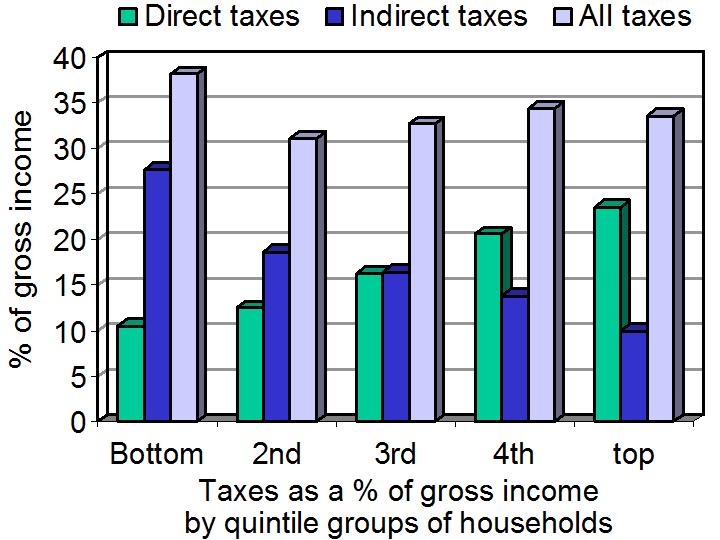
The progressiveness of the UK tax system is illustrated in the chart, which looks at the proportion of income paid in direct, indirect and all taxes by quintile groups of households – that is, households grouped into five equal sized groups ranked from lowest to highest gross income. (Click here for a PowerPoint of the chart.)
The following articles look at the debate as it has raged over the past few weeks. Try to unpick the genuine arguments from the political rhetoric!
Articles
Clegg Says U.K. Could Apply Mansion Tax ‘in Five Seconds’ Bloomberg, Robert Hutton (25/9/12)
Two thirds back mansion tax on £1m homes Metro, Tariq Tahir (8/10/12)
Mansion tax would ‘tackle inequality’ This is Tamworth (27/9/12)
Council tax: the easy way to make mansion-dwellers pay Guardian, Simon Jenkins (25/9/12)
Rich must pay fair share in tax BBC Andrew Marr Show, Nick Clegg (23/9/12)
We will get mansion tax on £2 million homes through next budget, promise Lib Dems The Telegraph, Rowena Mason (25/9/12)
Trying to tax the wealthy not worth the price The Scotsman, George Kerevan (31/8/12)
Tax on wealth is true to Tory principles Financial Times, Janan Ganesh (24/9/12)
How would Clegg’s emergency wealth tax work? Guardian, Hilary Osborne (29/8/12)
Labour considers mansion tax on wealthy Financial Times, George Parke (5/9/12)
Conservative conference: Cameron rules out ‘mansion tax’ BBC News (7/10/12)
Don’t make wealth tax a habit Financial Times, Howard Davies (29/8/12)
George Osborne blocks mansion tax, but insists wealthy will pay more The Telegraph, Robert Winnett (8/10/12)
Why George Osborne had to kill the mansion tax The Spectator, Matthew Sinclair (7/10/12)
David Cameron rules out mansion tax and plans further welfare cuts Guardian, Hélène Mulholland (7/10/12)
Viewpoint: Would a wealth tax work? BBC News, Mike Walker (29/8/12)
For all the claims made about wealth taxes, it’s not correct to say the rich are paying their fair share Independent, Jonathan Portes (2/10/12)
Data
House price data links Economics Network
The Effects of Taxes and Benefits on Household Income, 2010/2011 ONS (26/6/12) (see especially Tables 2 and 3 and Table 26 for historical data)
Questions
- Explain the distinction between direct and indirect taxes, and between progressive and regressive taxes. For what reasons do the poor pay a higher proportion of their income in indirect taxes than the rich?
- What forms can a tax on wealth take?
- How progressive are taxes in the UK (see the ONS site in the Data section above)?
- Assess the arguments in favour of a mansion tax.
- Assess the arguments against a mansion tax.
- What type of wealth tax would be hardest to evade?
- What are the likely income and substitution effects of a wealth tax?