 We all know that our spending changes during the Christmas period: namely we spend a lot more than during the rest of the year. This applies across the board – we buy more clothes, food and drink, even though each day, we can generally only wear, eat and drink the same amount as usual! This has some interesting points from a behavioural economics stance, but here I’m going to think about the impact of this on some key retailers.
Marks & Spencer have previously made headlines for the wrong reasons: poor sales on clothes and the need for serious restructuring of its stores, target audience and marketing in order for this long-standing retailer to remain current and competitive. Although sales were expected to rise in the Christmas period, they did significantly better than expected, with sales growth of 2.3%, above the expected 0.5%. More encouragingly, this growth was not just in food, but in clothing and homeware as well.
One of the key reasons given for this above-expected improvement in sales was the conveniently timed Christmas, falling on a Sunday and hence giving extra shopping days. M&S have said that this certainly helped with their Christmas trading. Although this was good for Q4 trading, the timing will not play ball for Easter and they are expecting a negative effective during that trading period. Some analysts have said that despite the growth being boosted by the timing of Christmas, there were still signs of a change in fortunes. Bryan Roberts from TCC Global said:

“It might be the sign of some green shoots in that part of the business.”
This is consistent with the Chief Executive, Steve Rowe’s comments that despite the timing of Christmas adding around 1.5% to clothing and home sales growth, the recovery was also due to “better ranges, better availability and better prices”.
It appears as though many other retailers have experienced positive growth in Christmas sales, with the John Lewis Partnership seeing like-for-like sales growth of 2.7%, with Waitrose at a 2.8% rise.
The other interesting area is supermarkets. Waitrose and M&S are certainly competitors in the food industry, but at the higher end. If we consider the mid-range supermarkets (Asda, Morrisons, Sainsbury’s and Tesco), they have also performed, as a whole, fairly well. The low-cost Aldi and Lidl have been causing havoc for these supermarket chains, but the Christmas period seemed to prove fruitful for them.
Tesco saw UK like-for-like sales up by 1.8%, which showed significant progress in light of previously difficult trading periods with the emergence of the low-cost chains. Q$ was its better quarter of sales growth for over five years. One of the key drivers of this growth is fresh food sales and its Chief Executive, Dave Lewis said “we are very encouraged by the sustained strong progress that we are making across the group.” However, despite these positive numbers, Tesco only really met market expectation, rather than surpassing them as Morrison, Sainsbury’s and Marks & Spencer did.
 Perhaps the stand-out performance came from Morrisons, with its best Christmas performance for seven years. Another casualty of the low-cost competitors, it has been making a recovery and Q4 of 2016 demonstrated this beyond doubt. Like-for-like sales for the nine weeks to the start of 2017 were up by 2.9%, with growth in both food and drink and clothing.
Morrisons has been on a long and painful journey, with significant reorganisation of its stores and management. While this has created problems, it does appear to be working.
We also saw a general move up to the more premium own-brands and this again benefited all supermarkets. Morrisons Chief Executive, David Potts said:
“We are delighted to have found our mojo … Every year does bring its challenges, but so far we haven’t seen any change in consumer sentiment. Customers splashed out over Christmas and wanted to trade up … We are becoming more relevant to more people as we turn the company around.”
So it seems to be success all round for traders over the Christmas period and that, in many cases, this has been a reversal of fortunes. The question now is whether or not this will continue with the uncertainty over Brexit and the economy.
Articles
M&S beats Christmas sales forecast in clothing and homeware BBC News (12/1/17)
Marks & Spencer reports long-awaited rise in clothing sales The Telegraph, Ashley Armstrong (12/1/17)
Marks and Spencer reveals signs of growth in clothing business Financial Times, Mark Vandevelde (12/1/17)
Tesco’s festive sales lifted by fresh food The Telegraph, Ashley Armstrong (12/01/17)
Tesco caps year of recovery with solid Christmas Reuters, James Davey and Kate Holton (12/1/17)
Tesco, Marks & Spencer, Debenhams, John Lewis and co cheer strong Christmas trading Independent, Josie Cox and Zlata Rodionova (12/1/17)
Morrisons sees best Christmas performance for seven years BBC News (10/12/17)
Morrisons enjoys some ‘remarkable’ Christmas cheer’ The Guardian, Sarah butler and Angela Monaghan (10/1/17)
Record Christmas as Sainsbury’s ‘shows logic of Argos takeover’ The Guardian, Sarah Butler and Angela Monaghan (11/1/17)
Questions
- Why have the big four in the supermarket industry been under pressure over the past 2 years in terms of their sales, profits and market share?
- How have the changes that have been made by M&S’ Chief Executive helped to boost sales once more?
- Share prices for supermarkets have risen. Illustrate why this is on a demand and supply diagram. Why has Tesco, despite its performance, seen a fall in its share price?
- What are the key factors behind Morrison’s success?
- What type of market structure is the supermarket industry? Does this help to explain why the big four have faced so many challenges in recent times?
- If there has been a general increase in sales across all stores over the Christmas trading period, that goes beyond expectations, can we infer anything about customer tastes and their expectations about the future?
 In two recent speeches, the Governor of the Bank of England, Mark Carney, and the Bank’s Chief Economist, Andy Haldane, have reflected on the growing inequality in the UK and other countries. They have also answered criticisms that monetary policy has exacerbated the problem. As, Andy Haldane puts it:
It is clear monetary policy has played a material role in lifting all boats since the financial crisis broke. …[But] even if monetary policy has lifted all boats, and could plausibly do so again if needed, that does not mean it has done so equally. In particular, concerns have been expressed about the potential distributional effects of monetary policy.
Jan Vlieghe [member of the Monetary Policy Committee] has recently looked at how monetary policy may have affected the fortunes of, among others, savers, pension funds and pensioners. The empirical evidence does not suggest these cohorts have been disadvantaged to any significant degree by the monetary policy stance. For most members in each cohort, the boost to their asset portfolios and the improved wages and profits due to a stronger economy more than offset the direct loss of income from lower rates [of interest on savings accounts].
Andy Haldane’s speech focused largely on regional inequality. He argued that productivity has grown much more rapidly in the more prosperous regions, such as London and the South East. This has resulted in rising inequality in wages between different parts of the UK. Policies that focus on raising productivity in the less prosperous regions could play a major role in reducing income inequality.
Mark Carney’s speech echoed a lot of what Andy Haldane was saying. He argued that expansionary monetary policy has, according to Bank of England modelling, “raised the level of GDP by around 8% relative to trend and lowered unemployment by 4 percentage points at their peak”. And the benefits have been felt by virtually everyone. Even savers have generally gained:
That’s in part because, to a large extent, the thrifty saver and the rich asset holder are often one and the same. Just 2% of households have deposit holdings in excess of £5000, few other financial assets and don’t own a home.
But some people still gained more from monetary policy than others – enough to contribute to widening inequality.
Losers from the lost decade
 Mark Carney looked beyond monetary policy and argued that the UK has experienced a ‘lost decade’, where real incomes today are little higher than 10 years ago – the first time this has happened for 150 years. This stalling of average real incomes has been accompanied by widening inequality between various groups, where a few have got a lot richer, especially the top 1%, and many have got poorer. Although the Gini coefficient has remained relatively constant in recent years, there has been a widening gap between the generations.
For both income and wealth, some of the most significant shifts have happened across generations. A typical millennial earned £8000 less during their twenties than their predecessors. Since 2007, those over 60 have seen their incomes rise at five times the rate of the population as a whole. Moreover, rising real house prices between the mid-1990s and the late 2000s have created a growing disparity between older home owners and younger renters.
This pattern has been repeated around the developed world and has led to disillusionment with globalisation and a rise in populism.  Globalisation has been “associated with low wages, insecure employment, stateless corporations and striking inequalities”. (Click here for a PowerPoint of the chart.)
And populism has been reflected in the crisis in Greece, the Brexit vote, Donald Trump’s election, the rise of the National Front in France, the No vote in the Italian referendum on reforming the constitution and the rise in anti-establishment parties and sentiment generally. Mainstream parties are beginning to realise that concerns over globalisation, inequality and a sense of disempowerment must be addressed.
Solutions to inequality
As far as solutions are concerned, central must be a rise in general productivity that increases potential real income.
Boosting the determinants of long-run prosperity is the job of government’s structural, or supply-side policies. These government policies influence the economy’s investment in education and skills; its capacity for research and development; the quality of its core institutions, such as the rule of law; the effectiveness of its regulatory environment; the flexibility of its labour market; the intensity of competition; and its openness to trade and investment.
But will this supply-side approach be enough to bring both greater prosperity and greater equality? Will an openness to trade be accepted by populist politicians who blame globalisation and the unequal gains from international trade for the plight of the poor? Carney recognises the problem and argues that:
For the societies of free-trading, networked countries to prosper, they must first re-distribute some of the gains from trade and technology, and then re-skill and reconnect all of their citizens. By doing so, they can put individuals back in control.
For free trade to benefit all requires some redistribution. There are limits, of course, because of fiscal constraints at the macro level and the need to maintain incentives at the micro level. Fostering dependency on the state is no way to increase human agency, even though a safety net is needed to cushion shocks and smooth adjustment.
Redistribution and fairness also means turning back the tide of stateless corporations.
… Because technology and trade are constantly evolving and can lead to rapid shifts in production, the commitment to reskilling all workers must be continual.
In a job market subject to frequent, radical changes, people’s prospects depend on direct and creative engagement with global markets. Lifelong learning, ever-greening skills and cooperative training will become more important than ever.
But whether these prescriptions will be accepted by people across the developed world who feel that the capitalist system has failed them and who look to more radical solutions, whether from the left or the right, remains to be seen. And whether they will be adopted by governments is another question!
Webcast
 Roscoe Lecture Bank of England on YouTube, Mark Carney (5/12/16)
Speeches
One Car, Two Car, Red Car, Blue Car Bank of England, Andrew Haldane (2/12/16)
The Spectre of Monetarism: Roscoe Lecture, Liverpool John Moores University Bank of England, Mark Carney (5/12/16)
Articles: Andrew Haldane speech
Bank of England chief economist says monetary stimulus stopped ‘left behind’ from drowning Independent, Ben Chu (2/12/16)
BoE’s Andrew Haldane warns of regional growth inequality BBC News (2/12/16)
‘Regions would have faced contraction’ without rate cuts and money printing Belfast Telegraph (2/12/16)
Bank of England chief: UK can be transformed if it copies progress on Teesside Gazette Live, Mike Hughes (2/12/16)
Articles: Mark Carney speech
Governor’s ‘dynamite’ warning on wages and globalisation Sky News, Ed Conway (6/12/16)
Mark Carney warns Britain is suffering first lost decade since 1860 as people across Europe lose trust in globalisation The Telegraph, Szu Ping Chan and Peter Foster (5/12/16)
Mark Carney: we must tackle isolation and detachment caused by globalisation The Guardian, Katie Allen (6/12/16)
Bank of England’s Carney warns of strains from globalization Reuters, William Schomberg and David Milliken (6/12/16)
CARNEY: Britain is in ‘the first lost decade since the 1860s’ Business Insider UK, Oscar Williams-Grut (7/12/16)
Carney warns about popular disillusion with capitalism BBC News (5/12/16)
Some fresh ideas to tackle social insecurity Guardian letters (7/12/16)
Report
Monitoring poverty and social exclusion 2016 (MPSE) Joseph Rowntree Foundation, Adam Tinson, Carla Ayrton, Karen Barker, Theo Barry Born, Hannah Aldridge and Peter Kenway (7/12/16)
Data
OECD Income Distribution Database (IDD): Gini, poverty, income, Methods and Concepts OECD
The effects of taxes and benefits on household income Statistical bulletins ONS
Questions
- Has monetary policy aggravated the problem of inequality? Explain.
- Comment on Charts 11a and 11b on page 19 of the Haldane speech.
- Does the process of globalisation help to reduce inequality or does it make it worse?
- If countries specialise in the production of goods in which they have a comparative advantage, does this encourage them to use more or less of relatively cheap factors of production? How does this impact on factor prices? How does this affect income distribution?
- How might smaller-scale firms “by-pass big corporates and engage in a form of artisanal globalisation; a revolution that could bring cottage industry full circle”?
- Why has regional inequality increased in the UK?
- What types of supply-side policy would help to reduce inequality?
- Explain the following statement from Mark Carney’s speech: “For free trade to benefit all requires some redistribution. There are limits, of course, because of fiscal constraints at the macro level and the need to maintain incentives at the micro level”.
- Mark Carney stated that “redistribution and fairness also means turning back the tide of stateless corporations”. How might this be done?
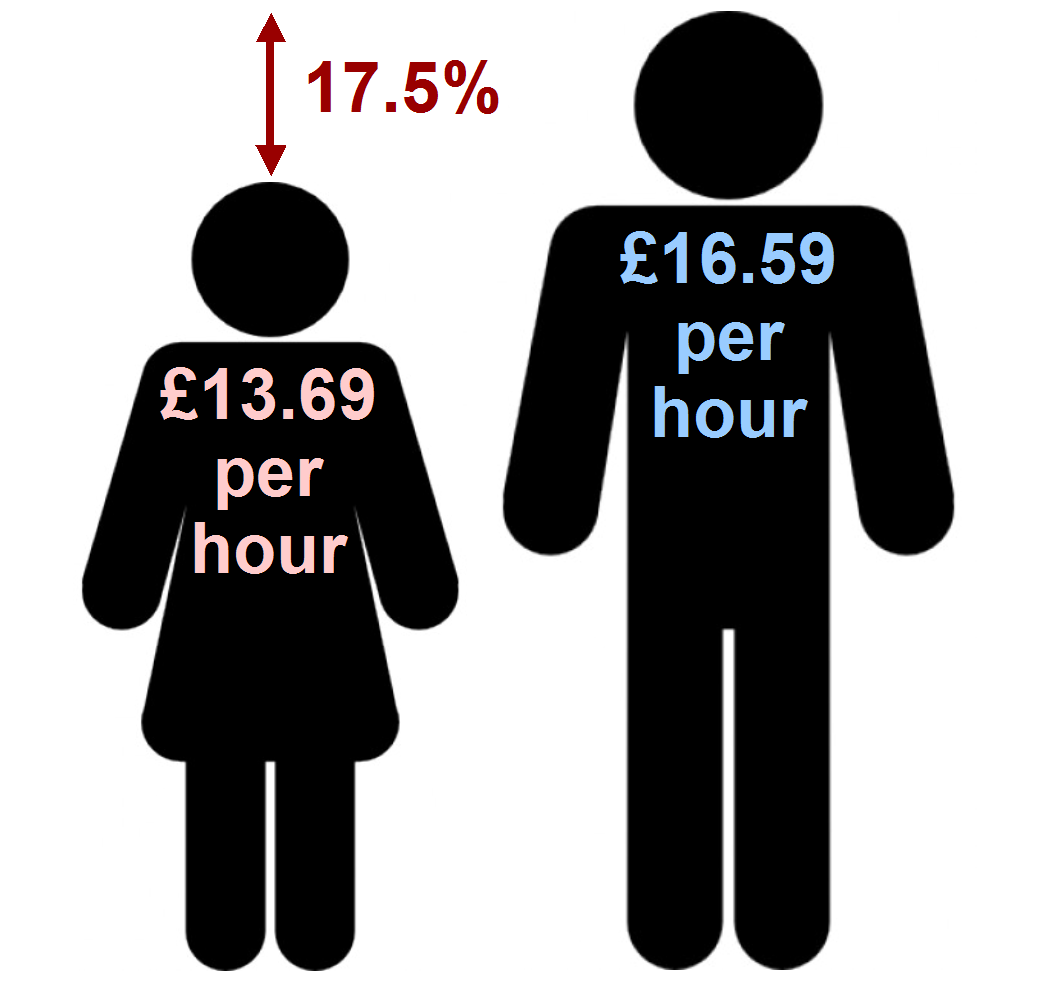 Women in the UK on average earn less per hour than men. According to the Annual Survey of Hours and Earnings, the mean hourly pay for women in 2015 was 17.5% less than that for men. This figure is for all employees, full and part time. As far as full-time employees is concerned, the gap was slightly smaller at 13.9%. Nevertheless, as you can see from Table 6 in the linked Excel file, these gaps have decreased in recent years – but only slightly.
A recent paper from the Institute for Fiscal Studies has disaggregated the figures to give a better picture of this wage gap. It finds that having children is a major contributing factor to the gap. It also finds that this has a bigger impact on the earnings of graduates and those without a degree but with A levels.
On entry to the labour market, men and women earn roughly the same. People’s wages tend to rise during their 20s, but men’s rise slightly faster than women’s, causing a pay gap to open and widen – but slowly at first. Average (mean) men’s wages continue to grow during their 30s and a bit during their 40s. However, average women’s wages flatline. Thus the wage gap grows substantially, especially for the higher educated.
The paper argues that the arrival of children is a major contributing factor to this picture. It looks at the gap before and after the arrival of children. “The crucial observation is that the gap opens up gradually after the first child arrives and continues to widen for many years after that point.” By 12 years after the first child is born, the wage gap has widened to 33%.
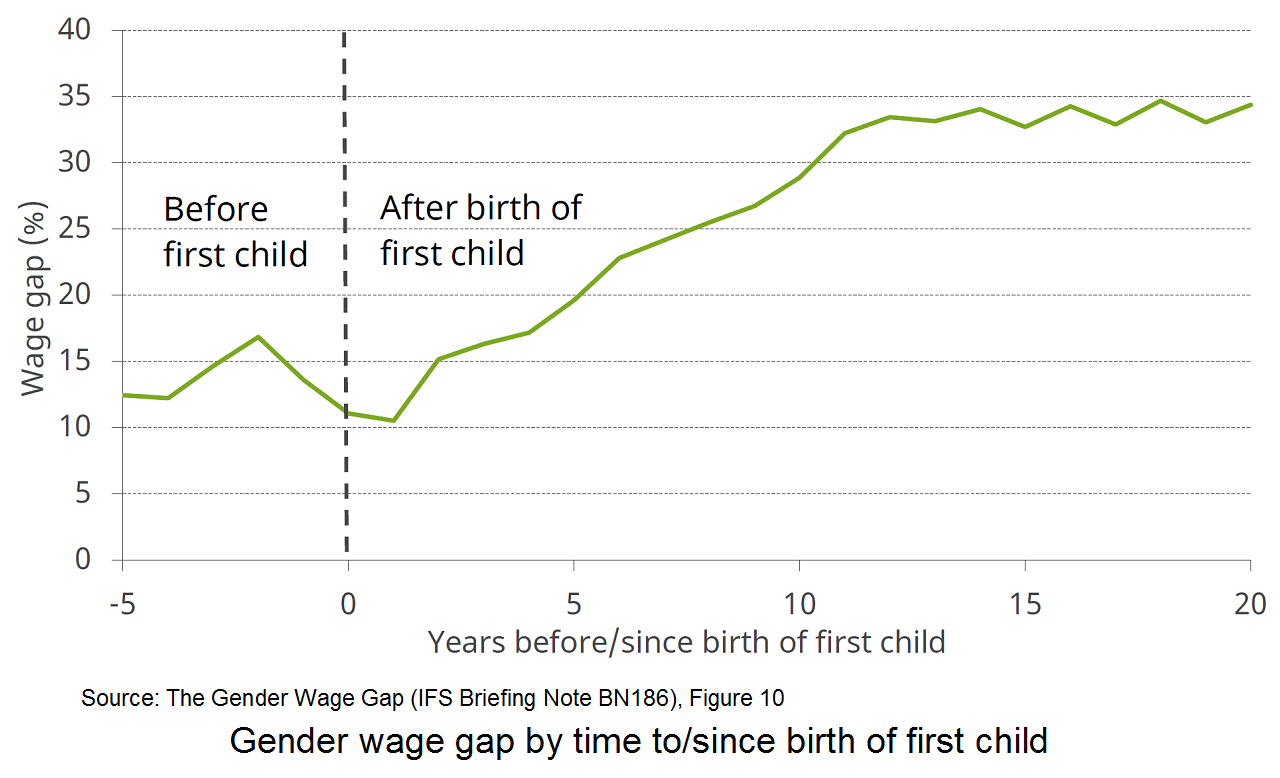
The paper does not offer reasons for the small gap that exists before the arrival of children. But it does give possible reasons for the widening gap after having children. A major one, it suggests, has to do with labour market experience.
“As women are likely to do less paid work after the arrival of children, the level of labour market experience they have falls further and further behind that of their male counterparts, and the wage gap therefore widens.” They may also miss out on promotions.
Each year a woman spends away from the labour market is associated with an average 2% drop in pay compared with those who remain in work. For those with at least A levels, the penalty is 4%; but there is no drop in pay for those without A levels.
Other possible explanations include mothers taking work that requires a lower skill level, and at lower hourly pay, in order to gain flexibility in working hours. However, the evidence suggests that women who move to part-time work on having a child suffer no immediate drop in pay. But their hourly pay does grow more slowly, thus contributing to a widening of the gap.
Another explanation is employers exercising market power to discriminate against women with children. The paper does not consider this explanation.
The articles discussing the paper look at policy implications and identify various things that can be done to narrow the gap. Read the paper and articles and try answering the questions below.
Videos and podcasts
IFS: gender pay gap widens after first child Compendium of News Reports from BBC News at Six, Channel 4 News, ITV News at Ten and BBC Newsnight from Incorrigible Forever on YouTube (23/8/16)
Gender Pay Gap Hits Women With Children Hardest Sky News (23/8/16)
In Business: Supportive partner = success at work World of Business, BBC Radio 4, Peter Day (25/8/15)
Gender Pay Gap More or Less, BBC Radio 4, Tim Harford (26/8/16)
Gender pay gap: Why do mums increasingly earn less? BBC Victoria Derbyshire programme (23/8/16)
Articles
UK women still far adrift on salary and promotion as gender pay gap remains a gulf The Guardian, Katie Allen (23/8/16)
Gender pay gap: mothers returning to work earn a third less than men The Telegraph, Tim Wallace (23/8/16)
Mothers’ pay lags far behind men BBC News (23/8/16)
Four ways the gender pay gap isn’t all it seems BBC News Magazine, Simon Maybin (29/8/16)
Six ways to tackle the gender pay gap BBC News, Emma Atkinson (23/8/16)
Wage gap for UK women unchanged in 20 years Financial Times, Gemma Tetlow (23/8/16)
The UK’s slow march to gender pay equality Financial Times (23/8/16)
Gender Pay Gap For Mothers Widens For 12 Years After Having Children, New Research Finds Huffington Post, Jack Sommers (23/8/16)
Motherhood costs women a third of their salary compared to men, report reveals Independent, Joe Watts (23/8/16)
The gender pay gap means that more women will be in poverty later in life – but there is something the government can do Independent, Claire Turner (26/8/16)
Gender pay gap won’t close until 2069, says Deloitte The Guardian, Katie Allen (24/9/16)
Papers and Reports
Gender wage gap grows year on year after childbirth as mothers in low-hours jobs see no wage progression IFS Press Release (23/8/16)
The Gender Wage Gap IFS Briefing Note BN18, William Elming , Robert Joyce and Monica Costa Dias (23/8/16)
Women in STEM: Technology, career pathways and the gender pay gap Deloitte (September 2016)
Data
Gender pay differences: Annual Survey of Hours and Earnings: 2015 Provisional Results ONS Statistical Bulletin (18/11/15)
All data related to Annual Survey of Hours and Earnings: 2015 Provisional Results ONS datasets (18/11/15)
ASHE 1997 to 2015 selected estimates (See Tables 1 to 4, 6 and 9) ONS dataset (18/11/15)
All Employees – ASHE: Table 1 ONS dataset (18/11/15)
Questions
- Identify possible reasons for the wage gap between men and women.
- Why is the median wage gap different from the mean wage gap?
- Why is the wage penalty for periods without work greater for more highly educated women?
- To what extent is the gender wage gap a reflection of marginal productivity differences?
- Is the gender pay gap primarily about men and women being paid differently for doing the same job?
- What evidence is provided by the Chartered Management Institute (CMI) on women’s lack of pay progression?
- What could the government do to reduce the wage gap?
- Discuss the relative effectiveness of different policy alternatives.
 In the following article, Joseph Stiglitz argues that power rather than competition is a better starting point for analysing the working of capitalism. People’s rewards depend less on their marginal product than on their power over labour or capital (or lack of it).
As inequality has widened and concerns about it have grown, the competitive school, viewing individual returns in terms of marginal product, has become increasingly unable to explain how the economy works.
Thus the huge bonuses, often of millions of pounds per year, paid to many CEOs and other senior executives, are more a reflection of their power to set their bonuses, rather than of their contribution to their firms’ profitability. And these excessive rewards are not competed away.
Stiglitz examines how changes in technology and economic structure have led to the increase in power. Firms are more able to erect barriers to entry; network economies give advantages to incumbents; many firms, such as banks, are able to lobby governments to protect their market position; and many governments allow powerful vested interests to remain unchecked in the mistaken belief that market forces will provide the brakes on the accumulation and abuse of power. Monopoly profits persist and there is too little competition to erode them. Inequality deepens.
According to Stiglitz, the rationale for laissez-faire disappears if markets are based on entrenched power and exploitation.
Article
Monopoly’s New Era Chazen Global Insights, Columbia Business School, Joseph Stiglitz (13/5/16)
Questions
- What are the barriers to entry that allow rewards for senior executives to grow more rapidly than median wages?
- What part have changes in technology played in the increase in inequality?
- How are the rewards to senior executives determined?
- Provide a critique of Stiglitz’ analysis from the perspective of a proponent of laissez-faire.
- If Stiglitz analysis is correct, what policy implications follow from it?
- How might markets which are currently dominated by big business be made more competitive?
- T0 what extent have the developments outlined by Stiglitz been helped or hindered by globalisation?
 Research published by the Institute for Fiscal Studies shows that graduates from wealthier family backgrounds earn significantly more than those from poorer backgrounds. If you compare the 20% of graduates from the richest backgrounds with the remaining 80%, the average earnings gap in 2012/13, 10 years after graduation, was £8000 per year for men and £5300 for women. Even when you take graduates in similar degrees from similar universities, there is still a gap of around 10% between those from richer and those from poorer backgrounds.
 The research also shows that in 2012/13, 10 years after graduation, the median earnings for economics graduates was the second highest of any subject (just behind graduates in medicine) and that at the 90th percentile economics graduates had the highest earnings (£93 900 for women and £121 400 for men) of any subject. In fact, graduates in economics were the only males at this percentile earning over £100 000. (Click here for a PowerPoint of the chart.) As the Press Release to the IFS working paper states:
For males, it is estimated that approximately 12% of economics graduates earned above £100 000 some ten years after graduation; by contrast, 6% of those studying medicine or law earned more than £100 000.
For females, it is estimated that approximately 9% of economics graduates earned above £100 000 some ten years after graduation; by contrast, just 1% of those studying medicine and 3% of those studying law did so.
For some subjects, graduates earned little more than non-graduates.
Those studying the creative arts had the lowest earnings, and indeed earned no more on average than non-graduates.
The research also shows that earnings vary substantially by gender and university. For those earning £8000 or more, the median earnings for male graduates 10 years after graduation was £30 000 (compared with £21 000 for non-graduates), whereas for women it was £27 000 (compared with £18 000 for non-graduates).
Earnings are substantially higher for graduates from some universities, such as Oxford, Cambridge and the LSE. “At the other end of the spectrum, there were some institutions (23 for men and 9 for women) where the median graduate earnings were less than those of the median non-graduate ten years on.” Differences in graduate earnings by university tend to compound the difference by students’ family background as those from poorer backgrounds disproportionately attend universities with lower average graduate earnings by discipline.
The following articles consider the findings and their implications for higher education policy
Articles
Graduates from wealthy backgrounds reap earnings benefits Times Higher Education, John Morgan (13/4/16)
Graduate Earnings Guided By Parents’ Wealth, Institute For Fiscal Studies Report Finds Huffington Post, George Bowden (13/4/16)
Graduates from poorer backgrounds earn less than richer peers on same course, major international study finds Independent. Oliver Wright (13/4/16)
Richer students have higher graduate income, study finds The Guardian (13/4/16)
Want a Higher Salary? It Helps If You’re a Man With Rich Parents Bloomberg, Robert Hutton (13/4/16)
Economics graduates are in the money Why Study Economics? Economics in Action blog (15/4/16)
IFS paper
What and where you study matter for graduate earnings – but so does parents’ income IFS Press Release (13/4/16)
How English domiciled graduate earnings vary with gender, institution attended, subject and socio-economic background IFS Working Paper W16/06, Jack Britton, Lorraine Dearden, Neil Shephard and Anna Vignoles (13/4/16)
Data
Free Online Statistics – Students & qualifiers Higher Education Statistics Agency (HESA)
Applications and acceptances for types of higher education course – 2015 UCAS
What do graduates do? Higher Education Careers Services Unit
Questions
- For what reasons are graduates from rich backgrounds likely to earn substantially more than graduates from poor backgrounds?
- Why are graduates in economics likely to earn more than graduates in other subjects, especially those in the top percentile of earners from any given subject?
- How might marginal productivity help to explain the differences in earnings of different graduates?
- What are meant by ‘soft skills’. Why may students from richer backgrounds have better soft skills in the context of (a) university admission and (b) getting a job on graduation?
- Why are female graduates likely to earn less than male graduates with the same class of degree in the same subject?
- What could be done by (a) universities and (b) the government to increase social mobility?
- Do you think that the findings of the research have implications for the way students’ study is funded? Explain.