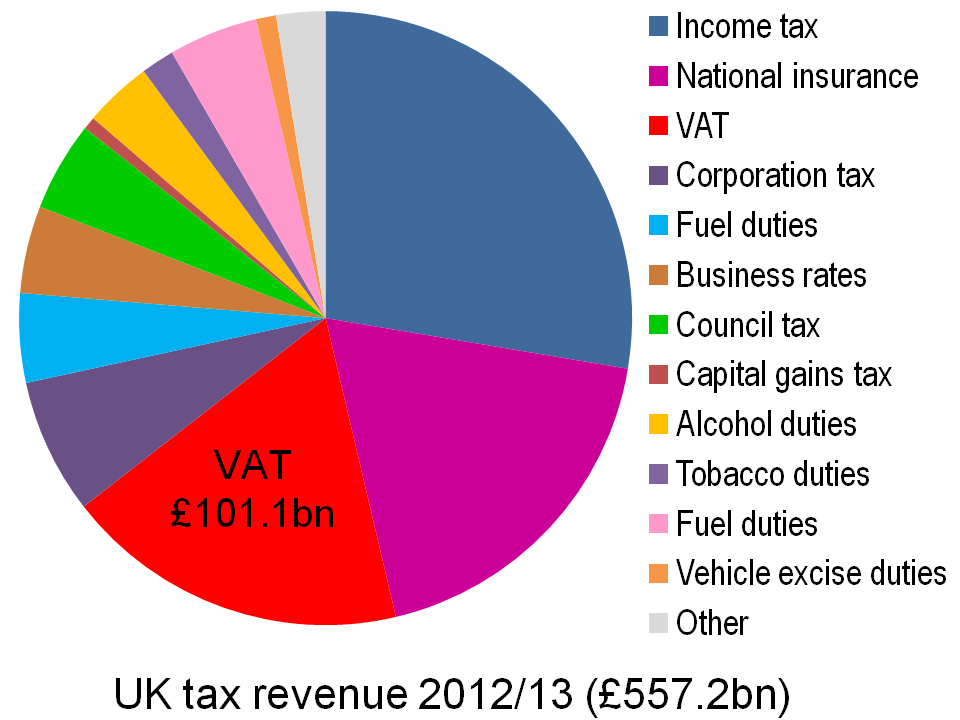
 VAT was introduced on the 1st of April 1973, as part of the conditions for the UK entering the Common Market. Designed by a French tax expert, Maurice Lauré, it was initially envisaged as a straightforward replacement for purchase tax, which would be applied to most goods and services.
Forty years on, VAT is increasingly complex, with numerous exemptions, many anomalies in its scope, and increasingly expensive challenges to its imposition. How did we get to this point? And is it time for VAT to undergo a mid-life makeover?
All governments have to raise taxes – to redistribute income and to fund public spending. They have a number of mechanisms they can use, but essentially they have to tax incomes (direct taxes), spending (indirect taxes) or a mix of both. The main indirect tax in the UK is VAT, which now raises over £100bn a year, compared with £1.5bn in its first year (see above chart: click here for a PowerPoint version). Initially envisaged as a simple, cross-Europe purchase tax, the current system is complex and at times appears to have been formulated ‘on the hoof’, never a good way to build a tax system.
In the 2012 Budget, the Chancellor decided to apply the standard rate of income tax to hot takeaway pasties; previously they had been zero-rated. However, he had sharply underestimated the ability of the industry to lobby against the tax, working closely with the tabloid press. Perhaps more importantly, he also missed the complex nature of the good; when is a hot pasty just cooling down? And what is hot? The government backtracked and now 20% VAT is only charged on pasties that are deliberately kept hot. You might think that this change of heart avoided introducing an anomaly, but consider how you might feel if you sell takeaway baked potatoes, which are subject to VAT.
Apart from the complexity of the system, VAT is unpopular with some commentators who feel that it falls too heavily on low-income households. Although many foodstuffs are zero-rated and housing is exempt, VAT is charged at 20% on clothing and many necessities such as cleaning materials. Gas and electricity are subject to a reduced rate of 5% and both alcohol and cigarettes have additonal excise duties imposed and yet are disproportionally consumed by the poor. When the standard rate of VAT was temporarily dropped to 15% in 2010, but then permanently raised to 20% in 2011, many felt that this was a shift in the tax burden to the poor.
So complex, irrational and prone to changes following political lobbying or expensive legal cases, VAT does seem to be stumbling into its forties under something of a cloud. However, it remains the case that it raises a large proportion of UK tax revenues at relatively low direct cost and provides the Chancellor with a reasonably effective fiscal policy tool. Even if a government wanted to put in place an alternative, it is likely that the associated political risks would be too high for it to do so. We might hope for some rationalisation of the current system, but there is little doubt that we will be raising a glass to VAT’s 50th birthday in 2023.
The links below include some articles on VAT’s 40th birthday and some more general articles on VAT.
Articles
VAT is 40 years old- and now has middle-age spread The Guardian, Juliette Garside (31/1/13)
Is VAT suffering a mid-life crisis at 40? BBC News, Colin Corder (31/3/13)
VAT at 40, not simple, not popular, but central to government revenue-raising The Chartered Institute of Taxation (28/3/13)
Happy birthday VAT, here’s how not to pay you The Telegraph, Rosie Murray-West (31/3/13)
Poorest spend higher proportion of VAT than richest BBC News (31/10/11)
A Value- Added Tax offers much to love- and hate New York Times, Gregory Mankiw (1/5/10)
EC Standard VAT Declaration European Commission Roadmap (2012)
Data and information
VAT pages HMRC
Public sector finance statistics HM Treasury (follow link to latest Public finances databank (Excel file) and go to Worksheet C2)
Latest European Union EU VAT rates VATLive
Questions
- Explain why VAT might be deemed regressive. Can you formulate an argument that it falls more heavily on the rich than the poor?
- Why is VAT administratively cheap? Other than generating tax revenues, can you think of any advantages of the tax?
- Newspapers and books are zero-rated in the UK, while e-books and news apps are standard rated at 20%. Can you identify some other anomalies in the UK VAT system? Is there an argument that a better approach would be to charge a lower rate on all goods and services?
- Who pays VAT, consumers or producers? Illustrate your answer with a diagram, or two.
- A business has to register for VAT once it has a turnover of £77,000 pa. Does this system give rise to any perverse incentives?
- Countries across the European Union have varying VAT rates, applied to very different ranges of products. Explain why this might hinder the workings of a single European market.
- Imagine you were running a brand new economy; would you use a value-added tax to raise revenues? What are the alternatives open to governments?
 Pressure has been growing in the UK for people to be paid no less than a living wage. The Living Wage Foundation claims that this should be £8.55 per hour in London and £7.45 in the rest of the UK. The current minimum wage is £6.19.
There has been considerable support for a living wage across the political spectrum. Ed Miliband, the Labour leader, has stated that a Labour government would ensure that government employees were paid at least the living wage and that government contracts would go only to firms paying living wages. Other firms that paid less could be ‘named and shamed’. The living wage has also been supported by Boris Johnson, Conservative Mayor of London. The Prime Minister said that a living wage is ‘an idea whose time has come’, although many Conservatives oppose the idea.
The hourly living wage rate is calculated annually by the Centre for Research in Social Policy and is based on the basic cost of living. The London rate is calculated by the Greater London Authority.
Advocates of people being paid at least the living wage argue that not only would this help to reduce poverty, it would also help to reduce absenteeism and increase productivity by improving motivation and the quality of people’s work.
 It would also bring in additional revenue to the government. According to a report by the Institute for Public Policy Research and the Resolution Foundation, if everyone were paid at least a living wage, this would increase the earnings of the low paid by some £6.5bn per year. Of this, some £3.6bn would go to the government in the form of higher income tax and national insurance payments and reduced spending on benefits and tax credits. Of this £6.5bn, an extra £1.3 billion would be paid to public-sector workers, leaving the Treasury with a net gain of £2.3bn.
But what would be the effect on employment? Would some firms be forced to reduce their workforce and by how much? Or would the boost to aggregate demand from extra consumer spending more than offset this and lead to a rise in employment?. The following articles look at the possible effects.
Articles
Living wage for all workers would boost taxes and GDP Independent, Nigel Morris (28/12/12)
Living wage could save £2bn – think tank research BBC News (28/12/12)
‘Living wage’ would save money, says study Financial Times, Helen Warrell (28/12/12)
Why the Resolution Foundation and IPPR can go boil their heads Adam Smith Institute, Tim Worstall (30/12/12)
Living wage for public servants moves a step closer The Observer,
Yvonne Roberts and Toby Helm (15/12/12/)
Living wage: Ed Miliband pledge over government contracts BBC News (5/11/12)
‘London Living Wage’ increased to £8.55 by mayor BBC News (5/11/12)
Q&A: The living wage BBC News (5/11/12)
Scrooges in UK firms must pay a Living Wage This is Money, John Sentamu (23/12/12)
Report
What price a living wage? IPPR and The Resolution Foundation, Matthew Pennycook (May 2012)
Questions
- How would you set about determining what the living wage rate should be?
- Distinguish between absolute and relative poverty. Would people being paid below a living wage be best described as absolute or relative poverty (or both or neither)?
- What do you understand by the term ‘efficiency wage’? How is this concept relevant to the debate about the effects of firms paying a living wage?
- Under what circumstances would raising the statutory minimum wage rate to the living wage rate result in increased unemployment? How is the wage elasticity of demand for labour relevant to your answer and how would this elasticity be affected by all firms having to pay at least the living wage rate?
- What would be the macroeconomic effects of all workers being paid at least the living wage rate? What would determine the magnitude of these effects?
 More and more food banks are opening every week across the developed world. In the UK alone, there are over 250 food banks. These are run by volunteers and provide food and other basic provisions to those who struggle to feed themselves and their children. The food is donated by people or sometimes supermarkets. Some food banks receive financial help from local authorities.
According to the Trussell Trust, which runs many food banks in the UK, “In 2011-12 food banks fed 128,687 people nationwide, 100% more than the previous year.” But why, in mixed economies, where the State is expected to provide benefits to the poor, do so many people have to resort to food handouts?

Partly the problem is a cut in benefits – a response of many countries to rising public-sector deficits; partly it’s delays in receiving benefits or the complexities in claiming; partly it’s because some people have had their benefits suspended because of a change in their circumstances or changes in the conditions for claiming benefits; partly it’s the inability of people to afford to feed their families properly in times of rising food and energy prices and rising rents, where incomes are not rising in line with the personal rates of inflation that poor households experience; partly it’s the sky-high interest rates that many poor people, often deep in debt, have to pay to continue obtaining credit – often from ‘payday loan companies’ or ‘doorstep lenders’; partly it’s the inability of many poor people to find work which pays enough to feed their families and pay all their other bills.
Food poverty is a real and growing problem. But are food banks the answer? The following videos and articles look at the issues.
Webcasts
UK
 Growing demand for food banks in Britain BBC Newsnight, Paul Mason (5/9/12)
Children will go hungry warn Bristol food banks This is Bristol, (2/7/12)
Children going hungry ITV News (16/10/12)
Food bank: We need more food to feed UK’s hungry The Telegraph, Gregg Morgan (27/9/12)
Food banks help struggling London families BBC News (21/6/12)
Europe
EU food aid to dry up by 2014? France 24 (16/10/12)
Spain
Food banks squeezed in Spain Euronews (3/11/12)
USA
As donations dwindle, food banks are feeling the pinch Komo News, Elisa Jaffe (28/9/12)
Articles
UK
Breadline Britain: councils fund food banks to plug holes in welfare state The Guardian, Patrick Butler (21/8/12)
Councils to invest in food banks LocalGov, Dominic Browne (22/8/12)
The growing demand for food banks in breadline Britain BBC News, Paul Mason (4/9/12)
Food banks: ‘I had no-one else to turn to’ BBC News (4/9/12)
Poorest starved of dignity as charity food parcels double in just two years Daily Record (4/9/12)
More and more banking on generosity to others for food South Wales Evening Post (13/11/12)
USA
Northern Illinois Food Bank Kicks Off Hunger Action Month St. Charles Patch, Rick Nagel (1/9/12)
Australia
More families get help as food becomes discretionary spend Sydney Morning Herald (21/8/12)
Information
How a foodbank works The Trussell Trust
Questions
- Why do so many people find themselves trapped in food poverty?
- What factors are likely to lead to an increase in food poverty in the coming months?
- Should the government subsidise food banks?
- Discuss ways of tackling the problem of poor families being trapped in debt and having to pay very high interest rates.
- Is rent control a good means of tackling poverty?
 There has been considerable discussion recently about whether the government should introduce a property tax on high value properties. The government, finding it difficult to reduce the public-sector deficit and yet determined to do so, is looking for additional measures to reduce government expenditure or raise tax revenue.
But would it favour a mansion tax as a means of raising additional revenue?
The imposition of such a tax is favoured by both Liberal Democrats and the Labour Party. It is strongly opposed, however, by Conservatives. But just what would such a tax look like and what are the arguments for and against it?
One alternative would be to impose a one-off tax on property valued over a certain amount, such as £2 million. Alternatively it could be levied only for as long as the government is seeking to make substantial inroads into the deficit.
Another would be to add one or more bands to council tax. At present, council tax in England is levied in 8 bands according to the value of a person’s property. The highest band is for property valued over £320,000 in 1991 prices, with the amount of tax due for each band varying from local authority to local authority. (Average UK house prices in 2012 are 135% higher than in 1991.) In Scotland the bands are lower with the top band being for property valued over £212,000 in 1991 prices. In Wales, there is an additional band for property valued over £424,000, but properties are valued in 2003 prices, not 1991 prices.
With low top bands for council tax, people in mansions end up paying the same as people in much more modest property. It would be relatively easy to add additional bands, with the top band applying only to property worth, say, over £1 million or more.
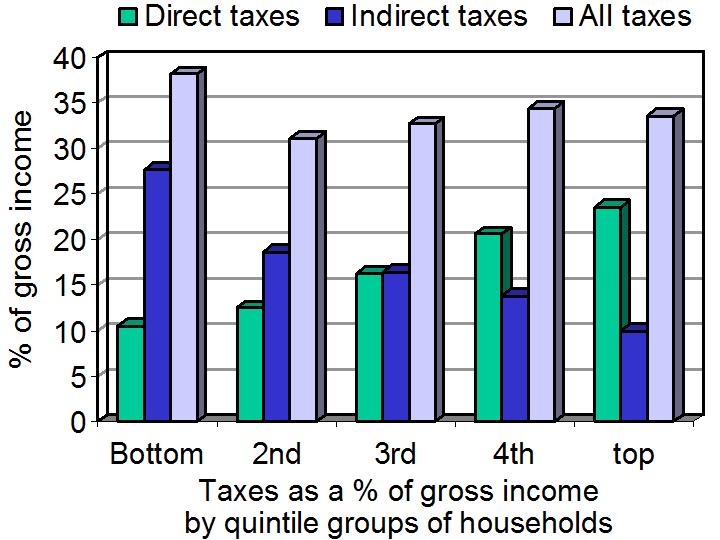 The arguments in favour of a mansion tax are that it is progressive, relatively easy to collect, hard to evade and with minimal disincentive effects. The arguments against are that it would make the tax system ‘too progressive’, would not necessarily be related to an individual’s ability to pay and could have substantial disincentive effects.
The progressiveness of the UK tax system is illustrated in the chart, which looks at the proportion of income paid in direct, indirect and all taxes by quintile groups of households – that is, households grouped into five equal sized groups ranked from lowest to highest gross income. (Click here for a PowerPoint of the chart.)
The following articles look at the debate as it has raged over the past few weeks. Try to unpick the genuine arguments from the political rhetoric!
Articles
Clegg Says U.K. Could Apply Mansion Tax ‘in Five Seconds’ Bloomberg, Robert Hutton (25/9/12)
Two thirds back mansion tax on £1m homes Metro, Tariq Tahir (8/10/12)
Mansion tax would ‘tackle inequality’ This is Tamworth (27/9/12)
Council tax: the easy way to make mansion-dwellers pay Guardian, Simon Jenkins (25/9/12)
Rich must pay fair share in tax BBC Andrew Marr Show, Nick Clegg (23/9/12)
We will get mansion tax on £2 million homes through next budget, promise Lib Dems The Telegraph, Rowena Mason (25/9/12)
Trying to tax the wealthy not worth the price The Scotsman, George Kerevan (31/8/12)
Tax on wealth is true to Tory principles Financial Times, Janan Ganesh (24/9/12)
How would Clegg’s emergency wealth tax work? Guardian, Hilary Osborne (29/8/12)
Labour considers mansion tax on wealthy Financial Times, George Parke (5/9/12)
Conservative conference: Cameron rules out ‘mansion tax’ BBC News (7/10/12)
Don’t make wealth tax a habit Financial Times, Howard Davies (29/8/12)
George Osborne blocks mansion tax, but insists wealthy will pay more The Telegraph, Robert Winnett (8/10/12)
Why George Osborne had to kill the mansion tax The Spectator, Matthew Sinclair (7/10/12)
David Cameron rules out mansion tax and plans further welfare cuts Guardian, Hélène Mulholland (7/10/12)
Viewpoint: Would a wealth tax work? BBC News, Mike Walker (29/8/12)
For all the claims made about wealth taxes, it’s not correct to say the rich are paying their fair share Independent, Jonathan Portes (2/10/12)
Data
House price data links Economics Network
The Effects of Taxes and Benefits on Household Income, 2010/2011 ONS (26/6/12) (see especially Tables 2 and 3 and Table 26 for historical data)
Questions
- Explain the distinction between direct and indirect taxes, and between progressive and regressive taxes. For what reasons do the poor pay a higher proportion of their income in indirect taxes than the rich?
- What forms can a tax on wealth take?
- How progressive are taxes in the UK (see the ONS site in the Data section above)?
- Assess the arguments in favour of a mansion tax.
- Assess the arguments against a mansion tax.
- What type of wealth tax would be hardest to evade?
- What are the likely income and substitution effects of a wealth tax?
 The UK has always been an attractive place for investment, as foreign companies look to cities such as London for stable investment opportunities. This provides not only jobs and output, but also tax revenue for the government. However, one drawback is the lost tax revenue through tax avoidance schemes and big businesses say that if the UK is to remain competitive it needs to look at cutting taxes and bureaucracy.
In recent months, we have seen cases of individuals being prosecuted for tax evasion and more recently in the USA, Microsoft and Hewlett-Packard have been criticized by the Senate for allegedly moving an estimated £13bn to offshore accounts. (Microsoft and HP deny any wrong-doing). It is cases like this that provide an argument for governments to cut business rates and avoid losing business and jobs to other tax havens. Lord Fink, who is a Director of Firms located in a variety of tax havens said:
’I don’t see why the UK should not compete for jobs that at present are going to the Cayman Islands’
 Tax havens are obviously attractive to firms, as they provide a means of retaining more of a firm’s earnings and hence their profits. By offering a much lower rate of tax than countries such as the UK, they help to ease the tax burden on wealthy individuals and investors in hedge funds, along with many others.
The question is, do these lower tax rates discourage investment into the UK and thus would a relaxation of Revenue Customs’ rules mean an increase in inward investment and the other positive things that this would bring? Or would a decrease in tax rates for wealthy investors send the wrong message?
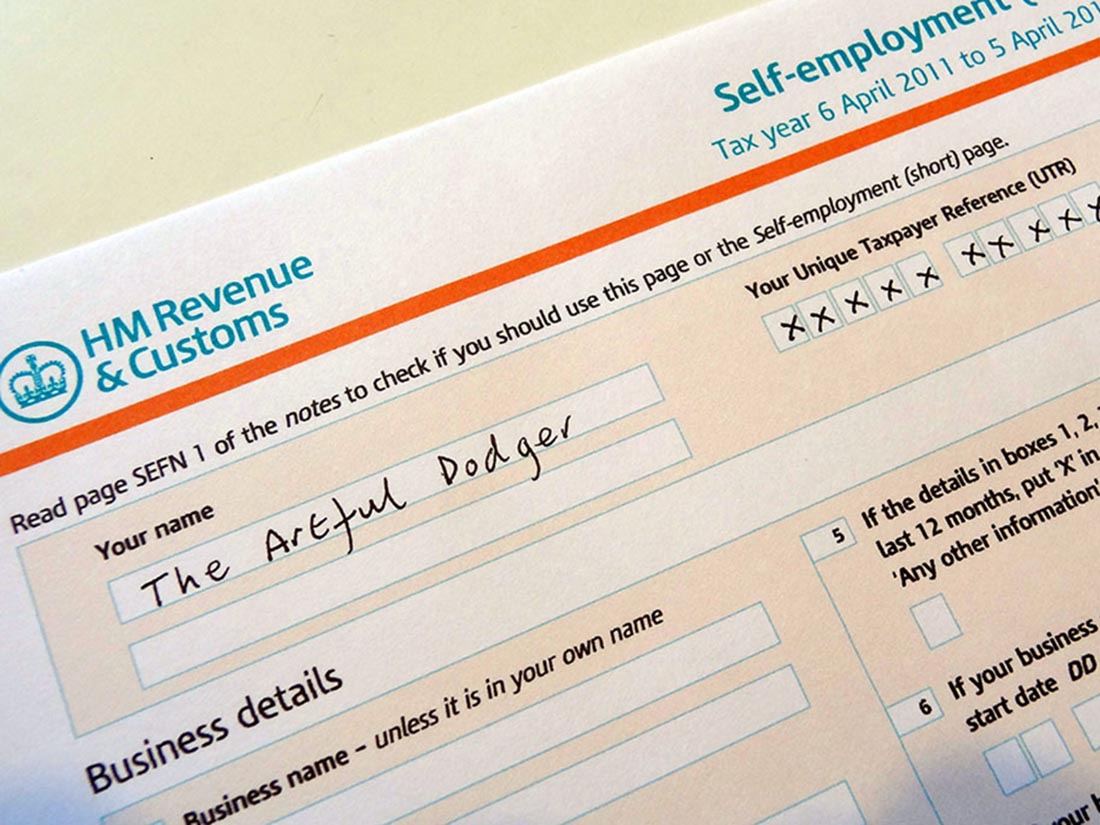 In a time of austerity, tax cuts for the rich are never going to be a popular policy – at least not amongst the ‘non-rich’ – in truth, the majority of the population. Furthermore, many simply see tax havens as morally wrong – or as George Osborne put it ‘morally repugnant’. The use of them provides the better off with a means of paying less to the taxman, whilst the worse off continue to pay their share.
The controversy surrounding tax havens is perhaps even more of an issue given the size of the public-sector deficit. With tax havens being used by those who should be paying the most, tax revenues are lower than would be the case without tax evasion and avoidance. Is this adding to the burden of basic rate tax payers?
This doesn’t help the gap between government expenditure and revenue, which has contributed to the largest amount of UK public-sector borrowing in August 2012 since records began. Net borrowing reached £14.4bn, as things like corporation tax receipts fell and benefit payments rose. Money that should go in to the government’s coffers is undoubtedly making its way into tax havens, but does that also mean that jobs are making their way out of the country? If tax rates in the UK were cut, cities such as London may become even more attractive places to invest, which could potentially create a much needed boost for the economy. But, at what cost? The following articles consider the controversy of tax havens.
Microsoft and HP rapped by US Senate over tax havens BBC News (20/9/12)
Morally repugnant tax avoiders can rest easy under David Cameron Guardian, Tanya Gold (21/9/12)
Britain could prevent the use of tax havens by ending ‘archaic’ business rules Telegraph, Rowena Mason (21/9/12)
UK public-sector borrowing hits record high of £14.4bn BBC News (21/9/12)
The top Tory who wants to make Britain a tax haven for millionaires Guardian, Martin Williams and Rajeev Syal (20/9/12)
Make UK a tax haven to attract investment from millionaires, urges Tory treasurer Mail Online, Daniel Martin (21/9/12)
Microsoft saved billions using Irish tax havens Irish Times, Genevieve Carbery (21/9/12)
Microsoft, HP skirted taxes via offshore units: U.S. Senate Panel Reuters, Kim Dixon (21/9/12)
Danny Alexander says tax avoidance ‘adds 2p in every £1 to basic tax rate’ Independent, Oliver Wright (24/6/12)
Questions
- What are the key features of tax havens?
- Briefly explain the arguments in favour of tax havens and those against. Think about them from all points of view.
- Explain the way in which a cut in UK tax rates could create jobs and how the multiplier effect may provide a boost for the UK economy.
- If tax rates were cut, how might this affect an individual’s decision to work? What about an individual’s decision to invest? Use indifference analysis to help explain your answer.
- How does tax avoidance and evasion affect public sector borrowing? Is there any way a cut in tax rates on foreign investment could improve the government’s finances?
- Do you think there is any truth in the argument that the UK is losing out to other countries because of its higher tax rates? Is a reduction in tax rates necessary to help us compete?