 Should the object of monetary policy be simply one of keeping inflation within a target range? In a speech given on 9 October, the Governor of the Bank of England, Sir Mervyn King, questioned whether the interest-rate setting policy of the Monetary Policy Committee (MPC) has been too narrow.
He considered whether interest rates should have been higher before the financial crisis and crash of 2007–9. This could have helped to reduce the asset price bubble and discouraged people from taking out excessive loans.
But then there is the question of the exchange rate. Would higher interest rates have pushed the exchange rate even higher, with damaging effects on exports? Today the trade weighted exchange rate is some 20% lower than before the crash. The government hopes that this will encourage a growth in exports and help to fuel recovery in demand. But as Dr King said, “The strategy of reducing domestic spending and relying more on external demand is facing a real problem because not everyone can do it at the same time.”
 Then there is the question of economic growth. Should a target rate of growth be part of the MPC’s target? Should the MPC adopt a form of Taylor rule which targets a weighted average of the inflation rate and the rate of economic growth?
Certainly monetary policy today in the UK and many other countries is very different from five years ago. With interest rates being close to zero, there is little scope for further reductions; after all, nominal rates cannot fall below zero, otherwise people would be paid for borrowing money! So the focus has shifted to the supply of money. Several attempts have been made to control the money supply through programmes of quantitative easing. Indeed many economists expect further rounds of quantitative easing in the coming months unless there is a substantial pick up in aggregate demand.
So what should be the targets of monetary policy? The following articles look at Dr King’s speech and at various alternatives to a simple inflation target.
Articles
Mervyn King says must face up to monetary policy’s limits’ Reuters, David Milliken and Sven Egenter (9/10/12)
Bank of England’s Mervyn King defends low interest rates pre-crisis The Telegraph, Emma Rowley (9/10/12)
Banks should have had a leverage cap before crash, says Mervyn King The Guardian, Heather Stewart and Phillip Inman (9/10/12)
King Says BOE Must Keep Targeting Inflation as Tool Revamp Looms Bloomberg, Scott Hamilton and Svenja O’Donnell (9/10/12)
After 20 years, time to change Merv’s medicine? Channel 4 News blogs, Faisal Silam (9/10/12)
King signals inflation not primary focus Financial Times, Norma Cohen and Sarah O’Connor (9/10/12)
Should Bank start the helicopter? BBC News, Stephanie Flanders (12/10/12)
Speech
Twenty years of inflation targeting Bank of England speeches, Mervyn King (9/10/12)
Questions
- What are the arguments for using monetary policy to target a particular rate of inflation?
- Would it ever be a good idea to adjust the targeted rate of inflation up or down and if so when and why?
- Explain how a Taylor rule would work and in what ways it is superior or inferior to pursuing a simple inflation target.
- Are attempts to control the money supply through quantitative easing (or tightening) consistent or inconsistent with pursuing an inflation target? Explain.
- What are the arguments for and against abandoning targeting in monetary policy and replacing it with discretionary policy that takes a number of different macroeconomic indicators into account?
 At the start of 2013, the USA faces a ‘fiscal cliff’. By this is meant that, without agreement by Congress on new fiscal measures, the USA will be forced into tax rises and expenditure cuts of around $650 billion (over 4% of GDP). This would probably push the economy straight back into recession. This in turn would have a serious dampening effect on the global economy.
But why would fiscal policy be automatically tightened? The first reason is that tax cuts given under the George W. Bush administration during 2001–3 (largely to the rich) are due to expire. Also a temporary cut in payroll taxes and an increase in tax credits given by President Obama are also due to end. These tax increases would form the bulk of the tightening. The average US household would pay an extra $3500 in taxes, reducing after-tax income by around 6%.
The second reason is that various government expenditure programmes are scheduled to be reduced. These reductions in expenditure amount to around $110 billion.
 It is likely, however, that Congress will agree to delay or limit the tax increases or expenditure cuts; politicians on both sides want to avoid sending the economy back into recession. But what the agreement will be is not at all clear at this stage.
Republicans are taking a tougher line than Democrats on cutting the budget deficit; they are calling for considerably less restraint in implementing the government expenditure cuts. On the other hand, they are likely to be less willing to raise taxes.
But unless something is done, the consequences for 2013 could be dire. The fiscal cliff edge rapidly approaches.
Articles
Nearly 90 percent of Americans would see taxes rise if ‘fiscal cliff’ hits Washington Post, Lori Montgomery (1/10/12)
Fiscal cliff a serious threat, but unlikely CNN Money, Chris Isidore (1/10/12)
“Fiscal cliff” fears may impede faster job growth Chicago Tribute, Lucia Mutikani (1/10/12)
Avert Fiscal Cliff With Entitlement Cuts, Tax Increases Bloomberg (2/10/12)
‘Fiscal cliff’ to hit 90% of US families Financial Times, James Politi (1/10/12)
Investors don’t want the US to fall off the fiscal cliff The Telegraph, Tom Stevenson (22/9/12)
Gauging the fiscal cliff BBC News, Stephanie Flanders (27/9/12)
The US fiscal cliff – and the fiscal chasm BBC News, Stephanie Flanders (2/10/12)
US fiscal cliff threat fails to galvanise policymakers Guardian Economics blog, Mohamed el-Erian (1/10/12)
Multiplying Europe’s fiscal suicide (technical) The Telegraph, Ambrose Evans-Pritchard (1/10/12)
Q&A: The US fiscal cliff BBC News (7/11/12)
US election: Four more years… of what? BBC News, Stephanie Flanders (7/11/12)
Background
United States fiscal cliff Wikipedia
Questions
- Explain what is meant by the ‘fiscal cliff’ and what is its magnitude.
- What would be the multiplier implications of the USA ‘falling off the cliff’ both for the USA and for the rest of the world?
- What factors determine the size of the government expenditure and tax multipliers? What would be the problems of (a) underestimating and (b) overestimating the size of these multipliers?
- How can a fiscal stimulus be reconciled with a policy of reducing the size of the budget deficit as a proportion of GDP over the longer term?
- In what ways can the actions of Democrats and Republicans be seen as game playing? What are the possible payoffs and risks to both sides?
- Is relying on export growth to bring the world economy out of recession a zero sum game?
- Explain which is likely to be more effective in stimulating short- and medium-term economic growth in the USA: fiscal policy or monetary policy.
 New data released on 25/7/12 by the Office for National Statistics showed that the UK economy shrank by a further 0.7% in the second quarter of 2012. This makes it the third quarter in a row in which GDP has fallen – and it is the steepest fall of the three. Faced with this, should the government simply maintain the status quo, or does it need to take new action?
The construction sector declined the most steeply, with construction output 5.2% down on the previous quarter, which in turn was 4.9% down on the quarter previous to that. The output of the production industries as a whole fell by 1.3% and the service sector fell by 0.1%. (For a PowerPoint of the following chart, click here.)
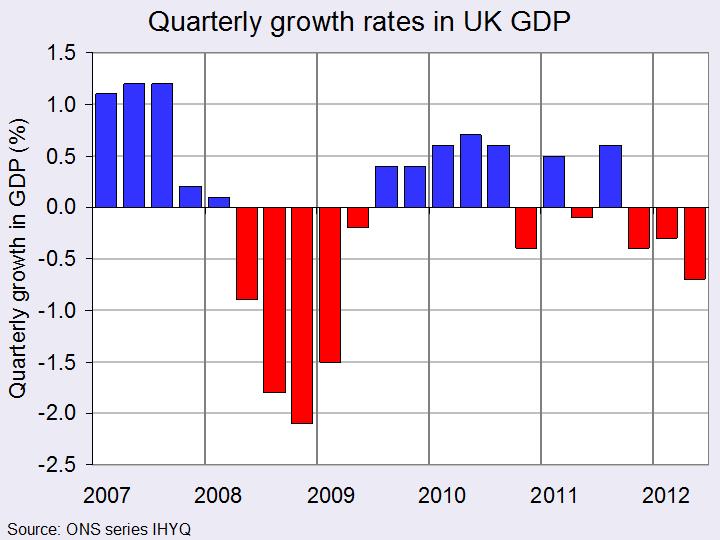
The immediate cause of the decline in GDP has been a decline in real aggregate demand, but the reasons for this are several. Consumer demand has fallen because of the squeeze on real wages, partly the result of low nominal pre-tax wage increases and partly the result of inflation and tax rises; the government’s austerity programme is holding back a growth in government expenditure; export growth has been constrained by a slowing down in the global economy and especially in the eurozone, the UK’s major trading partner; and investment is being held back by the pessimism of investors about recovery in the economy and difficulties in raising finance.
So what can be done about it?
Monetary policy is already being used to stimulate demand, but to little effect (see Pushing on a string. Despite record low interest rates and a large increase in narrow money through quantitative easing, broad money is falling as bank lending remains low. This is caused partly by a reluctance of banks to lend as they seek to increase their capital and liquidity ratios, and partly by a reluctance of people to borrow as individuals seek to reduce their debts and as firms are pessimistic about investing. But perhaps even more quantitative easing might go some way to stimulating lending.
Fiscal policy might seem the obvious alternative. The problem here is that the government is committed to reducing the public-sector deficit and is worried that if it eases up on this commitment, this would play badly with credit rating agencies. Indeed, on 27/7/12, Standard & Poor’s, one of the three global credit rating agencies, confirmed the UK’s triple A rating, but stated that “We could lower the ratings in particular if the pace and extent of fiscal consolidation slows beyond what we currently expect.” Nevertheless, critics of the government maintain that this is a risk worth taking.
The following articles look at the causes of the current double-dip recession, the deepest and most prolonged for over 100 years. They also look at what options are open to the government to get the economy growing again.
Articles
Britain shrinks again The Economist (25/7/12)
Shock 0.7% fall in UK GDP deepens double-dip recession Guardian, Larry Elliott (25/7/12)
UK GDP figures: expert panel verdict Guardian, Frances O’Grady, Will Hutton, Sheila Lawlor, Vicky Pryce and John Cridland (25/7/12)
GDP shock fall: UK growth in 2012 ‘inconceivable’, warn economists The Telegraph, Angela Monaghan (25/7/12)
UK recession deepens after 0.7% fall in GDP BBC News (25/7/12)
UK economy: Why is it shrinking? BBC News (25/7/12)
UK GDP: A nasty surprise and a puzzle BBC News, Stephanie Flanders (25/7/12)
Tough choices for Mr Osborne BBC News, Stephanie Flanders (26/7/12)
David Cameron in pledge to control UK’s debt Independent, Andrew Woodcock and James Tapsfield (26/7/12)
David Cameron defends economic policies BBC News (26/7/12)
The GDP number is awful – and it’s the product of the Government’s amateur policies, not the euro crisis The Telegraph, Thomas Pascoe (25/7/12)
UK recession: have we heard it all before? Guardian, Duncan Weldon (25/7/12)
US economic growth slows in second quarter BBC News (27/7/12)
GDP data trigger debate on economy Financial Times, Norma Cohen and Sarah O’Connor (25/7/12)
Does weak UK growth warrant more QE? Financial Times (25/7/12)
The recession: Osborne’s mess Guardian editorial (25/7/12)
Data
Gross Domestic Product, Preliminary Estimate, Q2 2012 ONS (25/7/12)
Preliminary Estimate of GDP – Time Series Dataset 2012 Q2 ONS (25/7/12)
Questions
- What are the causes of the deepening of the current recession in the UK?
- Search for data on other G7 countries and compare the UK’s performance with that of the other six countries (see, for example, the OECD’s StatExtracts.
- Compare the approach of George Osborne with that of Neville Chamberlain in 1932, during the Great Depression.
- Does weak UK growth warrant more quantitative easing by the Bank of England?
- To what extent can fiscal policy be used to stimulate the economy without deepening the public-sector deficit in the short term?
- What is meant by ‘crowding out’? If fiscal policy were used to stimulate demand, to what extent would this cause crowding out?
 In the models of perfect and monopolistic competition, the long-run equilibrium involves firms making zero supernormal profit. The key assumption driving this outcome is that supernormal profits in the short run attract new entrants to the market.
Increased competition then results in lower prices for consumers and firms’ profits fall. Therefore, an important question is how long does it take for this process to take place?
In a recent post on the Freakonomics blog, Daniel Hamermesh describes a situation in which he was actually able to observe this adjustment process taking place amongst buskers in the centre of Madrid.
This interesting example illustrates that, at least in some cases, this process can start even before entry occurs. This is because incumbents are able to make adjustments to their existing strategies, in the case of the buskers by changing their location. Consequently, profitable opportunities start to be eroded away very quickly.
Perfect competition Chillin’Competition blog, (24/10/11)
Questions
- What are the assumptions of the model of monopolistic competition?
- What is the difference between monopolistic and perfect competition?
- Does the market for buskers fit well with the assumptions of monopolistic competition?
- In this market what might be the benefits for consumers of increased competition?
- What are the key strategies incumbents might use in this market?
- How long do you think entry might take in this market?
 Figures released by the Bank of England show that M4 fell by 5.0% in the year to March 2012. This record fall comes despite over £320 billion of assets purchased by the Bank under its quantitative easing programme. These are funded by the creation of reserves in the Bank of England. (See the Bank of England site for details of the timing and amounts of QE.)
Because of the considerable injection of new money into the banking system, notes and coin plus banks’ reserve balances in the Bank of England rose by 44.9%. So how is it that this measure of narrow money has increased massively and yet M4 has fallen?
One problem with using figures for changes in M4 to gauge economic activity is that they include intra-financial sector transactions – transactions between ‘other financial corporations’ (OFCs). Such transactions do not impact on the real economy. For this reason, the Bank of England prefers to focus on a measure that excludes these transactions between OFCs, a measure known as ‘M4 excluding intermediate OFCs’. This measure rose by 2.7% in the year to March 2012. Although this was positive, it was still weak.
So why does quantitative easing seem to be having such a small effect on bank lending? The following articles look at the issue.
Articles
Record collapse in UK money supply blamed on banks The Telegraph, Philip Aldrick (2/5/12)
UK March mortgage approvals rise unexpectedly London South East (2/5/12)
UK March Net Consumer Lending +GBP1.4 Billion NASDAQ, Jason Douglas and Nicholas Winning (2/5/12)
M4 Hits Record Low; Non-Residents Sell Gilts Market News International (2/5/12)
Data
Bankstats (Monetary & Financial Statistics) – March 2012 Bank of England (2/5/12): see Tables A1.1.1, A2.1.1 and A2.2.3
Questions
- How does quantitative easing impact on the narrow measure of money: notes, coin and banks’ reserve balances in the Bank of England?
- How might an increase in narrow money lead to an increase in broad money (such as M4)?
- How is it that notes, coin and banks’ reserve balances rose so rapidly in the year to March 2012, while M4 fell and even M4 excluding OFCs rose only slightly?
- Does this suggest that money supply is endogenous? Explain.
- How does requiring banks to rebuild their capital base impact on the relationship between narrow and broad money?
 Should the object of monetary policy be simply one of keeping inflation within a target range? In a speech given on 9 October, the Governor of the Bank of England, Sir Mervyn King, questioned whether the interest-rate setting policy of the Monetary Policy Committee (MPC) has been too narrow.
 Then there is the question of economic growth. Should a target rate of growth be part of the MPC’s target? Should the MPC adopt a form of Taylor rule which targets a weighted average of the inflation rate and the rate of economic growth?