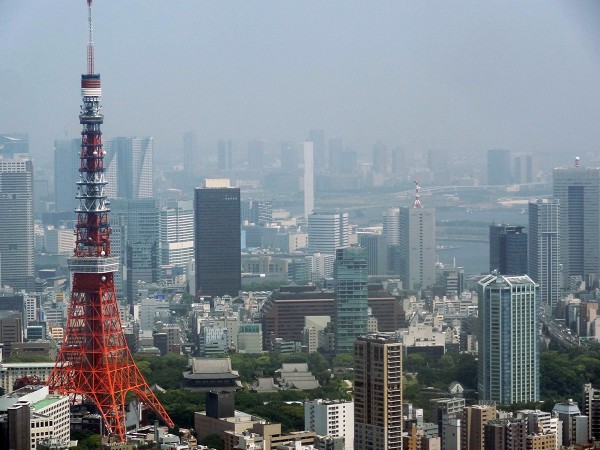
 Since coming to office two years ago, Shinzo Abe’s government has been determined to revive the Japanese economy. The policy has involved ‘three arrows‘: expansionary fiscal policy, expansionary monetary policy and supply-side reforms. But figures just out show that the Japanese economy is back in recession. The economy shrank by 0.4% in quarter 3, having shrunk by 1.9% in quarter 2.
This has come as a huge disappointment for Mr Abe, who has staked his political reputation on escaping from deflation and achieving sustained economic growth. In response, he has called a general election to put a revised economic plan to the electorate.
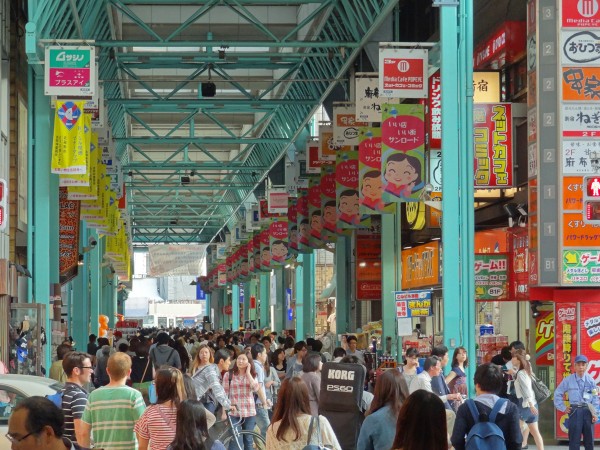
The main cause of the reversal into recession has been an increase in the sales tax on all goods, which has dampened spending. The tax rise, planned by the previous government, was to help reduce the deficit and start tackling the huge public-sector debt, which, at over 230% of GDP, is by far the highest in the developed world. Another rise in sales tax is due in October 2015 – from 8% to 10%. Mr Abe hopes to cancel the rise and it is this that he may put to the electorate.
So what is the outlook for Japan? Will quarter 4 show economic growth, or will pessimism have set in? Will the Bank of Japan introduce even more quantitative easing, or will it wait for the latest increase in QE to take effect (see the blog post, All eased out: at least for the USA and UK)?
The following articles look at the implications of the latest news, both for Japan and globally, and at the options for the government and central bank.
Articles
Japanese economy falls into surprise recession Independent, Maria Tadeo (17/11/14)
Japan’s economy makes surprise fall into recession BBC News (17/11/14)
Coming to a crunch: Time is running out for Abenomics The Economist (20/11/14)
Japan’s economy: Delay the second consumption tax hike The Economist (17/11/14)
Defying Expectations, Japan’s Economy Falls Into Recession New York Times, Jonathan Soble (16/11/14)
Japan shocks as economy slips into recession CNBC, Li Anne Wong (17/11/14)
Japan Unexpectedly Enters Recession as Abe Weighs Tax: Economy Bloomberg, Keiko Ujikane and Toru Fujioka (17/11/14)
The world should be wary: Japan’s economic woes are contagious The Guardian, Larry Elliott (17/11/14)
Why is Japan heading to the polls? BBC News (18/11/14)
Previous news items on this site
A new economic road for Japan? (January 2013)
A J-curve for Japan? (May 2013)
Japan’s three arrows (June 2013)
Abenomics – one year on (December 2013)
Japan’s recovery (January 2014)
Japan’s CPI: An Update (May 2014)
All eased out: at least for the USA and UK (November 2014)
Data
Quarterly Estimates of GDP Japanese Cabinet Office
Japan and the IMF IMF Country Reports
Economic Outlook Annex Tables OECD
Questions
- Give details of the Japanese government’s three arrows.
- Discuss the pros and cons of the rise in the sales tax. Is it possible for the rise in the sales tax to increase the size of the public-sector deficit?
- What have been the effects of Japanese government policies on (a) prices of goods and services; (b) living standards; (c) asset prices?
- Who have been the gainers and losers of the policies?
- How is the Japanese situation likely to effect the value of the yen? How is this, in turn, likely to affect its trading partners? Could this set off a chain reaction?
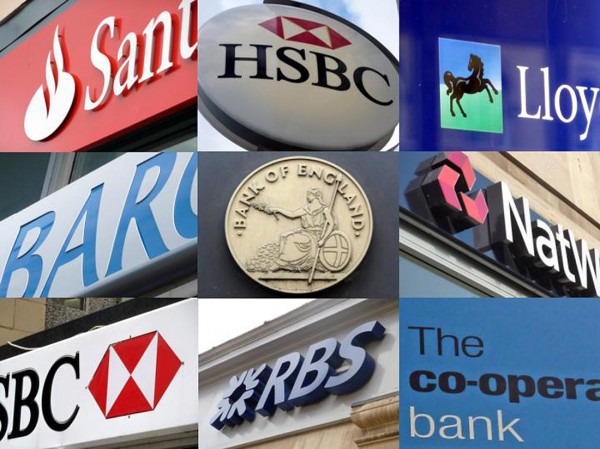 The spectre of debt has awoken many of us in the night. Indebtedness is a key economic issue in the 2010s. Economists are devoting ever increasing amounts of research time trying to understand its impact on economic behaviour. This will not surprise you when you learn that the debt owed by the UK non-bank private sector to banks stood at £2.17 trillion at the end of September. This is the equivalent to 150% of annual GDP.
 Chart 1 shows the stock of outstanding lending by Monetary Financial Institutions (banks and building societies) to the non-bank private sector bank since 1979. Back then the non-bank private sector had bank debt to the tune of around £70 billion or 10 per cent of GDP. Today’s figure is nearly 3000 per cent higher! Of this debt, around about 55 per cent is currently held by the household sector, 27 per cent by Other Financial Corporations (such as insurance companies and pension funds) and 18 per cent by private non-financial corporations. (Click here for a PowerPoint of the chart.)
 Chart 2 shows the stocks of debt as percentages of annual GDP. We can infer from it that there are waves of growth in bank debt. Two notable periods are during the 1980s and again from the late 1990s up to the financial crisis of the late 2000s. During the early and mid 1990s the relative size of debt stocks tended to stabilise while in the early 2010s the actual stocks of debt, as well as relative to GDP, declined. A credit binge seems to be followed by a period of consolidation. (Click here for a PowerPoint of the chart.)
It is important that we understand the drivers of the growth of debt. The impact of debt on the balance sheets of the non-bank private sector and on banks themselves has implications for economic behaviour. In the early 2010s this has been to markedly slow the pace of growth through its impact on aggregate demand. Economic agents have, in general, looked to consolidate. There is no doubt that this partly reflects a precautionary motive. An important means by which debt and the balance sheets on which it is recorded affect behaviour is through a precautionary mechanism. This is difficult to accurately quantify because it represents a psychological influence on spending. Furthermore, it is affected by the prevailing circumstances of the time.
In looking to understand the factors that affect the growth of debt we may, as a result, learn more about the framework within which we may want banks and their customers to operate. Consequently, we may be in a better position to ensure sustainable longer-term growth and development. If there are cycles in credit it is important that we understand why they arise and whether, as some have suggested, they are an inherent part of the financialised economy in which we live. If they are, can we mitigate their potentially destabilising effects?
Articles
Retail shares facing nightmare before Christmas The Telegraph, John Ficenec (9/11/14)
Growing wealth inequality in the UK is a ticking timebomb The Guardian, Danny Dorling (15/10/14)
Richest 10% of Britons now control more than half the country’s wealth: Nation is only member of G7 where inequality between rich and poor has increased this century Mail Online, Mark Duell and Corey Charlton, (15/11/14)
Household debt is growing as families struggle Yorkshire Evening Post (31/10/14)
Consumer spending forecast to be the highest for four years The Telegraph, Ashley Armstrong (10/11/14)
Data
Statistical Interactive Database Bank of England
Quarterly National Accounts, Q2 2014 Dataset Office for National Statistics
Questions
- What is the non-bank private sector?
- What factors might affect the rate at which non-bank private sector debt stocks grow?
- How might we go about assessing whether the aggregate level of lending by financial institutions to the non-bank private sector is sustainable?
- How might we go about assessing whether the level of lending by individual financial institutions to the non-bank private sector is sustainable?
- What information is conveyed in the balance sheets of economic agents, such as households and private non-financial corporations
- What is meant by precautionary saving?
- Can precautionary saving occur when the economy is growing strongly?
- What are the mechanisms by which non-bank private sector debt could impact on economic behaviour?
 The French economy is flatlining. It has just recorded the second quarter of zero economic growth, with growth averaging just 0.02% over the past 12 months. What is more, the budget deficit is rising, not falling. In April this year, the French finance minister said that the deficit would fall from 4.3% in 2013 to 3.8% in 2014 and to the eurozone ceiling of 3% in 2015. He is now predicting that it will rise this year to 4.4% and not reach the 3% target until 2017.
The deficit is rising because a flatlining economy is not generating sufficient tax revenues. What is more, expenditure on unemployment benefits and other social protection is rising as unemployment has risen, now standing at a record 10.3%.
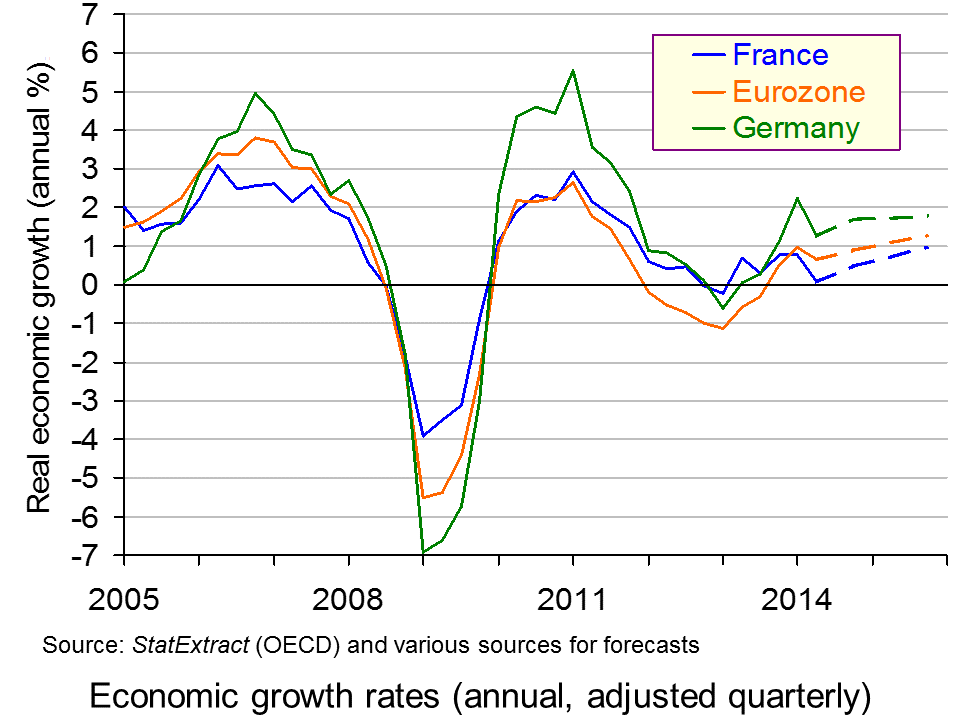
And it is not just the current economic situation that is poor; the outlook is poor too. The confidence of French companies is low and falling, and investment plans are muted. President Hollande has pledged to cut payroll taxes to help firms, but so far this has not encouraged firms to invest more.
So what can the French government do? And what can the EU as a whole do to help revive not just the French economy but most of the rest of the eurozone, which is also suffering from zero, or near zero, growth?
There are two quite different sets of remedies being proposed.

The first comes from the German government and increasingly from the French government too. This is to stick to the austerity plans: to get the deficit down; to reduce the size of government in order to prevent crowding out; and to institute market-orientated supply-side policies that are business friendly, such as reducing business regulation. Business leaders in France, who generally back this approach, have called for reducing the number of public holidays and scrapping the maximum 35-hour working week. They are also seeking reduced business taxes, financed by reducing various benefits.
Increasingly President Hollande is moving towards a more business-friendly set of policies. Under his government’s ‘Responsibility Pact’, a €40 billion package of tax breaks for business will be financed through €50 billion of cuts in public spending. To carry through these policies he has appointed an ex-investment banker, Emmanuel Macron, as economy minister. He replaces Arnaud Montebourg, who roundly criticised government austerity policy and called for policies to boost aggregate demand.
This brings us to the alternative set of remedies. These focus on stimulating aggregate demand through greater infrastructure investment and cutting taxes more generally (not just for business). The central argument is that growth must come first and that this will then generate the tax revenues and reductions in unemployment that will then allow the deficit to be brought down. Only when economic growth is firmly established should measures be taken to cut government expenditure in an attempt to reduce the structural deficit.
There are also compromise policies being proposed from the centre. These include measures to stimulate aggregate demand, mainly through tax cuts, accompanied by supply-side policies, whether market orientated or interventionist.
As Europe continues to struggle to achieve recovery, so the debate is getting harsher. Monetary policy alone may not be sufficient to bring recovery. Although the ECB has taken a number of measures to stimulate demand, so far they have been to little avail. As long as business confidence remains low, making increased liquidity available to banks at interest rates close to zero will not make banks more willing to lend to business, or businesses more willing to borrow. Calls for an end, or at least a temporary halt, to austerity are thus getting louder. At the same time, calls for sticking to austerity and tackling excessive government spending are also getting louder.
Articles
Hollande entrusts French economy to ex-banker Macron Reuters, Ingrid Melander and Jean-Baptiste Vey (26/8/14)
France’s new Minister of the Economy Emmanuel Macron described by left-wingers as a ‘copy-and-paste Tony Blair’ Independent, John Lichfield (28/8/14)
Merkel praises France’s economic reform plans after Berlin talks with PM Valls Deutsche Welle (22/9/14)
French economy flat-lines as business activity falters Reuters, Leigh Thomas (23/9/14)
French public finances: Rétropédalage The Economist (13/9/14)
French employer group urges ‘shock therapy’ for economy Reuters (24/9/14)
Last chance to save France: loosen 35-hour week and cut public holidays, say bosses The Telegraph (24/9/14)
‘Sick’ France’s economy is stricken by unemployment ‘fever’ The Telegraph (17/9/14)
France’s economics ills worsen but all remedies appear unpalatable The Observer, Larry Elliott and Anne Penketh (31/8/14)
The Fall of France The New York Times, Paul Krugman (28/8/14)
Why Europe is terrified of deflation Salon, Paul Ames (20/9/14)
Europe’s Greater Depression is worse than the 1930s The Washington Post, Matt O’Brien (14/8/14)
Worse than the 1930s: Europe’s recession is really a depression The Washington Post, Matt O’Brien (20/8/14)
Eurozone business growth slows in September, PMI survey finds BBC News (23/9/14)
Europe must ‘boost demand’ to revive economy, US warns BBC News (21/9/14)
Valls says France would never ask Germany to solve its problems Reuters, Annika Breidthardt and Michelle Martin (23/9/14)
The euro-zone economy: Asset-backed indolence The Economist (11/9/14)
Data
Annual macro-economic database (AMECO) Economic and Financial Affairs DG, European Commission
Business and Consumer Surveys Times Series Economic and Financial Affairs DG, European Commission
StatExtracts OECD
Statistics database European Central Bank
Questions
- What types of supply-side reforms would be consistent with the German government’s vision of solving Europe’s low growth problem?
- How could a Keynesian policy of reflation be consistent with getting France’s deficit down to the 3% of GDP limit as specified in the Stability and Growth Pact (see)?
- What is meant by (a) financial crowding out and (b) resource crowding out? Would reflationary fiscal policy in France lead to either form of crowding out? How would it be affected by the monetary stance of the ECB?
- Give examples of market-orientated and interventionist supply-side policies.
- What is meant by the terms ‘cyclical budget deficit’ and ‘structural budget deficit’. Could demand-side policy affect the structural deficit?
- Using the European Commission’s Business and Consumer Surveys find our what has happened to business and consumer confidence in France over the past few months.
- How important is business and consumer confidence in determining economic growth in (a) the short term and (b) the long term?
 The instability of the economy was clearly demonstrated by the events of the late 2000s. Economists have devoted considerable energies to understanding the determinants of the business cycle. Increasing attention is focused on the role that credit cycles play in contributing to or exacerbating cycles. Therefore, data on lending by banks is followed keenly by policymakers who wish to avoid the repeat of the pace of growth in credit seen in the period preceding the financial crisis. Interestingly, the latest data from the Bank of England show that lending by financial institutions to households (net of repayments) rose in July to its highest level since November 2009.
The idea of credit cycles is not new. But, the financial crisis of the late 2000s has helped to reignite analysis and interest. Many economists have revisited the work of Hyman Minsky (1919–1996), an American economist, who argued that financial cycles are an inherent part of the economic cycle and contribute to fluctuations in real GDP. Notably, he argued that credit extended to households and businesses is pro-cyclical so that flows of credit extended by banks are larger when the growth of the economy’s output is stronger. Since credit flows are dependent on the phase of the business cycle, they are said to be endogenous to the path of output. The key point here is that there is an inherent mechanism within the economy which is potentially destabilising.
Banks, it is argued, may use the growth of the economy’s output as an indicator of the riskiness of its lending. Households and businesses may undertake a similar assessment. After a period of sustained growth banks and investors become more confident about the future path of the economy and, consequently, in the returns of assets. This means that there is a role for psychology in understanding the business cycle.
 If we look at the chart, this period of heightened confidence may correspond with the period starting from the late 1990s. Between 1998 and 2007 the average monthly net flow of credit to private non-financial corporations and households was £9.4 billion. In other words, households and businesses were acquiring a staggering £9.4 billion of additional debt from banks each month. But, this was as high as £14.0 billion per month in 2007. (Click here for a PowerPoint of the chart.)
What helped to fuel the impact of heightened confidence on credit provision was financial innovation. In particular, the bundling of assets, such as mortgages, to form financial instruments which could then be purchased by investors helped to provide financial institutions with further funds for lending. This is the process of securitisation. The result was that during the 2000s as households and businesses began to acquire larger debts their financial well-being became increasingly stretched. This was hastened by central banks raising interest rates. The intention was to dampen the rising rate of inflation, partly attributable to rising global commodity prices, such as oil. Suddenly, euphoria was replaced with pessimism.
Some argue that a Minsky moment had occurred. Many countries then witnessed a balance sheet recession. As individual households and businesses try and improve their own financial well-being they collectively contribute to its worsening. For instance, large-scale attempts to sell assets, such as shares or property, only help to cause their value to decline.
A global response to the events of the financial crisis has been for policy-makers to pay more attention to the aggregate level of credit provision. The chart shows that lending in 2014 is more robust than it has been form some time. Across the first seven months of 2014 the average monthly net flow of credit extended by banks to households and businesses (private non-financial corporations) has been £2.2 billion.
However, the 2014-rebound of credit is wholly attributable to lending to households. Net lending to households has averaged £2.7 billion per month while businesses have been repaying credit to banks to the tune of £437 million per month – something that businesses have collectively done in each year from 2009. While net lending to households remains considerably lower than pre-financial crisis levels, it will be something that policymakers will be watching very closely. This, in turn, means that they will be paying particular interest to the housing and mortgage markets.
Articles
Appetite for loans picks up again, say major banks BBC News (23/9/14)
Business lending by UK banks is down by £941m Herald Scotland, Ian McConnell (27/8/14)
How bank lending fell by £365 BILLION in five years… much to the delight of controversial payday loan firms Mail, Louise Eccles (7/09/14)
U.K.’s Big Banks Cut Lending by $595 Billion, KPMG Says Bloomberg, Richard Partington (8/9/14)
UK banks’ home loan approvals fall to 12-month low – BBA Reuters, Andy Bruce and Tom Heneghan (23/9/14)
Data
Bankstats (Monetary and Financial Statistics) – Latest Tables Bank of England
Statistical Interactive Database Bank of England
Questions
- What is meant by the term the business cycle?
- What does it mean for the determinants of the business cycle to be endogenous? What about if they are exogenous?
- Outline the ways in which the financial system can impact on the spending behaviour of households. Repeat the exercise for businesses.
- How might uncertainty affect spending and saving by households and businesses?
- What does it mean if bank lending is pro-cyclical?
- Why might lending be pro-cyclical?
- How might the differential between borrowing and saving interest rates vary over the business cycle?
- Explain what you understand by net lending to households or firms. How does net lending affect their stock of debt?
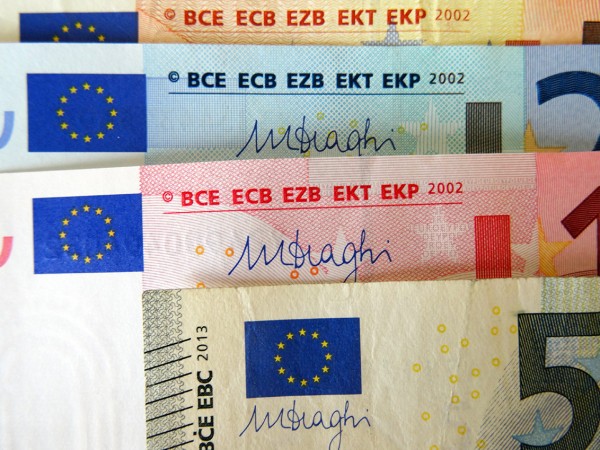 The spectre of deflation haunts the eurozone economy. Inflation in the 12 months to May 2014 was 0.5%, down from 0.7% to April and well below the target of 2% (see). Price deflation can result in deflation of the whole economy. With the prospect of falling prices, many consumers put off spending, hoping to buy things later at a lower price. This delay in spending deflates aggregate demand and can result in a decline in growth or even negative growth: hardly a welcome prospect as the eurozone still struggles to recover from the long period of recession or sluggish growth that followed the 2007–8 financial crisis.
The ECB is well aware of the problem. Its President, Mario Draghi, has stated on several occasions that the central bank will do whatever it takes to ward off deflation and stimulate recovery. At its monthly meeting on 5 June, the ECB Council acted. It took the following measures (see Mario Draghi’s press conference and the press release):
• The main refinancing rate it charges banks on reverse repos (when using open-market operations) was cut from 0.25% to 0.15%.
• The rate it pays banks for depositing money in the ECB was cut from 0% to –0.1%. In other words, banks would be charged for ‘parking’ money with the ECB rather than lending it.
• It will provide targeted lending to banks (targeted longer-term refinancing operations (TLTROs)), initially of 7% of the total amount of each banks’ loans to the non-financial private sector within the eurozone. This will be provided in two equal amounts, in September and December 2014. These extra loans will be for bank lending to businesses and households (other than for house purchase). The total amount will be some €400 billion. Substantial additional lending will be made available quarterly from March 2016 to June 2016.
• It will make preparations for an asset purchase scheme. Unlike that in the UK, which involves the purchase of government bonds, this will involve the purchase of assets which involve claims on private-sector (non-financial) institutions. Depending on financing arrangements, this could amount to quantitative easing.
 • It will suspend sterilising the extra liquidity that has been injected under the Securities Markets Programme (operated from May 2010 to September 2012), which involved purchasing eurozone countries’ existing bonds on the secondary market. In other words it will stop preventing the securities that have been purchased from increasing money supply. This therefore, for the first time, represents a genuine form of quantitative easing.
The question is whether the measures will be enough to stimulate the eurozone economy, prevent deflation and bring inflation back to around 2%. The measures are potentially significant, especially the prospect of quantitative easing – a policy pursued by other main central banks, such as the Fed, the Bank of England and the Bank of Japan. A lot depends on what the ECB does over the coming months.
The following articles consider the ECB’s policy. The first ones were published before the announcement and look at alternatives open to the ECB. The others look at the actual decisions and assess how successful they are likely to be.
Articles published before the announcement
Mario Draghi faces moment of truth as man with power to steady eurozone The Observer, Larry Elliott (1/6/14)
What the ECB will do in June? Draghi spells it out The Economist (26/5/14)
Draghi as Committed as a Central Banker Gets, as Economists Await ECB Stimulus Bloomberg, Alessandro Speciale and Andre Tartar (19/5/14)
ECB’s credit and credibility test BBC News, Robert Peston (2/6/14)
90 ECB decamps to debate monetary fixes Financial Times, Claire Jones (25/5/14)
Speech
Monetary policy in a prolonged period of low inflation ECB, Mario Draghi (26/5/14)
Articles published after the announcement
ECB launches €400bn scheme, seeks to force bank lending Irish Independent (5/6/14)
The ECB’s toolbox BBC News, Linda Yueh (5/6/14)
ECB’s justified action will help but is no panacea for eurozone deflationary ills The Guardian, Larry Elliott (5/6/14)
Why Negative Rates Won’t Work In The Eurozone Forbes, Frances Coppola (4/6/14)
Germany’s fear of QE is what’s stopping us from cracking open the Cava The Telegraph, Roger Bootle (8/6/14)
Data
Euro area economic and financial data ECB
Questions
- Why has the eurozone experienced falling inflation and a growing prospect of negative inflation?
- Explain how the Securities Markets Programme (SMP) worked (check it out on the ECB site). What countries’ bonds were purchased and why?
- What is meant by sterilisation? Why did the ECB sterilise the effects of the assets purchased under the SMP?
- If it is practical for the ECB to set a negative interest rate on the deposit facility for banks, would it be practical to set a negative interest rate for the main refinancing operations or the marginal lending facility? Explain.
- Why has the ECB, up to now, been unwilling to engage in quantitative easing? What has changed?
- Why may the introduction of a negative interest rate on bank deposits in the ECB have only a very small effect on bank lending?
- How much is broad money supply growing in the eurozone? Is this enough or too much? Explain.
- What else could the ECB have done to ward off deflation? Should the ECB have adopted these measures?
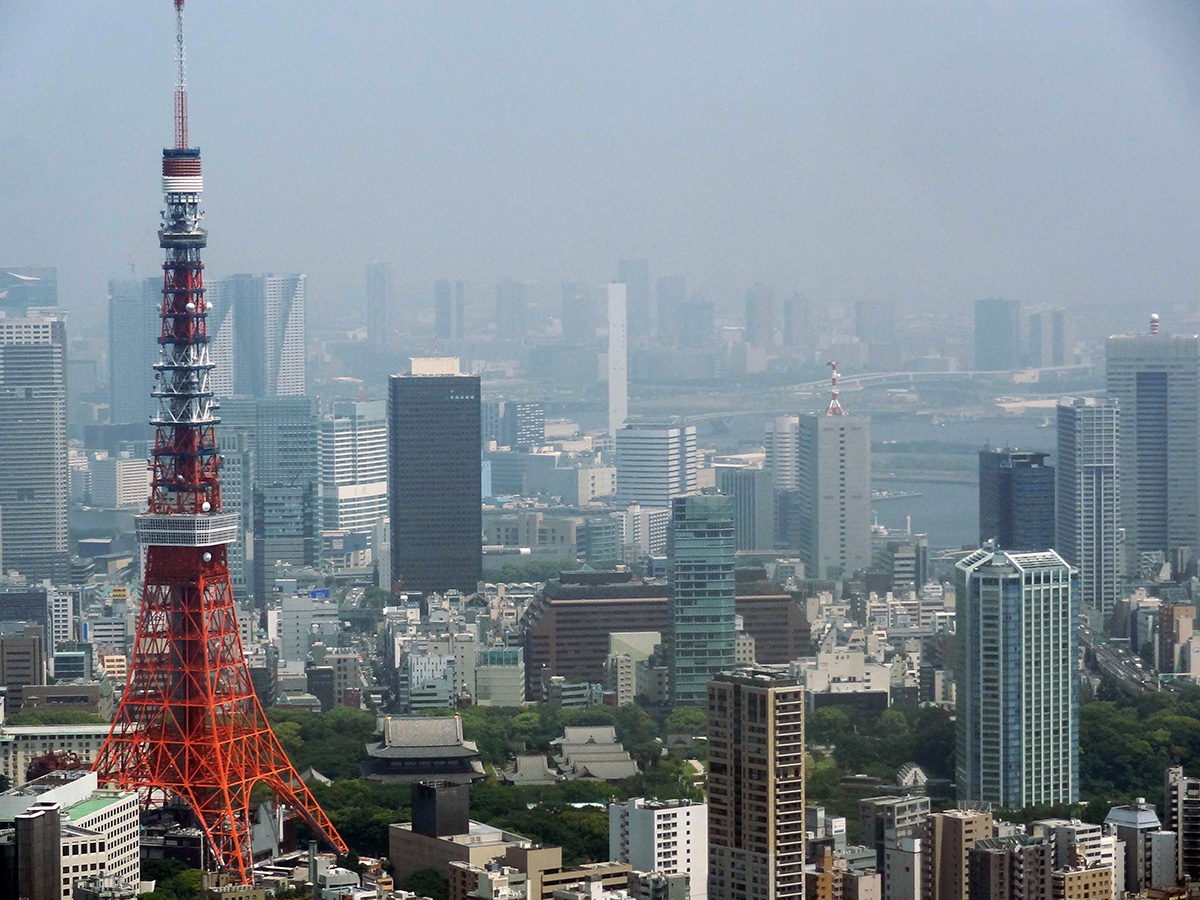 Since coming to office two years ago, Shinzo Abe’s government has been determined to revive the Japanese economy. The policy has involved ‘three arrows‘: expansionary fiscal policy, expansionary monetary policy and supply-side reforms. But figures just out show that the Japanese economy is back in recession. The economy shrank by 0.4% in quarter 3, having shrunk by 1.9% in quarter 2.