 Ten years ago (on 9 August 2007), the French bank BNP Paribas sparked international concern when it admitted that it didn’t know what many of its investments in the US sub-prime property market were worth and froze three of its hedge funds. This kicked off the financial crisis and the beginning of the credit crunch.
In September 2007 there was a run on the Northern Rock bank in the UK, forcing the Bank of England to provide emergency funding. Northern Rock was eventually nationalised in February 2008. In July 2008, the US financial authorities had to provide emergency assistance to America’s two largest mortgage lenders, Fannie Mae and Freddie Mac.
Then in September 2008, the financial crisis really took hold. The US bank, Lehman Brothers, filed for bankruptcy, sending shock waves around the global economy. In the UK, Lloyds TSB announced that it was taking over the UK’s largest mortgage lender, Halifax Bank Of Scotland (HBOS), after a run on HBOS shares.
Later in the month, Fortis, the huge Belgian banking, finance and insurance company, was partly nationalised to prevent its bankruptcy. Also the UK government was forced to take control of mortgage-lender, Bradford & Bingley’s, mortgages and loans, with the rest of the business sold to Santander.
Early in October 2008, trading was suspended in the main Icelandic banks. Later in the month, the UK government announced a £37 billion rescue package for Royal Bank of Scotland (RBS), Lloyds TSB and HBOS. Then in November it partially nationalised RBS by taking a 58% share in the bank. Meanwhile various other rescue packages and emergency loans to the banking sector were taking place in other parts of the world. See here for a timeline of the financial crisis.

So, ten years on from the start of the crisis, have the lessons of the crisis been learnt. Could a similar crisis occur again?
The following articles look at this question and the answers are mixed.
On the positive side, banks are much more highly capitalised than they were ten years ago. Moves by the Basel Committee on Banking Supervision in its Basel III regulatory framework have ensured that banks are much more highly capitalised and operate with higher levels of liquidity. What is more, banks are generally more cautious about investing in highly complex and risky collateralised assets.
On the negative side, increased flexibility in labour markets, although helping to keep unemployment down, has allowed a huge squeeze on real wages as austerity measures have dampened the economy. What is more, household debt is rising to possibly unsustainable levels. Over the past year, unsecured debt (e.g. personal loans and credit card debt) have risen by 10% and yet (nominal) household incomes have risen by only 1.5%. While record low interest rates make such loans relatively affordable, when interest rates do eventually start to rise, this could put a huge strain on household finances. But if households start to rein in their borrowing, this would put downward pressure on aggregate demand and jeopardise economic growth.
Articles
- The crisis: 10 years in three chart
BBC News, Simon Jack (9/8/17)
 Darling: ‘Alarm bells ringing’ for UK economy
BBC News (9/8/17)
- Alistair Darling warns against ‘complacency’ 10 years on from financial crisis
The Telegraph (9/8/17)
- A decade after the financial crisis consumers are still worried
Independent, Kate Hughes (9/8/17)
- Bankers still do not understand complex reasons behind financial crash, senior politician warns
Independent, Ashley Cowburn (9/8/17)
- We let the 2007 financial crisis go to waste
The Guardian, Torsten Bell (9/8/17)
- Bank of England warns of complacency over big rise in personal debt
The Guardian, Larry Elliott (24/7/17)
- On the 10th anniversary of the global financial meltdown, here’s what’s changed
USA Today, Kim Hjelmgaard (8/8/17)
- Financial crisis: Ten years ago today the tremors started
Irish Times (9/8/17)
- If We Are Racing to the Pre-Crisis Bubble, Here Are 12 Charts To Watch
Bloomberg, Sid Verma (9/8/17)
Videos
Questions
- Explain what are meant by ‘collateralised debt obligations (CDOs)’.
- What part did CDOs play in the financial crisis of 2007–8?
- In what ways is the current financial situation similar to that in 2007–8?
- In what ways is it different?
- Explain the Basel III banking regulations.
- To what extent has the Bank of England exceeded the minimum Basel III requirements?
- Explain what is meant by ‘stress testing’ the banks? Does this ensure that there can never be a repeat of the financial crisis?
- Why is it desirable for central banks eventually to raise interest rates to a level of around 2–3%? Why might it be difficult for central banks to do that?
 On the 15th June, the Bank of England’s Monetary Policy Committee decided to keep Bank Rate on hold at its record low of 0.25%. This was not a surprise – it was what commentators had expected. What was surprising, however, was the split in the MPC. Three of its current eight members voted to raise the rate.
At first sight, raising the rate might seem the obvious thing to do. CPI inflation is currently 2.9% – up from 2.7% in April and well above the target of 2% – and is forecast to go higher later this year. According to the Bank of England’s own forecasts, even at the 24-month horizon inflation is still likely to be a little above the 2% target.
Those who voted for an increase of 0.25 percentage points to 0.5% saw it as modest, signalling only a very gradual return to more ‘normal’ interest rates. However, the five who voted to keep the rate at 0.25% felt that it could dampen demand too much.
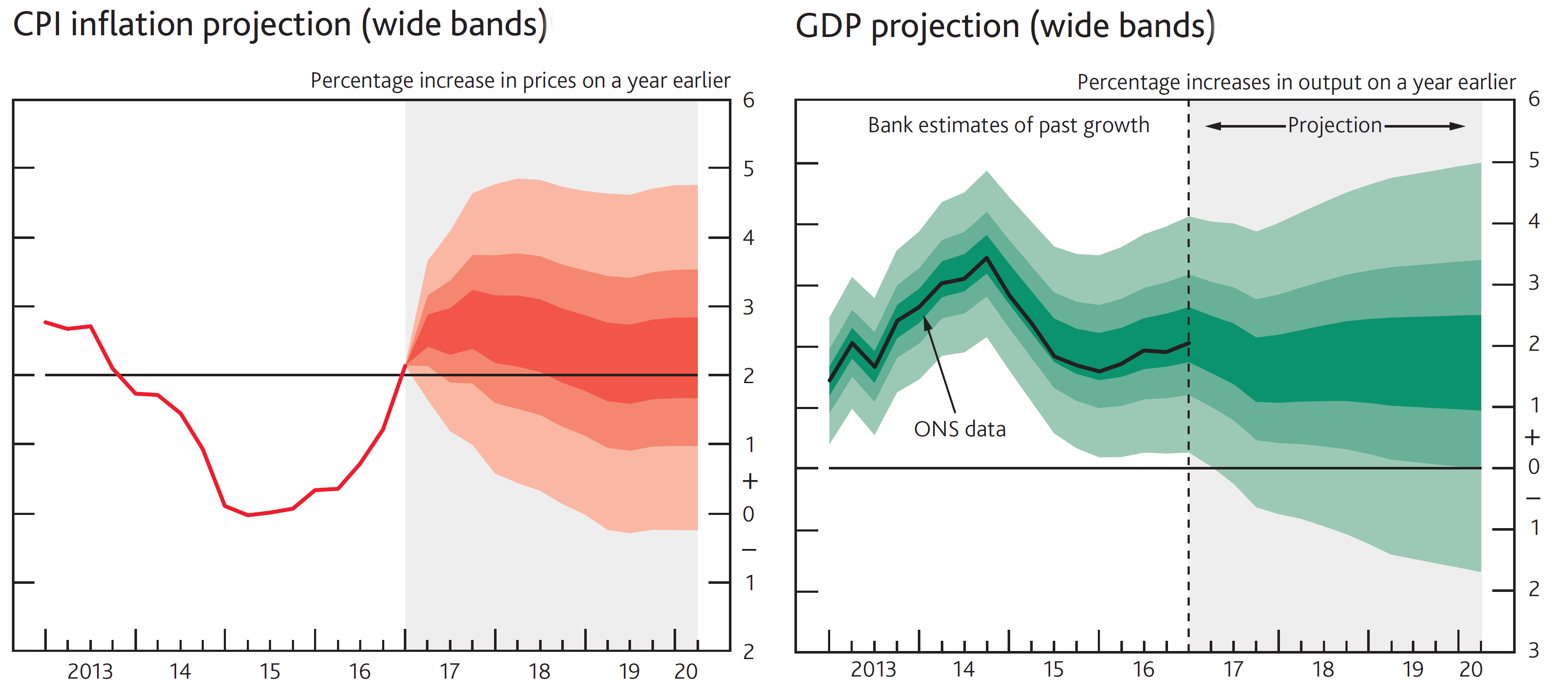
The key argument is that inflation is not of the demand-pull variety. Aggregate demand is subdued. Real wages are falling and hence consumer demand is likely to fall too. Thus many firms are cautious about investing, especially given the considerable uncertainties surrounding the nature of Brexit. The prime cause of the rise in inflation is the fall in sterling since the Brexit vote and the effect of higher import costs feeding through into retail prices. In other words, the inflation is of the cost-push variety. In such cirsumstances dampening demand further by raising interest rates would be seen by most economists as the wrong response. As the minutes of the MPC meeting state:
Attempting to offset fully the effect of weaker sterling on inflation would be achievable only at the cost of higher unemployment and, in all likelihood, even weaker income growth. For this reason, the MPC’s remit specifies that, in such exceptional circumstances, the Committee must balance any trade-off between the speed at which it intends to return inflation sustainably to the target and the support that monetary policy provides to jobs and activity.
The MPC recognises that the outlook is uncertain. It states that it stands ready to respond to circumstances as they change. If demand proves to be more resilient that it currently expects, it will raise Bank Rate. If not, it is likely to keep it on hold to continue providing a modest stimulus to the economy. However, it is unlikely to engage in further quantitative easing unless the economic outlook deteriorates markedly.
Articles
The Bank of England is moving closer to killing the most boring chart in UK finance right now Business Insider, Will Martin (16/6/17)
UK inflation hits four-year high of 2.9% Financial Times, Gavin Jackson and Chloe Cornish (13/6/17)
Surprise for markets as trio of Bank of England gurus call for interest rates to rise The Telegraph, Szu Ping Chan Tim Wallace (15/6/17)
Bank of England rate setters show worries over rising inflation Financial TImes, Chris Giles (15/6/17)
Three Bank of England policymakers in shock vote for interest rate rise Independent, Ben Chu (15/6/17)
Bank of England edges closer to increasing UK interest rates The Guardian, Katie Allen (15/6/17)
Bank of England doves right to thwart hawks seeking interest rate rise The Guardian, Larry Elliott (15/6/17)
Haldane expects to vote for rate rise this year BBC News (21/6/17)
Bank of England documents
Monetary policy summary Bank of England (15/6/17)
Monetary Policy Summary and minutes of the Monetary Policy Committee meeting ending on 14 June 2017 Bank of England (15/6/17)
Inflation Report, May 2017 Bank of England (11/5/16)
Questions
- What is the mechanism whereby a change in Bank Rate affects other interest artes?
- Use an aggregate demand and supply diagram to illustrate the difference between demand-pull and cost-push inflation.
- If the exchange rate remains at around 10–15% below the level before the Brexit vote, will inflation continue to remain above the Bank of England’s target, or will it reach a peak relatively soon and then fall back? Explain.
- For what reason might aggregate demand prove more buoyant that the MPC predicts?
- Would a rise in Bank Rate from 0.25% to 0.5% have a significant effect on aggregate demand? What role could expectations play in determining the nature and size of the effect?
- Why are real wage rates falling at a time when unemployment is historically very low?
- What determines the amount that higher prices paid by importers of products are passed on to consumers?
 In the last blog post, As UK inflation rises, so real wages begin to fall, we showed how the rise in inflation following the Brexit vote is causing real wages in the UK to fall once more, after a few months of modest rises, which were largely due to very low price inflation. But how does this compare with other OECD countries?
In an article by Rui Costa and Stephen Machin from the LSE, the authors show how, from the start of the financial crisis in 2007 to 2015 (the latest year for which figures are available), real hourly wages fell further in the UK than in all the other 27 OECD countries, except Greece (see the chart below, which is Figure 5 from their article). 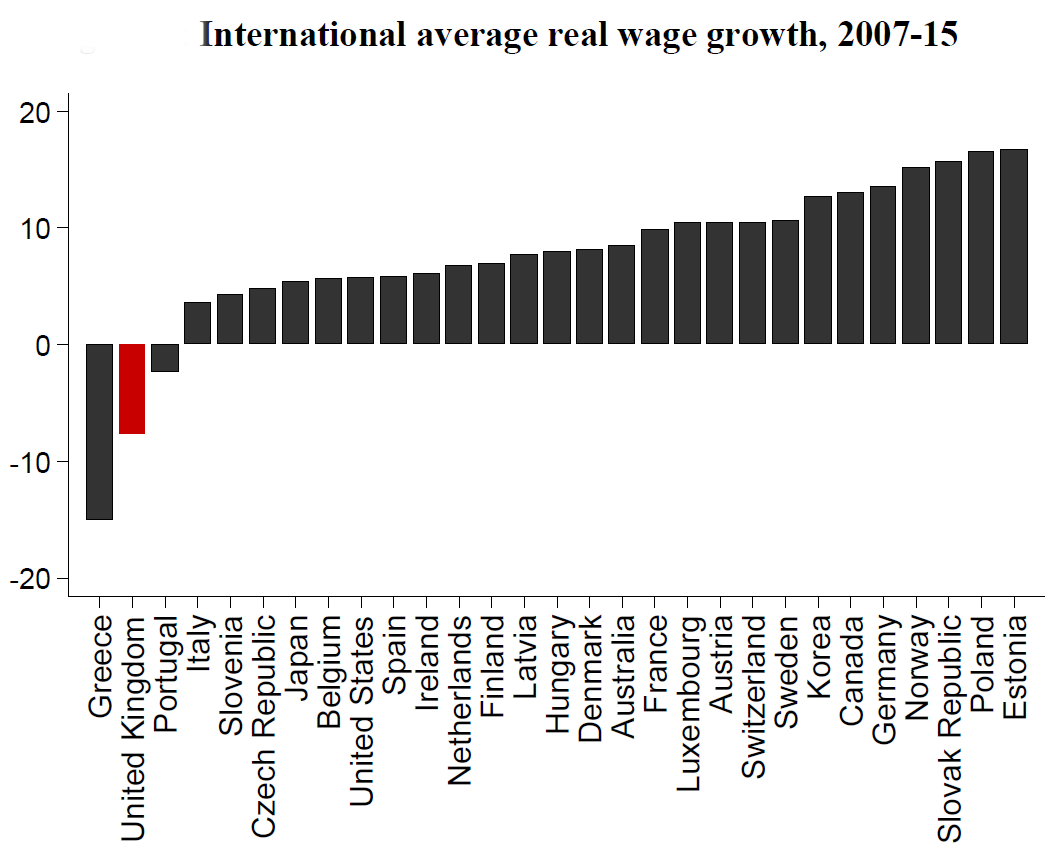 Indeed, only in Greece, the UK and Portugal were real wages lower in 2015 than in 2007.
The authors examine a number of aspects of real wages in the UK, including the rise in self employment, differences by age and sex, and for different percentiles in the income distribution. They also look at how family incomes have suffered less than real wages, thanks to the tax and benefit system.
The authors also look at what the different political parties have been saying about the issues during their election campaigns and what they plan to do to address the problem of falling, or only slowly rising, real wages.
Articles
Real Wages and Living Standards in the UK LSE – Centre for Economic Performance, Rui Costa and Stephen Machin (May 2017)
The Return of Falling Real Wages LSE – Centre for Economic Performance, David Blanchflower, Rui Costa and Stephen Machin (May 2017)
The chart that shows UK workers have had the worst wage performance in the OECD except Greece Independent, Ben Chu (5/6/17)
Data
Earnings and working hours ONS
OECD.Stat OECD
International comparisons of productivity ONS
Questions
- Why have real wages fallen more in the UK than in all OECD countries except Greece?
- Which groups have seen the biggest fall in real wages? Explain why.
- What policies are proposed by the different parties for raising real wages (a) generally; (b) for the poorest workers?
- How has UK productivity growth compared with that in other developed countries? What explanations can you offer?
- What is the relationship between productivity growth and the growth in real wages?
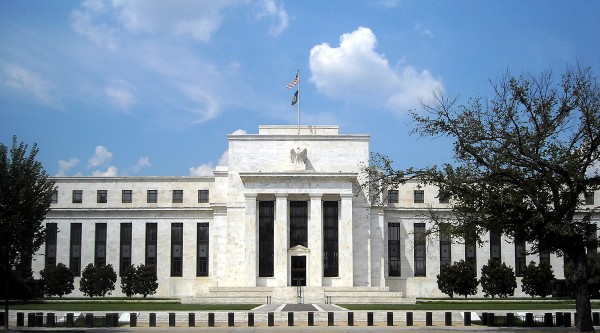 The US Federal Reserve, like many other central banks, engaged in massive quantitative easing in the wake of the financial crisis of 2007/8. Over three rounds, QE1, QE2 and QE3, it accumulated $4.5 trillion of assets – mainly government bonds and mortgage-backed securities (see chart below: click here for a PowerPoint). But, unlike its counterparts in the UK, the eurozone and Japan, it has long ceased its programme of asset purchases.. In October 2014, it announced that QE was at an end. All that would be done in future would be to replace existing holdings of assets as they matured, keeping total holdings roughly constant.
But now this policy is set to change. The Fed is about to embark on a programme of ‘quantitative tightening’, already being dubbed ‘QT’. This involves the Fed reducing its holdings of assets, mainly government bonds and government-backed mortgage-related securities.
 This, however, for the time being will not include selling its holding of bonds or mortgage-backed securities. Rather, it will simply mean not buying new assets to replace ones when they mature, or only replacing part of the them. This was discussed by the 75 participants at the joint meeting of the Federal Open Market Committee (FOMC) and Board of Governors on 14–15 March.
As the minutes put it: “Many participants emphasized that reducing the size of the balance sheet should be conducted in a passive and predictable manner.”
A more active form of QT would involve selling assets before maturity and thus reducing the size of the Fed’s balance sheet more rapidly. But either way, reducing assets would put downward pressure on the money supply and support the higher interest rates planned by the FOMC.
The question is whether there is enough liquidity elsewhere in the system and enough demand for credit, and willingness of the banking system to supply credit, to allow a sufficient growth in broad money – sufficient, that is, to support continued growth in the economy. The answer to that question depends on confidence. The Fed, not surprisingly, is keen not to damage confidence and hence prefers a gradualist approach to reducing its holdings of assets bought during the various rounds of quantitative easing.
Articles
Fed’s asset shift to pose new test of economy’s recovery, resilience Reuters, Howard Schneider and Richard Leong (6/4/17)
Federal Reserve likely to begin cutting back $4.5 trillion balance sheet this year Washington Post, Ana Swanson (5/4/17)
Why the Fed’s debate about shrinking its balance sheet really, really matters Money Observer, Russ Mould (7/4/17)
The Fed and ECB keep a cautious eye on the exit Financial Times (7/4/17)
Get ready for the Fed’s next scary policy change CBS Money Watch, Anthony Mirhaydari (5/4/17)
The Fed wants to start shrinking its $4.5 trillion balance sheet later this year Business Insider, Akin Oyedele (5/4/17)
Inside the Fed’s March Meeting: The Annotated Minutes Bloomberg, Luke Kawa, Matthew Boesler and Alex Harris (5/4/17)
QE was great for asset prices – will ‘QT’ smash them? The Financial Review (Australia), Patrick Commins (7/4/17)
Shrinking the Fed’s balance sheet Brookings, Ben Bernanke (26/1/17)
Data
Selected data Board of Governors of the Federal Reserve System
Questions
- Distinguish between active and passive QT.
- If QE is a form of expansionary monetary policy, is QT a form of contractionary monetary policy?
- Could QT take place alongside an expansion of broad money?
- What dangers lie in the Fed scaling back its holdings of government (Treasury) bonds and mortgage-backed securities?
- Why is it unlikely that the Fed will reduce its holdings of securities to pre-crisis levels?
- Why are the Bank of England, the ECB and the Bank of Japan still pursuing a policy of QE?
- What are the implications for exchange rates of QT in the USA and QE elsewhere?
- Find out data for the monetary base, for narrow money (M1) and broader money (M2) in the USA. Are narrow and/or broad money correlated with Federal Reserve asset holdings?
 Both the financial and goods markets are heavily influenced by sentiment. And such sentiment tends to be self-reinforcing. If consumers and investors are pessimistic, they will not spend and not invest. The economy declines and this further worsens sentiment and further discourages consumption and investment. Banks become less willing to lend and stock markets fall. The falling stock markets discourage people from buying shares and so share prices fall further. The despondency becomes irrational and greatly exaggerates economic fundamentals.
This same irrationality applies in a boom. Here it becomes irrational exuberance. A boom encourages confidence and stimulates consumer spending and investment. This further stimulates the boom via the multiplier and accelerator and further inspires confidence. Banks are more willing to lend, which further feeds the expansion. Stock markets soar and destabilising speculation further pushes up share prices. There is a stock market bubble.
 But bubbles burst. The question is whether the current global stock market boom, with share prices reaching record levels, represents a bubble. One indicator is the price/earnings (PE) ratio of shares. This is the ratio of share prices to earnings per share. Currently the ratio for the US index, S&P 500, is just over 26. This compares with a mean over the past 147 years of 15.64. The current ratio is the third highest after the peaks of the early 2000s and 2008/9.
An alternative measure of the PE ratio is the Shiller PE ratio (see also). This is named after Robert Shiller, who wrote the book Irrational Exuberance. Unlike conventional PE ratios, which only look at average earnings over the past four quarters, the Shiller PE ratio uses average earnings over the past 10 years. “Because this factors in earnings from the previous ten years, it is less prone to wild swings in any one year.”
 The current level of the Shiller PE ratio is 29.14, the third highest on record, this time after the period running up to the Wall Street crash of 1929 and the dot-com bubble of the late 1990s. The mean Shiller PE ratio over the past 147 years is 16.72.
So are we in a period of irrational exuberance? And are stock markets experiencing a bubble that sooner or later will burst? The following articles explore these questions.
Articles
2 Clear Instances of Irrational Exuberance Seeking Alpha, Jeffrey Himelson (12/2/17)
Promised land of Trumpflation-inspired global stimulus has been slow off the mark South China Morning Post, David Brown (20/2/17)
A stock market crash is a way off, but this boom will turn to bust The Guardian, Larry Elliott (16/2/17)
The “boring” bubble is close to bursting – the Unilever bid proves it MoneyWeek, John Stepek (20/2/17)
Questions
- Find out what is meant by Minksy’s ‘financial instability hypothesis’ and a ‘Minsky moment’. How might they explain irrational exuberance and the sudden turning point from a boom to a bust?
- Is it really irrational to buy shares with a very high PE ratio if everyone else is doing so?
- Why are people currently exuberant?
- What might cause the current exuberance to end?
- How does irrational exuberance affect the size of the multiplier?
- How might the behaviour of banks and other financial institutions contribute towards a boom fuelled by irrational exuberance?
- Compare the usefulness of a standard PE ratio with the Shiller PE ratio.
- Other than high PE ratios, what else might suggest that stock markets are overvalued?
- Why might a company’s PE ratio differ from its price/dividends ratio (see)? Which is a better measure of whether or not a share is overvalued?
 Ten years ago (on 9 August 2007), the French bank BNP Paribas sparked international concern when it admitted that it didn’t know what many of its investments in the US sub-prime property market were worth and froze three of its hedge funds. This kicked off the financial crisis and the beginning of the credit crunch.