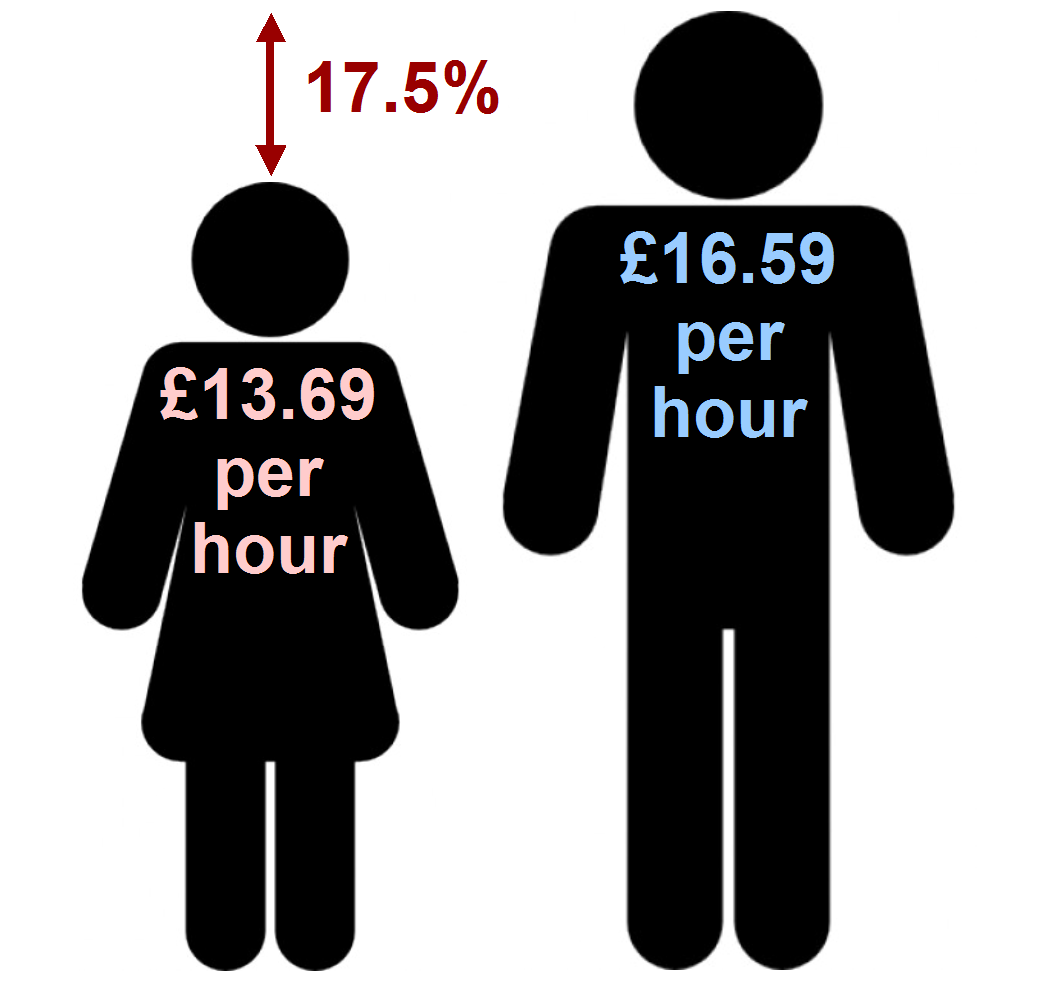
 Women in the UK on average earn less per hour than men. According to the Annual Survey of Hours and Earnings, the mean hourly pay for women in 2015 was 17.5% less than that for men. This figure is for all employees, full and part time. As far as full-time employees is concerned, the gap was slightly smaller at 13.9%. Nevertheless, as you can see from Table 6 in the linked Excel file, these gaps have decreased in recent years – but only slightly.
A recent paper from the Institute for Fiscal Studies has disaggregated the figures to give a better picture of this wage gap. It finds that having children is a major contributing factor to the gap. It also finds that this has a bigger impact on the earnings of graduates and those without a degree but with A levels.
On entry to the labour market, men and women earn roughly the same. People’s wages tend to rise during their 20s, but men’s rise slightly faster than women’s, causing a pay gap to open and widen – but slowly at first. Average (mean) men’s wages continue to grow during their 30s and a bit during their 40s. However, average women’s wages flatline. Thus the wage gap grows substantially, especially for the higher educated.
The paper argues that the arrival of children is a major contributing factor to this picture. It looks at the gap before and after the arrival of children. “The crucial observation is that the gap opens up gradually after the first child arrives and continues to widen for many years after that point.” By 12 years after the first child is born, the wage gap has widened to 33%.
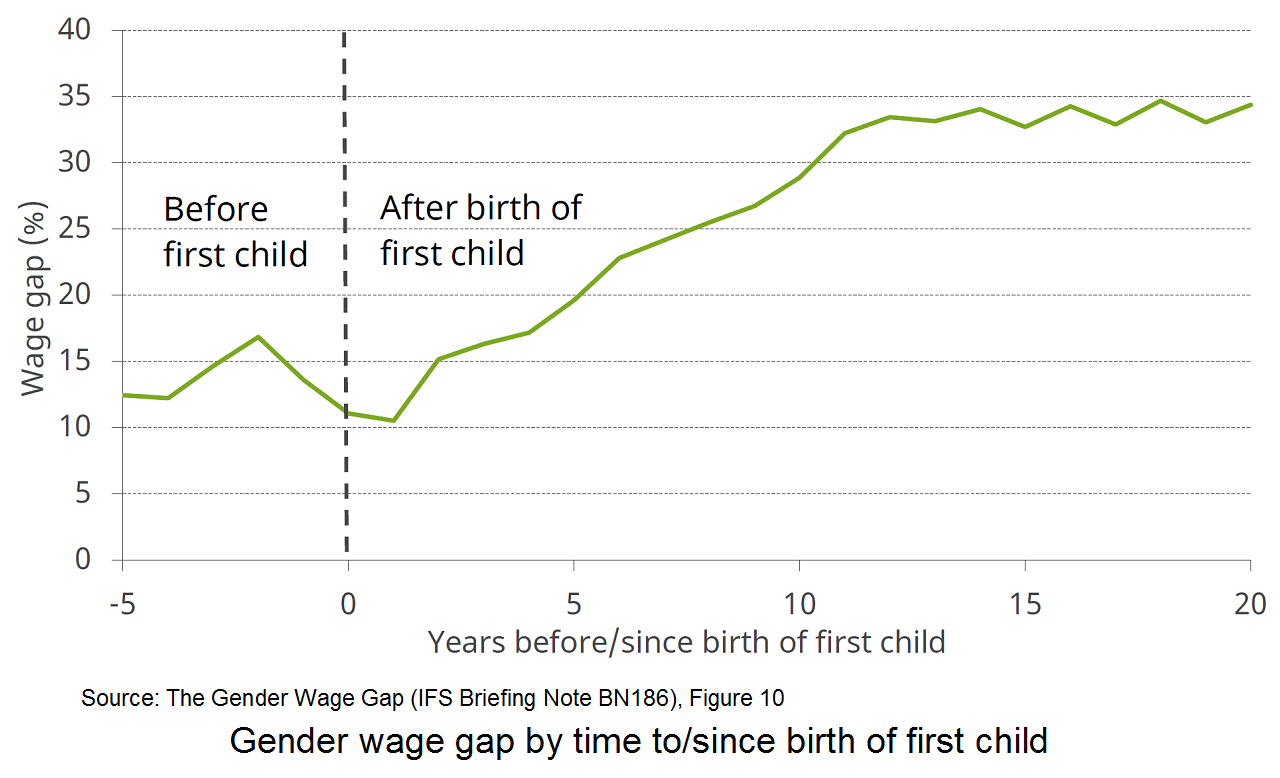
The paper does not offer reasons for the small gap that exists before the arrival of children. But it does give possible reasons for the widening gap after having children. A major one, it suggests, has to do with labour market experience.
“As women are likely to do less paid work after the arrival of children, the level of labour market experience they have falls further and further behind that of their male counterparts, and the wage gap therefore widens.” They may also miss out on promotions.
Each year a woman spends away from the labour market is associated with an average 2% drop in pay compared with those who remain in work. For those with at least A levels, the penalty is 4%; but there is no drop in pay for those without A levels.
Other possible explanations include mothers taking work that requires a lower skill level, and at lower hourly pay, in order to gain flexibility in working hours. However, the evidence suggests that women who move to part-time work on having a child suffer no immediate drop in pay. But their hourly pay does grow more slowly, thus contributing to a widening of the gap.
Another explanation is employers exercising market power to discriminate against women with children. The paper does not consider this explanation.
The articles discussing the paper look at policy implications and identify various things that can be done to narrow the gap. Read the paper and articles and try answering the questions below.
Videos and podcasts
 IFS: gender pay gap widens after first child Compendium of News Reports from BBC News at Six, Channel 4 News, ITV News at Ten and BBC Newsnight from Incorrigible Forever on YouTube (23/8/16)
Gender Pay Gap Hits Women With Children Hardest Sky News (23/8/16)
In Business: Supportive partner = success at work World of Business, BBC Radio 4, Peter Day (25/8/15)
Gender Pay Gap More or Less, BBC Radio 4, Tim Harford (26/8/16)
Gender pay gap: Why do mums increasingly earn less? BBC Victoria Derbyshire programme (23/8/16)
Articles
UK women still far adrift on salary and promotion as gender pay gap remains a gulf The Guardian, Katie Allen (23/8/16)
Gender pay gap: mothers returning to work earn a third less than men The Telegraph, Tim Wallace (23/8/16)
Mothers’ pay lags far behind men BBC News (23/8/16)
Four ways the gender pay gap isn’t all it seems BBC News Magazine, Simon Maybin (29/8/16)
Six ways to tackle the gender pay gap BBC News, Emma Atkinson (23/8/16)
Wage gap for UK women unchanged in 20 years Financial Times, Gemma Tetlow (23/8/16)
The UK’s slow march to gender pay equality Financial Times (23/8/16)
Gender Pay Gap For Mothers Widens For 12 Years After Having Children, New Research Finds Huffington Post, Jack Sommers (23/8/16)
Motherhood costs women a third of their salary compared to men, report reveals Independent, Joe Watts (23/8/16)
The gender pay gap means that more women will be in poverty later in life – but there is something the government can do Independent, Claire Turner (26/8/16)
Gender pay gap won’t close until 2069, says Deloitte The Guardian, Katie Allen (24/9/16)
Papers and Reports
Gender wage gap grows year on year after childbirth as mothers in low-hours jobs see no wage progression IFS Press Release (23/8/16)
The Gender Wage Gap IFS Briefing Note BN18, William Elming , Robert Joyce and Monica Costa Dias (23/8/16)
Women in STEM: Technology, career pathways and the gender pay gap Deloitte (September 2016)
Data
Gender pay differences: Annual Survey of Hours and Earnings: 2015 Provisional Results ONS Statistical Bulletin (18/11/15)
All data related to Annual Survey of Hours and Earnings: 2015 Provisional Results ONS datasets (18/11/15)
ASHE 1997 to 2015 selected estimates (See Tables 1 to 4, 6 and 9) ONS dataset (18/11/15)
All Employees – ASHE: Table 1 ONS dataset (18/11/15)
Questions
- Identify possible reasons for the wage gap between men and women.
- Why is the median wage gap different from the mean wage gap?
- Why is the wage penalty for periods without work greater for more highly educated women?
- To what extent is the gender wage gap a reflection of marginal productivity differences?
- Is the gender pay gap primarily about men and women being paid differently for doing the same job?
- What evidence is provided by the Chartered Management Institute (CMI) on women’s lack of pay progression?
- What could the government do to reduce the wage gap?
- Discuss the relative effectiveness of different policy alternatives.
 The Bank of England has responded to forecasts of a dramatic slowdown in the UK economy in the wake of the Brexit vote. On 4th August, it announced a substantial easing of monetary policy, but still left room for further easing later.
Its new measures are based on the forecasts in its latest 3-monthly Inflation Report. Compared with the May forecasts, the Report predicts that, even with the new measures, aggregate demand growth will slow dramatically. As a result, over the next two years cumulative GDP growth will be 2.5% lower than it would have been with a Remain vote and unemployment will rise from 4.9% to around 5.5%.
What is more, the slower growth in aggregate demand will impact on aggregate supply. As the Governor said in his 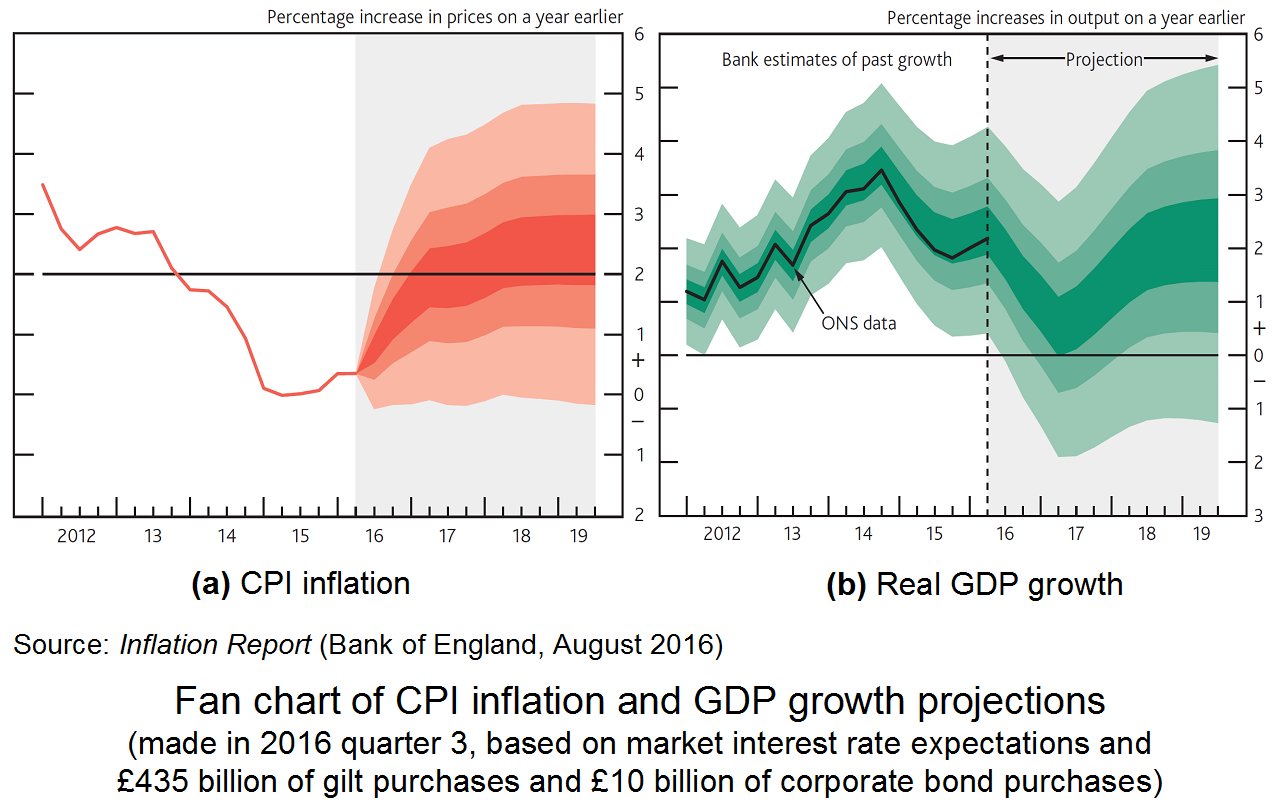 opening remarks at the Inflation Report press conference:
“The weakness in demand will itself weigh on supply as a period of low investment restrains growth in the capital stock and productivity.
There could also be more direct implications for supply from the decision to leave the European Union. The UK’s trading relationships are likely to change, but precisely how will be unclear for some time. If companies are uncertain about the future impact of this on their businesses, they could delay decisions about building supply capacity or entering new markets.”
Three main measures were announced.
|
|
| • |
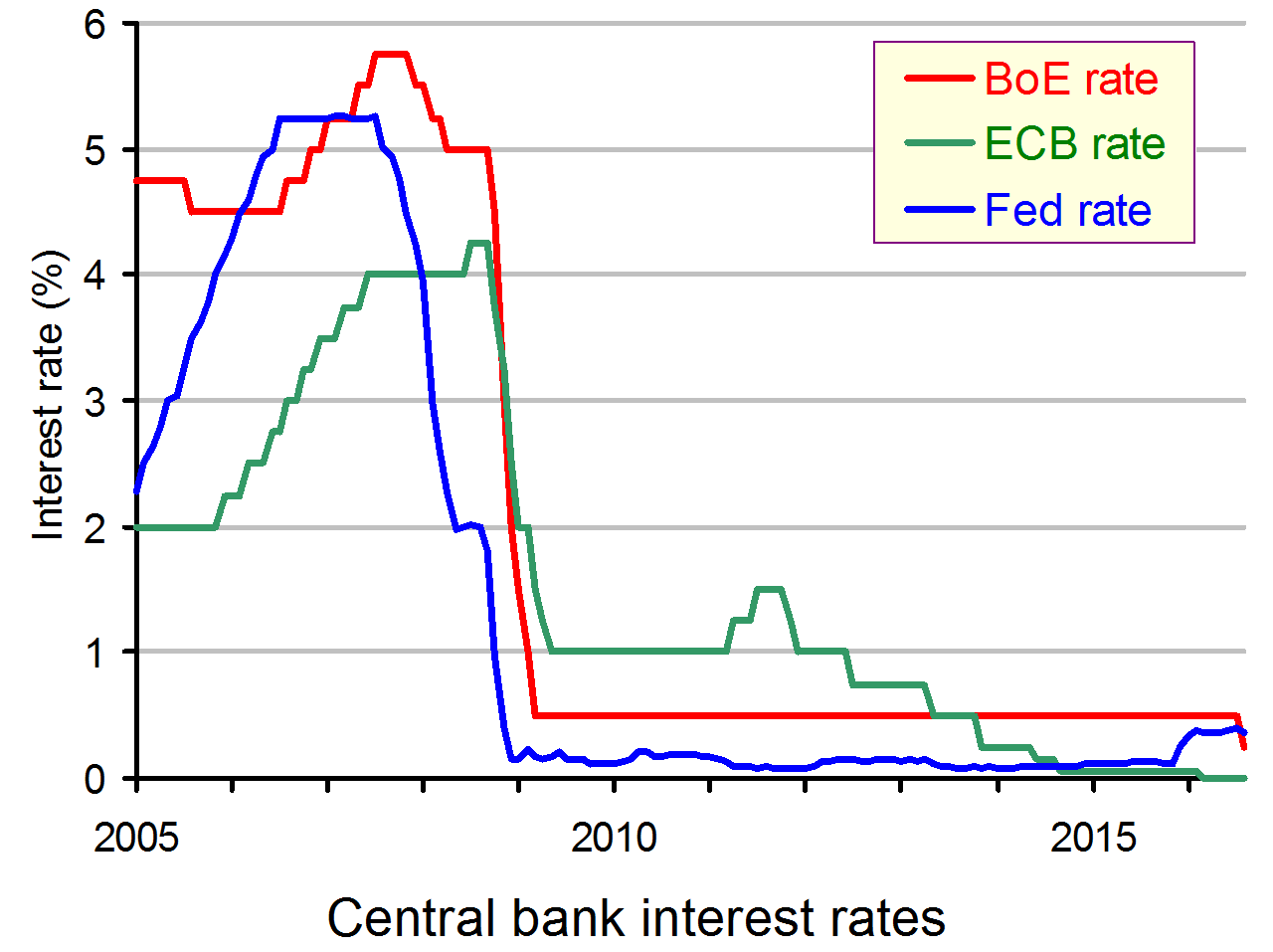
A cut in Bank Rate from 0.5% to 0.25%. This is the first time Bank Rate has been changed since March 2009. The Bank hopes that banks will pass this on to customers in terms of lower borrowing rates. |
| • |
A new ‘Term Funding Scheme (TFS)’. “Compared to the old Funding for Lending Scheme, the TFS is a pure monetary policy instrument that is likely to be more stimulative pound-for-pound.” The scheme makes £100bn of central bank reserves available as loans to banks and building societies. These will be at ultra-low interest rates to enable banks to pass on the new lower Bank Rate to customers in all forms of lending. What is more, banks will be charged a penalty if they do not lend this money. |
| • |
An expansion of the quantitative easing programme beyond the previous £375 billion of gilt (government bond) purchases. This will consist of an extra £60bn of gilt purchases and the purchase of up to £10bn of UK corporate bonds. |
 The Bank recognises that there is a limit to what monetary policy can do and that there is also a role to play for fiscal policy. The new Chancellor, Philip Hammond, is considering what fiscal measures can be taken, including spending on infrastructure projects. These are likely to have relative high multiplier effects and would also increase aggregate supply at the same time. But we will have to wait for the Autumn Statement to see what measures will be taken.
But despite the limits to monetary policy, there is more the Bank of England could do. It already recognises that there may have to be a further cut in Bank Rate, perhaps to 0.1% or even to 0% (the ECB has a 0% rate). There could also be additional quantitative easing or additional term funding to banks.
 Some economists argue that the Bank should go further still and, in conjunction with the Treasury, provide new money directly to fund infrastructure spending or tax cuts, or even as cash handouts to households. This extra money provided to the government would not increase government borrowing.
We discussed the use of this version of ‘helicopter money’ in the blogs, A flawed model of monetary policy, Global warning and People’s quantitative easing. Some of the articles below also consider the potential for this type of monetary policy. In a letter to The Guardian 35 economists advocate:
A fiscal stimulus financed by central bank money creation [which] could be used to fund essential investment in infrastructure projects – boosting the incomes of businesses and households, and increasing the public sector’s productive assets in the process. Alternatively, the money could be used to fund either a tax cut or direct cash transfers to households, resulting in an immediate increase of household disposable incomes.
Webcasts and podcasts
Inflation Report Press Conference Bank of England, Mark Carney (4/8/16)
Bank spells out chance of further rate cut this year BBC Radio 4 Today Programme, Ben Broadbent, Deputy Governor of the Bank of England (5/8/16)
Broadbent Ready to Back Another BOE Rate Cut Amid Slowdown Bloomberg, Chris Wyllie (5/8/16)
What’s Top of Mind? ‘Helicopter Money’ Goldman Sachs Macroeconomic Insights, Allison Nathan (April 2016)
Articles
Bank of England measures
Interest rate cut: What did the Bank of England announce today and how will it affect you? Independent, Ben Chu (5/8/16)
This is the Bank of England’s all-action response to Brexit The Guardian, Larry Elliott (4/8/16)
Bank of England unveils four-pronged stimulus package in bid to avoid Brexit recession The Telegraph, Szu Ping Chan (4/8/16)
Record-breaking Bank of England Financial Times, Robin Wigglesworth (4/8/16)
The Bank of England has delivered – now for a fiscal response Financial Times (4/8/16)
Bank of England Cuts Interest Rate to Historic Low, Citing Economic Pressures New York Times, Chad Bray (4/8/16)
Sledgehammer? This is more like the small tool to fix a fence The Telegraph, Andrew Sentance (5/8/16)
All eyes are on Hammond as Bank runs low on options The Telegraph, Tom Stevenson (6/8/16)
Bank of England’s stimulus package has bought the chancellor some time The Guardian, Larry Elliott (7/8/16)
Helicopter money
A post-Brexit economic policy reset for the UK is essential Guardian letters, 35 economists (3/8/16)
Cash handouts are best way to boost British growth, say economists The Guardian, Larry Elliott (4/8/16)
Helicopter money: if not now, when? Financial Times, Martin Sandbu (2/8/16)
The helicopters fly on for now, but one day they will crash The Telegraph, Tom Stevenson (23/7/16)
Is the concept of ‘helicopter money’ set for a resurgence? The Conversation, Phil Lewis (2/8/16)
Helicopter money talk takes flight as Bank of Japan runs out of runway Reuters, Stanley White (30/7/16)
Helicopters 101: your guide to monetary financing Deutsche Bank Research, George Saravelos, Daniel Brehon and Robin Winkler (15/4/16)
Helicopter money is back in the air The Guardian, Robert Skidelsky (22/9/16)
Bank of England publications
Inflation Report, August 2016 Bank of England (4/8/16)
Inflation Report Press Conference: Opening Remarks by the Governor Bank of England, Mark Carney (4/8/16)
Inflation Report Q&A Bank of England Press Conference (4/8/16)
Inflation Report, August 2016: Landing page Bank of England (4/8/16)
Questions
- Find out the details of the previous Funding for Lending (FLS) scheme. How does the new Term Funding Scheme (TFS) differ from it? Why does the Bank of England feel that TFS is likely to be more effective than FLS in expanding lending?
- What is the transmission mechanism between asset purchases and real aggregate demand?
- What factors determine the level of borrowing in the economy? How is cutting Bank Rate from 0.5% to 0.25% likely to affect borrowing?
- If the Bank of England’s latest forecast is for a significant reduction in economic growth from its previous forecast, why did the Bank not introduce stronger measures, such as larger asset purchases or a cut in Bank Rate to 0.1%?
- What are the advantages and disadvantages of helicopter money in the current circumstances? If helicopter money were used, would it be better to use it for funding public-sector infrastructure projects or for cash handouts to households, either directly or in the form of tax cuts?
- How does the Bank of England’s measures of 4 August compare with those announced by the Japanese central bank on 29 July?
- What effects can changes in aggregate demand have on aggregate supply?
- What supply-side policies could the government adopt to back up monetary and fiscal policy? Are the there lessons here from the Japanese government’s ‘three arrows’?
 In a recent blog, Falling sterling – bad for some; good for others, we looked at the depreciation of sterling following the Brexit vote. We saw how it will have beneficial effects for some, such as exporters, and adverse effects for others, such as consumers having to pay a higher price for imports and foreign holidays. The article linked below examines these effects in more depth.
Just how much the quantity of exports will increase depends on two main things. The first is the amount by which the foreign currency price falls. This depends on what exporters choose to do. Say the pound falls from €1.30 to €1.18. Do exporters who had previously sold a product selling in the UK for £100 and in the eurozone for €130, now reduce the euro price to €118? Or do they put it down by less – say, to €125, thereby earning £105.93 (£(125/1.18)). Their sales would increase by less, but their profit margin would rise.
The second is the foreign currency price elasticity of demand for exports in the foreign markets. The more elastic it is, the more exports will rise for any given euro price reduction.
 It is similar with imports. How much the sales of these fall depends again on two main things. The first is the amount by which the importing companies are prepared to raise sterling prices. Again assume that the pound falls from €1.30 to €1.18 – in other words, the euro rises from 76.92p (£1/1.3) to 84.75p (£1/1.18). What happens to the price of an import to the UK from the eurozone whose euro price is €100? Does the importer raise the price from £76.92 to £84.75, or by less than that, being prepared to accept a smaller profit margin?
The second is the sterling price elasticity of demand for imports in the UK. The more elastic it is, the more imports will fall and, probably, the more the importer will be prepared to limit the sterling price increase.
The article also looks at the effect on aggregate demand. As we saw in the previous blog, a depreciation boosts aggregate demand by increasing exports and curbing imports. The effects of this rise in aggregate demand depends on the degree of slack in the economy and the extent, therefore, that (a) exporters and those producing import substitutes can respond in terms of high production and employment and (b) other sectors can produce more as multiplier effects play out.
Finally, the article looks at the effect of the depreciation of sterling on asset prices. UK assets will be worth less in foreign currency terms; foreign assets will be worth more in sterling. Just how much the prices of internationally traded assets, such as shares and some property, will change depends, again, on their price elasticities of demand. In terms of assets, there has been a gain to UK balance sheets from the depreciation. As Roger Bootle says:
Whereas the overwhelming majority of the UK’s liabilities to foreigners are denominated in sterling, the overwhelming bulk of our assets abroad are denominated in foreign currency. So the lower pound has raised the sterling value of our overseas assets while leaving the sterling value of our liabilities more or less unchanged.
Article
How a lower pound will help us to escape cloud cuckoo land, The Telegraph, Roger Bootle (31/7/16)
Questions
- What determines the amount that exporters from the UK adjust the foreign currency price of their exports following a depreciation of sterling?
- What determines the amount by which importers to the UK adjust the sterling price of their products following a depreciation of sterling?
- What determines the amount by which sterling will depreciate over the coming months?
- Distinguish between stabilising and destabilising speculation? How does this apply to exchange rates and what determines the likelihood of there being destabilising speculation against sterling exchange rates?
- How is UK inflation likely to be affected by a depreciation of sterling?
- Why does Roger Bootle believe that the UK has been living in ‘cloud cuckoo land’ with respect to exchange rates?
- Why has the UK managed to sustain a large current account deficit over so many years?