 One of the reasons why it is so hard to forecast economic growth and other macroeconomic indicators is that economies can be affected by economic shocks. Sometimes the effects of shocks are large. The problem with shocks is that, by their very nature, they are unpredictable or hard to predict.
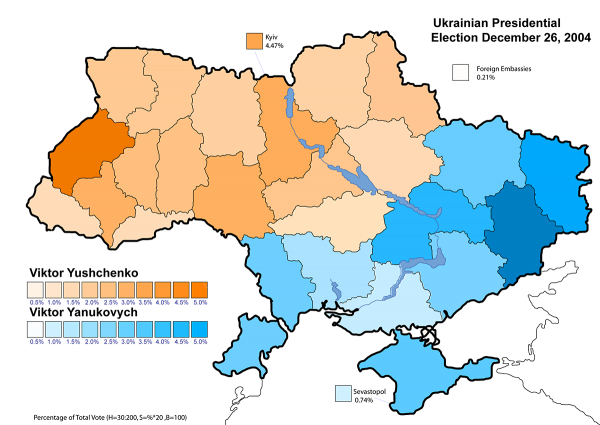
A case in point is the current crisis in Ukraine. First there was the uprising in Kiev, the ousting of President Yanukovich and the formation of a new government. Then there was the seizing of the Crimean parliament by gunmen loyal to Russia. The next day, Saturday March 1, President Putin won parliamentary approval to invade Ukraine and Russian forces took control of the Crimea.
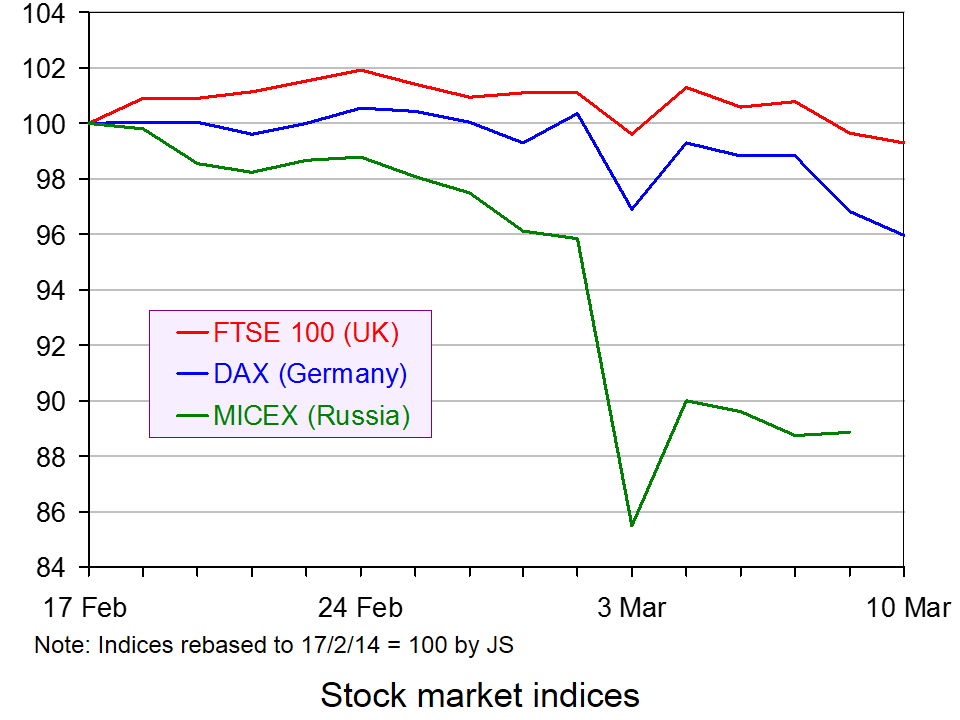 On Monday 3 March, stock markets fell around the world. The biggest falls were in Russia (see chart). In other stock markets, the size of the falls was directly related to the closeness of trade ties with Russia. The next day, with a degree of calm descending on the Crimea and no imminent invasion by Russia of other eastern parts of Ukraine, stock markets rallied.
What will happen to countries’ economies depends on what happens as the events unfold. There could be a continuing uneasy peace, with the West effectively accepting, despite protests, the Russian control of the Crimea. But what if Russia invades eastern Ukraine and tries to annex it to Russia or promote its being run as a separate country? What if the West reacted strongly by sending in troops? What if the reaction were simply sanctions? That, of course would depend on the nature of those sanctions.
Some of the possibilities could have serious effects on the world economy and especially the Russian economy and the economies of those with strong economic ties to Russia, such as those European countries relying heavily on gas and oil imports from Russia through the pipeline network.
Economists are often criticised for poor forecasts. But when economic shocks can have large effects and when they are hard to predict by anyone, not just economists, then it is hardly surprising that economic forecasts are sometimes highly inaccurate.
What Wall Street is watching in Ukraine crisis USA Today (3/3/14)
Ukraine’s economic shock waves – magnitude uncertain Just Auto, Dave Leggett (7/3/14)
Ukraine: The end of the beginning? The Economist (8/3/14)
Russia will bow to economic pressure over Ukraine, so the EU must impose it The Guardian, Guy Verhofstadt (6/3/14)
Russia paying price for Ukraine crisis CNN Money, Mark Thompson (6/3/14)
Ukraine Crimea: Russia’s economic fears BBC News, Nikolay Petrov (7/3/14)
How Russia’s conflict with Ukraine threatens vital European trade links The Telegraph, Szu Ping Chan (8/3/14)
Will a Russian invasion of Ukraine push the west into an economic war? Channel 4 News, Paul Mason (2/3/14)
Who loses from punishing Russia? BBC News, Robert Peston (4/3/14)
Should Crimea be leased to Russia? BBC News, Robert Peston (7/3/14)
The Ukraine Economic Crisis Counter Punch, Jack Rasmus (7-9/3/14)
UK price rise exposes failure to prepare for food and fuel shocks The Guardian, Phillip Inman (2/3/14)
Questions
- What sanctions could the West realistically impose on Russia?
- How would sanctions against Russia affect (a) the Russian economy and (b) the economies of those applying the sanctions?
- Which industries would be most affected by sanctions against Russia?
- Is Russia likely to bow to economic pressure from the West?
- Should Crimea be leased to Russia?
- Is the behaviour of stock markets a good indication of people’s expectations about the real economy?
- Identify some other economic shocks (positive and negative) and their impact.
- Could the financial crisis of 2007/8 be described as an economic shock? Explain.
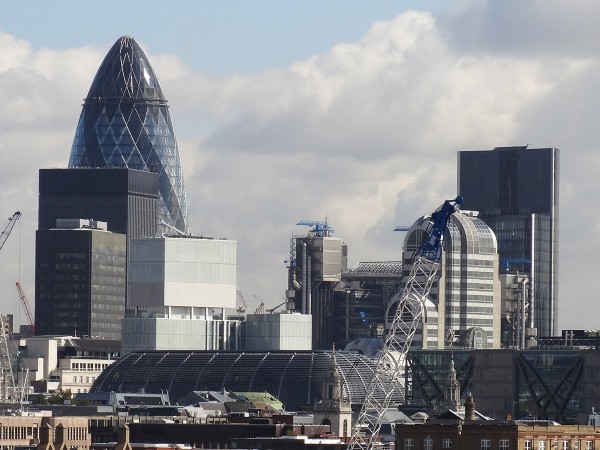 While much of the UK is struggling to recover from recession, the London economy is growing strongly. This is reflected in strong investment, a growth in jobs and rapidly rising house prices.
There are considerable external economies of scale for businesses locating in London. There is a pool of trained labour and complementary companies providing inputs and services are located in close proximity. Firms create positive externalities to the benefit of other firms in the same industry or allied industries.
London is a magnet for entrepreneurs and highly qualified people. Innovative ideas and business opportunities flow from both business dealings and social interactions. As Boris Johnson says in the podcast, “It’s like a cyclotron on bright people… People who meet each other and spark off each other, and that’s when you get the explosion of innovation.”
 Then there is a regional multiplier effect. As the London economy grows, so people move to London, thereby increasing consumption and stimulating further production and further employment. Firms may choose to relocate to London to take advantage of its buoyant economy. There is also an accelerator effect as a booming London encourages increased investment in the capital, further stimulating economic growth.
But the movement of labour and capital to London can dampen recovery in other parts of the economy and create a growing divide between London and other parts of the UK, such as the north of England.
The podcast examines ‘agglomeration‘ in London and how company success breeds success of other companies. It also looks at some of the downsides.
Podcast
Boris Johnson: London is cyclotron on bright people BBC Today Programme, Evan Davis (3/3/14)
Articles
London will always win over the rest of the UK The Telegraph, Alwyn Turner (2/3/14)
Evan Davis’s Mind The Gap – the view from Manchester The Guardian, Helen Pidd (4/3/14)
London incubating a new economy London Evening Standard, Phil Cooper (Founder of Kippsy.com) (10/2/14)
Reports and data
London Analysis, Small and Large Firms in London, 2001 to 2012 ONS (8/8/13)
Regional Labour Market Statistics, February 2014 ONS (19/2/14)
London Indicators from Labour Market Statistics (11 Excel worksheets) ONS (19/2/14)
Annual Business Survey, 2011 Regional Results ONS (25/7/13)
Economies of agglomeration Wikipedia
Questions
- Distinguish between internal and external economies of scale.
- Why is London such an attractive location for companies?
- Are there any external diseconomies of scale from locating in London?
- In what ways does the expansion of London (a) help and (b) hinder growth in the rest of the UK?
- Examine the labour statistics (in the links above) for London and the rest of the UK and describe and explain the differences.
 Business performance is always affected by the economy and we can always look at the economic theory to explain why profits rise and fall. Some companies prosper during recession, whereas others decline and the key is to understand the economics behind the data. This blog takes a look at the performance of a variety of companies and asks you to think about the economic theory behind it.
The world of betting has grown significantly and the profits of companies in this market, while certainly linked to economic performance, is also dependent on sport results. Paddy Power has announced pre-tax profits of €141m for 2013, an increase from €139.2m, despite sporting results causing profit performance to fall. On the part of football clubs, Liverpool FC saw a loss emerge for the 2012-2013 financial year, whereas Newcastle’s profits rose by 900% to £9.9m. What factors can explain the vastly different performance (off and on the pitch) of these two clubs?
In the USA, Radio Shack has been forced to close 1100 stores. This is, in part, as a response to a change in the way we are shopping. More and more consumers are purchasing goods online and Radio Shack is therefore experiencing growing competition from online retailers. Sales fell by 10% last year and even during the fourth quarter sales continued to decline.
Companies based in the largest economy in Europe have also experienced declines in performance, showing that a strong performing country doesn’t imply the same for companies operating in it. RWE, Germany’s biggest energy provider, has not made a loss since 1949. However, in 2013, this company posted its first annual loss in over 60 years: a loss of £2.28bn. With energy being in constant demand and criticism being levelled at UK energy providers for the high profits they’re making, the economics behind these data is important.
In better news for a company, Thorntons has boasted a significant increase in pre-tax profits, with much of this due to strong trading in the months leading up to Christmas and a sensible business strategy, involving selling more in supermarkets. Thorntons has cut its number of stores, but its profitable position has been saved by a good business strategy and this is going to lead to significant investment by the company.
Another strong performance was recorded by Berkshire Hathaway, an investment firm run by Warren Buffett. The company made a profit of £11.6bn in 2013, a significant increase on its 2012 performance. It is the insurance, rail and energy parts of the business that have contributed to the big increase in profits.
These are just some recent examples of data on business performance and your job is to think about the economic theory that can be used to explain the varying performance of different companies.
Liverpool announce annual loss of £50m in new club accounts Guardian, David Conn (4/3/14)
Thorntons makes biggest manufacturing investment for 25 years Telegraph, Natalie Thomas (3/3/14)
Thorntons cashes in on the snowman Independent, Simon Neville (3/3/14)
Warren Buffett’s Berkshire Hathaway sees record profit BBC News (2/3/14)
Newcastle says ‘player trading’ helped increase profits to £9.9m BBC Sport (25/2/14)
RWE posts first annual net loss for over 60 years BBC News (4/3/14)
UK among RWE woes as it posts first annual loss since 1949 The Telegraph, Denise Roland (4/3/14)
Germany’s RWE slides into €2.8bn net loss for 2013 Financial Times, Jeevan Vasagar (4/3/14)
John Menzies profits hit by drop in magazine sales BBC News (4/3/14)
Fresnillo profits drop as gold prices and production falls The Telegraph, Olivia Goldhill (4/3/14)
Glencore 2013 profit rises 20% as copper production gains Bloomberg, Jesse Riseborough (4/3/14)
Questions
- In each of the cases above, explain the economic theory that can be used to explain the performance of the respective company.
- To what extent is a change in the market structure of an industry a contributing factor to the change in company performance?
- To what extent do you think a company’s performance is dependent on the performance of the economy in which it operates?
- Are the profits of a company a good measure of success? What else could be used?
 One of the reasons why it is so hard to forecast economic growth and other macroeconomic indicators is that economies can be affected by economic shocks. Sometimes the effects of shocks are large. The problem with shocks is that, by their very nature, they are unpredictable or hard to predict.