 Wobbles in the private credit market in the fourth quarter of 2025 spooked those retail investors with investments in private credit funds – a significant segment of the growing shadow banking sector. These funds use investors’ money to finance lending to businesses and individuals who struggle to, or do not want to, access credit from banks and the public market. Therefore, the risks are higher.
The failures of two auto parts suppliers in the USA last year have highlighted the risks involved. Retail investors are exiting such funds in significant numbers. Bcred, Blackstone’s $82 billion private credit fund, saw money equivalent to 8% of its net asset value (NAV) withdrawn. The firm, and employees, put $400m in to maintain confidence.
Blue Owl, another credit manager, closed investors’ usual quarterly redemption window, largely due to unprecedented demand. The fund’s managers have decided that they will wind down the fund and return money back to investors over time, whether that want it or not.
Several other listed funds run by big names, such as Blackrock and KKR, have slashed dividends and written down asset values. This week, both Morgan Stanley and Cliffwater limited withdrawals from their credit funds.
So, what has happened? In recent years, there has been a big growth in private credit funds in the USA aimed at individual retail investors. With interest margins low and fees from public investment products diminishing due to the shift to passive investing, financial institutions spied an opportunity for chunky fees by offering private credit investment to retail investors.
The liquidity–return trade-off
 Such investors are attracted by the potential for higher returns that private credit funds offered compared to public funds. The need to provide higher returns was related partly to the higher credit risk associated with the lending, but also to the illiquidity of the private credit assets that the funds invested in.
While much attention in the financial media has focused on the heightened credit risk in private funds, less attention has been given to the liquidity issue. At the heart of the private credit business model is a level of illiquidity that individual retail investors would not be comfortable with. The liquidity–return trade-off is one of the fundamental concepts in finance. Investors must be prepared to trade-off liquidity for higher returns, and vice versa. They cannot have both.
This blog will discuss that trade-off in the context of private credit funds and its lessons for retail investors, particularly in Europe where institutions are gearing up to offer such investment products.
Liquidity preference
One of the fundamental concepts in finance is the maturity mismatch between the preferences of ultimate lenders (typically households) and the requirements of ultimate borrowers (typically firms, but also households and governments too). Typically, lenders want to ‘lend short’ while borrowers want to ‘borrow long’. The financial system reconciles this mismatch by providing two important economic functions – maturity transformation and liquidity provision.
 Banks offer maturity transformation by offering current and other accounts to individuals where deposits can be redeemed at short notice. These institutions use the deposits to finance long-term lending for a variety of purposes; examples include property, investment in capital or day-to-day spending. Their effective management of this process is important economically for the smooth running of the payments mechanism and for economic growth.
But, to fulfil this, banks have to hold a mixture of assets with varying degrees of liquidity – some highly liquid, such as cash and short-term government debt instruments, and some illiquid, such as long-term loans. Liquidity is such an important issue for banks that their assets are listed on their balance sheet in order of liquidity – from most liquid to least liquid.
However, there is an inverse relationship between liquidity and expected return. Banks and their customers have to sacrifice return if they want higher liquidity. Therefore, liquid assets tend to offer a low rate of return and illiquid assets a higher rate of return. Consequently, in order to retain sufficient liquidity, the overall return banks can generate is limited compared to a situation where they invest wholly in illiquid assets.
If individuals want to invest directly in long-term financial assets, such as debt and equity, there must be a secondary market where these can be bought and sold – the stock market. Without this mechanism providing liquidity, individuals are less likely to invest in these assets in the first place. Few would want to wait for a debt security to mature or hold a share in perpetuity. Secondary markets mean they don’t have to.
Liquidity and private credit
Private credit funds have existed for a long time as part of the shadow banking sector and have grown in scale. Such funds invest in non-tradable, long-term illiquid loans as a parallel to the better-known private equity sector. Traditionally they have been targeted at institutional investors, who are more comfortable with the higher credit risk and illiquidity involved.
However, while institutions are prepared to forgo liquidity for many years in expectation of higher returns, individual retail investors are not – they have a higher liquidity preference. Funds tailoring private credit funds acknowledged that individual investors required a liquidity incentive to invest. Since there is no liquid secondary market to facilitate liquidation, private funds aimed at such retail investors offered quarterly redemption opportunities. The industry standard settled on around 5% of a fund’s value.
However, offering these ‘liquidity windows’ creates a tension in the private credit business model. Private credit operates on the basis of illiquidity in return for higher returns. This includes borrowers prepared to pay a higher interest rate on debt to avoid exposure to the glare of public market scrutiny.
Further, the prices of private loans are not ‘marked-to-the-market’ like publicly traded debt, so they are not correlated with public markets. This enables fund managers to work out credit problems over time rather than be forced into fire sales to meet the liquidity needs of investors.
 Offering liquidity confounds that. To do so, private credit funds end up operating like quasi-public funds. They have to hold sufficient liquid assets to cover redemptions. Indeed, regulations for such funds in Europe are proposing a minimum of 20% of assets in liquid investments so there is a reserve to meet redemptions. But, by doing so, funds will not be able to generate the promised returns. Indeed, returns may be not much higher that that offered by public traded funds.
Further, providing quarterly redemption windows requires fair and timely valuations of the fund. Irrespective of perceptions around credit risk, if investors feel that the valuation is generous then many will want to take advantage of the liquidity window to redeem and no limit on withdrawals, be it 5%, 10% or whatever, is sufficient. However, with no secondary market mechanism to remove the excess demand, those told they cannot redeem their investment will only increase their demands for liquidity further and exit at the next available opportunity.
This irreconcilable tension in offering private credit funds to retail investors is being recognised. Not only are funds like Blue Owl being wound up, but the share prices of providers in the USA have fallen sharply as markets realise that the anticipated returns from selling private credit to retail investors are unlikely to be realised. Blackstone’s market capitalisation has halved from $250 billion at the end of 2024 to $134 billion on 11 March 2026.
But this is the moment when private credit funds are being offered to retail investors in Europe. The lesson for European retail investors from the US experience is that you can’t have high liquidity and high return. As with most allocation decisions, there is a trade-off.
Articles
Questions
- What is maturity transformation? Explain how banks conduct maturity transformation.
- What is liquidity provision? Explain how secondary financial markets provide liquidity.
- Explain why private credit funds offer a higher expected return than public ones?
- Analyse the pressures on profit margins in public markets which led financial institutions to offer private credit funds. In doing so, consider the ethics around offering such a product to retail investors.
- Explain why offering such funds to individual (retail) investors has not worked.
 Recently, a flurry of bankruptcies among non-bank financial intermediaries (NBFIs) in the USA has drawn attention to the risks associated with alternative credit channels in the shadow-banking sector – lending which is not financed with deposits. There is concern that this could be the start of a wave of bankruptcies among such NBFIs, especially given concerns about a potential downswing in the economic cycle – a time when defaults are more likely.
While providing alternative sources of funding, the opacity of lending in the shadow-banking sector means it is not clear what risks NBFIs face themselves and, more significantly, what risks they pose to the financial system as a whole. There is particular concern about the impact on regulated banks.
Already, JP Morgan Chase in its third quarter earnings report announced a $170m charge stemming from the bankruptcy of Tricolor, which specialised in sub-prime car financing. Mid-sized banks, Western Alliance and Zions Bancorp, have reported losses from loans to a group of distressed real estate funds. This has highlighted the interconnectedness between NBFIs and regulated banking, and the potential for problems in the shadow-banking sector to have a direct impact on mainstream banks.
In this blog, we will trace the secular trends in the financial systems of more advanced economies which have given rise to alternative credit channels and, in turn, to potential banking crises. We will explain the relationship between regulated banks and shadow banks, analysing the risks involved, the potential impact on the financial system and the policy implications.
What are the secular trends in banking?
The traditional model of commercial banking involved taking deposits and using them to finance loans to households and firms. However, cycles of banking crises, regulatory changes and financial innovation over the past 50 years produced new models.
First, banks diversified away from direct lending to providing other banking services – on-balance sheet activities, such as investing in financial securities, and off-balance sheet activities, such as acting as agents in the sale of financial securities.
Second, alternative credit channels based on financial markets have grown in significance.
 In the 1980s, international regulations around traditional banking activities – taking deposits and making loans – were being formalised by the Bank for International Settlements (BIS) under what became known as the Basel framework (see, for example, Economics section 18.2 or Economics for Business section 28.2). For the first time, this stipulated liquidity and capital requirements for international banks relating to their traditional lending activities. However, at the same time the deregulation of financial markets and financial innovation provided banks with opportunities to derive revenues from a range of other financial services.
After the financial crisis, liquidity and capital requirements for banks were tightened further through the Basel III regulations. Commercial banks had to have even higher levels of capital as a buffer for bad debts associated with direct lending. A higher level of capital to cover potential losses increases the marginal cost of lending, since each pound of additional loan requires additional capital. This reduced the marginal return, and consequently, the incentive to lend directly.
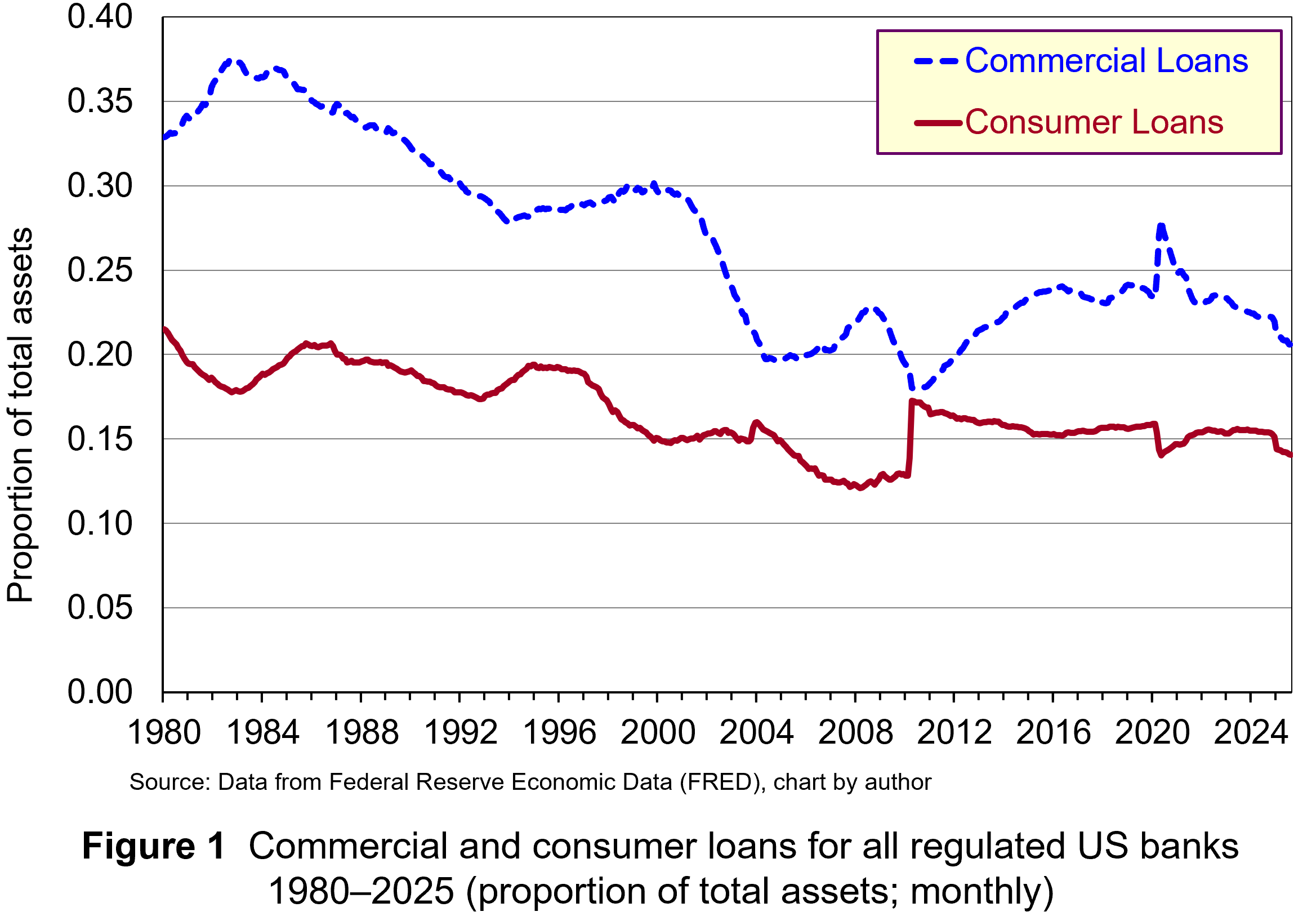 These regulatory developments created an incentive to pursue activities which do not require as much capital, since their marginal cost is lower and potential return is higher. Consequently, banks have placed less emphasis on lending and more on purchasing short-term and long-term financial securities and generating non-interest income from off-balance sheet activities. For instance, research by the Bank of England found that during the 1980s, interest income accounted for more than two-thirds of total income for large international banks. In contemporary times, non-interest income tends to be greater than interest income. Figure 1 illustrates the declining proportion of total assets represented by commercial and consumer loans for all regulated US banks. (Click here for a PowerPoint.)
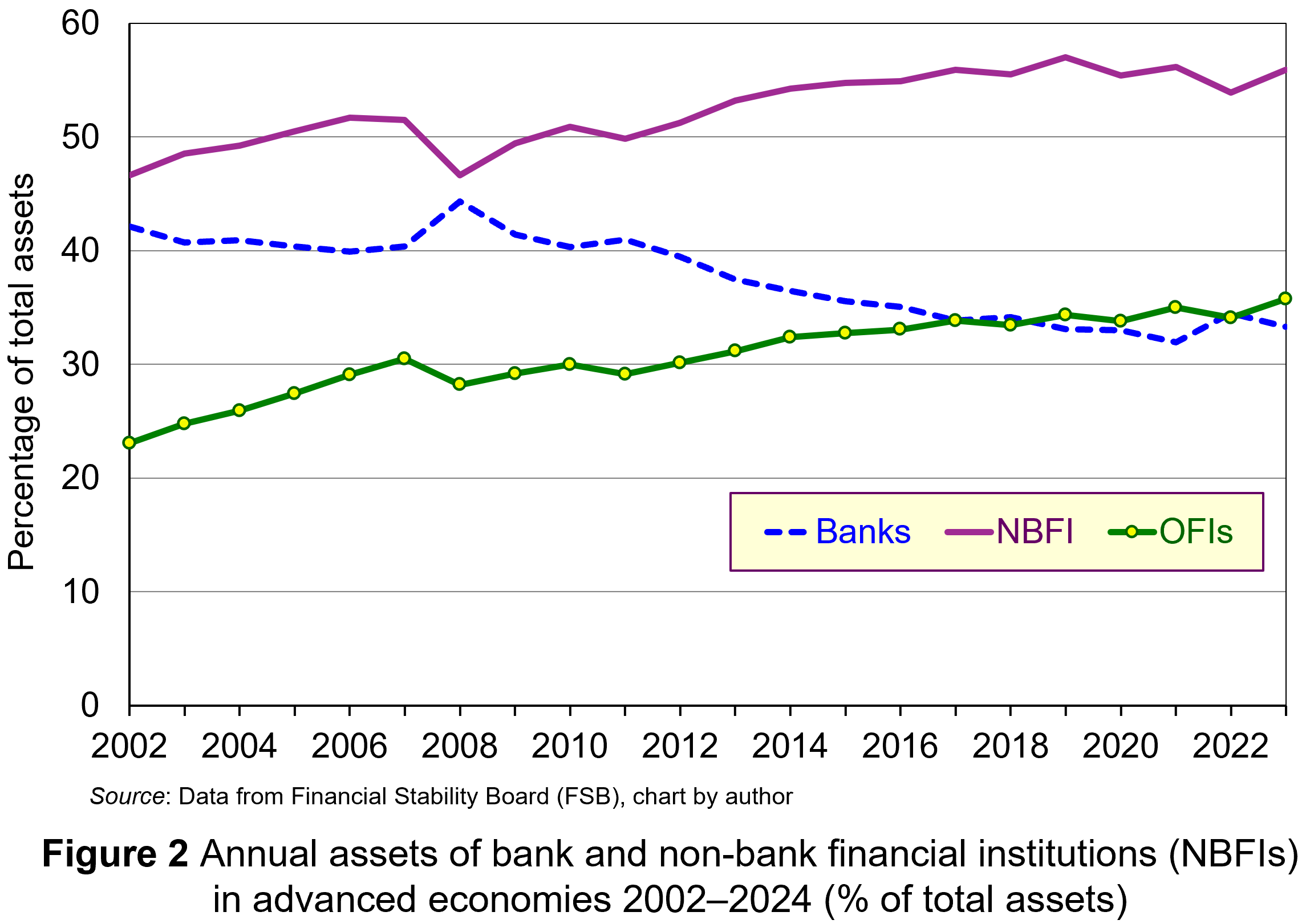 With banks originating less lending, activity has migrated to different avenues in the shadow-banking sector. This sector has always existed, but deregulation and financial innovation created opportunities for the growth of shadow banking – lending which is not financed with deposits. Traditionally, non-bank financial intermediaries (NBFIs), such as pension funds, hedge funds and insurance companies, use funds from investors to buy securities through financial markets. However, new types of NBFIs have emerged which originate loans themselves, notably private credit institutions. As Figure 2 illustrates, a lot of the expansion in the activities of NBFIs has been the due to increased lending by these institutions (defined as ‘other financial institutions (OFIs)). Note that the NBFI line includes OFIs. (Click here for a PowerPoint.)
Since, NBFIs operate outside conventional regulatory frameworks, their credit intermediation and maturity transformation are not subject to the same capital requirements or oversight that banks are. As a result, they do not need to have the same level of capital to insulate against loan losses. Therefore, lending in the shadow-banking sector has a lower marginal cost compared to equivalent lending in the banking sector. Consequently, it generates a higher rate of return. This can explain the large growth in the assets of OFIs illustrated in Figure 2.
Risks in shadow banking
 Banking involves trade-offs and this is the case whether the activities happen in the regulated or shadow-banking sector. Increasing lending increases profitability. But as lending continues to increase, at some point the risk-return profile becomes less favourable since institutions are lending to increasingly higher-risk borrowers and for higher-risk projects.
In downturns, when rates of defaults rise, such risks become apparent. Borrowers fail and default, causing significant loan losses for lenders. With lower levels of capital, NBFIs will have a lower buffer to insulate investors from these losses, increasing the likelihood of default.
Is this a problem? Well, for a long-time regulators thought not. It was thought that failures in the shadow-banking sector would have no implications for deposit-holders in regulated banks and the payments mechanism. Unfortunately, current developments in the USA have highlighted that this is unlikely to be the case.
The connections between regulated and shadow banking
The financial system is highly interconnected, and each successive financial crisis has shown that systemic risks lurk in obscure places. On the face of it, NBFIs appear separate from regulated banks. But banks’ new business models have not removed them from the lending channel, merely changed their role. Short-term financing used to be conducted and funded by banks. Now, it is conducted by NBFIs, but still financed by banks. Long-term loan financing is no longer on banks’ balance sheets. However, while the lending is conducted by NBFIs, it is largely funded by banks.
NBFIs cannot be repositories of liquidity. Since they do not have deposits and are not part of the payments system, they have no access to official liquidity backstops. So, they do so indirectly by using deposit-taking banks as liquidity insurance. Banks provide this liquidity in a variety of ways:
- Investing in the securities issued by private capital funds;
- Providing bridge financing to credit managers to securitise credit card receivables;
- Providing prime broker financing to a hedge fund engaged in proprietary trading.
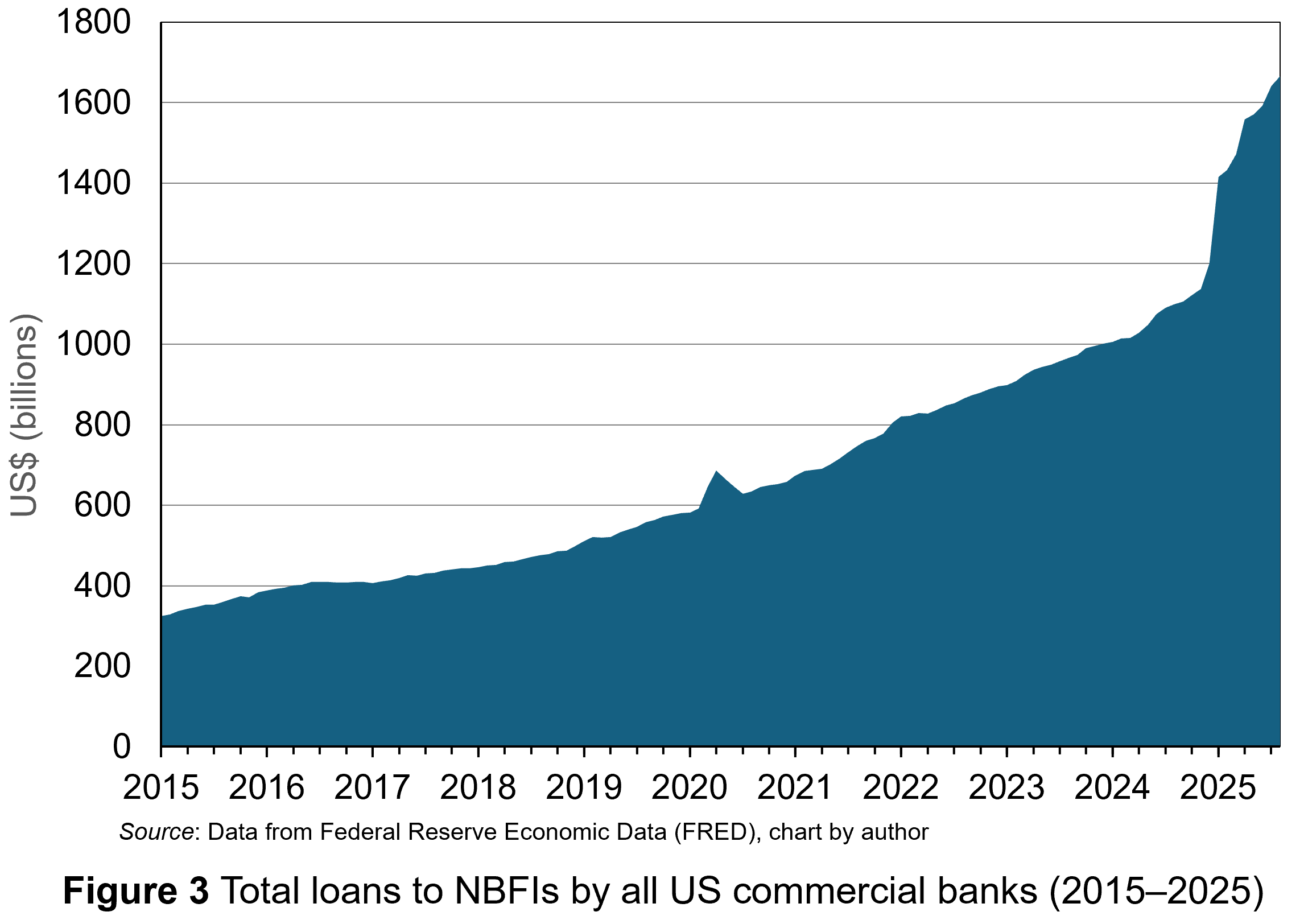 Furthermore, banks have increasingly made loans to NBFIs. Data for US commercial banks lending to the shadow-banking sector are publicly available only since 2015. But, as Figure 3 illustrates, it has seen a steady upward trend with a surge in activity in 2025. (Click here for a PowerPoint.)
Banks had an incentive to diversify into these activities since they are a source of revenue requiring less regulatory capital. The model requires risk and return to follow capital out of the banking system into the shadow-banking sector. However, while risky capital and its associated expected return have moved in the shadow-banking system, not all of the liquidity and credit default risk may have done so. Ultimately, some of that risk may be borne by the deposit-holders of the banks.
This is not an issue if banks are fully aware of the risks. However, problems arise when banks do not know the full risks they are taking.
There are reasons why this may be the case. Credit markets involve significant asymmetric information between lenders and borrowers. This creates conditions for the classic problems of moral hazard and adverse selection.
Moral hazard is a hidden action problem, whereby borrowers take greater risks because they share the possible downside losses with the lender. Adverse selection is the hidden information problem, whereby lenders do not have full information about the riskiness of borrowers or their activities.
The economics of information suggests that banks exploit scale, scope and learning economies to overcome the costs associated with asymmetric information in lending. However, that applies to direct lending when banks have full information about credit default risk on their loan book. When banks finance lending indirectly through NBFIs, there is an extension of the intermediation chain, and while banks may know the NBFIs, they will have much less information about the risks associated with the lending they are ‘underwriting’. This heightens their problems of asymmetric information associated with credit default risk.
What are the risks at present?
 The level of debt in the global economy is at unprecedented levels. Data from the International Monetary Fund (IMF) show that it rose to $351 trillion dollars in 2024, approximately 235% of weighted global gross domestic product (GDP). It is in this environment that private credit channels through NBFIs have been expanding. With this, it is more likely that NBFIs’ trade-off between credit risk and return has tilted greatly in favour of the former. Some point to the recent collapse of Tricolor and First Brands – both intermediary financing companies funded by private credit – as evidence of elevated levels of risk.
Many are pointing out that the failures observed in the USA so far have a whiff of fraud associated with them, with suggestions of multiple loans being secured against the same working capital. However, such behaviour is symptomatic of ‘late-cycle’ lending, where the incentive to squeeze more profit from lending in a more competitive environment leads to short-cuts – short-cuts that banks, at one stage removed along the intermediation chain, will have less information about.
It is in a downturn that such risks become apparent. Widening credit spreads and the reduced availability of credit causes financial stress for higher-risk borrowers. Inevitably, that higher risk will lead to higher defaults, more provision for loan losses and write-downs in the value of loan assets.
While investors in NBFIs are first in line to bear the losses, they are not the only ones exposed. At moments of stress, the credit lines that banks have provided get drawn and that increases the exposure of banks to the risks associated with NBFIs and whoever they have lent to. As NBFIs fail, the financing provided by banks will not be repaid and they will thus have to absorb losses associated with the lending of the NBFIs. So, while it appears that risk has left the banking system, it hasn’t. Ultimately, the liquidity and credit default risk of the non-bank sector is financed by bank deposits.
Furthermore, the opaqueness of the exposure of banks to risks in the shadow-banking sector may have issues for the wider financial system. In 2008, banks became wary of lending to each other during the financial crisis because they didn’t know the exposure of counterparty institutions to losses from securitised debt instruments. Now, as more and more banks reveal exposures to NBFIs, concerns about the unknown position of other banks may produce a repeat of the credit crunch which occurred then. A seizing up of credit markets will worsen any downturn. However, unlike 2008, the financial resources available to central banks and governments to deal with any consequences are severely limited.
Only time and the path of the US economy will reveal the extent of any contagion related to lending in the shadow-banking sector. However, central banks are already worried about the risks associated with the shadow-banking sector and have been taking steps to identify and ameliorate them. Events in the USA over the past few weeks may accelerate the process and bring more of that lending within the regulatory cordon.
Articles
- Bank chief says US firm collapses ring ‘alarm bells’
BBC News, Michael Sheils McNamee (21/10/25)
- BoE finds non-bank financial firms pose wider risks in crisis periods
Reuters, Lawrence White (2/12/24)
- Global Debt Remains Above 235% of World GDP
IMF Blogs, Vitor Gaspar, Carlos Eduardo Goncalves and Marcos Poplawski-Ribeiro (17/9/25)
- IMF sounds alarm about high global public debt, urges countries to build buffers
Reuters, Andrea Shalal (15/10/25)
- Major international banks performance 1980-91
Quarterly Bulletin 1992 Q3, Bank of England (1/9/92)
- Shadow Banking System: Definition, Examples, and How It Works
Investopedia, Michael Bromberg (18/10/24)
- What is private credit, and should we be worried by the collapse of US firms?
The Guardian, Kalyeena Makortoff (18/10/25)
Academic paper
Data
Questions
- Explain why the need to hold more capital raises its cost for banks.
- Why does this reduce the lending they undertake?
- What is the attraction of ‘off-balance sheet transactions’ for regulated banks?
- Analyse the asymmetric information that banks face when providing liquidity to non-bank financial institutions (NBFIs).
- Examine the dangers for the financial system associated with regulated banks’ exposure to NBFIs?
- Discuss some policy recommendations regarding bank lending to NBFIs.
The governor of the Bank of England, Mervyn King, made an important speech in New York on 25th October. The Governor’s speech was a wide-ranging discussion of the banking system. At the heart of it was a fundamental economic concept: market failure. The market failure that King was referring to stems from the maturity transformation which occurs when banks borrow short, say through our savings or wholesale funds from other financial institutions, and then lend long as is the case with mortgages. Of course, the positive outcome of this maturity transformation is that it does allow for funds to be pooled and this, in turn, enables long-term finance, something which is incredibly important for business and households. However, King believes that banks have become too heavily reliant on short-term debt to finance lending. Indeed he went so far as to describe their levels of leverage as ‘extraordinary’ and ‘absurd’. He argued that such a system can only work with the ‘implicit support of the taxpayer’.
In elaborating on the market failure arising from maturity transformation in today’s financial system, King notes
…the scale of maturity transformation undertaken today produces private benefits and social costs. We have seen from the experience of first Iceland, and now Ireland, the results that can follow from allowing a banking system to become too large relative to national output without having first solved the “too important to fail” problem.
In the speech, King considers a range of remedies to reduce the risks to the financial system. These include: (i) imposing a tax on banks’ short-term borrowing which could, to use the economic terminology, help internalise the external cost arising from maturity transformation; (ii) placing limits on banks’ leverage and setting capital requirements as outlined in the recent Basel III framework (for a discussion on Basel III see Basel III – tough new regulations or letting the banks off lightly?; (iii) functional separation of bank activities to safeguard those activities critical to the economy. King argues that whatever remedies we choose they should be guided by one fundamental principle: “ensure that the costs of maturity transformation – the costs of periodic financial crises – fall on those who enjoy the benefits of maturity transformation – the reduced cost of financial intermediation”.
Mervyn King’s speech makes considerable reference to our banks’ balance sheets. So to conclude this piece we consider the latest numbers on the liabilities of British banks. At the end of each month, in its publication Monetary and Financial Statistics, the Bank of England publishes figures on the assets and liabilities of Britain’s banking institutions or ‘MFIs’ (monetary and financial institutions). The latest release showed that British banks had total liabilities of some £8.15 trillion at the end of September 2010. To put it into perspective that’s equivalent to around 5½ times the country’s annual Gross Domestic Product. Of this sum, £3.75 trillion was classified as Sterling-denominated liabilities, so largely reflecting operations here in the UK, while £4.39 trillion was foreign currency liabilities reflecting the extent of over-seas operations.
The Sterling liabilities of our financial institutions are dominated by two principal deposit types: sight deposits and time deposits. The former are deposits that can be withdrawn on demand without penalty whereas time deposits require notice of withdrawals. Sterling sight deposits at the end of September totalled £1.16 trillion (31% of Sterling liabilities and 80% of annual GDP) while time deposits totalled £1.52 trillion (40% of Sterling liabilities and 105% of annual GDP). The next largest group of deposits are known repos or, to give them their full title, sales and repurchase agreements. Repos are essentially loans, usually fairly short-term, where banks can sell some of their financial assets, such as government debt, to other banks and this can help to ease any shortages in funds. Sterling-denominated repos totalled £197.8 billion at the end of September (8% of Sterling liabilities and 21% of annual GDP).
To conclude, the growth in our banking system’s liabilities has been pretty staggering. Compared with today’s liabilities of nearly £8.15 trillion, liabilities 13 years ago totalled £2.35 trillion. So over this period the banks’ liabilities have risen from a little below 3 times Gross Domestic Product to over 5½ times GDP. That is certainly worthy of analysis.
Mervyn King’s speech
Banking: from Bagehot to Basel, and back again The second Bagehot lecture, New York City (25/10/10)
Articles
Mervyn King mobilises his tanks Independent, Ben Chu (26/10/10)
Get tougher on banks, says banking governor Mervyn King’ Daily Mail, Hugo Duncan (26/10/10)
Mervyn King attacks ‘absurd’ bank risk BBC News (26/10/10)
Mervyn King says banking must be reinvented BBC News blogs: Peston’s Picks, Robert Peston (26/10/10)
Data
Data on banks’ liabilities and assets are available from the Bank of England’s statistics publication, Monetary and Financial Statistics (Bankstats) (See Table B1.4.)
Questions
- What do you understand by the terms: (i) market failure; and (ii) maturity transformation?
- What is the external cost identified by Mervyn King arising out of maturity transformation?
- What does it mean to internalise an external cost? Can you think of examples from everyday life where attempts are made to do this?
- Consider the various ‘remedies’ identified by Mervyn King to reduce the riskiness of our financial system. (You may wish to download the speech using the web link above).
- Distinguish between the following deposits: (i) time deposit; (ii) sight deposit; and (iii) repos.