 The share prices of various AI-related companies have soared in this past year. Recently, however, they have fallen – in some cases dramatically. Is this a classic case of a bubble that is bursting, or at least deflating?
Take the case of NVIDIA, the world’s most valuable company, with a market capitalisation of around $4.2 trillion (at current share prices). It designs and produces graphics cards and is a major player in AI. From a low of $86.62 April this year, its share price rose to a peak of $212.19 on 29 October. But then began falling as talk grew of an AI bubble. Despite news on 19 November that its 2025 Q3 earnings were up 62% to $57.0bn, beating estimates by 4%, its share price, after a temporary rise, began falling again. By 21 November, it was trading at around $180.
Other AI-related stocks have seen much bigger rises and falls. One of the biggest requirements for an AI revolution is data processing, which uses huge amounts of electricity. Massive data centres are being set up around the world. Several AI-related companies have been building such data centres. Some were initially focused largely on ‘mining’ bitcoin and other cryptocurrencies (see the blog, Trump and the market for crypto). But many are now changing focus to providing processing power for AI.
 Take the case of the Canadian company, Bitfarms Ltd. As it says on its site: ‘With access to multiple energy sources and strategic locations, our U.S. data centers support both mining and high-performance computing growth opportunities’. Bitfarms’ share price was around CAD1.78 in early August this year. By 15 October, it had reached CAD9.27 – a 421% increase. It then began falling and by 24 November was CAD3.42 – a decline of over 63%.
Data centres do have huge profit potential as the demand for AI increases. Many analysts are arguing that the current share price of data centres undervalues their potential. But current profits of such companies are still relatively low, or they are currently loss making. This then raises the question of how much the demand for shares, and hence their price, depends on current profits or future potential. And a lot here depends on sentiment.
If people are optimistic, they will buy and this will lead to speculation that drives up the share price. If sentiment then turns and people believe that the share price is overvalued, with future profits too uncertain or less than previously thought, or if they simply believe that the share price has overshot the value that reflects a realistic profit potential, they will sell and this will lead to speculation that drives down the share price
 The dot.com bubble of the late 1990s/early 2000s is a case in point. There was a stock market bubble from roughly 1995 to 2001, where speculative investment in internet-based companies caused their stock values to surge, peaking in late 1999/early 2000. There was then a dramatic crash. But then years later, many of these companies’ share prices had risen well above their peak in 2000.
Take the case of Amazon. In June 1997, its share price was $0.08. By mid-December 1999, it had reached $5.65. It then fell, bottoming out at $0.30 in September 2001. The dot-com bubble had burst.
But the potential foreseen in many of these new internet companies was not wrong. After 2001, Amazon’s share price began rising once more. Today, Amazon’s shares are trading at over $200 – the precise value again being driven largely by the company’s performance and potential and by sentiment.
So is the boom in AI-related stock a bubble? Given that the demand for AI is likely to continue growing rapidly, it is likely that the share price of companies providing components and infrastructure for AI is likely to continue growing in the long term. But just how far their share prices will fall in the short term is hard to call. Sentiment is a fickle thing.
Articles
Questions
- Using a supply and demand diagram, illustrate how speculation can drive up the share price of a company and then result in it falling.
- What is meant by overshooting in a market? What is the role of speculation in this process?
- Does a rapid rise in the price of an asset always indicate a bubble? Explain.
- What are the arguments for suggesting that markets are/are not experiencing an AI share price bubble? Does it depend of what part of the AI market is being considered?
- What is meant by the market capitalisation of a company? Is it a good basis for deciding whether or not a company’s share price is a true reflection of the company’s worth? What other information would you require?
- Find out what has been happening to the price of Bitcoin. What factors determine the price of Bitcoin? Do these factors make the price inherently unstable?
 The election of Donald Trump saw the market price of bitcoin rise from $67 839 on election day (5 November 2024) to £106 168 on 18 December: a rise of 56%. It was $104 441 the day before inauguration (20 January 2025).
Trump has been a keen supporter of cryptocurrencies. He has stated that he wants the USA to become the world’s ‘crypto capital’. Indeed, he and Melania Trump have launched their own meme coins hosted on the Solana blockchain. Meme coins are tokens, a form of cryptocurrency, inspired by specific individuals, characters, cartoons or artwork.
On 23 January, three days after his inauguration, President Trump signed an Executive Order. This states that it is:
…the policy of my Administration to support the responsible growth and use of digital assets, blockchain technology, and related technologies across all sectors of the economy, including by … protecting and promoting the ability of individual citizens and private-sector entities alike to access and use for lawful purposes open public blockchain networks without persecution, including the ability to develop and deploy software, to participate in mining and validating, to transact with other persons without unlawful censorship, and to maintain self-custody of digital assets…
The full Executive Order can be read here.
Cryptocurrencies
Although cryptocurrencies can be used for certain transactions and avoid the need for banks, their use as a medium of exchange or unit of account is limited by their price volatility. The supply of national or regional currencies, such as the US dollar, the euro and the pound sterling is controlled by central banks, and central banks have a key mandate of achieving price stability, where price is in terms of their currency’s consumer price index. Although exchange rates fluctuate and thereby affect the prices of internationally traded goods and assets, such fluctuations are small in comparison with crypto price fluctuations.
 The supply of many cryptocurrencies is not controlled with the objective of achieving price stability. Indeed, certain cryptocurrencies, such as bitcoin (the coins with the highest total market value of approximately $2060bn) have a limited maximum supply. The supply of bitcoin in January 2025 is officially 19.81m, 94.3% of the eventual official total of 21m. However, with some 1.8m coins lost, the current effective total supply is more like 18m and the ceiling 19.2m. New coins are created by ‘mining’, involving massive computer power to perform complex calculations. Coins in circulation at any one time are therefore fixed and increase only slowly and at a decelerating rate over time, with increased mining costs per coin. On any one day, however, the supply offered for sale can fluctuate wildly.
Some other crypto currencies also have a long-term supply ceiling and are created by mining. Others, such as ether (the coins with the second highest market value of approximately $394bn) do not have a fixed supply ceiling. They are not created by mining, but by a system known as ‘Proof-of-Stake (PoS)’. This uses the cryptocurrency’s owners, who stake some of their currency, to validate transactions on the Ethereum blockchain. They receive new ether as a reward. PoS uses considerably less energy than mining and hence is regarded as greener.
Unlike mined coins, Ethereum coins (ether) created by PoS can be ‘burned’: i.e. removed from circulating supply. This can more than offset new coins created and lead to a net decrease in supply. See the Fidelity Digital Assets and Paxful links below for a discussion of what determines the net burn/net creation rate of ether. Other coins, such as BNB (Binance’s cryptocurrency), have regular burns to control supply.
 There are some cryptocurrencies that are suitable as a medium of exchange and as a unit of value. These are ‘stablecoins’, whose value is linked 1:1 to a major currency, such as the US dollar or euro. Supply is adjusted to maintain this value. Stablecoins are used primarily for transactions. They account for some two-thirds of all transactions using crypto. They are particularly used for transactions in parts of the world with monetary instability and/or limited access to major currencies.
With the exception of stablecoins, crypto currencies are best seen as assets, rather than as a means of exchange or unit of account. As such, they are more comparable to gold than to conventional currencies.
The market for crypto in the long term
The market price of cryptocurrencies is determined by supply and demand. With limited supply, their price is likely to increase as demand is forecast to increase relative to supply. This is particularly the case with mined cryptocurrencies where there is a ceiling to supply. But even with PoS-created currencies, the amount supplied is likely to increase more slowly than demand, especially with burn mechanisms in place.
With many countries recognising and embracing cryptocurrencies as an asset, so the long-term price should rise. The endorsement by Donald Trump is likely to hasten this process.
The market for crypto in the short term
While the total supply of cryptocurrency is limited, the supply to market can fluctuate wildly, as can demand. This can cause huge gyrations in price.
Short-run demand and supply decisions are governed largely by expectations of future price changes, over anything from the next few hours to the coming months. If people think the price will rise, people will demand more, while those already holding crypto and thinking of selling will hold back. These actions will amplify the very effect they had predicted, namely a rise in price.
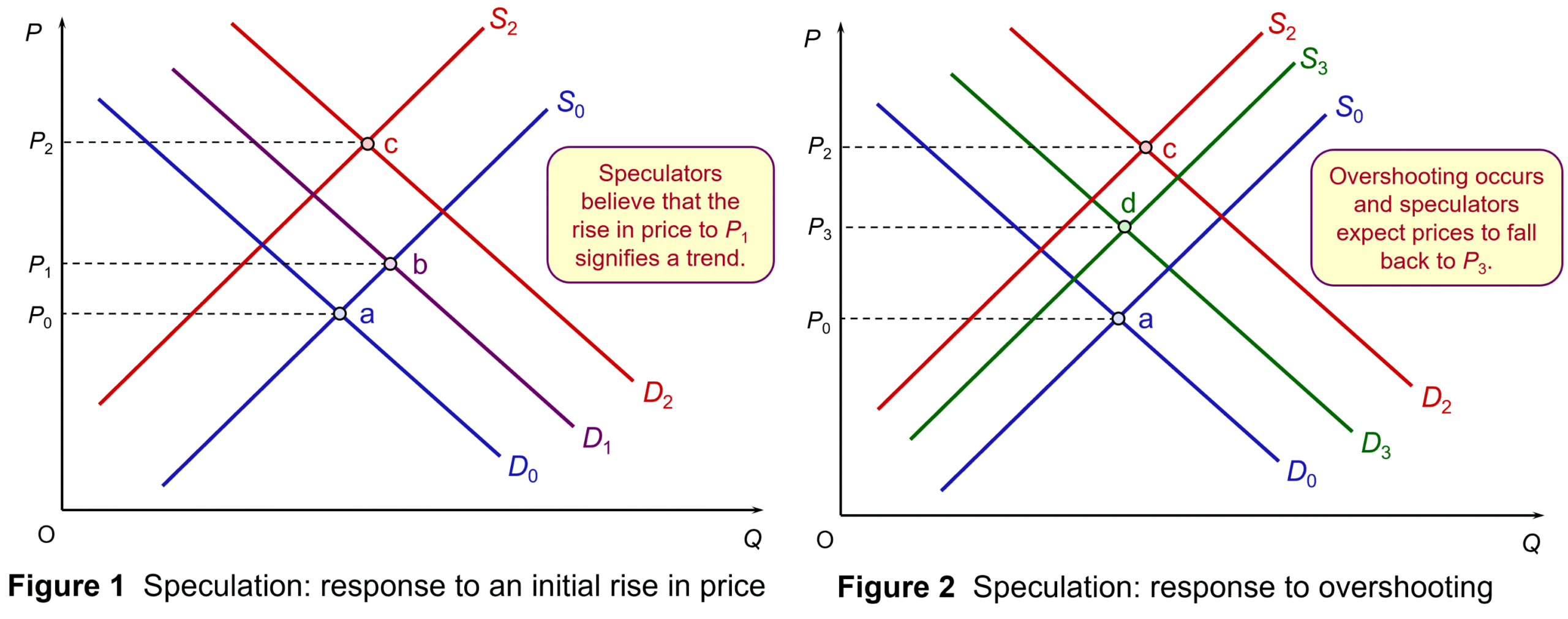
This is illustrated in Figure 1. Assume an initial rise in demand for a particular cryptocurrency from D0 to D1. Equilibrium moves from point a to point b and the price of the cryptocurrency rises from P0 to P1. Speculators believe that this is a trend and that prices will rise further. Demand increases to D2 as purchasers rush to buy; and supply falls to S2 as potential sellers of the crypto hold back. Equilibrium moves to point c and price rises to P2.
But in their exuberance, people may have pushed the price above the level that reflects underlying demand and supply. People respond to this overshooting by selling some of the currency to take advantage of what they see as a temporary high price. In Figure 2, supply rises from S2 to S3. Meanwhile, potential purchasers wait until price has settled back somewhat. Demand falls from D2 to D3. Equilibrium moves to point d, with price falling to P3. (Click here for a PowerPoint of the two diagrams.)

A similar process of speculation takes place when people expect prices to fall, with price potentially plummeting before it then recovers somewhat.
With computer algorithms interpreting underlying economic/political data, the price changes are likely to be frequent, with speculation amplifying these changes.
Articles
- Trump orders crypto working group to draft new regulations, explore national stockpile
Reuters, Hannah Lang and Trevor Hunnicutt (24/1/25)
- Bitcoin soars past $109,000 ahead of possible early action on crypto by Trump
MSN, Alan Suderman (20/1/25)
- 3 Things to Watch as Trump Becomes Memecoin Billionaire and US President
PYMNTS (20/1/25)
- Crypto Community Reacts to Trump and Melania Meme Coins as Market Sinks
Decrypt, Vismaya V (20/1/25)
- Trump’s plan for a strategic bitcoin reserve could trigger a crypto ‘arms race’ and reshape the global economic order
The Conversation, Huw Macartney, Erin McCracken and Robert Elliott (14/1/25)
- Bitcoin’s resurgence: A regulatory reset and a path to innovation
crypto.news, editorial (17/1/25)
- Bitcoin Retreats As Traders Await Trump Crypto Executive Order
Bloomberg on NDTV Profit (21/1/25)
- Bitcoin edges higher as investors shake off initial Trump Day One disappointment
Reuters, Tom Westbrook and Elizabeth Howcroft (21/1/25)
- Has bitcoin’s limited supply driven its rally? Experts weigh in
ABC News, Max Zahn (10/12/24)
Background information
Data
Questions
- What determines the supply of cryptocurrencies (a) in circulation; (b) to the market at any given time?
- Why are the prices of digital currencies so volatile?
- Why or why not are cryptocurrencies a good asset to hold?
- How may speculation (a) amplify and (b) dampen price fluctuations?
- What determines the net burn/net creation rate of ether?
- Should cryptocurrencies be classified as ‘money’?
What do tulips, nickel mining in Australia, South Seas trading, Beanie Babies and cryptocurrencies have in common? The answer is that they have all been the subject of speculative bubbles. In the first four cases the bubble burst. A question currently being asked is whether it will happen to bitcoin.
Bitcoin
 Bitcoin was created in 2009 by an unknown person, or people, using the alias Satoshi Nakamoto. It is a digital currency in the form of a line of computer code. Bitcoins are like ‘electronic cash’ which can be held or used for transactions, with holdings and transactions heavily encrypted for security – hence it is a form of ‘crytocurrency’. People can buy and sell bitcoins for normal currencies as well as using them for transactions. People’s holdings are held in electronic ‘wallets’ and can be accessed on their computers or phones via the Internet. Transfers of bitcoins from one person or organisation to another are recorded in a public electronic ledger in the form of a ‘blockchain‘.
The supply of bitcoins is not controlled by central banks; rather, it is determined by a process known as ‘mining’. This involves individuals or groups solving complex and time-consuming  mathematical problems and being rewarded with a new block of bitcoins.
The supply of bitcoins is currently growing at around 150 per hour and the current supply is around ₿16.7 million. However, the number of new bitcoins in a block is halved for every 210,000 blocks. This means that the rate of increase in the supply of bitcoins is slowing – the number generated being halved roughly every four years. The supply will eventually reach a maximum of ₿21 million, probably sometime in the next century, but around 99% will have been mined by around 2032.
The bitcoin bubble
The price of bitcoins has soared in recent months and especially in the past two. On 4 October, the price of a bitcoin was $4226; by 7 December it was nearly four times higher, at $16,858 – a rise of 399% in just nine weeks. Many people have claimed that this is a bubble, which will soon burst. Already there have been severe fluctuations. By December 10, for example, the price had fallen at one point to $13,152 – a fall of nearly 22% in just two days – only to recover to over $15,500 within a few hours.
So what determines the price of bitcoin? The simple answer is very straightforward – it’s determined by demand and supply. But what has been happening to demand and supply and why? And what will happen in the near and more distant future?
As we have seen, the supply is limited by the process of mining, which allows a relatively stable, but declining, increase. The explanation of the recent price rise and what will happen in the future lies on the demand side. Increasing numbers of people have been buying bitcoin, not because they want to use it for transactions, whether legitimate or illegal over the dark web, but because they want to invest in bitcoin. In other words, they want to hold bitcoin as an asset which is increasing in value. These people are known as ‘hodlers’ – a deliberate misspelling of ‘holders’.
But this speculation is of the destabilising form. The more prices have risen, the more people have bought bitcoin, thus pushing the price up further. This is a classic bubble, whereby the price does not reflect an underlying value, but rather the exuberance of buyers.
 The problem with bubbles is that they will burst, but just when is virtually impossible to predict with any accuracy. If the price of bitcoins falls, what will happen next depends on how the fall is interpreted. It could be interpreted as a temporary fall, caused by some people cashing in to take advantage of the higher prices. At the same time, other people, believing that it is only a temporary fall, will rush to buy, snapping up bitcoins at the temporary low price. This ‘stabilising speculation’ will move the price back up again.
However, the fall in price may be seen as the bubble bursting, with even bigger falls ahead. In this case, people will rush to sell before it falls further, thereby pushing the price even lower. This destabilising speculation will amplify the fall in prices.
But even if the bubble does burst, people may believe that another bubble will then occur and, once they think the bottom has been reached, will thus start buying again and there will be a second speculative rise in the price.
The crash could be very short-lived. This happened with the second biggest cryptocurrency, Ethereum. On 21 June this year, the price at the beginning of the day was $360. It then began to fall during the say. Once its price reached $315, it then collapsed by 96% to $13 with massive selling, much of it automatic with computers programmed to sell when the price falls by more than a certain amount. But then, on the same day, it rebounded. Within minutes it had bounced back and was trading at $337 at the end of the day. It is now trading at around $450 – up from around $300 four weeks ago.
Whether the bubble in bitcoin has more to inflate, when it will burst, and when it will rebound and by how much, depends on people’s expectations. But what we are looking at here is people’s expectations of what other people are likely to do – in other words, of other people’s expectations, which in turn depend on their expectations of other people’s expectations. This situation is known as a Keynesian Beauty Contest (see the blog, A stock market beauty contest of the machines). Perhaps we need a crystal ball.
Information site
Articles
- Is Bitcoin a bubble? Here’s what two bubble experts told us
Trade Online, Timothy B. Lee (8/12/17)
- Bitcoin and tulipmania have a lot more in common than you might think
Business Insider, Seth Archer (8/12/17)
- Bitcoin ends dramatic week with 20% slump followed by recovery
The Guardian, Jill Treanor (8/12/17)
- Putting a price on Bitcoin
The Economist, Buttonwood’s notebook (8/12/17)
- Is Bitcoin a Bubble Waiting to Pop?
InvestorPlace, Matt McCall (8/12/17)
- Bitcoin bubble follows classic pattern of investment mania
Financial Times, John Authers (8/12/17)
- The Bitcoin bubble – how we know it will burst
The Conversation, Larisa Yarovaya and Brian Lucey (6/12/17)
- Bitcoin isn’t a currency – and unless it becomes one it could be worthless
The Conversation, Vili Lehdonvirta (6/12/17)
- How Bitcoin futures trading could burst the cryptocurrency’s bubble
The Conversation, Nafis Alam (13/12/17)
- Op-ed: Bitcoin Is Not a Bubble; It’s in an S-Curve and It’s Just Getting Started
Bitcoin Magazine, Brandon Green (8/12/17)
- Bitcoin vs history’s biggest bubbles: They never end well
CNN Money, Daniel Shane (8/12/17)
- The 10 Most Ridiculous Price Bubbles In History
Business Insider, Vincent Fernando and Anika Anand (11/10/10)
- After bitcoin’s wild week, traders brace for futures launch
Reuters, Saqib Iqbal Ahmed (10/12/17)
Cryptocurrencies current market prices
Questions
- To what extent does Bitcoin meet the functions of money?
- Why is bitcoin unsuitable for normal transactions?
- To what extent is bitcoin like gold as a means of holding wealth?
- How would you advise someone thinking of buying bitcoin today? Explain why.
- Does a rapid rise in the price of an asset always indicate a bubble? Explain
- To what extent is the current rise in the price of bitcoin similar to that of the tulip, Poseidon and Beanie Baby bubbles?
- If bitcoin is appreciating relative to the dollar and other currencies, does this mean that the price of goods and services valued in bitcoin are falling? Explain.
- Explain and comment on the following sentence from the first Conversation article: “Like any asset, Bitcoin has some fundamental value, even if only a hope value, or a value arising from scarcity.”
- How might the introduction of futures trading in bitcoin impact on its price and the volatility of price swings?
- Explain and assess the argument that the price trend of bitcoin is more likely to be an S curve rather than a roller coaster
 The world’s biggest company just told everyone to chill out
