 In 2009, the European Commission investigated Microsoft’s practice of bundling its own browser, Internet Explorer, with new copies of Windows. It found that this was an abuse of market power and created an unfair barrier to entry of other browsers, such as Firefox.
An agreement was reached that Microsoft would include a ‘choice screen’ in which users in the EU would be given a full list of alternative browsers and asked which they would like to install. On making their selection, a link would take them to the browser site to download the installation program. This screen would be available until 2014. Between March 2010, when the choice screen was first provided and November of the same year, 84 million browsers were downloaded through it.
In May 2011, however, the screen was no longer present on new Windows 7 purchases. The Commission took some time to realise this: indeed it was Microsoft’s rivals that pointed it out. The screen reappeared some 13 months later, after some 15m copies of Windows software had been sold.
 For this lapse, the Commission has just fined Microsoft €561m. Commission Vice President in charge of competition policy, Joaquín Almunia, said:
In 2009, we closed our investigation about a suspected abuse of dominant position by Microsoft due to the tying of Internet Explorer to Windows by accepting commitments offered by the company. Legally binding commitments reached in antitrust decisions play a very important role in our enforcement policy because they allow for rapid solutions to competition problems. Of course, such decisions require strict compliance. A failure to comply is a very serious infringement that must be sanctioned accordingly.
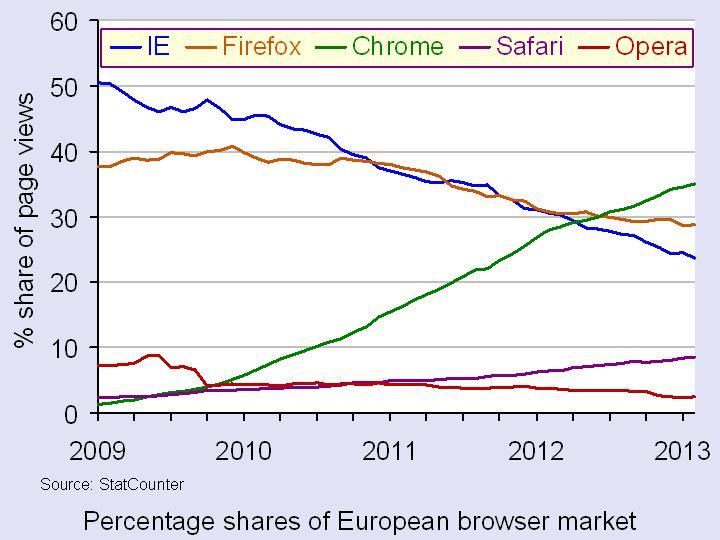 This may seem unduly harsh, given that Internet Explorer’s share of the browser market has fallen dramatically. In 2009, it had around 50% of the European market, with its main rival at the time, Mozilla’s Firefox, having just under 40%. By 2013, Internet Explorer’s share has fallen to around 24% and Firefox’s to around 29%. Google’s Chrome, which was just starting up in 2009, has seen its share of the European market rise to around 35% and is now the market leader. Partly this is due to the rise in tablets and smartphones, a large proportion of which use Google’s Android operating system and the Chrome browser.
Not surprisingly, the European Commission is investigating Google to see whether it is abusing a dominant position. Is Google’s case, it’s not just about its share of the browser market, it’s more about its share of the search market, which in the EU is around 90% (compared with around 65% in the USA). As The Economist article below states:
The Commissioner believes that Google may be favouring its own specialised services (eg, for flights or hotels) at rivals’ expense; that its deals with publishers may unfairly exclude competitors; and that it prevents advertisers from taking their data elsewhere.
Joaquín Almunia asked Google to respond to these concerns by January 31. Google delivered its suggestions on the deadline, but we await to hear precisely what it said and how the Commission will respond. It is understood that Google’s proposal is for clearly labelling its own products on its search engine.
Articles
Microsoft Fined $732 Million By EU Over Browser eWeek, Michelle Maisto (6/3/13)
Microsoft faces hefty EU fine The Guardian (6/3/13)
Sin of omission The Economist (9/3/13)
Microsoft fined by European Commission over web browser BBC News (6/3/13)
 EU commissioner Joaquin Almunia announces Microsoft fine BBC News (6/3/13)
Microsoft’s European Fine Comes in an Era of Browser Diversity Forbes, J.P. Gownder (6/3/13)
Life after Firefox: Can Mozilla regain its mojo? BBC News, Dave Lee (11/4/12)
Google responds to European commission’s antitrust chief The Guardian, Charles Arthur (31/1/13)
Google May Clinch EU Settlement After ‘Summer,’ Almunia Says Bloomberg Businessweek, Stephanie Bodoni and Aoife White (22/2/13)
European Commission Press Release
Antitrust: Commission fines Microsoft for non-compliance with browser choice commitments Europa (6/3/13)
Questions
- Why did Microsoft’s share of the browser market continue to decline between May 2011 and June 2012?
- Why would it matter if Microsoft had market power in the browser market, given that it’s free for anyone to download a browser?
- In what ways might Google be abusing a dominant position in the market?
- Can Mozilla regain its mojo?
- According to the second Guardian article, the Microsoft-backed lobby group Icomp said “To be seen as a success, any settlement must … include specific measures to restore competition and allow other parties to compete effectively on a level playing field with Google in the key markets of search and search advertising.” Give examples of such measures and assess how successful they might be.
- Would “clearly labelling its own products on its search engine” be enough to ensure adequate competition?
The EU competition acuthorities have just fined ten producers of memory chips a total of €331 million for operating a cartel. One of the ten, Micron, will pay no fine because it blew the whistle on the other nine. They, in turn, have had their fines reduced by 10% for co-operating with the authorities. According to the EU Press Release:
The overall cartel was in operation between 1 July 1998 and 15 June 2002. It involved a network of contacts and sharing of secret information, mostly on a bilateral basis, through which they coordinated the price levels and quotations for DRAMs (Dynamic Random Access Memory), sold to major PC or server original equipment manufacturers (OEMs) in the EEA.
“This first settlement decision is another milestone in the Commission’s anti-cartel enforcement. By acknowledging their participation in a cartel the companies have allowed the Commission to bring this long-running investigation to a close and to free up resources to investigate other suspected cartels. As the procedure is applied to new cases it is expected to speed up investigations significantly”, said Commission Vice President and Competition Commissioner Joaquín Almunia.
Articles
Chipmakers to pay fines of €330m over cartel Financial Times, Nikki Tait (20/5/10)
Chipmakers fined by EU for price-fixing BBC News (19/5/10)
European Commission douments and findings
Antitrust: Commission introduces settlement procedure for cartels Europa Press Release (3/6/08)
Antitrust: Commission introduces settlement procedure for cartels – frequently asked questions Europa Memo (30/6/08)
Antitrust: Commission fines DRAM producers € 331 million for price cartel; reaches first settlement in a cartel case Europa Press Release (19/5/10)
Antitrust: Commission adopts first cartel settlement decision – questions & answers Europa Memo (19/5/10)
Questions
- Explain how the new fast-track cartel settlement procedure works.
- Are the incentives built into the procedure appropriate for reducing oligopolistic collusion?
- Are the any reasons why the chip cartel might have been in consumers’ interests?
- Why does EU competition legislation apply in this case given than all but one of the companies are non-EU businesses?
The European Commission has received three complaints against Google for anti-competitive practices. The complainants are Microsoft’s Ciao, UK price comparison site Foundem and French legal search engine ejustice.fr
“The Commission has not opened a formal investigation for the time being. As is usual when the Commission receives complaints, it informed Google earlier this month and asked the company to comment on the allegations. The Commission closely cooperates with the national competition authorities. No further information can be given at this stage.”
Although the complaints are different (see articles below), the common feature is that Google has used its dominant market position to the detriment of competitors and consumers. Not surprisingly, Google has vigorously defended itself against the accusations.
So just what is the case against Google? Are the complaints justified, or are they merely competitors whinging about their relative lack of success? The following articles look at the facts and the issues.
EU launches antitrust inquiry into Google ‘dominance’ Times Online, Mike Harvey (24/2/10)
Google Says It Faces Competition Complaints in Europe BusinessWeek, Brian Womack and Joseph Galante (24/2/10)
Google faces anti-monopoly probe by European Commission Guardian, Andrew Clark (24/2/10)
Why Europe could prove Google’s undoing Guardian, Bobbie Johnson (24/2/10)
Analysis: not evil? Are you sure? Times Online, Mike Harvey (24/2/10)
Google faces Brussels antitrust scrutiny Financial Times, Richard Waters and Nikki Tait (24/2/10)
EU Opens Antitrust Investigation Into Google. Microsoft’s Fingerprints Are Everywhere. Washington Post, MG Siegler (23/2/10)
Google Hit With Antitrust Probe in Europe PC World, James Niccolai (23/2/10)
Is Redmond The Puppet Master In Google EU Anti-Trust Investigation? search engine land, Greg Sterling (23/2/10)
Google Under Investigation by European Union PCMag, Mark Hachman (24/2/10)
EU inquiry points the searchlight on Google’s methods Telegraph, Kamal Ahmed (24/2/10)
Google under investigation for alleged breach of EU competition rules Telegraph, Kamal Ahmed (24/2/10)
Questions
- What is the case against Google? Does this make it in breach of EU competition law?
- Assess Google’s response.
- Is Google “doing anything to choke off competition or hurt our users and partners”?
- How could competition be increased for Google? Is this likely to happen?
Competition authorities in the USA and Europe tend to have a different approach to firms that have a dominant market position by virtue of their ownership of specific intellectual property, such as software codes. Thus companies such as Microsoft can exploit network economies, thereby making it hard for rival firms to compete. After all, if most people use Windows, there is an incentive to keep using it so as to be compatible with other users. Similar arguments apply to the ownership of physical property, such as ports, airports, railways and power lines, where the owners may choose to deny access to competitors.
So should companies such as Microsoft grant rivals access to their intellectual property? Would such access increase competition, or would it be a disincentive for rivals to innovate? The following article from The Economist considers the issue and refers to a recent paper by Sir John Vickers, former head of the Office of Fair Trading and now Warden of All Souls College, Oxford and President of the Royal Economic Society. He argues for a mid-way course between Europe and America – more interventionist than in the USA, but less rigidly regulated than in the EU.
What’s mine is yours The Economist (28/5/09)
Competition Policy and Property Rights, John Vickers Oxford University , Department of Economics, Discussion Paper Series (26/5/09)
See also
‘Intel inside’ could be outside the law
Questions
- Explain what is meant by ‘network economies’ and give some examples.
- What are the arguments for and against requiring companies to give rivals access to their intellectual property?
- If companies are required by the competition authorities to give others access to their intellectual property, should they be allowed to charge their rivals for using such property, and, if so, how would the authorities determine the appropriate amount?
The European Competition authorities have just imposed a record fine of €1.06 billion for anti-competitive practices under Article 82 of the Treaty of Amsterdam. The fine was imposed on Intel, the world’s largest computer chip producer, for paying computer manufacturers to favour its chips over those of its main rival AMD. But were its practices against the interests of the consumer, as the European Commission and AMD maintain, or did it simply result in lower prices, as Intel maintains? The following articles explore the issues.
Intel on offensive in EU case BBC News (23/9/09)
Intel Fined $1.45 Bln by EU for Abuse of Dominance Announcement of fine by EU Competition Commissioner, Neelie Kroes: YouTube (13/5/09)
A billion-euro question The Economist (14/5/09) (see also)
EU fines Intel $1.45b for sales tactics The Chronicle Herald (Canada) (17/5/09)
Why Intel was fined in Europe — but not the U.S. USA Today: TechnologyLive (15/5/09)
EU slaps a record fine on Intel (plus video) BBC News (13/5/09) (see also)
European commission and Intel fine: Q and A Guardian (13/5/09)
Intel’s chipped credibility CNN Money, Fortune (14/5/09)
Intel–Anti-competitive or No? BusinessWeek (13/5/09)
Anti-competitve Intel fined record €1bn Times Online (14/5/09)
Questions
- Does a firm giving its customers discounts to use its products instead of a rivals always constitute predatory pricing?
- Under what circumstances would behaviour such as that of Intel be (a) against and (b) in the public interest?
- What is meant by ‘ordoliberalism’? How is the concept relevant to understanding the different approaches of regulatory authorities in different countries? (see USA Today article)
 In 2009, the European Commission investigated Microsoft’s practice of bundling its own browser, Internet Explorer, with new copies of Windows. It found that this was an abuse of market power and created an unfair barrier to entry of other browsers, such as Firefox.