 When we think about suppliers and retailers working together, we usually imagine negotiations over things like the price a retailer pays for products, the quantities ordered, or delivery schedules. However, some suppliers do much more than simply supplying products. In fact, suppliers to many supermarkets also advise them on which brands to stock, how much shelf space each brand should get, and which products to promote. In this role, known as a ‘category captain’, a supplier can influence not only its own products but also those of its competitors within a specific category of products.
For example, if Red Bull were acting as a category captain in the energy drinks category for a supermarket like Tesco, it could also advise on where its competitor, Monster Energy, appears on the shelves, or even whether it appears at all!
Sounds problematic? Arrangements like these are an example of vertical relationships between suppliers and retailers, something economists often study. Like other vertical arrangements, such as exclusive dealing, they can have both benefits and drawbacks. For example, while a category captain can result in efficiency gains, allow for a more organised category of products and improve consumer choice, it also raises questions when the supplier giving the advice also competes with the products it is advising on.
 That is exactly what the European Commission (EC), the EU’s competition authority, began examining in November 2025, when it opened an investigation into potential anticompetitive conduct by Red Bull.
One of the key concerns is whether Red Bull used its role as a category captain to disadvantage competing energy drink brands.
Category management is common … but novel for enforcement
The practice of appointing a category captain is not new. Many large supermarkets appoint category captains from major consumer goods suppliers. For example, firms such as Kraft Foods and Procter & Gamble have long taken on category management roles in a range of consumer-packaged goods categories.
However, despite how common these arrangements are in retail, this is the first time the EC has formally investigated whether a supplier has misused its category management role to limit or disadvantage competing products, and it has said it will treat the case as a priority.
How Red Bull could be disadvantaging competitors
 According to the Commission, Red Bull appears to hold a dominant position in the wholesale supply of branded energy drinks, at least in The Netherlands. In competition policy, a firm which holds a dominant position has a special responsibility to ensure that its actions do not unfairly restrict competition. Regulators are investigating whether the company abused this position by offering financial or non-financial incentives and/or leveraging its role as a category captain to disadvantage competing energy drinks sold in larger can sizes.
At an extreme, a category captain could advise a supermarket to stop selling a competitor’s product entirely, effectively excluding the brand from the shelves and potentially reducing consumer choice.
But there are also more subtle ways Red Bull could disadvantage its competitors. Insights from behavioural economics suggest that the placement of products on shelves can strongly influence what consumers notice and buy. By reducing the visibility of rival energy drinks, for example, products in less prominent locations are less likely to be purchased and are therefore disadvantaged.
These practices matter for consumers as well as competitors. By limiting which products are stocked or how prominently they are displayed, dominant suppliers could reduce choice and potentially keep prices higher.
Growing scrutiny of category management?
 Competition authorities seem to be paying closer attention to how suppliers influence the management of product categories in retail stores. In April 2025, the Belgian Competition Authority fined three large pharmaceutical companies more than €11 million for co-ordinating the placement of over-the-counter medicines in pharmacies. The companies had created shelf layouts that favoured their own products, disadvantaged competing brands, and monitored whether pharmacies followed the plans.
Thus far there have not been many European cases related to category management.
Why the Red Bull case matters
The Red Bull investigation is the first EC case focusing specifically on the potential misuse of category management by a dominant supplier. There is currently little guidance on how these arrangements should be assessed under competition law, meaning the case could set an important precedent.
If the Commission concludes that category management was used strategically to disadvantage competitors, Red Bull could be found to have abused its dominant position under EU competition rules. Such a decision could reshape supplier–retailer relationships across Europe.
Articles
Questions
- Beyond prices, how might dominant suppliers influencing shelf space affect competition and consumer choice?
- How might category captain arrangements affect barriers to entry?
- What are the potential efficiencies of supplier-led category management, and what are the possible anti-competitive effects?
- What guidelines or safeguards could regulators provide to ensure category captains deliver the potential efficiencies without harming competition?
 In April 2015 the European Commission (EC) opened a formal investigation into the behaviour of Google in the market for smartphones and tablets. On the 20th April Google was sent a preliminary judgment (referred to formally as a Statement of Objections) in which it was accused of abusing its dominant market position. The European Commissioner argued that the case was similar to the famous and protracted investigation into the conduct of Microsoft.
In the early 2000s Microsoft had a dominant position in the market for desktop operating systems. It has been estimated that 97% of all computing devices at the time used Microsoft Windows. This market power attracted the attention of the EC who accused the company of using its dominance in the operating systems market to restrict competition in complementary markets for software such internet browsers and media players. This led to a complex legal battle between the two parties.
Windows is proprietory software and computer manufacturers have to pay Microsoft a licence fee to install it on their machines. Before the rulings by the EC, Microsoft could make a licence for Windows conditional on other Microsoft software such as Internet Explorer and Media Player being pre-installed. This is known as bundling and in this case the EC came to the conclusion that it restricted competition. The European Commissioner, Margrethe Vestager recently stated that
“If Microsoft’s media player was already there when you bought a PC, it would be hard to persuade people to even try an alternative, so innovators would be at a big disadvantage”
Microsoft lost most of its competition battles with the EC and had to pay a total of €2.2 billion in various fines. It was also forced to change its conduct. For example, the EC instructed Microsoft to provide its users with a choice of internet browsers.
The marketplace for operating systems has gone through some significant changes since the early 2000s. By 2016 Microsoft’s market share had fallen to 26 per cent. One of the major reasons for this decline has been the increasing popularity of smartphones and tablets.
Google’s Android operating system dominates the mobile market with a market share of over 80 per cent. However, the economics of the Android operating system are very different from those of Windows. Unlike Windows, Android is an example of ‘open-source software’. This means that, rather than having to obtain a licence fee, mobile handset or tablet manufacturers can freely install Android on their devices and are not obliged to pre-install other Google software – both Amazon and Nokia have done this. ,
Another major difference is that it is relatively straightforward for rival firms to develop software that can run on Android. Microsoft was accused of making it very difficult for rival software companies to develop products that would run smoothly on the Windows operating system.
It would appear far easier for rival firms to compete with Google than it ever was with Microsoft when it had a dominant market position. It might therefore seem surprising that the EC has accused Google of abusing its dominant market position.
Rather than any restrictions surrounding the licencing conditions for the operating system the EC’s objections to Google’s behaviour focus on its licencing conditions for other proprietary software products it provides. In particular, the EC has focused on the Google Play Store.

The pre-installation of the Google Play Store is seen as vital to the commercial success of any Android phone. Google Play Store was launched in 2012 and brought three previously separate services together – Android Market, Google Music and Google eBookstore. It is the official app store for all users of a device with an Android operating system. It has been argued that a mobile phone store would not stock an Android phone unless it had Google Play Store pre-installed because it is so highly valued by customers.
Therefore it is vital for Android smartphone and tablet manufacturers to obtain a licence for the Play Store. The conditions for obtaining a licence are outlined in the Mobile Application Distribution Agreement. This specifies that a number of other Google apps must also be pre-installed on the device in order for a licence to be granted for the Play Store. These apps include Gmail, Google Chrome, Google Drive, Google Hangouts, Google Maps, Google Search and YouTube. The manufacturer is free to install any other non-google apps.
The EC has specifically objected to the condition that Google Search has to be installed and set as the default search engine. It is concerned that this that will make it very difficult for other search services to compete with Google because (1) manufacturers will have limited incentives to pre-install any competing search engines and (2) consumers will have less incentive to download competing search engines.
The EC has also expressed concerns that the pre-installation of Google Chrome as the mobile browser will also have a negative impact on competition and innovation in this market.
Companies are given 12 weeks to respond after they have received a preliminary judgment. If they do not accept the objections, then the EC will take several months to come to a final ruling and suggest some appropriate remedies. In this case, the most likely remedy is the removal of the licence conditions for the Google Play Store. If Google appeals the ECs decision to the General Court of the EU, it could take years until a final judgment is made.
Murad Ahmed, the European Technology Correspondent at the Financial Times commented that
“One lesson Google might want to learn from Microsoft’s example is while it fights the EU watchdog it is not overtaken by a less distracted competitor.”
Articles
Europe v Google: how Android became a battleground The Guardian (20/4/16)
EU accuses Google of using Android to skew market against rivals The Guardian (20/4/16)
Google faces EU charge over Android ‘abuse of dominance’ BBC News (20/4/16)
Google hit with EU competition charges for ‘abusing’ dominant position with Android Independent (20/4/16)
Everything you need to know about Google and its EU battle The Telegraph (20/4/16)
Questions
- Draw a diagram to compare and contrast the price and quantity in a competitive market with a situation where a firm has market dominance. Clearly state any assumptions you have made in the analysis.
- What factors does the EC consider when judging if a firm has a dominant position in the market?
- This blog has focused on one aspect of Google’s behaviour/conduct that has raised concerns with the EC. What other elements of Google’s conduct has the European Commission objected to?
- Explain the difference between pure and mixed bundling.
- What impact does bundling have on consumer welfare?
 With the new Premier League football season only a week away, TV companies are heavily advertising the matches they will be showing. Until recently, BSkyB, having seen off competition from Setanta and ESPN, appeared to have an untouchable position in this market. However, competition now appears to be intensifying.
BT entered the market in 2012 by paying £738m for the rights to screen 38 Premier League matches a season for 3 seasons, with Sky showing another 116 matches. BT is clearly heavily backing its sports coverage with an initial outlay of £1.5b and them continuing to sign up high profile presenters and ambassadors including former players and a current manager.
Furthermore, BT dealt Sky (and ITV) a hefty blow last year when it outbid them to win the rights to exclusively show European club competition matches from 2015. Sky responded by saying that:
We bid with a clear view of what the rights are worth to us. It seems BT chose to pay far in excess of our valuation
If true, this would illustrate the winner’s curse which can arise in auctions. However, John Petter, chief executive of BT Retail, said that the deal demonstrated that BT Sport was committed to establishing itself in this market and countered Sky’s suggestion that they had overpaid by saying:
They would say that, wouldn’t they? Secretly, I’d expect them to be kicking themselves and full of regrets this morning
Clearly important to BT’s strategy is bundling its sports coverage in for free with their broadband packages. This is not without controversy since, at the same time as spending vast amounts of money to setup its sports coverage, BT is receiving large government subsidies to improve rural broadband provision.
An important forthcoming ruling from the Competition Appeal Tribunal will have a significant effect on how competition between BT and Sky develops. In this case Sky is accused of abusing its dominant position by refusing to supply BT’s YouView service with its sports channels at a reasonable wholesale price and could now be forced to do so.
It will also be fascinating to see how BT Sport’s strategy develops over time. BT is unlikely to continue  to provide all its coverage for free once it includes the European matches that it has won the rights to show at great expense. It will also be fascinating to see the extent to which it continues to have success in winning broadcasting rights in the future.
Competition will inevitably push up the amount that the Premier League raises in the next rights auction. Current predictions are that these will be sold for over £4bn, up from £3bn in the previous auction. This will increase the amount the Premier League clubs receive and is also likely to further push up player wages. It remains to be seen the extent to which this will benefit viewers, not to mention pubs wishing to show the games some of whom have in the past looked for alternative solutions because of the high prices they have to pay.
BT wins court battle forcing review of Sky wholesale pricing decision The Guardian, Mark Sweney (17/02/14)
BT Sport does little to lift BT TV homes informitv – connected vision (01/08/14)
BT Sport continues to invest in football line-up MediaWeek, Arif Durrani (29/07/14)
Questions
- What are the key characteristics of the market for sports broadcasting rights?
- What are the pros and cons for consumers of BT Sport’s emergence?
- How do you think Sky might respond to competition from BT Sport?
- How do you think BT Sport’s strategy might develop over time?
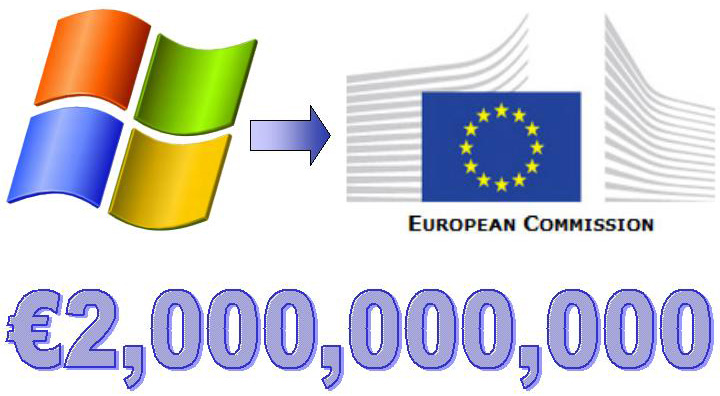 Since the late 1990s the European Commission (EC) has been concerned with trying to prevent Microsoft from abusing its dominant position. As described previously on this site, in the latest instalment last week Microsoft was fined for accidentally failing to adhere to an earlier commitment automatically to allow Windows users a choice of web browser.
This is the first case of fines being imposed for failure to comply with commitments required by the EC. In part because of Microsoft’s compliance, the fine imposed was well below the maximum level it could have been. However, it still means that Microsoft has now in total contributed enough to the EC’s coffers to cover the competition department’s budget for over 20 years.
Commitments appear to be increasingly the EC’s preferred solution for resolving competition disputes, especially in the rapidly changing IT sector (see for example Google and e-books). In contrast to a lengthy litigation process, in theory such commitments can quickly fix the problem and increase competition. The EC hopes that the fine imposed on Microsoft will send clear signals to firms that agreed upon commitments must be adhered to. However, this case also highlights that behavioural commitments require close monitoring by the competition authorities. As one industry consultant argues:
While it’s highly likely that it was a technical mistake that broke the browser choice facility the fact that it remained broken for 14 months raises significant questions about Microsoft’s ability and willingness to comply with the voluntary agreement with the EU.
At the same time the situation also raises concerns over the EU’s ability to actually monitor the outcomes of antitrust agreements.
Microsoft offers web browser choice to IE users BBC News (19/02/10)
Microsoft faces hefty EU fine The Guardian (06/03/13)
Microsoft fined €561m for ‘browser choice’ error The Guardian, Charles Arthur (06/03/13)
Questions
- Why is it essential that competition disputes in the IT sector are quickly resolved?
- What are the problems with monitoring company behaviour in this sector?
- What are the pros and cons of agreeing commitments rather than litigation for competition law infringements?
- How might Microsoft respond to this latest fine from the EC?
 In 2009, the European Commission investigated Microsoft’s practice of bundling its own browser, Internet Explorer, with new copies of Windows. It found that this was an abuse of market power and created an unfair barrier to entry of other browsers, such as Firefox.
An agreement was reached that Microsoft would include a ‘choice screen’ in which users in the EU would be given a full list of alternative browsers and asked which they would like to install. On making their selection, a link would take them to the browser site to download the installation program. This screen would be available until 2014. Between March 2010, when the choice screen was first provided and November of the same year, 84 million browsers were downloaded through it.
In May 2011, however, the screen was no longer present on new Windows 7 purchases. The Commission took some time to realise this: indeed it was Microsoft’s rivals that pointed it out. The screen reappeared some 13 months later, after some 15m copies of Windows software had been sold.
 For this lapse, the Commission has just fined Microsoft €561m. Commission Vice President in charge of competition policy, Joaquín Almunia, said:
In 2009, we closed our investigation about a suspected abuse of dominant position by Microsoft due to the tying of Internet Explorer to Windows by accepting commitments offered by the company. Legally binding commitments reached in antitrust decisions play a very important role in our enforcement policy because they allow for rapid solutions to competition problems. Of course, such decisions require strict compliance. A failure to comply is a very serious infringement that must be sanctioned accordingly.
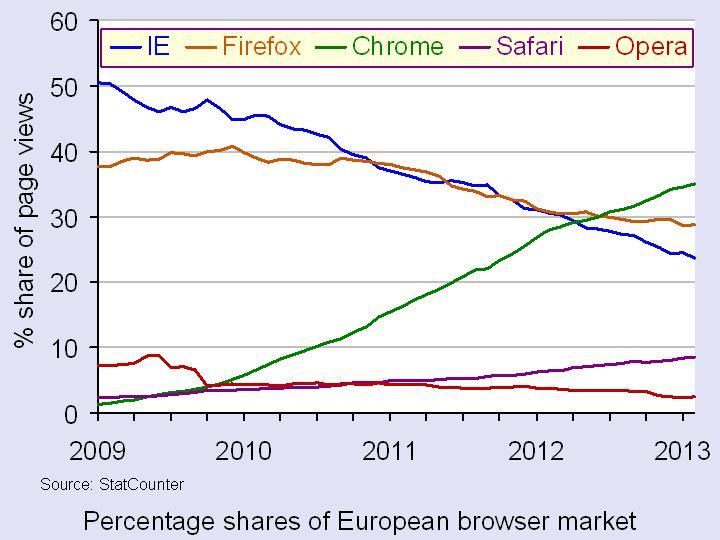 This may seem unduly harsh, given that Internet Explorer’s share of the browser market has fallen dramatically. In 2009, it had around 50% of the European market, with its main rival at the time, Mozilla’s Firefox, having just under 40%. By 2013, Internet Explorer’s share has fallen to around 24% and Firefox’s to around 29%. Google’s Chrome, which was just starting up in 2009, has seen its share of the European market rise to around 35% and is now the market leader. Partly this is due to the rise in tablets and smartphones, a large proportion of which use Google’s Android operating system and the Chrome browser.
Not surprisingly, the European Commission is investigating Google to see whether it is abusing a dominant position. Is Google’s case, it’s not just about its share of the browser market, it’s more about its share of the search market, which in the EU is around 90% (compared with around 65% in the USA). As The Economist article below states:
The Commissioner believes that Google may be favouring its own specialised services (eg, for flights or hotels) at rivals’ expense; that its deals with publishers may unfairly exclude competitors; and that it prevents advertisers from taking their data elsewhere.
Joaquín Almunia asked Google to respond to these concerns by January 31. Google delivered its suggestions on the deadline, but we await to hear precisely what it said and how the Commission will respond. It is understood that Google’s proposal is for clearly labelling its own products on its search engine.
Articles
Microsoft Fined $732 Million By EU Over Browser eWeek, Michelle Maisto (6/3/13)
Microsoft faces hefty EU fine The Guardian (6/3/13)
Sin of omission The Economist (9/3/13)
Microsoft fined by European Commission over web browser BBC News (6/3/13)
 EU commissioner Joaquin Almunia announces Microsoft fine BBC News (6/3/13)
Microsoft’s European Fine Comes in an Era of Browser Diversity Forbes, J.P. Gownder (6/3/13)
Life after Firefox: Can Mozilla regain its mojo? BBC News, Dave Lee (11/4/12)
Google responds to European commission’s antitrust chief The Guardian, Charles Arthur (31/1/13)
Google May Clinch EU Settlement After ‘Summer,’ Almunia Says Bloomberg Businessweek, Stephanie Bodoni and Aoife White (22/2/13)
European Commission Press Release
Antitrust: Commission fines Microsoft for non-compliance with browser choice commitments Europa (6/3/13)
Questions
- Why did Microsoft’s share of the browser market continue to decline between May 2011 and June 2012?
- Why would it matter if Microsoft had market power in the browser market, given that it’s free for anyone to download a browser?
- In what ways might Google be abusing a dominant position in the market?
- Can Mozilla regain its mojo?
- According to the second Guardian article, the Microsoft-backed lobby group Icomp said “To be seen as a success, any settlement must … include specific measures to restore competition and allow other parties to compete effectively on a level playing field with Google in the key markets of search and search advertising.” Give examples of such measures and assess how successful they might be.
- Would “clearly labelling its own products on its search engine” be enough to ensure adequate competition?