 Conservative Party leaders are considering the benefits of an above-inflation rise in the minimum wage. This policy has been advocated by both the Labour Party and the Liberal Democrats as a means of helping the lowest paid workers. From 2008 to 2013, minimum wage rates fell 5.2% in real terms: in other words, nominal increases were less than the increase in both the RPI and CPI (see UK minimum wage: a history in numbers).
Advocates of a real rise in the minimum wage argue that not only would it help low-paid workers, many of whom are in severe financial difficulties, but it would benefit the Treasury. According to Policy Exchange, a free-market think tank closely aligned to the Conservative Party, increasing the minimum wage by 50p would save the Government an estimated £750m a year through higher tax revenues and lower benefit payments.
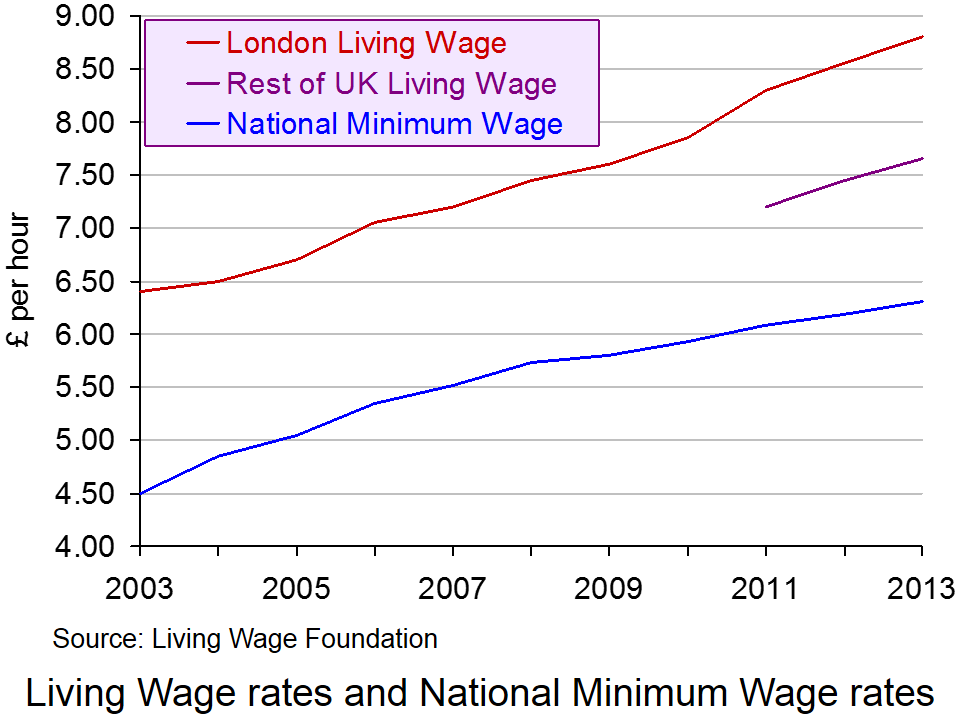 But even such a rise to £6.81 would still leave the minimum wage substantially below the living wage of £8.80 in London and £7.65 in the rest of the UK, as estimated by the Living Wage Foundation (see The cost of a living wage). Although many businesses are now paying at least the living wage, many others, especially small businesses, argue that a rise in the minimum wage above the rate of inflation would force them to consider cutting the number of employees or reducing hours for part-time workers.
Meanwhile, in the USA 13 states have raised their minimum wage rates from the 1st January 2014 (see). Some of the rises, however, were tiny: as little as 15 cents. In a couple of cases, the rise is $1. Currently 21 states and DC have minimum wage rates above the Federal level of $7.25 (approx. £4.40); 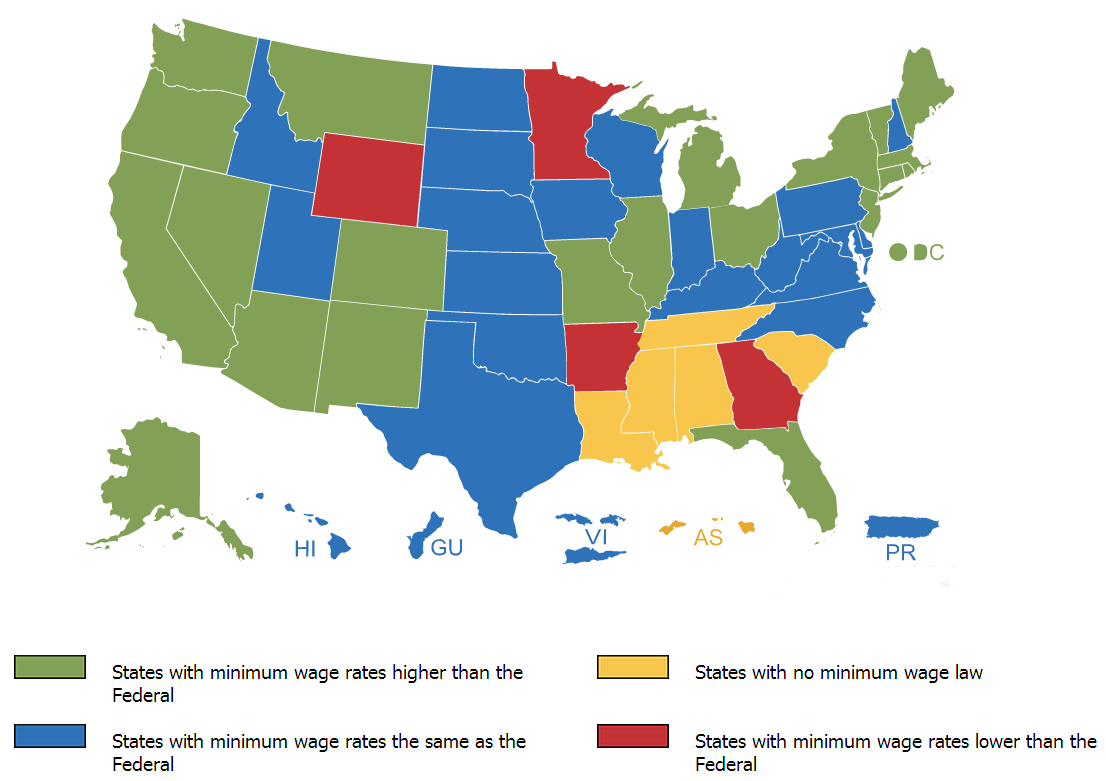 20 states have rates the same as the Federal level; 4 states have rates below the Federal level. At $9.32 per hour, Washington State has the highest state minimum wage; the lowest rates ($5.15) are in Georgia and Wyoming. In 5 states there is no minimum wage at all. As the ABC article below states:
The piecemeal increases at the local level are occurring amidst a national debate over low wages and income inequality. Fast food and retail workers have been staging protests and walking off work for more than a year, calling for better pay and more hours. Currently, fast food workers nationally earn an average of about $9 per hour.
Workers from McDonald’s, Wendy’s, Burger King and other fast food joints are calling for $15 per hour. Wal-Mart workers organizing as part of the union-backed OUR Walmart aren’t asking for a specific dollar amount increase, but they say it’s impossible to live on the wages they currently receive.
President Obama has been throwing his weight behind the issue. Earlier this month, the President said in a speech that it’s “well past the time to raise the minimum wage that in real terms right now is below where it was when Harry Truman was in office.” But such legislation has a bleaker outlook if it reaches the Republican-led House of Representatives. House Speaker John Boehner has said that raising the minimum wage leads to a pullback in hiring.
So what are the costs and benefits of a significant real rise is the minimum wage on either side of the Atlantic? The articles explore the issues.
Articles: UK
Lib Dems accuse Tories of ‘stealing’ their policy as George Osborne prepares to approve above-inflation rise in minimum wage Independent, Andrew Grice (7/1/14)
Lib Dems accuse Tories of ‘nicking’ party’s policy on low wages The Guardian, Nicholas Watt (7/1/14)
Cut housing benefit? A higher minimum wage would help The Guardian, Patrick Collinson (6/1/14)
Miliband prepares to wage war The Scotsman, Andrew Whitaker (8/1/14)
Increasing the minimum wage is only a half answer to poverty New Statesman, Helen Barnard (8/1/14)
Raise the bar: Economically and socially, Britain needs higher wages Independent (7/1/14)
Another Tory says there’s a ‘strong case’ for raising the minimum wage The Spectator, Isabel Hardman (8/1/14)
Fairness and the minimum wage Financial Times (7/1/14)
Osborne wants above-inflation minimum wage rise BBC News (16/1/14)
George Osborne backs minimum wage rise to £7 an hour The Guardian, Nicholas Watt, (16/1/14)
Minimum wage: in his efforts to defeat Labour, Osborne risks mimicking them The Telegraph, Benedict Brogan (16/1/14)
Minimum wage announcement is not just good economics The Guardian, Larry Elliott (16/1/14)
Articles: USA
13 states raising pay for minimum-wage workers USA Today, Paul Davidson (30/12/13)
Minimum wage increase: Wage to rise in 13 states on Jan. 1 ABC15 (30/12/13)
NJ minimum wage sees $1 bump on Jan. 1 Bloomberg Businessweek, Angela Delli Santi (31/12/13)
Minimum wage hike a job killer ctpost, Rick Torres (7/1/14)
A Business Owners Case For Raising The Minimum Wage Grundy Country Herald, David Bolotsky (7/1/14)
Raising the Minimum Wage Isn’t Just Good Politics. It’s Good Economics, Too. New Republic, Noam Scheiber (31/12/13)
Minimum wage rises across 13 US states Financial Times, James Politi (1/1/14)
Information
National Minimum Wage rates GOV.UK
UK minimum wage: a history in numbers Guardian Datablog
List of minimum wages by country Wikipedia
Questions
- Draw two diagrams to demonstrate the direct microeconomic effect of a rise in the minimum wage for two employers, both currently paying the minimum wage, where the first is operating in an otherwise competitive labour market and the other is a monopsonist.
- What is meant by the term ‘efficiency wage rate’? How is the concept relevant to the debate about the effects of raising the minimum wage rate?
- What are the likely macroeconomic effects of raising the minimum wage rate?
- What is the likely impact of raising the minimum wage rate on public finances?
- Is raising the minimum wage rate the best means of tackling poverty? Explain your answer.
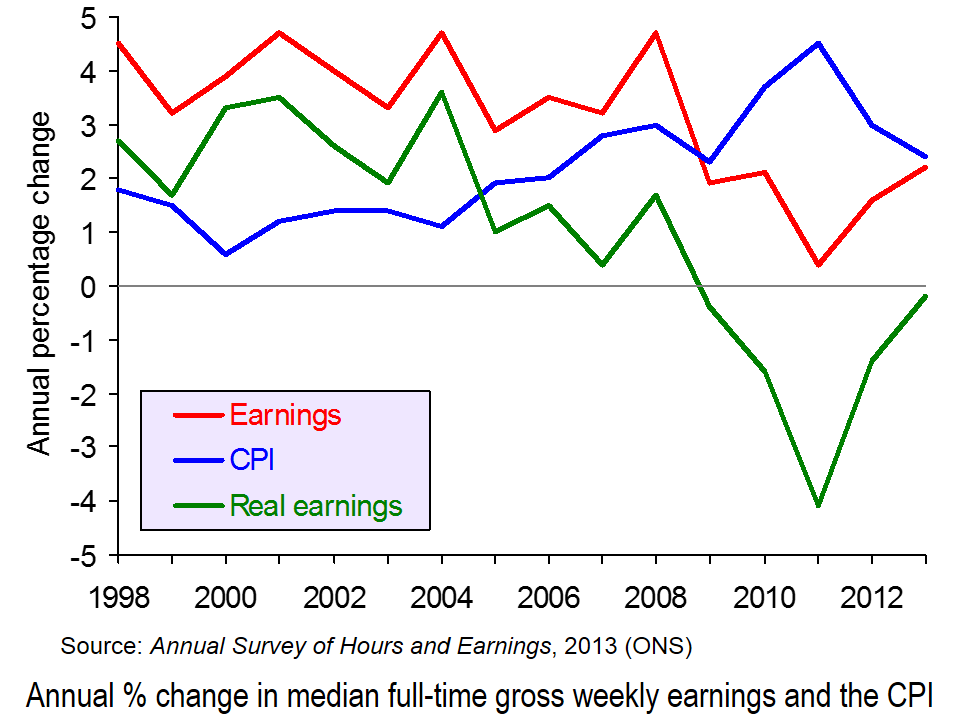 The ONS has just published two of its major annual publications on income and expenditure in the UK. The first is the Annual Survey of Hours and Earnings (ASHE) and looks at earnings from 1998 to 2013. The second is Family Spending and looks at the level and pattern of household spending each year from 2001 to 2012.
Figures from the two publications show that average real incomes have fallen each year since 2008. This is illustrated in the first chart (click here for a PowerPoint of the chart). They also show that household expenditure in real terms is falling and is at the lowest level since 2006.
Overall picture
In 2012, households’ average weekly disposable income was £597. In 2012 prices, this was down from £621 in 2010 (after the recession) and £659 in 2008 (before the recession).
Household expenditure is at its lowest level in real terms for over a decade. In 2012 households spent on average £489.00 per week. In 2012 prices, this compares with £521.90 in 2001/2 and £533.80 in 2006 (the peak year).
Picture for particular income groups and products
Although average real incomes have fallen, not everyone has been affected the same. For example, not all occupations have seen a fall in incomes (see the table at the end of the BBC article, Earnings rise slower than inflation for fifth year running). Also, as income distribution has become less equal, so those in lower income groups have seen their real incomes fall the fastest. This is partly the result of nominal wages rising less fast for low-paid workers and partly the result of price increases for various essentials, such as food and power being greater than the rate of inflation, and these products constituting a higher proportion of expenditure for poor people than rich people (see Squeezed Britain 2013).
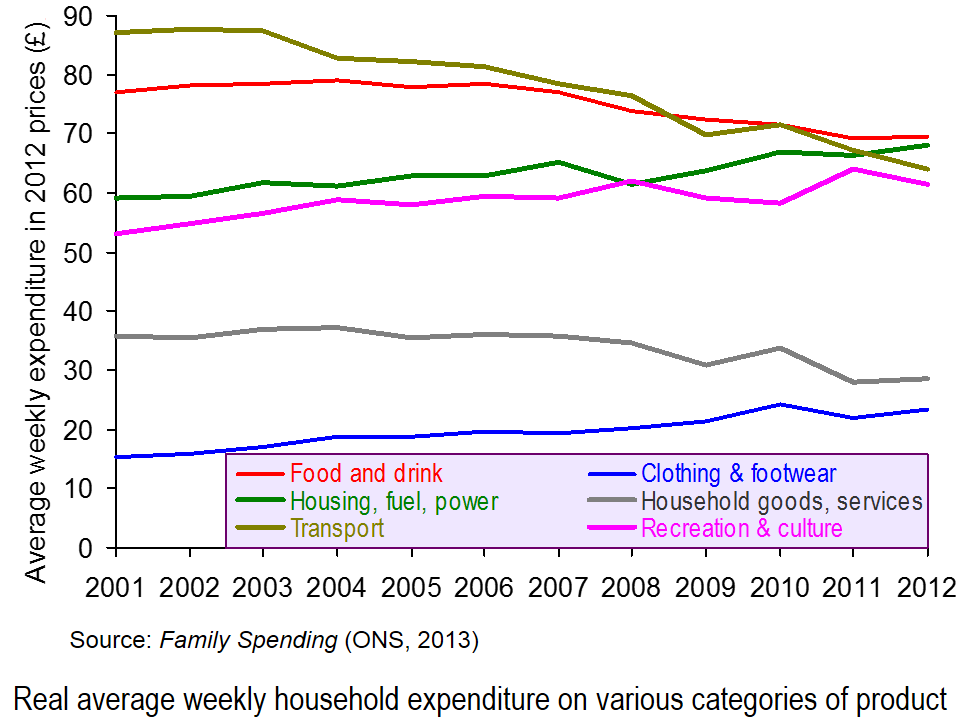 Likewise expenditure hasn’t fallen on all categories of product. Since 2006, real expenditure on clothing and footwear and on housing, fuel and power has risen. The second chart illustrates expenditure on some of the different categories and how the balance has changed (click here for a PowerPoint). This partly reflects the changes in prices of products, with some items, such as electricity, gas and rent having risen faster than the average, and with the demand for such items being relatively price inelastic.
The changing pattern is also partly the result of different income elasticities of demand for different items. Thus, with falling real incomes, the proportion of income spent on products with a low income elasticity of demand is likely to rise.
 Expenditure also varies by income group. People on higher incomes tend to spend a greater proportion of their income on things such as leisure activities (e.g. eating out and holidays), motoring, and clothing and footwear. Poorer people tend to spend proportionately more on food and drink, and on electricity, gas and rent (even net of housing benefit). These differences are illustrated in the third chart which looks at certain categories of expenditure of three different disposable income groups: the poorest 10% (decile), the richest 10% and the 6th decile (i.e. the 6th group up from the bottom – the group with average or just above average income) (click here for a PowerPoint for the chart). Detailed figures can be found here, which is Table 3.2 from Family Spending.
Just as the time-series data looking at changing income and expenditure over time can illustrate the different income elasticities of demand for different products, so can the cross-sectional data in Tables 3.1 and 3.2 of Family Spending.
Articles
Earnings rise slower than inflation for fifth year running BBC News (12/12/13)
Energy and rent are now the biggest family bills The Telegraph, Steve Hawkes (11/12/13)
Families spend £489 each week – on what? The Guardian, Mona Chalabi (11/12/13)
Cost of energy hits family budgets, says ONS BBC News (11/12/13)
Family spending interactive: how has it changed? The Guardian Datastore, Mona Chalabi (11/12/13)
Data
Annual Survey of Hours and Earnings, 2013 Provisional Results ONS (12/12/13)
Annual Survey of Hours and Earnings, 2013 Provisional Results: Statistical Bulletin ONS (12/12/13)
Family Spending, 2013 Edition ONS (11/12/13)
Family spending in 2012: Infographic ONS (11/12/13)
 Video Summary: Are you an average spender? ONS (11/12/13)
Household expenditure based on COICOP classification, 2001-02 to 2012 at 2012 prices: Table 4.1 of Family Spending ONS (11/12/13)
Detailed household expenditure as a percentage of total expenditure by disposable income decile group, 2012: Table 3.2 of Family Spending ONS (11/12/13)
Questions
- What are the determinants of the price elasticity of demand for a product?
- What are the limitations of using time-series data of prices and expenditure to estimate the price elasticity of demand for particular products?
- What are the determinants of the income elasticity of demand for a product?
- What are the limitations of using time-series data of incomes and expenditure to estimate the income elasticity of demand for particular products?
- What are the limitations of using cross-sectional data of expenditure of different income groups to estimate the income elasticity of demand for particular products?
- How do your answers to the above questions demonstrate the significance of the ceteris paribus (other things being equal) assumption?
- If real earnings are falling, why are people able to spend more in real terms?
- What are the macroeconomic implications of increased consumer spending at a time of falling real incomes?
- How could increased consumer spending help to reverse the fall in real incomes (a) in the short run (b) over a period of a few years? Distinguish between the effects on aggregate demand and aggregate supply.
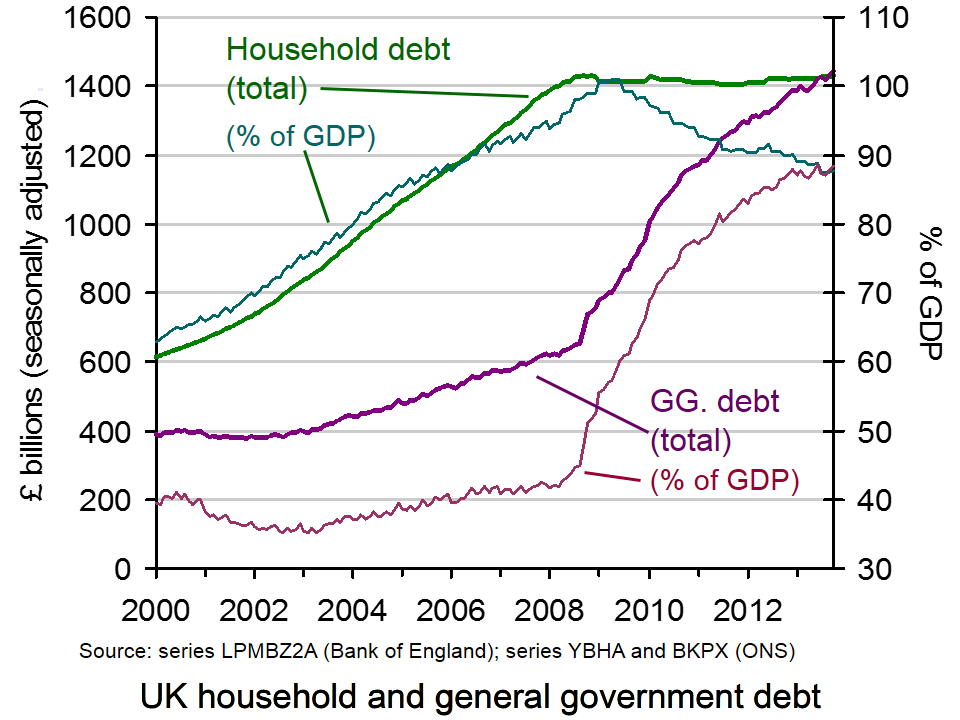 Household debt in the UK has reached a record level. Individuals now owe £1430 billion. This compares with the UK’s general government debt of £1443 billion – also at a record level. These figures are illustrated in the chart (click here for a PowerPoint).
But these figures are nominal. If you look at the real figures (i.e. corrected for inflation), household debt has been falling. In today’s prices, household debt peaked at £1668 billion in March 2008. Also, if you look at household debt as a proportion of GDP, it fell from a peak of 100.96% in May 2009 to 87.43% in July 2013 (see chart). However, since then it has begun rising again, standing at 87.65% in October 2013.
So has household debt become less of a problem? In aggregate terms, the answer is probably yes. However, it is too early to know whether a continuing recovery in the economy will be fuelled by real debt rising again and whether the recovery will encourage people to take on higher levels of debt?
For many people, however, debt has become more and more of a problem. In other words, the aggregate figures conceal what has happened in terms of the distribution of debt. According to a Centre for Social Justice (CSJ) study:
Indebted households in the poorest 10 per cent of the country have average debts more than four times their annual income. Average debt repayments within this group amounted to nearly half their gross monthly income.

And the poorest families, often with very poor credit ratings, are frequently forced to turn to payday lenders, charging sky-high interest rates (see Capping interest rates on payday loans: a government U-turn?).
As mainstream banks reduced access to credit following the financial crash, the market for short-term high-cost credit (payday lenders, pawnbrokers, rent-to-buy and doorstop lenders) increased dramatically and is now worth £4.8 billion a year.
Payday lenders have increased business from £900 million in 2008/09 to just over £2 billion (or around 8 million loans) in 2011/12. Around half of payday loan customers reported taking out the money because it was the only form of credit they could get. The number of people going to loan sharks is also said to have increased – the most recent estimate puts it at 310,000 people.
With rising energy and food bills hitting the poorest hardest, this section of the population could find debt levels continuing to rise, especially if interest rates rise. As Chris Pond, who chaired the CJS study, stated:
The costs to those affected, in stress and mental disorders, relationship breakdown and hardship is immense. But so too is the cost to the nation, measured in lost employment and productivity and in an increased burden on public services.
Articles
£1,430,000,000,000 (that’s £1.43 trillion): Britain’s personal debt timebomb Independent, Andrew Grice (20/11/13)
Average household debt ‘doubled in last decade’ The Telegraph, Edward Malnick (20/11/13)
UK household debt hits record high BBC News (29/11/13)
UK debt crisis: poorest face ‘perfect storm’ Channel 4 News (20/11/13)
One in five struggle with serious debt The Telegraph, Nicole Blackmore (27/11/13)
It doesn’t matter what we do with Wonga: personal debt is about to rocket The Telegraph, Tim Wigmore (26/11/13)
Poorest families ‘need more help over debt’ BBC News (20/11/13)
Report
More than 5,000 people a year ‘homeless’ as household debt crisis deepens, CSJ warns Centre for Social Justice Press Release (20/11/13)
Data
Monthly amounts outstanding of total (excluding the Student Loans Company) sterling net lending to individuals and housing associations (in sterling millions) seasonally adjusted Bank of England
Public Sector Finances First Release – Public Sector Consolidated Gross Debt ONS
Household debt (Economics Indicators update) House of Commons Library (29/11/13)
Questions
- What are the macroeconomic implications of rising levels of household debt?
- Why may an economy which has high levels of household debt be more subject to cyclical fluctuations in real GDP?
- What are the problems of having a recovery driven largely by increased consumer expenditure?
- Why have many people in the poorest sectors of society found their debt levels rising the fastest?
- Why may rising levels of debt of the most vulnerable people make it harder for the Bank of England to use conventional monetary policy if recovery becomes established?
- What policies could be pursued to try to reduce the debts of the poorest people?
- Discuss the effectiveness of these various policies.
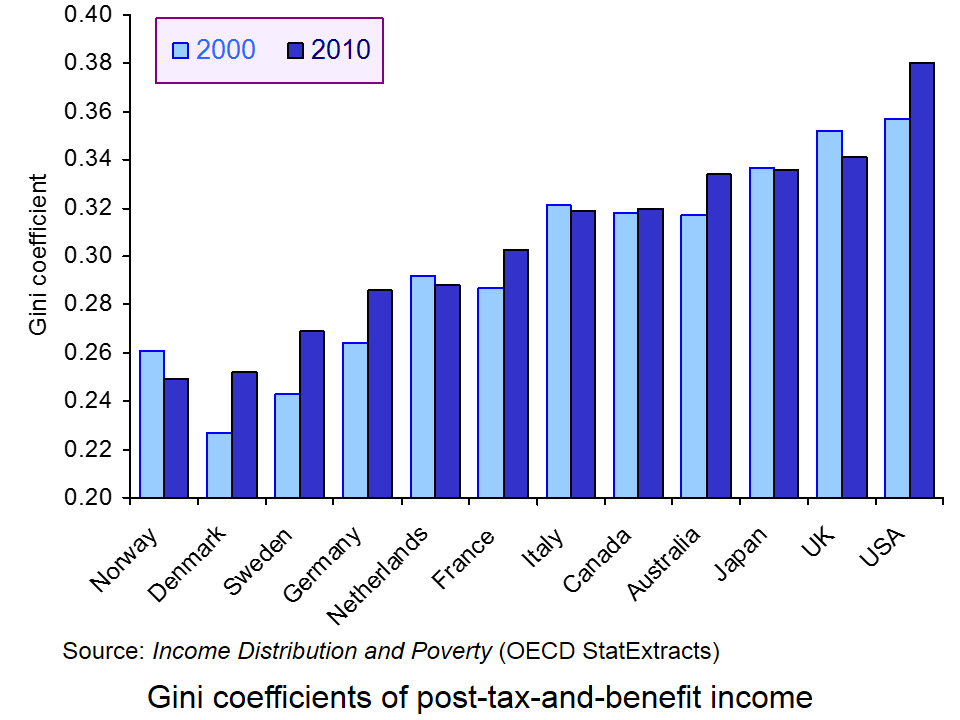 Growing inequality of income and wealth is a common pattern throughout the world. In the boom years up to 2008, the rich got a lot richer, but at least those on low incomes generally saw modest rises in their incomes. Since 2008, however, the continually widening gap between rich and poor has seen the poor and many on middle incomes getting absolutely poorer.
The problem is particularly acute in the USA. Indeed, in his 2012 State of the Union address, President Obama said that it was the ‘defining issue of our time.’
No challenge is more urgent. No debate is more important. We can either settle for a country where a shrinking number of people do really well, while a growing number of Americans barely get by. Or we can restore an economy where everyone gets a fair shot, everyone does their fair share, and everyone plays by the same set of rules.
The good news for the poor in the USA is that at last their incomes have stopped falling, thanks to stronger economic growth. But their share of the growth in GDP is tiny. As The Economist article states:
The main message is a grim one. Most of the growth is going to an extraordinarily small share of the population: 95% of the gains from the recovery have gone to the richest 1% of people, whose share of overall income is once again close to its highest level in a century. The most unequal country in the rich world is thus becoming even more so.
Apart from the ethical question of whether it is desirable for a society, already highly unequal, to become even more so, there is the question of whether this growth in inequality threatens economic recovery. Joseph Stiglitz argues that the rich have a low marginal propensity to consume and that this is threatening recovery.
Then there is the question of investment. Because most Americans have not seen any significant rise in incomes, it is easy for them to believe that the country cannot afford to invest more. And certainly it is difficult to persuade people that higher taxes are warranted to fund education, infrastructure or research.
The following articles consider the problem and its implications and look at various policy alternatives.
Articles and videos
Inequality: Growing apart The Economist (21/9/13)
What is income inequality, anyway? CNN, John D. Sutter (29/10/13)
Inequality is literally killing America Press TV (22/11/13)
It’s Economic Inequality Stupid – What to Do About the Biggest Crisis Facing America Huffington Post, Robert Creamer (14/11/13)
US Inequality Now Literally Off the Chart Truthout, Salvatore Babones (8/6/13)
Inequality moves to the front line of US politics Financial Times, Richard McGregor (20/11/13)
Is wealth inequality slowing growth? BBC News, Linda Yueh (21/11/13)
American Inequality in Six Charts The New Yorker, John Cassidy (18/11/13)
Income Inequality ‘Profoundly Corrosive’ Wall Street Journal, Larry Summers (19/11/13)
21 Charts On US Inequality That Everyone Should See Business Insider, Gus Lubin (12/11/13)
Data, information and reports
Income inequality in the United States Wikipedia
Inequality Data & Statistics Inequality.org
Income Main United States Census Bureau
World of Work Report 2013: Snapshot of the United States ILO
World of Work Report 2013 ILO
StatExtracts OECD (Search for Gini)
Questions
- How may income inequality be measured?
- Comment on the Gini coefficients in the above link to the StatExtracts site.
- Why has inequality grown in the USA?
- The Swiss have just voted in a referendum to reject a proposal to limit executive pay to 12 times that of the lowest paid worker in the same company. What are the arguments for and against the proposal?
- What features of an unequal society tend to perpetuate or even deepen that inequality over time?
- What features of a well functioning market economy would help to reduce income inequality?
- Are higher marginal tax rates and higher welfare payments the best way of reducing inequality? What other policy options are there?
- Compare the views of Paul Krugman and Joseph Stiglitz on the effects of growing inequality on economic growth. How significant is the difference in the marginal propensity to consume of the rich and the poor in explaining the relatively low rate of US economic growth?
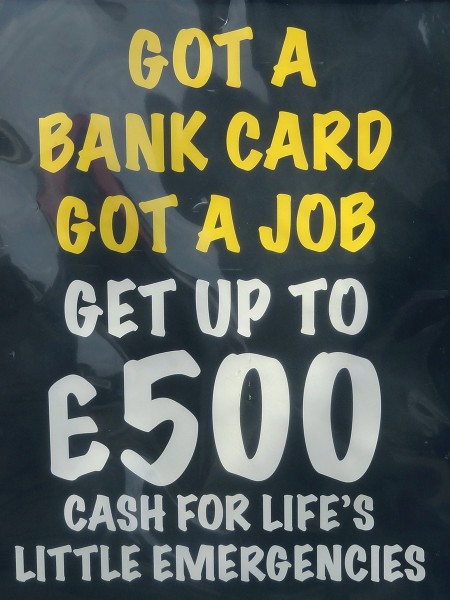 In an apparent U-turn, the Chancellor, George Osborne, has decided to cap the interest rates and other charges on payday loans and other short-term credit. As we have seen in previous news items, the sky-high interest rates which some of the poorest people in the UK are being forced to pay on these loans have caused outrage in many quarters: see A payday enquiry and Kostas Economides and the Archbishop of Canterbury. Indeed, the payday loan industry has been referred by the OFT to the Competition Commission (CC). The CC is required to report by 26 June 2015, although it will aim to complete the investigation in a shorter period.
It was becoming increasingly clear, however, that the government would not wait until the CC reports. It has been under intense pressure to take action. But the announcement on 25 November 2013 that the government would cap the costs of payday loans took many people by surprise. In fact, the new body, the Financial Conduct Authority, which is due to start regulating the industry in April 2014, only a month ago said that capping was very intrusive, arguing that it could make it harder for many people to borrow and push them into the hands of loan sharks. According to paragraph 6.71 of its consultation paper, Detailed proposals for the FCA regime for consumer credit:
The benefits of a total cost of credit cap has been looked at by the Personal Finance Research Centre at the University of Bristol. This report highlighted that 17 EU member states have some form of price restriction. Their research was ambiguous, on the one hand suggesting possible improved lending criteria and risk assessments. On the other, prices may drift towards a cap, which could lead to prices increasing or lead to a significant reduction in lenders exercising forbearance. Neither of these latter outcomes would be beneficial for consumers. Clearly this is a very intrusive proposition and to ensure we fully understand the implications we have committed to undertake further research once we begin regulating credit firms and therefore have access to regulatory data.
The government announcement has raised questions of how imperfections in markets should be dealt with. Many on the centre right argue that price controls should not be used as they can further distort the market.  Indeed, the Chancellor has criticised the Labour Party’s proposal to freeze gas and electricity prices for 20 months if it wins the next election, arguing that the energy companies will simply get around the freeze by substantially raising their prices before and after the 20 months.
Instead, those on the centre right argue that intervention should aim to make markets more competitive. In other words, you should attempt not to replace markets, but to make them work better.
So what is the reasoning of the government in capping payday loan charges? Does it feel that, in this case, there is no other way? Or is the reasoning political? Does it feel that this is the most electorally advantageous way of answering the critics of the payday loan industry?
Webcasts and podcasts
Payday Loans To Be Capped By Government Sky News (25/11/13)
New law to cap cost of payday loans BBC News, Robert Hall (25/11/13)
Osborne: ‘Overall cost’ of payday loans to be capped BBC Today Programme (25/11/13)
George Osborne announces cap on payday loan charges amid concerns ITV News (25/11/13)
Articles
UK to cap payday lenders’ interest charges Reuters, Steve Slater, Paul Sandle, Kate Holton and William James (25/11/13)
Capping payday loans: from light touch to strong arm Channel 4 News, Faisal Islam (25/11/13)
Payday loans: New law to cap costs BBC News (25/11/13)
Payday loan ‘risk to mortgage applications’ BBC News (26/11/13)
Q&A: Payday loans BBC News (25/11/13)
George Osborne is playing social democratic catch-up on payday loans The Guardian, Larry Elliott (25/11/13_
Payday loans cap: George Osborne caves in following intervention led by Archbishop of Canterbury Independent, Oliver Wright (25/11/13)
The principle, the practice and the politics of fixing payday loan prices: why? And why now? Conservative Home, Mark Wallace (25/11/13)
George Osborne and the risky politics of chutzpah New Statesman, Rafael Behr (26/11/13)
Chancellor too quick off the mark on payday lending cap The Telegraph, James Quinn (25/11/13)
Crap and courage of convictions: the political problem with Osborne’s payday loan plan Spectator, Isabel Hardman (26/11/13)
Payday loan calculator
Payday loan calculator: how monthly interest can spiral BBC Consumer (7/11/13)
Questions
- What types of market failing exist in the payday loan industry?
- What types of controls of the industry are being proposed by George Osborne?
- What is the experience of Australia in introducing such controls?
- What alternative forms of intervention could be used to tackle the market imperfections in the industry?
- What were the proposals of the FCA? (See paragraph 6.6 in its document, Detailed proposals for the FCA regime for consumer credit.)
- According to a representative example on Wonga’s website, a loan of £150 for 18 days would result in charges of £33.49 (interest of £27.99 and a fee of £5.50). This would equate to an annual APR of 5853%. Explain how this APR is calculated.
- The proposal is to allow a relatively large upfront fee and to cap interest rates at a relatively low level, such as 4% per month, as is the case in Australia. Explain the following comment about this in the Faisal Islam article above: “The upfront fee, in theory, should change the behavioural finance of consumers around taking the loan in the first place (there are ways around this though). So this is an intervention based not on lack of competition, but asymmetries of information in consumer finance.”
- Comment on the following statement by Mark Wallace in the Conservative Home article above: “If overpriced payday loans should be capped, why not overpriced DVDs, sandwiches or, er, energy bills?”
- Compare the relative advantages and disadvantages of George Osborne’s proposal with that of Justin Welby, the Archbishop of Canterbury (see the news item, Kostas Economides and the Archbishop of Canterbury).
 Conservative Party leaders are considering the benefits of an above-inflation rise in the minimum wage. This policy has been advocated by both the Labour Party and the Liberal Democrats as a means of helping the lowest paid workers. From 2008 to 2013, minimum wage rates fell 5.2% in real terms: in other words, nominal increases were less than the increase in both the RPI and CPI (see UK minimum wage: a history in numbers).