 The ONS has just released its annual publication, The Effects of Taxes and Benefits on Household Income. The report gives data for the financial year 2012/13 and historical data from 1977 to 2012/13.
The publication looks at the distribution of income both before and after taxes and benefits. It divides the population into five and ten equal-sized groups by household income (quintiles and deciles) and shows the distribution of income between these groups. It also looks at distribution within specific categories of the population, such as non-retired and retired households and different types of household composition.
The data show that the richest fifth of households had an average pre-tax-and-benefit income of £81,284 in 2012/13, 14.7 times greater than average of £5536 for the poorest fifth. The richest tenth had an average pre-tax-and-benefit income of £104,940, 27.1 times greater than the average of £3875 for the poorest tenth.
 After the receipt of cash benefits, these gaps narrow to 6.6 and 11.0 times respectively. When the effect of direct taxes are included (giving ‘disposable income’), the gaps narrow further to 5.6 and 9.3 times respectively. However, when indirect taxes are also included, the gaps widen again to 6.9 and 13.6 times.
This shows that although direct taxes are progressive between bottom and top quintiles and deciles, indirect taxes are so regressive that the overall effect of taxes is regressive. In fact, the richest fifth paid 35.1% of their income in tax, whereas the poorest fifth paid 37.4%.
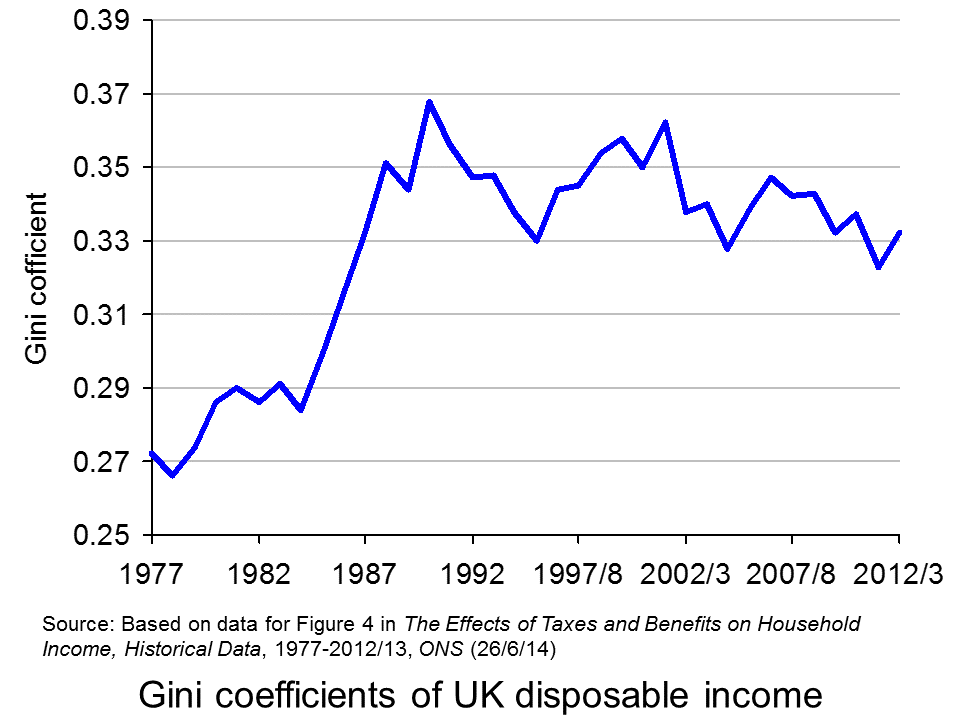 Taking the period from 1977 to 2012/13, inequality of disposable income (i.e. income after direct taxes and cash benefits) increased from 1977 to 1988, especially during the second two Thatcher governments (1983 to 1990) (see chart opposite). But then in the first part of the 1990s inequality fell, only to rise again in the late 1990s and early 2000s. However, with the Labour government giving greater cash benefits for the poor, inequality reduced once more, only to widen again in the boom running up to the banking crisis of 2007/8. But then, with recession taking hold, the incomes of many top earners fell and automatic stabilisers helped protect the incomes of the poor. Inequality consequently fell. But with the capping of benefit increases and a rise in incomes of many top earners as the economy recovers, so inequality is beginning to rise once more – in 2012/13, the Gini coefficient rose to 0.332 from 0.323 the previous year.
As far as income after cash benefits and both direct and indirect taxes is concerned, the average income of the richest quintile relative to that of the poorest quintile rose from 7.2 in 2002/3 to 7.6 in 2007/8 and then fell to 6.9 in 2012/13.
Other headlines in the report include:
Since the start of the economic downturn in 2007/08, the average disposable income has decreased for the richest fifth of households but increased for the poorest fifth.
Cash benefits made up over half (56.4%) of the gross income of the poorest fifth of households, compared with 3.2% of the richest fifth, in 2012/13.
The average disposable income in 2012/13 was unchanged from 2011/12, but it remains lower than at the start of the economic downturn, with equivalised disposable income falling by £1200 since 2007/08 in real terms. The fall in income has been largest for the richest fifth of households (5.2%). In contrast, after accounting for inflation and household composition, the average income for the poorest fifth has grown over this period (3.5%).
This is clearly a mixed picture in terms of whether the UK is becoming more or less equal. Politicians will, no doubt, ‘cherry pick’ the data that suit their political position. In general, the government will present a good news story and the opposition a bad news one. As economists, it is hoped that you can take a dispassionate look at the data and attempt to relate the figures to policies and events.
Report
The Effects of Taxes and Benefits on Household Income, 2012/13 ONS (26/6/14)
Data
Reference tables in The Effects of Taxes and Benefits on Household Income, 2012/13 ONS (26/6/14)
The Effects of Taxes and Benefits on Household Income, Historical Data, 1977-2012/13 ONS (26/6/14)
Rates of Income Tax: 1990-91 to 2014-15 HMRC
Articles
Inequality is on the up again – Osborne’s boast is over New Statesman, George Eaton (26/6/14)
Disposable incomes rise for richest fifth households only Money.com, Lucinda Beeman (26/6/14)
Half of families receive more from the state than they pay in taxes but income equality widens as rich get richer Mail Online, Matt Chorley (26/6/14)
Rich getting richer as everyone else is getting poorer, Government’s own figures reveal Mirror, Mark Ellis (26/6/14)
The Richest Households Got Richer Last Year, While Everyone Else Got Poorer The Economic Voice (27/6/14)
Questions
- Define the following terms: original income, gross income, disposable income, post-tax income, final income.
- How does the receipt of benefits in kind vary across the quintile groups? Explain.
- What are meant by the Lorenz curve and the Gini coefficient and how is the Gini coefficient measured? Is it a good way of measuring inequality?
- Paint a picture of how income distribution has changed over the past 35 years.
- Can changes in tax be a means of helping the poorest in society?
- What types of income tax cuts are progressive and what are regressive?
- Why are taxes in the UK regressive?
- Why has the fall in income been largest for the richest fifth of households since 2007/8? Does this mean that, as the economy recovers, the richest fifth of households are likely to experience the fastest increase in disposable incomes?
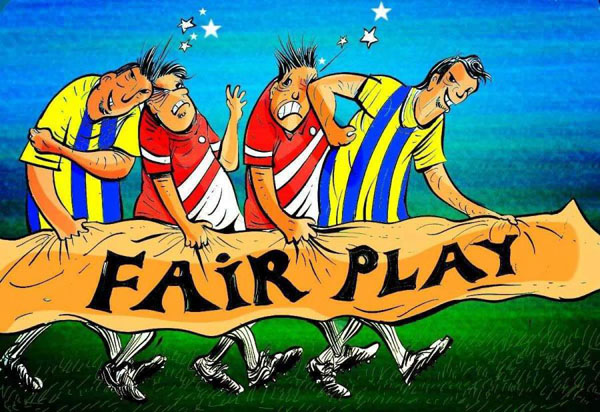 They may not have been happy about it but the executives of Manchester City have finally agreed a settlement with UEFA after it was judged that the club had broken Financial Fair Play (FFP) rules. The club had initially indicated that they might take their case to the Club Financial Control Body’s adjudicatory chamber. For details about FFP, see previous article on the website: What does ‘fair play’ mean for the big teams in Europe?They have also now accepted the sanctions for breaking these rules which appear to be very similar in magnitude to those imposed on Paris St-Germain. UEFA have also judged that seven other clubs have failed to meet their financial requirements.
Why did Manchester City fail the FFP rules when they appeared to be so confident that they would meet them? To understand this requires some discussion of a number of exemptions put in place by UEFA in the implementation of the FFP guidelines.
One of the key aims of FFP is to force the clubs who compete in European competitions to break even. However UEFA allow clubs to make some losses before any sanctions are applied. For the current monitoring period the clubs are allowed to make a cumulative loss of up to €45 million (approximately £37 million) over a two year period from 2011-2013 before any penalties are imposed. This permitted loss is referred to by UEFA as the ‘acceptable deviation’ from breaking even.
Manchester City reported losses in their financial accounts of £97million in 2011-12 and £51.6 million in 2012-13. At first sight this cumulative loss of nearly £149 million over the two year period would suggest that the club failed to meet the FFP regulations by a wide margin i.e. £112 million over the acceptable deviation. However the size of either the profit or loss reported in a club’s final accounts is different from the figure that is used by UEFA when assessing whether the teams have met the FFP criteria. UEFA exclude any costs incurred by the clubs on
– Youth development and community projects
– Building/developing their stadiums
Imagine a situation where after deducting these costs, Manchester City’s losses fell to £75 million in 2011-12 and £35 million in 2012-13. Once again it would still look as if they have failed to meet the FFP guidelines by a large margin. However there is another set of costs that can be excluded if a number of conditions are met. These are the wage costs in 2011-12 of those players who had signed contracts with the club before 1st June 2010. This exemption was introduced by UEFA because a number of clubs complained that they would struggle to meet the rules because of the nature of the players’ contracts. It is quite common for these to be of a 4 or 5 year duration. The teams argued that they were already committed to paying some players very large salaries in 2011-12 because of deals that were agreed long before the FFP rules were introduced. UEFA accepted this argument but only allowed the wage costs to be exempted from the FFP calculations on two conditions:
1. The club could show that the size of its losses were falling over time and that they had a clear strategy in place so that they would be able to comply with FFP regulations in future years.
2. The cumulative loss in excess of the acceptable deviation was caused by losses incurred in the 2011-12 period.
As there is a downward trend in the size of the losses being made by Manchester City they would appear to meet the first condition. It would also be important for them to convince UEFA that they had policies in place to reduce the losses below the permitted levels in the future. In the example above the second criterion is also met as the loss in 2012-13 of £35 million was lower than the acceptable deviation of £37 million. Therefore the reason why the cumulative permitted loss would be broken is because of the impact of the £75 million loss in 2011-12.
However there is another element to the second condition. The club also has to show that the sole reason for the loss in 2011-12 was because of the wage costs they were already committed to – i.e. from the contracts signed before the 1st June 2010. If these wage costs are smaller than the losses reported in that period then they cannot be exempted from the FFP calculations as they can only partly explain the loss.
Reports in the press have suggested that approximately £80 million of Manchester City’s wage bill in 2011-12 was caused by contracts that were signed with players before the 1st June 2010. If this was true then in the example above they would have met the FFP requirements as the £80 million of wages could fully account for the £75 million loss in the 2011-12 season. This would mean that the £80 million could be exempted from the FFP calculation and City would have made a cumulative loss of £35 million which was less than the acceptable deviation of £37 million.
If the wages paid to the players from the contracts signed prior to 1st June 2010 could not fully account for the losses in 2011-12 then they could not be deducted in the FFP calculations. For example imagine if after deducting the costs of youth/community projects and infrastructure spending that Manchester City’s loss had been £85 million in 2011-12 instead of £75 million. The wages bill of £80 million could not fully account for this loss of and hence the £80 million wage bill would be counted in the calculations. The cumulative loss would now be £120 million (£85 million + £35 million) and the acceptable deviation would have been exceeded by £83 million.
Unfortunately for Manchester City this appears to be more or less what happened. As part of the FFP process UEFA also examined deals struck between the club and other organisations in which the owner had an interest. These are referred to by UEFA as Related Party Transactions (RPTs). It would seem that the accountants at UEFA came to the conclusion that some of these RPTs were at above market prices. Interestingly some press reports have indicated that the £35 million a year deal with Etihad was judged to be fine. It was a number of secondary sponsorship deals which were considered to be above fair market values. Once adjustments were made to take account of this it looks as if the re-calculated losses for 2011-12 were greater than the £80 million of wages. With these wage costs not exempted from the calculation, Manchester City have been judged to have missed the FFP conditions by a wide margin.
The following quote is taken from a statement released by the club:
At the heart of the discussions is a fundamental disagreement between the club’s and UEFA’s respective interpretations of the FFP regulations on players purchased before 2010.
The following sanctions have been imposed:
– A £49 million fine to be withheld from UEFA prize money over the next three seasons. (£32 million is suspended and depends on their financial performance in future years)
– A limit on the squad size for the Champions League – 21 instead of 25 players
– Spending limited on transfers this summer to £49 million plus any revenue received in transfer fees from the sale of players
– A freeze on the wage bill of the Champions League squad for the next two seasons
It will be interesting to see if these penalties significantly constrain Manchester City’s ability to compete with the other big teams in Europe next season.
Articles
Manchester City accept world-record £50m fine for breach of Uefa Financial Fair Play rules The Telegraph, (16/5/14)
Manchester City facing £50m fine for breaching Uefa’s Financial Fair Play regulations The Telegraph, (6/5/14)
A beginner’s guide to UEFA’s financial fair play regulations SB Nation, (30/04/14)
Financial Fair Play Explained Financial Fair Play 2012
Man City to act swiftly in transfer market – Khaldoon Al Mubarak BBC Sport, (20/5/14)
Manchester City fined and squad capped for FFP breach BBC Sport, (16/5/14)
Manchester City facing Uefa sanctions over finances BBC Sport, (6/5/14)
Paris St-Germain’s £167m deal fails Uefa financial fair play rules BBC Sport, (1/5/14)
Manchester City and PSG breach Uefa FFP rules BBC Sport, (28/4/14)
Financial Fair Play: What rules have Manchester City broken and what are the likely sanctions? The Mirror, (6/5/14)
We’re innocent! Manchester City on the attack over FFP penalties The Express, (21/5/14)
Man City facing double UEFA punishment for breaching financial fair play rules talkSPORT, (6/5/14) .
Questions
- What are barriers to entry? Give 4 examples.
- What impact do barriers to entry have on a market? Draw a diagram to illustrate your answer.
- To what extent do you think that the UEFA Fair Play Rules act as a barrier to entry?
- What impact do you think the FFP rules will have on the marginal revenue product of the most talented players? Draw a diagram to illustrate your answer.
- Can you think of any methods that a club might use to try and circumvent a rule that attempts to restrict the size of its wage bill.
 We have had a minimum wage in the UK for well over a decade and one its key purposes was to boost the pay of the lowest paid workers and in doing so reduce the inequality gap. Rising inequality has been a concern for many countries across the world and not even the nations with the most comprehensive welfare states have been immune.
Switzerland, known for its banking sector, has been very democratic in its approach to pay, holding three referenda in recent years to give the Swiss public the chance to decide on pay. Imposing restrictions on the bonuses available to the bosses of the largest companies was backed in the first referendum, but in this latest vote, the world’s highest minimum wage has been rejected. The proposed wage is the equivalent of £15 per hour and it is the hourly wage which proponents argue is the wage needed to ensure workers can afford to ‘live a decent life’. However, prices in Switzerland are considerably higher than those in the UK and this wage translates to around £8.33 per hour in purchasing power parity terms, according to the OECD. In the UK, much debate has surrounded the question of a living wage and the impact that a significant increase in the NMW would have on firms. The concern in Switzerland has been of a similar nature.
With a higher wage, costs of production will inevitably rise and this is likely to lead to firms taking on fewer workers and perhaps moving towards a different mix of factors of production. With less workers being employed, unemployment would be likely to increase and it may be that the higher costs of production are passed onto consumers in the form of a higher price. One problem is that as prices rise, the real wage falls. Therefore, while advocates of this high minimum wage suggest that it would help to reduce the gap between rich and poor, the critics suggest that it may lead to higher unemployment and would actually harm the lowest paid workers. It appears that the Swiss population agreed with the critics, when 76% voted against the proposal. Cristina Gaggini, who is the Director of the Geneva Office of the Swiss Business Association said:
I think [it would have been] an own goal, for workers as well as for small companies in Switzerland … Studies show that a minimum wage can lead to much more unemployment and poverty than it helps people … And for very small companies it would be very problematic to afford such a high salary.

The proposal was made by Swiss Unions, given the high cost of living in Switzerland’s suggest cities. It was rejected by the Swiss Business Federation and government and this was then echoed by the overwhelming majority in the referendum. Switzerland has been found to be the most expensive place to live in the world and the wages paid are insufficient to provide a decent life, with many claiming benefits to support their earnings. The debate over the minimum wage and the living wage will continue in countries across the world, but for now the Swiss people have had their say. The following articles consider this issue.
Switzerland rejects world’s highest minimum wage BBC News (18/5/14)
Swiss voters reject plan to establish world’s highest minimum wage The Guardian, Julia Kollewe (18/5/14)
Swiss voters reject setting world’s highest minimum wage Wall Street Journal, Neil Maclucas (18/5/14)
Swiss voters reject world’s highest minimum wage, block fighter jets Reuters, Caroline Copley (18/5/14)
Switzerland votes on world’s highest minimum wage at £15 per hour Independent, Loulla-Mae Eleftheriou-Smith (18/5/14)
Swiss reject highest minimum wage in world Financial Times, James Shotter (18/5/14)
Swiss reject world’s highest minimum wage, jet purchase Bloomberg, Catherine Bosley (18/5/14)
Questions
- Using a demand and supply diagram, illustrate the impact of a national minimum wage being imposed.
- Using the diagram above, explain the impact on unemployment and evaluate the factors that determine the amount of unemployment created.
- Given what you know about the proposed Swiss minimum wage, how much of an impact on unemployment do you think there would be?
- Draw a diagram to show the effect on a firm’s costs of production of the national minimum wage. Explain how such costs may affect the prices consumers pay for goods and services.
- How is it possible that a higher minimum wage could actually lead to more inequality within a country?
- Is there a chance that a minimum wage could lead to inflation? What type would it be?
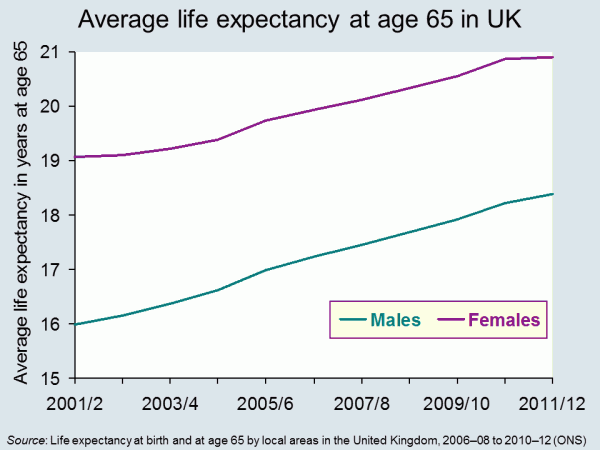 Life expectancy is increasing across the world and the latest set of figures from the Office for National Statistics show that in the UK it has passed 79 for boys born in 2010–12, and 82 for girls born then. In fact the prediction is that over a third of babies born in 2013 will live to more than 100. The data throws up some interesting questions. How well prepared are we for lives that last this long? And how evenly distributed is this increase in life expectancy? Pensions’ minister, Steve Webb, has called for better information on life expectancy to be shared. How would this impact on our decision making?
It seems reasonable to think that increasing life expectancy must be good news. And of course, for individuals it can be. In 1951 the average man retiring at 65, in England and Wales, could expect to live and draw a pension for another 12.1 years. By 2014 this had risen to 22 years.
 But while we can look forward to longer life, for the government, it presents some challenges The first is that we just don’t save enough for our old age. This seems to be partly because we find it hard to make decisions that will have an impact so far in the future. There are a number of measures that have been put in place to encourage us to save more, including auto-enrolment into company pension schemes. This is being rolled out across businesses over the next three years. In the 2014 Budget, the Chancellor announced that people reaching retirement age will be able to draw all their pension as a cash lump sum, rather than having to take it as a regular income.
Another concern for government is the variations that we find in life expectancy across the UK. The 2014 ONS data identified that life expectancy for men born in Glasgow in 2012 is 72.6, in East Dorset it is 82.9. 25% of those in Glasgow are not expected to live to 65. The gap in years of good health is even greater. This presents governments with a long-term problem. How do they achieve greater equality in this instance? Do they focus resources on the areas that need it most? Do they legislate to address behaviour? Or do they rely on the provision of good advice – on diet, exercise and other factors?
Information has a role to play in both areas identified above. In April 2014, Steve Webb, suggested that in order to make good decisions at the point of retirement, people need to understand more about what lies ahead. He said:
People tend to underestimate how long they’re likely to live, so we’re talking about averages, something very broad-brush. Based on your gender, based on your age, perhaps asking one or two basic questions, like whether you’ve smoked or not, you can tell somebody that they might, on average, live for another 20 years or so.
This suggestion has led to some concerns being expressed at what appears to be an over-simplistic approach. Estimates can only be based on a mix of averages modified by individual information. Would the projections be shared with pension providers? What would you do if you exceeded your forecast life expectancy – by a long way – and had spent all your money? Could you sue someone?
Will your pension pot last as long as you will? The Telegraph, Dan Hyde and Richard Dyson (23/4/2014)
Scientists invent death test that will tell us how long we have to live Metro (11/8/13)
Games host Glasgow has worst life expectancy in the UK The Guardian, Caroline Davies (16/4/2014)
Pensioners could get life expectancy guidance BBC News Politics (17/4/14)
ONS reveals gaps in life expectancy across the UK FT Adviser Pensions, Kevin White (23/4/14)
Health care aid for developing countries boosts life expectancy Health Canal, Ruth Ann Richter (22/4/14)
A third of babies born this year will live to 100 This is Money.co.uk, Adam Uren (11/12/13)
Questions
- Thinking about the UK, what are the factors that might explain variations in life expectancy across different regions? How might the government address these differences? Why would they want to do so?
- Do the same factors explain variations between countries? Who can address these differences? Who would want to do so?
- If you could have a reasonable prediction of your life expectancy at 65, would you want it? How would your behaviour change if you were predicted a longer than average life expectancy? How would it change if you were predicted a shorter than average life expectancy?
- If you could have an accurate prediction of your life expectancy at 18, how would your answers differ? If this were possible, would it present any problems?
 Officials of the Club Financial Control Body (CFCB) of UEFA met on Tuesday 15th April and Wednesday 16th April to decide the fate of a number of European clubs. The job of the CFCB is to implement UEFA’s Financial Fair Play (FFP) rules. Manchester City and Paris Saint-Germain (PSG) are said to be nervously awaiting the outcome of these meetings.
UEFA’s FFP rules apply to teams who want to play in either the Champions League or the Europa League. In order to be eligible to compete in these competitions teams not only have to perform well in their domestic league they also have to obtain a license from UEFA. The application process normally takes place midway through the current season for entry into either the Champions League or Europa League for the following season.
UEFA’s FFP rules cover a broad range of issues such as requirements for clubs to pay taxes, transfer fees and players’ wages on time in order to receive a license. However it is the ‘Break Even’ requirement that has caught the attention of a number of economists. This provision limits the size of the financial losses that team can incur before they become subject to sanctions from UEFA. Some of the stated aims of the policy are to:
– Introduce more discipline and rationality in club football finances
– Encourage clubs to operate on the basis of their own revenues
– Encourage responsible spending for the long-term benefit of football
– Protect the long term viability and sustainability of European club football.
The Royal Economic Society held a special session on the potential impact of the ‘Break Even’ requirement at its annual conference in April of this year.
One key way in which the UEFA rules differ from the rules imposed in the Championship in England is that the financial performance of the clubs is judged over a 2/3 year period rather than just one. The initial assessment period is over 2 seasons – 2011-12 to 2012-13. After this the monitoring period is over 3 seasons. Teams can make an initial loss of €5 million in total over the first two year period but this can increase to a maximum permitted loss €45 million over the two years – approximately £37 million – if the team’s owner is willing to fund this loss out of their own money. Certain categories of expenditure are exempt such as the cost of building a new stadium/stand or spending on youth development and the local community.
Manchester City made a total financial loss of £149 million over the last two seasons, far in excess of the permitted £37million, but these losses are falling which may count in their favour. They made losses of £97.9 million in 2012 and £51.6 million in 2013. Also some of the club’s expenditure will have been on some of the exempted categories so that the actual losses subject to FFP will be lower. Chelsea made a profit of £1.4million in 2011-12 and a loss of £49.4million in 2012-13. Although the losses over the two seasons were greater than £37 million, once adjustments were made for exempted expenditures the club was within the maximum permitted loss so was not subject to a full investigation.
In order to implement its FFP regulations UEFA created the Club Financial Control Body (CFCB). The CFCB has two departments – an investigatory chamber and an adjudicatory chamber. The investigatory chamber does the bulk of the work by investigating the accounts of all the 237 clubs that play in UEFA competitions. It was initially reported that the accounts of 76 clubs were being investigated in some detail because it was thought that they might have failed to meet FFP guidelines. However after further investigations in February it was reported that this number had fallen to below 20 teams. The investigatory panel met on Tuesday 15th April and Wednesday 16th April in order to make its final decisions which will be announced May 5th. The body can choose from one of the four following options in each case:
– Dismiss the case
– Agree a settlement with the club – effectively putting it on probation
– Reprimand and fine the club up to €100,000
– Refer the club to the CFCB adjudicatory chamber
The last option is the most serious as the adjudicatory chamber has the power to issue more serious penalties such as
– A deduction of points from the group stages of UEFA competitions.
– Withholding of revenues from UEFA competitions.
– Restrictions on the number of players that a club can register for participation in UEFA competitions.
– Disqualification from future UEFA competitions.
One issue that concerned UEFA was the possibility that very wealthy team owners might try to artificially inflate the revenues their club’s generate so as to circumvent the rules and make it look as if the team was meeting the FFP guidelines. In particular deals might be struck between other organisations that the club owner has an interest in and the football club at rates far in excess of the normal market level. For example some concerns have been expressed about the nature of the back-dated sponsorship deal of £167 million/year signed by PSG with the Qatar Tourism Authority. PSG are owned by Qatar Sport Investment which itself is a joint venture between the Qatari government and the Qatari Olympic Committee. The CFCB have said that they will analyse these types of deals and adjust club accounts if necessary so that they reflect true market rates.
May 5th could prove to be a very significant day for some of the biggest and most wealthy clubs in Europe.
Webcast
 The Economics of “Financial Fair Play” (FFP) in European Soccer (EJ Special Session) Royal Economic Society (7/4/14)
Articles
UEFA probes ‘fewer than 20’ clubs over financial fair play rules Sky Sports, (14/4/14)
Manchester City confident of satisfying Uefa financial fair play rules The Guardian (15/4/14)
Uefa’s Financial Fair Play rules explained The Telegraph (15/4/14)
Man City sweating over sanctions as UEFA prepare to rule over excessive spending Daily Mail (15/4/14)
How Bosman’s lawyer is plotting another football revolution BBC Sport (2/10/13)
Manchester City await fate as Uefa’s financial rules kick in BBC Sport (16/4/14)
Manchester City and Paris Saint-Germain face financial fair play fate The Guardian (14/4/14) .
Questions
- In standard economic theory it is assumed that both consumers and producers act rationally. What precisely does this mean?
- One of the stated aims of UEFA FFP is to ‘introduce more discipline and rationality in club football finances’. Why might the owners of a football club act in an irrational way?
- Consider some of the advantages and disadvantages of assessing the financial performance of a team over 3 years as opposed to 1 year.
- One of the major arguments made against the UEFA FFP rules is that they will lead to a ‘fossilisation’ of the existing market i.e. the current top clubs are more likely to maintain their leadership. Explain the logic of this argument in more detail.
- Which of the possible sanctions for breaking FFP regulations do you think would hit the clubs the hardest in terms of the revenue they would lose? i.e. Which of the sanctions would they most like to avoid?
 The ONS has just released its annual publication, The Effects of Taxes and Benefits on Household Income. The report gives data for the financial year 2012/13 and historical data from 1977 to 2012/13.