 In 2014, 19% of jobs in London and 23% of jobs outside London paid less than the living wage. This is according to figures just published by the Office for National Statistics. The figures compare with 17% and 22% respectively in 2013. The problem is that while the living wage rises with the cost of living, median wages have not kept pace with prices: in other words, in real terms median wages have fallen.
The living wage has been calculated annually since 2003 for London by the London Mayor’s Office and since 2011 for the rest of the UK by the Centre for Research in Social Policy (CRSP) at Loughborough University for the Living Wage Foundation.
According to the London Mayor’s Office:
The London Living Wage is an hourly rate of pay, calculated according to a combination of the costs of living in London and 60% of the median wage. This gives the wage rate needed to give a worker in London enough to provide their family with the essentials of life, including a cushion against unforeseen events. Unlike the compulsory national minimum wage, the London Living Wage is a voluntary commitment made by employers, who can become accredited with the Living Wage Foundation.
As the Chart 1 illustrates, the living wage is above the National Minimum Wage. 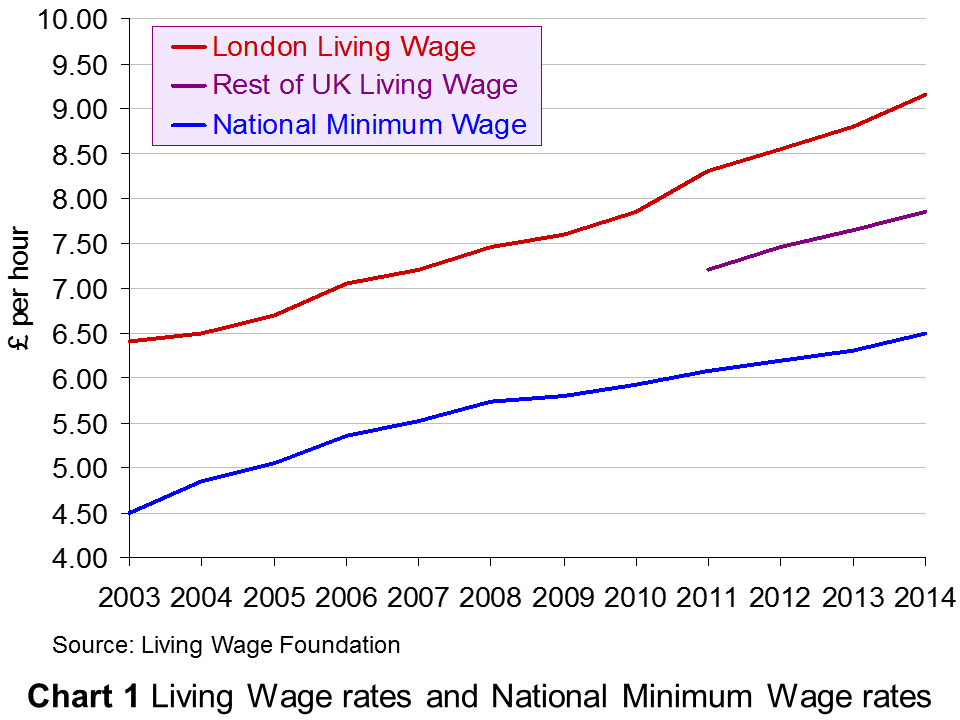 Since November 2014, the living wage in London has been £9.15 in London and £7.85 in the rest of the UK. It is due to be uprated at the beginning of November 2015. From 1 October 2014 to 30 September 2015, the National Minimum Wage (for people aged 21 and over) was £6.50. It rose to £6.70 on 1 October 2015.
Note that the (voluntary) living wage is different from the compulsory ‘National Living Wage’ announced by the Chancellor in his July 2015 Budget, which will come into effect in April 2016 as a top-up to the National Minimum Wage (NLW) for those aged 25 and over. This will be only 50p above the National Minimum Wage and thus considerably below the living wage, 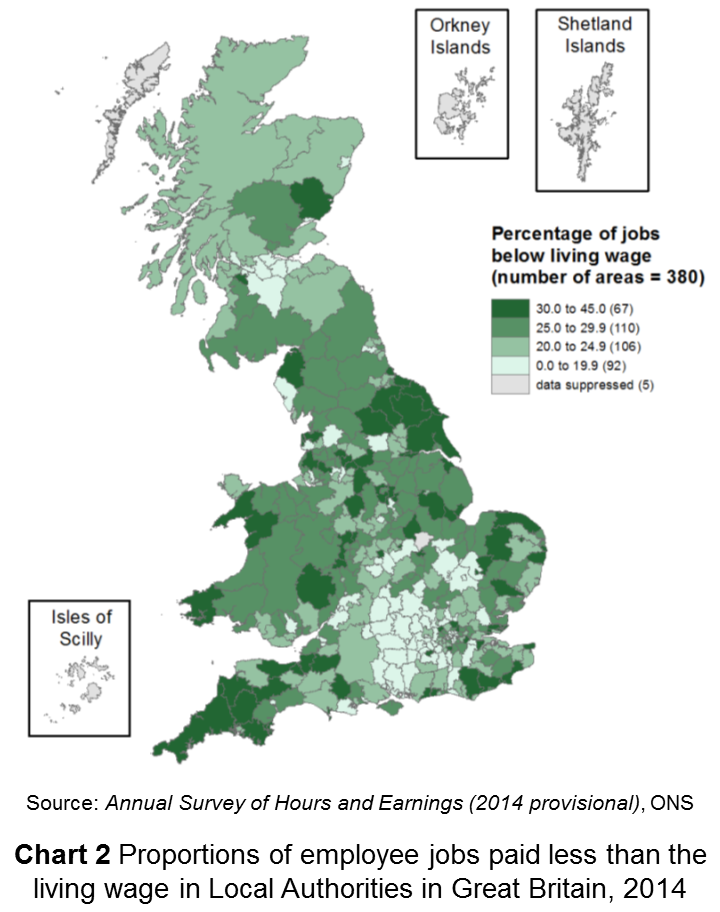 although the Chancellor has pledged to increase the NLW to 60% of median wage rates for those aged 25 and over by 2020. According to the Office for Budget Responsibility, “the NLW will rise from £7.20 in April 2016 (equivalent to around 55 per cent of estimated median hourly earnings for employees aged 25 and over) to around £9.35 in April 2020 (reaching 60 per cent of expected median hourly earnings for that group) in steps that imply the rise relative to median hourly earnings is a straight line.”
The percentage of people being paid below the living wage varies by occupation, location of jobs (see map in Chart 2 – click to enlarge), sex and age and whether the job is full or part time. For example, in accommodation and food services, in retail and in sales and customer services, more than half the jobs paid less than the living wage. A greater percentage of women than men were paid below the living wage (29% and 18% respectively outside London). As far as young people are concerned, 48% of 18–24 year olds were paid less than the living wage in London and 58% outside London 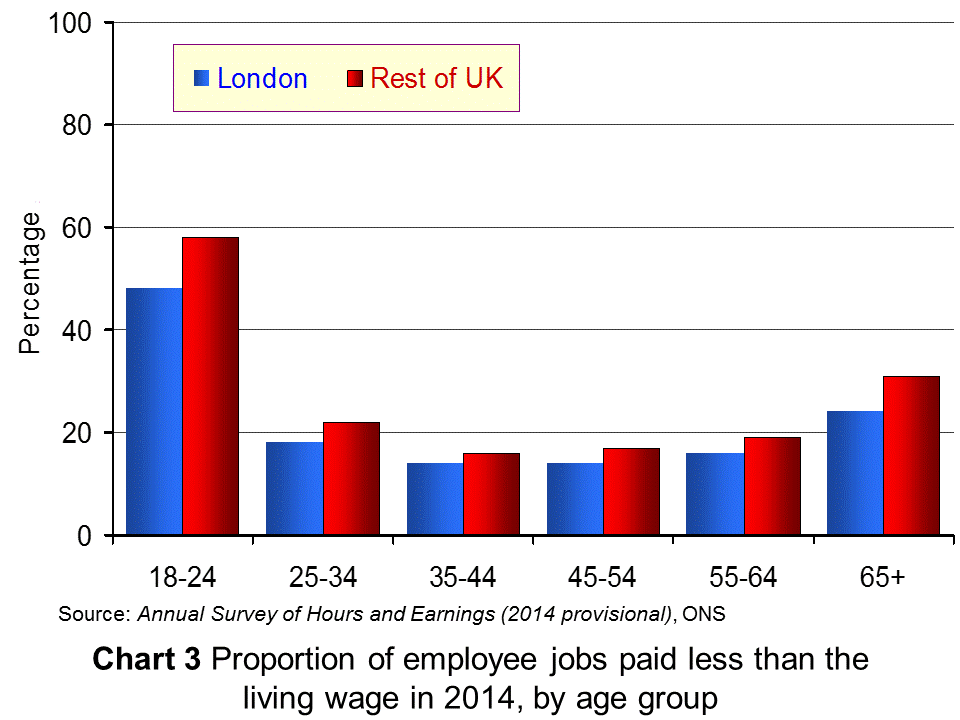 (see Chart 3). In London 45% of part-time jobs paid less than the living wage; in the rest of the UK the figure was 43%.
As The Guardian article linked below reports:
A spokesman for the Living Wage Foundation, which sets the figure each year, said despite ‘significant progress’ in many sectors, more jobs than ever were below the voluntary rates.
“These figures demonstrate that while the economy may be recovering as a whole, there is a real problem with ensuring everyone benefits, and low pay is still prevalent in Britain today,” he said.
The following articles look at the evidence presented by the ONS and examine the incidence of low pay in the UK.
Articles
More jobs paying below living wage BBC News (12/10/15)
A fifth of UK jobs pay less than living wage – ONS Financial Times (12/10/15)
The proportion of workers not being paid the living wage is rising Independent, Jon Stone (12/10/15)
Almost 30 per cent of women are paid below the living wage Independent, Jon Stone (12/10/15)
More UK jobs fail to pay a living wage The Guardian, Hilary Osborne and Damien Gayle (12/10/15)
Six million jobs pay below the living wage Full Fact, Laura O’Brien (19/10/15)
Data and Reports
Estimates of employee jobs paid less than the living wage in London and other parts of the UK ONS (12/10/15)
Annual Survey of Hours and Earnings ONS
Living wage rates: the calculation Living Wage Foundation
National Minimum Wage rates GOV.UK
Questions
- By referring to the Living Wage Foundation site, explain how the living wage is calculated. If you were defining the living wage, would you define it in this way? Explain.
- Distinguish between low pay and poverty. Does pay give a good indication of poverty?
- For what reasons has the number of jobs paying below the living wage increased? Does marginal productivty theory provide an explanation?
- Is it best to base statutory minimum wages on median earnings, mean earnings or the cost of living? Explain.
- If 6 million jobs pay below the living wage, does this mean that 6 million people, more than 6 million people or fewer than 6 million people receive average hourly wages below the living wage? Explain.
- For what reasons might firms volunteer to pay the living wage to their employees? Is doing so consistent with the aim of profit maximisation?
- Why are more women than men paid wage rates below the living wage?
- Why does the proportion of people being paid the living wage vary from one part of the UK to another? Is this likely to be purely a reflection of differences in the cost of living?
 What will production look like in 20 years time? Will familiar jobs in both manufacturing and the services be taken over by robots? And if so, which ones? What will be the effect on wages and on unemployment? Will most people be better off, or will just a few gain while others get by with minimum-wage jobs or no jobs at all?
The BBC has been running a series looking at new uses for robots and whether they will take people’s jobs? This complements three reports: one by Boston Consulting one by Deloitte and an earlier one by Deloitte and Michael Osborne and Carl Frey from Oxford University’s Martin School. As Jane Wakefield, the BBC’s technology reporter states:
Boston Consulting Group predicts that by 2025, up to a quarter of jobs will be replaced by either smart software or robots, while a study from Oxford University has suggested that 35% of existing UK jobs are at risk of automation in the next 20 years.
Jobs at threat from machines include factory work, office work, work in the leisure sector, work in medicine, law, education and other professions, train drivers and even taxi and lorry drivers. At present, in many of these jobs machines work alongside humans. For example, robots on production lines are common, and robots help doctors perform surgery and provide other back-up services in medicine.
A robot may not yet have a good bedside manner but it is pretty good at wading through huge reams of data to find possible treatments for diseases.
Even if robots don’t take over all jobs in these fields, they are likely to replace an increasing proportion of many of these jobs, leaving humans to concentrate on the areas that require judgement, creativity, human empathy and finesse.
 These developments raise a number of questions. If robots have a higher marginal revenue product/marginal cost ratio than humans, will employers choose to replace humans by robots, wholly or in part? How are investment costs factored into the decision? And what about industrial relations? Will employers risk disputes with employees? Will they simply be concerned with maximising profit or will they take wider social concerns into account?
Then there is the question of what new jobs would be created for those who lose their jobs to machines. According to the earlier Deloitte study, which focused on London, over 80% of companies in London say that over the next 10 years they will be most likely to take on people with skills in ‘digital know-how’, ‘management’ and ‘creativity’.
 But even if new jobs are created through the extra spending power generated by the extra production – and this has been the pattern since the start of the industrial revolution some 250 years ago – will these new jobs be open largely to those with high levels of transferable skills? Will the result be an ever widening of the income gap between rich and poor? Or will there be plenty of new jobs throughout the economy in a wide variety of areas where humans are valued for the special qualities they bring? As the authors of the later Deloitte paper state:
The dominant trend is of contracting employment in agriculture and manufacturing being more than offset by rapid growth in the caring, creative, technology and business services sectors.
The issues of job replacement and job creation, and of the effects on income distribution and the balance between work and leisure, are considered in the following videos and articles, and in the three reports.
Videos
 What is artificial intelligence? BBC News, Valery Eremenko (13/9/15)
What jobs will robots take over? BBC News, David Botti (15/8/14)
Could a robot do your job? BBC News, Rory Cellan-Jones (14/9/15)
Intelligent machines: The robots that work alongside humans BBC News, Rory Cellan-Jones (14/9/15)
Intelligent machines: Will you be replaced by a robot? BBC News, John Maguire (14/9/15)
Will our emotions change the way adverts work? BBC News, Dan Simmons (24/7/15)
Could A Robot Do My Job? BBC Panorama, Rohan Silva (14/9/15)
Articles
Technology has created more jobs in the last 144 years than it has destroyed, Deloitte study finds Independent, Doug Bolton (18/8/15)
Technology has created more jobs than it has destroyed, says 140 years of data The Guardian, Katie Allen (18/8/15)
Will a robot take your job? BBC News (11/9/15)
Intelligent Machines: The jobs robots will steal first BBC News, Jane Wakefield (14/9/15)
Robots Could Take 35 Per Cent Of UK Jobs In The Next 20 Years Says New Study Huffington Post, Thomas Tamblyn (14/9/15)
The new white-collar fear: will robots take your job? The Telegraph, Rohan Silva (12/9/15)
Does technology destroy jobs? Data from 140 years says no Catch news, Sourjya Bhowmick (11/9/15)
Reports
Takeoff in Robotics Will Power the Next Productivity Surge in Manufacturing Boston Consulting Group (10/2/15)
Agiletown: the relentless march of technology and London’s response Deloitte (November 2014)
Technology and people: The great job-creating machine Deloitte, Ian Stewart, Debapratim De and Alex Cole (August 2015)
Questions
- Which are the fastest growing and fastest declining occupations? To what extent can these changes be explained by changes in technology?
- What type of unemployment is caused by rapid technological change?
- Why, if automation replaces jobs, have jobs increased over the past 250 years?
- In what occupations is artificial intelligence (AI) most likely to replace humans?
- To what extent are robots and humans complementary rather than substitute inputs into production?
- “Our analysis of more recent employment data also reveals a clear pattern to the way in which technology has affected work.” What is this pattern? Explain.
- Why might AI make work more interesting for workers?
- Using a diagram, show how an increase in workers’ marginal productivity from working alongside robots can result in an increase in employment. Is this necessarily the case? Explain.
 Productivity has been a bit of a problem for the UK economy for a number of years. Earlier posts from 2015 have discussed the trend in Tackling the UK’s poor productivity and The UK’s poor productivity record. Although the so-called ‘productivity gap’ has been targeted by the government, with George Osborne promising to take steps to encourage more long-term investment in infrastructure and create better incentives for businesses to improve productivity, the latest data suggest that the problem remains.
The ONS has found that the UK continues to lag behind the other members of the G7, but perhaps more concerning is that the gap has grown to its biggest since 1991. The data showed that output per hour worked was 20 percentage points lower in the UK than the average for the other G7 countries. The economic downturn did cause falls in productivity, but the UK has not recovered as much as other advanced nations. One of the reasons, according to the Howard Archer, chief UK economist at IHS Global Insight is that it ‘had been held back since the financial crisis by the creation of lots of low-skilled, low-paid jobs’. These are the jobs where productivity is lowest and this may be causing the productivity gap to expand. Other cited reasons include the lack of investment which Osborne is attempting to address, fewer innovations and problems of finance.
Despite these rather dis-heartening data, there are some signs that things have begun to turn around. In the first quarter of 2015, output per hour worked did increase at the fastest annual growth rate in 3 years and Howard Archer confirmed that this did show ‘clear sign that UK productivity is now seeing much-needed improvement.’ There are other signs that we should be optimistic, delivered by the Bank of England. Sir John Cunliffe, Deputy Governor for financial stability said:
“firms have a greater incentive to find efficiency gains and to switch away from more labour-intensive forms of production. This should boost productivity.”
The reason given for this optimism is the increase in the real cost of labour relative to the cost of investment. So, a bit of a mixed picture here. UK productivity remains a cause for concern and given its importance in improving living standards, the Conservative government will be keen to demonstrate that its policies are closing the productivity gap. The latest data is more promising, but that still leaves a long way to go. The following articles consider this data and news.
Articles
UK productivity shortfall at record high Financial Times, Emily Cadman (18/9/15)
UK productivity lags behind rest of 7 BBC News (17/9/15)
UK’s poor productivity figures show challenge for the government The Guardian, Katie Allen (18/9/15)
UK productivity lags G7 peers in 2014-ONS Reuters (18/9/15)
UK productivity second lowest in G7 Fresh Business Thinking, Jonathan Davies (18/9/15)
UK is 33% less productive than Germany Economia (18/9/15)
UK productivity is in the G7 ‘slow lane’ Sky News (18/9/15)
Data
AMECO Database European Commission, Economic and Financial Affairs
Labour Productivity, Q1 2015 ONS (1/7/15)
International Comparisons of Productivity, 2014 – First Estimates ONS (18/9/15)
Questions
- How could we measure productivity?
- Why should we be optimistic about productivity if the real cost of labour is rising?
- If jobs are being created at slower rate and the economy is still expanding, why does this suggest that productivity is rising? What does it suggest about pay?
- Why is a rise in productivity needed to improve living standards?
 Labour markets can be a key indicator of the strength of an economy, with emphasis placed on measures including the unemployment rate and the rate of job creation. Over the past few decades, we have seen many changes in the UK labour market, with more women, more part-time jobs, flexible hours and a shift towards services. After the financial crisis, unemployment declined and more and more people were entering the labour market. But one criticism of this was zero-hours contracts. They are nothing new and were considered in earlier blogs.
Zero hours contracts are essentially what they say: a contract where you are guaranteed to work for zero hours. This means that under such a contract, there is no guarantee that you will have employment on any given day/week and hence this creates uncertainty. However, on the other side, there can be more flexibility with such a contract and with growth in female participation and part-time work, flexibility is essential for many people. James Sproule, Director of Policy at the Institute of Directors said:
“Zero hours contracts offer businesses and employees an important degree of flexibility. For skilled professionals, a degree of flexibility can boost their earning power, while flexibility also suits students and older people – the main users of zero-hours contracts – who cannot commit to a set number of hours each and every week.”
The ONS has found that businesses are using more zero-hours contracts, with a 6% rise. This reflects a growth in January from 1.4 million to 1.5 million zero-hours contracts, though this increase was not statistically significant. Over the past year, the use of these contracts has increased by 19%, from 624,000 people employed on them in 2014 to 744,000 people in 2015.
Although there has undoubtedly been an increase in the number of people employed on zero-hours contracts, there is also more recognition of these contracts. Therefore, part of the increase in the numbers could be down to this recognition and not just due to more and more people moving onto these contracts. With this greater flexibility, comes more opportunities for more people to enter the labour market. While this is a good thing, it can hide some other aspects. For example, if more people are working, it may suggest a fall in the rate of unemployment and a rise in employment, but perhaps this is misleading if some of those in employment are under-employed. The data revealed that:
On average, someone on a zero-hours contract usually works 25 hours a week, with around 40% of them wanting more hours, most from their current job, rather than in a different or additional one.
 Furthermore, for some people there may be very few other options. However, there was also evidence that the possibility of zero-hours contracts has created opportunities for those who may otherwise not have entered the labour market: perhaps women re-entering the labour market and students in full time education. They also offer businesses greater flexibility and this may be a key way for the UK to improve efficiency and productivity. Jon Ingham from Glassdoor, an employment analyst said:
“It’s no great surprise to see the number of people on these contracts is on the up … It’s safe to say that employees who accept a zero hours contract do not do so as a career choice. For most it’s because they have limited options. For some it might be beneficial to have the flexibility to fit around their lifestyle but for others it’s a substandard contract which offers little in the way of benefits or security.”
The change in the structure of the labour market has been on-going and this may be a small change in amongst a much larger structural change. As the economy continues its recovery, we may see a return to the more typical working contract, but it appears that there will always be this greater demand for flexibility in working patterns and hence perhaps the zero-hours contracts do have a place in Britain. The following articles consider the implications of this data.
ONS Report
Employee contracts that do not guarantee a minimum number of hours: 2015 udpate Office for National Statistics September 2015
Articles
Number of workers on zero-hours contracts up by 19% The Guardian, Phillip Inman (2/9/15)
Zero-hours contracts hold their place in UK labour market Financial Times, Sarah O’Connor (2/9/15)
Zero-hours contracts jump 19% in a year Sky News (2/9/15)
19 per cent rise in people on zero hours contracts recorded across Britain over the last year Independent (2/9/15)
Use of zero-hours contracts rises by 6% BBC News (2/9/15)
Insecure ‘zero-hours’ jobs on the rise in Britain – ONS Reuters (2/9/15)
Questions
- What is a zero-hours contract?
- Outline the main advantages and disadvantages of zero-hours contracts to both workers and businesses. You should think about different types of workers in your answer.
- How do you think the increase in zero-hours contracts has affected the unemployment rate in the UK?
- What is meant by under-employment? Would you class this as inefficient?
- What other changes have we seen in the UK labour market over the past 30 years? Have these changes made the labour market more or less flexible?
- Zero-hours contracts create greater flexibility. Do you think that they create greater functional, numerical of financial flexibility?
- If a company introduces a system of zero-hours contracts, is this in accordance with the marginal productivity theory of profit maximisation from employment?
- Using the ONS data, find out how the use of zero-hours contracts varies by occupation and explain why.
 You may be used to these types of blogs by now … On my commute to work on the 18th May, I listened to Start the Week on BBC radio 4 and happened upon a fascinating discussion on inequality.
Of those discussing the issue, one certainly needs no introduction: Joseph Stiglitz, a prominent economist, author and commentator on economics, in particular on inequality. He was joined by Steve Hilton, who has worked for David Cameron for many years in providing advice on a range of issues, including inequality and strategy and has written on existing institutions and their effectiveness. The final panellist was Masha Gessen, who has written extensively on Russia and in particular on the journey of the infamous Boston Bomber.
Though the discussion covers a variety of areas relevant to economics, one key area that is addressed is inequality and the policies that are being used to address the causes and the symptoms. You can access the 45-minute discussion at the link below.
Joseph Stiglitz and Steve Hilton on inequality BBC Radio 4 (18/5/15)
Questions
- How would you measure inequality?
- Why is it important to distinguish between the causes and symptoms of poverty when designing government policy?
- To what extent do you believe that education is an essential requirement for growth and development?
- Why has inequality grown in some of the most developed nations?
- How is it possible that inequality in the developed world has grown, while global inequality has fallen?
- Why does the report argue that the reforms they suggest would help boost growth?
- Do you agree that existing institutions are not suitable for society today?