Conservative Party leaders are considering the benefits of an above-inflation rise in the minimum wage. This policy has been advocated by both the Labour Party and the Liberal Democrats as a means of helping the lowest paid workers. From 2008 to 2013, minimum wage rates fell 5.2% in real terms: in other words, nominal increases were less than the increase in both the RPI and CPI (see UK minimum wage: a history in numbers).
Advocates of a real rise in the minimum wage argue that not only would it help low-paid workers, many of whom are in severe financial difficulties, but it would benefit the Treasury. According to Policy Exchange, a free-market think tank closely aligned to the Conservative Party, increasing the minimum wage by 50p would save the Government an estimated £750m a year through higher tax revenues and lower benefit payments.
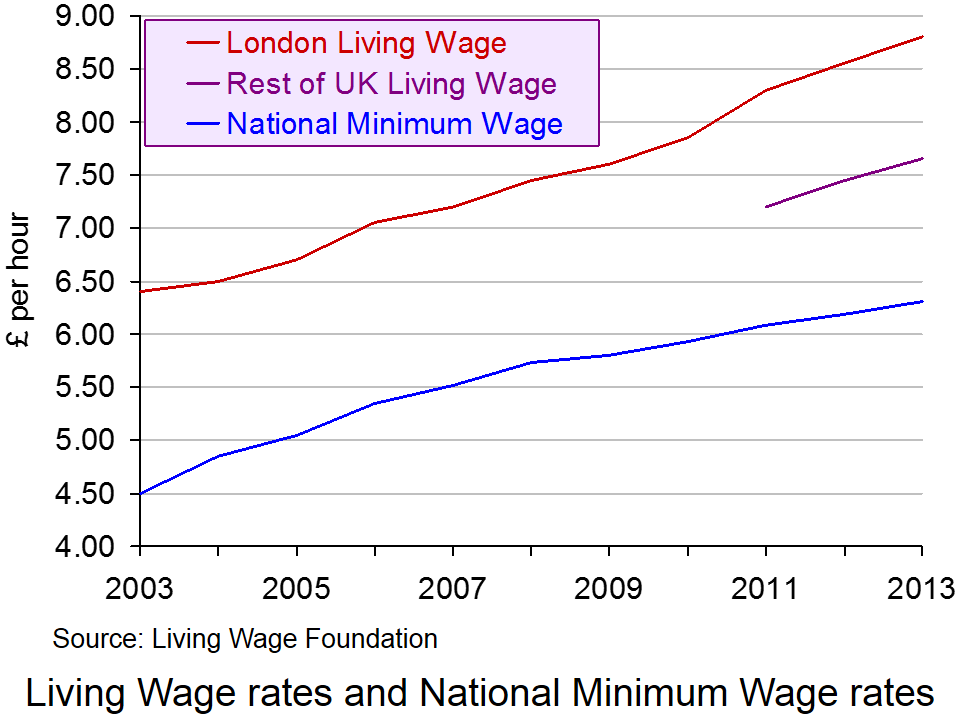
But even such a rise to £6.81 would still leave the minimum wage substantially below the living wage of £8.80 in London and £7.65 in the rest of the UK, as estimated by the Living Wage Foundation (see The cost of a living wage). Although many businesses are now paying at least the living wage, many others, especially small businesses, argue that a rise in the minimum wage above the rate of inflation would force them to consider cutting the number of employees or reducing hours for part-time workers.
Meanwhile, in the USA 13 states have raised their minimum wage rates from the 1st January 2014 (see). Some of the rises, however, were tiny: as little as 15 cents. In a couple of cases, the rise is $1. Currently 21 states and DC have minimum wage rates above the Federal level of $7.25 (approx. £4.40); 20 states have rates the same as the Federal level; 4 states have rates below the Federal level. At $9.32 per hour, Washington State has the highest state minimum wage; the lowest rates ($5.15) are in Georgia and Wyoming. In 5 states there is no minimum wage at all. As the ABC article below states:
The piecemeal increases at the local level are occurring amidst a national debate over low wages and income inequality. Fast food and retail workers have been staging protests and walking off work for more than a year, calling for better pay and more hours. Currently, fast food workers nationally earn an average of about $9 per hour.
Workers from McDonald’s, Wendy’s, Burger King and other fast food joints are calling for $15 per hour. Wal-Mart workers organizing as part of the union-backed OUR Walmart aren’t asking for a specific dollar amount increase, but they say it’s impossible to live on the wages they currently receive.
President Obama has been throwing his weight behind the issue. Earlier this month, the President said in a speech that it’s “well past the time to raise the minimum wage that in real terms right now is below where it was when Harry Truman was in office.” But such legislation has a bleaker outlook if it reaches the Republican-led House of Representatives. House Speaker John Boehner has said that raising the minimum wage leads to a pullback in hiring.
So what are the costs and benefits of a significant real rise is the minimum wage on either side of the Atlantic? The articles explore the issues.
Draw two diagrams to demonstrate the direct microeconomic effect of a rise in the minimum wage for two employers, both currently paying the minimum wage, where the first is operating in an otherwise competitive labour market and the other is a monopsonist.
What is meant by the term ‘efficiency wage rate’? How is the concept relevant to the debate about the effects of raising the minimum wage rate?
What are the likely macroeconomic effects of raising the minimum wage rate?
What is the likely impact of raising the minimum wage rate on public finances?
Is raising the minimum wage rate the best means of tackling poverty? Explain your answer.
Most football fans will probably never have heard of an organisation called FIFPro but, if it is successful, the labour market for football players could change quite radically.
FIFPro represents over 65,000 players from around the world. It is effectively an international trade union whose main objective is to promote the interests and defend the rights of professional football players. Its president, Philippe Piat, has recently announced that the organisation will challenge the way the current transfer system operates and is prepared to take its case to the European Commission and the European Court of Justice.
FIFPro’s argument is that players are being exploited under the current system. This may seem difficult to believe in the week when Luis Suarez signed a new four-and-a-half-year contract at Liverpool with earnings of £200,000 per week. However, referring to the transfer system, Piat stated that:
These legal and monetary shackles binding footballers to their current clubs can no longer be accepted and upheld. Football players are workers and only when they are able to enjoy the rights enshrined in law and enjoyed by all other workers, will Fifpro be satisfied.
In order to understand this argument, it is important to understand how the transfer system has evolved and how it now operates.
When the Football Association (FA) first accepted professionalism in 1885 it introduced a registration system. Before this reform it was possible for players to play for different teams each week. The new system meant that players had to register with a club at the beginning of each season. If a player was not registered with a team he was not allowed to play. He could only change team mid-season if his current club and the FA agreed to the transfer of his registration details to a different team. However, a player was free at the beginning of each season to register with a different team. Therefore there were no constraints on his mobility between teams from one season to another.
Significant changes were made to the system in 1893 when the retain-and-transfer system was first introduced. The new scheme allowed teams to keep retaining players they had initially registered for another year. This effectively meant that when a player was signed by a team he was tied to that team for as long as they wanted him. The mobility between clubs from one season to another had been removed. This gave the clubs significant monopsony power in the labour market. If a player wanted to change teams, he had to make a transfer request but the team was under no obligation to put him on the transfer list and allow him to move. Teams could decide to put players on a transfer list and would only allow them to leave if an agreeable level of compensation (a transfer fee) was offered by another team. A maximum wage of £4 per week was also introduced in 1901.
The system was periodically challenged and a number of minor changes were made. In particular, the conditions under which a player could be retained by a club were gradually altered. Originally a player could be retained by a club even if his contract was not renewed. Effectively a team could stop a player moving to another club by holding onto his registration without having to pay him. This was changed so that a minimum wage had to be paid to a player if he was to be retained by the team that held his registration.
The first major change to the system came in 1963 from a player called George Eastham. In 1959 he failed to sign a new contract with Newcastle United and made a transfer request which the club promptly rejected. Although they did eventually allow him to leave and join Arsenal, he still took his case to the High Court and the judge concluded that the retain-and-transfer system was an unreasonable restraint of trade. Following this judgment the system was amended so that, in order to retain a player, a club would have to offer the player a new contract with terms and conditions which were at least as good as the previous one. If this was done, then a player could be retained by a club and his registration would only be released if an acceptable transfer fee was offered by another team.
Perhaps the biggest change to the system was made in 2001 following the famous Bosman ruling. Jean-Marc Bosman had wanted to move to the French side Dunkirk, but FC Liege, the club that held his registration, demanded a transfer fee that Dunkirk were unwilling to pay. Bosman took his case to the European Court of Justice and in 1995 a decision was made that the system was in breach of European Union law on the free movement of people. Following this ruling, an informal agreement was reached between the European Commission, FIFA and UEFA. From 2001 players over the age of 23 were free to leave their clubs once their contracts had expired. Transfer fees no longer needed to be paid for players who had reached the end of their contracts.
In September 2013, Mesut Özil joined Arsenal from Real Madrid on the deadline day of the transfer period for a reported fee of £42.5 million.
Although the ease with which players can change teams has significantly improved over the past 50 years, they still face constraints on their labour mobility that are unusual for employees. Most workers simply have to give a period of notice in order to change employer. These vary between jobs but are not usually longer than 3 months. FIFPro’s argument is that professional football players should have these same rights. This would allow Luis Suarez to leave Liverpool at any point in the next four and a half years without any transfer fee having to be agreed. He would simply have a serve out a short period
of notice and then he would be free to join any other club. Under the current system he would have to wait four and a half years until the
end of his contract before he could leave without a transfer fee having
to be paid.
Whenever the transfer system has been challenged the football authorities have always used the same defence – sport is different from other industries because of the importance of maintaining an appropriate level of competitive balance. It is argued that the ease with which players can change clubs needs to be restricted in order for this level to be maintained. Ultimately a judgment will have to be made between this argument and the principle of freedom of movement.
Explain why the marginal revenue product of footballers is so much higher than it is for people in most other jobs. What impact do you think technology has had on the marginal revenue product of footballers over the past 20 years?
Draw a diagram to illustrate how the wage rate for footballers would be determined if the labour market was perfectly competitive.
What is monopsony? Explain how the retain-and-transfer system could give football clubs monopsony power in the labour market.
Draw a diagram to illustrate the impact of monopsony on wages and employment in the labour market for professional footballers.
Explain how limiting the mobility of players might help to maintain the level of competitive balance in a league.
If the proposals by FIFPro were accepted, what impact do you think it will have on players’ wages?
Growing inequality of income and wealth is a common pattern throughout the world. In the boom years up to 2008, the rich got a lot richer, but at least those on low incomes generally saw modest rises in their incomes. Since 2008, however, the continually widening gap between rich and poor has seen the poor and many on middle incomes getting absolutely poorer.
The problem is particularly acute in the USA. Indeed, in his 2012 State of the Union address, President Obama said that it was the ‘defining issue of our time.’
No challenge is more urgent. No debate is more important. We can either settle for a country where a shrinking number of people do really well, while a growing number of Americans barely get by. Or we can restore an economy where everyone gets a fair shot, everyone does their fair share, and everyone plays by the same set of rules.
The good news for the poor in the USA is that at last their incomes have stopped falling, thanks to stronger economic growth. But their share of the growth in GDP is tiny. As The Economist article states:
The main message is a grim one. Most of the growth is going to an extraordinarily small share of the population: 95% of the gains from the recovery have gone to the richest 1% of people, whose share of overall income is once again close to its highest level in a century. The most unequal country in the rich world is thus becoming even more so.
Apart from the ethical question of whether it is desirable for a society, already highly unequal, to become even more so, there is the question of whether this growth in inequality threatens economic recovery. Joseph Stiglitz argues that the rich have a low marginal propensity to consume and that this is threatening recovery.
Then there is the question of investment. Because most Americans have not seen any significant rise in incomes, it is easy for them to believe that the country cannot afford to invest more. And certainly it is difficult to persuade people that higher taxes are warranted to fund education, infrastructure or research.
The following articles consider the problem and its implications and look at various policy alternatives.
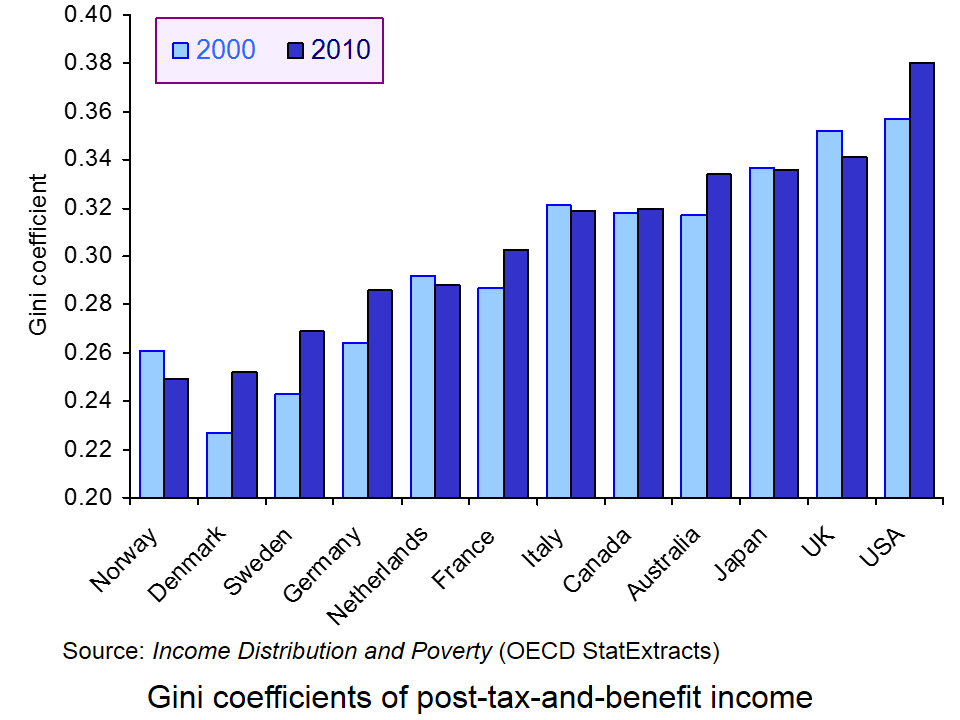
Comment on the Gini coefficients in the above link to the StatExtracts site.
Why has inequality grown in the USA?
The Swiss have just voted in a referendum to reject a proposal to limit executive pay to 12 times that of the lowest paid worker in the same company. What are the arguments for and against the proposal?
What features of an unequal society tend to perpetuate or even deepen that inequality over time?
What features of a well functioning market economy would help to reduce income inequality?
Are higher marginal tax rates and higher welfare payments the best way of reducing inequality? What other policy options are there?
Compare the views of Paul Krugman and Joseph Stiglitz on the effects of growing inequality on economic growth. How significant is the difference in the marginal propensity to consume of the rich and the poor in explaining the relatively low rate of US economic growth?
The enormous amounts of money broadcasters are willing to pay for the rights to show live football astonish most people. The figures have continued to rise despite the impact of a recession, slow economic growth and static or falling real incomes.
The deal to broadcast live games in the English Premier League (EPL) for the three seasons from 2007-10 was 65% higher than the agreement that ran from 2004-07. The recession did appear to slow growth down as the contract covering the seasons 2010-13 was only 5% higher than the previous one. However the total size of this deal was still a staggering £1.78billion or approximately £593 million per season. BSkyB was the most successful bidder in all of these auctions for live TV rights and successfully saw off competition from ITV Digital, ESPN and Setanta.
However in the last few years, BT Sport has entered the bidding process and has provided BSkyB with much stronger competition than its previous rivals. As a result, BskyB had to pay £2.3 billion in order to outbid BT Sport in the most recent auction. The three-year deal beginning in the 2013-14 season gives BSkyB the rights to show 116 lives matches each year. BT Sport also paid £738 million for the rights to show 38 live matches a season. In total this means that the EPL earns approximately £1billion per season from the sale of broadcasting rights in the domestic market – an increase of 70%!
The Champions and Europa League also auction the rights to broadcast live matches and there was a real shock when BT Sport recently announced that it had secured the exclusive rights to show all 350 live games in these competitions. Once again the figure it paid – just under £900 million for a three-year deal – took most people by surprise. It represented a 125% increase on the previous three-year deal with BSkyB and ITV. What was also surprising was that there was only one round in the sealed bid auction which suggests that BT Sport’s offer was well in excess of the one submitted by BSkyB.
Most of the initial reaction to this new deal has focused on its implications for the number of matches that will be available free to air: i.e. without having to pay for a subscription channel. The BT Sport contract does specify that the Champions League final and at least one match involving each British team will be shown free to air each season. However, this will be a significant reduction in the number of free to air games currently shown by ITV.
The new deal may also have implications for competitive balance in the EPL. This concept was discussed in a previous blog on this New Site Parachute payment problems for the English Football League and refers to how equally the most talented players are distributed amongst the teams in a league. This distribution will be heavily influenced by the degree to which the revenues of the teams in the league vary. Commenting on this latest contract Liverpool’s former managing director Christian Purslow stated that:
The fundamental effect of the BT deal will be additional wealth for England’s big teams. You will now have six teams (Manchester City, Chelsea and Manchester United, Arsenal, Liverpool and Spurs) playing for four Champions league places with the other 14 teams playing for survival. Never again will the likes of Everton, Newcastle or Villa get near the top – the difference in revenues will simply be too great.
To understand this statement one has to examine how the Champions League distributes the revenue it raises back to the teams that participate in the tournament. One part of the distribution mechanism is determined by the sporting performance of the teams in the competition. For example all 32 teams that make it to the group stages of the Champions League receive a minimum of €8.6 million. Each win in the group games earns a team an additional €1 million while a draw earns €500,000. The teams that make it to the last 16 receive an additional payment of €3.5 million, the quarter finalists earn an additional €3.9 million while the semi-finalists each receive €4.9 million. For example in the 2012-13 season, Manchester United received prize money of €16.1 million for reaching the last 16, whereas Bayern Munich received €35.9 million of prize money for winning the competition. If broadcasting revenues for the Champions League increase across the whole of Europe then the size of the prizes will almost certainly increase.
Teams also receive a share of the broadcasting revenue generated by the Champions League known as the market pool. The total size of the market pool allocated to the teams in any particular country depends on the value of the deal between the broadcasters in that country and UEFA. In the 2012-13 season the total market pool to be divided between the four English teams in the Champions League was €86.6 million. This was the second highest figure behind Italy. In contrast the four Portuguese teams had just over €7 million from the market pool to share between them because the value of the broadcasting deal in that country was so much lower. The market pool is split between the clubs based on (a) their finishing position in the domestic league the previous season and (b) how many games they played in the Champions League from the group stage onwards. FC BATE Borisov were the only representative from Belarus so did not have to share the market pool with any other team. Unfortunately for them the size of the market pool was only €290,000. Manchester United received a market pool payment of €19.45 million.
Given the dramatic increase in value of the broadcasting rights the size of the market pool for the English teams will rise significantly in 2015-16 season. The battle in the 2014-15 EPL season for the four Champions League places will be even stronger and more intense than ever. As a result, the competition for the services of the most talented players will probably push up their wages to ever higher levels.
What is a sealed bid auction? How does it compare with different types of auctions?
Suggest some reasons why BT Sport were willing to pay so much more than BSkyB for the broadcasting rights for the Champions League.
Do you think that the potentially higher revenues for the top clubs might actually reduce attendances at their matches? Explain your answer.
Explain how the potentially higher future revenues for teams participating in the Champions League in 2015-16 can be discounted in order to give them a present value.
Draw a diagram to illustrate the impact of the new broadcasting deal on the marginal revenue product of the most talented players.
Is the labour market for the most talented players competitive or is it an oligopsony? What implications does this have their wages? How does your answer change if the labour market is a bilateral monopoly?
The 2013 update was published on 4 November. The Living Wage was estimated to be £8.80 in London and £7.65 in the rest of the UK.
Two things need to be noted about the Living Wage rate. The first is that the figure is an average and thus does not take into account the circumstances of an individual household. Clearly households differ in terms of their size, the number of wage earners and dependants, the local costs of living, etc. Second, the figures have been reduced from what is regarded as the ‘reference’ living wage, which is estimated to be £9.08 outside London. The reason for this is that people earning higher incomes have seen their living standards squeezed since 2009, with prices rising faster than average post-tax-and-benefit wages. Thus, the Living Wage is capped to reflect the overall decline in living standards. As the Working Paper on rates outside London explains:
From 2012 onwards, two kinds of limit have been put on the amount that the Living Wage as applied can rise in any one year. The first limits the increase in the net income (after taxes and benefits) requirement for each household on which the living wage calculation is based, relative to the rise in net income that would be achieved by someone on average earnings. The second limits the increase in the living wage itself (representing gross income) relative to the increase in average earnings.
Nevertheless, despite this capping of the living wage, it is still significantly higher than the UK National Minimum Wage, which currently stands at £6.31 for those aged 21 and over. This can be seen from the chart (click here for a PowerPoint).
Paying the Living Wage is voluntary for employers, but as The Guardianreports:
A total of 432 employers are now signed up to the campaign, up from 78 this time last year, including Legal & General, KPMG, Barclays, Oxfam, Pearson, the National Portrait Gallery and First Transpennine Express, as well as many smaller businesses, charities and town halls. Together they employ more than 250,000 workers and also commit to roll out the living wage in their supply chain.
The number of people who are paid less than a ‘living wage’ has leapt by more than 400,000 in a year to over 5.2 million, amid mounting evidence that the economic recovery is failing to help millions of working families.
A report for the international tax and auditing firm KPMG also shows that nearly three-quarters of 18-to-21-year-olds now earn below this level – a voluntary rate of pay regarded as the minimum to meet the cost of living in the UK. The KPMG findings highlight difficulties for ministers as they try to beat back Labour’s claims of a “cost of living crisis”.
According to the report, women are disproportionately stuck on pay below the living wage rate, currently £8.55 in London and £7.45 elsewhere. Some 27% of women are not paid the living wage, compared with 16% of men. Part-time workers are also far more likely to receive low pay than full-time workers, with 43% paid below living-wage rates compared with 12% of full-timers.
But although paying a living wage may be desirable in terms of equity, many firms, especially in the leisure and retailing sectors, claim that they simply cannot afford to pay the living wage and, if they were forced to, would have to lay off workers.
The point they are making is that it is not economical to pay workers more than their marginal revenue product. But this raises the question of whether a higher wage would encourage people to work more efficiently. If it did, an efficiency wage may be above current rates for many firms. It also raises the question of whether productivity gains could be negotiated in exchange for paying workers a living wage
These arguments are discussed in the following podcast.
What are the reasons for announcing a Living Wage figure that is lower than a reference living wage? Assess these reasons.
If there are two separate figures for the Living Wage for London and the rest of the UK, would it be better to work out a living wage for each part, or even location, of the UK?
Why might it be in employers’ interests to pay at least the Living Wage? Does this explain why more and more employers are volunteering to pay it?
Assess the Labour Party’s pledge, if they win the next election, that ‘firms which sign up to the living wage will receive a tax rebate of up to £1000 for every low-paid worker who gets a pay rise, funded by tax and national insurance revenue from the higher wages’.
Which is fairer: to pay everyone at least the Living Wage or to use tax credits to redistribute incomes to low-income households?
 Conservative Party leaders are considering the benefits of an above-inflation rise in the minimum wage. This policy has been advocated by both the Labour Party and the Liberal Democrats as a means of helping the lowest paid workers. From 2008 to 2013, minimum wage rates fell 5.2% in real terms: in other words, nominal increases were less than the increase in both the RPI and CPI (see UK minimum wage: a history in numbers).
 But even such a rise to £6.81 would still leave the minimum wage substantially below the living wage of £8.80 in London and £7.65 in the rest of the UK, as estimated by the Living Wage Foundation (see The cost of a living wage). Although many businesses are now paying at least the living wage, many others, especially small businesses, argue that a rise in the minimum wage above the rate of inflation would force them to consider cutting the number of employees or reducing hours for part-time workers.
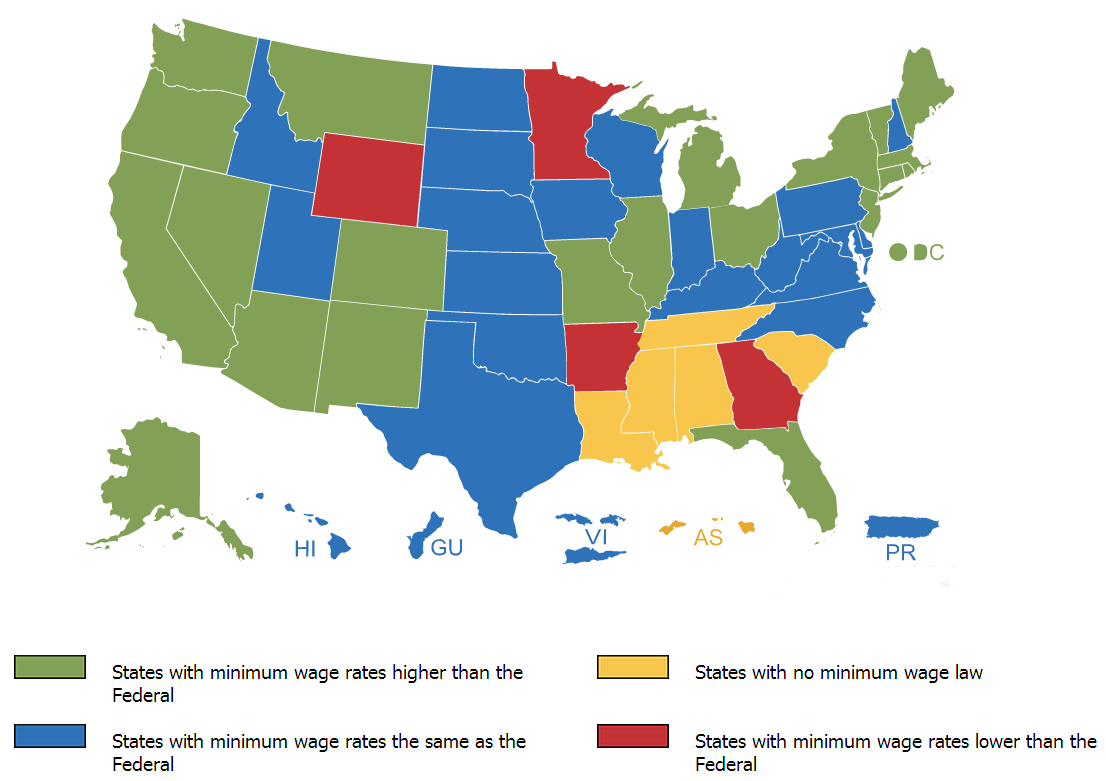 20 states have rates the same as the Federal level; 4 states have rates below the Federal level. At $9.32 per hour, Washington State has the highest state minimum wage; the lowest rates ($5.15) are in Georgia and Wyoming. In 5 states there is no minimum wage at all. As the ABC article below states: